






























How Much Does It Cost to Develop an App in 2026? A Detailed Guide
 Share -



- 01How Much Does It Cost to Create an App? Estimated Breakdown
- 02Key Factors That Affect App Development Costs
- 03Hidden Factors Affecting Mobile App Development Cost
- 04The Most Popular Examples of App Types and Estimated Costs
- 05How is AI changing mobile app development cost in 2026-27?
- 06How Can You Optimize Your Mobile App Development Costs?
- 07Step-by-Step Mobile App Development Process with Estimated Cost Breakdown
- 08Monetization Strategies for Mobile App Development
- 09How Can Appinventiv Help You With Mobile App Development Cost Estimation?
- 10FAQs




Key takeaways:
- The cost to build a mobile app in 2026-27 ranges from $40,000 for basic apps to $400,000+ for complex solutions.
- AI-assisted engineering trims routine build hours, but AI features, model usage fees, and review of AI-generated code add new line items, so the overall range still holds.
- Several factors influence the overall app development cost, including app complexity, platform selection, design, and features.
- Beyond development, app maintenance, marketing, security measures, and hosting fees, along with AI model usage for AI-enabled apps, can add significant ongoing costs.
- Outsourcing to cost-effective regions can save businesses 30–60% on labor costs as well as offer higher quality, though AI is shrinking the routine hours those rate savings apply to.
Mobile app development cost in 2026-27 ranges from $40,000 for a simple application to $400,000+ for complex, feature-rich platforms, and enterprise-grade builds can easily surpass $500,000. Where a project lands depends on its scope, integrations, security and compliance needs, and the delivery model behind it.
AI has changed what sits inside that range. With 90% of technology professionals now using AI at work, according to Google’s 2025 DORA research, routine coding, testing, and documentation can move faster than before (source: Google’s 2025 DORA report). At the same time, AI features, model usage fees, and closer review of AI-generated code add budget lines of their own, so the headline numbers hold while the mix of spend shifts.
This guide breaks the cost down by complexity, features, industry, team model, and hidden expenses, so product, technology, and finance leaders can plan a budget that stands up well past launch.
Also read this comprehensive mobile app development guide that cuts through all the complexities of app development and gives you straight answers.
How Much Does It Cost to Create an App? Estimated Breakdown
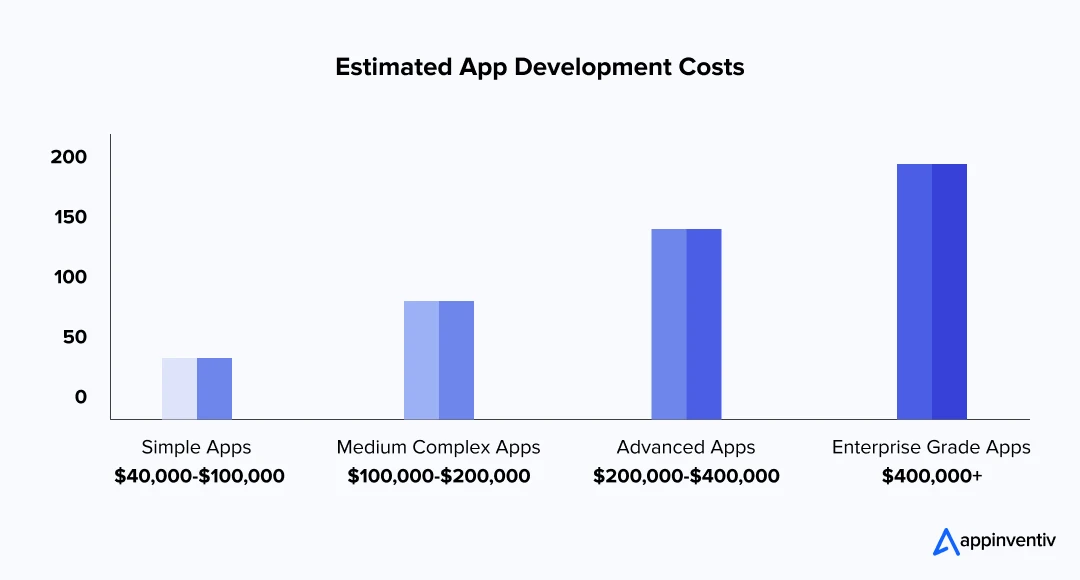
Let’s get straight to the point. The cost to develop a mobile app in 2026-27 ranges from $40,000 to $400,000+, depending on complexity and features. These numbers make more sense when viewed alongside real mobile app benchmarks for 2026 covering enterprise usage, spend, and retention trends. Here’s a fresh breakdown to help you visualize the pricing structure:
- Basic App: $40,000–$100,000 – Core functionality such as login, profiles, dashboards, and simple content or utility features.
- Moderate App: $100,000–$200,000 – More sophisticated functionality such as payment gateways, messaging, analytics, social integrations, and third-party services
- Advanced App: $200,000–$400,000 – Custom UI, real-time functionality, AI capabilities, complex integrations, and multi-platform development.
- Enterprise-Grade App: $400,000+ – Large-scale applications requiring scalable architecture, advanced security, complex integrations, regulatory requirements, and infrastructure for high user volumes.
Why such a wide range? Think of app development like building a house. A basic studio apartment costs far less than a smart mansion with automated systems, multiple floors, and custom features. Your app’s “architectural complexity” determines the final price tag.
The analogy still works once AI enters the picture. AI-assisted engineering is a bit like prefabricated walls: the framing goes up faster, so the app is ready sooner. Inspections, wiring checks, and permits still need their own time, and that time is worth spending, since it is what makes the app safe to use.
In an app, testing, security reviews, and governance do the same job: they raise quality and keep user data secure, so rushing them to match AI-speed coding would defeat their purpose. That is why a 30% cut in coding effort shortens the overall timeline, but not by the full 30%. And if the house needs a smart-home system, that’s a separate line on the quote with its own monthly bill. AI features in an app behave the same way.
How to Estimate the Cost to Develop a Mobile App
The cost to build a mobile app is often determined by two key components: development hours and the hourly rates of the developers. Here is a straightforward formula to help you estimate the price for developing an app:
| Development Hours × Developer’s Hourly Rate = Total Cost |
|---|
For example, if an app development company charges $40/hour and the project takes 2,500 hours, the app development cost would be $100,000, excluding post-launch maintenance and updates.
| $40/hour x 2,500 hours = $100,000 |
|---|
One factor for 2026-27: this formula describes a time-and-materials engagement. AI-assisted delivery can reduce the first variable on routine work, and apps with generative AI features add a third term that never shows up as development hours:
| (Development Hours × Hourly Rate) + AI Usage and Operating Costs = Total Cost of Ownership |
|---|
Once you can master this formula and understand the key factors influencing each variable, you can estimate your project’s cost with surprising accuracy. First, let’s look at how AI is changing both sides of that equation.
Supporting copy: See how our engineers pair AI with senior review to shorten delivery timelines, and get an estimate that shows what AI saves and what it adds.

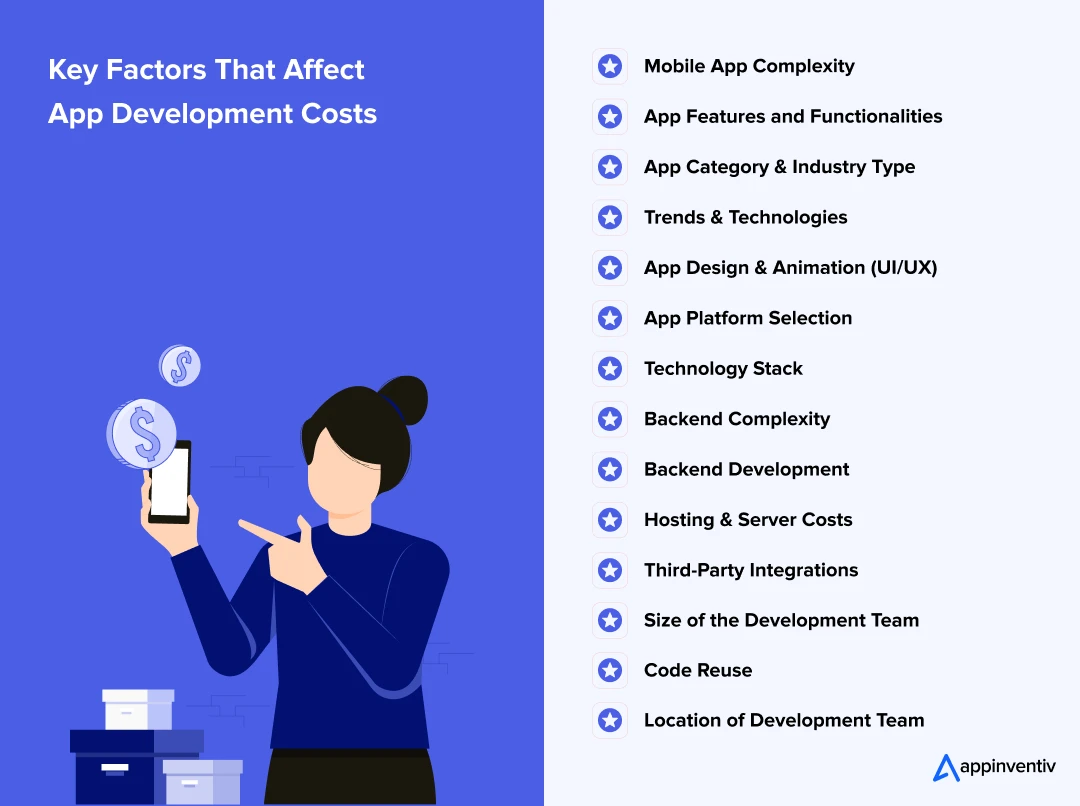
Key Factors That Affect App Development Costs
The cost of your mobile app is not a flat fee but an aggregate of many elements, each contributing to the final sum. Understanding these cost-determining factors will help you make informed decisions and yield the best return on your development investment. Moreover, it will also help you stay within your budget. So, let’s dive into the major factors that affect the overall cost of mobile application development.
Mobile App Complexity
Complexity is the heart of cost estimation. A simple app with login screens and basic UI logic is far less expensive than a multi-tenant, AI-powered enterprise platform. Let’s dive deeper:
- Simple App: An app with basic, core user features such as a login system, user profile, a straightforward dashboard, and limited administration.
- Average Cost: $40,000 – $100,000
- Examples: Basic calculators, flashlight apps, and simple content display apps.
- Medium Complex App: These apps pack more punch than basic ones, adding features that keep users hooked and help you make money. You’ll find social media connections, payment systems, audio/video streaming capabilities, and solid privacy settings on top of the core functions.
- Average Cost: $100,000 – $200,000
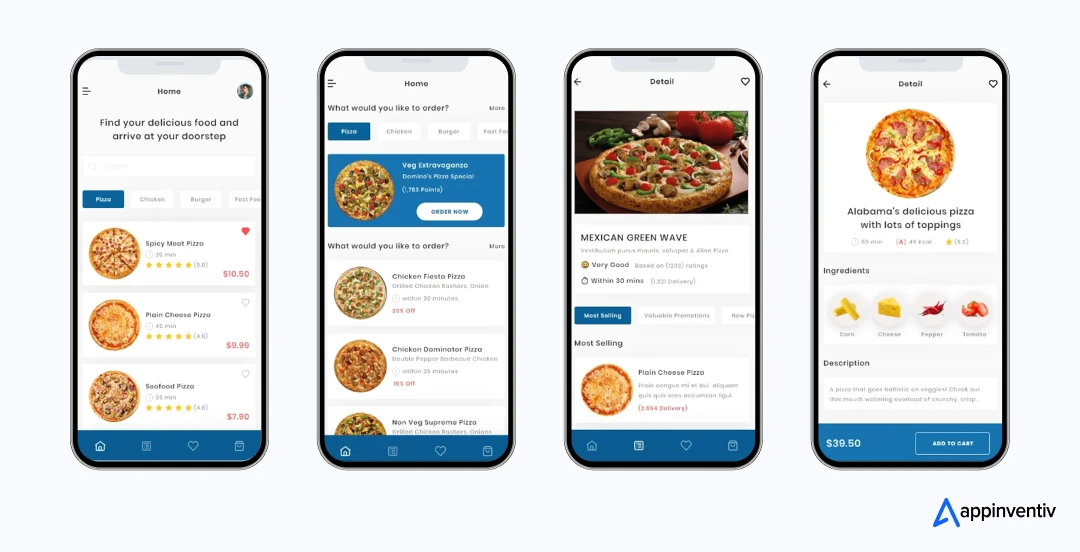
- Example: Our Domino’s app development case study, where we redefined the UI/UX strategy, resulted in a significant 23% increase in their conversion rate. This is a testament to medium-scale sophistication.
- Highly Complex App: These are the titans of the app world, integrated with cutting-edge technologies such as Augmented Reality (AR), Virtual Reality (VR), and advanced Artificial Intelligence (AI) and Machine Learning (ML) capabilities. Such apps typically boast features like multi-language support, intricate data logic, real-time analytics, and enterprise-grade security.
- Average Cost: $200,000 to $400,000 and above.
- Examples: A prime instance of a complex app project is the JobGet job search app development project secured over $52 million in funding and also rose to become the number one recruitment app for blue-collar workers. Currently, over 1+ million job seekers have been placed using JobGet, showcasing the power of a truly complex and impactful solution.
Here’s an average app development cost breakdown based on its complexity:
| App Complexity | Level of Complexity | Average Timeline | Average Cost |
|---|---|---|---|
| Simple app | Core functionality Basic UI | 3-6 months | $40,000-$100,000 |
| Medium Complex app | Sophisticated features Custom UI | 6-9 months | $100,000-$200,000 |
| Highly complex app | High-level advanced features Bespoke UI Two platforms | 9-12+ months | $200,000-$400,000 |
App Features and Functionalities
The granular detail of your app’s capabilities directly influences its final price. The more specific and numerous the features you integrate, the higher the overall cost.
Therefore, it is often advisable to concentrate only on the core features for the initial version of the app. This approach helps you offer a great customer experience at a more affordable cost and is best realized through a phased release plan. The first release carries just enough features to satisfy early adopters and gather valuable feedback for future iterations, saving both time and money.
Let’s take a look at the average app development cost and time required for essential features integration:
| Complexity Level | Features | Estimated Cost ($) | Estimated Timeline |
|---|---|---|---|
| Basic Features | User profiles Account registration/login Basic content display/listings Basic dashboard Contact form or help center | $10,000 – $20,000 | 3 – 6 weeks |
| Moderate Features | In-app messaging Push notifications Payment gateway integration Analytics dashboard Social media integration Multi-language or currency support | $20,000 – $30,000 | 6 – 10 weeks |
| Advanced Features | AI-based recommendations AR/VR integration Real-time data sync or streaming Advanced animations/gamification Voice commands or a chatbot High-end security layers Role-based user access | $30,000 – $50,000+ | 10 – 16 weeks |
AI features in the advanced tier also carry monthly model usage costs after launch, which the build estimates above don’t include.
App Category & Industry Type
The very purpose and industry your app serves significantly dictate its development cost. Moving from one category to another alters elements like user volume, necessary functionalities, security criteria, and regulatory compliance, all contributing to varying costs.
Let’s take a quick glance at the top categories of mobile app development and their unique cost considerations:
- E-commerce/M-Commerce Apps: Applications such as Amazon and Wayfair remain immensely popular because they are loaded with features that enable real-time performance, handle millions of users concurrently, and possess robust security protocols for financial transactions.
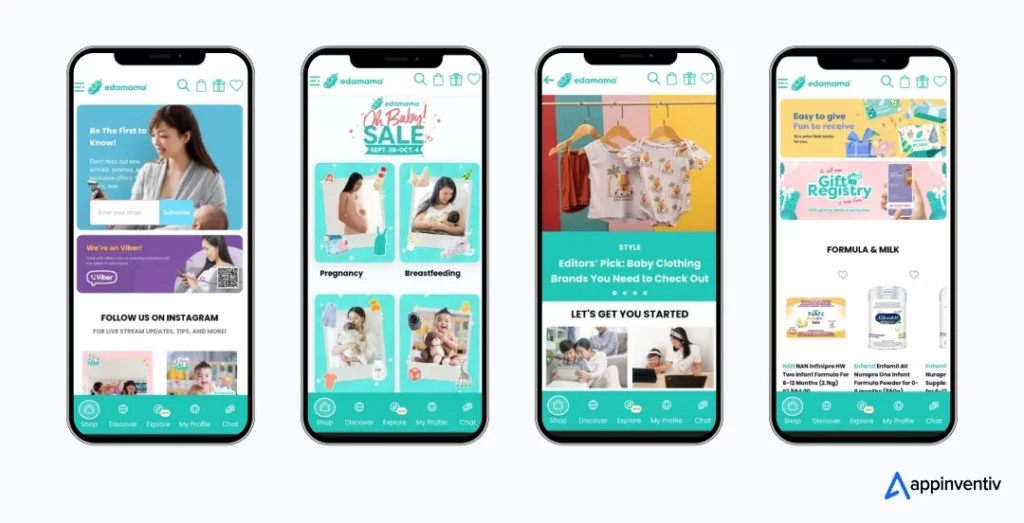
- For instance, Appinventiv developed the Edamama ecommerce app, an easy, trustworthy, and personalized shopping experience for mothers, a project that successfully raised $5 million in funding and currently serves thousands of mothers.
- Social Networking Apps: These apps are inherently complex, often requiring extensive third-party integrations, the ability to access hardware functions (like cameras and audio recorders), and exceptional scalability to support millions of concurrent users. As a result, the social media app development cost tends to be considerably higher than that of less complex mobile apps.
- On-Demand Apps: Even the simplest on-demand applications are inherently multi-faceted, typically requiring three distinct versions: one for users requesting services, one for individuals offering those services (e.g., drivers, delivery personnel), and a robust administration panel for the business managing the ecosystem.
- For instance, we developed the ActiDrive driver assistant app, an on-demand service application modeled on IoT technology, that enables drivers to navigate hassle-free, showcasing the multi-faceted nature of such solutions.
- Healthcare Apps: Healthcare app development demands unparalleled levels of data security and privacy compliance, and often requires integration with complex Electronic Health Records (EHR) or other medical devices. The emphasis is on accuracy, reliability, and robust data protection for sensitive patient information.
- For instance, the DiabeticU diabetes management app covered an AI-driven chronic disease management platform designed to help users effectively manage diabetes through personalized insights and comprehensive tracking.
- FinTech Apps: Financial technology applications handle sensitive monetary transactions and personal financial data, so the cost to build a fintech app reflects military-grade security, real-time data processing, and strict adherence to financial regulations (e.g., PCI DSS, AML). Features often include secure payment gateways, investment tracking, budgeting tools, and secure authentication.
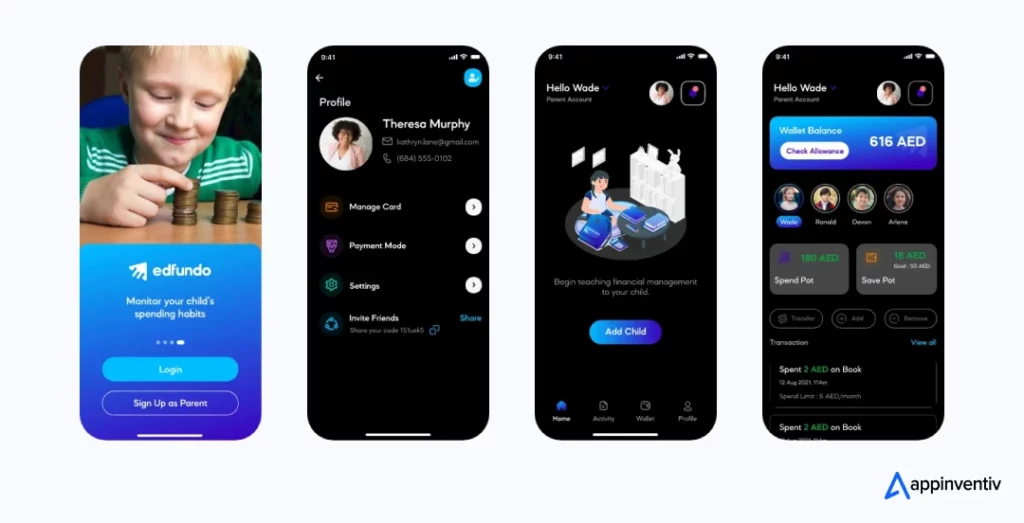
- For instance, the Edfundo financial literacy app development was done with children in mind to help them learn money management from an early age.
Now, here’s an estimation of the cost to develop an app based on its category:
| App Category | Average Cost (USD) | Approx. Hours | Development Timeline |
|---|---|---|---|
| eCommerce/M-Commerce | $30,000 – $250,000 | 1,200 hrs | 3–6 months |
| Social Media | $50,000 – $500,000 | 1,200 hrs | 4–8 months |
| EdTech (like Duolingo) | $60,000 – $225,000 | 900 hrs | 3–6 months |
| Dating (like Tinder) | $40,000 – $400,000 | 1,400 hrs | 4–9 months |
| Gaming (AR/3D) | $60,000 – $250,000+ | 1,800+ hrs | 6–12 months |
| On-Demand Services | $50,000 – $200,000 | 1,000 hrs | 4–6 months |
| Healthcare/HealthTech | $40,000 – $400,000+ | 1,200+ hrs | 6–12 months |
| FinTech (like Mint) | $30,000 – $300,000+ | 1,500+ hrs | 6–12 months |
Note: Apps in healthtech, FinTech, and AI-advanced products now require greater investment due to regulatory compliance, explainable AI models, and secure APIs.
Trends & Technologies
Beyond the industry itself, the specific cutting-edge technologies integrated into your app significantly affect its development timeline and budget. These integrations often demand specialized expertise and can introduce additional layers of complexity and ongoing maintenance.
- AI (Artificial Intelligence) & Machine Learning (ML): Incorporating AI/ML capabilities, such as predictive analytics, natural language processing (NLP), computer vision, recommendation engines, or intelligent automation, adds substantial cost. These features require significant data processing, complex algorithm development, and specialized hiring of machine learning engineers. Generative AI features also carry a recurring cost, since model usage fees grow with every active user, so budget the build and the monthly run separately.
- Appinventiv built the Mudra budget management app, which uses AI to provide users with personalized financial insights and smart recommendations for wealth management.
- Hardware-Dependent (IoT) Apps: All IoT-based applications intrinsically rely on hardware devices for performing actions like extracting data from sensors or sending commands for specific actions. Their development involves not just software but also firmware and hardware integration expertise.
- One popular reference of an IoT-based hardware-dependent app is our Moo electric scooter rental app development project. Moo represents the future of micro-mobility, demonstrating how an application can be completely hardware-centric in its operation.
- Blockchain Integration: Developing apps with blockchain technology for secure transactions or decentralized applications involves specialized cryptographic knowledge and complex infrastructure.
- The Empire hotel booking app that we built uses blockchain to ensure secure and transparent booking confirmations, creating immutable and trustworthy records.
- Cloud Services & Scalable Server Infrastructure: While cloud services (AWS, Google Cloud, Azure) are essential for modern apps, the cost varies based on the scale of data storage, traffic volume, computational needs, and the complexity of server architecture. Building highly scalable and resilient cloud infrastructure to support millions of users demands significant expertise and robust planning.
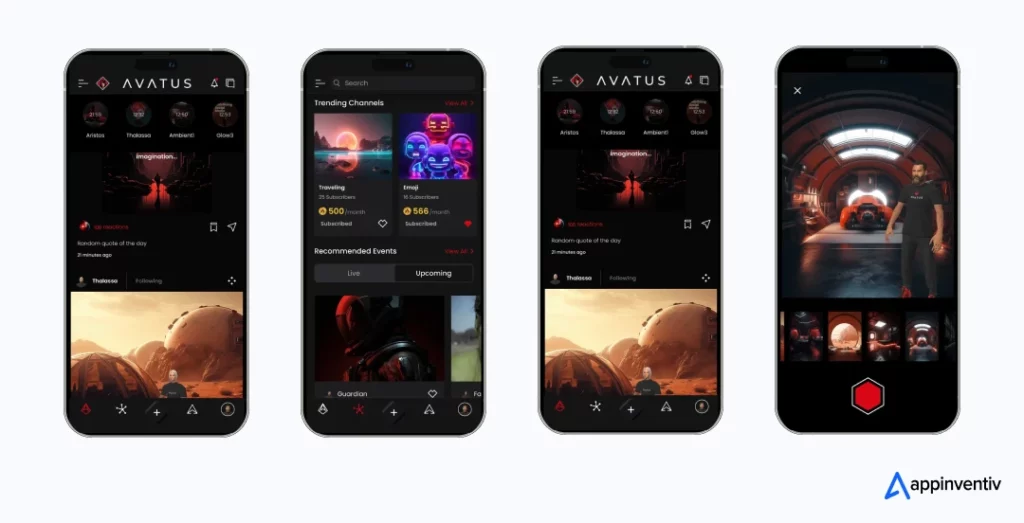
- Appinventiv’s Avatus social networking platform development project exemplifies scalable cloud infrastructure, managing real-time interactions and complex 3D avatar rendering for a vast user base.
| Technologies | Average Cost (USD) | Approx. Hours | Development Timeline |
|---|---|---|---|
| IoT-driven Apps | $45,000 – $500,000+ | 1,800+ hrs | 8–12 months |
| Blockchain | $40,000 – $300,000+ | 2,000+ hrs | 12+ months |
| AR/VR Apps | $30,000 – $300,000+ | 1,500+ hrs | 6–12 months |
| AI-powered Apps | $50,000 – $500,000+ | 1,200+ hrs | 6–12 months |
| Cloud-Powered Apps | $30,000 – $300,000+ | 1,000+ hrs | 8–12 months |
Note: The AI-powered apps range is wide because it spans everything from a single API-based feature to agentic, compliance-heavy platforms. The AI section earlier in this guide splits it into three tiers, along with the running costs each one carries.
App Design & Animation (UI/UX)
The next factor that adds to the answer to how much does it cost to make an app is User Interface (UI) and User Experience (UX). An engaging design ensures users invest their time and return to your app.
When contemplating app design, you generally have two primary options: Custom UI and Standard UI. While Standard UI relies on pre-built components and established patterns, Custom UI involves crafting unique, bespoke interfaces. Naturally, customized UI is much more difficult to design and implement than Standard UI, making it significantly more expensive but often yielding a more distinctive and memorable user experience.
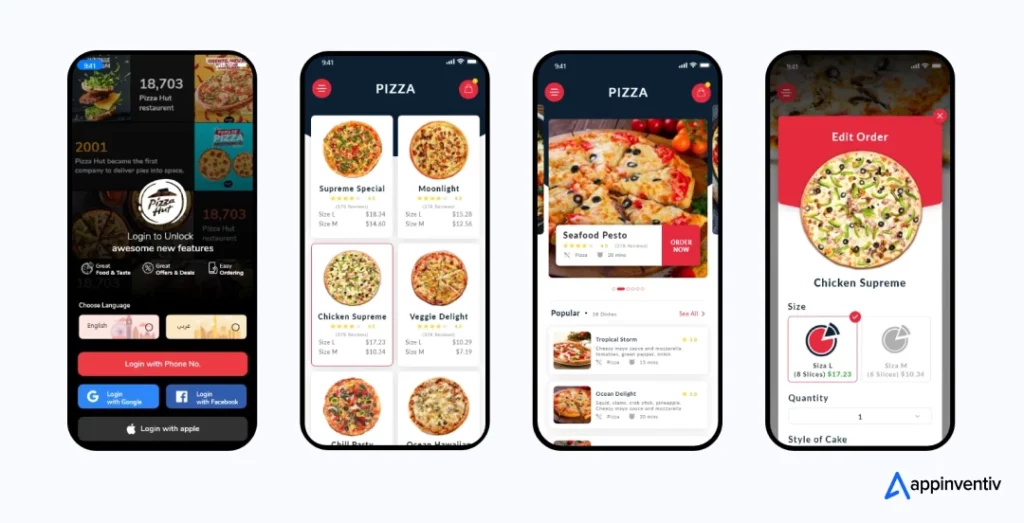
- For instance, Appinventiv designed the UI/UX and developed the Pizza Hut food delivery app, along with integrating unique features to automate food ordering and delivery right at the customer’s doorstep. Through these engaging app designs and animations, the app’s conversion rate has greatly increased by 30%.
Ready for an enterprise-level mobile app? Request a bespoke quote today
Other crucial components of mobile app design include:
- Wireframing & Prototyping – To map out effective user experience features and flows, developers rely on mobile app wireframing. Special tools like MARVEL, Balsamiq, and Photoshop are used.
- Animation – Animation has become a popular method to make certain aspects of any application interesting and intuitive. More often than not, gaming and social media applications employ animations to a great degree.
You may also want to look at : iOS vs Android app design differences
| App Process | Design Tasks | Average Development Time | Average Development Cost (Approx) |
|---|---|---|---|
| App design research | Market research Competitor analysis Market trend analysis Selecting ideal solutions | Based on the niche and available resources | $100-$350 |
| UX design | Rough sketches Low-fidelity wireframes High fidelity wireframes | Simple- 10-14 hours Medium- 50-60 hours Complex- 150+ hours | $2000-$8000 |
| UI design (visuals) | Mood boards UI mockup samples Final UI mockups | Simple – 14-20 hours Medium- 80-90 hours Complex- 100+ hours | $10,000-$40,000 |
| Branding | Creating brand identity | Logos, icons, and social media | $5,000-$20,000 |
| Animations and illustrations | Visualizing user and on-screen content Direct manipulation User action visualization | Based on the level of animations | $1000-$20,000 |
App Platform Selection
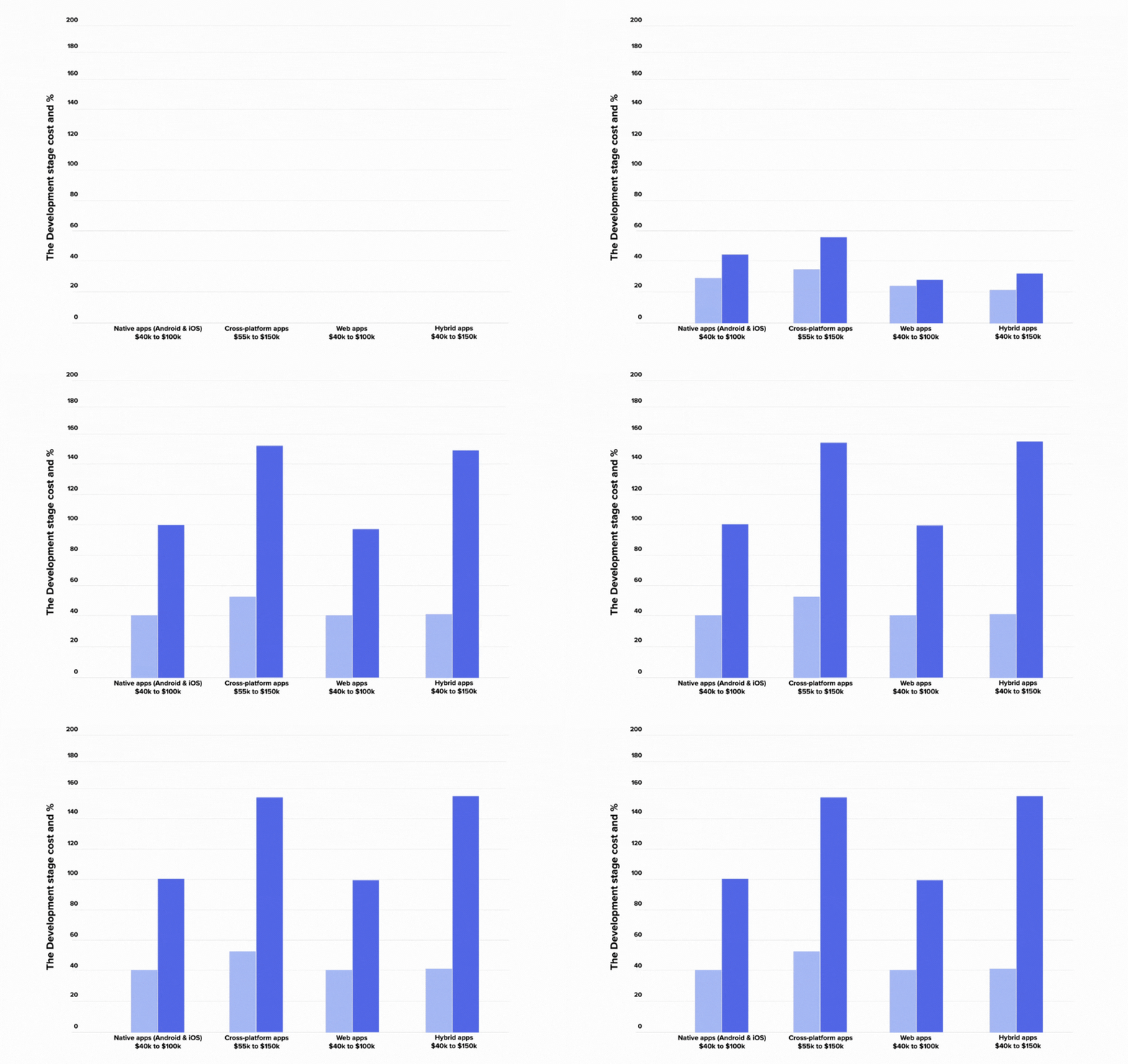
When getting started with the mobile app development process, it’s important to choose the right mobile platform. Depending on your target audience, you can choose to build an iOS, Android, web, or cross-platform application. If you are a startup with a minimal budget, it’s better to opt for one platform initially; later on, you can shift to multiple platforms.
Here are the most popular app development platform options you can choose from:
- Native app platform (Android & iOS) – Language-wise, iOS apps are built with Swift and Objective-C, while Android apps use Java and/or Kotlin. For platform-specific budgets, see this breakdown of iOS app development cost.
- Web app platform – Progressive Web Apps and other forms of web apps are much cost-efficient than native apps.
- Cross-platform – Getting an app developed for both iOS and Android simultaneously is the new cost-efficient trend. The platform comes with a series of benefits, like single code use and less development effort.
- Hybrid app platform – Hybrid Apps are a blend of both native and web apps. While it is installed like a native app, it runs in a webview component.
Pro Tip: If you’re on a tight budget and want to reach both iOS and Android users, cross-platform development is often the best choice.
Also Read: Native vs Hybrid App Development
Technology Stack (Programming Languages, Frameworks, Databases)
The specific combination of programming languages, frameworks, libraries, and databases chosen for your app’s development forms its “technology stack,” and this choice profoundly impacts cost. Different technologies come with varying learning curves, developer availability, and community support, which translate directly into development time and hourly rates.
| Backend Complexity | Estimated Cost ($) |
|---|---|
| Basic Architecture (Simple database, user authentication) | $5,000 – $15,000 |
| Moderate Architecture (Data caching, real-time updates, API integration) | $20,000 – $40,000 |
| Advanced Architecture (Scalability for millions of users, AI-driven analytics) | $40,000 – $80,000+ |
Backend Development (Server-side & APIs)
Beyond the user-facing interface, every interactive app requires a robust backend – the “brains” of the operation. This involves building and maintaining servers, databases, APIs (Application Programming Interfaces) for communication, and often cloud infrastructure. The complexity of your app’s data handling, user management, and real-time operations directly correlates with backend development costs.
| Backend Complexity | Description | Estimated Cost Range |
|---|---|---|
| Simple Backend | Basic data storage for user profiles and content, straightforward user authentication. | $5,000 – $20,000 |
| Complex Backend | Real-time data processing, intricate data analytics, extensive third-party integrations, AI model deployment, advanced security protocols, and requirements for high scalability. | $50,000 – $200,000+ (depending on scale and requirements) |
| Hosting & Server Costs | Ongoing expenses for cloud services vary based on data storage, user traffic, computational needs, and chosen service tiers. | Variable (Monthly/Annually) |
Third-Party Integrations
Apps today don’t work alone. You’ll need to connect with outside services, APIs, and SDKs for things like payments, social sharing, analytics, push alerts, and maps. These connections usually speed up development since you’re using ready-made solutions, but their complexity and licensing costs add to your budget.
| Integration Type | Estimated Cost |
|---|---|
| Basic Integration (Payments, login authentication) | $5,000 – $10,000 |
| Advanced Integration (Multiple APIs, Real-Time Analytics) | $10,000 – $30,000 |
Code reuse
It’s one of the factors that bring the cost of mobile app development down. When businesses decide to reuse the code of an existing app in their own app and just change the branding elements, the mobile application development cost becomes much less.
However, the experts at Appinventiv strongly suggest businesses to reuse only generic, common elements like “Contact Us” pages, login modules, or standard navigation patterns. Developing the core, unique features from scratch is paramount to establishing a separate, strong brand identity and ensuring the app stands out in a crowded market.
The cost for app development when the existing codes are used is 20 – 30% less than the cost of an app that is coded from scratch.
Size of the Development Team
The total mobile application development cost heavily depends on who builds your app, which is why it pays to choose the best mobile app developer for your project. You have multiple choices at hand: a proficient mobile app development company (local or offshore), an in-house development team, or a freelance developer.
While freelancers might offer the lowest hourly rates, they often lack the comprehensive skill sets (design, QA, project management, backend) and structured processes of a dedicated agency. An experienced mobile app development company, especially one with a proven track record like Appinventiv, can work wonders for your business app, crafting high-end applications with top-notch features and functionalities due to their integrated teams and established workflows.
Here is a rough estimate of what your mobile app developer cost for app development should range to, along with an outsourced app development team.
| Cost Factors and Requirements | Simple App | Medium App | Complex App |
|---|---|---|---|
| Development Time | 2-6 months | 6-9 months | 9-15 months+ |
| Developers | $30,000-$60,000 | $60,000-$150,000 | $150,000-$400,000+ |
| UI/UX Designer | $4,000-$8,000 | $7,000-$20,000 | $15,000-$50,000+ |
| Project Manager | $5,000-$10,000 | $10,000-$25,000 | $20,000-$60,000+ |
| QA Specialist | $8,000-$15,000 | $15,000-$30,000 | $25,000-$70,000+ |
| Business Analyst | $2,000-$5,000 | $5,000-$15,000 | $10,000-$30,000+ |
| DevOps Engineer | $2,000-$5,000 | $5,000-$15,000 | $10,000-$30,000+ |
| Solution Architect | $1,000-$5,000 | $5,000-$15,000 | $10,000-$40,000+ |
| Total (Team Cost Estimate) | $50,000-$100,000 | $100,000-$250,000 | $250,000-$700,000+ |
AI-assisted delivery is reshaping this mix more than the totals. Routine implementation hours shrink, while apps with AI features add roles that barely existed a few years ago, such as an AI/ML engineer and an evaluation specialist who tests model output. Senior engineers also spend more of their week reviewing generated code. In practice, expect the budget to move from the Developers line toward QA, architecture, and AI engineering rather than disappear.
Location of App Development Team
The hourly rates for app developers can vary dramatically across the globe. This directly impacts the overall project cost, as the total hours spent on development, design, testing, and project management are multiplied by these hourly rates. Countries with established tech hubs generally command higher rates, while emerging tech markets often offer more competitive pricing.
Here’s a brief breakdown of average hourly rates for app development across key regions in 2026-27:
| Region | iOS (Avg. $/Hr.) | Android (Avg. $/Hr.) | Cross-platform (Avg. $/Hr.) |
|---|---|---|---|
| India | 22–90 | 15–25 | 20–30 |
| Southeast Asia | 23–55 | 30–45 | 30–45 |
| Asia | 25–35 | 20–30 | 25–35 |
| Middle East | 30–70 | 35–60 | 30–70 |
| Europe | 35–55 | 35–55 | 30–50 |
| Ukraine | 40–78 | 38–60 | 40–78 |
| South Africa | 45–80 | 40–80 | 40–80 |
| Latin America | 28–90 | 28–90 | 40–160 |
| USA | 60–120 | 60–120 | 60–130 |
| UK | 60–75 | 60–75 | 55–75 |
| Canada | 90–120 | 80–140 | 90–120 |
| Australia | 90–120 | 100–120 | 90–120 |
Regional rate gaps still matter, but a little less each year. As AI absorbs a share of routine coding, fewer low-complexity hours get billed, and the hours that remain lean toward architecture, integration, and review, where experience counts for more than the rate card. Compare vendors on delivery maturity and senior talent, not the hourly figure alone.
Hidden Factors Affecting Mobile App Development Cost
In this section, we will be discussing the most common hidden costs of mobile app development projects. Understanding these factors will help reduce risks, as well as save time and money. So, without further ado, let’s dive into each of them in detail.
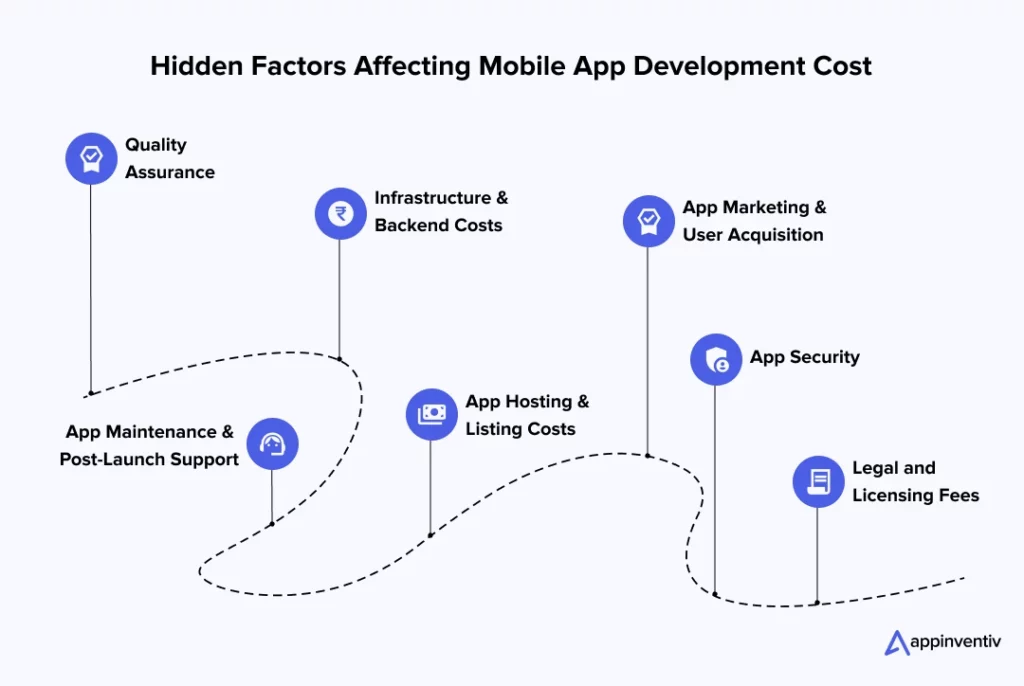
Quality Assurance
Cost: 15-25% of total development budget
Getting your app right means testing it thoroughly. Quality Assurance isn’t something you tack on at the end – it runs alongside development to catch bugs, fix usability issues, and make sure everything works smoothly. You’ll need QA specialists or a testing team, depending on how complex your app gets.
This includes not just functional testing, but also usability, performance, security, and compatibility testing across various devices and operating systems. Neglecting this phase leads to costly post-launch fixes, negative user reviews, and potentially irreparable damage to your app’s reputation.
In 2026-27, QA scope also covers AI. That means reviewing assistant-written code for logic and security flaws, and testing AI features such as chatbots or recommendation engines against evaluation sets, so answers stay accurate after every model or prompt change.
Infrastructure & Backend Costs
Monthly costs: $200-$5,000+ depending on user base
While we touched upon backend development as an upfront cost, the infrastructure that powers your app incurs ongoing monthly expenses. This includes the continuous costs for data storage, data delivery networks (CDNs), server maintenance, and app hosting. As your user base expands and your app handles more data and traffic, these costs will naturally escalate. Examples of infrastructure cost items include cloud server subscriptions (AWS, Google Cloud, Azure), database services, and licensing for development tools and libraries that require ongoing fees.
App Maintenance & Post-Launch Support
Undeniably, expenses do not cease at the final stage of the mobile application development process. A thriving app demands continuous nurturing. Businesses will have to allocate a budget for ongoing changes to keep up with varying market trends, new device & OS versions, security updates, and performance optimizations. What takes up your budget post-app development?
- App Bug Fixes: Perfect apps don’t exist – that’s just reality. Small bugs and weird compatibility problems always pop up once real users start downloading your app. You’ll need developers on standby or a support contract to fix these quickly.
- Design & Feature Updates: Your app’s look gets stale, and users want new stuff constantly. Brands have to refresh their designs and add features regularly or people lose interest and competitors pull ahead.
- OS & Device Compatibility: Apple and Google push out new iOS and Android versions all the time, plus phone makers keep releasing new models. Your app breaks if you don’t update it to work with these changes.
- Server & Database Costs: More users mean your backend gets hammered harder. You’ll pay more for bigger servers and databases as your app grows.
- Security Patches: Cyber threats are constant. Regular security audits and patches are vital to protect user data and maintain trust.
- Model & Prompt Updates: AI providers retire model versions on their own schedules. Each switch means retesting prompts, rerunning evaluations, and sometimes reworking features that depended on the old model’s behavior.
App maintenance cost is typically calculated annually, often estimated at 15% to 20% of the initial mobile app development cost. For AI-enabled apps, budget model usage and evaluation on top of that figure, since both recur every month.
AI Model Usage & Operations
Cost: Usage-based, best tracked per active user per month
If your app includes generative AI, part of its running cost now arrives as a usage bill. Each chat reply, summary, or agent action consumes tokens, so spend climbs with engagement rather than with server capacity alone. Add evaluation runs, guardrails, monitoring, and periodic model migrations, and AI operations become a standing line in the post-launch budget. Set usage alerts and per-user limits before launch, not after the first invoice.
App Hosting & Listing Costs
Annual costs: ~$25 (one-time for Google Play), $99-$299 (annually for Apple)
When preparing your masterpiece for the public, you must consider the gatekeepers of the digital marketplaces. The app stores levy certain fees for the privilege of listing your application. While these are relatively minor compared to overall development, they are essential.
App Marketing & User Acquisition
Cost: Highly variable, often 50-100% or more of initial development cost (annually)
To build a magnificent edifice and then keep its existence a secret is folly. An exceptional app, however innovative, will languish in obscurity without a well-conceived marketing strategy. This is perhaps the most significant “hidden” cost because its scale is entirely up to your ambition and competitive landscape.
App marketing encompasses a wide array of activities designed to attract and retain users:
- Pre-launch Marketing: Building anticipation through teaser campaigns, landing pages, email list building, and early press outreach.
- App Store Optimization (ASO): Optimizing your app’s title, keywords, descriptions, and screenshots to rank higher in app store search results. This is crucial for organic discovery.
- Paid User Acquisition (UA): Running targeted advertising campaigns on platforms like Google Ads, Apple Search Ads, social media (Facebook, Instagram, TikTok), and mobile ad networks to drive downloads.
- Content Marketing: Creating blog posts, videos, and social media content that highlights your app’s value.
- Public Relations (PR): Securing media coverage and positive reviews.
- Social Media Management: Maintaining an active and engaging presence on relevant social platforms.
App Security
Cost: Specific audits/features can add $5,000-$100,000+
App security is a major concern, which is why mobile app security best practices should be implemented from day one. Users need to trust your app with their information. For this reason, you should have a proper security plan in place.
If you consider this point at the start and include time for testing and security checks in advance, everything will be fine. If this is not the case, the costs will be higher and may be accompanied by financial and reputational losses.
AI opens two newer fronts. In-app assistants can be targeted with prompt injection attacks that try to extract data or bypass rules, and AI-generated code can carry vulnerabilities nobody reviewed closely. Both belong in the security plan from the first sprint.
Legal and Licensing Fees
Cost: Highly variable, from $1,000 for basic terms to $50,000+ for complex ventures
Navigating the legal landscape is as crucial as navigating the technical one. Ignoring legal considerations can lead to costly disputes, intellectual property infringements, or regulatory fines. These fees are often underestimated but are vital for protecting your business and your users.
AI features bring their own legal checklist. For apps serving EU users, the EU AI Act’s transparency obligations, such as disclosing that people are interacting with an AI system, apply from August 2, 2026, while obligations for stand-alone high-risk AI systems now begin on December 2, 2027. Model licensing terms, rights to training data, and privacy rules for user prompts also need review before launch, ideally as part of a broader AI governance plan.
The Most Popular Examples of App Types and Estimated Costs
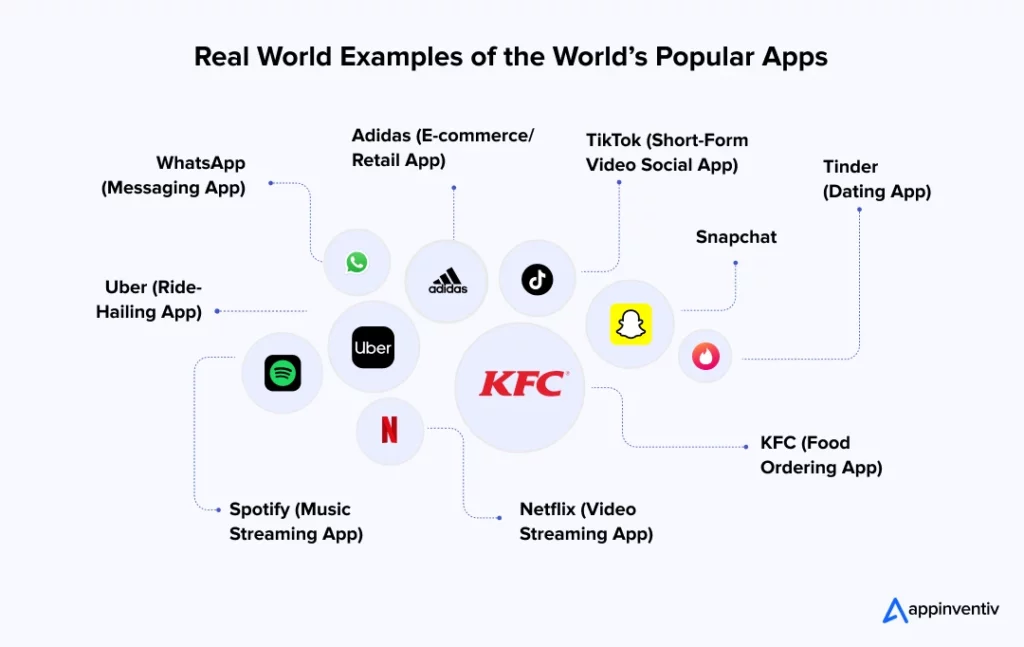
Below are examples of a few popular apps that have truly redefined and transformed the concept of customer experience, currently leading the app market in various domains. While their exact initial development costs are often closely guarded secrets, we can provide well-researched estimates for developing an app with similar foundational features and complexity.
Keep AI in mind as you read these. Spotify, Netflix, and TikTok all depend on recommendation engines, which fall into the knowledge-grounded AI tier covered earlier and carry ongoing running costs of their own.
WhatsApp (Messaging App)
WhatsApp revolutionized communication by offering free, instant messaging across the globe. Its core features include text messaging, voice and video calls, group chats, media sharing, and status updates. Its simplicity and reliability quickly made it a ubiquitous tool.
Average Development Cost (for a similar app): The cost to develop a chat app like WhatsApp could range from $50,000 to $200,000.
Spotify (Music Streaming App)
Spotify transformed how we consume music, offering a vast library of songs accessible via streaming. Its key features include personalized recommendations, playlist creation, offline listening, and a freemium model that combines free ad-supported streaming with paid premium subscriptions.
Average Development Cost (for a similar app): Creating a music streaming app with a substantial content library, personalized recommendations, offline mode, and a robust user management system could cost between $80,000 and $300,000+.
Netflix (Video Streaming App)
Netflix redefined home entertainment by offering a vast, on-demand library of movies and TV shows. Its sophisticated platform includes user profiles, personalized content recommendations, adaptive streaming for various internet speeds, multi-device compatibility, and robust content delivery networks.
Average Development Cost (for a similar app): The cost to develop a video streaming app like Netflix with features comparable to Netflix’s core functionality would typically range from $100,000 to $400,000+.
KFC (Food Ordering App)
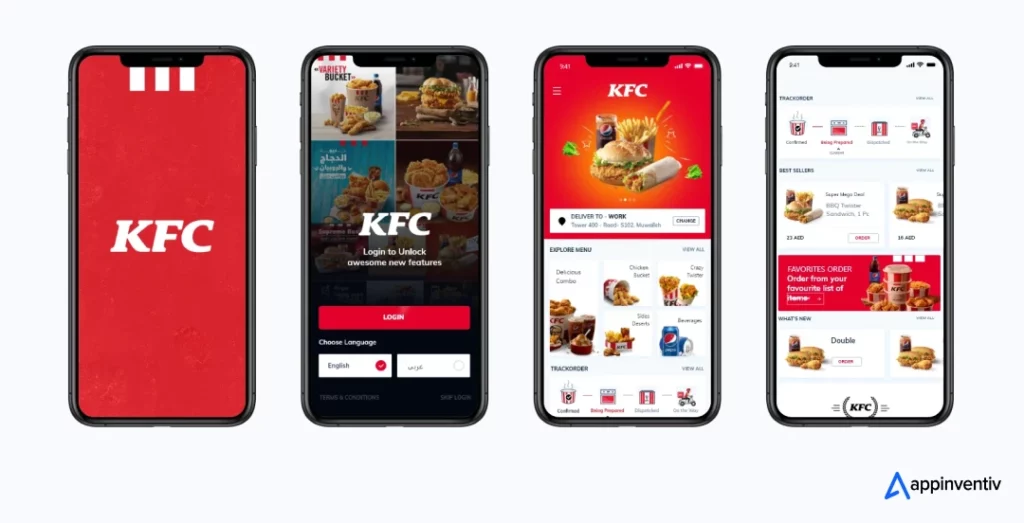
Appinventiv developed the KFC food delivery app, which provides a streamlined experience for customers to browse menus, customize orders, find nearby restaurants, and place orders for delivery or pickup. Key functionalities include location services, secure payment integration, loyalty programs, and push notifications for order status and promotions.
Average Development Cost (for a similar app): A robust food ordering app like KFC’s, encompassing features such as detailed menus, order tracking, diverse payment gateways, and backend integration with restaurant systems, could range from $50,000 to $180,000+.
Also Read: Cost to Develop an App Like KFC
Tinder (Dating App)
Tinder popularized the “swipe” mechanism for online dating, simplifying the process of connecting with new people based on proximity and mutual interest. Its features include profile creation, geolocation-based matching, instant messaging, and premium subscription tiers that offer enhanced visibility and features.
Average Development Cost (for a similar app): Building a dating app with the core functionalities of Tinder (profile creation, matching algorithm, chat, push notifications, and basic location services) can cost from $60,000 to $180,000+.
Snapchat
Snapchat revolutionized social media with its focus on ephemeral content (“Snaps” that disappear after viewing), augmented reality (AR) filters, and visual storytelling through “Stories” and “Spotlight.” Its unique camera-first interface encourages real-time sharing and playful communication, alongside features like Snap Map and Bitmoji.
Average Development Cost (for a similar app): Building an app with Snapchat’s core ephemeral messaging, extensive AR filters, media editing tools, stories, and location-based features would typically range from $70,000 to $250,000+.
Adidas (E-commerce/Retail App)
The Adidas app serves as a comprehensive mobile retail platform, allowing users to explore product catalogs, make purchases, manage their accounts, and access exclusive drops and content. Its sophisticated design integrates high-quality product imagery, secure payment systems, personalized recommendations, and seamless order management.
The Adidas eCommerce app development significantly expanded their mobile presence with over 2+ million downloads.
Average Development Cost (for a similar app): The cost to develop an e-commerce app like Adidas with the breadth of features like extensive product catalogs, search and filtering, AR try-on features, and secure checkout processes could range from $80,000 to $300,000+
[Image: Adidas app screens]
Uber (Ride-Hailing App)
Uber pioneered the on-demand ride-hailing service, connecting passengers with drivers via a mobile app. Its complex ecosystem involves separate apps for passengers and drivers, real-time GPS tracking, payment integration, and a sophisticated backend for fare calculation, dispatch, and rating systems.
Average Development Cost (for a similar app): Due to its dual-app nature (for driver and passenger) and intricate real-time functionalities, the cost to develop an app like Uber can range anywhere from $70,000 to $250,000+.
TikTok (Short-Form Video Social App)
TikTok transformed the digital content landscape by popularizing short-form, vertical video content driven by a highly intelligent recommendation algorithm (“For You Page”). Its key features include intuitive video creation and editing tools, an extensive sound library, various effects and filters, duet and stitch functionalities, and live streaming capabilities.
Average Development Cost (for a similar app): The cost to develop an app like TikTok, with its powerful video editing suite, vast audio library, complex content recommendation AI, and scalable video hosting infrastructure, could range from $100,000 to $500,000+.
How is AI changing mobile app development cost in 2026-27?
AI now touches an app budget in two separate ways, and blending them together is one of the fastest routes to a bad estimate. The first is AI as a delivery tool: coding assistants and agents that change how many hours a build takes.
The second is AI as a product feature, such as an in-app assistant, personalized recommendations, or smart search, and each of those carries its own build and running costs. A third shift is commercial, as buyers question whether hourly billing still makes sense.
With adoption close to universal, the open question is what all that usage does to the invoice.
Does AI reduce app development cost?
Yes, on specific tasks. At project level, the saving is smaller than most headlines suggest, and the best evidence so far explains why:
- Field experiments: A randomized study of over a thousand developers internally, found an approx 30% increase in completed tasks among developers given an AI coding assistant. Less experienced developers saw the biggest gains.
- Controlled trials: A controlled trial found experienced open-source developers took around 20% longer with early-2026 AI tools.
- Enterprise rollouts: In a June 2026 study of 800 developers internally, our researchers found pull request volume per developer roughly doubled within about a year, which they describe as a near-best-case result. The gains sat mostly in newer code, barely appeared in legacy repositories, and review load per reviewer roughly doubled.
Reviewing the field evidence, our experts put the most credible estimates between a modest slowdown and a gain of roughly 38%. The pattern behind that spread is consistent: AI saves the most on new, well-scoped code and the least on complex changes inside older systems.
That matters for app budgets because most business apps mix both: a fresh mobile front end wired into payment gateways, EHRs, ERPs, or legacy systems that no assistant has seen before.
Where AI saves money in app development, and where it doesn’t
Mapped against the stages of a typical app project, that pattern looks like this:
| Project stage | Where AI speeds things up | What still needs senior time | Net effect on cost |
|---|---|---|---|
| Discovery and requirements | Summarizing research, drafting user stories, analyzing competitor apps | Business rules, compliance scope, stakeholder trade-offs | Small saving |
| UI/UX design | First-pass layouts, copy variations, clickable prototypes | Design systems, accessibility, brand consistency | Small to moderate saving |
| Front-end and API development | Boilerplate, standard screens, common integrations, code conversion | Architecture, performance tuning, offline sync, edge cases | Moderate saving on routine work |
| Legacy and third-party integration | Reading unfamiliar code, drafting adapters | Undocumented behavior, data mapping, vendor limits | Minimal saving |
| Testing and QA | Unit tests, test data, regression scripts | Test strategy, device coverage, reviewing AI-written code | Moderate saving, partly offset by extra review |
| Documentation | Code comments, API docs, release notes | Accuracy checks | Strong saving |
| Security and compliance | Static analysis triage, first-draft policies | Threat modeling, HIPAA, PCI DSS, or GDPR sign-off, audits | Little to no saving |
Why the total bill doesn’t fall in step with coding hours
Coding is only one part of the workload. Our internal analysis suggests developers spend roughly 20% of their time coding, with the rest going to testing, debugging, reviews, deployment, and operations. A 30% boost in coding speed would therefore free up only about 6% of total developer capacity.
Three more forces eat into what’s left:
- Review and verification: In Stack Overflow’s 2025 Developer Survey, 46% of developers said they distrust the accuracy of AI tools, and 66% named AI solutions that are “almost right, but not quite” as their top frustration. Someone experienced has to catch those near misses before users do.
- Delivery stability: DORA’s 2025 research links AI adoption to higher delivery throughput, but also to higher delivery instability. Code that ships sooner and breaks in production isn’t a saving.
- Rework on cheap code: AI makes a convincing demo cheap to produce. Turning that demo into a secure, scalable app often means rebuilding large parts of it, which is how low opening quotes return later as change requests.
For planning purposes, count AI-assisted delivery as a real but bounded efficiency gain on routine work, not a discount on the whole project. Quotes that promise far more deserve scrutiny, especially if they don’t explain how quality is protected.
What AI features add to your app budget
AI inside the product works the other way around. It usually adds cost, because every AI feature needs data preparation, prompt or model design, evaluation, guardrails, and a way to watch quality after launch. How much it adds depends on what the feature has to do:
| AI capability | Typical examples | Where it lands in this guide’s ranges | Main cost drivers |
|---|---|---|---|
| API-based AI features | Smart search, text summaries, a support chatbot on a hosted model, image tagging | Adds roughly the Advanced Features tier ($30,000 to $50,000+) to a moderate app | Prompt design, fallback handling, usage limits |
| Knowledge-grounded assistants and personalization | In-app assistants that answer from your own content (RAG), recommendation engines, copilots | Usually moves a build into the Advanced App band ($200,000 to $400,000) | Data cleanup, retrieval infrastructure, evaluation sets, access controls |
| Agentic and custom-model apps | AI agents that act inside CRMs, EHRs, or payment systems; fine-tuned or custom ML models | Often lands in the Enterprise-Grade band ($400,000+) | System integrations, audit trails, human approval steps, compliance reviews, model training |
If AI is the product itself rather than one capability inside a broader app, the math changes again. Appinventiv’s AI development cost guide covers that scenario in detail.
The running costs AI features add after launch
Most traditional features get cheaper per user as an app grows. AI features behave differently, because every prompt, retrieval call, and agent step consumes tokens or compute. Unit prices are falling fast: Stanford HAI’s 2025 AI Index found that the inference cost of a system performing at GPT-3.5’s level dropped more than 280-fold between November 2022 and October 2024.
Usage often climbs just as quickly, though, especially once agents chain several model calls to finish a single task. Plan for these lines from day one:
- Model or API usage, tracked per active user per month
- Vector database and retrieval infrastructure for features that answer from your data
- Evaluation and regression testing each time prompts, models, or data change
- Guardrails, content moderation, and prompt-injection defense
- Human review for high-stakes outputs in healthcare, finance, or legal workflows
- Model migration when a provider retires the version your app depends on
- Monitoring for answer quality, hallucinations, and AI spend
- Compliance work for AI rules in markets such as the EU
Reliable public benchmarks for these lines don’t exist yet, since they swing with model choice, prompt design, and traffic. A credible estimate names each line and shows the usage assumptions behind it instead of burying them in a blended monthly figure.
How AI is changing the way app projects are priced
The hours-times-rate model assumes hours are a fair proxy for value. AI weakens that link. When an assistant drafts in minutes what used to take a day, buyers reasonably ask why they should pay for the day. That pressure is pushing more engagements toward structures that tie payment to scope or results:
| Pricing model | How it’s priced | Who carries delivery risk | Best fit |
|---|---|---|---|
| Time and materials | Hours × rate | Mostly the client | Evolving scope, early discovery |
| Fixed price | Agreed price for a defined scope | Mostly the vendor | Clear, stable requirements |
| Dedicated team | Monthly fee per team | Shared | Long-running products with a steady roadmap |
| Milestone or outcome-linked | Payments tied to delivered milestones or measured results | Shared, with more on the vendor | Projects with measurable targets and an agreed baseline |
Outcome-linked pricing only works when both sides agree on the baseline and how results get measured. Before signing any model, ask how AI-written code is reviewed, which delivery metrics are reported (cycle time, defect escape rate, rework), and who absorbs the change if AI usage costs shift after launch.
How Can You Optimize Your Mobile App Development Costs?
Fortunately, business owners and entrepreneurs can reduce the costs of developing mobile apps by following a few industry practices and applying some useful tricks. In this section, we will take a closer look at the steps that companies can use to reduce overall custom app development costs.
| Cost Optimization Strategy for Mobile App Development | |
|---|---|
| Prioritize Essential Features | 20-50% reduction in unnecessary costs |
| Involve Quality Assurance Early On | 5x Reduction in bug-fixing costs and prevention of costly reworks and delays. |
| Plan for the Future | Minimizes future maintenance costs and rework |
| Use Cross-Platform Development | 20-40% reduction in costs |
Prioritize Essential Features
When building an app, it’s crucial to prioritize your app features correctly. It’s a smart move to prioritize the functionalities of your app to start driving business value as quickly as possible. You can save the nice-to-have elements for the later stages of development. Hence, it’s advisable to launch a focused first release built around the features that prove value.
Involve Quality Assurance Early On
Since your application is prone to bugs and errors, you need to address them as soon as possible. By involving QA professionals right from the beginning, you can identify serious problems and bugs before the development phase begins. As a result, you will save up a huge amount that might become very high in the middle of your project.
Plan for the Future
The app built today might look completely different in the future. For example, after your first release, you might want to change some features based on customer feedback. Your target market might evolve in a completely new direction, forcing you to adjust your product accordingly.
That’s why it’s wise to be mindful of short-term and long-term goals when developing an application. It will save you a significant amount of money in the long run. The same thinking applies to AI features: design them so you can swap models or providers without rebuilding the app, since model versions get retired regularly and pricing changes often.
In-house or Outsourcing
Choosing the type of mobile app development staffing structure is an important element of your project planning. Your final decision will influence budget costs, workflow structure, and even the product maintenance concept. So, the ultimate question is what to choose – outsourcing or in-house development.
When you outsource app development, you get access to a pool of exceptional talent to choose from. It also allows you to cut down on office expenses and equipment costs and minimize internal workflow.
On the other hand, in-house development provides more direct control over the project and can facilitate tighter communication, but often comes with higher operational costs and resource demands.
AI shifts this math a little. Small internal teams can now prototype more on their own, but production-grade AI features still call for evaluation, security, and compliance skills that are slow and expensive to hire. A common middle path is to keep product ownership in-house and bring in a partner for the build and the AI groundwork.
Consider Cross-Platform Development
Every entrepreneur, when launching an app, faces a dilemma – whether to launch for just Android, iOS, or both platforms. Creating native apps for both platforms is not cost-effective. If you create an app for just one platform, you can potentially miss out on a large chunk of the user base on the other platform.
The best solution is to develop cross-platform apps that work on both platforms. Twitter is one of the best examples of a cross-platform mobile app. Popular technologies for developing cross-platform apps include Flutter, Unity 3D, and React Native, among others.
Use AI-Assisted Development With Guardrails
AI coding assistants can shorten the routine parts of a build, from screen scaffolding and API wiring to unit tests and documentation. The saving only sticks when the process around them is solid. DORA’s 2025 research describes AI as an amplifier: teams with strong testing, version control, and fast feedback loops get faster, while teams without them ship problems faster. Ask any vendor how AI-written code is reviewed, tested, and security-scanned before it reaches your users.
Also Read: Ways to Reduce App Development Costs
Whether you are a small to medium-sized brand or an established enterprise revitalizing your digital presence, the team at Appinventiv can deliver a solution that works for you. Want to know how? Here is a step-by-step process that Appinventiv follows to build a cutting-edge mobile app.
Step-by-Step Mobile App Development Process with Estimated Cost Breakdown
Building a mobile app is a meticulous journey, but it doesn’t have to be daunting. From research to launch, here’s a breakdown of what it takes to create a successful app, along with the mobile app development costs that will help you plan your budget. Let’s explore what each stage adds to the budget in 2026-27, without breaking the bank.
1. Conduct Market Research (Cost Estimate: $2,000 – $10,000)
Before you even start coding, you need to know your market inside and out. Market research ensures that you understand your audience, competitors, and emerging trends. You’ll dive deep into user behavior, existing app reviews, and feedback to create a product that users genuinely need. Skipping this step rarely saves money, since apps built without market insight often pay for it later in rework and repositioning.
- Action: Analyze competitor apps, understand user needs, and identify gaps in the market.
- Outcome: A clear understanding of your target audience and a roadmap for your app’s functionality.
2. Define Features and Functionalities (Cost Estimate: $4,000 – $20,000)
Once you have your research, it’s time to define the features that will make your app stand out. You want to focus on the core features for your first release, which helps you launch faster and gather feedback at a lower mobile app development cost. Whether it’s a simple user profile or complex AI-powered functionalities, clearly defining the scope can save you big.
- Action: Prioritize essential features, then plan for scalable functionality in future versions.
- Outcome: A set of features that drive user value while keeping costs in check.
3. Craft a Business Plan (Cost Estimate: $2,000 – $10,000)
A business plan is crucial for any app, not just a technical document, but a roadmap for success. Define your app’s revenue model, marketing strategy, and growth projections. This business plan will be your guide, helping you decide whether to charge per download, offer in-app purchases, or run ads. Building without one usually costs more in course corrections than the plan itself.
- Action: Set clear goals, choose your monetization strategy, and create a financial projection.
- Outcome: A strategic plan that maximizes your app’s potential.
4. Choose the Right Platform (Cost Estimate: $5,000 – $25,000)
Platform choice plays a pivotal role in the overall budget. Native apps for iOS or Android will often come with higher costs due to their specialized codebases, but cross-platform solutions like Flutter or React Native are more cost-efficient and allow you to reach both Android and iOS users simultaneously.
- Action: Decide between iOS, Android, or cross-platform solutions based on your budget and target audience.
- Outcome: A platform that balances performance with cost efficiency.
5. Choose the Right Tech Stack (Cost Estimate: $2,000 – $20,000)
The mobile app technology stack you choose determines how stable and scalable your app will be. In this phase, your development team will select the right programming languages, frameworks, and database technologies based on the platform. A good tech stack ensures you avoid future scaling problems and makes updates smoother, avoiding costly future fixes.
- Action: Choose languages and frameworks that match your app’s needs.
- Outcome: A technically sound app architecture that supports growth.
6. Secure Data and Compliance (Cost Estimate: $5,000 – $25,000)
For apps handling sensitive data (like personal or financial details), security and compliance are non-negotiable. This step ensures your app is GDPR or CCPA compliant, protecting both your users and your business from legal risks. Cutting corners here can cost far more later in breach response, fines, and lost user trust.
- Action: Implement security measures like encryption, two-factor authentication, and compliance checks.
- Outcome: A secure app that users can trust.
7. Design UI/UX (Cost Estimate: $5,000 – $50,000)
UI/UX design takes a sizable share of the budget, and the importance of UI/UX design explains why. A seamless, visually appealing UI can significantly boost engagement and retention. A great UX design ensures users can navigate your app without frustration, leading to higher customer satisfaction and more downloads.
- Action: Collaborate with designers to create wireframes, prototypes, and a sleek UI.
- Outcome: An intuitive, visually engaging app design that maximizes user satisfaction.
8. Develop the App (Cost Estimate: $5,000 – $200,000)
This is the heavy-lifting phase of the app development process, where the app comes to life. Depending on your app’s complexity, you’ll need back-end and front-end development. The cost will also vary based on features like databases, APIs, or third-party integrations. Development is where the bulk of the mobile app development cost goes, but it’s worth every penny when done right. AI coding assistants now handle a share of routine front-end and API work, which can shorten this phase on well-scoped builds. The time saved should go into code review and integration testing rather than vanish from the plan.
- Action: Code the front-end and back-end, ensuring that the app performs flawlessly across devices.
- Outcome: A working app that matches your vision.
9. Test and Launch the App (Cost Estimate: $5,000 – $10,000)
Before launching, well-planned mobile app testing strategies ensure your app runs smoothly and is bug-free. You’ll perform a mix of unit tests, integration tests, and user acceptance testing (UAT) to iron out any issues. Once your app passes the tests, you can submit it to the app stores for approval and launch. If your app includes AI features, testing also means running evaluation sets that check answer accuracy, safety, and bias before release.
- Action: Conduct thorough testing across multiple devices and platforms to ensure smooth operation.
- Outcome: A polished, bug-free app ready for launch.
10. Maintain the App (Cost Estimate: $5,000 – $30,000 annually)
Your app doesn’t end at launch; it’s a continuous process. Regular updates, bug fixes, and feature additions are needed to ensure the app stays relevant, functional, and engaging. This is where ongoing maintenance comes into play, costing 15% to 20% of the initial development cost annually. AI-enabled apps should add model usage fees, model version updates, and output monitoring to this line.
- Action: Plan for regular updates and bug fixes, ensuring that your app keeps pace with user needs and OS changes.
- Outcome: An app that evolves with the market and user demands, retaining users over the long term.
Mobile App Development Cost Breakdown by Stages
Developing a mobile app is a multi-phase process. Each step contributes to the overall cost to make an app, from initial planning to long-term maintenance. Therefore, understanding the cost and timeline associated with these steps is crucial for a clear budget alignment.
| Step | Estimated Cost | Development Timeline |
|---|---|---|
| 1. Conduct Market Research | $2,000 – $10,000 | 1–2 weeks |
| 2. Define Mobile App Features and Functionalities | $4,000 – $20,000 | 2–4 weeks |
| 3. Craft a Business Plan | $2,000 – $10,000 | 1–2 weeks |
| 4. Choose the Right Platform | $5,000 – $25,000 | 2–4 weeks |
| 5. Choose the Right Tech Stack | $2,000 – $20,000 | 1–2 weeks |
| 6. Secure Data and Compliance | $5,000 – $25,000 | 2–3 weeks |
| 7. Design UI/UX | $5,000 – $50,000 | 4–6 weeks |
| 8. Develop the App | $5,000 – $200,000 | 8–12 weeks |
| 9. Test and Launch the App | $5,000 – $10,000 | 3–5 weeks |
| 10. Maintain the App (Annually) | $5,000 – $30,000 per year | Ongoing (Annual Updates) |
| Total | $40,000 – $400,000 | 18–34 weeks (initial) |
Get in touch with our mobile app experts and start building an intelligent, scalable, and cost-effective mobile application today.

Monetization Strategies for Mobile App Development
The fundamental goal of any commercial application, beyond serving its users, is to generate revenue. In the dynamic world of mobile apps, developers and businesses employ various ingenious strategies to monetize their creations. The choice of monetization model often depends on the app’s type, its target audience, and its core value proposition. Here are the most common ways apps make money:
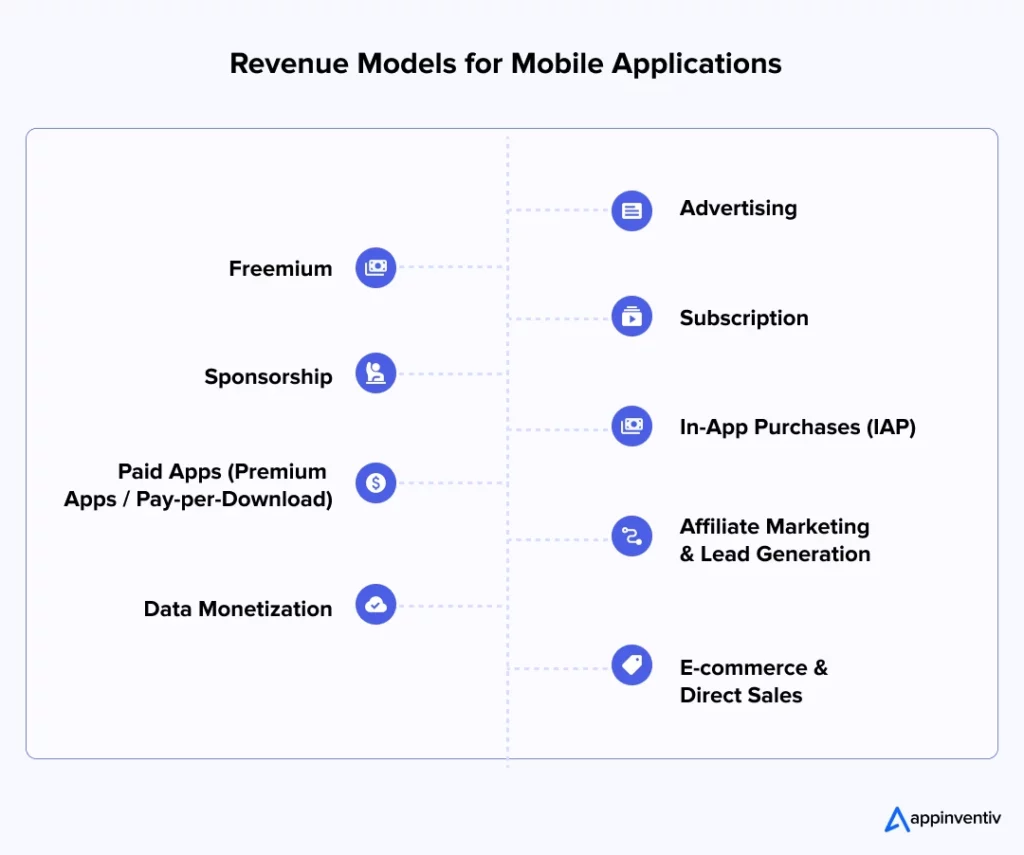
Advertising
It is one of the most popular ways to earn money from an application. In this monetization model, you promote services or products for third-party clients on your application, and in return, get paid.
Freemium
In this monetization model, users are allowed to access basic features for free. To access premium features, they are required to pay a certain amount. Freemium also offers the scope for implementing secondary revenue channels, such as in-app advertising.
Subscription
In this model, users must purchase a subscription plan to access the features for which the app is primarily known. There are several options available under this model, including monthly, yearly, and per-day subscriptions. Major platforms like Google and Apple allow users to manage subscriptions through them.
Sponsorship
The sponsorship model involves finding a sponsor related to your niche and striking up a compensation structure. In return for the monetary compensation, the app could include the sponsor’s brand, advertise its products, or send users to its website.
In-App Purchases (IAP)
This model allows users to buy virtual or physical goods, unlock features, or access premium content directly within the app. Purchases can range from one-time consumables like in-game currency to non-consumable items that permanently unlock features. It’s a highly effective way to monetize engaged users who derive significant value from the app.
Paid Apps (Premium Apps / Pay-per-Download)
In this straightforward model, users pay a one-time upfront fee to download and use the application. Once purchased, the app typically offers full functionality without additional charges or advertisements. This model relies on a strong perceived value to convince users to make an initial investment.
Affiliate Marketing & Lead Generation
Apps can generate revenue by promoting external products or services and earning a commission from resulting sales or leads. This involves integrating unique affiliate links or offering sponsored content within the app. Revenue is earned when users click these links and complete a desired action, like a purchase or sign-up.
Data Monetization
With explicit user consent, apps can collect, anonymize, and aggregate user data (e.g., usage patterns, demographics) and sell these insights to third parties. This data is typically used for market research, trend analysis, or to inform targeted advertising strategies, providing a revenue stream without directly charging users.
E-commerce & Direct Sales
For apps that are extensions of a business or designed specifically for retail, direct sales are the primary monetization method. Users browse and purchase physical products or book services directly within the application. The app functions as a direct sales channel, streamlining the buying process for customers.
Now that you know all the ins and outs of how much does it cost to build an app, its optimization strategies, monetization models, and development process, let’s look at how Appinventiv can help you estimate and control those costs.
How Can Appinventiv Help You With Mobile App Development Cost Estimation?
At Appinventiv, we understand that determining mobile app development cost can be a complex process, especially as the industry evolves and new technologies emerge. In 2026-27, knowing how much it costs to build an app isn’t just about raw numbers: it’s about delivering scalable solutions that align with your business objectives, and about knowing where AI genuinely lowers cost and where it adds new lines.
Whether you’re a startup or an established enterprise, creating an app involves much more than just coding; it’s about delivering a solution that scales, provides real business value, and resonates with your users.
Our skilled team of 1600+ tech experts is dedicated to ensuring that your app development journey is cost-efficient, transparent, and results-driven. With over a decade of experience across industries like healthcare, eCommerce, fintech, and more, we are recognized as a top mobile app development company by leading platforms like Clutch and GoodFirms.
We provide tailored cost estimates, development roadmaps, and strategic insights at every stage. Our proven track record is reflected in our client testimonials and industry recognition featured in leading publications.

Appinventiv is also an OpenAI and Anthropic partner, so the AI features we add to your app are built by a team that works closely with the models behind them. That helps us match each feature to the right model and give you clearer estimates of its usage costs.
We offer you:
- IT consulting services to plan a realistic estimate of your app’s cost based on your business needs.
- Cost estimates that separate build, run, and AI operating costs, so you can see what AI-assisted delivery saves and what AI features add.
- Technology consulting and deep insight into the best platform choice, tech stack, and scalability selection for your app.
- AI integration services that add assistants, personalization, or agentic workflows to your app, with evaluation and guardrails built in.
- A dedicated development team, ensuring quality, security, and timely delivery, all within your budget.
- Comprehensive mobile app development services to build a next-gen application that scales and grows
Ready to take the next step? Contact Appinventiv today, and let us help you turn your app idea into a cost-effective reality.
FAQs
Q. How much does it cost to develop an app?
A. Though it’s impossible to quote an exact mobile app development cost without knowing the scope, here are the approximate costs to build an app:
- Simple apps: $40,000- $100,000
- Medium complex app development: $100,000-$200,000
- Complex app development: $200,000- $400,000 and above
If your app includes generative AI features, also plan for monthly model usage costs, which grow with your user base.
Still unsure how much an app costs? Contact us and get a more precise estimate for app creation cost tailored to your unique project requirements.
Q. Does AI reduce the cost of mobile app development?
A. Partly. AI coding assistants speed up routine work such as boilerplate code, unit tests, and documentation, and a randomized field study of nearly 4,900 developers found a 26% increase in completed tasks.
Coding takes up only part of a project, though, and AI-generated code still needs careful review, so total project savings are usually more modest. Gains run higher on new, well-scoped builds and lower on apps that depend on complex legacy integrations.
Q. How much does it cost to add AI features to a mobile app?
A. It depends on what the feature has to do. API-based features such as smart search or a support chatbot typically add $30,000 to $50,000+ to a build. Assistants that answer from your own data, or recommendation engines, usually push an app into the $200,000 to $400,000 range, while AI agents that act on business systems often cross $400,000. Every option also carries monthly usage costs that scale with your user base.
Q. How much does it cost to maintain an app?
A. Your yearly budget for app maintenance can be somewhere between 15% and 20% of the initial mobile app cost. Apps with AI features should also budget for model usage fees, evaluation runs, and model version updates every year.
Q. How long does it take to build an app?
A. The time it takes to build an app varies depending on its complexity, features, and platform. On average, the timeline for app development is
- Simple apps: 3-6 months
- Moderate apps: 6–9 months
- Complex apps: 9–12 months or more
However, it is just a rough estimate; the actual timeline for app development can be shorter or longer, depending on the project scope, team size, and the number of iterations required for testing and feedback. AI-assisted development can shorten coding phases on well-scoped builds, but discovery, integrations, compliance, and testing still set the overall pace.
Q. What is the importance of mobile app development?
A. “If your business is not on the Internet, then your business will be out of business”.
This timeless quote by Bill Gates remains relevant even in 2026-27, particularly in a world where 9 out of 10 smartphone users reach for their devices within 30 minutes of waking up. In such a digital-driven scenario, your business faces a stark choice: live on that home screen, or get forgotten.
Still skeptical about the importance of mobile app development? Look at the transformation mobile apps have enabled:
- In 2012, Instagram, a photo-sharing app with just 13 employees, was acquired by Facebook for $1 billion. Fast forward to today, and that same Instagram now generates over $20 billion in annual revenue for Meta.
- WhatsApp was acquired for $19 billion in 2014.
- ByteDance, the parent of TikTok, is now valued at over $315 billion in 2025.
- Uber’s latest valuation hovers near $175 billion.
These are not anomalies. They are evidence that a great mobile app, paired with market timing and a clear need, can build empires. And while the opportunity is massive, so is the competition. As of 2025, there are approximately 2.61 million apps vying for attention on the Google Play Store and 2.29 million on the Apple App Store. The mobile app market has grown into something massive – we’re looking at revenues hitting $781.70 billion by 2029, which is frankly staggering when you think about it.
Q. What are the factors that affect the overall app development costs?
A. Some of the factors that affect the cost of building an app include features and functionalities, the complexity of the app, app design and animation, code reusability, size and location of your development team, the AI capabilities you plan to include, etc, along with other hidden app development factors.
To gain an in-depth understanding of these factors affecting the cost of developing a mobile app, please refer to the above blog.
Q. Are online app cost calculators accurate to know how much app development costs?
A. When seeking an answer to “how much does an application cost”, online calculators can give you a rough ballpark, but they often miss important variables like integrations, compliance, AI usage costs, or post-launch needs.
So, if you want to build something extraordinary, a detailed consultation is the only way to get a reliable estimate.
You can discuss your project idea with us and get a more accurate estimate to calculate the cost of app development.


Know Your App’s Development Cost Before You Build

Fast 2-minute response, fully NDA-protected.

In today’s digital age, having a strong online presence is the key to unlocking the door of business transformation and reaching the target audience. One of the most efficient ways to achieve this is through web app development. Web applications have grown at an unprecedented pace in the past decade, revolutionizing operations across various industries.…

Flutter has become increasingly popular, establishing itself as the go-to framework for developing cross-platform mobile apps. It can be used to create intuitive and feature-rich apps for different operating systems while achieving native performance and visual consistency on different platforms.

Key takeaways: With 6.05 billion users expected by 2028, social media apps are growing fast, creating opportunities for new entrants. Essential and advanced features for social media apps include profiles, feeds, media sharing, messaging, notifications, security, AR filters, and analytics. AI-driven personalization, social commerce, and AR/VR experiences are some of the emerging trends in social…