


























Legacy System Modernisation in Australia: A Practical Roadmap for Enterprises

 Share -


- 01What Counts as a Legacy System in Today’s Enterprise Environment
- 02Commonly Used Legacy Systems Across Australian Enterprises
- 03The Real Cost of Delaying Legacy System Modernisation
- 04When Should You Modernise a Legacy System?
- 05Common Legacy Modernisation Mistakes Businesses in Australia Often Repeat
- 067Rs of Legacy System Modernisation Approaches and When Each Works
- 07How to Modernise a Legacy System - A Practical Roadmap for Australian Enterprises
- 08Legacy Modernisation Costs in Australia: What Enterprises Should Expect
- 09Governance, Compliance, and Risk Management in the Australian Context
- 10How to Modernise Legacy Systems without Disrupting the Business?
- 11Outcome Driven Benefits of Modernising Legacy Systems
- 12How Appinventiv Helps Enterprises Modernise Legacy Systems

Key takeaways:
- Legacy systems in Australian enterprises now represent measurable cost, operational risk, and compliance exposure, not just technical debt.
- Legacy system modernisation programs typically range between AUD 70,000 and AUD 700,000+.
- Delaying legacy system modernisation increases long-term cost, concentrates risk, and reduces controlled execution options.
- The right modernisation roadmap enables risk reduction, operational continuity, and future readiness for AI, automation, and data-driven decision-making.
Legacy system modernisation in Australia is no longer a planned upgrade. It is increasingly a forced decision.
Most enterprises don’t act when systems become outdated. They act when something breaks. An outage, a failed audit, a security incident, or a missed integration that blocks a business initiative. By that point, timelines compress, costs escalate, and options narrow.
Across Australian enterprises, legacy systems are not failing loudly. They are failing quietly. Rising maintenance spend, slower delivery cycles, fragile integrations, and growing reliance on manual workarounds. None of these trigger immediate action, but together they create operational drag and hidden risk.
We see this most clearly in regulated and asset-heavy sectors. Banking, mining, healthcare, government, and retail networks rely on systems built for stability, not adaptability. Those systems now struggle to support real-time reporting, cyber resilience, data transparency, and rapid change.
This is why boards are now asking a different question. Not “Does the system still work?” but “How long can we afford to keep it?”
Appinventiv has delivered 500+ legacy modernisation programs for government, banking, mining and other sectors, helping organisations reduce operational risk, achieve compliance with CPS 230 and the SOCI Act, and cut run costs by an average of 30–45%. This blog reflects what we have learned from those engagements.
Most modernisation failures begin with the wrong starting point. We help leadership teams understand what to modernise, when, and why before committing to delivery.
What Counts as a Legacy System in Today’s Enterprise Environment
A common mistake in modernisation programs is defining legacy purely by age. In practice, some of the most problematic systems in Australian enterprises are not decades old. They are systems that have grown opaque, tightly coupled, and difficult to change safely.
A system should be considered legacy when it exhibits one or more of the following traits:
- Changes introduce disproportionate risk or effort
- Business logic is embedded in code that only a few people understand
- Observability is limited, making incidents hard to diagnose
- Integration depends on brittle point-to-point connections
- Security controls rely on manual processes rather than automation
These characteristics often emerge after years of incremental customisation.
Common Legacy Patterns Seen Across Australian Enterprises
Application modernisation in Australia frequently involves systems that began as standard platforms but were gradually shaped around local processes, regulatory workarounds, and reporting requirements. While every organisation is different, certain patterns appear repeatedly:
- Heavily customised ERP platforms
Custom code replaces standard workflows, making upgrades risky and expensive. - Monolithic line-of-business applications
Core functionality is tightly coupled, preventing selective change or scaling. - Vendor-locked platforms
Limited integration capability forces workarounds and restricts future options. - Middleware sprawl
Layers of integration tools accumulate without a clear ownership model.
These environments are not inherently broken. They become problematic when transparency and control are lost. At that point, even small changes carry enterprise-level risk.
Why clarity matters before action
Before selecting legacy system modernisation approaches, enterprises need a shared understanding of what they are modernising and why. Without that clarity, they often commit to modernisation programs that exceed budget expectations or fail to reduce measurable risk.
Also Read: AI Implementation in Australia (2026): Use Cases, Costs & Governance
Commonly Used Legacy Systems Across Australian Enterprises
Many Australian enterprises continue to run critical operations on legacy platforms that remain reliable but increasingly constrain change, compliance, and integration. These systems persist because they embed decades of business logic and regulatory interpretation, making replacement risky. As a result, legacy system modernisation in Australia often starts by managing integration complexity and upgrade constraints around these platforms.
| Industry | Common Legacy Systems | Integration or Upgrade Considerations |
|---|---|---|
| Banking & Financial Services | SAP ECC, Oracle E-Business Suite, Temenos T24 (older versions), COBOL-based core banking systems | Tightly coupled integrations, batch-heavy processing, high regulatory risk during upgrades |
| Mining, Energy & Utilities | SAP ECC, IBM Maximo (customised), ABB Ellipse | Heavy customisation, asset data dependencies, limited API exposure |
| Healthcare | Cerner Millennium (on-prem), InterSystems TrakCare | Interoperability constraints, compliance-driven upgrade windows |
| Government & Public Sector | Custom Java/.NET case management systems, mainframe-backed revenue platforms | Hard-coded business rules, data sovereignty constraints |
| Retail & Distribution | Oracle EBS, JD Edwards, Siebel CRM | Point-to-point integrations, upgrade risk due to custom logic |
| Enterprise Integration & Data | IBM WebSphere, TIBCO middleware, legacy data warehouses | ESB bottlenecks, scalability limits, migration sequencing risk |
The Real Cost of Delaying Legacy System Modernisation
For many enterprises, the decision to delay modernisation is framed as caution. In reality, it is often a decision to absorb escalating cost and risk in less visible forms. These costs rarely sit in a single budget line, which is why they persist longer than they should. Typically, the impact of delayed legacy system modernisation in Australia falls into four distinct categories.
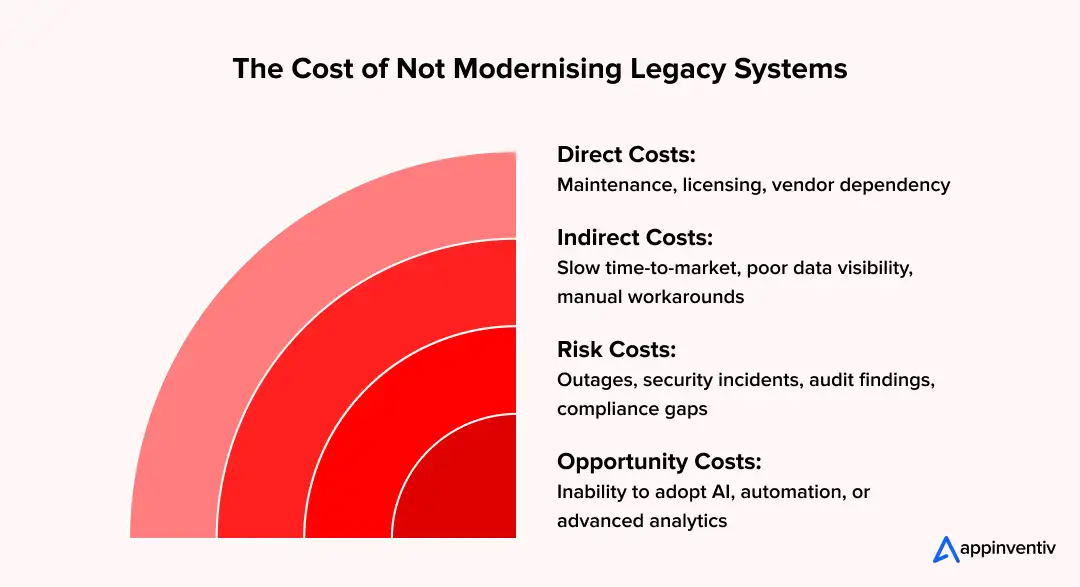
Direct Cost: Keeping Legacy Systems Alive
Maintenance and licensing costs rise year over year without improving capability. Specialist skills become scarce and expensive. Vendor dependency increases, reducing commercial leverage and locking organisations into unfavourable support terms.
Indirect Cost: Slower Execution and Hidden Inefficiency
Change takes longer as systems are tightly coupled and fragile. Data visibility relies on manual reconciliation and batch reporting. Teams compensate with workarounds that introduce error, rework, and operational drag.
Risk Cost: Concentrated Exposure and Audit Friction
Outages have wider impact due to unclear dependencies. Security and access controls rely on manual processes. Audit findings linked to change management, logging, and data handling take longer to close and attract greater scrutiny.
Opportunity Cost: Innovation That Never Scales
Legacy platforms limit automation, analytics, and AI adoption. Data is fragmented and poorly governed. As a result, AI legacy system modernisation initiatives stall because foundational architecture cannot support reliable, scalable use cases.
Delaying action compounds these costs. What appears conservative in the short term often results in higher financial, operational, and compliance exposure over time.
Australian Enterprise Benchmark
Organisations that delayed legacy modernisation by 2+ years typically reported 2.3× higher incident remediation costs and nearly 40% longer audit closure timelines. Enterprises that phased modernisation over 18–24 months reduced licensing and maintenance spend by AUD 800K–AUD 2.4M annually. (Appinventiv internal data).
When Should You Modernise a Legacy System?
Most enterprises delay modernisation because nothing appears urgent in isolation. The shift happens when multiple signals appear together:
- Maintenance costs rise without capability improvement
- Integration with new systems becomes increasingly complex
- Security controls depend on manual intervention
- Business teams rely on workarounds to operate
Individually, these are manageable. Together, they indicate structural limitation.
At this point, modernisation is no longer optional. It becomes a matter of controlling risk before it escalates under pressure.
Common Legacy Modernisation Mistakes Businesses in Australia Often Repeat
Most failed modernisation programs do not fail because the technology was wrong. They fail because the program was framed incorrectly from the start. Across enterprise legacy modernisation engagements, the same patterns appear regardless of industry. Here are some common mistakes that enterprises in Australia keep repeating:
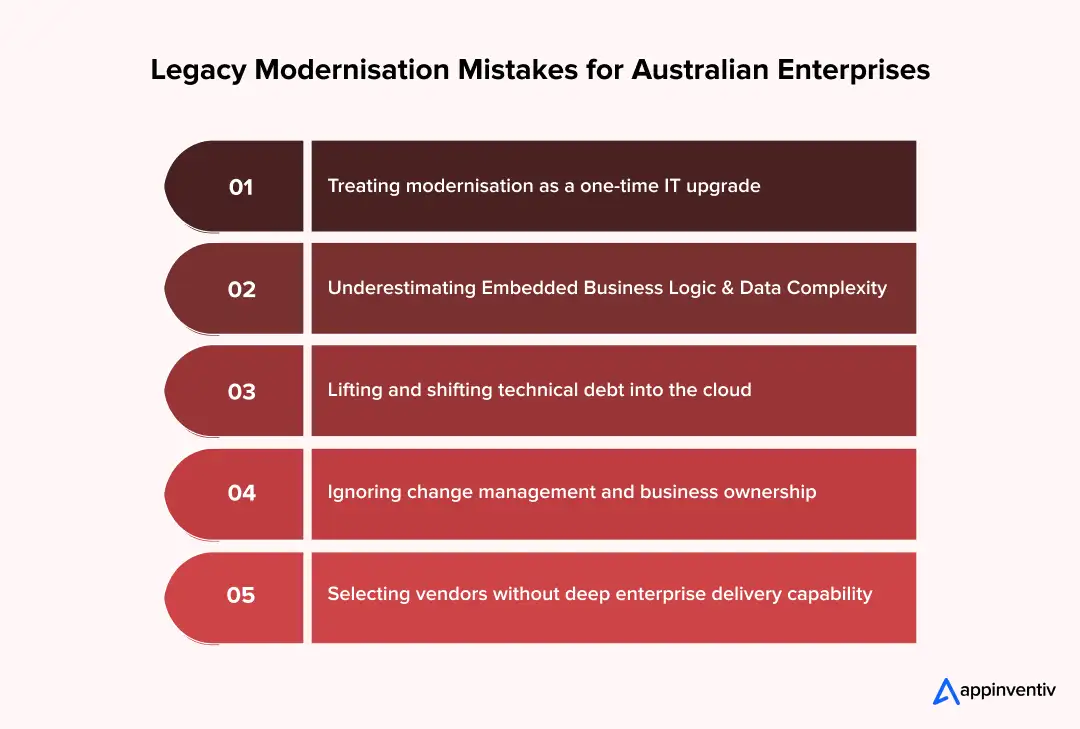
Treating Modernisation as a One-time IT Upgrade
A frequent mistake is positioning modernisation as a finite technology refresh. This framing pushes decisions toward speed over sustainability. Once the initial delivery pressure passes, governance weakens, standards erode, and the organisation slowly recreates the same constraints in a new environment.
Modernising legacy systems in Australia requires treating change as a continuous capability, not a project milestone.
Underestimating Embedded Business Logic & Data Complexity
Many legacy systems encode decades of regulatory interpretation, pricing logic, and operational nuance. When this logic is poorly documented, teams assume it can be rebuilt quickly or replaced with configuration.
The result is late-stage rework, production defects, or parallel systems running longer than planned. Data is often the hidden risk. Migration timelines slip because data quality, lineage, and ownership were not addressed early.
Lifting Technical Debt into Modern Infrastructure
Cloud migration in Australia without structural change is another recurring issue. Enterprises move workloads quickly, but retain brittle integration patterns, manual controls, and opaque dependencies. Costs increase without corresponding risk reduction.
This approach creates the illusion of progress while leaving the underlying constraints untouched.
Ignoring Organisational Change & Ownership
Technology changes faster than operating models. When teams are not trained or empowered to own modern platforms, they revert to old practices. Security and governance become reactive. Over time, the modern environment inherits the same fragility as the legacy one.
Outsourcing Vendors without Enterprise Execution Depth
Legacy system modernisation in Australia programs demand experience across governance, architecture, and delivery at scale. Vendors optimised for speed or isolated use cases often struggle with enterprise complexity. The cost is paid later through delays, rework, and loss of executive confidence.
Case in Point: A Tier-2 Australian bank engaged Appinventiv after a failed first modernisation attempt by another vendor. The program had stalled at Phase 3 due to undiscovered COBOL business logic.
Our team ran a targeted discovery sprint, documented 140+ embedded rules, and delivered a sequenced re-modernisation plan within 6 weeks. The bank achieved production go-live 4 months ahead of their revised timeline.
7Rs of Legacy System Modernisation Approaches and When Each Works
There is no single best approach to modernise legacy systems in Australiaas a long-term Australian AI consulting partner. Effective programs apply different strategies based on system criticality, risk profile, and long-term value. The table below outlines the 7Rs commonly used and when each is appropriate.
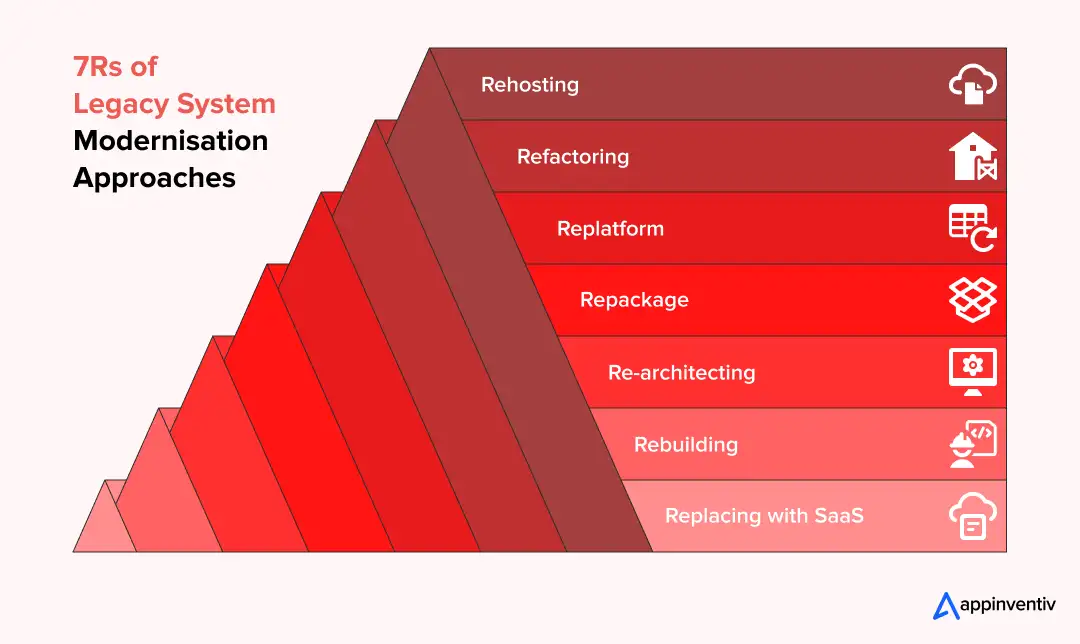
| Approach | When It Works | Key Trade-Off |
|---|---|---|
| Rehost | Stable workloads with minimal change needs | Limited risk reduction |
| Refactor | Systems needing scalability or performance gains | Requires strong testing discipline |
| Replatform | Platforms where infrastructure is the main constraint | Some technical debt remains |
| Repackage | Vendor systems that can be upgraded with minimal customisation | Functional flexibility may reduce |
| Re-architect | Core systems requiring modularity and resilience | Higher upfront complexity |
| Rebuild | Systems that block growth or compliance | Longer timelines |
| Replace with SaaS | Non-differentiating capabilities | Loss of custom control |
How Enterprises Decide the Right Modernisation Approach?
Understanding the 7 Rs of legacy system modernisation approaches helps leadership avoid blanket decisions that either over-invest or under-protect critical assets.
However, selecting a modernisation path is rarely a technical decision. Before choosing the right approch, you must evaluate:
- Business criticality → revenue, operations, compliance impact
- Risk exposure → failure impact and recovery complexity
- Cost vs longevity → short-term savings vs long-term stability
- Dependency footprint → integration and downstream impact
High-risk, high-dependency systems justify deeper transformation. Supporting systems are optimised for stability and cost control.
Decisions made without this framing often lead to over-investment or incomplete risk reduction.
How to Modernise a Legacy System – A Practical Roadmap for Australian Enterprises
Legacy system modernisation in Australia fails when execution skips discipline in favour of speed. The roadmap below reflects how Australian enterprises reduce risk while maintaining operational continuity. Each phase serves a distinct purpose and should not be collapsed or reordered. Here are the practical steps to modernise legacy systems:
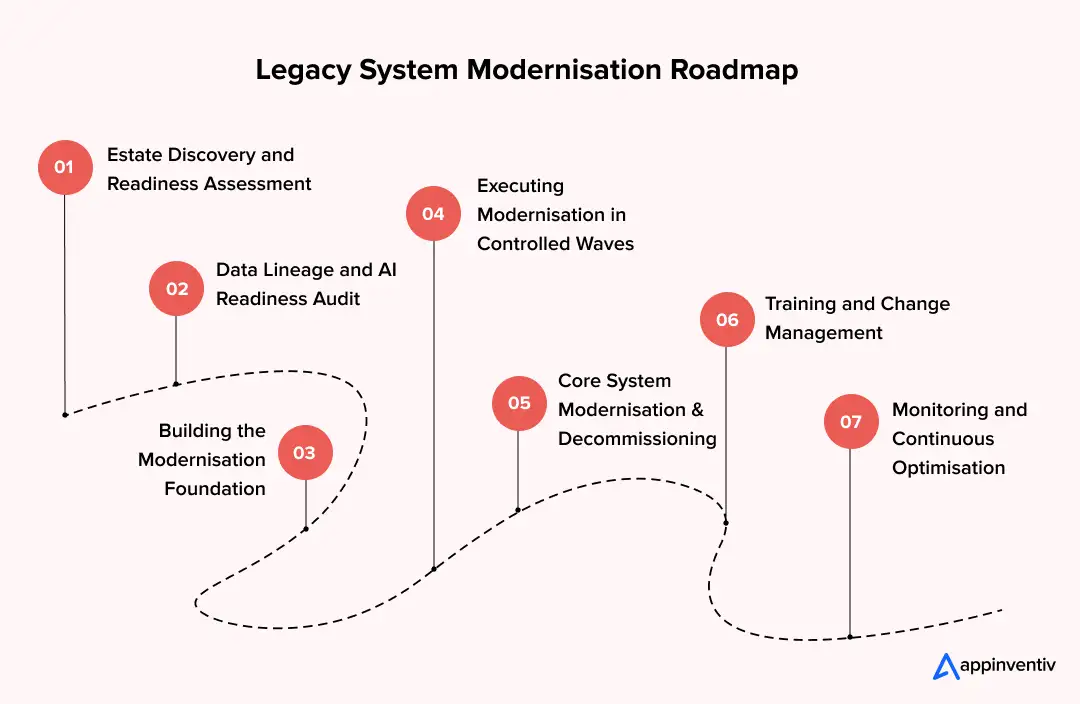
Phase 1: Estate Discovery and Readiness Assessment
Modernisation must start with clarity, not assumptions. That’s why this initial phase focuses on creating a reliable view of the existing estate so prioritisation decisions are based on evidence, not intuition.
Businesses establish control by:
- Creating a complete inventory of applications, integrations, and data assets
- Mapping system dependencies to understand failure impact and sequencing risk
- Capturing baseline metrics for cost, performance, incidents, and recovery time
Without this foundation, delivery plans become subjective and risk exposure increases.
Phase 2: Data Lineage and AI Readiness Audit
Before technical migration begins, enterprises must validate that their underlying data is structured, clean, and governed.
Enterprises secure their AI future by:
- Removing decades of redundant, obsolete, and trivial (ROT) data that compromises LLM accuracy.
- Documenting how data moves from legacy silos to modern endpoints to ensure auditability for AI-driven outcomes.
- Identifying which legacy databases contain the authoritative records required to ground GenAI Agents.
This phase ensures the legacy estate is capable of supporting Generative AI and automated decisioning without introducing hallucinations or compliance breaches.
Phase 3: Building the Modernisation Foundation
Before change accelerates, enterprises must set clear guardrails. This phase defines the architectural and operational boundaries that shape all downstream work.
Enterprises reduce future risk by:
- Defining platform, cloud, and architecture principles aligned with security and data residency expectations
- Standardising identity, access management, logging, and CI/CD to support auditability
- Establishing integration, API, and data governance models to reduce complexity
This phase determines whether application modernisation in Australia improves control or merely shifts risk.
Phase 4: Executing Modernisation in Controlled Waves
Execution begins with deliberate constraint. This phase allows teams to validate assumptions before modernising systems at scale.
Here teams maintain predictability by:
- Modernising low-risk workloads to test delivery patterns and tooling
- Reusing proven migration and refactoring approaches across the estate
- Managing parallel run states to protect business continuity
This is where modernising legacy systems in Australia either stabilises or destabilises operations.
Phase 5: Core System Modernisation and Decommissioning
Enterprises address business-critical systems only after execution confidence is established.
This phase converts modernisation efforts into measurable cost and risk reduction.
Businesses can unlock value by:
- Applying progressive carve-outs using strangler patterns without downtime
- Reducing dependency on legacy platforms while maintaining operational stability
- Enforcing decommissioning once dependencies are removed
Enterprises that defer decommissioning carry legacy risk forward indefinitely.
Phase 6: Training and Change Management
Technology change without capability change creates operational friction. So, this phase is essential to ensure teams can operate and sustain modern platforms.
The teams enable adoption by:
- Upskilling staff across modern platforms, tooling, and delivery practices
- Shifting from project-led execution to product-aligned ownership
- Embedding security, resilience, and governance into daily workflows
This phase determines adoption speed and long-term sustainability.
Phase 7: Monitoring and Continuous Optimisation
Modernisation does not end at go-live. It is an ongoing journey which protects the investment and prevents the creation of new legacy systems.
Enterprises sustain value by:
- Monitoring performance, cost, and risk against established baselines
- Optimising platforms, integrations, and data flows incrementally
- Enforcing standards and governance as the environment evolves
This phase ensures upgrading legacy system in Australia remains a continuous enterprise capability.
Unlike many vendors who treat data lineage as an afterthought, Appinventiv’s Phase 2 audit specifically maps data assets for GenAI readiness, ensuring your modernised estate can support AI agents, automated decisioning, and LLM-integrated workflows without a second migration cycle.
Legacy Modernisation Costs in Australia: What Enterprises Should Expect
The cost of legacy system modernisation in Australia varies widely based on scope, complexity, and regulatory exposure. What matters more than the estimated figure is how investment aligns with risk reduction and long-term ownership.
Australian enterprises increasingly evaluate cost through a small set of decision metrics:
| Metric | Why It Matters |
|---|---|
| Cost to run vs cost to change | Reveals whether delay is financially rational |
| Failure recovery time | Signals operational resilience |
| Audit remediation effort | Reflects governance maturity |
| Delivery stability | Indicates readiness for scale |
In practical terms, Australian enterprise programs typically fall within:
- AUD 70,000–200,000 → contained or low-risk systems
- AUD 200,000–400,000 → multi-system modernisation
- AUD 400,000–700,000+ → core systems with compliance and re-architecture
The range matters less than sequencing. Poorly structured programs often exceed these ranges without reducing risk.
For most Australian enterprises, a phased modernisation program in the AUD 200,000–AUD 400,000 range delivers measurable payback within 18–24 months through licensing rationalisation, reduced specialist contractor dependency, and improved audit closure rates. Appinventiv structures programs with phased milestone payments tied to delivery outcomes, not upfront commitments.
Governance, Compliance, and Risk Management in the Australian Context
Legacy system modernisation succeeds or fails on governance long before technology choices matter. Australian enterprises operate under increasing scrutiny from regulators, auditors, and boards. When modernisation programs treat compliance as a downstream task, risk surfaces late and expensively.
Modernisation decisions must align with operational resilience expectations, cyber maturity targets, and internal assurance models from the outset. Key governance considerations enterprises must actively manage include:
- Operational resilience alignment
Modernised platforms must support continuity, recoverability, and clear accountability under CPS 230 expectations, particularly for critical business services.
- Cyber security maturity
Enterprises need to align modernisation with Essential Eight maturity goals, embedding controls into platforms rather than relying on manual enforcement.
- Application and change control governance
Modernisation must strengthen application-level controls, including segregation of duties, change traceability, and release governance.
- Third-party and vendor risk
Modernisation expands supplier exposure. Enterprises must maintain visibility into delivery practices, access controls, and data handling across vendors.
- Data sovereignty and privacy
Architecture choices must reflect where data resides, how it moves, and how access is logged and audited under the Privacy Act 1988 and Notifiable Data Breaches scheme. Australian enterprises often prefer local sovereign data environments, and for AU Government workloads, in-country data residency is mandatory.
- Mandatory Modernisation under the SOCI Act
For critical sectors like Energy, Health, and Finance, modernisation is now a statutory mandate. Under 2026 SOCI Act reforms, legacy systems that cannot support mandatory incident reporting or Enhanced Cyber Security Obligations (ECSO) expose the enterprise to significant civil penalties and government intervention.
Governance works best when it constrains design early and enables delivery later. When organisations bolt it on, modernisation slows and risk increases.
Also Read: IT Compliance for Australian Business– A Strategic Guide
How to Modernise Legacy Systems without Disrupting the Business?
Operational disruption remains the primary concern for Australian enterprises. They cannot afford extended downtime or degraded service while modernising critical systems.
Successful programs are designed for coexistence rather than replacement. Legacy and modern platforms operate side by side for defined periods, allowing validation under real conditions. This approach reduces risk but demands discipline in integration and data consistency.
Practical measures enterprises use to minimise disruption include:
- Running controlled parallel operations for critical services
- Isolating change through modularisation rather than full replacement
- Sequencing releases around operational and regulatory cycles
- Aligning change windows with business tolerance rather than delivery convenience
Change management plays a decisive role here. When business owners understand sequencing and risk controls, resistance drops and adoption improves. Modernisation becomes a managed transition rather than a forced cutover.
Outcome Driven Benefits of Modernising Legacy Systems
The business benefits of modernising legacy systems extend beyond cost reduction. Australian enterprises increasingly measure outcomes in terms of control, speed, and strategic optionality. This includes:
- Cost profile improvement
Reduction in run costs through decommissioning, licensing rationalisation, and lower dependency on scarce skills. - Operational efficiency gains
Faster change cycles, reduced manual workarounds, and improved data availability for decision-making. - Risk reduction
Fewer incidents, faster recovery times, and declining audit findings linked to technology controls. - Strategic enablement
The ability to adopt automation, analytics, and AI without structural rework.
AI legacy system modernisation efforts, in particular, depend on these foundations. Enterprises that modernise effectively create platforms that support future initiatives without rework.
Our tech architects will assess your top 3 modernisation risks and give you a prioritisation framework. No sales pitch. No commitment.
How Appinventiv Helps Enterprises Modernise Legacy Systems
Legacy system modernisation in Australia is rarely constrained by intent. It is constrained by execution discipline. Enterprises struggle not because they lack strategy, but because risk, sequencing, and ownership are not handled with enough precision.
This is where our work typically begins. Being QLD Government ICTSS-approved and Local Buy LGA listed, we support enterprises as a long-term Australian AI consulting company, focusing on reducing operational risk, restoring control, and ensuring modernisation decisions remain defensible under audit and board scrutiny.
We start by creating clarity before momentum. In the first few weeks, we help leadership teams understand which systems can change safely, where dependencies concentrate risk, and how to sequence modernisation without destabilising operations. This early discipline prevents acceleration in the wrong direction.
Our execution approach adapts to enterprise reality rather than forcing a single delivery model. Depending on scale and risk profile, we support:
- Establishing modernisation foundations before scaling change
- Executing repeatable transformation work through controlled delivery lanes
- Strengthening platform engineering capability for sustained evolution
In practice, our experience demonstrates sustained enterprise delivery, as evidenced by our 90% client retention rate. Australian organisations also report 35% efficiency gains as manual workarounds are removed and systems become easier to operate. We have also secured 99.50% security compliance SLA across ISO and SOC2-aligned environments.
A Snapshot of our delivery footprint in Australia
Our 11+ years of experience in Australia and the broader APAC region reflect sustained enterprise delivery for brands like Lite N’ Easy, Multinail and Rapid Teachers. With a team of 1600+ technology specialists across cloud, data, security, and platform engineering, we have deployed more than 3000 digital assets across Australia and transformed over 500 legacy processes.
These numbers matter because they reflect repeatability and control, not scale for its own sake.
Closing Thoughts
The risk with legacy systems is not immediate failure. It is delayed consequences.
Costs rise gradually. Constraints build quietly. Then change is forced under pressure.
Enterprises that act early retain control over cost, sequencing, and risk. Those that delay often modernise reactively, with fewer options and higher exposure.
The difference lies in execution maturity. The right partner helps you modernise at the pace your business and governance model can sustain, not the pace technology headlines suggest.
That is the standard we hold ourselves to when upgrading legacy systems in Australia. Let’s connect.
FAQs
Q. How to modernise legacy systems in Australia?
A. Australian enterprises modernise legacy systems by starting with estate clarity, not technology selection. Leaders assess application, integration, and data risk first, then define governance, security, and data residency guardrails.
Modernisation proceeds in controlled phases, prioritising low-risk workloads before addressing business-critical platforms, with decommissioning planned from the outset to realise cost and risk reduction.
Q. Why do Australian enterprises need to modernise legacy systems?
A. Legacy systems increasingly expose Australian enterprises to operational, cyber, and compliance risk. They slow change, obscure data, and rely on scarce skills, while regulators and boards expect stronger resilience and accountability. Modernisation reduces risk, improves delivery speed, and enables future initiatives without compromising audit confidence.
Q. What are common signs that a legacy system needs modernisation?
A. Enterprises typically identify legacy risk when change requires disproportionate effort, incidents are difficult to diagnose, and audit findings persist. Other signals include rising maintenance costs, heavy reliance on manual workarounds, limited integration capability, and data that cannot support timely reporting or automation.
Q. How much does legacy system modernisation cost in Australia?
A. The cost of legacy system modernisation in Australia typically ranges between AUD 70,000 and AUD 700,000, depending on system complexity, data sensitivity, and regulatory exposure.
- AUD 70,000–150,000 for contained modernisation of low-risk applications or infrastructure stabilisation
- AUD 150,000–350,000 for multi-system modernisation involving data migration, integration refactoring, and governance uplift
- AUD 350,000–700,000+ for enterprise-wide legacy modernisation covering core systems, compliance-led architecture, and enforced decommissioning
Q. How long does a legacy system modernisation project take?
A. Legacy system modernisation projects in Australia typically span 4 to 12 months, depending on scope, sequencing discipline, and regulatory constraints.
- 4–6 months for contained estates or non-business-critical systems
- 6–9 months for multi-system modernisation with integration and data complexity
- 9–12 months for core or regulated platforms requiring parallel runs, compliance validation, and staged decommissioning
Q. What industries in Australia benefit most from legacy modernisation?
A. Industries with high operational complexity and regulatory exposure see the strongest outcomes:
- Modernisation in Banking and Financial Services
- Mining and Resources
- Healthcare and Life Sciences
- Government (Federal, State, Local)
- Large-Scale Retail and Logistics


Fast 2-minute response, fully NDA-protected.
A Practical Enterprise Guide To AWS Application Modernization for Legacy Systems
Key takeaways: AWS modernization improves the application itself, not just where it runs. The right modernization path depends on workload risk, value, and effort. Hidden dependencies, fragile integrations, and buried logic cause the biggest failures. Data modernization is critical for reporting, analytics, automation, and AI readiness, making data modernization AWS a key consideration for enterprises…