



























 Leader in AI-First Product Engineering Read Full Article
 IT Managed & Outsourcing
 Contact Us
Most OTT platforms don’t break on day one. Issues show up later, when traffic builds, content scales, and systems start interacting in ways that weren’t planned. As a trusted OTT platform development company, we focus on how streaming platforms behave in production, so performance, tracking, and monetization don’t drift under real usage.
Where OTT Platforms Start Breaking




















A decade of delivery,
measured in impact
Global Recognitions and Awards
App Downloads Achieved for Clients
Client Satisfaction Rate
On-Time Delivery Record
AI-Powered Solutions Delivered
Legacy Processes Transformed


Most OTT platforms run into trouble before a single user complains. Architecture decisions made early without enough context create failures that only surface under production conditions. As part of our custom OTT solution development approach, we find where things are likely to break, and structure the platform to avoid those problems at scale.
• Architecture gap mapping
Identifies weaknesses across playback pipelines, CDN routing, and data flow layers before production traffic exposes them.
• Monetization alignment
Structures subscription, billing, and entitlement logic so revenue flows reconcile cleanly across payment gateways and regions.

Building a custom OTT platform is not a feature delivery exercise. Concurrency management, session control, and content workflows need to be engineered together, otherwise performance holds up in testing and falls apart when real users show up across different devices and network conditions.
• Playback orchestration
Builds pipelines using LL-HLS, CMAF, and WebRTC to manage load and bitrate shifts, keeping live latency ~2–5s and sub-second where needed.
• Video player architecture
We build custom players with adaptive controls, UI skins, offline playback, and SDK integration for consistent playback across devices.

On OTT platforms, user experience is only as good as the backend responding to it. Slow content retrieval, and laggy recommendation flows push users toward the exit. Our OTT application development services cover UI & UX engineering that stays responsive when the system is under pressure, not just when it's running in a controlled environment.
• Content discovery logic
Optimizes navigation, search, and recommendation flows so users reach content faster without backend delays degrading the experience.
• Response-driven UX
Keeps interfaces stable under load during content fetch, playback initiation, and interaction-heavy browsing flows.

Legacy OTT infrastructure tends to accumulate technical debt quietly until a traffic spike or integration change forces the issue. We modernize legacy platforms without touching active users, replacing the parts that limit performance and visibility while keeping streaming continuity intact throughout.
• Live migration control
Moves legacy platforms without interrupting active users, maintaining playback continuity and data integrity across transition phases.
• Observability upgrades
Introduces logging, monitoring, and tracing layers that give teams actual visibility into performance issues and user behavior patterns.

OTT software development does not end when the app is built. CDNs, DRM systems, payment gateways, and analytics tools all need to stay in sync under load. When those connections are fragile, the symptoms show up as failed transactions, content access errors, and reporting inconsistencies that are hard to trace back to a source.
• Stable system connectivity
Integrates CDNs, DRM, payment gateways, and analytics tools without sync failures or data inconsistencies across connected systems.
• Ad tech integration
We connect SSAI and CSAI pipelines with CDNs, analytics, and monetization systems so ad delivery, tracking, and revenue reporting remain consistent under load.

White-label OTT platforms often look ready on the surface but break when customization, integrations, or scale come into play. We adapt and extend base platforms with structured content workflows, flexible monetization logic, and stable delivery layers so they perform reliably in production.
• Platform extensibility
Customize content workflows, user journeys, and monetization logic without breaking core system stability or creating upgrade conflicts
• Integration readiness
Connect DRM, analytics, payments, and CDNs seamlessly while maintaining consistent data flow and platform performance under load

Most platforms treat FAST as a feature addition. It is a separate monetization infrastructure with its own scheduling logic, ad delivery pipeline, and content syndication requirements. We build FAST channel systems that run reliably under continuous programmatic ad load.
• Channel scheduling and playout logic
Builds automated linear scheduling and playout infrastructure that manages content sequencing, gap filling, and EPG delivery at scale.
• Ad insertion pipeline
Integrates SSAI-based ad delivery into FAST channel infrastructure so programmatic ads load server-side, keeping impression tracking clean across devices and regions.

Linear OTT systems rely on precise scheduling, sequencing, and metadata delivery to keep streams continuous and predictable. We build playout and EPG layers that keep linear and FAST channels running without gaps, sync issues, or content mismatches.
• Playout automation
Builds automated playout systems that manage content sequencing, ad breaks, and fallback logic to keep linear streams running without interruptions.
• EPG management
Structures program guides with accurate metadata, scheduling sync, and real-time updates so content availability and timing stay consistent across devices.

A live OTT platform is never really finished. Traffic spikes, content drops, and integration updates create constant pressure on system stability. We monitor behavior continuously, catch problems before they reach users, and keep the platform running cleanly as usage and content volume grow.
• Performance monitoring
Tracks system health continuously to catch early signs of buffering, latency spikes, or infrastructure strain before impact spreads.
• Load resilience
Keeps the platform stable during traffic surges, content releases, and regional spikes without streaming quality or uptime taking the hit.
From consulting to post-launch stability, we handle the full build so your team focuses on content and growth.




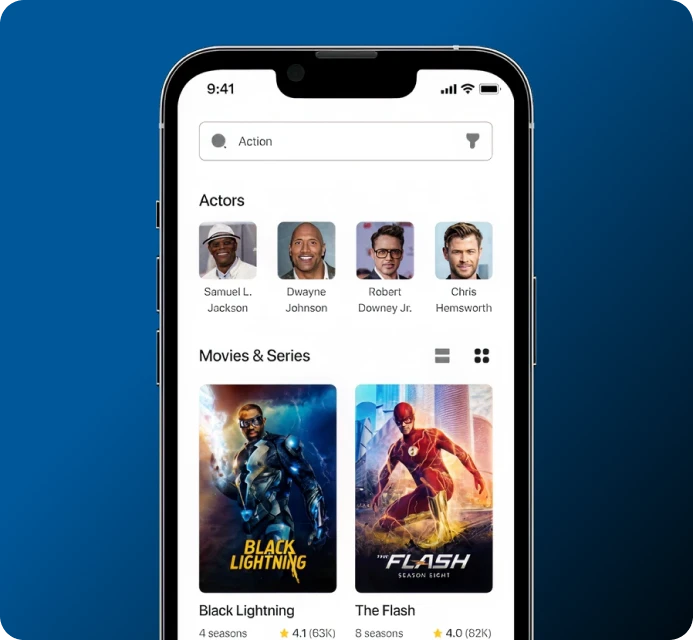
The user panel provides a highly engaging and personalized experience for users, ensuring seamless content discovery, viewing, and interaction across multiple devices.
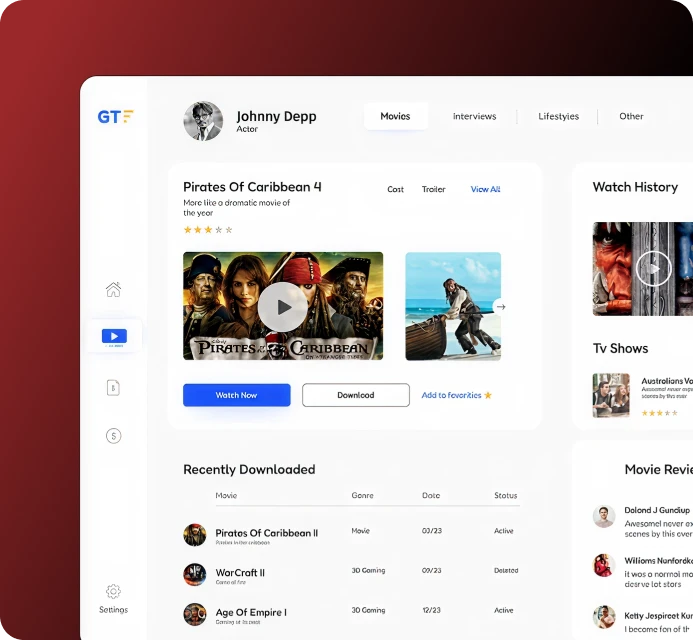
The admin panel provides comprehensive tools for efficient platform management. It allows administrators to manage content, monitor performance, and access real-time analytics, ensuring smooth operations and data-driven decision-making.





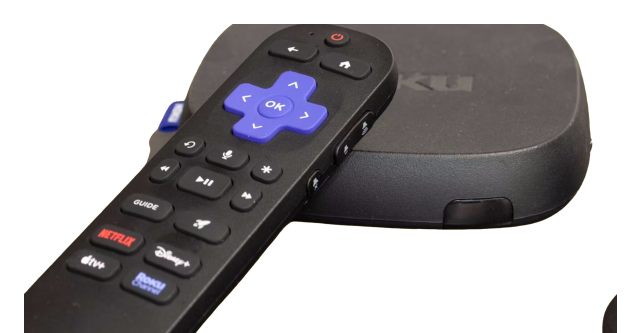
We create intuitive, fast-loading Roku apps that blend performance with polished interfaces, perfectly aligned with Roku’s platform guidelines.
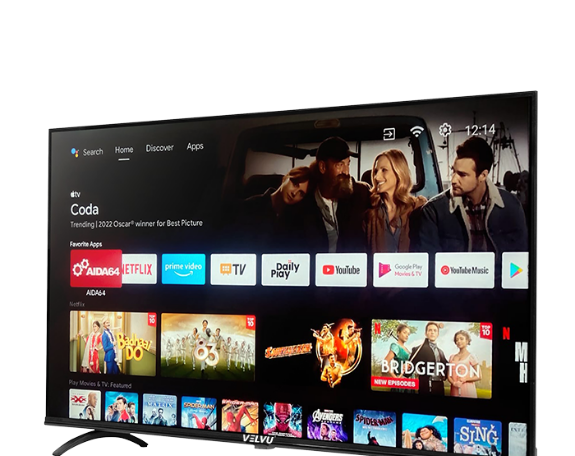
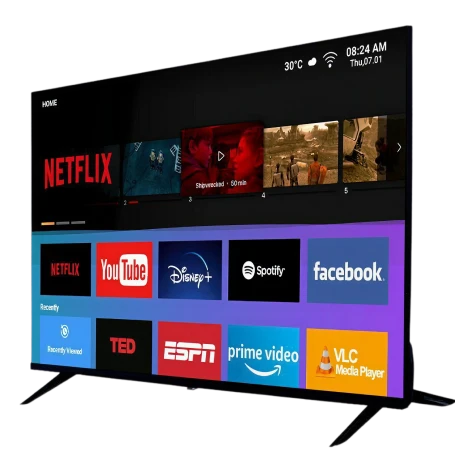
Our team builds custom OTT apps for Smart TVs, delivering cinematic user experiences on Samsung, LG, Android TV, and more.
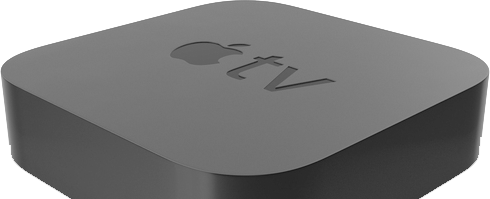
Every OTT app developer on our team brings platform-specific expertise to tvOS, designing immersive Apple TV experiences with sleek interfaces, Siri integration, and fluid navigation.
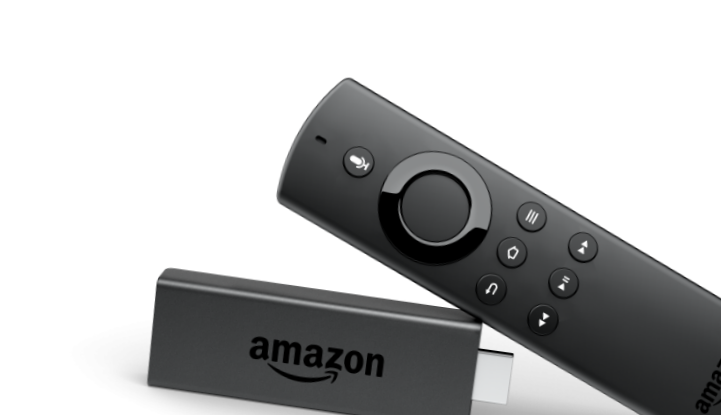
Our OTT developers build powerful Fire TV apps that support smooth streaming, custom features, and monetization with Amazon’s ecosystem.
Every OTT app developer on our team brings platform-specific expertise to tvOS, designing immersive Apple TV experiences with sleek interfaces, Siri integration, and fluid navigation.

Our engineers craft Android OTT apps that are fast, flexible, and built to perform across a wide range of Android-powered devices.

We ensure your Android OTT apps are Play Store-ready with seamless deployment, compliant updates, and optimal app store visibility.

We design companion OTT video platforms that complement main-screen experiences, enabling real-time interactions, synced content, and audience engagement.

We offer cross-platform OTT app development by building high-performance CTV apps designed for large-screen environments, optimizing navigation, ad delivery, and viewing consistency across smart TV ecosystems and devices.

The global OTT market crossed $400B in 2025, growing at over 20% CAGR with rising digital consumption.
OTT services are projected to scale beyond $3T by 2035, driven by global streaming demand and infrastructure growth.
Subscription models generate over 70% of OTT revenue, with hybrid models reshaping monetization.
APAC leads OTT growth, fueled by mobile-first users, regional content, and expanding digital ecosystems.

Build high-performance audio streaming apps with seamless playback, smart discovery, and offline access for artists, labels, and global audiences.

Create scalable OTT video platforms with adaptive streaming, content management, and immersive viewing experiences across devices.

Develop interactive learning platforms with structured courses, live sessions, certifications, and engaging digital classrooms.

Build engaging short-video platforms with creator tools, real-time interactions, and community-driven content ecosystems.

Deliver live sports streaming with real-time stats, match highlights, and personalized fan experiences.

Enable secure enterprise streaming solutions for internal communication, training, and content distribution with advanced analytics.

























Most OTT vendors optimize for one vertical and adapt everything else. We've built production platforms across entertainment, education, fitness, healthcare, and live events, which means architecture decisions around content workflows, access control, and monetization logic are informed by how these systems actually behave across different business models, not just repurposed from a single template.
OTT platforms built as monoliths become expensive to change as streaming standards, device ecosystems, and audience expectations shift. We use API-first, modular architecture from the start so individual components like recommendation engines, DRM layers, and billing systems can be upgraded or replaced without rebuilding the platform around them.
Subscription, TVOD, AVOD, and FAST channels introduce different entitlement, ad delivery, and reporting dependencies. We design monetization into the platform, aligning subscriptions, ad insertion, FAST channel delivery, and revenue tracking so systems stay consistent as scale and complexity grow.
Subscription, TVOD, AVOD, and hybrid models each carry different entitlement logic, billing reconciliation requirements, and regional compliance considerations. We add multiple monetization options where subscription management, payment gateway integration, and revenue reporting are built into the platform architecture rather than bolted on after the fact.
Streaming platforms that perform well in controlled environments routinely degrade under concurrent load, regional traffic spikes, and simultaneous content drops. We build with load distribution, adaptive bitrate pipelines, and autoscaling infrastructure as baseline requirements so performance holds up when actual usage patterns hit the system.
Bolt-on analytics tools produce lagging reports that don't reflect what's happening in real time. We instrument platforms with event-level tracking from the ground up so teams get live visibility into playback quality, content performance, drop-off behavior, and monetization conversion without waiting on data pipelines to catch up.
The India's Fastest-Growing Companies 2026 Recognised by TIME and Statista

Statista High Growth Companies APAC - 2026

Statista India's Growth Champions 2023






Large content libraries break down without automated tagging, moderation, and segmentation working reliably behind them. We wire AI into content workflows so platforms stay operationally manageable as libraries grow without editorial teams scaling at the same rate.
Recommendation engines built on fixed rules quietly stop working as catalogs expand and viewer habits shift. We build ML pipelines that retrain continuously on real behavioral signals so personalization holds up over time instead of becoming background noise.
Most OTT teams are flying partially blind across regions, devices, and revenue flows. We build analytics infrastructure that pulls playback, engagement, and transaction data together in near real time so the team sees what is actually happening on the platform.
OTT infrastructure that grew without a clear structure tends to become a visibility problem before it becomes a performance problem. We design multi-cloud environments across AWS, Azure, and GCP with identity models and logging in place so teams know what is running and who has access to it.
Platforms that ship manually start accumulating small inconsistencies between environments that eventually cause real production problems. We set up CI/CD with infrastructure as code so releases follow the same path every time and the team stops firefighting after deployments.
Platforms handling content rights, subscriber records, and payment flows in the same system carry more risk than most teams account for early on. We build DRM, access controls, and audit logging into the architecture from the start so the gaps do not show up after the platform is already live.
Infrastructure built for linear streaming was never designed to handle concurrent spatial sessions and real-time asset delivery running together. We build the session management and compute layers that stop the backend from becoming the bottleneck in virtual events and immersive viewing experiences.
Immersive content experiences tend to fall apart at the backend, not the front end. We build the delivery and compute infrastructure that keeps AR and VR sessions stable across enterprise training programs and live interactive events without latency creeping in under load.
At a certain content volume, manual moderation and quality checks stop being viable. We run vision workloads on elastic infrastructure so moderation pipelines and automated tagging keep pace with publishing volume without the team having to add headcount to keep up.
Rights agreements, royalty distributions, and nft ott platform development requirements across multiple parties and regions create audit trail problems that spreadsheets and emails cannot reliably solve. We connect blockchain where verifiable ownership records genuinely matter without letting it slow down content delivery or financial reconciliation on the operational side.













Tell us what you're building and we'll show you exactly how we'd stack it.


Most OTT projects run into trouble because business requirements, content workflows, and technical constraints were never mapped against each other before build started. Our OTT streaming app development services begin with understanding traffic expectations, monetization models, and regional requirements so architecture decisions reflect reality.
OTT interfaces that work well in demos often break down across real device ecosystems. We design across every target surface simultaneously using iterative wireframes and device-specific prototypes so interaction patterns hold up before frontend development begins.
Choosing the wrong streaming infrastructure early creates performance ceilings that are expensive to fix later. We evaluate codec requirements, CDN architecture, and DRM compatibility before committing to a stack so the platform is built on infrastructure that supports long-term scale.
OTT platforms built without structure accumulate inconsistencies that surface under real concurrent loads. We build through structured agile sprints covering playback, authentication, CMS, subscription logic, and analytics with clean maintainable code that holds up as the platform scales.
Content rights, DRM enforcement, entitlement logic, and payment flows need to work together without gaps that create compliance exposure or revenue leakage. We integrate advanced encryption, access controls, and audit logging into platform architecture before testing begins.
Big bang launches carry unnecessary risk when infrastructure behavior under real concurrent load has not been validated. We follow a staged rollout strategy starting with controlled environments that surface performance issues and integration failures before full production exposure.
Validates playback, load behavior, and platform stability across devices, TV OS versions, and network conditions. Covers functional testing, device-specific QA, and concurrency checks to ensure consistent performance before security integration and rollout.
Working with a dedicated OTT software development company means your platform keeps evolving after launch. Viewing behavior shifts, and platforms that stop improving lose ground quickly. We monitor playback quality, engagement patterns, and infrastructure performance to help your app keep winning.
Honestly, the range is wide. Most custom OTT platforms land somewhere between $40,000 and $300,000, but that number moves significantly based on what the platform actually needs to do. A single-platform app with standard playback and subscription logic is a very different build from a multi-device system handling adaptive streaming, DRM, recommendation engines, and high-concurrency traffic. Team location, timeline, and how much of the infrastructure needs to be built from scratch versus integrated all factors into the final number.
Three to eight months covers most builds, but the honest answer depends on what's actually being built. Standard playback, authentication, and basic subscription management can move quickly. The timeline stretches when the platform needs custom interfaces across multiple device surfaces, third-party integrations that require back-and-forth, compliance work, or performance testing under realistic load conditions. The part most teams underestimate is device-specific QA. It takes longer than expected and skipping it tends to show up as user complaints after launch.
OTT platforms usually rely on a mix of monetization models based on content and audience. Subscription models work when there is consistent premium content. Transaction-based models suit exclusive or high-demand titles. Ad-supported models focus on scale and audience reach. In most cases, platforms combine these approaches to diversify revenue. The key is to design monetization systems early, as adding billing and entitlement logic later can become complex and costly.
Key models: