



























 Leader in AI-First Product Engineering Read Full Article
 IT Managed & Outsourcing
 Contact Us
We build mental health platforms for organizations that have to operate inside real clinical and regulatory boundaries. The focus is not just on features, but on whether the system works for clinicians, protects patient data, and holds up as usage grows. Our digital mental health app development services are designed to support therapy delivery, care coordination, and behavioral health programs without introducing risk or instability.
Core Capabilities





















Numbers Reflecting Our
Healthcare App Delivery at Scale
Years of Experience
Engineers, Designers, and Clinical Technology Specialists
Global Recognitions and Awards
Healthcare Clients Served
Medical and Wearable Devices Integrated
Industries Mastered


Enterprise mental health programs often require platforms built around specific care models, populations, and regulatory constraints. We design and develop custom mental health applications that reflect how care is delivered, governed, and scaled in real environments.
• Custom platform design
Define workflows, roles, and architecture aligned to clinical programs and enterprise needs.
• Regulated-by-design development
Build HIPAA-compliant systems with privacy, auditability, and scale built in.

Effective mental health platforms start with clear clinical, technical, and compliance decisions. Our mental health app consulting services help organizations define the right platform direction before committing to full-scale implementation.
• Clinical and platform assessment
Evaluate care workflows, systems, and risks to guide platform decisions.
• Architecture and compliance planning
Define scalable structures aligned with HIPAA and regulatory expectations.

Mental health programs need structure to scale. We build custom behavioral health platforms that support consistent therapy delivery across providers, populations, and partner networks.
• Therapy model enablement
Support individual therapy, group programs, asynchronous care, and blended delivery models.
• Behavioral program management
Enable session planning, progress tracking, and outcome reporting tied to care objectives.

Mental health platforms operate under heightened data and safety expectations. We design systems with compliance and patient protection built in from the start.
• HIPAA and privacy controls
Implement identity and access management, consent handling, audit logs, encryption, and secure data separation.
• Safety and crisis workflows
Configure risk indicators, escalation paths, and emergency actions with full traceability.

We provide AI-powered mental health app development services that prioritize safety, transparency, and clinical trust.
• Clinical decision support
Assist care teams with triage cues, risk signals, and care recommendations under defined controls.
• Engagement and outcomes intelligence
Use analytics to track adherence, identify drop-off risk, and measure program effectiveness.

Our cloud-based mental health app development solutions are designed to perform under real usage conditions at scale.
• Enterprise-grade architecture
Design resilient cloud environments with monitoring, fault tolerance, and incident readiness.
• Governed release and change control
Support controlled deployments with audit-ready processes and operational oversight.
Achieve 2X operational efficiency, 45% workflow optimization, and 90%+ data accuracy with HIPAA-compliant mental health platforms designed for real clinical environments.



Built for daily use with personalized routines, guided practices, and progress tracking that support habit formation without compromising data privacy.

Designed to help users manage stress through assessments and guided interventions while giving organizations visibility into engagement and outcomes.

Structured around evidence-based CBT workflows, these apps support exercises, reflections, and progress monitoring aligned with clinical frameworks.

Recovery platforms that balance accountability, privacy, and long-term engagement through structured tracking and secure support workflows.

Enable consistent mood and symptom logging over time, helping users and care teams identify patterns and support informed care decisions.

Support healthy sleep behavior through therapy-aligned routines, tracking, and optional wearable integration for deeper sleep insights.

Secure virtual care platforms enabling video sessions, scheduling, documentation, and compliant communication across care teams.

Age-appropriate platforms with built-in safety, consent handling, and privacy controls designed to support younger users responsibly.

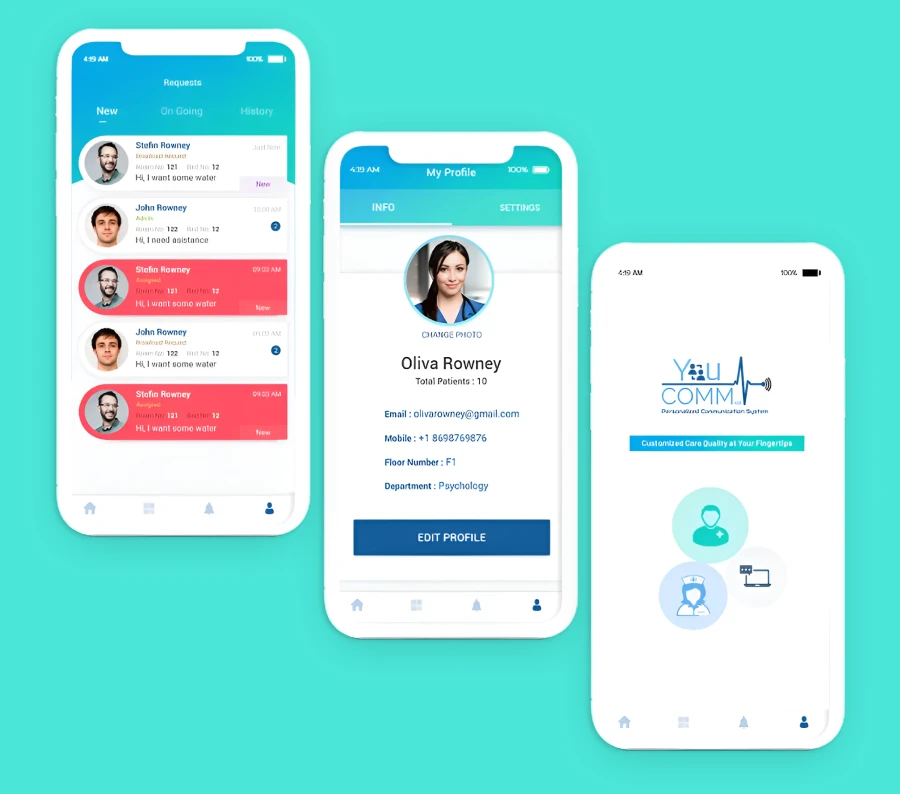
In-hospital patient communication was inefficient and inconsistent, especially for patients with limited mobility. Traditional call bell systems delayed care and compromised response times, directly affecting patient satisfaction and clinical workflows.

We built YouCOMM, a real-time communication platform that enables patients to request assistance via manual selection, voice commands, and head gestures, ensuring inclusivity and responsiveness.

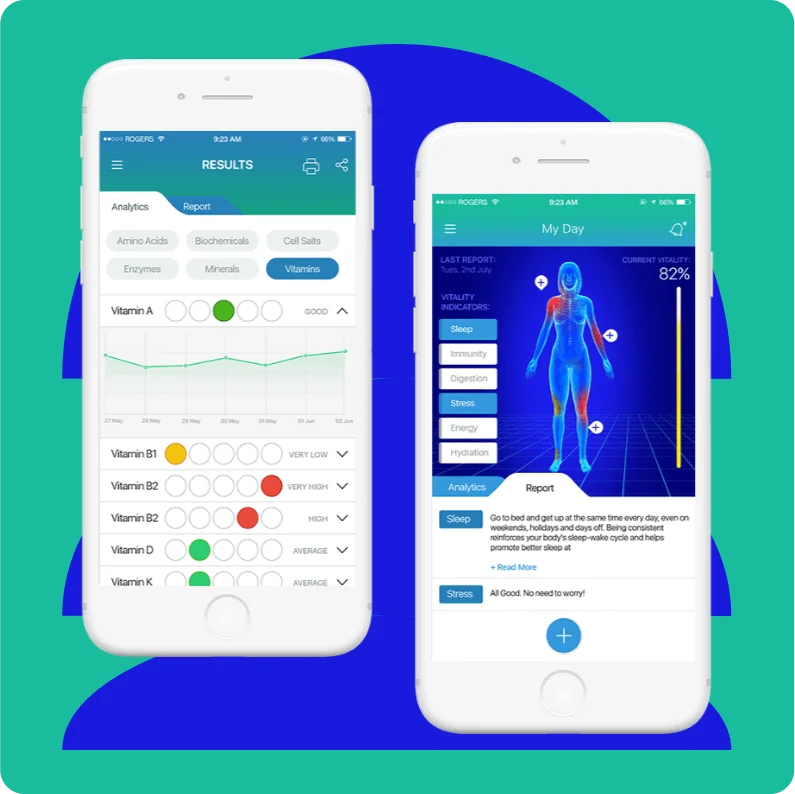
The hard part wasn’t collecting biometric data. It was figuring out what actually mattered. Signals were inconsistent, noisy, and easy to misread, and the system had to work reliably without overreacting or confusing users.
We built Soniphi step by step, testing how vocal signals behaved in real conditions. Instead of chasing perfect accuracy on paper, the focus was on extracting signals that stayed consistent and turning them into health insights people could understand and use in real time.
Health information was scattered. Some data lived in reports, some in apps, some with providers. None of it came together in a way that made long-term tracking or personalized care easy.
We built Health-e-People to pull everything into one place. It lets users and providers see health records over time, spot patterns, and keep track of progress without jumping between systems.

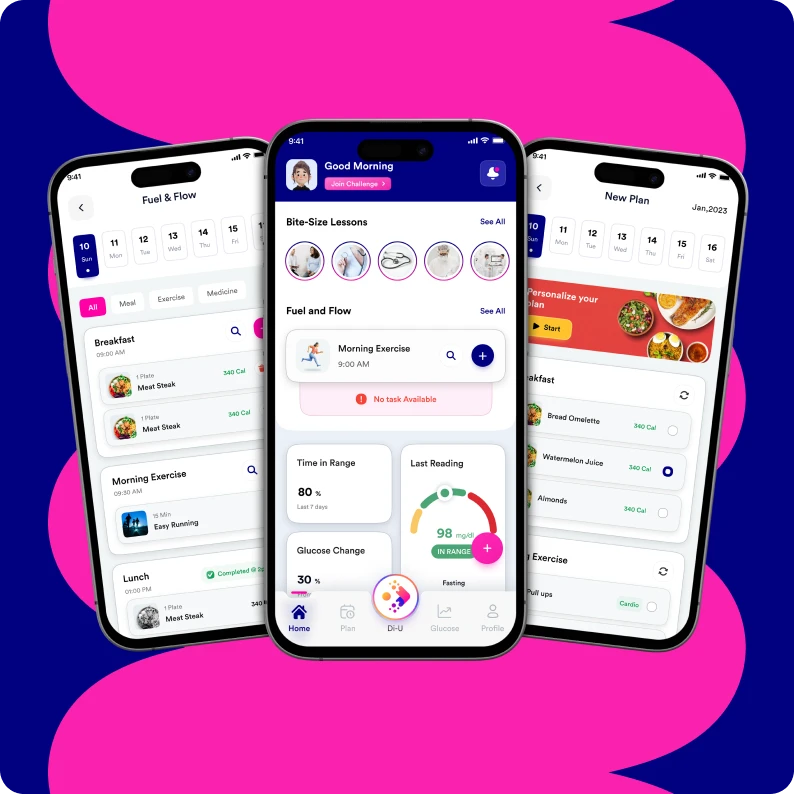
The platform was growing fast, but scale brought new pressure. It had to stay secure, meet HIPAA requirements, and still feel personal for people managing diabetes remotely. Doing all three at once was the real test.
We built DiabeticU to handle that balance. The platform supports day-to-day diabetes management with tracking, medication support, and remote consultations, while AI is used carefully to offer relevant guidance. Everything was designed to scale safely without breaking trust or compliance.
Our approach emphasizes EHR-integrated with mental health app development to maintain continuity of care
Continuous signals support better clinical context when device data is integrated responsibly.
Mental health platforms often sit within broader enterprise ecosystems that require stability and governance.
Virtual care requires reliability, security, and seamless clinical handoffs across systems.


ВА, Toki App
Build a mental health platform shaped around your regulatory, clinical, and operational reality.



















Across multi-hospital systems and scaled HealthTech enterprises, our work delivers outcomes that matter to leadership. We enable faster clinical decisions and operational efficiency while meeting stringent requirements for HIPAA, GDPR, SOC 2 Type II, and enterprise security governance.
Security is not handled as a separate stream. It is built into how identity, access, data movement, and environments are designed. This includes role-based access, encryption across layers, audit trails, and controls that can be enforced consistently without slowing delivery.
Most enterprise platforms sit at the center of a wider ecosystem. We routinely integrate with EHRs, core enterprise systems, analytics platforms, identity providers, and third-party services. The focus is on maintaining data integrity and traceability as systems become more connected.
Releases in enterprise environments are rarely simple. We design delivery workflows that account for environment segregation, approvals, rollback paths, and audit requirements. This helps teams move forward without introducing instability or compliance exposure.
Regulations shift, business models change, new capabilities get added. We design platforms with that in mind, so changes can be introduced without destabilizing what already works. This reduces long-term technical debt and operational risk.
Our mental health app developers work closely with product, engineering, security, and operations stakeholders. That cross-functional exposure helps align technical decisions with ownership models, governance expectations, and the realities of running platforms at scale.
We design mental health platforms with the discipline
required for growth and
regulation.



The India's Fastest-Growing Companies 2026 Recognised by TIME and Statista

Statista High Growth Companies APAC - 2026

Statista India's Growth Champions 2023






We introduce AI capabilities where it can remove friction from everyday decision-making. This often means embedding intelligence into workflows to prioritize actions, flag anomalies, or assist teams in responding faster, while keeping behavior explainable and governed.
Our machine learning implementations start with data readiness, not algorithms. We work with teams to define learning objectives, feedback loops, and ownership models so models improve accuracy over time without creating black-box dependencies.
We apply computer vision in scenarios where visual inputs already exist but are underutilized. By integrating image and video analysis directly into operational systems, we help teams turn visual signals into timely, actionable insights.
Rather than adding another analytics layer, we focus on structuring big data so teams can trust it. This includes defining data flows, governance rules, and reporting logic that support consistent decision-making across functions.
Our cloud implementation services are shaped around workload behavior and compliance needs. We design architectures that scale during peak demand, recover cleanly from failure, and remain observable so operations teams retain control as usage grows.
We implement blockchain only when transparency and immutability are genuine requirements. This typically involves designing shared workflows where transaction history, auditability, and trust between parties must be verifiable by design.
IoT becomes valuable when device data connects to business action. With our IoT development we build custom platforms, including connected medical device software solutions, that collect, normalize, and contextualize sensor data, then integrate it into operational systems so teams can respond with confidence.
Cybersecurity is implemented alongside core functionality, not layered on later. We implement threat modeling, access design, and continuous scanning into development and release workflows so vulnerabilities are addressed before they reach production.
We use AR and VR where visual context improves execution. This includes training, guided processes, and remote collaboration scenarios where hands-on understanding reduces errors and accelerates adoption.









Build mental health platforms where technology works as
one governed system.


We begin by understanding how care is delivered today. This includes patient journeys, clinician workflows, data capture points, and regulatory constraints. The goal is to ensure the platform supports real-world care delivery rather than forcing behavioral change through technology.
Once workflows are clear, we define the platform structure. This covers application boundaries, data models, integration points, and security controls. Architectural decisions are made with scale, interoperability, and compliance in mind from the start.
Design and development progress in controlled phases, with frequent validation against clinical, operational, and compliance expectations. This helps surface issues early and ensures features align with both patient experience and provider usability.
Security and compliance checks are embedded throughout delivery. We implement access controls, auditability, and data protection alongside integrations with EHRs, analytics platforms, and third-party services commonly used in healthcare environments.
Before launch, platforms go through structured testing and readiness reviews. Post-launch, we support stabilization, performance tuning, and incremental enhancements as usage grows and requirements evolve.
This approach allows Appinventiv to deliver mental health platforms that are stable, compliant, and built for long-term use in enterprise settings.
Yes. Our mental health platform development services are built to support mental health app development with EHR integration and wearable ecosystems commonly used in clinical care. We integrate platforms using HL7 and FHIR standards, secure APIs, and governed data exchange models to ensure continuity across systems.
As a mental health app development company, we focus on maintaining data accuracy, traceability, and compliance while enabling real-time and historical data flow from EHRs, medical devices, and remote monitoring tools.
Mental health software development supports therapists by reducing administrative overhead and improving care continuity. Purpose-built platforms centralize assessments, session notes, and patient history, allowing clinicians to focus more on care delivery. With custom mental health application development services, workflows are designed around real clinical practices rather than generic software constraints.
Development timelines vary based on clinical depth, integrations, and regulatory scope. Enterprise platforms are typically delivered in phases to support validation and controlled rollout.
Key timeline factors include:
For enterprise mental health app development solutions, timelines prioritize long-term stability over speed alone.
A custom mental health app improves access and engagement for users while giving providers better visibility into care progress. Patients experience consistent, secure interactions, while providers gain structured data and operational clarity. Well-planned mental health app development solutions help align patient outcomes with organizational efficiency.
The cost to build a mental health app typically ranges from $40K to $400K, depending on clinical depth, compliance requirements, and integration complexity. Enterprise mental health app development solutions often require higher upfront investment to reduce long-term risk and rework.
Cost drivers typically include:
Experienced mental health app developers at a specialized mental health app development company help control cost by designing scalable foundations early.
Mental health app feature selection should reflect both clinical needs and enterprise governance. Beyond user-facing tools, platforms must support operational and compliance requirements. End-to-end mental health app development solutions ensure features work together as a cohesive system, not isolated components.
Compliance is embedded into architecture, workflows, and data handling from the start rather than applied later.
Our approach includes:
With HIPAA compliant mental health application development services, regulatory readiness becomes part of daily platform operations.
Developing an MVP for a mental health application starts with identifying the smallest set of features required to support safe, compliant care delivery. As a mental health app development company, we focus MVPs on core clinical workflows, secure data handling, and early validation with real users.
Our approach to mental health app development solutions includes defining essential therapy or tracking features, implementing HIPAA-aligned security controls, and designing scalable architecture so the MVP can evolve into a full enterprise platform without rework.
Sustained engagement depends on trust, usability, and clinical relevance. Through digital mental health app development services, we design platforms that support consistent user interaction without overwhelming patients or providers.
This includes structured therapy journeys, progress visibility, reminders, and outcome tracking. When appropriate, AI-powered mental health app development services are applied carefully to personalize experiences while maintaining transparency and clinical oversight.
Mental health apps with crisis intervention require carefully designed workflows and safeguards. Our HIPAA compliant mental health app development services include configurable risk indicators, escalation paths, and emergency response logic aligned with clinical governance.
We ensure crisis workflows integrate seamlessly with care teams, telehealth platforms, and support systems, allowing timely intervention while maintaining auditability, privacy, and patient safety across the platform.