






























 Leader in AI-First Product Engineering Read Full Article
 IT Managed & Outsourcing
 Contact Us
With over a decade of product engineering expertise, we’ve delivered wearable apps trusted by 10M+ users worldwide. Built on secure device-to-cloud architectures, real-time sensor processing, and scalable backends, each solution meets strict privacy and compliance standards for reliable, intelligent performance.
Our Core Capabilities



















Specialists in Wearable Innovation
Apps Delivered Across Industries
Users Impacted Worldwide
Satisfied Clients
Awards and Certifications
4.7 Rating on Clutch


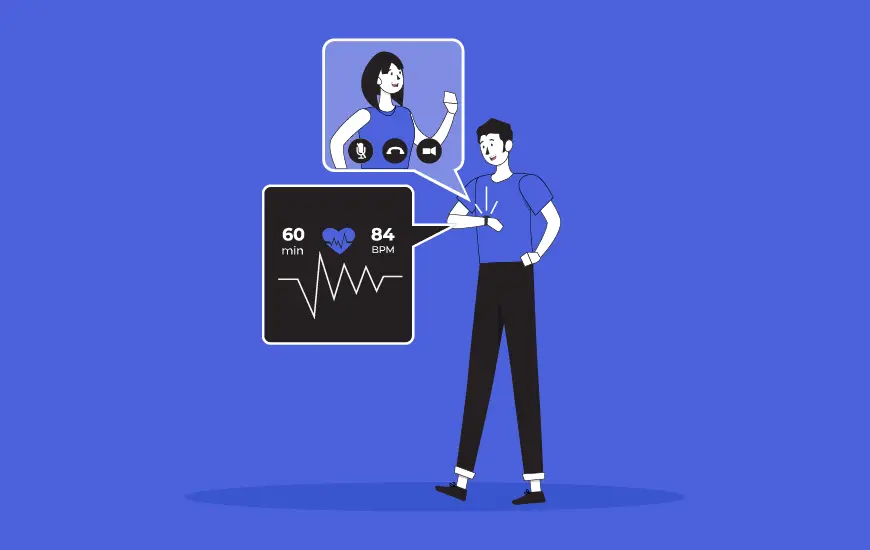
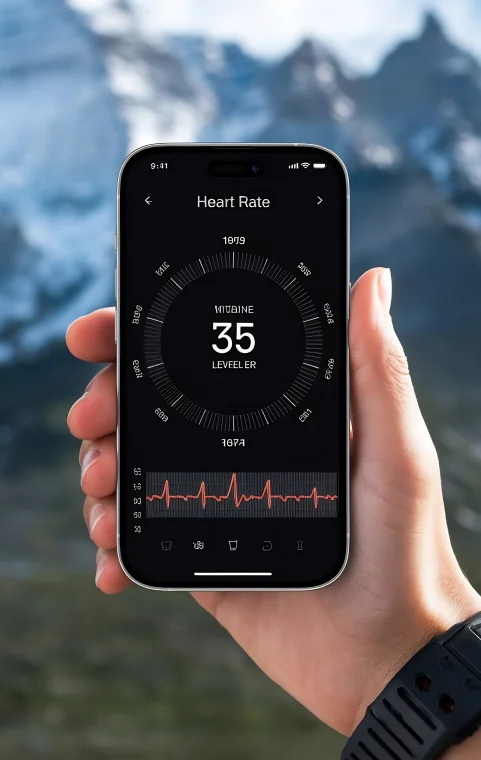
We build wearable health monitoring apps that capture real-time vitals, activity patterns, and biometric signals through connected sensors.

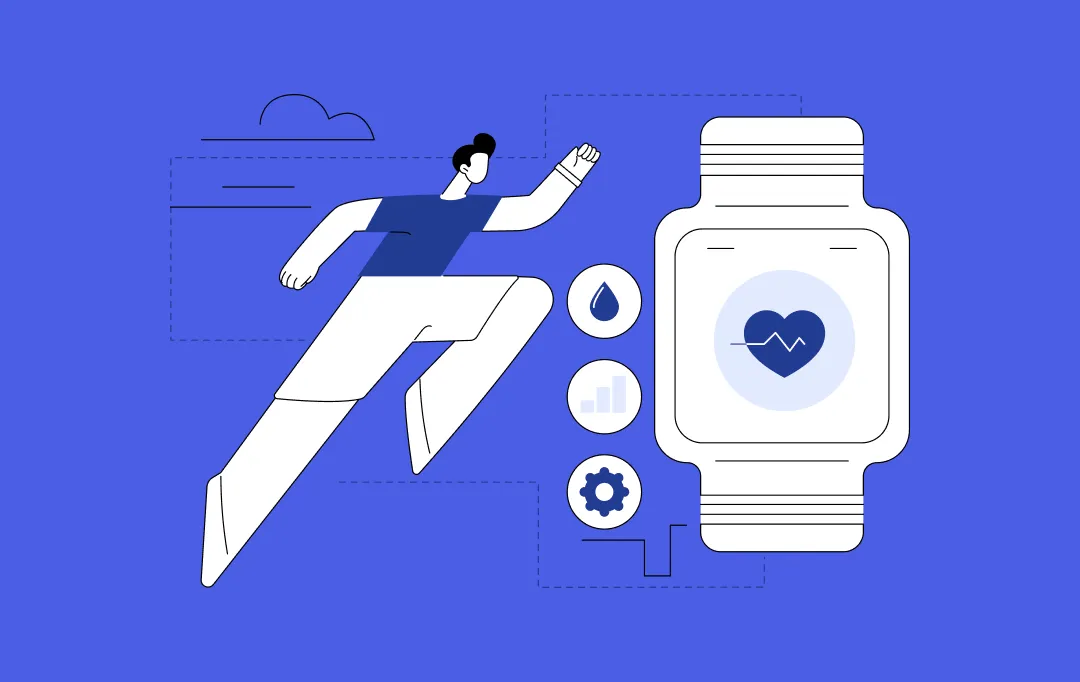
Our team offers wearable fitness app development that help users track movement, recovery, endurance, and workout progress with personalized insights.

We build AI-powered wearable systems that help apps move beyond tracking and respond intelligently to user behavior, sensor activity, and changing conditions.

We create wearable safety applications for industrial, logistics, field service, and high-risk work environments.

We develop apps for smart glasses and AR/VR headsets that support hands-free workflows, immersive training, and real-time guidance.

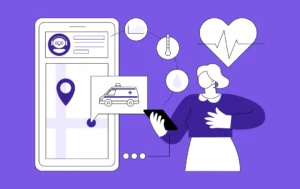
We build medical alert wearable apps that connect users, caregivers, and emergency teams through real-time triggers and location-aware alerts.

Our wearable app development services also cover smart earbuds and voice-first devices designed for hands-free interaction.

We build smart clothing applications that capture movement, posture, muscle activity, temperature, and biometric signals through sensor-embedded fabrics and connected apparel.

Smart ring apps collect health, activity, sleep, and other biometric data through compact wearable sensors. These customized solutions connect smart rings with mobile and cloud platforms for real-time tracking and personalized insights.

Meta smart glasses can support hands-free access to information, voice interactions, image capture, and connected experiences. We develop companion apps that connect the glasses with mobile platforms and business workflows.
Partner with us to create applications that deliver seamless experiences, intelligent insights, and trusted performance



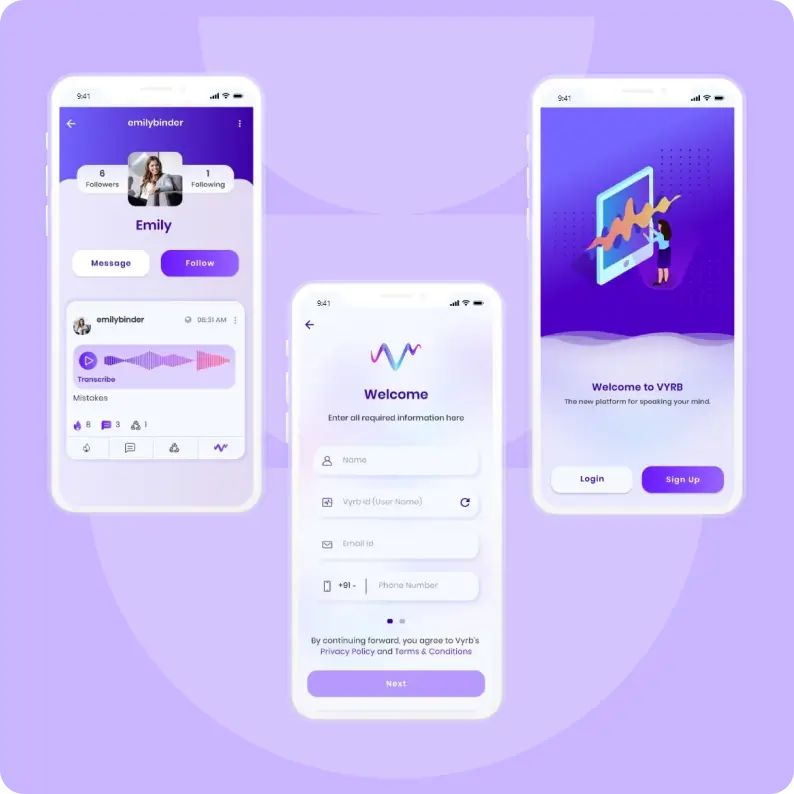
Vyrb wanted to create a hands-free social media experience by enabling users to seamlessly share and consume audio messages through Bluetooth-enabled smart glasses. The goal was to build a platform optimized for wearable technology while maintaining a smooth mobile experience.

We built a powerful social networking app designed specifically for audio conversations. The platform works perfectly with Bluetooth glasses, providing instant syncing, fast streaming, and easy voice controls that make user interaction feel natural and effortless.




Bankruptcy Lawyer, DebtBlaster
From healthcare monitoring to workforce safety and immersive training, we create wearable apps that turn real-time data into measurable business value.

CCPA (California Consumer Privacy Act)

ISO/IEC 27001

IEEE 802.15.6

CE & FDA Approvals

ISO 13485

FCC (Federal Communications Commission)

ISO/IEC 62304

SOC 2 Type II

NIST Cybersecurity Framework (CSF)

MDR - Medical device compliance in the European Union
CCPA (California Consumer Privacy Act)
ISO/IEC 27001
IEEE 802.15.6
CE & FDA Approvals
ISO 13485
FCC (Federal Communications Commission)
ISO/IEC 62304
SOC 2 Type II
NIST Cybersecurity Framework (CSF)
MDR - Medical device compliance in the European Union

We secure wearable data with encryption, tokens, and safe APIs, preventing unauthorized access.

We protect BLE and NFC connections with encrypted pairing, rotating keys, and safe sessions.

Apps are sandboxed, permissions limited, and inputs validated to reduce security risks.

Face ID, fingerprints, or voice plus proximity checks ensure only authorized access.

Firmware updates are signed and encrypted, verified before installation to prevent tampering.
We know how to work through complex compliance requirements, including HIPAA, FDA, and MDR for healthcare, and PCI-DSS for finance. This makes sure your wearable solution is completely audit-ready from day one, giving you confidence while meeting industry regulations and standards.
Security gets built into every part of the wearable apps we build. From tamper-resistant firmware and encrypted BLE communication to secure cloud integration, we protect sensitive data both in transit and at rest, keeping users' privacy safe and your business integrity intact.
Wearables have specific hardware limitations, and we excel in optimizing the same for peak performance. We craft apps that provide smooth, fast performance without impacting the battery life, creating a natural user experience that feels effortless on every device.
Through our wearable devices app development skills, we connect wearable devices to AI and IoMT systems, turning raw sensor data into predictive, useful intelligence. From early health risk detection to context-aware insights, we build solutions that help businesses and users make informed, real-time decisions.
Create secure, compliant, and high-performing wearable solutions backed by AI, IoMT, and real-world device engineering.


The India's Fastest-Growing Companies 2026 Recognised by TIME and Statista

Statista High Growth Companies APAC - 2026

Statista India's Growth Champions 2023






As an esteemed AI development company, we add AI-powered features into wearables that allow predictive health monitoring, real-time analytics, and highly personalized user experiences that boost engagement and decision-making.
Leverage our generative AI development services to create wearable applications that adapt intelligently to each user. From custom workout and wellness plans to predictive health alerts, we craft wearable apps that enhance engagement and provide real-time insights.
Our ML development services use intelligent models that constantly learn from user behavior, creating adaptive wearable solutions that improve performance, spot issues, and provide useful insights without manual work.
Being a trusted IoT app development firm, we make sure devices connect smoothly with secured data transfers, and real-time syncing, working seamlessly across wearable ecosystems.
Through our blockchain development services, we boost data security, make sure health records can't be tampered with, and create decentralized systems for wearable applications, building trust and transparency.
With our AR/VR app development services, we create engaging wearable experiences for industries like healthcare, fitness, and business training, merging the physical with the digital world.
We are a metaverse app development company known for connecting wearable devices to virtual environments, creating interactive simulations, social experiences, and business collaboration in the metaverse.
Our cloud consulting services make sure wearable applications can grow, stay reliable, and remain secure, with smooth data storage, processing, and access from anywhere, anytime.
Through advanced business intelligence services, we turn wearable data into useful insights, helping enterprises improve operations, get better results, and create data-driven strategies.


From concept to deployment, we help businesses create wearable applications that improve engagement, unlock new revenue streams, and drive measurable outcomes.

Wearable apps need accuracy from the beginning. We start with thorough workshops to outline functional needs like sensor connections, health tracking, or AR overlays. Compatibility tests across smartwatches, smart glasses, earbuds, and IoMT devices make sure your app is built for growth. The result is a future-ready plan designed for the special needs of wearable environments.
Wearables aren't smartphones, so resource planning matters. We pick the right tech stack, whether Swift for watchOS, Kotlin for Wear OS, or Flutter for cross-device builds. SDKs for BLE, NFC, GPS, and biometric data are carefully connected. Cloud setups and lightweight CI/CD pipelines are planned to handle wearable-specific data loads well without draining device performance.
In wearables, UX isn't about big screens but fast, easy-to-read interactions. We create micro-interactions, vibration feedback, and gesture-based controls for devices like smartwatches, AR glasses, and earbuds. Using Figma or Adobe XD, we build interactive prototypes and test usability with real users to make sure the design feels natural, unobtrusive, and smart about context.
Wearable app development needs lightweight engineering. We create modular backends with fast APIs, making sure quick sync with smartphones, cloud, or IoT devices works well. Features like BLE pairing, edge processing, biometric login, and AI-driven analytics get added to boost device intelligence. Every part gets tuned for small screens, low power, and real-time response.
Testing wearable apps means going beyond standard QA. We check apps on actual devices to make sure they run smoothly under battery limits, network interruptions, and constant sensor input. Multi-device syncing (watch + phone + cloud) gets tested thoroughly. Security checks like penetration testing protect sensitive health and personal data, making sure everything works reliably in real-world situations.
Wearable apps need careful deployment across app stores and manufacturer-specific channels. We set up CI/CD pipelines for quick releases, tune binaries for watchOS and Wear OS, and follow device-specific distribution rules. Monitoring tools get configured to track performance, user adoption, and connectivity, making sure your wearable app launches smoothly.
Wearable technology evolves quickly, and your app should too. We constantly watch device logs, sensor performance, and crash data to improve functionality. Regular updates make sure everything works with new OS versions, SDKs, and upcoming hardware like AR glasses or smart clothing. This method keeps your wearable app ready for the future, secure, and interesting for users.
The cost of wearable app development usually ranges between $50,000 and $500,000+, depending on device type, sensor integration, AI capabilities, platform coverage, and compliance needs. As part of our wearable technology solutions, Appinventiv evaluates hardware constraints, data workflows, and scalability goals to deliver a clear, business-aligned cost estimate.
Timelines of building a wearable app vary based on complexity. Basic wearable apps take around 2–3 months, while advanced solutions with AI, IoT, cloud analytics, or healthcare compliance typically take 6–8 months or more. Our smartwatch app development services follow a structured delivery model designed around device ecosystems and real-world usage scenarios.
We integrate IoT devices with wearable apps using BLE, MQTT, WebSockets, and custom APIs, supported by secure cloud middleware. This ensures reliable real-time data exchange between wearables, mobile apps, and enterprise systems without performance or battery trade-offs.
Yes, in our custom wearable app development service, we integrate with Apple HealthKit, Fitbit Web API, and Garmin Health API to consolidate activity, vitals, sleep, and fitness data into a unified experience. All integrations are designed with privacy controls and platform-specific optimizations.
Security is embedded across every layer. Our wearable application development services include AES-256 encryption, SSL/TLS, OAuth 2.0 authentication, role-based access, and alignment with HIPAA, GDPR, and SOC 2 standards. This ensures sensitive data remains protected across devices, networks, and cloud environments.
Wearable apps face limitations such as battery constraints, device fragmentation, interoperability issues, and regulatory requirements. As a custom wearable app development company, we address these through lightweight architectures, edge processing, modular APIs, and compliance-ready engineering frameworks.
AI enables wearable apps to move beyond tracking into real-time intelligence and automation. Within our wearable application development services, AI analyzes sensor data, detects behavioral patterns, predicts risks, and personalizes experiences. This supports smarter health monitoring, workforce safety, and adaptive user journeys.
Our smartwatch app development services follow a 5-layer battery optimization system that includes lightweight code execution, edge processing, intelligent sensor polling, background task control, and adaptive data syncing. This approach ensures consistent performance without compromising battery life, even in data-intensive wearable applications.
The best tools depend on device ecosystems. Our smartwatch app development services use Android Studio and Wear OS SDK for Android wearables, and Xcode with WatchKit for Apple Watch. We also integrate BLE SDKs, HealthKit, Google Fit APIs, and lightweight AI frameworks like TensorFlow Lite to build secure, high-performance wearable solutions.
Security and privacy are built into every stage of our wearable app development process. We implement end-to-end encryption, secure APIs, biometric authentication, role-based access controls, and encrypted Bluetooth Low Energy (BLE) communication to protect sensitive user data. Our team also develops solutions in compliance with standards such as HIPAA, GDPR, CCPA, and ISO/IEC 27001, ensuring wearable applications remain secure, compliant, and resilient against evolving cyber threats.
Successful wearable app engineering combines intuitive user experience, optimized device performance, secure connectivity, and scalable cloud architecture. It also requires seamless sensor integration, real-time data processing, AI-powered insights, low-power optimization, cross-platform compatibility, and rigorous testing across wearable devices. Together, these components ensure wearable applications deliver reliable performance, accurate data, and engaging user experiences while supporting future growth.