


























AI Agent Business Ideas in 2027: 25 Ways to Grow, Scale and Govern

 Share -



- 01The 2027 Problem: AI Agent Adoption is Growing Faster Than Business Value
- 02AI Agent Ideas That Grow Revenue
- 03AI Agent Ideas for Entering New Markets
- 04Enterprise AI Agents That Increase Operational Capacity
- 05AI Agent Ideas That Create New Offerings
- 06The Control Layer: Governing Your Agent Estate
- 07How to Choose the Right AI Agent Business Ideas for Your Enterprise
- 08AI Agent Adoption Strategy
- 09Why Enterprises Choose Appinventiv as Their AI Agent Development Company
- 10FAQs

You approved the pilot, and the demo impressed the board. Six months later, someone in finance asks which line of the P&L the agent has moved, and the room goes quiet. We hear a version of this often, and it is rarely a technology failure. The agent works. Nobody owns the workflow it sits in, and nobody agreed on the number it was meant to change.
The AI agent business ideas below start from that gap. Each one pairs a workflow automation opportunity with a revenue, margin, capacity or governance outcome, a risk level and a KPI you can hold a team to.
Key takeaways:
- Choose AI agent ideas that address specific revenue, cost, productivity or governance challenges.
- Set clear KPIs for every agent, such as revenue recovered, processing time reduced or operating costs saved.
- Agents can coordinate workflows across CRM, ERP, finance, security and other enterprise systems.
- Define access permissions, approval requirements and escalation rules before agents take action.
- Score every candidate on value, data readiness, integration effort and risk tier before committing budget.
Our team can map your workflows to the top agent use cases most likely to pay back.

The 2027 Problem: AI Agent Adoption is Growing Faster Than Business Value
Enterprise agent adoption is rising faster than the earnings it produces. The cause is rarely model quality. It is unclear ownership of the workflow an agent touches, which leaves no one accountable for the result. CTOs who fix ownership first tend to convert pilots into measurable outcomes.
McKinsey’s 2026 State of AI survey found that 40% of respondents at organizations with more than $1 billion in annual revenue reported scaling AI agents, up from 27% in 2025. Large enterprises moved quickly from experimentation to scaling, but most still cannot trace that activity to earnings.
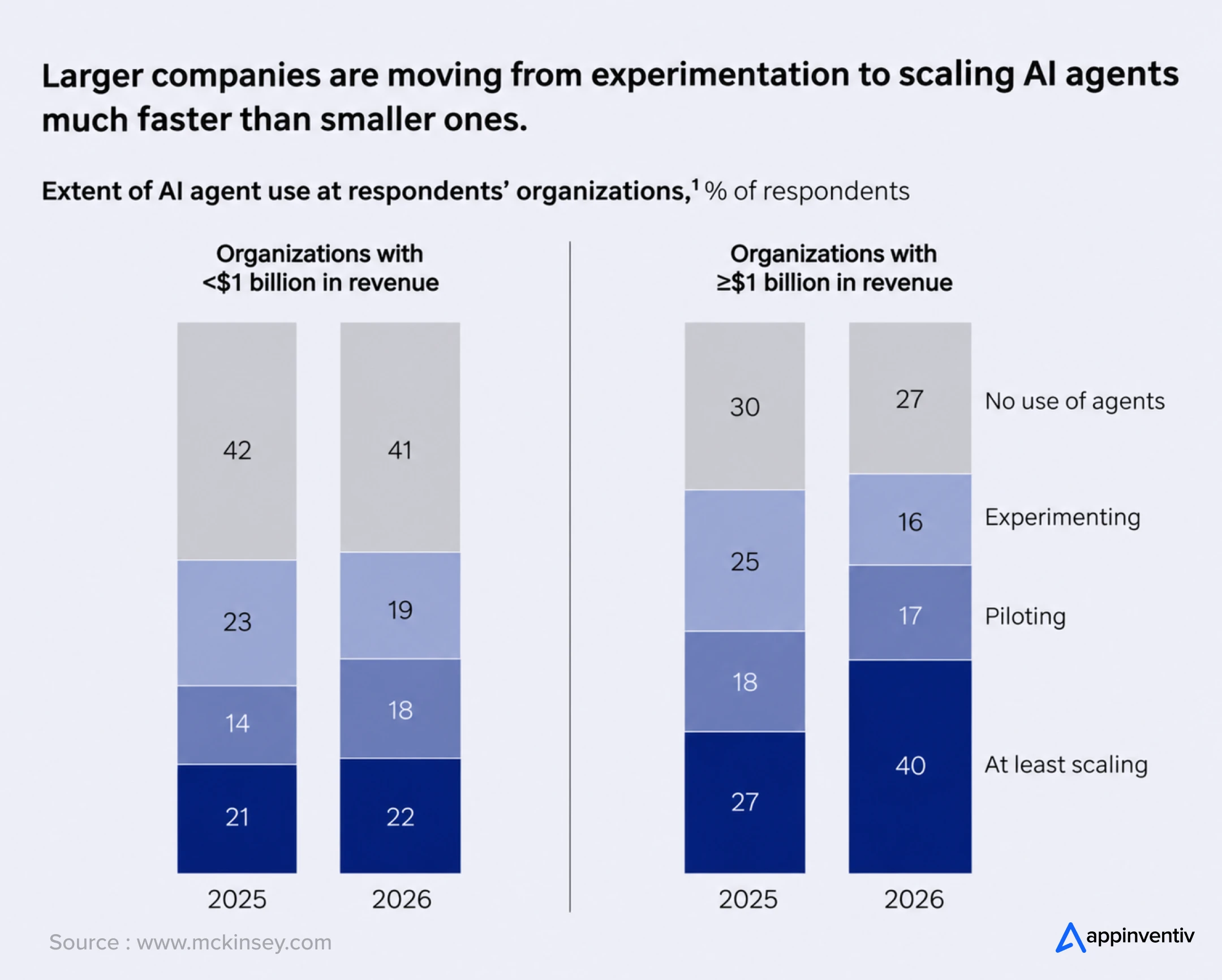
The pattern behind these numbers is familiar from our own engagements. An agent is dropped into a process that three teams touch and nobody owns, so nobody can say whether it worked.
The AI agent business ideas for 2027 mentioned below show where each idea sits on risk and build complexity, which lets you match ambition to the ownership you actually have.
AI Agent Ideas That Grow Revenue
Revenue often slips through gaps in pricing, sales follow-ups and billing. These AI agents for business growth help you capture missed opportunities, protect margins and grow existing accounts.
| AI Agents Business Ideas | Business Problem | What the Agent Does | Primary KPI |
|---|---|---|---|
| Agentic Commerce Readiness Agent | Buyer agents cannot find or order from you | Exposes catalog, pricing and RFQ rules to machines | Agent-channel orders |
| Deal Desk and Dynamic Pricing Agent | Uncontrolled discounts reduce margins. | Approves pricing within margin guardrails | Margin per deal |
| Revenue Operations Orchestrator | Sales-to-billing handoffs delay revenue. | Coordinates agents across CRM, CPQ and billing | Lead-to-cash cycle |
| Revenue Leakage Detection Agent | Unbilled usage goes unnoticed. | Reconciles contracts, usage and invoices | Recovered revenue |
| Account Expansion Agent | Cross-sell opportunities remain hidden. | Spots cross-sell signals | Expansion revenue |
| Renewal Rescue Agent | Churn risks surface too late. | Flags at-risk renewals | Customer retention |
| Bid and Proposal Agent | RFP responses consume excessive time. | Drafts responses from approved content | Bid throughput |
1. Agentic Commerce Readiness Agent
What happens when a buyer’s AI agent wants to compare products, check purchasing terms and place an order, but your business systems cannot respond? You risk missing a sales channel that is still developing. This agent helps make your catalog, pricing rules and purchasing information accessible to authorized machine-driven buyers.
It is worth exploring if your business sells through digital channels and wants to prepare for agent-mediated purchasing.
2. Deal Desk and Dynamic Pricing Agent
Discounts often become a problem when sales teams are under pressure to close deals. One-off concessions can gradually erode margins, especially when approval processes are slow or inconsistent. This agent analyzes deal terms and recommends pricing within approved commercial limits.
Sales leaders can use it to make faster decisions without giving away margin simply to move a deal forward.
3. Revenue Operations Orchestrator
A deal can move through sales, contracting and billing successfully on paper yet still get stuck between systems. Every missed handoff delays revenue recognition or collection. This agent coordinates work across CRM, quoting, contract and billing systems, flags missing information and routes exceptions to the right team.
It is a strong candidate for businesses where growth has made manual coordination increasingly difficult.
4. Revenue Leakage Detection Agent
Your finance team may be billing customers correctly for the transactions it sees while missing usage, contractual changes or chargeable services recorded elsewhere. This agent compares contracts, usage records and invoices to identify discrepancies that deserve investigation.
The opportunity is straightforward: recover revenue the business has already earned instead of relying entirely on new sales to improve financial performance.
5. Account Expansion Agent
Your existing customers may already be signalling what they need next through product usage, support requests and purchasing patterns. The challenge is connecting those signals before a competitor does. This agent identifies potential cross-sell and upsell opportunities and gives account managers a reason to start a relevant conversation.
It is particularly useful when expanding existing accounts is more practical than continually acquiring new customers.
6. Renewal Rescue Agent
A customer rarely becomes a retention risk on the day their contract expires. Declining usage, unresolved support issues and missed engagement can provide earlier warning signs. This agent brings those signals together, flags accounts that need attention and recommends appropriate retention actions.
Customer success teams can spend less time searching for warning signs and more time addressing the reasons customers may leave.
7. Bid and Proposal Agent
When a RFP (request for proposal) arrives, the clock starts ticking. Teams must find approved credentials, locate relevant case studies, respond to technical requirements and coordinate reviews, often while handling other bids. This agent assembles relevant source material and prepares a structured first draft.
It can help businesses respond to more suitable opportunities without treating speed as a substitute for accuracy or a properly reviewed submission.
AI Agent Ideas for Entering New Markets
Entering new markets brings uncertainty around demand, regulations, data residency and local partners. These agents help businesses assess risks and prepare for expansion with better information.
| AI Agent Business Idea | Business Problem | What the Agent Does | Primary KPI |
|---|---|---|---|
| Market Entry Intelligence Agent | Market research slows expansion. | Tracks rules, rivals and pricing per country | Time to go/no-go |
| Cross-Border Trade and Tax Agent | Trade errors delay shipments. | Classifies goods, prepares filings | Clearance time |
| Data Residency Orchestration Agent | Regional data rules complicate launches. | Routes data to compliant regions | Time to launch |
| Partner and Distributor Onboarding Agent | Partner activation takes too long. | Runs diligence, documents and training | Time to first sale |
8. Market Entry Intelligence Agent
Entering a new market involves more than estimating demand. Leaders need to understand competitors, pricing, local requirements and potential distribution partners before committing capital. This agent continuously gathers and organizes relevant market signals, helping teams compare opportunities and prepare a more informed go/no-go decision.
It is useful when expansion research is consuming weeks of time without producing a clear recommendation.
9. Cross-Border Trade and Tax Agent
A classification error, incorrect duty calculation or incomplete declaration can delay a shipment and increase its cost. This agent helps classify goods, calculate potential duties and taxes, and prepare documentation using approved, current sources. Trade specialists still review material decisions, but they spend less time assembling information from separate systems.
It is especially relevant to businesses managing complex international supply chains.
10. Data Residency Orchestration Agent
Expanding into another country can introduce new questions about where customer data is stored, processed and accessed. If these requirements are assessed late, they can delay deployment or force expensive architectural changes. This agent checks proposed workloads against approved regional data policies and flags conflicts before launch.
It is worth considering for enterprises operating across jurisdictions with different privacy, security and data residency requirements.
11. Partner and Distributor Onboarding Agent
A signed distribution agreement does not generate revenue until the partner is ready to sell. Due diligence, document collection, training and system access can create a long gap between agreement and activation. This agent tracks onboarding requirements, follows up on outstanding tasks and routes incomplete checks for review.
It can help commercial teams bring partners into operation sooner without bypassing compliance procedures.
Enterprise AI Agents That Increase Operational Capacity
Manual workflows, disconnected systems and growing workloads limit operational capacity. These AI agents ideas for businesses help reduce repetitive work, resolve bottlenecks and give teams more time for higher-value decisions.
| AI Agent Business Idea | Business Problem | What the Agent Does | Primary KPI |
|---|---|---|---|
| Autonomous Security Response Agent | Security alerts overwhelm analysts. | Triages and contains reversible threats | Response time |
| Legacy Modernization Agent | Undocumented code delays upgrades. | Documents, converts and tests code | Discovery time |
| Treasury and Working Capital Agent | Poor cash-flow visibility complicates decisions. | Forecasts cash, times payments | Forecast accuracy |
| Autonomous Procure-to-Pay Agent | Invoice exceptions increase manual work. | Matches POs, receipts and invoices | Straight-through processing |
| Cloud FinOps Agent | Cloud spending lacks clear ownership. | Right-sizes resources under guardrails | Cost per workload |
| Knowledge Operations Agent | Employees struggle to find internal information. | Answers from permissioned content | Time to answer |
12. Autonomous Security Response Agent
Security teams spend valuable time investigating alerts that turn out to be related, repetitive or low priority. Meanwhile, genuinely serious incidents compete for the same attention.
This agent correlates available evidence, investigates alerts and carries out explicitly authorized, reversible containment actions. Security teams retain control over high-impact decisions while reducing the manual work involved in identifying and responding to threats.
13. Legacy Modernization Agent
Many modernization projects lose momentum before development begins because nobody has a complete picture of the existing system. Dependencies are undocumented, business rules are buried in code, and testing requirements are unclear.
This agent helps analyze legacy code, map dependencies, generate documentation and support migration testing. It can reduce the discovery burden on engineering teams, making it easier to estimate the work and identify risks before committing to a rewrite.
14. Treasury and Working Capital Agent
Cash-flow decisions become harder when finance teams work with fragmented forecasts, delayed updates and conservative assumptions. This agent consolidates relevant financial information, forecasts liquidity and recommends payment timing or funding actions within defined policies.
Treasury leaders gain a clearer view of potential cash constraints and can investigate issues earlier. Actual transfers and other material financial decisions remain subject to appropriate approval.
15. Autonomous Procure-to-Pay Agent
Procurement teams and accounts payable staff often spend more time resolving mismatched invoices than processing straightforward purchases. This agent checks purchase orders against receipts and invoices, identifies discrepancies and routes exceptions to the right people.
The benefit is not simply faster invoice processing. It is the ability to direct employee attention toward genuine supplier, pricing and compliance issues rather than routine checks.
16. Cloud FinOps Agent
Cloud bills can rise even when nobody has deliberately increased spending. Idle environments, oversized resources and workloads running outside business hours can quietly consume budget. This agent identifies unusual consumption, recommends resource changes and applies pre-approved scheduling or optimization rules.
It is particularly useful for organizations with multiple cloud environments where engineering teams control resources but finance teams remain accountable for the overall spend.
17. Enterprise Knowledge Operations Agent
Employees often lose time asking colleagues for information that already exists in policies, project records, technical documentation or internal systems. The problem is finding the right answer and knowing whether it can be trusted.
This agent retrieves relevant information from approved sources, respects existing access permissions and provides supporting references where available. It helps employees resolve routine questions without repeatedly interrupting subject-matter experts.
AI Agent Ideas That Create New Offerings
These agent-based product ideas for enterprise software providers turn internal capability or proprietary data into products customers pay for. That makes them valuable and exposed: service levels, multi-tenancy and customer data protection become part of the product itself.
| AI Agent Business Idea | Business Problem | What the Agent Does | Primary KPI |
|---|---|---|---|
| Agent-as-a-Service Product | Internal capabilities remain unmonetized. | Packages agents with multi-tenancy and SLAs | Service revenue |
| Outcome-Priced Service Agent | Customers resist seat-based pricing. | Bills per resolved task | Revenue per outcome |
| Embedded Action Agent | Software recommends actions but does not act | Acts inside customer workflows | Feature adoption |
| Proprietary-Data Insight Agent | Valuable datasets remain difficult to use. | Serves insights through entitlements | Subscription revenue |
18. Agent-as-a-Service Product
Your organization may already have built an agent that solves a recurring problem exceptionally well. Keeping it limited to your business could mean missing an opportunity to serve customers of other organizations facing the same challenge.
An Agent-as-a-Service product packages that capability into a managed commercial offering. Before investing, validate customer demand, differentiation, operating costs and the controls needed to serve multiple customers reliably.
19. Outcome-Priced Service Agent
Some customers care less about how many software seats they use than whether a task gets completed. An agent that resolves eligible support cases, processes documents or completes defined operational tasks could support pricing based on usage or outcomes.
The commercial opportunity is a pricing model tied more closely to delivered value. Success depends on defining billable outcomes clearly and accounting for exceptions, disputes and the cost of delivering each result.
20. Embedded Action Agent
Many software products already tell users what needs attention. The next opportunity is helping them act on that information without switching between screens or systems. An embedded agent can perform approved tasks within an existing application, such as updating a record, preparing a report or initiating a workflow.
For software companies, this can turn an underused recommendation feature into a more useful product capability that customers have a reason to keep using.
21. Proprietary-Data Insight Agent
Industry reports and specialist datasets often contain valuable information that customers struggle to query or apply to their own decisions. This agent allows authorized users to retrieve relevant insights through a conversational interface, with access controlled by customer entitlements.
It could support a subscription product or a premium service for businesses that own differentiated data. The commercial case rests on the usefulness and exclusivity of the insights, not the conversational interface alone.
The Control Layer: Governing Your Agent Estate
As agents gain access to business systems and take actions, oversight becomes harder to maintain. These agents for governance help track deployments, control permissions, enforce policies and test risks.
| AI Agent Business Idea | Business Problem | What the Agent Does | Primary KPI |
|---|---|---|---|
| AI Estate Registry Agent | Deployed agents lack central oversight. | Inventories and risk-classifies agents | Inventory coverage |
| Agent Identity and Access Guardian | Agents have excessive permissions. | Issues short-lived credentials | Excess permissions |
| Runtime Guardrail and Audit Agent | Agent actions lack traceability. | Enforces policy, keeps an audit trail | Policy violations detected |
| Agent Evaluation and Red-Team Agent | Agent weaknesses emerge after launch. | Tests for failure and prompt injection | Pre-release defects found |
22. AI Estate Registry Agent
Can your organization identify every AI agent operating across its business, who owns each one and what information it can access? If the answer requires several teams to compare spreadsheets, governance may already be falling behind deployment.
This agent helps discover registered deployments, maintain ownership records and classify them against internal risk policies. It gives CTOs a clearer starting point for managing an expanding agent estate.
23. Agent Identity and Access Guardian
An agent that needs to read a customer record does not automatically need permission to modify it, export it or access an entire database. Excessive permissions increase the impact of mistakes and security breaches.
This agent reviews agent identities and access rights against least-privilege policies, flags unnecessary privileges and supports credential revocation. It is particularly relevant when agents interact with sensitive systems or operate across multiple business applications.
24. Runtime Guardrail and Audit Agent
When an autonomous business agent takes an action, your team should be able to establish what happened, which policy applied and whether the action was authorized. This agent monitors agent activity, flags policy violations and records relevant events for review.
It can help security, compliance and operations teams investigate incidents and demonstrate oversight. The underlying policies and audit requirements must still be defined and maintained by accountable people.
25. Agent Evaluation and Red-Team Agent
An agent that performs well during a demonstration may behave differently when source data changes, a connected system fails or a user supplies malicious instructions. Waiting for production incidents to expose these weaknesses is an expensive way to test.
This agent evaluates task performance, probes failure scenarios and tests resistance to prompt injection and other adversarial inputs. It gives engineering teams a repeatable way to identify weaknesses before release and after significant changes.
Assess your use case, integration needs and business goals before committing to full-scale development.

How to Choose the Right AI Agent Business Ideas for Your Enterprise
The right agent is the one that solves a defined problem within acceptable operational and financial limits. Before approving development, you should understand what the agent can access, which actions it may perform and when it must stop or escalate.
You can score each candidate on business value, data readiness, integration effort and risk tier. Earn trust with one Beginner win, then commit to an Advanced agent where the workflow is revenue-critical.
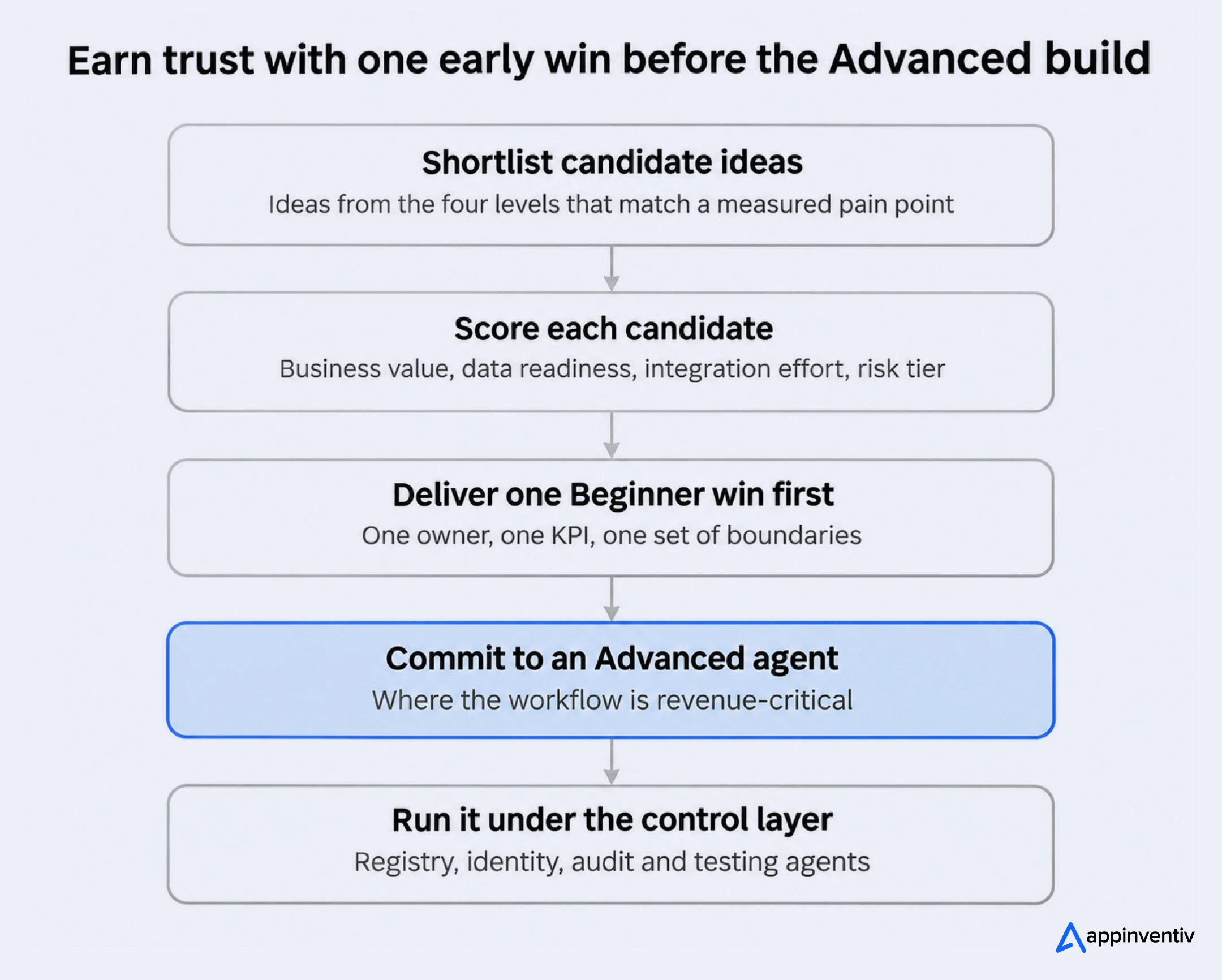
What to Consider When Deploying AI Agents for Business Ideas
- Business value: Identify a measurable revenue, cost, capacity or customer-service problem.
- Data readiness: Check whether the required information is accurate, accessible and permissioned.
- Integration effort: Map dependencies across CRM, ERP, finance and other systems.
- Decision risk: Set tighter approval and escalation rules for consequential actions.
- Success metrics: Baseline the current cost per task and cycle time, then set a review date to measure ROI against it.
AI Agent Adoption Strategy
To put AI agents into practice, you first need to define the right approach. In recent years, enterprises tend to follow one of two adoption paths.
A phased approach starts with a contained workflow automation win, then widens scope as teams build confidence and governance matures.
A transformation-led approach rebuilds selected workflows around agent-led execution as part of a wider digital transformation and enterprise AI strategy.
The phased path suits organizations still proving ROI, while the transformation path fits those with clear workflow ownership and strong data readiness.
Refer to our detailed blog to know more about how to build and deploy AI agents in your businesses.
Why Enterprises Choose Appinventiv as Their AI Agent Development Company
Choosing who builds and governs the agents matters as much as choosing which agents to build. As an AI agent development company, Appinventiv pairs delivery experience with the controls enterprises need to move from pilot to production.
We approach every AI agent business idea as an enterprise workflow automation problem first, so integration with existing systems, governance and ROI tracking are scoped before development starts.
In our 11+ years of delivery experience, we have shipped over 3000 digital products, including 300+ AI powered solutions for 35+ industries, with 98% AI prediction accuracy and a 95% client retention rate.
That record includes AI products for Tootle, MyExec, Vyrb, Flynas, Reel Media, ’Promise Time’ for Americana and more. For example, we have developed a multi-agent AI business system for MyExec that uses specialized agents to analyze business documents, retrieve relevant data, and generate personalized strategic recommendations. Recognizing our AI excellence, Economic Times has named us a Leader in AI-First Engineering.
So, whether your starting point is a Beginner knowledge agent or an Advanced revenue orchestrator agent, our team of 200+ Data Scientists & AI Engineers brings the same discipline to every AI project.
Ready to scope your next AI agent? Share your shortlisted ideas and we will pressure-test them against value, risk and revenue. Book a Strategy Call.
FAQs
Q. Which agent should an enterprise build first?
A. Start with a Beginner or Intermediate agent that runs on internal data, such as an enterprise knowledge or FinOps agent. These carry lower risk and produce a measurable KPI quickly. That early result builds the evidence and internal trust you need before committing to an Advanced agent in a revenue-critical workflow.
Q. What are the main enterprise AI agent use cases by industry?
A. In financial services, agents handle revenue reconciliation, treasury and security response. In manufacturing and distribution, they cover procurement, pricing and agentic commerce readiness. In software and services, they power agent-as-a-service products and embedded actions. Healthcare and public sector agencies lean on knowledge and modernization agents, subject to strict data controls.
Q. How can an AI agent help your business grow revenue and expand?
A. Practical AI agent business ideas for growth protect margin, recover unbilled revenue, speed renewals and shorten market entry. Revenue agents act on pricing, billing and bids, while expansion agents handle research, trade paperwork and partner onboarding. Each should be tied to one KPI, such as win rate or time to first sale.
Q. How much does an advanced AI agent development cost?
A. On average, an advanced AI agent development cost ranges between $40,000 and $500,000 or more. The cost varies with the number of integrations, data preparation, risk controls and ongoing run costs such as tokens and monitoring. Advanced agents that act in revenue or finance workflows cost more than read-only agents because they need approval logic, testing and audit trails.
Q. How long does it take to launch an AI agent?
A. A basic agent can typically be developed and launched in 3 to 6 months, especially if it relies on pre-trained models and readily available APIs. More advanced products with features like fine-tuning, multi-channel deployment, or user management basically take 6 to 12+ months. The exact timeline depends on integration depth, data readiness and the approval controls required.
Q. How do agents stay compliant across regions?
A. Compliance is built into the agent, not added afterward. That means region-aware data routing, least-privilege access, logged decisions and human approval on high-impact actions, mapped to the rules in each market, such as GDPR, AU Privacy Act or the EU AI Act. A registry and audit agent keep that evidence current.
Q. Where do agent projects fail?
A. They fail at the edges of the model: unclear workflow ownership, poor data permissions, over-broad access and costs nobody modeled. Each is visible at the scoping stage. Naming an owner, a KPI and a boundary before the build starts lowers the avoidable risk.
Q. How should enterprises measure the ROI of an AI agent?
A. Set a baseline for one KPI before launch, then compare cost per task, cycle time and quality against it at a fixed review date. Count run costs as well as build costs. Avoid projecting percentage returns until a pilot has produced your own data.
Q. What are the five types of AI agents?
A. AI agents are commonly classified into five types: simple reflex agents, model-based reflex agents, goal-based agents, utility-based agents, and learning agents. In business settings, they can also be grouped by function, such as customer service, sales, cybersecurity, operations, and predictive maintenance agents.


Fast 2-minute response, fully NDA-protected.
Generative AI in Software Testing: How Enterprises Scale Quality With Humans in the Loop
For CTOs and QA heads deciding where to trust AI-written tests, a practical way to scale coverage without scaling risk. Somewhere in your organization, code is being written faster than it can be tested. Developers have AI assistants, release windows keep shrinking, and QA is expected to keep pace without lowering the bar. Generative AI…
AI-Native Security Maturity Model: Score Where Your Security Stack Stands
Key takeaways: If Human oversight scores below 2, you're at Level 3 at most, whatever your total score says. Moving to Level 3 starts with unifying your telemetry, which most teams can do with tools they already own. Define approval points before you automate response. Oversight added later costs more. Buy a platform when your…

The AI ROI Crisis: Why Enterprises Are Struggling to Prove Value and How to Fix It
Key takeaways: AI ROI is a capital-allocation question. Boards want payback periods and P&L impact. AI ROI challenges rarely have a single cause. Data, legacy systems, use-case choice, ownership and stalled pilots compound each other. Choose two or three outcome metrics per use case, set the baseline first, and report in dollars. Make every further…