





























 Leader in AI-First Product Engineering Read Full Article
 IT Managed & Outsourcing
 Contact Us
Our teams have designed production-ready healthcare AI environments with governance as an integral part of the development process. We have been instrumental in enabling our clients to deploy AI that is scalable, auditable, and compliant with regulatory standards.
Our Core Capabilities





















Quantifiable Impact of Healthcare AI
Solutions We Delivered
Faster Retrieval of insights from unstructured clinical records
Earlier Identification of high-risk patients through predictive AI
Medical imaging studies analyzed through AI-assisted diagnostics
Clinical documents processed monthly using document intelligence
Patient interactions supported through AI-powered health assistants
Healthcare systems integrated across EHRs, PACS, LIS, and RIS
Our Services


Our strategic AI consulting involves guiding healthcare organizations in identifying high-impact AI use cases, developing AI implementation plans, and ensuring AI projects support clinical, operational, and regulatory goals.
Healthcare AI Use Cases
Identified and Prioritized for Scalable Clinical and Operational Transformation

AI clinical decision support systems empower clinicians with real-time patient insights, enabling faster diagnosis, informed treatment planning, and proactive risk identification.
Diagnostic Consistency
Across AI-Assisted Clinical Evaluations

With custom-built intelligent medical imaging solutions, we help radiologists identify abnormalities, prioritize urgent cases and increase diagnostic consistency.
Medical Images
Analyzed Daily Across High-Volume Diagnostic Workflows

We build AI medical nurse solutions that enable healthcare organizations to automate patient interactions, aid symptom evaluation, and facilitate care coordination.
Patient Conversations
Managed Every Month Across Virtual Care and Clinical Support Workflows

Our AI-powered staffing and scheduling agents ensure that healthcare organizations allocate their staff effectively, minimize scheduling conflicts, and have sufficient clinical coverage to guarantee patient care.
Shift Coverage Accuracy
Maintained Through Intelligent Workforce Planning and Real-Time Schedule Optimization

We create predictive analytics solutions for healthcare organizations that help them detect at-risk patients at an early stage before it gets too severe.
Patient Records
Processed to Uncover Risk Patterns and Gaps in Care

Our experts engineer AI-backed remote monitoring solutions that integrate wearable devices and medical sensors for continuous patient health monitoring.
Patient Monitoring
Across Connected Healthcare Ecosystems

We automate coding and medical billing workflows with AI to improve coding accuracy, reduce administrative effort, and streamline claims processing.
Medical Claims
Processed Monthly With Greater Coding Consistency

We create AI-based virtual health assistants that answer patient questions, coordinate appointments, and provide personalized support across digital channels.
Conversations
Handled Annually Across Digital Care Channels

We use ambient listening technology to capture clinical conversations as they happen, with intelligent medical scribing that transforms them into accurate, structured records.
Fewer Interruptions
During Patient Consultations With Ambient Listening Technology

We leverage AI in drug discovery to help research teams identify promising compounds, optimize candidate selection, and accelerate early-stage drug development.
Molecular Compounds
Screened For Early-Stage Drug Development
Can Your Healthcare Data Support Intelligent Decisions?
Turn fragmented records into actionable insights with
governed healthcare AI
solutions.


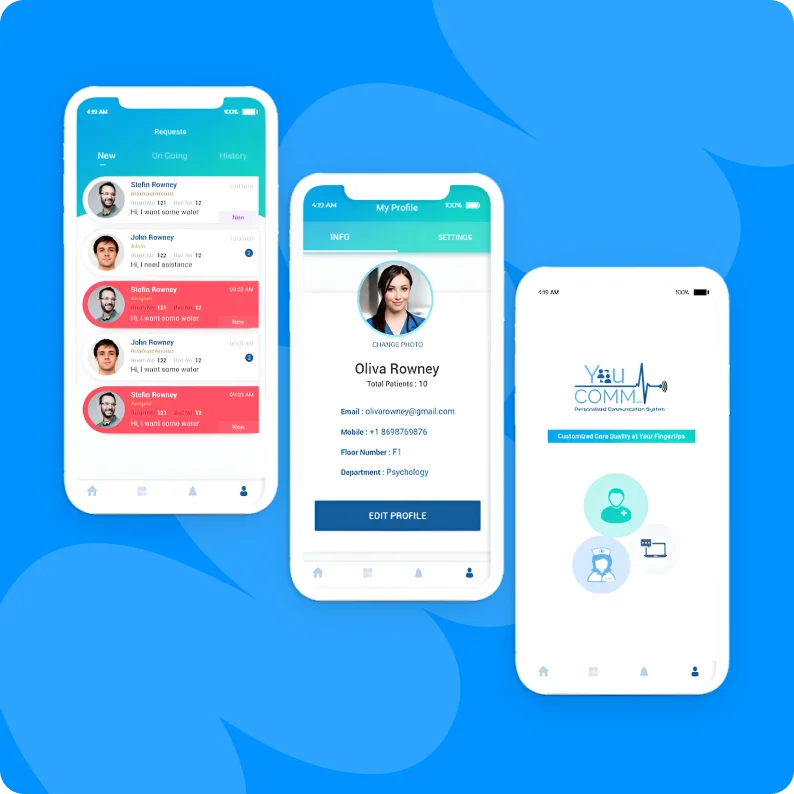
Traditional nurse call systems lacked context, making it difficult to prioritize patient requests, especially for those with speech or mobility limitations.

Appinventiv developed an AI-powered bedside communication platform that uses voice and gesture recognition to capture patient requests and route them to the right care teams faster.

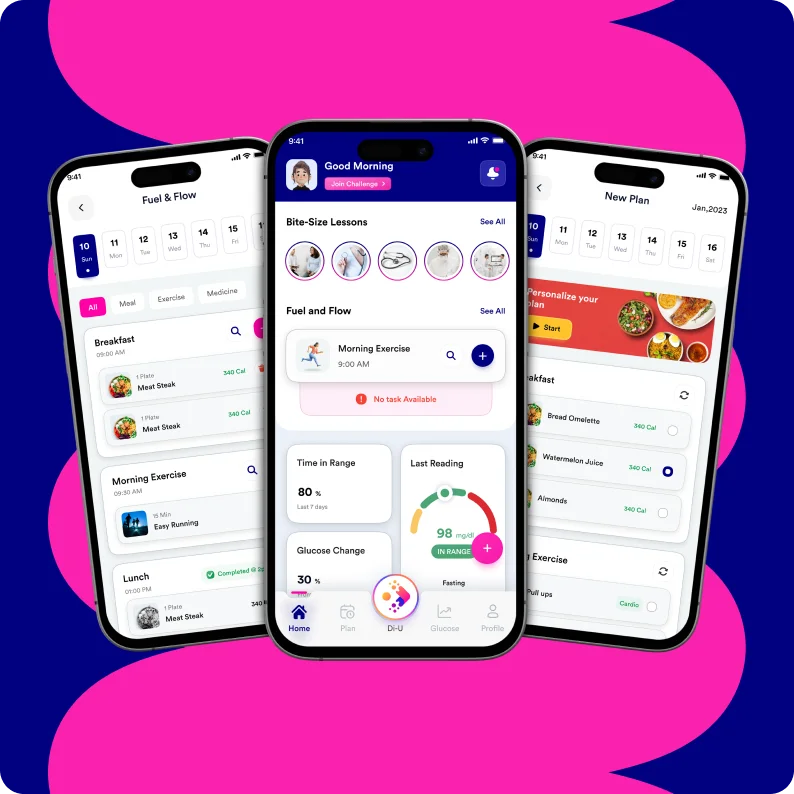
Existing diabetes management approaches offered limited personalized support, creating the need for an intelligent platform that could provide continuous guidance.
Appinventiv built an AI-powered diabetes management platform that combines health tracking with a conversational assistant to deliver personalized guidance, reminders, and daily care recommendations.
Care Delivery Has Changed.
Have Your Systems Kept Up?
Patient expectations, staffing pressures, and reporting requirements continue to shift. Many organizations are finding that older processes are becoming harder to maintain.


MHRA

IMDRF Good Machine Learning Practice (GMLP) Guiding Principles

NIST AI Risk Management Framework (AI RMF)

ISO/IEC 42001
ISO/IEC 23894

FDA Good Machine Learning Practice (GMLP)
FDA AI/ML Software as a Medical Device (SaMD)

WHO Guidance on Ethics and Governance of AI for Health

OECD AI Principles
MHRA
IMDRF Good Machine Learning Practice (GMLP) Guiding Principles
NIST AI Risk Management Framework (AI RMF)
ISO/IEC 42001
ISO/IEC 23894
FDA Good Machine Learning Practice (GMLP)

FDA AI/ML Software as a Medical Device (SaMD)
WHO Guidance on Ethics and Governance of AI for Health
OECD AI Principles
We build AI-powered healthcare platforms with clinical safety, patient privacy, and regulatory compliance in mind, enabling healthcare organizations to confidently and reliably implement intelligent systems.
The teams that we build are multidisciplinary, and we have expertise in healthcare, AI engineering and cloud-native architecture to create scalable solutions that integrate with clinical and administrative ecosystems.
We've cut AI healthcare development regression cycles from 18 days to 6 days in enterprise engagements through AI-assisted test generation, intelligent regression, and automated validation.
We create AI platforms that are interoperable with EHRs, EMRs, PACS, lab systems and payer systems via HL7 FHIR and other healthcare interoperability standards to facilitate secure and reliable data exchange.
We apply model versioning, explainability, continuous monitoring, and audit-ready governance frameworks, which assist healthcare organizations in ensuring the reliability of AI models across their lifecycle.
PHI protection, encryption, role-based access controls, de-identification and secure inference pipelines are all integral to our AI solutions, ensuring the protection of sensitive healthcare information throughout development and deployment.
Build Healthcare AI That Performs
Beyond the Proof of Concept
We develop AI systems engineered for clinical accuracy, secure data exchange, and responsible deployment across complex healthcare environments.
The India's Fastest-Growing Companies 2026 Recognised by TIME and Statista

Statista High Growth Companies APAC - 2026

Statista India's Growth Champions 2023

Specialized healthcare AI agents to coordinate scheduling, prior authorization, discharge planning, care navigation, and other operational aspects, alongside clinicians, but not in place of.
AI systems integrated into EHRs, physician dashboards, nursing systems and administrative platforms; to automate documentation, to provide summaries of patient history, to recommend treatment, and to minimize repetitive tasks.
RAG integrates LLM with hospital procedures, clinical guidelines, research papers and internal knowledge bases, resulting in responses that are based on reliable medical data.
Unstructured clinical notes, discharge summaries, pathology reports, referrals, and physician dictations can all be transformed into structured, searchable information with NLP.
Computer vision is used to analyze X-ray images, CT scans, MRIs, ultrasounds, pathology slides and more diagnostic images to help the clinician spot abnormalities and prioritize cases.
A machine learning model recognizes patterns among clinical and operational data to predict patient deterioration, readmission risk, disease progression, resource demand and health patterns of populations.
Integrates clinical notes, blood tests, X-rays, videos, structured EHR data and other wearable device data into one AI workflow to enable richer clinical reasoning.
Voice assistants and virtual nurses powered by conversational AI in healthcare automate appointment booking, symptom intake, medication reminders, and patient follow-ups.
Knowledge graphs link patients, diseases, drugs, procedures, physicians, and clinical concepts, provide AI with more context to reason and generate recommendations.
When access to real patient data is restricted, synthetic data in healthcare generates privacy-protected datasets that can be used to train models, test software and for research and validation.
Without sharing sensitive patient information, models are learnt across hospitals and healthcare providers, allowing for collaborative learning to take place.
AI transcribes the clinician-patient session, extracting relevant clinical information and generating structured documentation without disrupting the session.

















Build Healthcare AI That Delivers
More Than Predictions
Create intelligent systems that support clinical decisions, simplify operations, and work reliably across the healthcare ecosystem from day one.

PHASE 1
The first step in healthcare AI software development is to learn about the care pathways, systems in place, and data available. AI agents find workflow patterns, NLP sentiment analyzes clinical documents and RAG connects the team together before design work begins.
PHASE 2
Cleaning, connecting, and preparing healthcare data across EHR, imaging systems, claims, labs, and wearables. As an experienced EMR system development company, we build healthcare AI applications on a solid foundation of FHIR integrations, vector databases, and data pipelines.
PHASE 3
Our custom healthcare AI development services turn validated use cases into AI solutions built for real clinical and operational needs. Depending on your requirements, we develop predictive models, computer vision applications, NLP systems, and AI copilots tailored to healthcare workflows.
PHASE 4
Each model is tested prior to being used by its target audience. Explainable AI, clinician feedback, confidence scoring, and human review ensure outputs remain useful, explainable, and clinically appropriate.
PHASE 5
Before deployment into production environments, models undergo rigorous testing with synthetic datasets, automated validation, multimodal testing, and AI-assisted quality checks before they can go into production.
PHASE 6
As the next vital part of our healthcare AI software development services, applications are moved into production via MLOps pipelines, containers, cloud-native services, and automated release workflows that can be operated at scale in a stable and secure manner.
PHASE 7
Deployment is just the first step to the end! Drift monitoring, AI observability, autonomous agents, and feedback loops ensure that models remain up to date with evolving data, clinical practices, and business needs.
The expenses associated with healthcare AI development can vary based on the complexity of the project, the type of AI technologies used, integration with electronic health records (EHR) or electronic medical records (EMR), compliance standards, data accessibility, and deployment platforms.
The AI feature is a much cheaper option than a complete clinical platform. For an accurate estimate, personalized to your needs, reach out to a healthcare AI development company to have a comprehensive project assessment.
We use a variety of AI technologies, such as:
The timeframe for development will depend on the scope and integrations, compliance and AI of the project. A feature developed for a focused use case can take a few months, and enterprise-level healthcare platforms a longer time to deliver.
Our approach to develop the features of our healthcare AI solutions & services is agile which enables us to develop, validate and release them in stages to accelerate the business value.
We incorporate top-tier clinical information, ongoing model refinement, human oversight, AI explainability, and thorough testing prior to deployment in our healthcare AI development services.
Moreover, we are tracking model performance, detecting data drift, and retraining models periodically as healthcare data changes. This is an iterative process that ensures consistency and reliability of accuracy and clinical relevance throughout the AI lifecycle.
Yes. Implementing AI capabilities into current health care systems doesn't require a new platform to be built. AI-powered search, medical image analysis, clinical documentation, predictive analytics, virtual assistants, intelligent automation or decision support can be added depending on your needs, without disrupting your workflows, integrations or healthcare data infrastructure.
Here are some factors to take into account when assessing a healthcare AI development services company:
Healthcare Domain Experience
Look for a partner who has hands-on experience of building AI solutions for providers, payers, life sciences, and/or digital health.
Regulatory Knowledge
Make sure that the team is familiar with compliance standards, like HIPAA, GDPR, HL7, and FHIR, in healthcare.
AI Engineering Expertise
Search for skills in machine learning, generative AI, NLP, computer vision, AI agents, and MLOps.
Integration Capabilities
The partner needs to be able to integrate AI with the EHRs/EMRs, lab systems, PACS, and other healthcare platforms.
Data Security Practices
Go over their strategy for safeguarding PHI, encryption, access controls and secure AI implementation.
End-to-End Delivery
Choose a healthcare AI consulting services partner that can assist with strategy, development, deployment, monitoring and long-term optimization of AI.