




























How to Outsource App Development: Costs, Models, Risks, and Best Practices

 Share -



- 01Key Steps to Outsource App Development
- 02When Should You Outsource Mobile App Development?
- 03Freelance Developer vs. Staff Augmentation vs. Mobile App Development Agency
- 04How to Choose the Right App Development Outsourcing Model
- 05Advantages of Outsourcing Mobile App Development
- 06How to Evaluate an App Development Outsourcing Partner
- 07How Appinventiv Helped KFC Launch 7 Mobile Apps
- 08How Appinventiv Built an ERP Solution for IKEA Across 7+ Stores
- 09How Much Does It Cost to Outsource App Development?
- 10How Do You Protect Security, Data, and IP When Outsourcing?
- 11Challenges of Outsourcing Mobile App Development and How to Manage Them
- 12Best Practices and Risk Management for Outsourced App Development
- 13How to Manage Outsourcing Mobile Application Development and Maintenance After Launch
- 14Why Enterprises Choose Appinventiv for Mobile App Development Outsourcing
- 15FAQs





Key takeaways:
- Successful app outsourcing relies on system architecture, project ownership, data security, delivery governance, and vendor capability rather than just hiring coders.
- Enterprise app outsourcing budgets reach $400K+, driven by target platforms, backend integrations, architecture, security standards, compliance, and delivery complexity.
- Selecting the proper commercial engagement model dictates budget flexibility, internal administrative control, operational delivery ownership, and scope adaptation during development.
- Comprehensive vendor due diligence must evaluate system architecture, production scale, security protocols, code quality, developer retention, and offboarding readiness.
- Launching apps without direct access to the repository, technical documentation, and cloud infrastructure ownership results in permanent vendor lock-in.
For large enterprises, finding an app development vendor is rarely the hard part. The harder decision is choosing a delivery setup that fits the product, the internal engineering team, the budget, and the risk profile. A team can join an existing product organization through staff augmentation or take responsibility for end-to-end design, engineering, QA, DevOps, and release management.
The real cost sits beyond screens and features. Architecture, backend services, API integrations, cloud infrastructure, platform coverage, security controls, data requirements, and team composition can significantly affect the budget. A reliable estimate requires that these variables be defined before development begins.
The same applies to ownership and risk. Enterprises need clear IP terms, repository control, access policies, CI/CD ownership, observability, security testing, and post-launch support. This guide explains how to outsource app development, select the right model, assess vendors, control costs, and retain technical ownership throughout the product lifecycle.
Appinventiv aligns commercial models with product scope, delivery ownership, architecture, engineering capacity, and measurable release outcomes.

Key Steps to Outsource App Development
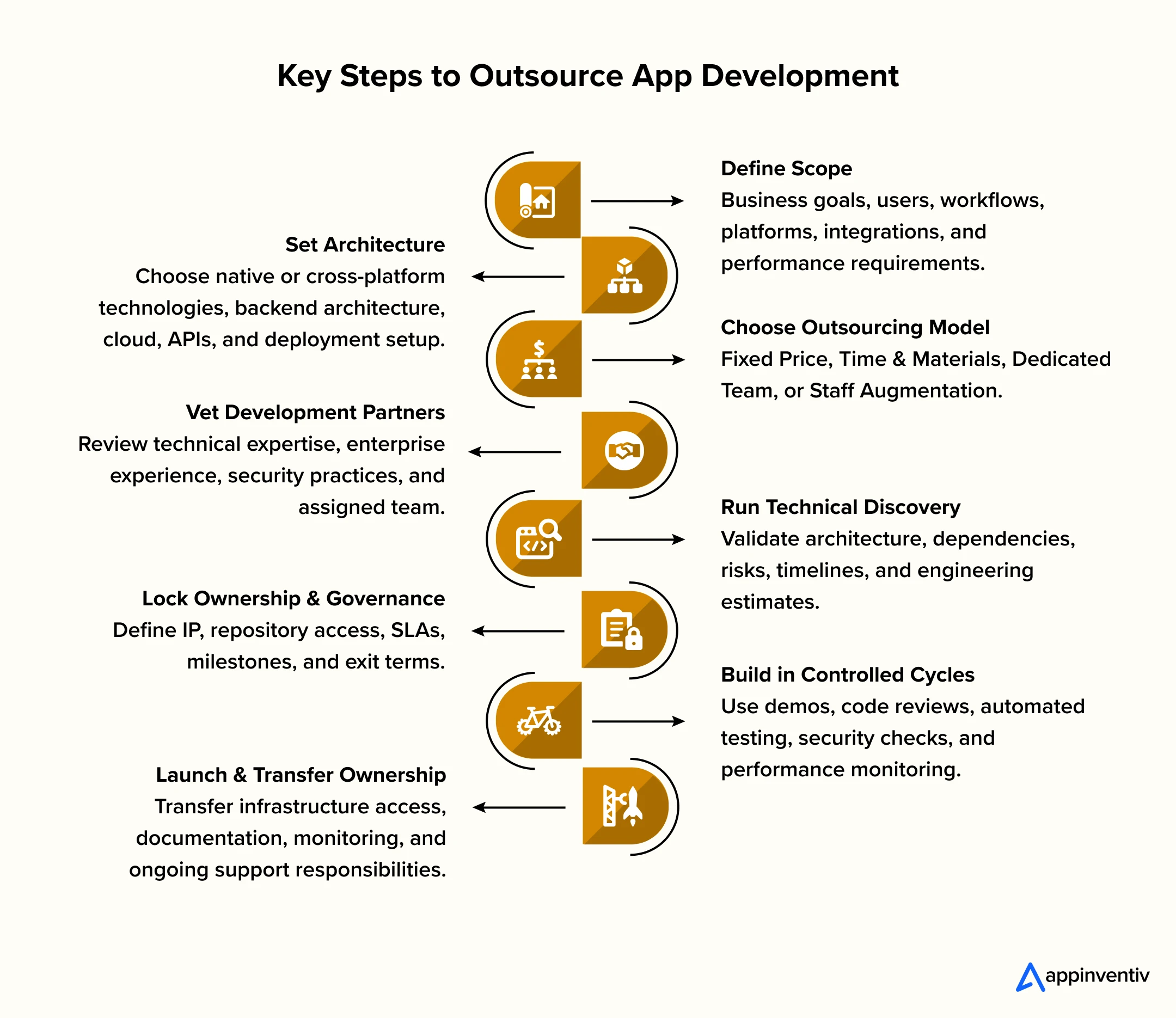
The key to a successful app development outsourcing project is the planning stage. The product scope is well-defined, the technical approach is committed, and accountability for delivery is tight. These basic steps provide a solid foundation and save you money from rework.
Step 1: Define the Business Scope and Technical Requirements
Focus on business outcomes first rather than jumping straight into a feature backlog. Define the specific business problem, target user groups, and key metrics for success. Document core workflows, user permissions, supported devices, target operating systems, and any mobile website version. Specify non-functional requirements such as response speeds, uptime targets, data retention, and transaction limits. Map every backend system connecting to the new mobile application. List payment gateways, CRM platforms, ERP tools, identity systems, and external analytics. Detail the exact data each service exchanges along with failure recovery rules. A complete technical scope connects business goals directly with architecture, security, and operational limits.
Step 2: Decide the Product Architecture and Technology Approach
Choose technology stacks for products, not for vendors. Select an IDE from the native options, such as Swift and Kotlin, or from cross-platform options, such as Flutter and React Native. For mobile products, the architecture decision should account for OS capabilities, device fragmentation, App Store and Google Play requirements, offline behavior, and long-term maintenance. Outline the back-end architecture, API strategy, database layers, cloud platforms, and deployment pipelines up front. For large enterprise applications, API gateway, microservices, event queues and container orchestration are common requirements. All building choices affect development effort, hosting costs and long-term maintenance. Define the requirements for automation, continuous integration, logging and performance monitoring beforehand. Vague technical requirements lead to inaccurate estimates and project delays.
Also Read: React Native vs Native: What to choose for App Development
Step 3: Choose the Right Outsourcing Model
Match your engagement model with project complexity and desired operational control.
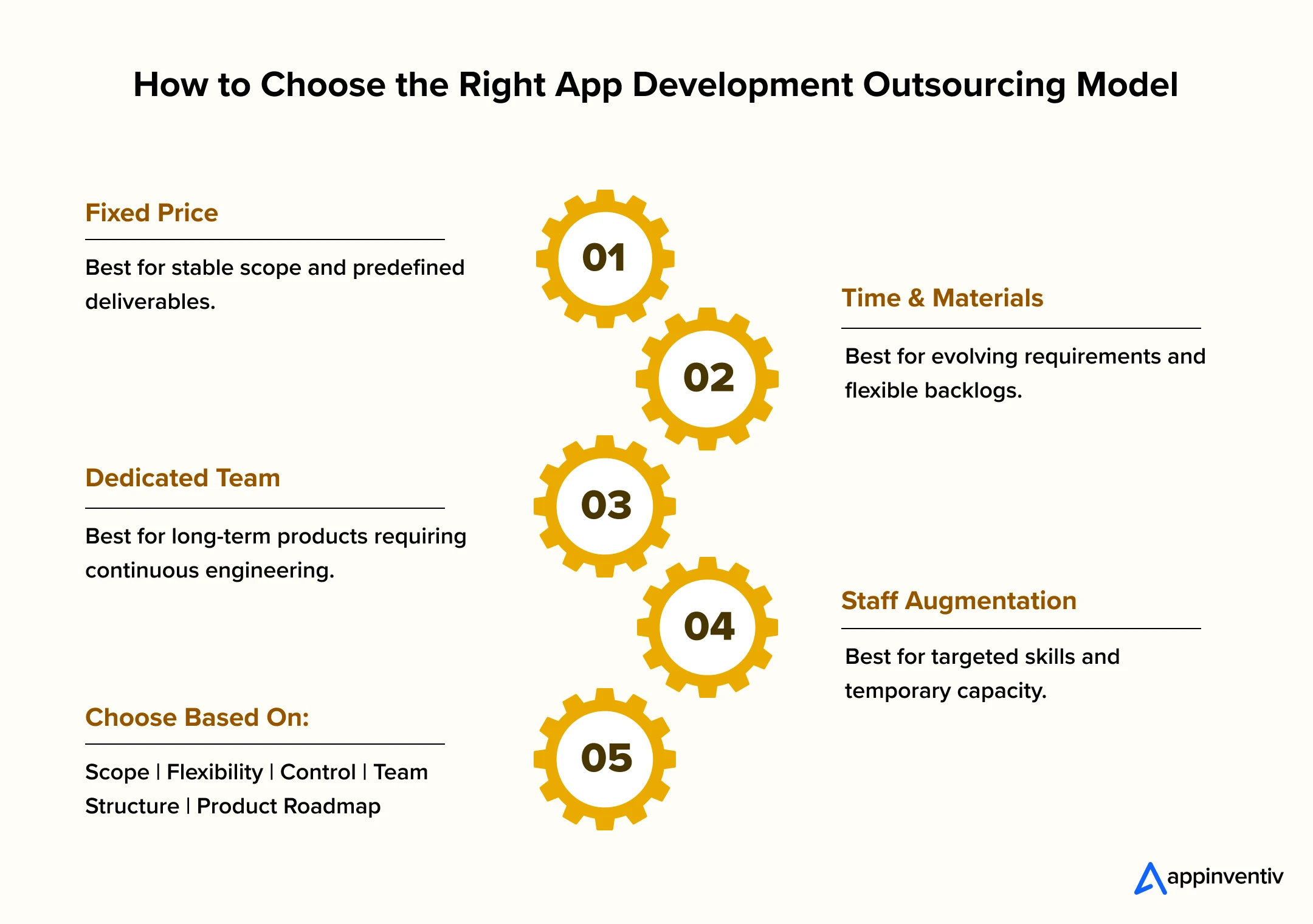
- Fixed-Price: Fits projects with clear requirements, fixed scopes, and predefined acceptance criteria.
- Time and Materials: Fits evolving products with changing feature backlogs and flexible timelines.
- Dedicated Team: Fits long-term initiatives requiring a permanent, full-time engineering squad.
- Staff Augmentation: Fits organizations seeking niche technical skills or extra capacity under internal management.
Select the commercial structure that best aligns with your long-term product strategy and internal oversight capabilities.
Step 4: Build a Shortlist of Potential Partners
Identify development partners with proven experience building similar high-scale systems. Evaluate vendor case studies for verified performance metrics, production-scale operations, and architectural quality. Examine the specific engineering talent assigned to your project rather than the company’s general credentials. Verify key team leads across application architecture, quality assurance, security, and project delivery. Assess vendor experience connecting mobile frontends to complex corporate backends. Strong mobile UI experience does not guarantee deep backend or cloud architecture capability.
Step 5: Conduct Technical and Security Due Diligence
Technical due diligence does not review previous portfolio designs, but rather application engineering practices. Examine vendor requirements for code reviews, automated testing processes, dependency management, and disaster recovery. Review data protection policies, including encryption protocols, key management, access controls, and logging. Don’t settle for word-of-mouth assurances about penetration testing and security compliance; insist on tangible evidence. Review architecture diagrams, API documentation, deployment runbooks, and team training documentation. Detailed technical documentation prevents vendor lock-in and helps preserve valuable institutional knowledge.
Step 6: Run a Discovery Phase Before Full Development
How do engineering leads turn raw app business ideas into production-ready mobile applications? They conduct a structured technical discovery phase before writing code. A structured technical discovery phase produces several critical engineering deliverables:
- Comprehensive system architecture choices and technical recommendations
- Complete user journey maps and functional product specifications
- Dependency maps for backend systems and external APIs
- Data governance rules and detailed security compliance specifications
- Milestone roadmaps and precise engineering resource estimates
- Comprehensive risk registers and active risk mitigation plans
- Prioritized feature backlogs ready for sprint execution
Technical discovery validates system feasibility, highlights integration risks, and clarifies financial budgets.
Step 7: Finalize the Contract, Ownership, and Delivery Governance
Define project scope, deliverables, milestones, payment schedules, and change order processes in formal agreements. Specify full enterprise ownership of source code, design assets, documentation, and cloud infrastructure configurations. Maintain repository control within internal enterprise accounts and manage developer permissions directly. Establish legally binding service level agreements for support response times and security incidents. Include exit clauses to allow smooth team transitions without disrupting ongoing operations.
Step 8: Develop in Controlled Delivery Cycles
Execute short development sprints with clear acceptance standards and working app demonstrations. Require functional feature demos rather than static design mockups or status updates. Enforce strict quality gates for code reviews, automated testing, vulnerability scans, and performance benchmarks. Conduct periodic architecture reviews during system expansion or traffic spikes. Monitor progress using concrete metrics such as code coverage, deployment frequency, defect rates, and cycle times.
Step 9: Launch, Transfer Ownership, and Establish Support
Production deployment extends far beyond submitting applications to app stores. Verify full administrative ownership of cloud environments, security certificates, build pipelines, and analytics tools. Complete all documentation and technical knowledge transfer sessions before final offboarding. Configure crash-reporting systems, active performance monitoring, and rapid incident-response workflows. Schedule ongoing maintenance plans for operating system updates, security patches, and infrastructure adjustments. Aligning post-launch support with long-term operating needs protects your mobile app investment.
Also Read: The Complete Guide to Mobile App Development: Process, Architecture & Strategic Decisions
When Should You Outsource Mobile App Development?
Outsourcing serves enterprises facing internal bandwidth limits, technical skill gaps, or high system complexity. Deloitte’s 2025 Tech Exec Survey found that 45% of 622 U.S.-based senior technology leaders identified GenAI skills as the most urgently needed competency in their organizations. Engineering leaders choose external teams to solve specific technical bottlenecks rather than simply lowering operational costs.
| Situation | What It Means For The Enterprise |
|---|---|
| Specialist Skill Gaps | The product needs skills like Swift, Kotlin, Flutter, cloud engineering, cybersecurity, AI/ML, DevOps, or QA that internal teams lack. |
| Limited Engineering Capacity | Major product launches or aggressive schedules demand additional developers, designers, and quality assurance engineers. |
| Complex Technical Requirements | Real-time processing, legacy systems, high availability, multi-region cloud setups, or compliance rules require deep technical experience. |
| Faster Delivery Required | External engineering teams begin product discovery and application development immediately, without waiting through lengthy recruitment processes. |
| Flexible Team Capacity | Technical staffing scales up during major build phases and scales down once specific project milestones conclude. |
Organizations that outsource mobile app development get poor results when they lack internal product direction or micromanage daily development tasks. Enterprise leadership must establish clear internal product governance before bringing external engineers on board.
Also Read: How can Mobile Apps Advance Your Enterprise Digital Transformation Efforts
Freelance Developer vs. Staff Augmentation vs. Mobile App Development Agency
Select your provider structure based on product complexity, internal engineering skills, and required governance. The engagement model defines how delivery ownership splits between internal managers and external vendors.
| Model | Delivery Responsibility | Client Involvement | Best Suited For |
|---|---|---|---|
| Freelance Developer | Defined task or specialist scope | High | Prototypes, isolated features, and short-term work |
| Staff Augmentation | Shared with the internal engineering team | High | Skill gaps and temporary capacity needs |
| Mobile App Development Agency | Broader end-to-end delivery | Medium | Complex products and enterprise applications |
Freelance Developer
Freelancers handle focused technical tasks such as building isolated prototypes, standalone UI features, or specialized code modules. Enterprises can find developers through freelance marketplaces, with hourly rates varying by experience and technical specialization. Internal engineering teams retain full responsibility for architecture, project management, quality testing, data security, and release management, which can create additional team coordination and quality control requirements.
Staff Augmentation
Staff augmentation integrates external application engineers directly into an existing internal development team. Internal technology leaders manage product architecture, daily sprint workflows, technical decisions, and operational delivery. This flexible engagement fills specific capacity gaps, such as adding Android developers for upcoming launches or outsourced DevOps specialists for cloud migrations. The enterprise retains greater delivery control, though team coordination and knowledge-transfer challenges require active management.
Mobile App Development Agency
A mobile app development agency supports complex mobile applications requiring unified expertise across strategy, interface design, mobile engineering, backend systems, cloud setup, testing, and cybersecurity.
Appinventiv delivers end-to-end app development through cross-functional teams that guide enterprise clients through discovery, system architecture, mobile app development, deployment, and ongoing product maintenance.
This structure can include a dedicated development team for long-term product engineering and support. It suits enterprises seeking complete delivery accountability without having to manage several independent vendors or rely on off-the-shelf solutions that may not fit complex business requirements.
Your final decision depends on how much operational delivery ownership your enterprise plans to retain versus transfer to an external partner.
Also Read: Taking a Glimpse of Advantages of Outsourcing to a Mobile App Development Company
How to Choose the Right App Development Outsourcing Model
Your chosen application development outsourcing model directly shapes budget control, team decision-making, engineering structure, and project ownership. Deloitte’s 2026 research found that 67% of surveyed organizations had adopted outcome-based outsourcing models, up from 45% two years earlier.
Selecting an agreement solely on initial price creates operational friction later in development. Key factors to consider when outsourcing app development include product requirements, internal engineering capabilities, and future technical roadmaps.
Fixed-Price Development
Fixed-price models fit fixed mobile app requirements and clearly defined project boundaries. This structure suits early products with fully documented key features that make the app successful, along with concrete deliverables and firm acceptance criteria. Finance leaders gain predictable cost visibility from day one. Requirements shifts during implementation cause operational friction. Unplanned feature additions, workflow revisions, or extra backend integrations trigger formal change requests and budget increases. Products undergoing active user testing require more adaptive commercial terms.
Time-and-Materials Outsourcing
Time-and-materials arrangements suit mobile app projects whose specifications evolve through active testing and direct user feedback, such as a mobile app MVP. Organizations pay directly for the actual engineering effort used, based on pre-agreed hourly rates and team sizes. Product leaders gain freedom to reprioritize sprint backlogs throughout development. Financial control depends on disciplined backlog reviews, detailed time tracking, and clear sprint planning.
Dedicated Development Team
Hiring a dedicated mobile app development team supplies a permanent group of application engineers, quality assurance testers, designers, and delivery managers. This model serves multi-year platforms needing continuous engineering support beyond initial store launches. External teams retain institutional domain knowledge across multiple product releases. Enterprise mobile app development outsourcing benefits from combined expertise across mobile, backend, cybersecurity, and cloud.
Staff Augmentation
Staff augmentation integrates external technical experts into your existing internal engineering group. Enterprise organizations retain full ownership of architecture and delivery, integrating specific engineering skills on demand. Typical skill requests cover Swift, Kotlin, Flutter, React Native, cloud engineering, DevOps, cybersecurity, and automated testing. Internal engineering managers oversee these external engineers, overseeing daily tasks and code quality.
Outsourcing Model Comparison
The table outlines operational differences across cost structures, flexibility levels, administrative control, and project fit.
| Model | Commercial Structure | Flexibility | Client Control | Best Suited For |
|---|---|---|---|---|
| Fixed Price | Predefined project fee | Lower | Medium | Stable scope |
| Time & Materials | Pay for effort used | High | High | Evolving products |
| Dedicated Team | Team-based recurring cost | High | High | Long-term products |
| Staff Augmentation | Resource-based | High | Very high | Existing engineering teams |
Matching your commercial structure with product delivery needs brings operational clarity to mobile app development outsourcing. A defined prototype benefits from strict budget limits, and a complex enterprise app requires ongoing technical continuity.
Advantages of Outsourcing Mobile App Development
Outsourcing mobile app development offers strategic value beyond simple headcount relief. Specialized technical partners shorten time to market, introduce specialized expertise, and provide continuous long-term support.
Access Specialized Engineering Expertise
External development partners deliver immediate capabilities across cloud engineering, cybersecurity, AI, DevOps, data architecture, and mobile platforms. Enterprises gain access to a wider talent pool, including devops specialists and QA engineers, without having to maintain expensive internal positions permanently.
Improve Time-to-Market
Experienced engineering teams execute system design, backend development, mobile frontends, and quality testing simultaneously. Reusable code libraries, structured workflows, and automated testing help reduce common delivery delays across cycles and improve time to market.
Scale Engineering Capacity Faster
Enterprise leaders quickly expand development teams for major releases and reduce capacity following deployment. This engineering capacity can scale based on the chosen delivery model, aligning with fluctuating product roadmaps and temporary specialized skill demands.
Control Engineering and Operating Costs
External partnerships minimize the fixed overhead tied to hiring and retaining application engineers. This supports cost-effectiveness and lets enterprises keep internal teams focused on their core business focus through clear project boundaries, precise team allocation, infrastructure budgets, and active management.
Reduce Technology Delivery Risk
Established mobile development partners supply structured testing protocols, automated deployment pipelines, security checks, and formal architecture reviews. These controls strengthen risk management, support scalability, and isolate application bugs and technical debt early in development.
Extend Product Development Beyond the Initial Release
Technical partners manage ongoing mobile application maintenance and system enhancements following public releases. Long-term engagement covers operating system updates, security patches, performance tuning, cloud adjustments, feature additions, and mobile app redesign.
How to Evaluate an App Development Outsourcing Partner
Vendor portfolios show past visual results without revealing application engineering capabilities. Forrester’s 2026 survey of 2,078 enterprise services decision-makers found that 55% cited industry or domain expertise as a factor defining a strategic partner. Technology expertise ranked at 32%, followed by the ability to handle projects end-to-end at 22%.
Portfolios, case studies, and client reviews reveal different aspects of a vendor’s capabilities, but none alone proves delivery quality. Enterprise teams that outsource mobile app development must perform thorough technical evaluations before signing contracts.
Assess Technical Capabilities
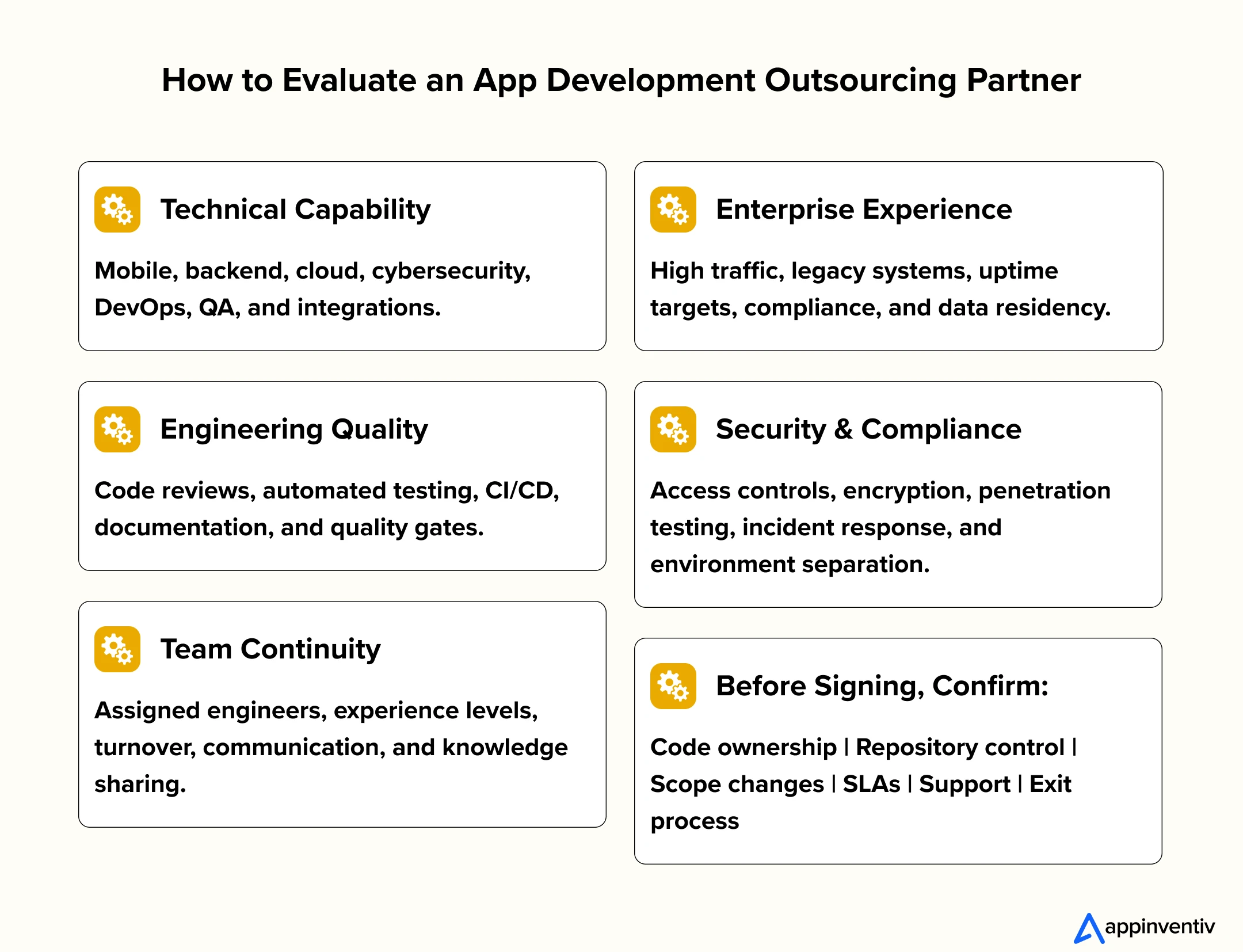
Portfolios show design quality without proving engineering depth. Match partner technical expertise directly to product requirements across native platforms, cloud environments, cybersecurity, and relevant technology stacks. Review architecture diagrams, technology choices, case studies, and live production systems before signing contracts.
Verify Experience at Enterprise Scale
Confirm candidates have proven delivery experience with mobile applications under high-traffic conditions, complex integrations, and uptime targets. Connecting new mobile applications to legacy corporate systems requires specialized experience and strong domain understanding. Regulated industries like banking and healthcare demand proven industry experience, along with audit logging and data residency rules.
Also Read: A Complete Guide on Fintech Development Outsourcing
Review Engineering and Quality Practices
Examine how candidate teams push code to production. Disciplined vendors enforce peer reviews, CI/CD, and automated testing through defined quality gates. Evaluate testing across unit checks, performance metrics, and vulnerability scans. Require clear documentation for architecture, APIs, and operational runbooks.
Validate Security and Compliance Capabilities
Inspect security protocols before development starts. Evaluate vendor security practices for access controls, encryption, penetration tests, and incident management. Confirm logical separation between development, staging, and production environments to protect sensitive corporate data.
Check Team Continuity and Delivery Governance
Interview the specific engineers assigned to your project and review the vendor’s team structure. Evaluate developer experience levels, turnover rates, and knowledge-sharing practices. Establish a clear communication approach, schedules, escalation paths, and decision authority before project kickoff.
Questions to Ask Before Signing
- Who owns the source code, design assets, and intellectual property?
- Who controls administrative access to main code repositories and cloud accounts?
- How do teams estimate, approve, and record scope changes?
- Who handles production incidents, and what SLA response times apply?
- Which technical documentation and post-launch maintenance remain in effect after release?
- How can the organization transition project operations to another team if needed?
Qualified development partners answer these questions with concrete protocols, technical expertise, delivery processes, and operational proof rather than generic claims.
Appinventiv combines mobile engineering, backend integration, AI, legacy modernization, cross-platform development, and post-launch support within a single delivery team.

How Appinventiv Helped KFC Launch 7 Mobile Apps
Americana Group partnered with Appinventiv to build and launch seven KFC mobile applications across the UAE, Saudi Arabia, Kuwait, Egypt, Qatar, Bahrain, and Oman. The project supported diverse regional markets and established a uniform ordering experience across iOS and Android.
Appinventiv directed app engineering, language localization, order processing, payment systems, analytics, and market requirements. Building the primary application created reusable technical frameworks for remaining launches, allowing project teams to complete all seven app releases within target deadlines.
Key Success Metrics and Outcomes
- 22% increase in conversion rate
- 50%+ of total orders coming through KFC mobile apps
- 60% increase in repeat purchases
- 30,000+ orders fulfilled through the apps each day
- 4.5 average rating across the App Store and Google Play
How Appinventiv Built an ERP Solution for IKEA Across 7+ Stores
IKEA required store-level apps to handle customer onboarding, product discovery, and real-time inventory details across its UAE locations. Appinventiv engineered custom enterprise applications featuring dedicated server setups for each store, along with secure private-IP remote access. The platform collected buyer preferences in real time, granting floor staff immediate access to active product stock and promotional pricing.
Key Success Metrics and Outcomes
- Deployed across 7+ IKEA stores in the UAE
- Provided real-time product and offer availability
- Captured customer information and preferences for marketing
- Created a data source for ROI measurement
- Supported store-specific deployment requirements and private network access
How Much Does It Cost to Outsource App Development?
Enterprise app development outsourcing costs range from $40K to $400K+, while MVP costs are lower. Final budgets depend on app complexity, platforms, backend integrations, security standards, team composition, and delivery schedules.
Real-time services, legacy connections, and artificial intelligence features increase engineering hours beyond what basic feature lists indicate. The selected engagement model and project management approach can further affect the total cost.
App Development Outsourcing Cost by Complexity
| App Type | Estimated Outsourcing Cost | Typical Scope |
|---|---|---|
| Basic/MVP | $40K–$80K | Core workflows, standard UI, limited integrations |
| Mid-Complexity | $80K–$150K | Custom backend, APIs, multiple roles |
| Complex | $150K–$250K+ | Advanced integrations, real-time features, stronger security |
| Enterprise | $250K–$400K+ | High scale, legacy integration, compliance, advanced architecture |
These figures serve as planning estimates for your app development budget rather than fixed vendor tariffs. App architecture, developer seniority, team composition, and delivery models directly influence the cost of outsourcing mobile app development.
Regional Outsourcing Rates
Regional market data and hourly rates across geographic regions offer baseline reference points for vendor evaluation:
| Region | Typical Hourly Range |
|---|---|
| North America | $100–$200/hr |
| Western Europe | $70–$150/hr |
| Eastern Europe | $25–$70/hr |
| South Asia | $15–$45/hr |
| Latin America | $25–$70/hr |
| Middle East | $30–$80/hr |
Hourly billing rates do not directly dictate total project costs. Experienced developers, who charge higher rates, complete tasks faster, reducing billable hours compared to lower-rate teams.
What Does the Outsourcing Cost Estimate Include?
A complete mobile application estimate covers core project deliverables:
- Discovery and Architecture: Requirements analysis, solution design, technical specs, and delivery planning.
- UI/UX Design: User flows, interaction design, visual systems, and prototypes.
- Mobile Engineering: Native development vs cross-platform development across iOS, Android, or cross-platform code development.
- Backend Engineering: Databases, business logic, authentication, and third-party APIs.
- QA: Functional, integration, performance, and automated testing.
- DevOps: Build pipelines, cloud infrastructure, release automation, and monitoring.
- Security: Vulnerability checks, access controls, encryption, and security reviews.
- Deployment: Production launches, app store submissions, and handovers.
Also Read: How Much Does It Cost to Develop an App?
What Factors Increase Outsourced App Development Costs?
Multiple platforms, scope changes, custom backends, legacy system integrations, real-time data, machine learning, regulatory compliance, and compressed schedules increase development effort. The choice between native development vs cross-platform development, third-party dependencies, and infrastructure requirements can further affect the final estimate.
What Hidden Costs Should Enterprises Budget For?
Hidden costs can include cloud hosting, third-party app licensing, third-party APIs, store fees, security patches, system updates, infrastructure expenses, and post-launch maintenance. Identify these operating expenses before concluding commercial agreements.
How Do You Protect Security, Data, and IP When Outsourcing?
Enterprise leaders establish strict operational controls on day one of an outsourcing partnership. Verizon’s 2026 Data Breach Investigations Report found that third-party involvement appeared in 48% of breaches, up 60% from the previous year’s dataset. Non-disclosure agreements alone cannot defend app repositories, corporate databases, or production environments.
Control Source-Code and Repository Access
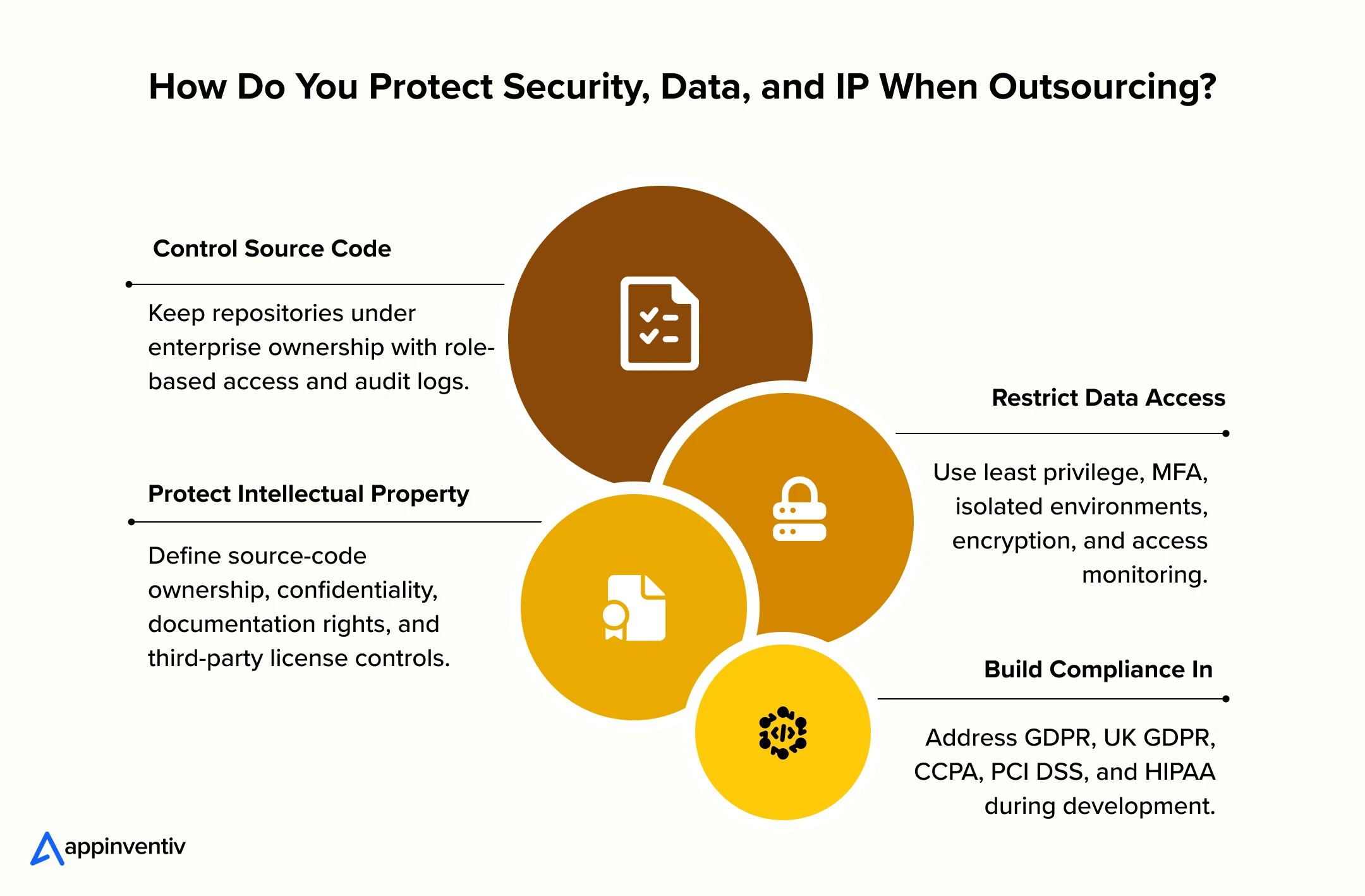
Maintain primary code repositories within internal company accounts and restrict user permissions based on specific staff roles. Implement protected code branches, peer reviews, activity logs, and automated backups to track application changes. Enterprise managers must retain administrative controls rather than transferring account authority to external vendors.
Control Access to Enterprise Data
External developers require strict least-privilege access to systems necessary for active sprint tasks. Enforce multi-factor authentication, credential management, and isolated development environments to protect sensitive operational files. Encrypt sensitive corporate data at rest and in transit, and maintain access logs for security audits.
Protect Intellectual Property
Formal contracts must explicitly assign full ownership of source code, UI designs, technical documentation, and system configurations to the enterprise. Standard confidentiality agreements supplement contractual ownership provisions rather than replacing explicit property rights. Audit open-source libraries thoroughly to avoid restrictive distribution licenses that compromise mobile app ownership.
Build Compliance Into the Development Lifecycle
Regulatory standards and legal issues in app development shape architecture from initial project discovery through final release. Mandates such as GDPR, UK GDPR, CCPA, PCI DSS, and HIPAA govern user privacy, payment processing, and the handling of health records. Integrating regulatory checks directly into sprint cycles prevents costly architectural redesigns and product launch delays.
Challenges of Outsourcing Mobile App Development and How to Manage Them
Application development outsourcing projects face operational risks stemming from poor planning, unclear ownership, and misaligned technical priorities. Enterprise teams manage these delivery challenges by implementing clear governance controls early in the engagement.
Unclear Requirements Can Trigger Scope Creep
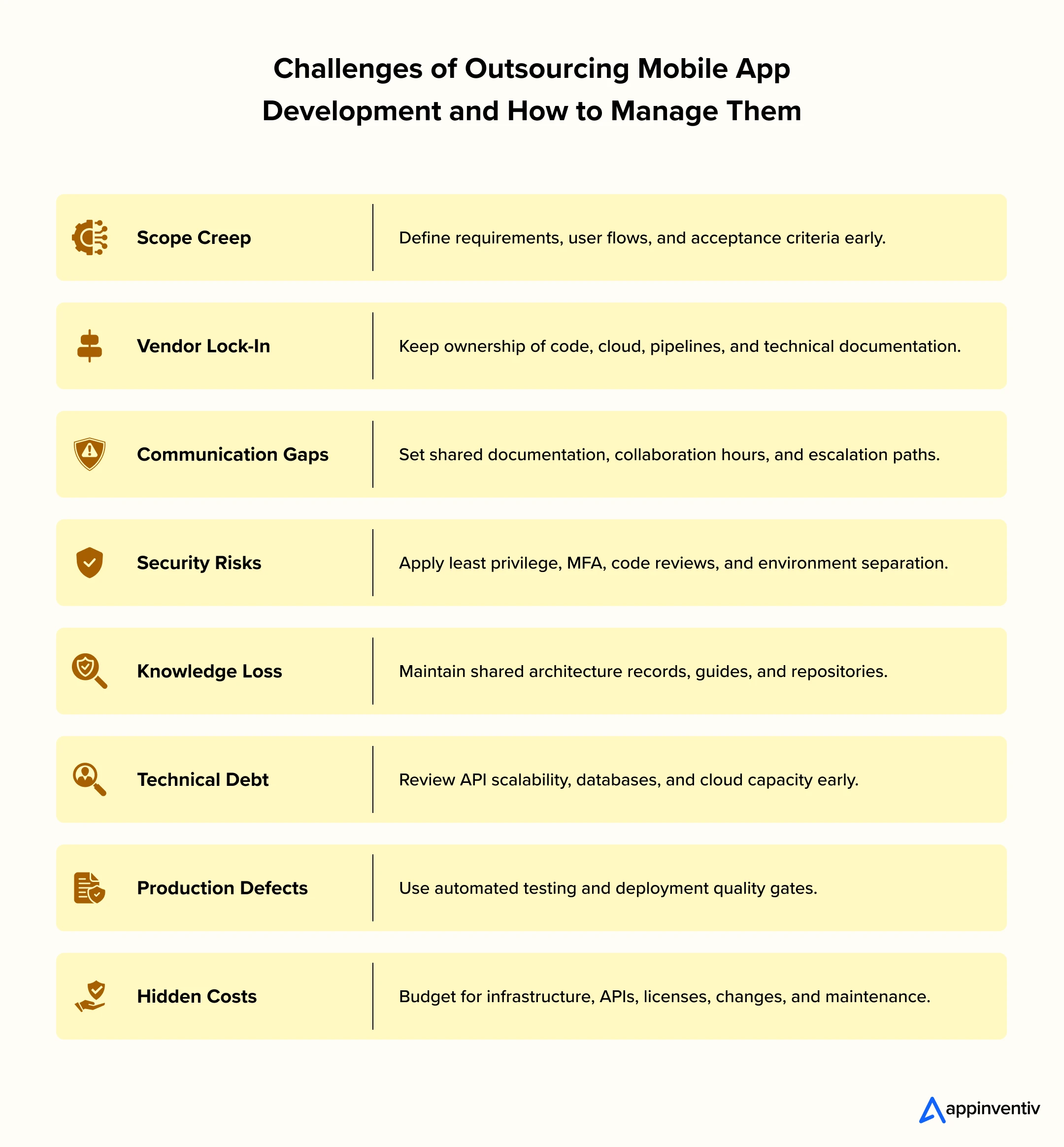
Vague feature lists lead to conflicting technical interpretations, resulting in costly rework and extended project schedules. Run a discovery phase to define user flows, technical specifications, and acceptance criteria before development begins.
Vendor Lock-In Can Make Transitions Difficult
Heavy reliance on vendors makes it difficult to transfer product operations to new teams when documentation and credentials are still missing. Retain direct ownership of code repositories, cloud accounts, deployment pipelines, and architecture guides throughout the project.
Communication Gaps Can Slow Delivery
Time zone differences and fragmented communications delay critical engineering decisions across multiple sprint cycles. Establish shared documentation platforms, escalation paths, and daily collaboration hours to align internal and external engineering teams.
Weak Security Controls Can Expose Data and IP
Granting broad access to codebases, internal networks, and backend services creates major security vulnerabilities. Enforce role-based access limits, multi-factor authentication, code reviews, and environment separation before granting developer access.
Team Turnover Can Cause Knowledge Loss
Developer departures destroy institutional memory when technical details exist only in private conversations or local files. Maintain updated architecture records, onboarding guides, and shared repositories to preserve product knowledge during staff changes.
Poor Architecture Can Create Long-Term Technical Debt
Shortsighted system design choices lead to system crashes under higher user traffic or new feature additions. Assign technical leadership to evaluate database structures, API scalability, and cloud capacity during initial engineering reviews.
Quality Gaps Can Reach Production
Weak mobile app quality assurance protocols allow application bugs to reach live users, disrupting business operations and consuming engineering capacity. Set up automated quality gates in deployment pipelines for unit tests, API integration tests, and security reviews.
Hidden Costs Can Push Budgets Beyond the Original Estimate
Basic vendor quotes frequently exclude cloud usage fees, application licenses, third-party APIs, and post-launch maintenance. Build a comprehensive lifecycle budget that details change-order rates, recurring fees, and infrastructure expenses before signing agreements.
Best Practices and Risk Management for Outsourced App Development
Strong outsourcing governance keeps product decisions, technical accountability, and commercial control aligned throughout the engagement. These development best practices provide enterprise teams with a clear operating model without adding unnecessary management overhead.
Keep Business and Product Ownership In-House
The vendor can manage delivery execution, but the enterprise should retain product priorities, roadmap decisions, and business acceptance. This keeps development tied to commercial goals rather than vendor-led output.
Also Read: Why Does Your Business Need A Mobile Application for Growth
Treat Architecture as a Joint Governance Responsibility
Assign clear technical ownership across the client and partner teams. Review major architecture decisions at defined stages and document the reasoning behind changes to APIs, data models, cloud services, and application components. This creates a shared technical record that supports future engineering work.
Measure Delivery Through Outcomes
Track delivery using metrics that show product and engineering health rather than activity alone. Useful measures include:
- Release frequency: Shows how often validated changes reach users.
- Defect escape rate: Tracks defects that pass testing and reach production.
- Sprint predictability: Compares planned work with completed work across cycles.
- Lead time: Measures the time from approved work to production release.
- Availability and performance: Shows whether the application meets agreed service targets.
- Security findings: Tracks unresolved vulnerabilities and recurring control gaps.
Keep Exit Readiness From Day One
A vendor relationship should never become the only source of operational knowledge. Deloitte’s 2026 survey of more than 500 global business and technology executives found that 70% of organizations had brought previously outsourced work back in-house over the previous five years.
Maintain current access to source code, documentation, infrastructure configuration, credentials, build pipelines, data, and deployment knowledge throughout the contract. This gives the enterprise a practical path to change teams, expand internal ownership, or transition the product without disrupting operations.
Also Read: How to Recover From a Failed App Project: Enterprise Guide
Appinventiv addresses architecture, security, delivery governance, team continuity, and maintenance risks before they become expensive operational problems.
How to Manage Outsourcing Mobile Application Development and Maintenance After Launch
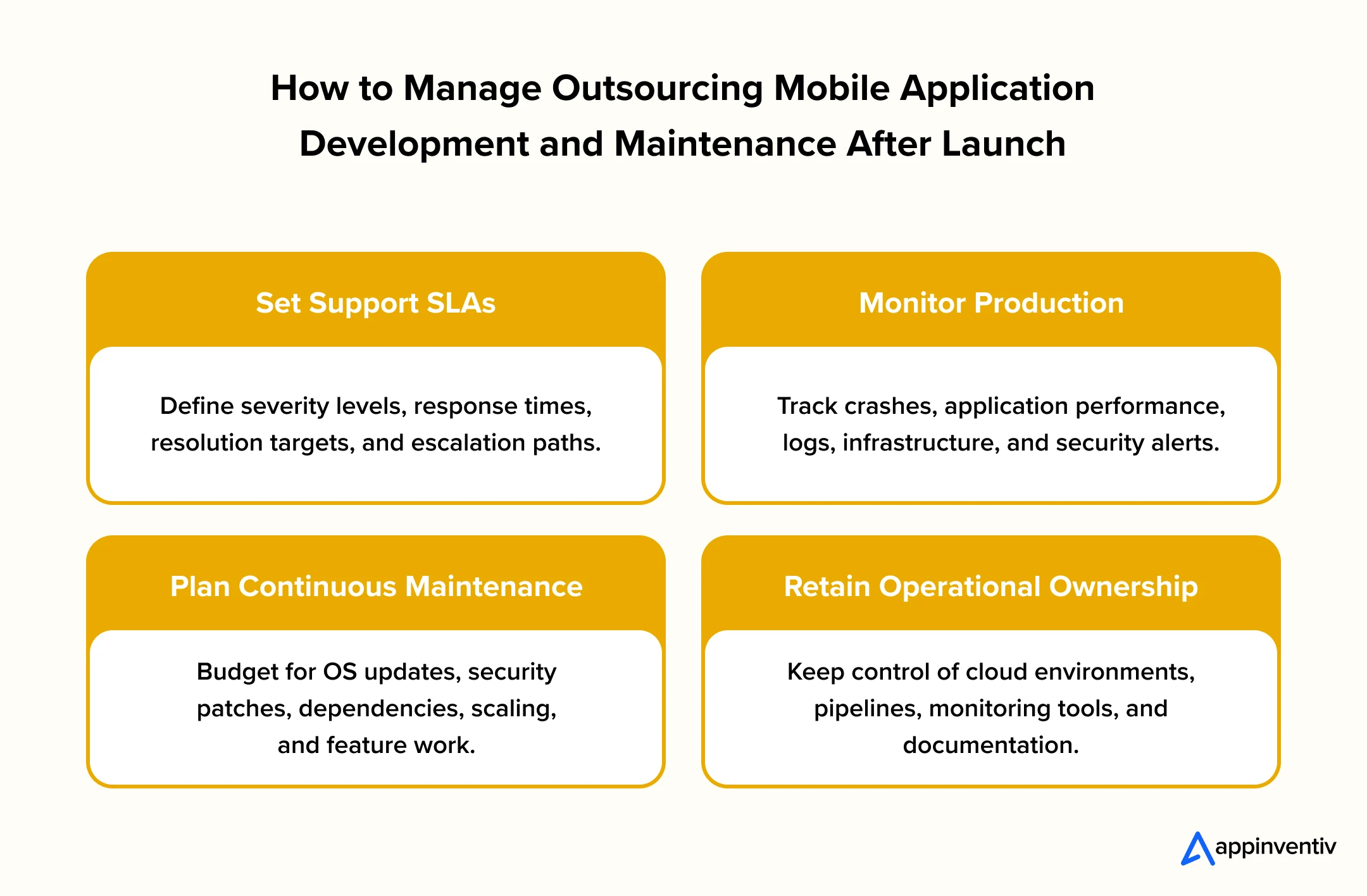
Production deployments mark the beginning of long-term mobile app operations, not the end of vendor engagement. Structured governance frameworks for outsourcing application development and maintenance define how corporate teams monitor, update, and support live applications following initial public launches.
Establish Post-Launch Support SLAs
Define service-level agreements that outline incident severity tiers, initial response times, resolution targets, and escalation paths. Critical system outages require rapid remediation protocols, whereas minor visual bugs or low-priority application defects do not. Formal vendor agreements specify these performance thresholds using clear quantitative operational benchmarks.
Monitor the Production Environment
Effective production oversight combines application performance monitoring, crash telemetry, system logs, cloud infrastructure metrics, and security alerts. These operational signals help engineering leads identify transaction failures and system bottlenecks before service disruptions affect active users.
Plan for Continuous Maintenance
Allocate recurring budgets for operating system updates, security patches, third-party library upgrades, and cloud scaling needs. Mobile operating systems evolve continuously, making ongoing maintenance work a permanent requirement on long-term product roadmaps.
Retain Ownership as the Product Evolves
Maintain internal administrative control over live cloud environments, build pipelines, monitoring tools, and technical documentation. Enterprise teams preserve complete operational independence when vendor relationships change, or internal staffing expands over time.
Why Enterprises Choose Appinventiv for Mobile App Development Outsourcing
Enterprise mobile application delivery requires comprehensive technical capabilities beyond standard feature coding. Appinventiv’s mobile app development services integrate product strategy, cloud architecture, mobile engineering, cybersecurity, DevOps, and post-launch maintenance into a single engagement framework.
With 10+ years of experience, 1,600+ tech evangelists, and 2,000+ applications delivered, our teams manage complex mobile app initiatives across 35+ industries. This cross-functional organization solves integration challenges, platform updates, and technical debt without requiring multiple specialized vendors.
Appinventiv guides platforms through complete product lifecycles, spanning technical discovery, architectural design, testing, release, and long-term support. Our execution framework helps clients achieve 2x the speed to deployment while maintaining a 99.90% uptime SLA.
Long-term client partnerships continue far past initial release dates. Appinventiv maintains a 95% client satisfaction rate and 90% repeat clientele, demonstrating sustained engagement across multiple app releases.
Contact our team to outsource app development and review your technical scope, system architecture, integration dependencies, security policies, and team structure for a precise project estimate.
FAQs
Q. How to outsource mobile app development?
A. To outsource app development, define product scope, target platforms, business goals, and performance metrics. Evaluate app development vendors based on verified technical work, enterprise projects, security standards, and delivery capacity. Run a technical discovery phase to verify architecture, system integrations, build effort, and project risks. Choose an outsourcing model that aligns with your scope, team capacity, and required level of control. Write contracts covering acceptance criteria, IP ownership, repository rights, SLAs, and change procedures. Build mobile applications through controlled cycles with code reviews, continuous testing, and quality checks. Keep full control over cloud hosting, technical guides, system monitoring, and support workflows after launch.
Q. What are the best practices for outsourcing mobile app development?
A. Set clear product leadership and technical roles before hiring a vendor. Review vendor architecture standards, QA automation, deployment setups, cloud management, and security controls. Define exact acceptance criteria and review the working app during regular team demos. Hold administrative rights to code repositories, cloud hosting, system records, and user accounts. Apply security controls such as role-based access, data encryption, key management, and vulnerability scanning. Track vendor progress with finished engineering deliverables rather than hours worked. Write clear transition plans so your enterprise can change engineering teams smoothly.
Q. How do I keep data secure when outsourcing app development?
A. Give external developers access only to tools necessary for their daily tasks. Use multi-factor logins, data encryption, credential managers, and separate testing servers. Block access to production databases and log administrative user actions for audit checks. Build security into daily work through peer code reviews, vulnerability scans, and penetration tests. Write security duties, incident response times, and data privacy rules into vendor contracts. Follow regulatory frameworks such as GDPR, UK GDPR, CCPA, PCI DSS, and HIPAA.
Q. How do I protect my app idea when outsourcing development?
A. Sign NDAs and formal IP ownership contracts before sharing product details. Contracts must state that your enterprise owns all source code, design files, technical guides, and project assets. Store primary code repositories inside company accounts and manage user access by job role. Require employees, contractors, and external vendors to follow strict confidentiality rules. Check third-party code licenses before adding external libraries into your product codebase. These steps protect your original business idea and all application assets created during development.
Q. How much does it cost to outsource mobile app development?
A. Enterprise app development outsourcing costs range from $40K to $400K+ based on product scope and app complexity. Basic MVPs cost $40K-$80K, mid-complexity tools cost $80K-$150K, complex apps cost $150K-$250K+, and enterprise platforms cost $250K-$400K+. Target platforms, custom backends, third-party APIs, legacy tools, real-time data, AI features, security rules, team composition, and delivery deadlines change total estimates. Native development vs cross-platform development, project management, developer hourly rates, regional market data, and the chosen engagement model affect overall costs. Scope changes, infrastructure expenses, hidden costs, and post-launch maintenance should be included in the budget. Set separate budgets for cloud hosting, maintenance, technical support, security updates, and future features.
Q. What are the benefits of outsourcing app development?
A. Outsourcing provides access to a wider talent pool and specialized expertise, including DevOps specialists and QA engineers. The right delivery model can increase engineering capacity, improve cost-effectiveness, accelerate time to market, support scalability, strengthen risk management, and let internal teams maintain stronger core business focus through a dedicated team.
Q. How do I evaluate and choose an app development outsourcing vendor?
A. Evaluate vendors based on technical expertise, relevant technology stacks, case studies, client reviews, industry experience, and proven delivery. Review their CI/CD, automated testing, security practices, team structure, and communication approach to assess delivery quality, domain understanding, and fit with your project requirements.
Q. Should I choose freelancers, staff augmentation, or a mobile app development agency?
A. Freelancers from freelance marketplaces suit focused work needing specific freelancers’ expertise and flexible hourly rates. Staff augmentation provides a flexible engagement for adding skills while your team retains team coordination and delivery control. A mobile app development agency suits complex products needing end-to-end app development, a dedicated development team, stronger quality control, and fewer knowledge-transfer challenges than managing multiple providers or off-the-shelf solutions.


Fast 2-minute response, fully NDA-protected.
Application Development Outsourcing in Australia: How to Find the Right Development Partner
Key takeaways: Choose an outsourcing partner based on technical capability, security, governance, delivery evidence, and long-term fit. Select an onshore, offshore, or hybrid model based on your risk, control, cost, and scalability requirements. Plan for AUD 70,000 to AUD 700,000 per project, and compare vendors on total cost of governance, not hourly rate alone. Treat…
Hire vs Outsource Development After Funding: What Actually Scales Faster?
Key takeaways: After funding, the real challenge is execution speed without instability, not just adding engineers. Hiring in-house takes longer to show impact than most emerging businesses expect. Outsourcing accelerates delivery by adding experienced execution capacity without long hiring cycles. Most emerging businesses scale best with a hybrid model that balances control and speed. The…

Build In-House vs Hire a Development Agency: Real Cost Comparison
Key takeaways: There’s no universal winner in build in-house vs hire development agency, the right choice depends on stage, speed, and strategic priority. In-house development builds long-term capability but comes with higher fixed costs and slower ramp-up. Outsourcing offers flexibility, faster execution, and predictable project-based spend typically ranging from $40,000 to $400,000 for mid-scale initiatives.…