


































 Leader in AI-First Product Engineering Read Full Article
 IT Managed & Outsourcing
 Contact Us
Supported by a team of 1700+ specialists and more than 11+ years of enterprise software experience, we engineer ERP systems suited for cross-border operations, high transaction volumes, and strict reporting obligations.
Our Core Capabilities





















A Record Built on
Consistency and Scale
Enterprise software initiatives brought from concept to deployment
Outdated processes replaced with structured digital systems
Distinct industries served with tailored engineering models
Nations connected through our technology implementations
Global honors recognizing execution quality
Client approval rating across multi-year engagements







Our ERP consultancy project starts with an in-depth examination of the way your teams really work. We analyze existing work processes, reporting gaps, and system redundancy.
• Process Review/Gap Mapping
We consider the persistent gaps in your existing workflow, analyzing where the coordination fails.
• Implementation Planning
We plan the deployment phases and the system structure in accordance with real business priorities.

Not every business fits inside a standard ERP template. Our custom ERP systems are developed based on your organization and how it operates today, or how it plans to operate in the future.
• Business-Precise Modules
Workforce control modules are introduced based on the real-life operational requirements.
• Architecture Built to Grow
The system architecture considers increased transaction volumes and greater data volumes as the system grows.

A hybrid ERP system provides a balance when regulatory policies limit full cloud adoption. We integrate internal and external cloud services to have control and to not restrict growth.
• Calculated Migration Ramp-Up
We establish transition timeframes that do not interrupt the workflow and minimize downtimes.
• Integrated Reporting Structure
Data from both cloud and on-site systems are consolidated into centralized dashboards, enabling informed decision-making.

ERP software rarely operates alone. Our experts connect the ERP system with accounting tools, CRMs, payroll systems, and sometimes older legacy applications that cannot be replaced overnight.
• System Connectivity
We provide a safe exchange of data between the ERP systems and other third-party tools that are already in use.
• Data Consistency Controls
Well-organized synchronization minimizes duplication, errors in reporting and manual reconciliation efforts.

We manage secure ERP migration processes, whether transitioning from legacy systems or upgrading to modern platforms through our legacy modernization services.
• Data Legacy Data Migration
We migrate records, configurations, and historical data with staged and validated control.
• Post-Migration Testing
Once deployed, we conduct tests on the accuracy of data and system behavior prior to complete handover of the system.
Move to a centralized ERP platform designed for real-time control.


Heavy customer traffic across UAE stores made onboarding and in-store engagement difficult to coordinate. Sales associates did not have immediate access to live inventory, pricing updates, or active promotions. Customer information remained scattered across systems, limiting visibility.

We introduced an ERP-driven in-store platform that combined digital self-service catalogs with centralized inventory and customer records. Each outlet operated on a secure local server within IKEA’s private network, while headquarters retained centralized monitoring and control.


Independent systems across departments slowed reporting cycles and restricted financial transparency. The organization required a unified ERP platform to replace multiple legacy applications.
We implemented a centralized cloud-based ERP hosted on AWS, bringing finance, HR, logistics, and CRM into a single environment. Real-time dashboards and automated approval workflows were configured to align with GCC regulatory requirements.

Shaped around your processes, approval chains, and reporting structure. Teams work the way they already do.
Comes with preset workflows. Companies often adjust their operations to fit the system.
Modules are added based on operational need. Expansion happens when complexity increases.
Features are bundled by the vendor. New capability depends on product editions.
Connects with legacy systems, internal databases, and external tools as required.
Works within supported connectors or paid add-ons.
Can be structured for multi-entity growth and geographic expansion from the start.
Growth is tied to license tiers and vendor direction.
Access controls and audit logs follow your regulatory obligations.
Security standards are uniform across all customers.
Higher upfront cost. Long-term control stays internal.
Lower entry price. Subscription and upgrade costs continue.
From multi-entity accounting to complex supply chains, our ERP teams work within the rules and reporting standards your industry requires from the outset.


The manufacturing module aids in the management and simplification of numerous aspects of the manufacturing process, including bill management, production planning and scheduling, quality control, and cost management.
Built by our supply chain software developers, this module assists in the optimization of key supply chain components, including logistics, inventory management, demand planning, and procurement.
The customer relationship management module lets organizations track customer interactions, manage customer information, and automate marketing and sales activities. It offers a consolidated platform to boost sales and streamline customer-related processes.
The inventory module enables firms to manage inventory across various locations, automate transactions, and analyze expenses. It offers a single platform to decrease stockouts and overstocking, enhance accuracy, and streamline inventory-related procedures.
The distribution module offers an intuitive platform to increase visibility and collaboration across the whole distribution process by enabling organizations to track shipments, handle client orders, and automate billing procedures.
ERP software's business intelligence module assists in real-time reporting, data analysis and informed decision-making. Businesses can analyze data from numerous sources through BI platforms, create reports and dashboards, and base their decisions on data-driven insights.
Aspects of sales and marketing, such as lead management, opportunity monitoring, and campaign management, can be smoothly managed and automated by the marketing and sales module of ERP software.
By enabling organizations to conduct transactions, track expenses, and produce financial reports, the ERP accounting platform enhances financial accuracy, decreases errors, and streamlines financial and accounting-related procedures.
Businesses can obtain deeper insights into their operations and performance through the ERP analytics module. This module is leveraged for intricate data analysis, charting out unique reports, and meaningfully visualizing data to aid in decision-making.
By allowing companies to manage employee data, measure performance indicators, and automate HR procedures, the human resources module offers a consolidated platform to enhance HR efficiency, lower administrative responsibilities, and expedite HR-related activities.
Whether you want to build an ERP system from scratch or need improvement in the existing one, we get all your needs covered without sacrificing business continuity.
Using the iterative and agile business model, our team develops the MVP version of the ERP solution, usually within 2-3 months and releases a new version every 4-6 weeks.
With Appinventiv as your chosen ERP software development company, you can rest assured that we will take care of everything, from design and development to implementation and post-deployment support.
We craft solutions that are accessible on different platforms, be it mobile, web, or desktop. Our ERP software developers focus on building an intuitive UI/UX that boosts user engagement and satisfaction.
Our team ensures smooth integration of the ERP solution with popular platforms such as Magento and Salesforce, innovative technologies such as blockchain and IoT, and other ERP modules.
IKEA and Y.K. Almoayyed & Sons entrusted us with enterprise-wide ERP initiatives. If your systems demand the same level of structure and reliability, let us begin the conversation.



Access rights defined by role, department, and reporting authority.

Consolidated view of revenue, expenses, inventory levels, and pending approvals.

Built-in approval chains for purchases, payments, hiring, and policy exceptions.

Separate tracking for branches or business units with consolidated reporting.

Automated journal entries, expense matching, and statutory reporting controls.

Inbound, outbound, and internal transfers recorded with location accuracy.

Supplier evaluation, purchase history, and contract tracking in one place.

From quotation to invoice, with visibility into fulfillment status.

Time-stamped activity history for accountability and review.
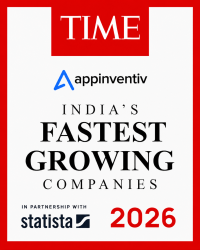
The India's Fastest-Growing Companies 2026 Recognised by TIME and Statista

Statista High Growth Companies APAC - 2026
Statista India's Growth Champions 2023






ERP systems leverage ML to forecast demand and supply, recognize workflow bottlenecks, and bring trends in operational or financial data to light.
Agentic AI introduces independent decision-making in the ERP, enabling it to issue alerts, propose actions, and even automatically approve routes with less human control.
We integrate generative AI into ERP to automatically design documents, draft reports, and save time on repetitive activities, allowing teams to focus on strategic activities.
Computer vision modules process visual data obtained at warehouses, production lines, or during asset inspections and convert these inputs into operational ideas.
We integrate big data across the departments into ERP dashboards, where leaders can see trends, track performance, and identify exceptions without filtering raw data.
are scaled to offices, factories, and stores, thus maintaining a high uptime, enabling quick expansion and software updates without interrupting operations.
We incorporate blockchain across areas that require a high degree of transparency. ERP systems record transactions securely and maintain immutable audit trails.
ERP modules that are connected to IoT receive real-time sensor data of machines, vehicles, or devices. This enhances predictive maintenance, the availability of resources and efficiency.
ERP systems are built with security in mind. Audits, role-based access controls, encryption, and monitoring help ensure sensitive enterprise information is secured.
Applications of AR/VR in ERP include training, remote guidance, and interactive walkthroughs. Such tools help employees better understand complex processes.


















Automated Document Processing – Extract SKUs, quantities, and supplier details instantly
Operational Summaries – Turn raw data into concise insights
ERP Search Assistant – Find the right records, fast
Predictive Analytics – Make smarter inventory and procurement decisions
We start our ERP solutions development services by mapping the actual workflow across departments. Inefficiencies and delays in reporting are revealed through interviews, data reviews, data audits, and gaps. The outcome is a realistic ERP roadmap aligned with how your teams actually operate.
We begin with data structure and access control as our approach to enterprise resource planning systems. We structure roles, integrations and reporting levels early and form dashboards based on daily decisions, maintaining the system modular and stable.
When specific modules like finance, HR, and supply chain are developed, it is through focused ERP application development in controlled sprints. Every element is checked in real-world situations prior to expansion, minimizing repetition and operational interruptions.
ERP customization is carried out with care so that the new system is integrated with CRM, POS, and legacy databases. Cleaning, validating and migrating data in stages is carried out to ensure continuity and prevent operational gaps in the process.
Within our ERP software development services, the security controls are implemented at all layers. Role access, audit reports, and regulatory controls facilitate adherence to standards related to your operational region and industry.
Functional and load testing of each module is done in a structured manner. Under realistic conditions, the workflows, calculations, and reporting outputs are checked to ensure the system is stable before release.
Our methodical ERP software services strategy leads to gradual deployment, environment setup, and user onboarding. Go-live is handled with caution to restrict the downtime and ensure continuity of operations.
Post-launch performance monitoring and system reviews are carried out. When the business needs change, updates, refinements, and the addition of new modules are made to ensure that the ERP environment remains reliable over the years.
The cost of developing a custom ERP solution depends on various factors such as the amount and complexity of features, application design, and the number of hours required to develop the system, ranging from $40,000 to $350,000 and more.
Connect with a reliable ERP software development company like ours to get a complete cost estimation.
The duration of custom enterprise software development might range from a few days to months, depending on the project's size and other important variables, including
We work with a wide range of enterprise-grade ERP platforms, including Microsoft Dynamics 365, SAP S/4HANA, Oracle NetSuite, Odoo ERP, Infor CloudSuite, Epicor ERP, TallyPrime, Workday, Acumatica, Syspro, IFS Applications, and Sage X3.
Appinventiv offers a myriad of ERP software development services, taking care of all the enterprise resource planning software needs of your business.
Hiring our custom ERP software development services in the USA can offer you a host of benefits, including:
Improved productivity: ERP systems can automate tedious work, optimize corporate processes, and give real-time data insights, which leads to increased productivity and efficiency.
Enhanced decision-making: With robust ERP systems and access to reliable, real-time data, businesses can make informed decisions quickly.
Scalability: ERP systems can expand and change to match a business's changing demands, enabling it to scale as the business grows.
Cost savings: ERP systems can save expenses by automating operations and decreasing manual data entry.
Better collaboration: Collaboration between departments and locations can be enhanced through ERP systems, which offer a common hub for information exchange and communication.
Overall, custom ERP development services can assist companies in growing their flexibility, effectiveness, and competitiveness.
As an experienced ERP development company, we treat change management as a structured business initiative, not an afterthought. Our services include impact evaluation, process realignment, and structured onboarding plans to prepare teams before go-live.
Through our ongoing ERP services, we conduct user training, provide hands-on support, and maintain open communication with leadership and staff. This approach encourages adoption, reduces resistance, and helps the ERP system settle naturally into daily operations.