




















How to Create a Video Streaming App like Netflix? Features, Tech Stack, and Costs

 Share -


- 01A Brief Glimpse into the OTT App Market: Understanding the Streaming Surge
- 02Who Should Create an App Like Netflix in 2026?
- 03How to Create an App Like Netflix?
- 04Features to Introduce in Your Netflix-like App
- 05Technology Stack Businesses Can Leverage for a Robust Video Streaming App Development Process
- 06Cost to Develop a Video Streaming App like Netflix
- 07Factors Affecting the Cost to Develop a Video Streaming App Like Netflix
- 08Compliance and Risk Considerations for Video Streaming Apps
- 09Challenges of Developing a Video Streaming App like Netflix
- 10How Does an App Like Netflix Make Money?
- 11Why Appinventiv Is the Right Partner to Build Your Netflix-Like Streaming App?
- 12FAQs

Key takeaways:
- Building a video streaming app like Netflix requires focus on personalization, intuitive UI, and cross-device access to keep users engaged.
- Incorporating advanced tech like AI, adaptive bitrate streaming, and real-time analytics can significantly enhance app engagement and retention.
- Personalization, seamless cross-device access, and intuitive UI are critical success factors in streaming app development.
- Plan your development timeline carefully, typically spanning 4 to 9 months depending on scope, integrations, and content strategy.
- Development costs range from $40,000 to $300,000 +, depending on the complexity, features, and technology stack.
The majority of entertainment and media businesses are now moving toward building their own OTT platforms instead of depending on large streaming networks. The appeal is clear, but the real challenges usually appear once the idea moves beyond the initial concept.
Netflix and similar platforms did not expand just due to content. They flourished because streaming technology had made it easy, quick, and addictive to stream to any device. The numbers are also indicative of that shift. As of March 2026, Netflix has already surpassed over 325 million paid subscribers all over the world, and the platform is steadily growing in new markets.
This is why many businesses today want to create an app like Netflix. Deciding to build one is not the hard part. The real challenge is creating a platform that users continue to watch after the first download. Here’s a glimpse into how the platform works behind the scenes.
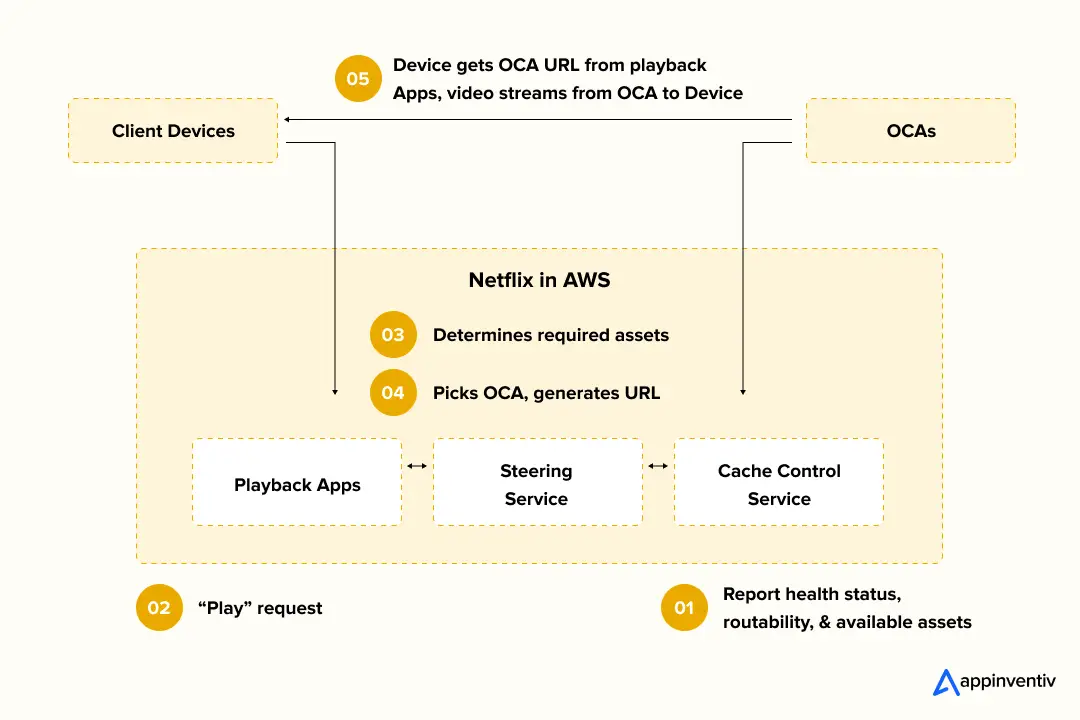
The diagram above shows how Netflix streams video to millions of users without slowing down. Instead of using one central server, it selects the nearest content server and delivers the video from the fastest available source, which makes instant playback possible even during peak traffic.
Most companies struggle with the same questions in the early stage. What should be included in the first version? Which technology ensures smooth streaming across devices? What does development actually cost, and how long does it take to launch a stable product?
This guide is written for companies seeking straightforward answers before investing in a video streaming platform. Below, you can find a practical analysis of the main characteristics, the technology stack of large-scale streaming platforms, the development schedule, and the cost considerations that affect the end product.
The real question is whether your business is ready to enter the space.
A Brief Glimpse into the OTT App Market: Understanding the Streaming Surge
Undoubtedly, streaming platforms redefine the media industry, and the emergence of Over-the-top (OTT) platforms and video streaming apps, such as Netflix, has revolutionized content consumption, shifting audiences from traditional TV to on-demand streaming. Netflix’s success, driven by its original content and user-friendly interface, has paved the way for a booming over-the-top (OTT) industry.
Here are some key statistics highlighting the OTT and video streaming market’s growth:
- Global OTT Subscriptions: Projected to reach $3.5 trillion by 2029, marking a CAGR of 3.7%. (source: PwC)
- OTT Market Revenue Growth: Expected to reach $1,425.63 billion by 2033, with the US accounting for nearly half of global revenue. (source: GVR)
- Video Streaming Industry: Expected to generate $416.8 Billion billion by the end of 2030, encompassing both free and paid platforms. (source: GVR)
So, what does this growth signify for businesses?
It signals a massive opportunity to tap into a rapidly expanding market where consumer demand for on-demand, personalized video content is at an all-time high. Businesses across industries, from entertainment and education to fitness and eCommerce, can leverage video streaming apps to build deeper user engagement, unlock new revenue streams, and future-proof their digital presence. With the right tech stack, monetization strategy, and user experience, the time to enter the OTT space today isn’t just right but also strategic.
Who Should Create an App Like Netflix in 2026?
A full-scale streaming platform is not necessary in all businesses. Nevertheless, for businesses highly dependent on video content, creating a dedicated OTT application has become a viable business choice rather than an experimental concept. Here’s who should create an app like Netflix in 2026:
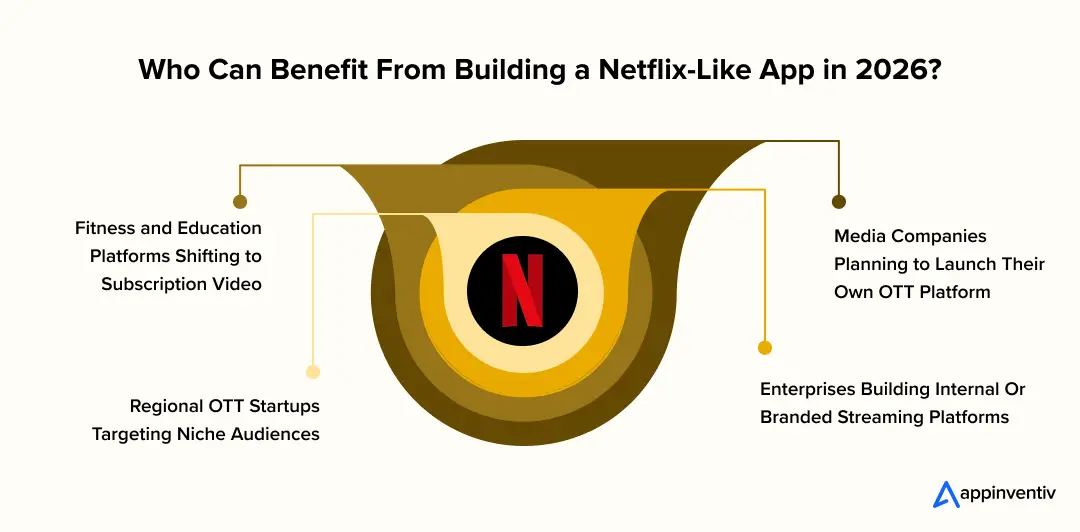
Fitness and Education Platforms Shifting to Subscription Video
Fitness programs, coaching platforms, and e-learning businesses are shifting towards video-first subscriptions more and more. They are not placing content on generic platforms, and instead they are creating dedicated apps on which users would consume structured programs, exclusive content and customized recommendations.
A Netflix-type application is particularly effective with companies providing continuous video content as opposed to courses that are taken once.
Regional OTT Startups Targeting Niche Audiences
International streaming services primarily focus on big markets. It has opened up room to regional OTT startups, targeting a language, community, or niche of content. Companies with an already established local fan base can grow more quickly because their platform is built on an existing user base rather than a general or global market.
Media Companies Planning to Launch Their Own OTT Platform
The trend is that many production houses and digital media firms are abandoning the practice of relying on third-party platforms. The control over content distribution, subscription income and viewer information is one of the advantages of owning a streaming app rather than relying on external marketplaces. Another logical next step for media brands with an expanding content library is an OTT platform.
Reel Media teamed up with Appinventiv to deliver a fan app, creator app, event gate app, and admin app, building a complete multi-app platform within 90 days. Attention was paid to enable the entire multi-app platform to be underpinned by scalable back-end architecture using AWS cloud-native services, incorporate role-based access, and enable appropriate workflow across all apps.
Other significant features developed included real-time data and the multi-app ecosystem, role-based access, and seamless workflows across the various apps. This approach ensured that the build of all applications was production-ready, integrated, and on schedule.
Enterprises Building Internal Or Branded Streaming Platforms
There are organizations that are not even attempting to compete with Netflix. They instead create personal or branded streaming services to train employees, communicate with corporations or provide high-value customer content.
In these situations, less emphasis is placed on entertainment and more on performance, scalability and safe content delivery.
How to Create an App Like Netflix?
The live streaming mobile app development process requires a clear strategy, the right features, and a robust backend infrastructure capable of handling high traffic, ensuring smooth content delivery, and protecting user data. Let’s look at the process to build a video platform like Netflix:
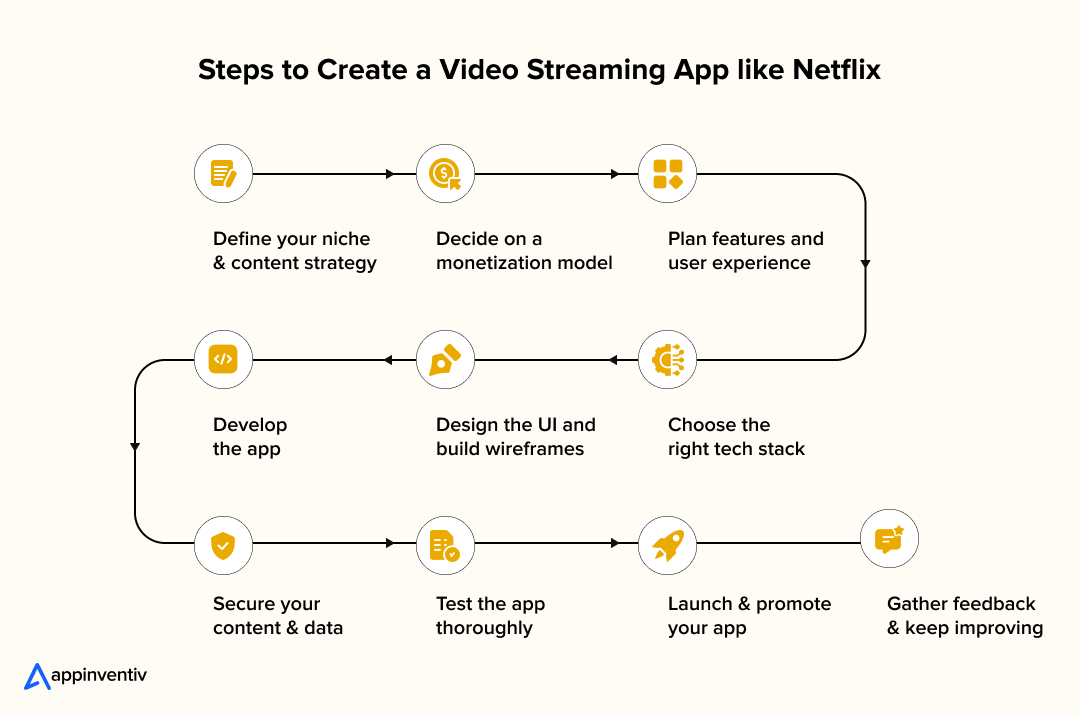
Define Your Niche and Content Strategy
Start by deciding what kind of content your platform will offer. It could be movies, TV shows, documentaries, educational videos, or niche-specific content, such as fitness or cooking. This helps you stand out in a crowded market.
Decide on Monetization Model
During this stage, choose how you want to earn from the app. For example, you can choose from monetization models like subscriptions, ads, pay-per-view, or a freemium model. The right monetization strategy depends on your target audience and the type of content.
Plan Features and User Experience
List key features like user profiles, watchlist, multi-device support, payments, search filters, and content recommendations. Keep the interface simple and engaging, allowing users to find and enjoy the content easily.
Choose the Right Tech Stack
At this stage, businesses must select the right technologies to support seamless streaming, content storage, and a secure backend. You’ll need tools for video processing, database management, cloud hosting, and content delivery.
Design the UI and Build Wireframes
To create an app like Netflix, this stage required the businesses to work with designers to generate clean, intuitive layouts for each screen. Wireframes help map the user journey and define how the app will look and function before actual development.
Develop the App
Your development team will build both the user-facing side of the app and the backend that handles streaming, data, and user management. This step includes integrating video players, payment gateways, and APIs.
Secure Your Content and Data
Leveraging encryption technology and secure login features to safeguard both user data and your video content from piracy or unauthorized use. A safe platform fosters user trust and ensures compliance with relevant standards.
Test the App Thoroughly
During this phase of video streaming app development, test every aspect of your app, from sign-up and streaming to payments and notifications. Ensure the app functions smoothly across various devices and internet speeds, without any bugs or glitches.
Launch and Promote Your App
Once the app is ready, launch it on app stores and promote it through social media, influencer partnerships, and SEO. Encourage reviews and feedback to build credibility.
Gather Feedback and Keep Improving
After launch, monitor user behavior and reviews to identify what’s working and what needs improvement. Roll out updates regularly to fix issues, add new features, and improve performance.
Now that you understand the process of how to create a streaming app, let us move ahead and understand in detail the video streaming application development costs below.
We’ll hook you up with killer features like voice search, AR, and next-level recommendations that truly move the needle.
Features to Introduce in Your Netflix-like App
Netflix achieved huge success due to its content algorithm, which repurposes content based on users’ interests. Not only this, but the app places importance on ease of usability. So, before starting the video streaming app development process, let’s first understand the features to develop a video streaming app.
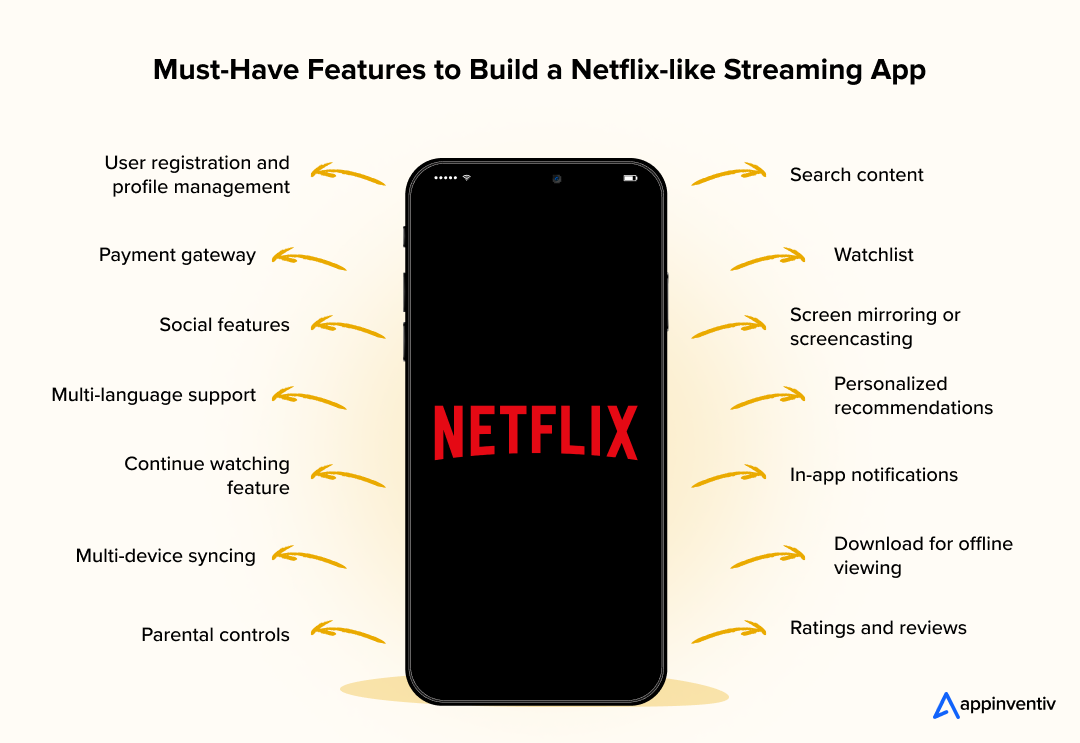
1. User Registration and Profile Management
The essential feature to focus on while Netflix-like entertainment app is user registration and profile management. When it comes to these features, minimizing the requested details in the form is not enough. You should introduce the functionality of social media integration or SSO verification, as it improves the app user retention rate.
2. Search Content
As a platform offering thousands of video contents, it is imperative to consider the search and filter features. With them, users will be able to search for their favorite shows and movies based on various criteria, such as genre, language, and country of production.
3. Payment Gateway
With data security and privacy gaining huge momentum in the marketplace, a secure payment gateway integration is a profitable idea for apps like Netflix. When you provide users with the opportunity to pay via various fast payment options, it reduces the bounce rate on your app or website.
4. Watchlist
A watchlist is also a prominent feature to consider when you decide to develop a video streaming application. This is the section where users add programs they wish to watch later. It reduces the effort required to search for the same TV show or series again and positively influences the app user retention rate.
5. Social Features
Users, these days, love to share anything and everything on social networking sites. In such a scenario, adding the social feature during the video streaming app development process is unavoidable. It helps market trending or newly released video content.
6. Screen Mirroring or Screencasting
You must include a screencasting feature that enables viewing the video on your app on other screens, such as a TV or Laptop, with the help of a Wi-Fi connection. It allows the app to act as a remote control, enabling users to enjoy content on larger screens with convenient playback options, such as play, pause, or rewind.
7. Multi-Language Support
This feature allows users to access content and navigate the app in their preferred language. By offering subtitles, audio tracks, and interfaces in multiple languages, the app becomes more inclusive and appealing to a global audience.
Also Read: Key Challenges Faced in Developing Multilingual Mobile Apps
8. Personalized Recommendations
This feature utilizes user watch history, ratings, and viewing patterns to suggest shows or movies that align with their preferences. It helps improve engagement and keeps users watching longer by offering content they are more likely to enjoy.
9. Continue Watching Feature
Users often leave shows midway and return later. A “Continue Watching” feature allows them to pick up right where they left off without having to search again, thereby improving the user experience and convenience.
10. In-app Notifications
Push notifications help users stay updated about new releases, upcoming shows, or content similar to what they’ve liked. Always ensure to add this feature during the process to build a video platform like Netflix, as it boosts re-engagement and encourages more frequent app visits.
11. Multi-device Syncing
Many users access the app from different devices. This feature ensures that watch history, preferences, and profiles stay synced, offering a seamless experience across smartphones, tablets, smart TVs, and desktops.
12. Download for Offline Viewing
This feature enables users to download content when connected to Wi-Fi and watch it later without an internet connection. It’s especially useful for travelers or users with limited data plans.
13. Parental Controls
By adding parental controls, you allow families to set viewing restrictions for younger viewers. Parents can filter content, set screen time limits, and monitor what kids are watching.
14. Ratings and Reviews
Users can rate shows and leave feedback, which helps others decide what to watch and provides your platform with valuable insights into viewer preferences.
The above Netflix app features made the application a global success. There’s no denying it. However, the user experience the app offers made users pick Netflix over other top video streaming apps.
Considering this, it is advisable to review the design guidelines before embarking on video streaming app development.
Technology Stack Businesses Can Leverage for a Robust Video Streaming App Development Process
To get a robust prodigy like Netflix that offers it all, it’s necessary to understand the technology stack for developing video streaming apps. Below are the details of the tech stack, segmented according to various aspects, including applications and data, utilities, DevOps, and business tools.
| Layer | Category | Tools / Technologies | Purpose |
|---|---|---|---|
| Frontend Development | Web Frameworks | React.js, Vue.js | Dynamic, responsive interfaces |
| Cross-platform Mobile | React Native, Flutter | Single codebase for iOS & Android | |
| Native Mobile | Swift (iOS), Kotlin (Android) | High-performance native apps | |
| Video Players | Video.js, Plyr; ExoPlayer, AVPlayer | Adaptive video playback | |
| UI/UX Tools | Figma, Adobe XD, Framer | Design and prototyping | |
| Enhancements | AI search, voice search, personalized thumbnails | Improved user experience | |
| Backend Development | Languages & Frameworks | Node.js, Python (Django/Flask), Go; Express.js, Spring Boot | Core logic and scalability |
| Databases | PostgreSQL, MySQL; MongoDB, Cassandra; Redis | Data storage and caching | |
| APIs & Protocols | REST, GraphQL, WebSocket | Data communication and real-time features | |
| Advanced Features | AI recommendations, tagging, predictive analytics | Personalization and insights | |
| Video Processing & Streaming | Encoding & Transcoding | FFmpeg, AWS MediaConvert, Zencoder, Bitmovin | Adaptive bitrate streaming |
| Streaming Protocols | HLS, MPEG-DASH, RTMP, WebRTC | Multi-device and low-latency streaming | |
| Content Delivery | Cloudflare Stream, Amazon CloudFront, Akamai | Global content distribution | |
| Storage | Amazon S3, Google Cloud Storage, Backblaze B2 | Scalable storage | |
| Enhancements | AI compression, real-time quality adjustment, AR/VR | Enhanced streaming experience | |
| Cloud & DevOps | Cloud Providers | AWS, GCP, Microsoft Azure | Infrastructure scalability |
| Containerization | Docker, Kubernetes | Deployment and orchestration | |
| CI/CD | Jenkins, GitHub Actions, CircleCI | Continuous integration and delivery | |
| Monitoring | Prometheus, Grafana, New Relic, Datadog, Mixpanel, Google Analytics | Performance tracking | |
| Enhancements | Real-time streaming analytics | Load and UX optimization | |
| Security & Authentication | Authentication | Auth0, Okta, Firebase Authentication, JWT | User access control |
| Content Protection | Widevine, FairPlay, PlayReady; AES-128 | DRM and encryption | |
| Network Security | SSL/TLS, Cloudflare, AWS WAF | DDoS and network protection | |
| Data Privacy | GDPR/CCPA, Vault, AWS Secrets Manager | Secure data handling | |
| Additional Features | Live Streaming | Wowza, Ant Media Server, Mux | Low-latency live streaming |
| Video Analytics | TensorFlow, PyTorch, AWS Rekognition, Algolia | Recommendations and search | |
| Monetization | Stripe, PayPal, Google Ad Manager | Revenue models | |
| Social Features | Socket.IO, Twilio | Engagement and communication | |
| Accessibility | WebVTT, SRT, Speech-to-Text APIs | Captions and inclusivity | |
| Testing & QA | Unit Testing | Jest, JUnit, PyTest | Code validation |
| End-to-End Testing | Cypress, Selenium, Appium | Workflow testing | |
| Performance Testing | JMeter, LoadRunner, BlazeMeter | Load handling | |
| Video Testing | Bitmovin Analytics, TestRTC | Streaming quality assurance | |
| Scalability | Architecture | Microservices | Independent scaling |
| Serverless | AWS Lambda, Google Cloud Functions | Event-driven tasks | |
| Load Balancing | NGINX, AWS ELB, Kubernetes HPA | Traffic distribution |
Frontend Development
The frontend is responsible for the user interface and client-side interactions, ensuring a smooth and engaging experience across devices.
Frameworks & Libraries:
- Web: React.js, Vue.js for dynamic, responsive interfaces
- Cross-platform Mobile: React Native, Flutter for iOS and Android apps with a single codebase
- Native Mobile: Swift (iOS), Kotlin (Android) for high-performance, platform-specific optimization
Video Players: Video.js, Plyr (web); ExoPlayer (Android), AVPlayer (iOS) for adaptive streaming
UI/UX Tools: Figma, Adobe XD for interface design; Framer for interactive prototyping
Emerging Enhancements: AI-driven smart search, voice search, and personalized thumbnails integrated into UI workflows
Backend Development
The back-end handles core logic, video processing, storage, and delivery while ensuring scalability.
- Languages & Frameworks: Node.js, Python (Django/Flask), Go; Express.js, Spring Boot
- Databases: PostgreSQL, MySQL (structured data); MongoDB, Cassandra (unstructured/semi-structured data); Redis for caching
- APIs & Protocols: REST, GraphQL for flexible data fetching; WebSocket for real-time features
- Advanced Features: AI-powered recommendations, content tagging, and predictive analytics integrated at the server layer
Video Processing and Streaming
This layer ensures smooth, high-quality playback on any device.
- Encoding & Transcoding: FFmpeg, AWS Elemental MediaConvert, Zencoder, Bitmovin for adaptive streaming
- Streaming Protocols: HLS, MPEG-DASH, RTMP, WebRTC for ultra-low-latency live streaming
- Content Delivery: Cloudflare Stream, Amazon CloudFront, Akamai
- Storage: Amazon S3, Google Cloud Storage, Backblaze B2
- Emerging Enhancements: AI-assisted compression, real-time quality adjustments, and AR/VR support for immersive content
Cloud Infrastructure and DevOps
Cloud platforms and DevOps tools ensure scalable deployment and continuous performance monitoring.
- Cloud Providers: AWS, GCP, Microsoft Azure
- Containerization & Orchestration: Docker, Kubernetes
- CI/CD Tools: Jenkins, GitHub Actions, CircleCI
- Monitoring & Analytics: Prometheus, Grafana, New Relic, Datadog, Mixpanel, Google Analytics
- Emerging Enhancements: Real-time streaming analytics to optimize server load and user experience dynamically
Security and Authentication
Protecting content, data, and user access is critical for streaming apps.
- Authentication: Auth0, Okta, Firebase Authentication, JWT
- Content Protection: DRM solutions like Widevine, FairPlay, PlayReady; AES-128 encryption
- Network Security: SSL/TLS, Cloudflare or AWS WAF for DDoS protection
- Data Privacy: GDPR/CCPA compliance, Vault or AWS Secrets Manager for secure secrets storage
Additional Features and Enhancements
To stand out, streaming apps can integrate advanced features using specialized tools and application programming interfaces (APIs).
- Live Streaming:
- Wowza Streaming Engine: For scalable live streaming with low latency.
- Ant Media Server: For WebRTC-based ultra-low-latency streaming.
- Mux: For developer-friendly live and on-demand streaming APIs.
- Video Analytics and Recommendations:
- TensorFlow or PyTorch: For building AI-driven recommendation engines.
- AWS Rekognition: For video content analysis and metadata extraction.
- Algolia: For fast, relevant search and personalized content recommendations.
- Monetization:
- Stripe or PayPal: For subscription-based or pay-per-view models.
- AdTech Platforms (e.g., Google Ad Manager): For in-stream advertisements.
- Social Features:
- Socket.IO: For real-time chat during live streams.
- Twilio: For SMS notifications or in-app communication.
- Accessibility:
- WebVTT or SRT: For closed captions and subtitles.
- Speech-to-Text APIs (e.g., Google Cloud Speech-to-Text): For auto-generating captions.
Testing and Quality Assurance
Ensuring a seamless, bug-free experience across devices.
- Unit Testing: Jest, JUnit, PyTest
- End-to-End Testing: Cypress, Selenium, Appium
- Performance Testing: JMeter, LoadRunner, BlazeMeter
- Video Quality Testing: Bitmovin Analytics, TestRTC for WebRTC-based streaming
Scalability Considerations
Designed to handle millions of concurrent users.
- Microservices Architecture: Independent services for video processing, user management, and recommendations
- Serverless Functions: AWS Lambda, Google Cloud Functions for sporadic tasks like transcoding or notifications
- Load Balancing & Auto-Scaling: NGINX, AWS ELB, Kubernetes HPA for dynamic resource management
Cost to Develop a Video Streaming App like Netflix
To give you a quick idea, the cost to build a video streaming app like Netflix can range anywhere from $40,000 to $300,000 or more. The price varies depending on the complexity of features, the platforms on which you want the app, the tech stack used, and the experience of your development team.
Let us offer you a quick formula to estimate the cost to create an app like Netflix, since no two apps are built the same way:
Video Streaming Application Development Cost = Total Development Time × Hourly Rate of Developers
Total development time means the number of working hours it takes to build your app from start to finish. This includes designing the interface, writing the code, integrating features like video players or payments, testing the app, and fixing bugs.
The hourly rate of developers is the amount a developer or development team charges for each hour they work on your project.
Now, let’s look into how the cost breakdown to develop an app like Netflix is, as per different development stages through this table:
| Development Stage | What It Entails | Estimated Cost (USD) |
|---|---|---|
| Requirement gathering and planning | Business analysis, feature planning, project scope definition and technical roadmap | $3,000 – $7,000 |
| UI and UX design | User flows, app wireframes, interface design, and visual layouts | $5,000 – $15,000 |
| User-facing and back-end development | Application development, back-end architecture, APIs, and database design | $20,000 – $80,000 |
| Video player integration and streaming configuration | Video hosting, encoding, CDN integration, and streaming configuration | $5,000 – $20,000 |
| Payment processing, billing configuration and subscription set-up | Incorporation of a payment gateway, billing and set-up of payment processing, and billing | $2,000 – $8,000 |
| Admin panel and content management | Dashboard development, content upload system and user management tools | $4,000 – $12,000 |
| Testing and quality assurance | Functional testing, performance testing and bug fixing | $3,000 – $10,000 |
| Maintenance and upgrades after launching, and continue improvement and updates (annual cost) | Continue improvement and updates after launch (annual cost) | $5,000 – $15,000 / year |
Each stage plays a role in the total cost and should be planned carefully based on your goals, timeline, and app features. A basic app with core features will be cheaper, while a full-scale platform like Netflix with advanced AI, multiple user profiles, and multilingual support will be on the higher end. Let’s move on and understand the factors affecting the live video streaming app development cost in detail below.
Send a few details about your idea, and we will provide a tailored cost range

Factors Affecting the Cost to Develop a Video Streaming App Like Netflix
Building a video streaming app like Netflix involves many moving parts that influence the overall development cost. Understanding these factors helps in budgeting wisely and setting realistic expectations for your project.
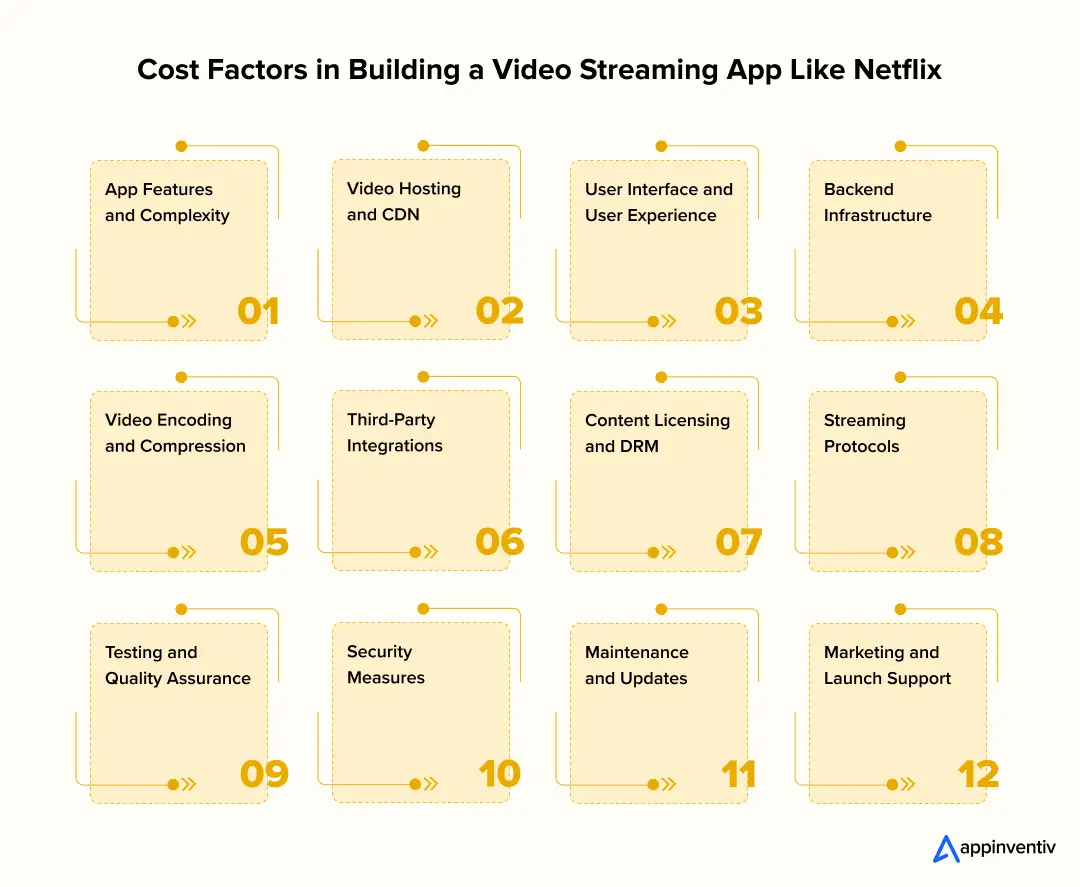
App Features and Complexity: The more advanced the feature set, the higher the cost. Capabilities such as live streaming, multi-device sync, offline viewing, and personalized user profiles require additional development time and significantly increase the total investment.
Video Hosting and CDN: Reliable video hosting and a strong content delivery network are essential for smooth streaming. Integrating these services increases infrastructure costs and affects long-term scalability.
User Interface and User Experience: A clean and intuitive interface requires careful design, user testing, and continuous refinement. This additional design effort directly contributes to the overall development cost.
Backend Infrastructure: Building a scalable and secure backend that can support a large number of users is one of the most expensive parts of the project. It involves complex architecture, data handling, and performance optimization.
Video Encoding and Compression: Supporting multiple video resolutions requires efficient encoding and compression. This is a technically demanding area and adds to the cost to create an app like Netflix.
Third-Party Integrations: Integrating payment gateways, analytics platforms, recommendation engines, and social login systems increases both development time and technical complexity.
Content Licensing and DRM: Implementing digital rights management and managing licensed content adds to both development costs and long-term operational expenses.
Streaming Protocols: Supporting streaming protocols such as HLS, DASH, and RTMP ensures compatibility across devices, but it also increases technical complexity and development effort.
Testing and Quality Assurance: Streaming apps must work smoothly across different devices, operating systems, and network conditions. Extensive testing adds time to the development cycle and affects the overall cost.
Security Measures: Strong security for user data and content protection requires encryption, secure multi-factor authentication, and continuous monitoring, all of which increase the total cost.
Maintenance and Updates: After launch, the app will require regular updates, bug fixes, and server maintenance. These are ongoing costs that must be planned from the beginning.
Marketing and Launch Support: Launching a streaming app also involves marketing, user acquisition, and early promotion efforts, which indirectly influence the total investment needed to build an app like Netflix.
To understand in detail the development steps and costs associated with OTT platform like Netflix, check out our blog on- A Comprehensive Guide To Custom OTT Development: Market, Features, and Cost
Compliance and Risk Considerations for Video Streaming Apps
The development of a streaming platform similar to Netflix can not be merely a matter of the intuitive design and smooth playback because compliance and risk management have to be considered throughout the whole process.
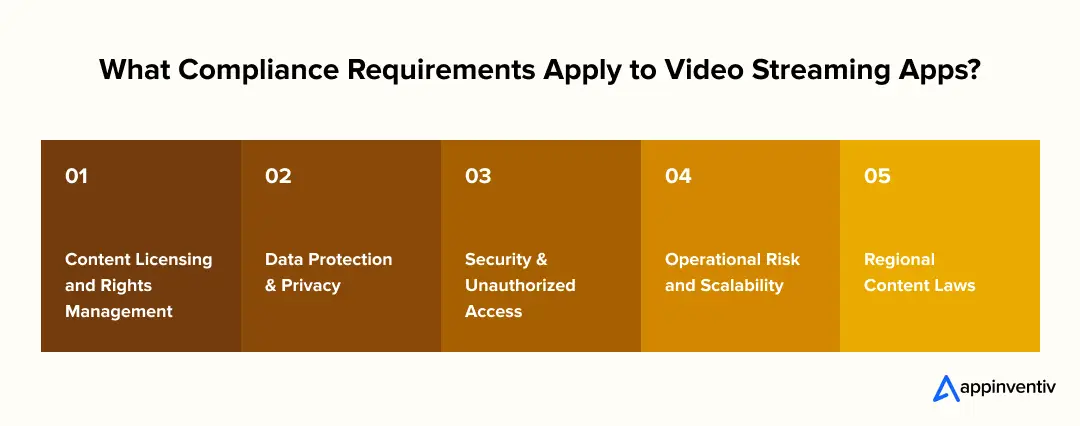
Content Licensing and Rights Management: It is critical to ensure that the appropriate rights to content have been obtained in every region to avoid legal issues, takedowns, or penalties.
Data Protection & Privacy: Streaming applications harvest sensitive user information, including payment history and watching behaviors. Adherence to GDPR, CCPA and other local privacy laws is vital towards ensuring trust and preventing fines.
Security & Unauthorized Access: Encryption, secure authentication, and constant monitoring of the system are methods that protect the system against breaches, piracy, and reputational damage to users, content libraries, and the system itself.
Operational Risk and Scalability: Intensive usage and traffic require a powerful backend. User retention is crucial in ensuring that your infrastructure is in a position to support load, avoid downtime, and ensure a smooth playback.
Regional Content Laws: Various jurisdictions have different content policies and online policies. These are some of the ways of ensuring you adapt your app to be used in various markets.
By addressing these compliance and risk factors early in the development process, legal exposure and operational hiccups are minimized, and the market entry process can be more seamless.
An example of such a partner is Appinventiv, which offers knowledge of regulations compliance, secure architecture, and risk management policies specifically designed for large-scale streaming systems to help you not only develop an app but a stable, regulatory-compliant service that ensures customers and stakeholders trust.
Challenges of Developing a Video Streaming App like Netflix
Video streaming app development at the scale of Netflix is a complex endeavor that requires addressing numerous technical and operational challenges. Successfully overcoming these obstacles is essential to deliver a seamless, engaging user experience while maintaining scalability and security.
| Challenge | Explanation | Solution |
|---|---|---|
| Scalability and Performance | Handling millions of concurrent users without performance drops or downtime is difficult due to sudden traffic spikes. | Use cloud infrastructure with auto-scaling capabilities and Content Delivery Networks (CDNs) to build a video streaming app like Netflix. This will distribute theload efficiently. |
| Content Delivery and Latency | Streaming high-quality videos globally demands minimizing buffering and latency, especially for live broadcasts. | Optimize streaming protocols like HLS and DASH, and deploy edge servers closer to end-users to reduce delay. |
| User Experience & Interface | Users expect fast, intuitive, and visually appealing interfaces across devices, which requires careful design and testing. | Invest in thorough UI/UX research, build adaptive interfaces, and perform extensive cross-device testing to ensure consistency. |
| Video Encoding and Compression | Balancing video quality with bandwidth limits is challenging, especially when supporting multiple resolutions and devices. | Implement advanced video codecs such as HEVC or AV1 and adaptive bitrate streaming to dynamically adjust quality based on connection. |
| Security and DRM | Protecting valuable content from piracy and unauthorized access is critical in the streaming industry. | Integrate strong Digital Rights Management (DRM) solutions, end-to-end encryption, and secure user authentication mechanisms. |
| Content Management | Managing, categorizing, and updating vast content libraries efficiently requires robust backend systems. | While carrying out the steps to create an app like Netflix, deploy scalable Content Management Systems (CMS) with metadata tagging and automated workflows to streamline operations. |
| Multi-Device Compatibility | Streaming apps must work seamlessly on smartphones, tablets, smart TVs, and web browsers, each with unique requirements. | Develop cross-platform apps using responsive design and optimize for platform-specific performance characteristics. |
| Personalization & Recommendations | Providing personalized content suggestions in real time is complex and requires processing large volumes of user data. | Utilize AI and machine learning algorithms to analyze user behavior and deliver tailored recommendations dynamically. |
| Regulatory Compliance | Navigating differing content regulations, AI rules and compliances, copyright laws, and privacy policies across countries complicates global rollout. | Engage legal experts, implement region-specific content restrictions, and ensure data privacy compliance according to local laws. |
| Monetization Models | Supporting multiple revenue models like subscriptions, ads, pay-per-view requires flexible, scalable payment and ad systems. | Build modular payment gateways and ad management platforms integrated with analytics to optimize revenue streams. |
How Does an App Like Netflix Make Money?
The business and revenue model of the Netflix app is essentially backed by a subscription-based model, supported by tiered pricing plans, original content production, and international expansion. Let’s look into the major monetization strategies for video app development in detail below:
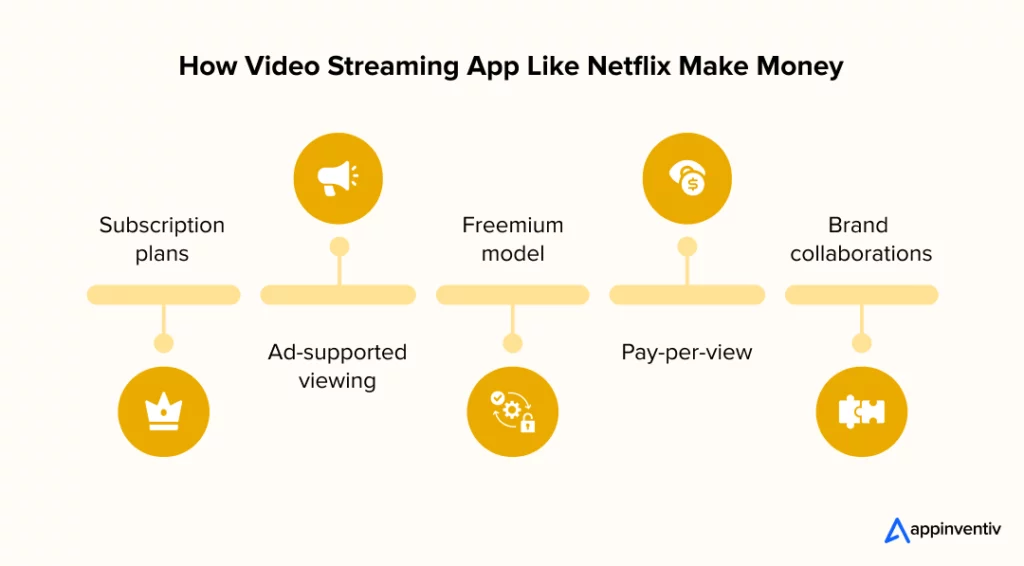
1. Subscription Plans
Most video streaming apps charge users a fixed monthly or yearly fee to access their content. Plans typically vary by video quality, number of screens, or features such as offline downloads. This model generates consistent and predictable revenue.
2. Ad-Supported Viewing
Some platforms offer lower-cost or free plans that include ads. Brands pay the app to show ads before or during videos. This helps the app generate revenue while providing users with an affordable option to access content.
3. Freemium Model
This model provides users with basic access to the platform at no cost. To unlock premium features, such as ad-free viewing, early access, or exclusive shows, users can upgrade to a paid plan. It helps build a large user base and gradually turns free users into paying ones.
4. Pay-Per-View
Instead of full access, users pay for individual movies, shows, or live events. This model is useful for newly released content or special performances where users are willing to pay once to watch.
5. Brand Collaborations
Apps with popular original content often sell branded products like t-shirts, posters, or collectibles. They also team up with well-known brands to create limited-edition items, launch promotions, or co-host events that drive revenue.
Why Appinventiv Is the Right Partner to Build Your Netflix-Like Streaming App?
The future of OTT platforms is being shaped more by technology than by content alone. Faster video delivery, adaptive streaming, cloud-based architecture, and better data analytics are becoming the real differentiators across live streaming, learning platforms, sports apps, and subscription-based content platforms. As the technology stack evolves, businesses that invest in scalable and performance-driven streaming apps today will be in a stronger position to compete.
As a leading video streaming app development company, we focus on building digital products that are smooth, scalable, and easy to use. From creating live content platforms like ABP Live to building movie promotion apps like Gully Beat that support user-generated content, our work covers different kinds of media and entertainment experiences.
Video streaming apps require more than just a good design. They need robust backend systems, seamless video playback, and features that function effectively even during peak traffic. That’s why every decision we make is based on long-term performance.
It’s also important to create a great user experience. Users should be able to find what they want quickly, switch devices easily, and enjoy content without buffering or errors. Our video streaming app developers understand that a well-built app keeps users engaged and turns them into loyal viewers.
Whether it’s designing a clean interface, adding secure payment systems, or setting up strong video streaming features, each part of the app we develop for you is carefully planned to make sure it works well and gives users a great experience.
As an OTT video platform development services provider, we combine technical precision with user-first design to build platforms that scale seamlessly. From content delivery to monetization, we ensure every feature drives engagement and business growth.
If you are planning to build a video streaming app like Netflix, it all starts with a solid plan, the right technology, and a team that understands your goals. Let’s work together to build an app that stands out in today’s digital world.
FAQs
Q. How to create an app like Netflix?
A. Creating a streaming app like Netflix involves a few essential steps that bring together technology, design, and content delivery. Here’s a quick breakdown of the process:
- Research the market and define your target audience.
- Choose the core features such as user profiles, search, recommendations, and video player.
- Design an intuitive user interface for multiple devices.
- Develop the backend infrastructure for content management and streaming.
- Integrate video hosting, encoding, and content delivery networks (CDNs).
- Implement security measures like DRM and encryption.
- Test thoroughly across devices and network conditions.
- Launch the app and continuously update based on user feedback.
Q. How much does it cost to build a video streaming app from scratch?
A. The cost estimation for building a video streaming app typically ranges from $40,000 to $300,000. Basic versions with essential features and limited content libraries fall at the lower end, while advanced platforms with AI-powered recommendations, live streaming, and extensive security measures increase development costs. Factors such as regulatory compliance, integration complexity, user interface design, and ongoing maintenance also influence the overall budget.
Q. How long does it take to build a streaming platform?
A. Live video streaming app development usually takes between 4 to 9 months, depending on the app’s complexity and the development team’s size. Basic apps with core functionalities may be developed within 4 to 6 months, while feature-rich platforms with advanced AI, multi-device support, and robust backend infrastructure typically require 7 to 9 months or more for thorough development and testing.
Q. What kind of technology stack is used for developing video streaming apps?
A. To get a robust prodigy like Netflix that offers it all, it’s necessary to understand the technology stack for developing video streaming apps. Below are the details of the technology stack for developing video streaming apps.
- Frontend (User Interface)
React, Angular, Swift (iOS), Kotlin (Android), Flutter, React Native - Backend (Application Logic)
Node.js, Java, .NET, Python, microservices architecture - Video Streaming and Processing
HLS and MPEG-DASH streaming, video encoding tools, AWS Media Services, CDN integration - Database and Storage
MySQL, PostgreSQL, MongoDB, Firebase, cloud storage solutions - Cloud and Infrastructure
AWS, Google Cloud, Microsoft Azure, Docker, Kubernetes - Analytics and User Tracking
Google Analytics, Firebase Analytics, real-time user behaviour tracking tools - Payment and Subscription Management
Stripe, PayPal, in-app purchase systems, subscription billing platforms
Q. What are the essential features for a successful video-on-demand application?
A. Here are some of the key features that you need to consider while building a video-on-demand application:
- User sign-up and profile management
- Simple search features for quick browsing
- AI recommendation system that suggests content
- Secure payment and subscription handling for paid content
- Option to download videos for offline viewing
- Watchlist or save feature for later viewing
- Clear content tagging and categorisation for easier navigation
- Parental controls to manage restricted content access
- Basic analytics to understand user behaviour and content performance
Q. How do streaming apps like Netflix personalize content for users?
A. Video streaming apps like Netflix use ML algorithms and AI-driven personalization to analyze user behavior such as engagement platform, watch history, language or regional preferences and other metrics to recommend personalized content.


Fast 2-minute response, fully NDA-protected.
Top 10+ OTT App Security Risks and How to Block Them
As the demand for on-demand content continues to surge, OTT platforms handle more than just high traffic; they manage vast amounts of user data, digital assets, and third-party integrations with significant security implications. What was once considered a niche service is now a critical infrastructure layer in the global media and entertainment landscape, making it…
OTT Analytics for Businesses: How Streaming Data Drives Revenue, Retention, and Scalable Growth
Key takeaways: OTT growth now depends on data maturity, not content scale, with billions of users driving complex, real-time decision needs. Platforms that act on user behavior in real time see measurable gains in retention, watch time, and revenue per user. A unified analytics architecture connects data, models, and actions, turning raw events into continuous…
10 Powerful Ways AI is Transforming OTT Streaming Platforms
Key takeaways: AI personalization and predictive analytics drive over 80 percent of viewing, increasing retention, watch time, and subscriber lifetime value. Adaptive streaming and AI-driven delivery reduce buffering, cut latency, and lower churn rates by up to 30 percent. Automated moderation and fraud detection reduce operational costs by 50 percent and protect revenue from piracy…