





















![70 Points Apple App Store Submissions Checklist [2019 Edition]](https://appinventiv.com/wp-content/uploads/2018/05/70-Points-Apple-App-Store-Submissions-Checklist.png)




Capture 22% More Restaurant Visits With Restaurant Loyalty App Development

 Share -



- 01Restaurant Loyalty App Development Process From Planning to Launch
- 02Choosing the Right Development Approach for a Restaurant Loyalty App
- 03Restaurant Loyalty App Features Enterprises Need to Drive Loyalty
- 04Restaurant Loyalty App Architecture for Scalable Enterprise Systems
- 05Restaurant Loyalty App Integrations With POS, Payments, CRM, and Ordering
- 06How Can Data and AI Improve Restaurant Loyalty Apps?
- 07Benefits of Choosing to Develop a Restaurant Loyalty App
- 08Restaurant Loyalty App Development Cost and Key Cost Factors
- 09Common Restaurant Loyalty App Development Mistakes and Challenges
- 10How to Choose a Restaurant Loyalty App Development Partner
- 11Restaurant Loyalty App Development With Appinventiv for Enterprise Restaurant Brands
- 12Frequently Asked Questions




Key Takeaways
- An enterprise loyalty app requires rule engines, POS synchronization, event-driven APIs, and auditable ledgers to protect the accuracy of transaction data.
- Custom versus white-label app choices depend on data rights, integration depth, extensibility, scalability, differentiation, and lifetime cost.
- POS, ordering, payment, CRM, and CDP connections construct unified customer profiles across restaurant store channels and transactions.
- AI personalization systems target offers, predict churn, recommend menu items, estimate CLV, and detect risks of loyalty program fraud.
- Enterprise build costs range from $40K to $400K+, driven by integrations, architecture, AI tools, and multi-unit scale.
Restaurants earn 22% more visits with well-designed loyalty programs that give guests reasons to return. (Source: Circana) Large restaurant brands gain this increase by building tools beyond basic points and discounts. A centralized loyalty app integrates ordering, POS sales, payments, CRM data, and customer actions. This single data source lets operators send targeted offers, personalized rewards, and buyer reactivation messages.
Building an enterprise platform requires structured technical planning across every component. The core rules engine calculates customer points, tiers, reward eligibility, redemptions, and reversals without slowing the payment checkout process. Real-time APIs and event workflows keep POS, ordering, payment, and CRM records synchronized across channels.
System infrastructure supports multi-unit operations, high transaction bursts, role permissions, and secure customer records. Targeted rewards rely on analytics pipelines, customer profiles, and machine learning models. This guide details the restaurant loyalty app development process, covering product planning, architecture, integrations, testing, deployment, costs, and post-launch growth.
Appinventiv builds POS-connected loyalty platforms that turn customer data into repeat visits, personalized rewards, and measurable revenue.

Restaurant Loyalty App Development Process From Planning to Launch
To develop a restaurant loyalty app, you need more than an attractive mobile interface. Success depends on integrating business rules, POS transactions, store operations, and customer engagement into a single cohesive system. Every development phase addresses a specific operational or technical requirement within this ecosystem.
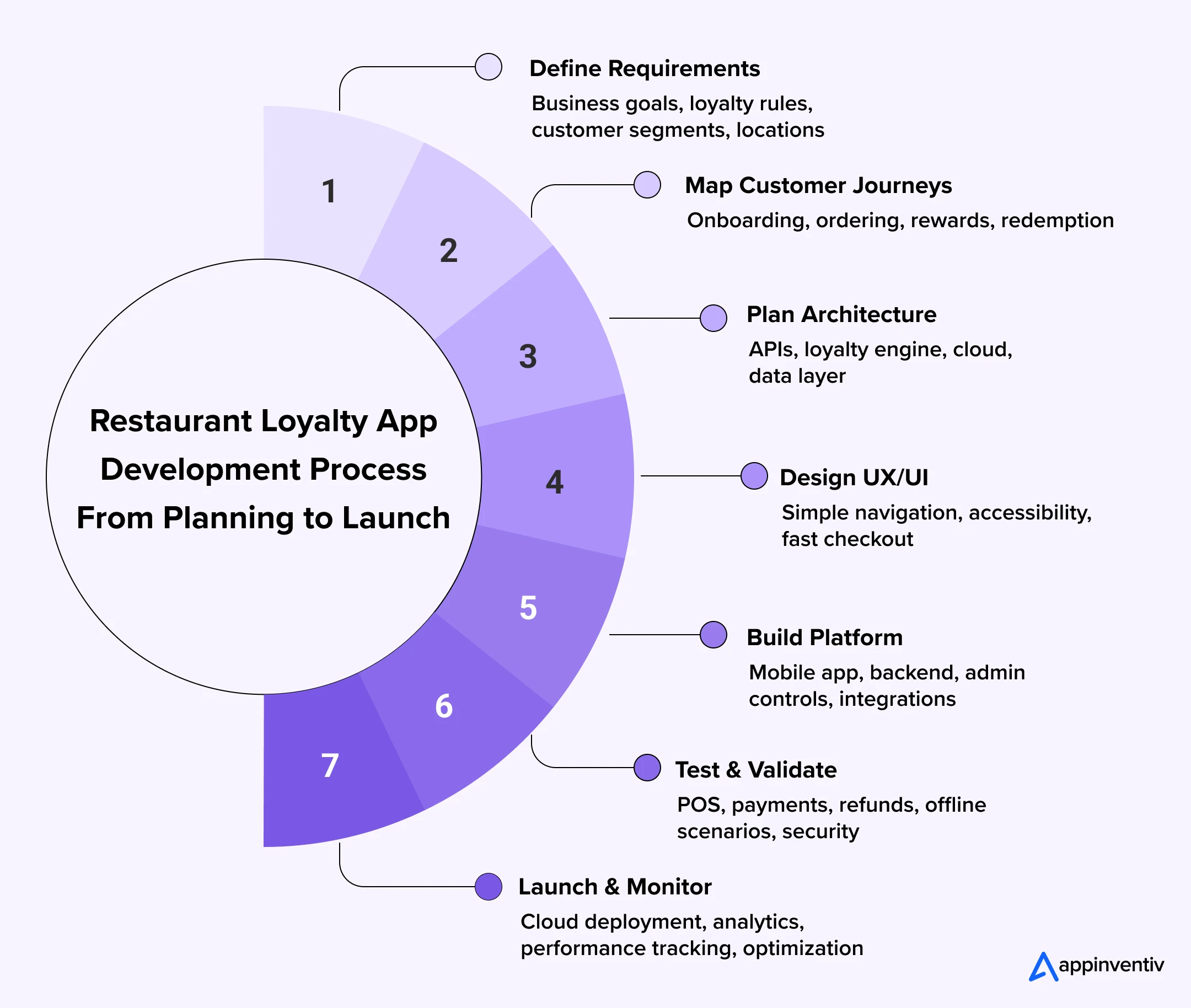
Step 1: Define Business, Customer, and Loyalty Requirements
Executives first define clear business targets for restaurant rewards app development. Teams identify customer segments, visit-frequency targets, participating store locations, direct-ordering goals, and core success metrics.
Program structure must align directly with brand financial metrics. Leadership determines whether guests earn points per dollar spent, collect digital stamps, reach membership tiers, or unlock perks through actions. Rules for reward values, redemption limits, expiration dates, and special promotions must be approved before being sent to engineering.
Enterprise restaurant groups outline multi-unit operational requirements early in the project. Franchises demand local campaign tools, independent reporting dashboards, and custom user access controls inside the shared platform.
Also Read: 10 Innovative Restaurant Business Ideas That Are Disrupting the Industry
Step 2: Design Loyalty Rules and Customer Journeys
For restaurant loyalty program app development, product teams convert business strategy into precise functional specifications for app developers. System rules dictate how user accounts earn, hold, redeem, reverse, and expire points. The core rules engine processes events such as completed sales, cancelled orders, refunds, bonus-point multipliers, tier upgrades, and reward redemptions. Every transaction requires immediate state tracking to keep member balances accurate across touchpoints.
User journeys require full mapping across digital channels before technical development. Designers map sign-up screens, onboarding, reward browsing, mobile ordering, checkout, barcode scanning, and post-purchase messaging. Clear reward mechanics help guests understand their balance and available perks immediately.
Also Read: Features to Consider When Building a Restaurant Search App
Step 3: Plan the Technical Architecture and Technology Stack
Engineers design system architecture based on expected transaction volume, system integrations, store counts, security standards, and future product goals. Standard enterprise stacks include mobile apps, API gateways, backend microservices, loyalty engines, databases, cloud infrastructure, and analytics pipelines. Separating the loyalty engine from front-end user interfaces keeps rules independent. This design lets one central engine serve mobile orders, in-store POS registers, and third-party delivery connections.
Event-driven workflows maintain reliable data synchronization across systems without tight coupling. System events like order.completed, reward.redeemed, and order.refunded trigger downstream database updates. Cross-platform frameworks like Flutter or React Native lower costs by sharing code across iOS and Android. Native code remains an option for apps requiring deep device access or specialized hardware features.
Step 4: Design the UX/UI
Product designers shape interface choices based on customer expectations from restaurant apps and the interactions that drive guest retention and frequent use. Account creation requires minimal input fields and displays points, tier levels, active rewards, and redemption rules directly on primary screens. Ordering and checkout steps require equal clarity to prevent abandoned baskets. Customers scan account IDs, apply available rewards, complete payments, and view receipts within a single continuous purchasing flow.
Restaurant loyalty card app development depends on barcode displays and scanner interfaces that give fast visual feedback on mobile screens. Accessibility guidelines mandate readable font sizes, high color contrast, large touch targets, screen reader support and clear error alerts. Targeted offers and custom menu suggestions provide personalization without clogging user screens with extra navigation steps.
Step 5: Develop the Application and Backend
At this stage of restaurant loyalty program app development, app developers construct the customer mobile app, server services, business rules engine, and administrative control panels. Backend systems store customer accounts, point balances, transaction logs, marketing campaigns, and core application rules. Secure APIs connect backend systems to mobile applications, POS registers, payment processors, CRM tools, and online ordering channels.
Authentication protocols support secure user identity management, session tracking, and data protection policies. Role-based security controls enforce separate access levels for executive leaders, regional managers, franchise owners, and store employees. Administrative dashboards give management teams full control over rewards, campaigns, locations, customer cohorts, and reporting without code edits.
Step 6: Integrate, Test, and Validate
Quality assurance teams test the complete transaction journey across connected application systems. Functional tests verify individual features, and integration tests confirm reliable data exchange between backend databases and third-party systems. POS testing scenario plans verify completed sales, partial refunds, total cancellations, duplicate receipts, reward redemptions, and network timeouts. Payment testing confirms successful authorizations, card declines, charge reversals, and network drops during checkout.
Load testing assesses app performance by simulating high order volumes during lunch rushes and promotional events. Security audits evaluate login systems, user permissions, API endpoints, payment data safety, and high-value financial transactions. Offline store operations demand rigorous testing across store locations. POS equipment often loses internet connectivity, requiring local data storage and reconciliation routines to prevent duplicate point credits.
Step 7: Deploy, Monitor, and Optimize
DevOps teams launch backend services to production cloud servers and submit mobile apps to public app marketplaces. Monitoring software tracks application crashes, API latency, failed redemptions, checkout drops, and database synchronization failures. Real-time operational dashboards provide technical teams clear views into live system performance.
Data analytics in restaurant platforms track account sign-ups, return visit rates, reward claims, promotional response rates, and customer retention numbers. Executive teams use these metrics to evaluate promotional structures, onboarding flows, and reward campaign messaging.
Post-launch updates in restaurant customer loyalty app development always reflect actual customer usage metrics. Engineering teams build new capabilities to eliminate friction and capture revenue opportunities identified in live production data.
A strong development process matters most when it translates into reliable restaurant technology at enterprise scale, as Americana demonstrates.
Americana replaced fragmented delivery operations across thousands of stores with a central data platform. Appinventiv built ALMP with automated order dispatching, geospatial tracking, live analytics, and store-monitoring dashboards. System automation increased order dispatch rates from 42% to 82%, improved geofencing compliance fourfold, and processed over 60.45M+ orders with zero platform downtime.
Choosing the Right Development Approach for a Restaurant Loyalty App
The development approach for a restaurant loyalty app varies in cost, ownership rights, deployment speed, and degree of custom control. Enterprise leaders weigh key factors before deciding how to develop a restaurant loyalty app, such as integration needs, internal technical capacity, and long-term brand differentiation.
| Development Option | Suitable For | Main Trade-Offs |
|---|---|---|
| Custom Development | Enterprise products with complex requirements | Higher initial investment but complete system control |
| White-Label Platform | Rapid deployment of branded loyalty templates | Limits brand differentiation and deep system access |
| In-House Team | Organizations with mature engineering departments | Demands continuous hiring, infrastructure, and management costs |
| Development Partner | Enterprise brands needing specialized technical execution | Requires strong project governance and delivery oversight |
Custom Loyalty Platforms vs Off-The-Shelf Application
Custom restaurant loyalty app development grants brands full ownership over system architectures, database records, custom APIs, loyalty mechanics, and integrations. Direct control supports POS connectivity, custom reward structures, multi-brand workflows, and product updates without relying on vendor release schedules.
White-label platforms accelerate initial app launches by providing prebuilt app templates. Technical limitations surface through restricted data access, rigid integration rules, fixed operational workflows, and recurring subscription fees.
When Should Enterprises Outsource Custom Restaurant Loyalty App Development?
Custom engineering projects deliver maximum value through specialized technical expertise across restaurant systems. Appinventiv excels at custom development by building tailored loyalty engines, POS integrations, and enterprise architectures for major restaurant brands.
Outsourcing to experienced partners like Appinventiv supplies dedicated teams across system architecture, mobile programming, POS engineering, quality assurance, and security compliance. Enterprise restaurant chains gain complete platform ownership, scalable backend infrastructure, and integration flexibility to control total lifetime costs.
Restaurant Loyalty App Features Enterprises Need to Drive Loyalty
The right restaurant loyalty app features support operations by integrating guest interactions, store workflows, and corporate administrative oversight into a single, connected interface.
Customer-Facing Features
The guest app simplifies participation, and its core features for restaurant mobile apps start with frictionless registration and an accessible digital loyalty wallet. The National Restaurant Association found that 78% of restaurant customers are more likely to visit a restaurant where they can earn points, even when another option is more convenient. Real-time points and tier tracking keep guests informed about earned rewards, personalized offers, and digital coupons. Mobile ordering handles pickup and delivery alongside built-in digital payments for smooth checkouts. In-store diners link purchases directly to their account records using QR/barcode scanning. Automated push notifications deliver timely promotional updates. Order history, referrals, and customer feedback features support post-purchase engagement.
Staff and POS Features
Store employees require speed during service rushes to handle guest requests at the counter. Cashiers use customer lookup and fast QR/barcode scanning to perform instant reward validation, points accrual, and redemption. The POS system manages refund and reversal handling through automatic transaction synchronization with central databases. During network outages, offline transaction support logs guest activity without creating duplicate points.
Also Read: Building a Restaurant Inventory Management System to Stop Food Cost Leaks
Admin and Enterprise Features
Corporate leaders direct brand strategy through a centralized loyalty rules engine. Administrators control the reward catalog, tier management, campaign management, and audience segmentation to target specific diner groups. Multi-location controls allow unified governance with custom regional settings across store networks. Strict role-based access keeps administrative permissions safe across departments. Comprehensive customer profiles, analytics, and reporting provide visibility into ordering patterns, visit rates, and overall platform growth.
Also Read: How to Build a Custom Restaurant Management Software? Features, Process, Costs
Restaurant Loyalty App Architecture for Scalable Enterprise Systems
A restaurant loyalty platform requires an architecture that keeps customer, transaction, and loyalty data synchronized across every channel. Enterprise data moves through a clear flow:
Customer App/Web → API Gateway → Identity & Customer Profile → Loyalty Engine → Rewards/Promotion Engine → Ordering → Payments → POS → CRM/CDP → Analytics/Data Warehouse
Each structural layer manages specific duties so updates inside one service never disrupt adjacent operations.
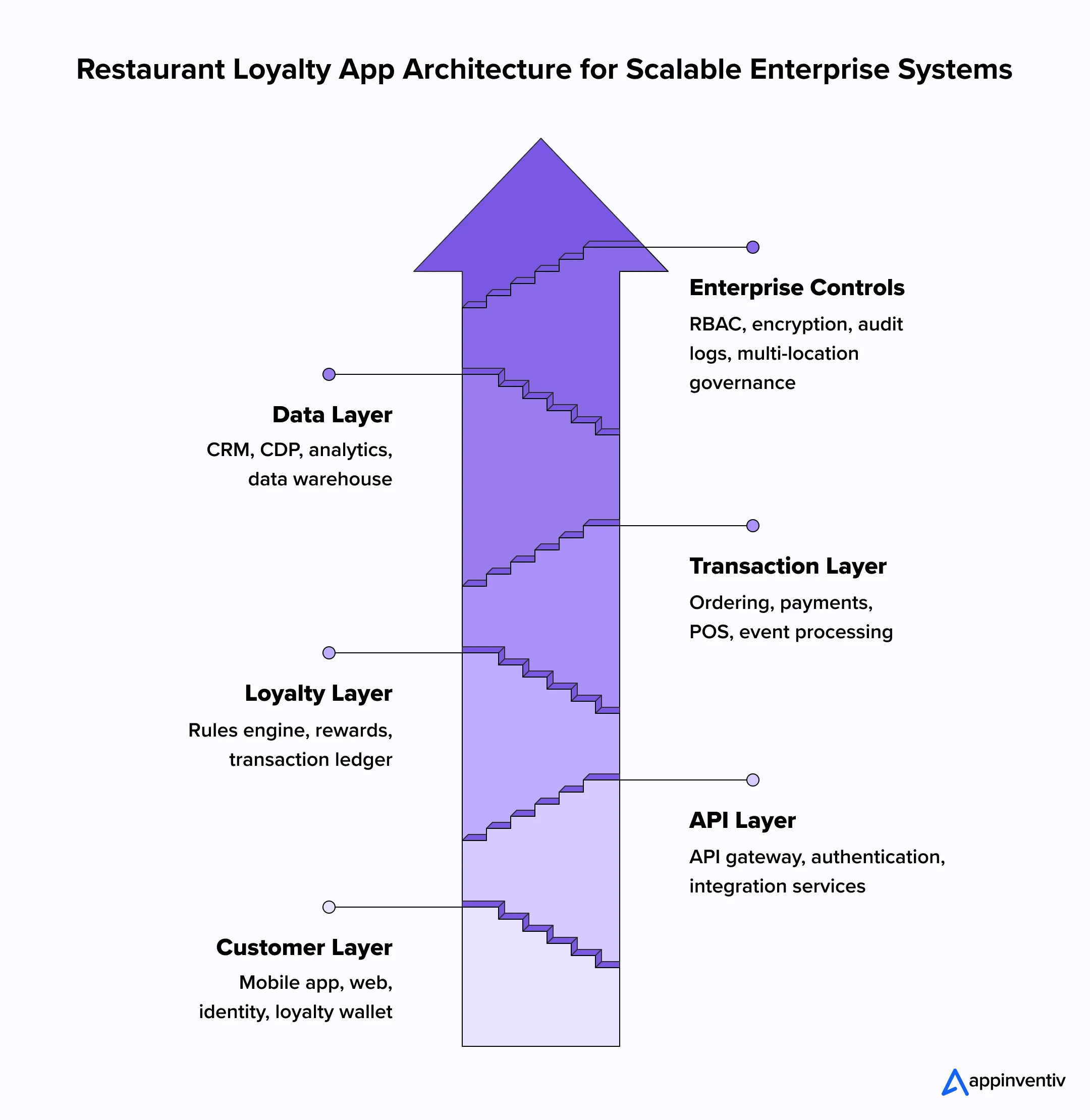
Customer Identity and Profile Layer
The identity layer establishes a single guest record across mobile orders, store visits, loyalty actions, and CRM communications. Identity resolution links these separate events to one profile without exposing personal details.
The profile service stores guest attributes including visit frequency, order histories, preferences, loyalty tiers, and privacy consents. A pseudonymized identifier separates analytical activity from direct personal data. OAuth 2.0 and OpenID Connect protocols handle account authentication, and consent records govern permitted messaging and data usage.
Loyalty Engine and Transaction Ledger
The loyalty engine forms the central system of record for account balances and rewards. Every transaction moves through a defined sequence of states:
Earn → Pending → Available → Redeem → Reverse → Expire
The engine calculates point accruals, tier progression, reward eligibility, promotional multipliers, and location-specific rules. A transaction ledger logs balance adjustments alongside original event details and timestamps. This ledger maintains a complete audit trail for financial reconciliation following refunds, order cancellations, or network errors.
API and Event Architecture
REST APIs manage customer profiles, rewards, mobile ordering, and administrative requests across platforms. Webhooks receive event data directly from POS registers, payment gateways, and third-party ordering systems. Asynchronous event distribution sends transaction updates across dependent microservices without creating rigid system dependencies.
Idempotency keys prevent duplicate point assignment during repeated network requests. Retry queues automatically process temporary integration failures, and reconciliation routines compare source records against loyalty logs to detect balance discrepancies.
Enterprise Scalability and Security
Multi-location and multi-brand deployments require tenant-aware data models, store-level configurations, and centralized administrative controls. Horizontal scaling distributes API traffic and processing workloads across multiple server nodes. Strategic database caching reduces the number of read operations during peak ordering hours.
Data encryption protects sensitive records during transmission and storage. RBAC protocols limit administrative actions by staff role and store location, and API security manages authentication, authorization, rate limits, and request validation. Complete audit logs record sensitive administrative actions and balance edits. Comprehensive system observability across APIs, message queues, databases, and third-party integrations helps technical teams address operational issues quickly.
Restaurant Loyalty App Integrations With POS, Payments, CRM, and Ordering
Restaurant loyalty platforms rely on backend connections that link customer activity directly with store operations. Every connected tool exchanges transaction details at specific points in the purchase process.
POS Integrations
POS links match completed counter sales with guest loyalty profiles. Cloud POS systems like Toast, Square, and Clover send order subtotals, customer IDs, and store location codes to calculate points or apply rewards. The System Reversals process customer refunds automatically, and audit routines identify discrepancies across multi-terminal setups.
Ordering and Delivery Integrations
Ordering interfaces connect loyalty perks to first-party channels like pickup, delivery, curbside, and digital menus. Paytronix reports an 18% increase in order frequency when restaurant loyalty programs are paired with online ordering. Checkout screens identify registered guests and attach order receipts to their profiles, while APIs pass permitted customer details from connected ordering platforms into the central profile.
Also Read: How To Implement AI Voice Ordering For Restaurants: Benefits and Use Cases
Payment Integrations
Payment gateways process credit cards, tokenized credentials, and digital options like Apple Pay and Google Pay. Payment confirmations attach directly to order records before awarding loyalty points. Strict PCI DSS standards mandate that cardholder data be kept within secure payment channels rather than in loyalty databases.
CRM and CDP Integrations
CRM and CDP software gathers customer purchase histories, demographic tags, and behavioral records into unified profiles. Shared profiles power targeted marketing campaigns across all digital channels. Data flows follow strict identity matching routines and user privacy choices.
Marketing and Engagement Integrations
Push notifications, email, and SMS tools issue messages for earned rewards, abandoned carts, or inactive accounts. Marketing automation engines launch targeted messaging sequences based on real-time guest choices. Consent management flags move alongside customer records to preserve user preferences across communication channels.
The value of an integration strategy becomes clearer in practice, and Kudu shows how connected restaurant channels can improve operations.
Kudu required a unified digital presence covering mobile apps, websites, languages, and ordering options. Appinventiv engineered a digital core featuring headless architecture, central management tools, and uniform ordering flows for delivery, pickup, carhop, and dine-in. The platform registered 500K+ new users and gave operators control over menus, promotions, localization, and ordering workflows.
How Can Data and AI Improve Restaurant Loyalty Apps?
First-party customer data helps restaurant loyalty platforms increase guest retention and average order values. Value grows through connecting identity records with order histories, store visit rates, and digital engagement signals across channels.
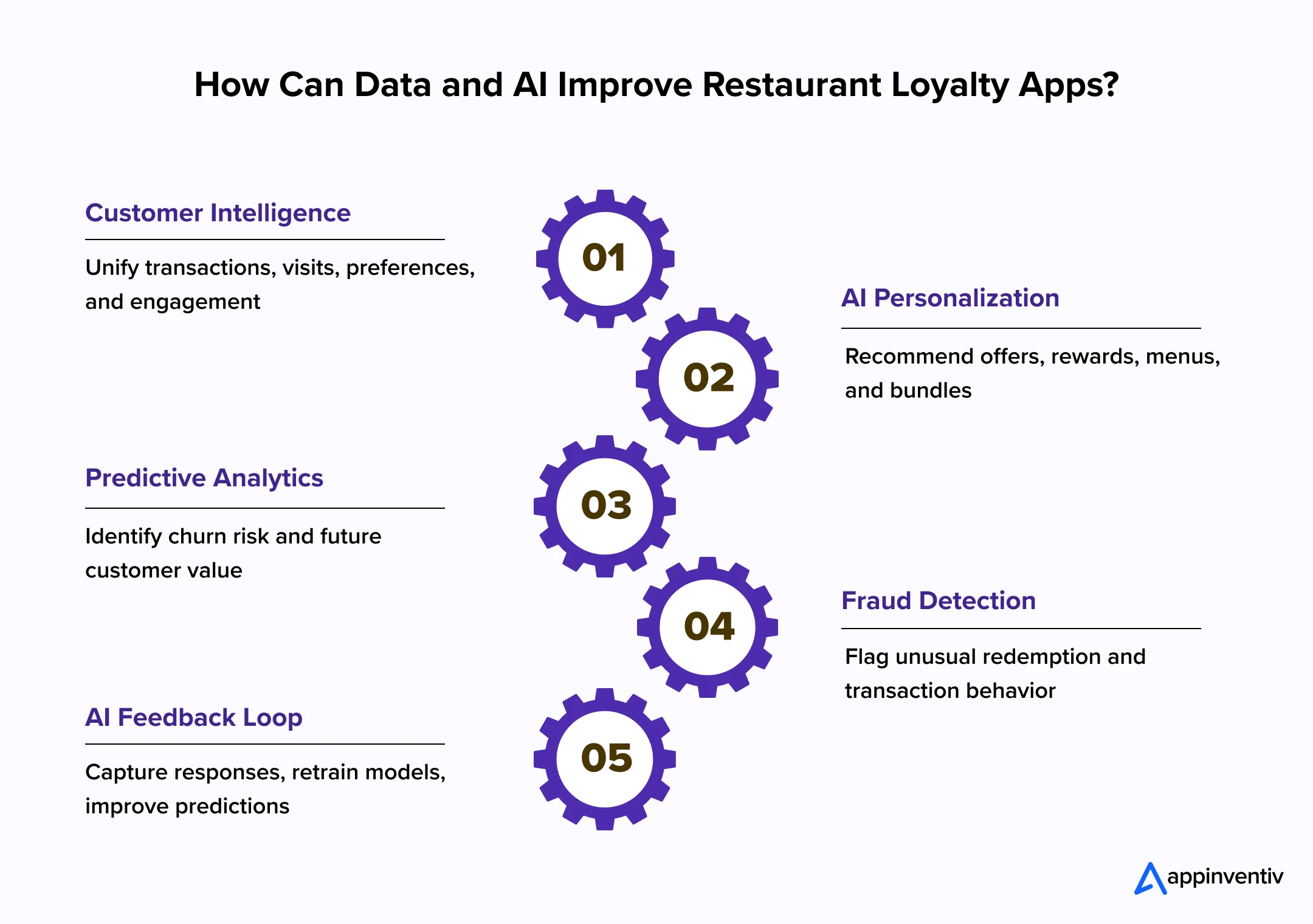
Turn Loyalty Data Into Customer Intelligence
System pipelines process guest transactions to record purchased items, store locations, and visit frequency. Behavioral metrics capture menu browsing habits, offer redemption patterns, and campaign responses.
Customer data platforms combine these signals into actionable audience segments. Predictive analytics then spot churn risks, purchase frequencies, and campaign response probabilities. Paytronix reports that predictive personalization can increase retention by up to 25%, showing the commercial value of turning loyalty data into targeted actions. Marketing tools can then deliver rewards based on these segments across apps, websites, and POS registers.
AI-Powered Loyalty Use Cases
In restaurant rewards app development, AI in the restaurant industry converts customer signals into targeted actions across acquisition, retention, ordering, and fraud prevention.
- Next-Best-Offer Recommendations: Models rank offers by evaluating purchase history, visit timing, location, reward usage, and prior campaign responses.
- Personalized Rewards: Machine learning algorithms select rewards that match individual guests’ preferences rather than assigning generic incentives across membership tiers.
- Churn Prediction: Predictive tools flag accounts showing declining visit frequency or reduced ordering activity to launch targeted win-back campaigns.
- Menu Recommendations: Recommendation engines suggest specific dishes, add-ons, or meal bundles based on past choices and real-time context.
- Customer Lifetime Value Prediction: CLV models estimate future spending to help operational teams segment accounts and align reward expenditures with revenue.
- Fraud and Anomaly Detection: Anomaly detection systems flag unusual redemption rates, suspicious account edits, or irregular transaction patterns for human review.
AI Architecture for Personalization
Personalization flows begin by gathering user events from mobile applications, POS terminals, and CRM software. Data pipelines push these raw signals into structured storage where feature engineering builds model-ready inputs.
Machine learning models generate recommendations like churn risk scores or custom offers. The campaign engine applies active business logic and transmits messaging through chosen communication channels. Response logs are returned to storage pipelines to update model training cycles continuously.
Build AI-powered restaurant loyalty platforms with customer segmentation, churn prediction, next-best-offer models, and real-time personalization from Appinventiv.

Benefits of Choosing to Develop a Restaurant Loyalty App
Investing in a well-executed restaurant app built around customer loyalty improves revenue performance by turning customer actions into repeat business and targeted engagement.
- Increase Repeat Visits: Loyalty rewards encourage guests to return and drive targeted reactivation campaigns during periods of low visitation. Operational teams track guest habits to measure changes in repeat-purchase frequency.
- Increase First-Party Orders: Branded restaurant mobile apps establish direct sales channels and strengthen guest relationships. Direct digital orders lower reliance on third-party marketplaces, giving operators control over customer records and commission costs.
- Increase Customer Lifetime Value: Purchase history details help teams send targeted incentives to guests showing strong retention traits. Tailored rewards increase visit frequency, average check sizes, and total lifetime spend.
- Build First-Party Customer Intelligence: Loyalty app records identity, sales, and behavioral data across all touchpoints. These records create complete customer profiles for audience segmentation, reporting, and campaign evaluation.
- Personalize Customer Engagement: Specific customer groups receive tailored deals that match their visit patterns, meal preferences, and past orders. Marketing departments gain precise promotion options instead of running blanket discount campaigns.
- Improve Customer Relationships Across Locations: Unified platforms link customer activity across separate stores, restaurant brands, and digital channels. Executive teams view centralized operational reports, and store managers execute local promotions.
Restaurant Loyalty App Development Cost and Key Cost Factors
Restaurant loyalty app development costs $40K to $400K+, depending on features, integrations, architecture, platforms, and security needs. Multi-brand deployments, complex POS networks, custom AI, or enterprise data infrastructure exceed this range.
| Development Scope | Estimated Cost | Estimated Timeline | Typical Scope |
|---|---|---|---|
| Loyalty MVP | $40K – $80K | 2 to 4 months | Profiles, points, rewards, basic notifications, loyalty wallet |
| Mid-Level Platform | $80K – $150K | 4 to 6 months | Ordering, POS, payments, campaigns, analytics, referrals |
| Advanced Platform | $150K – $250K | 6 to 9 months | Multiple integrations, personalization, complex loyalty rules, advanced analytics |
| Enterprise Ecosystem | $250K – $400K+ | 9 to 12+ months | Multi-location or multi-brand architecture, AI, advanced data infrastructure, enterprise security |
Factors That Influence Development Cost
Project budgets depend on technical choices and operating requirements.
- Feature scope: Mobile ordering, referrals, tiered rewards, personalization, and campaign tools increase programming work.
- Platforms: Supporting iOS, Android, web, and store terminals adds frontend engineering and testing needs.
- UX/UI complexity: Custom journeys, accessibility, localization, and branding affect design hours.
- Backend architecture: Microservices, event queues, data pipelines, and transaction logic require deep engineering.
- Loyalty engine: Intricate points, tiers, expiration rules, eligibility, and reversals increase backend work.
- POS integrations: POS providers demand separate API mapping, authentication, webhooks, and reconciliation logic.
- Payment integrations: Gateways, digital wallets, tokenization, and transaction status checks add build effort.
- CRM/CDP connections: Customer identity resolution and bidirectional data flows expand integration scope.
- Analytics and AI: Predictive models, recommendation engines, feature stores, and monitoring require data engineering.
- Security: Encryption, RBAC permissions, audit logs, penetration testing, and privacy controls add validation work.
- Multi-location support: Shared platform architectures with store-level rules demand multi-tenant models.
- Team composition: Project budgets reflect architects, mobile developers, backend engineers, DevOps, data specialists, QA, and security leads.
Ongoing Operational Costs
Initial restaurant app development cost represents one part of total ownership costs.
- Cloud infrastructure: Storage, databases, computing, bandwidth, backups, and pipelines.
- Third-party APIs: Subscriptions for POS, CRM, messaging, maps, and analytics.
- Payment processing: Gateway fees, processing charges, and digital wallet costs.
- Platform maintenance: Bug fixes, dependency updates, OS compatibility, and server maintenance.
- Security maintenance: Vulnerability scans, monitoring, audits, certificates, and patches.
- System monitoring: Performance tracking, log servers, alerts, and incident management.
- Technical support: Help desk operations, troubleshooting, and system management.
- Future enhancements: Expansion for new loyalty structures, integrations, markets, and AI capabilities.
How to Measure Loyalty App ROI
Financial evaluation measures incremental shifts in behavior rather than baseline guest spending.
- Repeat purchase frequency
- Average order value
- Customer lifetime value
- Reward redemption rate
- Customer reactivation rate
- First-party order share
- Incremental revenue
- Net reward cost for each incremental purchase
- Loyalty program ROI
Accurate measurement compares loyalty member metrics against a control group or historical baseline. This comparison isolates reward-driven revenue from purchases that guests would have made anyway.
Common Restaurant Loyalty App Development Mistakes and Challenges
Enterprise loyalty platforms often break at the system architecture level rather than in user interfaces. Technical oversights affect customer adoption, transaction accuracy, profit margins, and data quality.
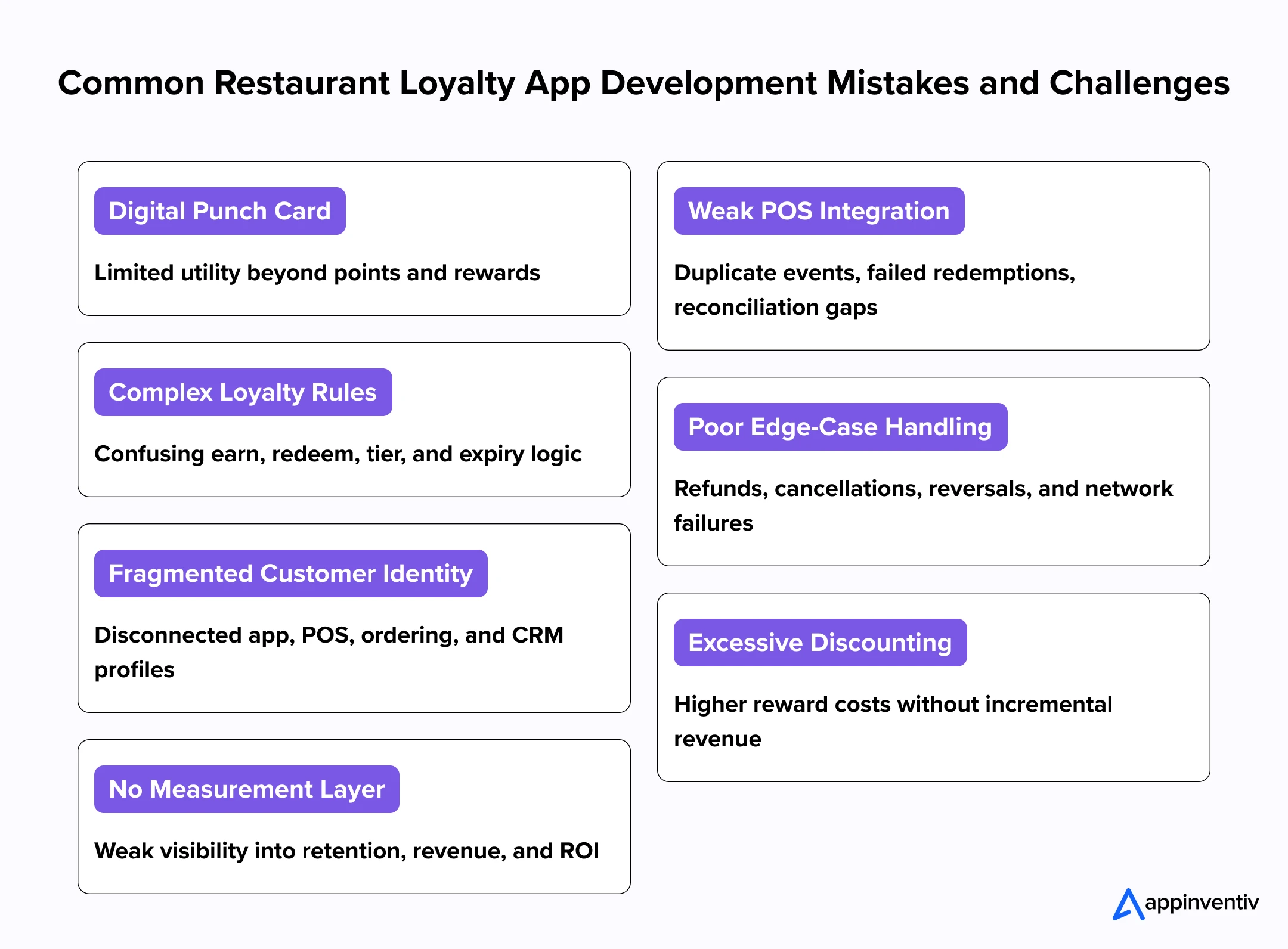
Treating the App as a Digital Punch Card
Restaurant loyalty card app development that stops at points-only features gives guests little motivation to open the app between visits. A smart restaurant app needs direct ordering, reward tracking, personalized offers, customer service, and engagement workflows.
Fix: Connect loyalty programs directly to purchasing channels, customized incentives, and measurable financial metrics.
Underestimating POS and Legacy Integrations
POS hardware environments display varying API formats, order states, and data schemas across store networks. Flawed integrations produce duplicate events, delayed points, failed redemptions, and reconciliation discrepancies.
Fix: Implement event-driven pipelines, idempotency controls, retry queues, and audit jobs that process completed, cancelled, refunded, and failed transactions.
Designing Complicated Loyalty Rules
Complex earn-and-redemption calculations confuse guests and delay counter staff during checkout. Every additional rule increases the loyalty engine’s complexity and QA testing requirements.
Fix: Establish clear earning rates, expiration rules, tier thresholds, and eligibility terms, then test workflows across store channels.
Ignoring Refunds, Cancellations, and Edge Cases
Loyalty ledgers must remain accurate after customer refunds, order cancellations, partial reversals, duplicate records, failed payments, and network delays. Poor error management produces incorrect user balances and audit discrepancies.
Fix: Model transaction states directly inside auditable ledgers that execute systematic reversals, automated reconciliation, and controlled retries.
Fragmenting Customer Identity
Disconnected profiles across mobile apps, POS terminals, ordering platforms, and CRM databases prevent the creation of unified data records. Broken records weaken audience segmentation, offer targeting, campaign attribution, and multi-channel reporting.
Fix: Deploy unified identity architectures using identity resolution, consent management, and consistent customer IDs across connected tools.
Overusing Discounts
Broad discount campaigns increase reward redemptions without generating net new revenue, thereby protecting profit margins. Mass promotions reward guests who would have paid full price anyway.
Fix: Target promotional incentives based on behavioral segments, purchase histories, visit-frequency metrics, and incremental-margin evaluations.
Launching Without Measurement
Loyalty platforms require clear telemetry tracking performance metrics from initial deployment. Missing event instrumentation prevents engineering teams from separating genuine retention growth from standard purchasing activity.
Fix: Instrument platforms for cohort tracking, split testing, purchase frequency analysis, incremental revenue measurement, and customer lifetime value.
Every new location, POS, brand, and reward rule increases technical complexity when the foundation is not designed for enterprise growth.

How to Choose a Restaurant Loyalty App Development Partner
Selecting an engineering partner requires evaluating restaurant domain knowledge, enterprise system architecture, and complex transaction management. Specialized technical experience outweighs headcount during application builds across multi-unit operations.
- POS Integration Track Record: Verify experience connecting POS systems, APIs, webhooks, and ledger reconciliation routines across legacy environments.
- Engineering Breadth: Inspect frontend and backend engineering capabilities across guest mobile apps, cashier terminals, admin portals, and microservices.
- Loyalty Engine Expertise: Evaluate custom rule engines that process points, membership tiers, expiration schedules, reward reversals, and financial ledgers.
- Scalable Architecture: Audit event-driven architectures, cloud infrastructure design, and horizontal scaling capabilities for high transaction volumes.
- Data and AI Capabilities: Review data engineering experience building segmentation pipelines, predictive analytics, product recommendations, and personalization engines.
- Security and Compliance: Confirm security protocols that cover data encryption, RBAC controls, privacy consent records, audit logging, and PCI DSS compliance.
- Multi-Location Governance: Prioritize development teams experienced with multi-brand deployments, tenant configuration models, and central admin systems.
- DevSecOps Practices: Examine quality assurance testing, continuous integration, performance monitoring, and rapid deployment procedures.
- Post-Launch Support: Evaluate long-term maintenance agreements, infrastructure monitoring, security updates, and planned feature enhancements.
- Delivery Discipline: Require transparent pricing models detailing project scope, milestones, technical dependencies, and change management terms.
Proven technical capability and delivery discipline generate superior app outcomes over simple agency size.
Technical capability should be backed by proven AI delivery, and Compass India demonstrates how predictive systems can support restaurant operations.
Compass India required precise meal forecasting across store locations with fluctuating daily traffic. Appinventiv developed a predictive forecasting platform built with Prophet and AutoGluon, incorporating confidence scoring and human review stages. Initial deployments reached 92%+ forecast accuracy, and planner feedback continuously trains the underlying machine learning models.
Restaurant Loyalty App Development With Appinventiv for Enterprise Restaurant Brands
Appinventiv brings 10+ years of experience in restaurant loyalty app development to multi-unit platforms, connecting diner engagement with store operations. Development teams deliver custom restaurant app development services, including rule engines, native mobile apps, POS integrations, payment gateways, customer data platforms, and cloud backends.
Engineers deploy pre-developed application kits and modular code repositories for identity authentication, rules logic, API orchestration, and analytics, shortening build timelines without sacrificing custom flexibility. Machine learning models generate targeted offers, churn prediction, menu recommendations, and customer segmentation. Security engineering embeds role-based access, data encryption, and audit logging into every transaction path.
Clients achieve 40% efficiency gains through intelligent automation, backed by a 99.5% SLA on platform reliability and system performance. Appinventiv has completed 10+ loyalty and POS integrations, unifying customer activity across store registers and digital channels into scalable enterprise systems.
Let’s connect and plan restaurant loyalty app development before integration costs escalate.
Frequently Asked Questions
Q. How much does it cost to build a loyalty app for a restaurant?
A. Restaurant loyalty app development costs range from $40K to over $400K+, depending on features and project requirements. Initial loyalty MVPs run between $40K and $80K to deliver core point calculations and digital wallet access. Enterprise platforms featuring custom machine learning tools, POS connections, and multi-unit governance cost between $250K and $400K+.
Q. How long does it take to develop a restaurant loyalty app?
A. Building a loyalty application takes 2 to 12 months, depending on system complexity and integration depth. Simple MVP products take 2 to 4 months to deploy basic rewards and user profiles. Comprehensive enterprise builds with custom recommendation algorithms, payment gateways, and multi-brand networks require 9 to 12 months of development time.
Q. Can a restaurant loyalty app integrate with an existing POS system?
A. A custom loyalty application connects directly to major POS systems such as Toast, Square, and Clover via secure APIs and webhooks. These integrations sync transaction records, check reward eligibility during checkout, update customer points, and process partial refunds. Event-driven workflows prevent duplicate point credits during unexpected store internet outages.
Q. Can you integrate a loyalty app with restaurant CRM and ordering systems?
A. Custom loyalty apps establish two-way data sharing with enterprise CRM systems, CDPs, and digital ordering platforms. Central customer files log ordering choices, store visits, and campaign responses across channels. Integrated software helps marketing teams trigger targeted push notifications and custom discount codes based on guest purchasing activity.
Q. How can a restaurant loyalty app improve customer retention?
A. Loyalty applications drive guest retention by swapping broad discounts for personalized incentives and membership tiers. Machine learning models analyze past order histories to present custom menu choices and relevant promotion offers. Predictive churn algorithms spot inactive diners early, triggering automated win-back campaigns that give lapsed guests clear reasons to return.
Q. Can a restaurant loyalty app support multiple restaurant locations?
A. Enterprise loyalty architectures support multi-unit restaurant chains and multi-brand portfolios through multi-tenant database models. Central administrative control panels provide executive leadership with global program data, letting local store managers manage regional promotions. Role-based security permissions limit staff access by store location, keeping regional data isolated.
Q. Should restaurants build a custom loyalty app or use a white-label solution?
A. Expanding restaurant chains gain advantages from custom engineering through total ownership over application architecture, customer databases, and POS connections. Custom platforms support tailored reward rules without vendor subscription limits or the risk of feature delays. White-label templates enable faster initial launches but limit multi-brand growth, custom data access, and specialized operational workflows.
Q. What are some examples of successful restaurant loyalty programs?
A. Starbucks, Chick-fil-A, McDonald’s, and Dunkin’ Donuts demonstrate how major quick-service restaurant chains use loyalty systems to drive signups, food rewards, and points redemption. Programs such as Chick-fil-A One combine rewards with personalized customer experiences, while Starbucks uses loyalty data to support hyper-personalized experiences and targeted offers. Birthday rewards, booking platforms, and customer data integrations can further increase engagement. Enterprises can study these models when designing custom loyalty systems instead of relying solely on white-label solutions.


Fast 2-minute response, fully NDA-protected.
Restaurant Digital Transformation Driving 25%+ of Sales Across Over Half of Brands
Key Takeaways Per the survey, digital channels generate over 25% of sales for 57% restaurant brands. Higher digital sales do not guarantee better margins once fees, discounts, and fulfillment costs are included. Connected ordering and kitchen systems help reduce delays, cancellations, and manual work. Successful modernization starts with a focused pilot and measurable business results.…

Building a Restaurant Inventory Management System to Stop Food Cost Leaks
Key Takeaways A restaurant inventory system connects purchasing, receiving, recipes, sales, waste, transfers, and stock counts. Theoretical-versus-actual inventory reveals overportioning, unrecorded waste, missing stock, and inaccurate recipes. POS, ERP, supplier, kitchen, and IoT integrations create a dependable flow of inventory data. AI can strengthen demand forecasting, purchasing, anomaly detection, expiry management, and outlet benchmarking. Development…

Build Your Own: A Complete Guide to Menu Engineering Software Development (2026)
Key takeaways: Menu engineering works best when treated as a decision system, not a one-time analysis exercise. Accurate menu decisions depend on real cost data, clean POS mappings, and continuous analysis. Building custom menu engineering software makes sense when complexity, scale, and control matter. Most menu engineering software built in 2026 falls between $40,000 to…