




















 Leader in AI-First Product Engineering Read Full Article
 IT Managed & Outsourcing
 Contact Us
Enterprise Agentic AI systems can coordinate tasks, retrieve data, call APIs, and adapt actions based on context. Our approach combines agent memory, workflow orchestration, guardrails, and human review to support reliable execution across complex business operations.
Our Core Capabilities










Numbers That Explain the Approach
Agentic AI and Automation Systems Delivered
Custom Agents Trained and Deployed
Faster Decisions Through Autonomous Agents
Agent Decision Accuracy in Production
Faster Time-to-Market for Agentic Systems
Average Cost Reduction From Automated Workflows







Every engagement starts with a look at your existing workflows, decision points, and data systems, to find where autonomous agents can take over judgment calls, not just tasks. The output is a scoped roadmap, not a generic maturity score.
Workflow and decision-point mapping
Data and systems readiness assessment
Agent feasibility scoring
Phased implementation roadmap

The agent hierarchy, memory layers, tool integrations, and control loops are what turn a single model into a system capable of acting independently within defined limits. Settling this layer, and the AI tech stack beneath it, early on avoids rework later.
Agent hierarchy and role design
Memory and context architecture
Tool and API integration blueprint
Control loop and fallback design

Some workflows are best handled by one AI agent built for a specific role, like reconciling invoices. Our AI agent development trains each agent on your own business data, so it does that job reliably before taking on more.
Role-specific agent design and scoping
Reasoning and tool-use configuration
Training on proprietary business data
Performance testing and fine-tuning

Complex, multi-step business workflows get broken down into agent-executable logic and mapped onto the enterprise systems they already run on. A process that once needed several manual handoffs can then run to completion under one system's oversight.
Workflow decomposition into agent tasks
Decision-branch logic design
Handoff and escalation mapping
End-to-end execution testing

Some work is too complex for a single agent to own. We split it across specialized agents that run in parallel, each handling a distinct function, and coordinate them around a shared goal using multi-agent frameworks such as LangGraph, AutoGen, and CrewAI.
Specialized agent development
Inter-agent communication protocols
Shared-goal coordination logic
Conflict resolution and task arbitration

Sequencing agent actions, managing handoffs between agents, and keeping execution on track when a task branches into several paths is the job of the orchestration layer. It also handles AI agent interoperability, so agents built on different models or frameworks can pass context and tasks to each other without breaking the flow.
Task sequencing and routing
Agent handoff management
Branching and conditional logic
Execution monitoring and recovery

Connecting agents to the APIs, CRMs, and internal systems they need is what lets them act on a recommendation instead of stopping at it. Once connected, an agent can complete the task inside the same systems your team already works in.
CRM, ERP, and internal API integration
Voice and conversational interfaces
Third-party service connectors
Action execution and confirmation logic

Short-term context and long-term knowledge bases keep an agent grounded in your actual business data instead of guessing. The agent carries context from one step to the next, so its decisions stay consistent across a workflow.
Short-term and long-term memory design
Retrieval-augmented generation (RAG) pipelines
Knowledge base structuring
Context persistence across sessions

Autonomous systems need boundaries. Guardrails, audit trails, and escalation paths go in from the start, under an agentic AI governance framework that defines what each agent can access, approve, and change on its own.
Permission and access scoping
Audit logging and traceability
Escalation and human-in-the-loop rules
Compliance and policy enforcement
Not sure which workflow to start with?
Tell us where the bottleneck actually sits, and we'll tell you whether it's a fit for a single agent or a full multi-agent build.


Support requests get resolved end-to-end using context from past interactions. A human steps in only when a case genuinely needs one.

Lead qualification and pipeline updates happen directly inside your CRM. Your sales team spends its time on deals that are ready to move.

Incidents get caught and triaged as they happen, without waiting on a person to notice first. Routine issues are fixed automatically, while larger ones go to an engineer.

Information gets gathered across internal and external sources, cross-checked, and compiled into a usable brief instead of a stack of open tabs.

Handoffs between departments are usually the slowest part of any cross-team process. With an agent owning that handoff, work moves to the next team instead of waiting in a queue.

Inventory and disruptions are tracked from live operational data instead of a weekly report. When stock runs low or a shipment slips, orders get adjusted before it turns into a problem.

Incoming documents are read and the relevant details routed to the right team. Your source system stays the record of truth throughout.

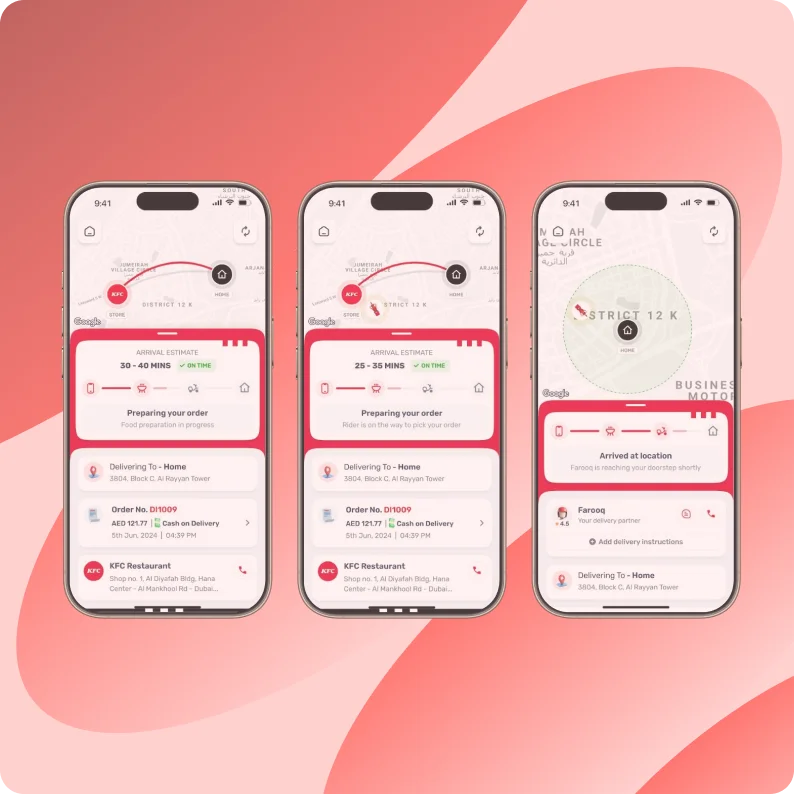
SMBs couldn't afford real strategic consultancy, and generic chatbots don't reason through a business's own documents.

A multi-agent RAG system: a router agent, a document-analysis agent, and a strategic-analysis agent working together on the ReAct framework, built on LangChain and GPT-4o.


A single static average for kitchen prep time across 11 UAE stores failed during peak hours, holidays, and bad weather.
11 independent per-store models reading live workload, weather, and time signals, corrected every minute, with a loss function tuned to the real cost of being wrong.
Responds to a single input with an output
Uses tools to finish a defined task
Plans, acts, and adapts to reach a goal
Low (20%)
Medium (55%)
High (90%)
A person makes every decision
Decides within preset rules or prompts
Makes multi-step decisions and corrects its own course
Someone asks
Responds to a single input with an output
A goal, an event, or a change in context
No persistent memory
Responds to a single input with an output
Persistent memory across sessions and systems
None; returns text, a score, or a prediction
Responds to a single input with an output
Coordinates many tools, APIs, and other agents



SOC 2 Type II

HIPAA
NIST SP 800-53
NIST AI Risk Management Framework (AI RMF)
NIST Cybersecurity Framework (CSF)
PCI DSS
FINRA AI Guidance

SEC AI and Predictive Data Analytics Rules and Guidance

FDA AI/ML Guidance

CCPA/CPRA
SOC 2 Type II
HIPAA
NIST SP 800-53
NIST AI Risk Management Framework (AI RMF)
NIST Cybersecurity Framework (CSF)

PCI DSS
FINRA AI Guidance
SEC AI and Predictive Data Analytics Rules and Guidance

FDA AI/ML Guidance

CCPA/CPRA
Sales, support, operations, and finance workflows touch each other. We build the agent architecture around those handoffs so work doesn't stall at a department boundary.
Appinventiv brings 3000+ digital solutions and 1600+ specialists to every build, the depth agentic AI development needs beyond a model wired to a few tools.
Audit trails, permission scoping, and escalation rules are part of the build from day one, so every agent action stays traceable and compliance ready.
We connect agents directly to your CRMs, ERPs, APIs, and internal systems, so they can act on real data instead of stopping at a recommendation.
We apply agentic AI where decisions are genuinely bottlenecked, in customer ops, revenue, IT, or supply chain, not to every process that touches a model, an approach rooted in causal AI for decision-making.
Launch isn't the finish line. We handle monitoring, guardrail tuning, and new agent capabilities as your workflows and business keep changing.
Still comparing agentic AI vendors?
Bring us your shortlist and your scoping questions. We'll walk you through how we'd approach it differently.

The India's Fastest-Growing Companies 2026 Recognised by TIME and Statista

Statista High Growth Companies APAC - 2026

Statista India's Growth Champions 2023






We place AI agent development inside sales, operations, and support workflows to catch bottlenecks, surface exceptions, and act on routine decisions before they pile up on a person's desk.
RAG development grounds every agent decision in your actual business data, pulling from internal documents and knowledge bases instead of letting a model guess at an answer.
AI governance consulting shapes how much autonomy an agent gets, where it needs to escalate, and how every action stays traceable once the system is live.
Generative AI development powers the reasoning and drafting layer inside agentic workflows, from proposal generation to document summarization to customer response drafting.
AI voice agent development extends agentic systems into phone and voice channels, so autonomous workflows aren't limited to chat and backend automation alone.
AI integration services connect agents securely to the CRMs, ERPs, and internal systems they need to act on, without fragile point-to-point workarounds that break the moment something upstream changes.
Ready to see this stack in action?
We'll show you how these technologies come together in a system built around your actual workflow, not a demo.



Reliability comes from testing agents against real edge cases before granting autonomy, building clear escalation paths for anything outside their confidence, and monitoring decisions in production rather than assuming they'll behave the same way they did in testing.
Multi-agent systems split a larger goal across specialized agents that each handle a distinct part of the work, then coordinate through an orchestration layer. They're worth the added complexity when a workflow is too broad for a single agent to own reliably, not for tasks a simpler system already handles well.
The main ones are giving an agent too much authority before it's proven reliable, weak error handling when a tool call or API fails, and insufficient monitoring once the system is live, so problems surface with a customer instead of in testing.
Cost depends on how many agents are involved, how many systems they integrate with, and how much governance the use case requires. A single-agent workflow costs meaningfully less than a multi-agent system spanning several departments, which is why we scope this during the strategy and assessment phase rather than quoting a flat number upfront.
RPA follows fixed, pre-defined rules with no reasoning involved. An AI agent uses tools and judgment within one defined task. Agentic AI goes further, planning multi-step work, coordinating several agents, and adapting when a process doesn't go as expected, closer to how a person would handle it than a rule-based script.
An agentic AI architecture typically includes an agent hierarchy defining roles and authority, a memory layer for context and retrieval, an orchestration layer that sequences actions and handoffs, tool and API integrations for taking real action, and a governance layer enforcing permissions and audit trails. Enterprise design means getting these layers right before the system touches production data.
Performance gets measured on task completion rate, decision accuracy against known outcomes, how often an agent escalates correctly versus incorrectly, latency under real load, and how it holds up against edge cases it wasn't explicitly trained on. A system that looks strong in a demo but hasn't been evaluated against these is still unproven.