
















12 Ways Restaurant Technology Is Transforming the Industry

 Share -


- 01Why Technology Investment Is Rising Across the Restaurant Industry
- 02From Front Counter to Back Office: Where Restaurant Technology Is Creating Value
- 0312 Restaurant Technology Trends Reshaping the Industry
- 04Emerging Restaurant Technology That Will Influence the Future
- 05Challenges Restaurants Must Address Before Adopting New Technology
- 06A Practical Framework for Choosing the Right Restaurant Technology
- 07Measuring the Business Value Created by Restaurant Technology
- 08How Appinventiv Helps Restaurants Turn Technology into Measurable Growth
- 09FAQs




Key Takeaways
- Restaurant technology now connects ordering, kitchens, inventory, staffing, payments, delivery, and management.
- AI-based forecasting helps restaurants plan purchasing, preparation, and employee coverage around expected demand.
- Smart kitchens, automated inventory, and connected equipment improve accuracy while reducing waste and downtime.
- AI voice ordering, personalized engagement, and contactless payments make customer journeys faster and more relevant.
- Reliable data, system integration, employee adoption, security, and human oversight determine whether automation succeeds.
- Restaurants should pilot new systems against clear performance baselines before scaling them across multiple locations.
Restaurants are no longer adopting technology simply to offer online ordering. They are using it to control food costs, plan staffing, manage delivery, improve table turnover, understand customers, and protect already narrow margins.
The pressure to make these investments is growing. According to the National Restaurant Association’s 2026 State of the Restaurant Industry report, more than nine in ten operators consider food, labour, insurance, energy, and payment-processing fees significant challenges. The report also found that 42% of operators were not profitable during the previous year.
Against this background, restaurant technology is becoming part of the operating model rather than a separate digital initiative. Ordering systems must communicate with the kitchen. Inventory records must reflect sales. Loyalty programs need payment and customer data. Forecasts must inform purchasing and staff schedules.
However, installing more software does not automatically improve a restaurant. The value comes from selecting systems that solve specific operational problems and connecting them around reliable data.
This blog examines the leading 2026 restaurant technology trends, how they are changing front- and back-of-house operations, and what restaurants must consider before investing.
Let us identify where connected systems, data, and automation can improve your margins and operations.
Why Technology Investment Is Rising Across the Restaurant Industry
Restaurant sales may be growing, but higher revenue does not necessarily produce stronger margins. Operators continue to face expensive ingredients, labour shortages, changing customer expectations, delivery costs, and uneven traffic.
Technology gives restaurants another way to manage this pressure. A forecasting system can help a kitchen prepare closer to actual demand. A connected ordering platform can reduce manual entry. Automated inventory records can reveal where ingredients are being overused or wasted.
Customer behaviour is also shaping investment. Diners now move between restaurant apps, websites, kiosks, drive-thrus, delivery platforms, and physical counters. They expect their account, rewards, preferences, order status, and payment options to remain consistent across these channels.
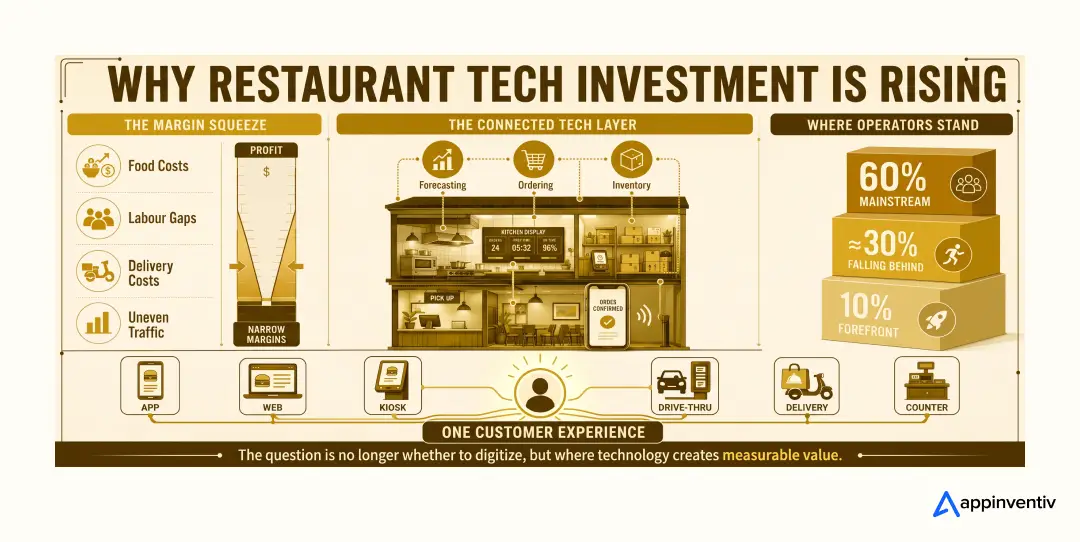
The National Restaurant Association reports that 60% of operators consider their businesses part of the technology mainstream. Almost three in ten believe they are falling behind, while only one in ten considers their restaurant to be at the forefront of technological innovation.
These figures show why technology in restaurants is receiving greater attention. The question is no longer whether restaurants should digitize. It is where technology can create a measurable improvement without disrupting hospitality or adding another disconnected system.
From Front Counter to Back Office: Where Restaurant Technology Is Creating Value
The technology used in restaurants now reaches almost every stage of the business. Some systems face the customer, while others operate quietly across kitchens, delivery networks, finance teams, and corporate offices.
| Area | Common technologies | Operational purpose |
|---|---|---|
| Customer discovery | Websites, restaurant apps, local search tools, AI discovery, digital listings | Helps customers find the restaurant and receive accurate information |
| Ordering | Mobile apps, kiosks, QR menus, voice systems and online ordering platforms | Reduces ordering friction and supports more service channels |
| Payments | Contactless terminals, mobile wallets, pay-at-table systems and tokenized payments | Accelerates checkout and improves payment security |
| Kitchen operations | Kitchen display systems, connected equipment and production-management tools | Improves order sequencing, preparation speed and accuracy |
| Inventory | Real-time stock records, waste tracking and demand forecasting | Reduces stockouts, overordering and food waste |
| Delivery | Dispatch platforms, geofencing, route optimization and driver tracking | Improves assignment, delivery visibility and fulfilment efficiency |
| Workforce management | Scheduling, attendance, labour forecasting and training platforms | Aligns employee coverage with expected demand |
| Customer retention | Loyalty platforms, CRM tools and personalization engines | Encourages repeat visits and more relevant engagement |
| Management | Business intelligence dashboards, financial reporting and anomaly detection | Gives operators a clearer view of performance across locations |
The strongest investments connect several of these areas. A sales forecast, for example, becomes more useful when it can influence purchasing, kitchen production, and staffing rather than remaining inside a reporting dashboard.
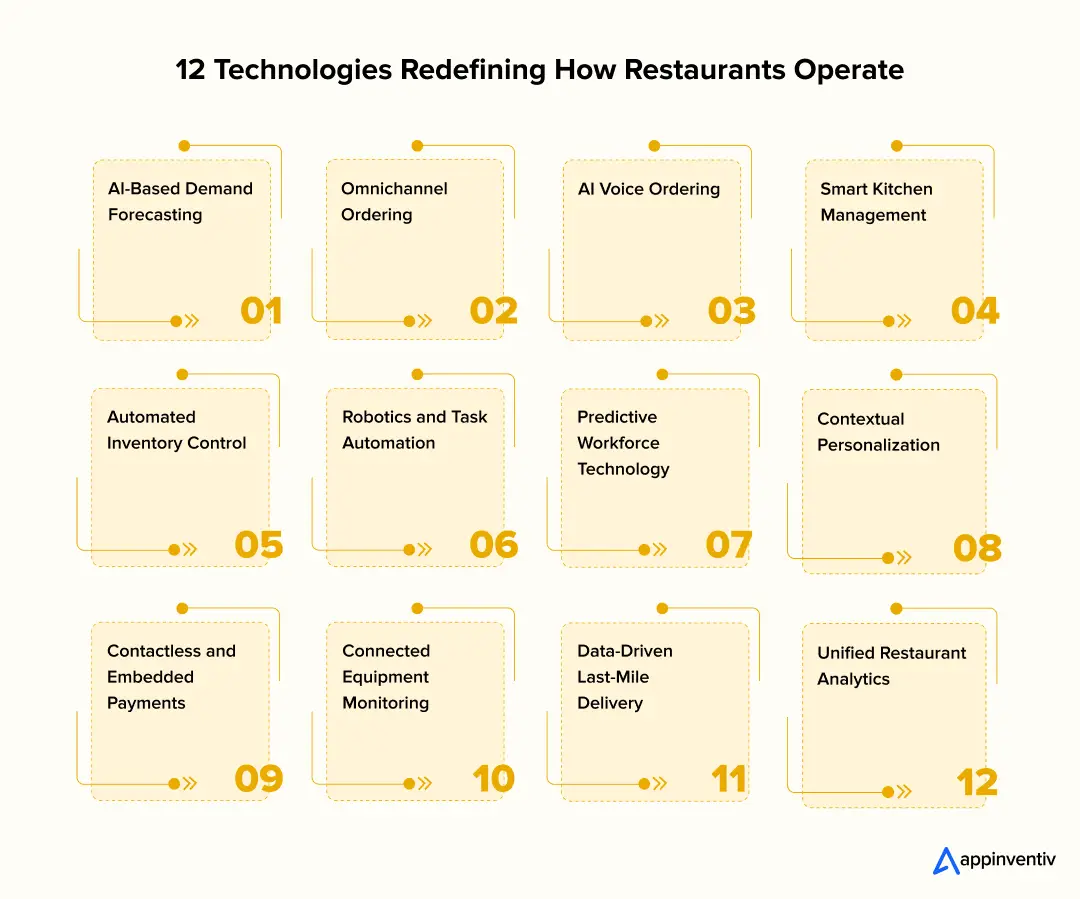
12 Restaurant Technology Trends Reshaping the Industry
The following restaurant industry technology trends extend beyond customer convenience. They are changing how restaurants plan, produce, serve, and grow.
1. AI-Based Demand Forecasting Is Improving Daily Planning
Traditional restaurant forecasting often depends on previous sales and a manager’s experience. That approach can work in stable conditions, but demand changes with weather, holidays, local events, promotions, school schedules, and delivery activity.
AI-based demand forecasting evaluates these variables together. It can estimate how many orders a restaurant may receive, which products are likely to sell, and when demand could rise or fall.
Managers can use these estimates to decide:
- How much stock to purchase
- Which ingredients to prepare
- How many employees to schedule
- When to begin batch preparation
- Which items may run out
- Whether a promotion could overwhelm capacity
The system should not make every decision independently. A manager may know about nearby construction, a private booking, or another local condition absent from historical data. The forecast should therefore present an informed starting point that employees can adjust.
Among the latest restaurant technology developments, demand forecasting has practical value because it connects directly with food costs, labour planning, and customer availability.
2. Omnichannel Ordering Is Replacing Isolated Sales Channels
A restaurant may receive orders through its app, website, delivery aggregators, kiosks, drive-thru, QR menus, telephone, and physical counter. When each channel operates separately, employees may need to monitor several devices and re-enter information into the POS system.
Omnichannel ordering brings these transactions into a coordinated workflow. Menus, prices, modifiers, taxes, availability, and order status can remain synchronized across channels.
A connected system can also determine where an order should go. A dine-in request may be linked to a table, while a delivery order may move to a dispatch queue. The kitchen still needs one clear production view.
The latest technology in restaurants is therefore moving away from adding independent channels. Operators are now focusing on orchestration: how every order enters the restaurant, reaches the kitchen, receives payment, and appears in reporting.
Restaurants should also retain control over channel-level rules. Delivery menus may require different products or prices, while drive-thru orders need shorter preparation journeys.
3. AI Voice Ordering Is Moving Beyond Basic Commands
Voice ordering systems are becoming more capable of handling accents, background noise, menu modifiers, substitutions, and follow-up questions. Restaurants are testing them across drive-thrus, telephone orders, apps, and kiosks.
An AI voice ordering system can:
- Welcome the customer
- Identify the selected location
- Answer menu questions
- Capture product modifications
- Suggest a relevant addition
- Confirm the order
- Send the request to the POS
- Transfer complex cases to an employee
Adoption remains at an early stage. Data cited from the National Restaurant Association’s 2026 report indicates that 26% of operators use some form of AI, but only 6% currently use it for customer ordering.
Voice AI must earn operational trust. The system needs to distinguish between a preference and an allergy, understand location-specific products, and confirm every modifier before payment. Employees should be able to intervene immediately when the conversation becomes uncertain.
These controls will determine whether new restaurant technology improves order speed or merely moves mistakes from the counter to an automated interface.
4. Smart Kitchens Are Connecting Orders with Production Capacity
Digital ordering can increase demand faster than the kitchen can handle it. A restaurant may accept dozens of orders within minutes even when equipment, ingredients, or employees cannot support the promised preparation times.
Smart restaurant technology addresses this gap by connecting incoming orders with the kitchen’s actual workload. Kitchen display systems can sequence orders according to channel, preparation requirements, promised time, and station capacity.
A connected kitchen may also:
- Route products to the correct preparation station
- Combine items belonging to the same order
- Alert employees about approaching deadlines
- Track preparation and holding time
- Adjust collection estimates
- Limit unavailable time slots
- Identify recurring production bottlenecks
This does not mean every kitchen needs robotics. For many restaurants, the most valuable improvement is simply giving employees one accurate order queue and preventing the ordering system from making promises the kitchen cannot keep.
The technology trends in restaurant industry operations increasingly connect demand with production rather than treating them as separate workflows.
5. Inventory Platforms Are Moving from Counting to Prevention
Basic inventory software records what a restaurant has purchased and used. More advanced platforms explain why actual usage differs from expected usage.
They can compare sales with recipe quantities, transfers, waste logs, refunds, voids, and employee meals. When the difference exceeds a set threshold, managers can investigate before the issue becomes a monthly financial surprise.
Emerging restaurant technology can also use sales forecasts and live stock records to recommend purchase quantities. The objective is not simply to prevent shortages. Restaurants must avoid buying ingredients that will expire before use.
A connected inventory system can help teams:
- Calculate theoretical and actual food costs
- Identify unusual ingredient usage
- Track shelf life and expiration
- Generate purchase recommendations
- Record waste by reason
- Transfer stock between locations
- Compare supplier prices
- Detect recurring portion inconsistencies
Inventory management is one of the clearest examples of how technology is changing the restaurant industry. It turns stock control from a periodic administrative task into a continuous operating process.
6. Robotics and Automation Are Taking Over Repetitive Tasks
Automation in restaurants attracts attention when a robot prepares food or delivers a plate. Yet many useful applications are less visible.
Restaurants can automate repetitive work such as beverage dispensing, ingredient portioning, frying, tray movement, dish handling, floor cleaning, temperature logging, and packaging checks.
The business case depends on more than labour replacement. Operators should assess whether automation can improve:
- Product consistency
- Employee safety
- Production speed
- Portion accuracy
- Equipment utilization
- Waste control
- Availability during peak periods
A machine designed for a high-volume, standardized menu may create value in a QSR but remain unsuitable for a chef-led restaurant with frequent menu changes.
The leading restaurant technology trends for 2026 show that AI and automation deliver the most value when applied to suitable workflows. They should handle repetitive physical and administrative tasks, allowing employees to focus on hospitality, judgment, and unusual situations.
7. Workforce Technology Is Becoming More Predictive
Employee scheduling affects labour costs, customer service, and staff satisfaction. Too few employees can slow operations, while excessive coverage raises costs without improving revenue.
Modern workforce platforms combine availability, skills, labour rules, historical traffic, sales forecasts, and planned events. Managers can build schedules around expected demand while checking overtime, break, and compliance requirements.
Employees may use the same system to:
- Submit availability
- Exchange approved shifts
- View schedules
- Clock in securely
- Complete training
- Receive operational updates
- Track performance goals
AI may recommend coverage, but managers still need to review its effect on employees. A schedule that is mathematically efficient can still create unstable hours or unreasonable shift patterns.
The responsible use of technology in restaurants should improve working conditions alongside productivity. Employee feedback and override controls are essential when predictive systems influence schedules or performance assessments.
8. Personalization Is Becoming More Contextual
Restaurants have long segmented customers according to broad categories such as frequent, inactive, or high-spending. Connected customer data allows more relevant personalization.
A restaurant can consider what the customer usually orders, when they order, which location they use, whether products are currently available, and which rewards they can redeem. The resulting recommendation can help the customer complete an order rather than simply display a generic promotion.
Examples include:
- Recommending a previously ordered breakfast during morning hours
- Reminding a customer about an unused reward
- Suggesting a meal suitable for the selected party size
- Presenting location-specific offers
- Adjusting communication frequency
- Identifying the most appropriate reorder time
Yum China shows the scale that connected loyalty and ordering can achieve. In February 2026, the company reported more than 590 million loyalty members.
Businesses must understand that innovative restaurant technology should still give customers meaningful control over their data. Personalization must be useful, proportionate, and easy to disable.
9. Contactless and Embedded Payments Are Shortening Checkout
Payment is no longer limited to a terminal placed beside the cash register. Customers can pay through mobile applications, QR codes, kiosks, digital wallets, table-side devices, links, and stored payment tokens.
Embedded payments reduce the need to move between ordering and payment systems. A customer can select a meal, apply loyalty credit, add a tip, and complete payment within one journey.
Restaurants benefit when payment data also reconciles with orders, refunds, promotions, taxes, tips, and location-level reporting.
The new technology in restaurants must account for difficult payment scenarios, including:
- A successful payment with a failed order
- Duplicate payment attempts
- Split bills
- Partial refunds
- Gift cards and loyalty balances
- Tips distributed across employees
- Chargebacks
- Offline terminal operation
Faster payment matters, but reliability matters more. Restaurants must use tokenization, strong authentication, role-based permissions, activity logs, and secure integrations to protect financial and customer data.
10. Connected Equipment Is Supporting Preventive Maintenance
Ovens, refrigerators, freezers, fryers, ventilation systems, and beverage machines affect both service and food safety. When equipment fails without warning, the restaurant may lose products, remove menu items, or stop operations.
Connected sensors can monitor temperature, energy consumption, operating time, vibration, and equipment behaviour. The system can alert the responsible employee when a value moves outside an acceptable range.
This form of smart restaurant technology can support:
- Automated temperature records
- Cold-storage monitoring
- Maintenance scheduling
- Equipment fault alerts
- Energy management
- Warranty records
- Multi-location asset visibility
- Food-safety documentation
Predictive maintenance goes a step further by identifying patterns that often appear before failure. It does not eliminate the need for technicians, but it gives teams more time to act.
Among restaurant industry technology trends 2026, connected equipment is especially relevant for multi-location brands that cannot rely on manual checks across every asset and outlet.
11. Last-Mile Delivery Is Becoming a Data Operation
Customers experience delivery as a simple journey from the restaurant to their door. Behind it sits a difficult coordination problem involving order preparation, driver availability, distance, traffic, location accuracy, handoff, and customer communication.
Modern delivery platforms can automate order assignment, validate customer locations, track drivers, adjust estimated arrival times, and highlight service exceptions.
Geofencing helps determine whether a driver entered the correct pickup or delivery area. Route optimization can account for distance and current conditions, while real-time dashboards allow managers to investigate delayed or unassigned orders.
Appinventiv helped Americana Restaurants address these challenges by developing the Americana Last Mile Platform. The platform unified fragmented order, driver, location, and delivery data across more than 2,100 restaurants and multiple brands. It also introduced automated order assignment, geofencing controls, rider tracking, and real-time operational dashboards.
The platform has processed more than 60.45 million orders without downtime. Automated order assignments increased from 42% to 82%, geofencing compliance improved from 20% to 80%, and report-loading time fell by 90%. These results gave store managers greater control over delivery performance while reducing manual intervention across last-mile operations.
12. Unified Analytics Is Replacing Disconnected Reports
Restaurants generate data through orders, payments, inventory, loyalty, staffing, delivery, customer support, and equipment. When every system produces a separate report, leaders still struggle to understand what is happening across the business.
A unified analytics layer can connect this information around shared definitions. For example, every location should calculate sales, refunds, labour cost, preparation time, and food variance consistently.
Dashboards can then answer questions such as:
- Which locations are losing customers after the first order?
- Where are preparation delays increasing?
- Which promotions generate profitable repeat business?
- Which products have high sales but weak margins?
- Where does actual ingredient usage exceed expected usage?
- Which ordering channels produce the highest contribution margin?
- How does staffing affect service time?
The latest restaurant technology is moving from retrospective reporting toward real-time alerts and recommended actions. Managers should not have to search through several dashboards to discover that one location has an unusual refund rate or growing delivery delay.
However, analytics is only reliable when the underlying data is consistent. Restaurants need common product identifiers, location records, time definitions, and ownership rules before introducing advanced intelligence.
We will help you separate promising technology from investments that can produce measurable returns.
Emerging Restaurant Technology That Will Influence the Future
Not every concept is ready for large-scale implementation. Some developments require further testing, better economics, or stronger governance before restaurants can depend on them.
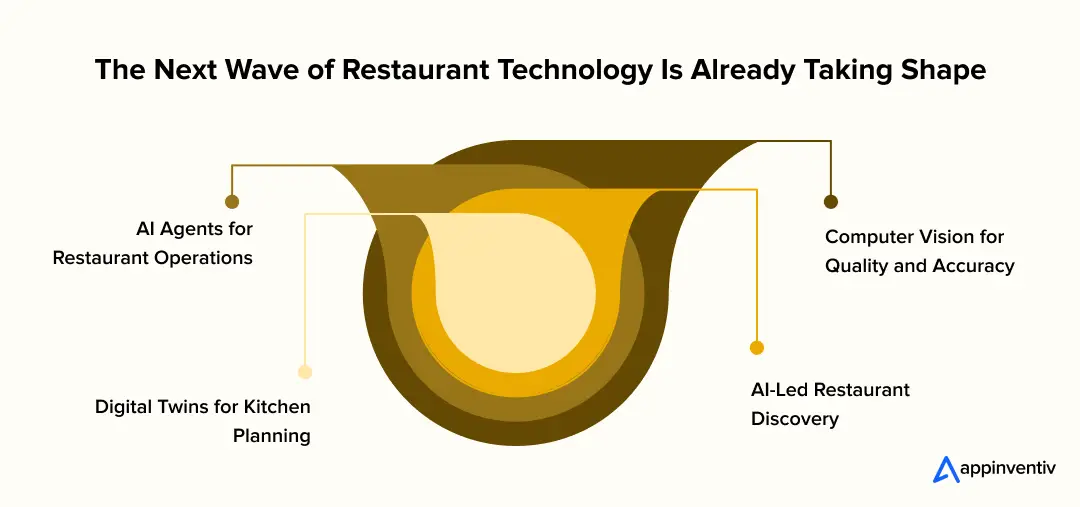
AI Agents for Cross-System Restaurant Operations
An AI agent can observe events, retrieve information, evaluate options, and complete approved actions across connected systems.
For example, an agent could identify that a delivery order will be late, check the customer’s loyalty status, prepare an appropriate credit, send an update, and escalate the case if the delay exceeds a defined limit.
Other potential uses include:
- Monitoring low-stock products
- Preparing purchase recommendations
- Rescheduling delivery capacity
- Identifying abnormal refund patterns
- Responding to routine customer requests
- Updating product availability
- Summarizing daily location performance
AI agents require strict permissions. Pricing changes, food-safety incidents, high-value refunds, employee decisions, and sensitive complaints should involve human approval.
Among the key restaurant technology trends in 2026, AI automation is moving beyond recommendations to completing selected operational tasks. Restaurants must therefore define what an AI agent can access, change, communicate, and execute without human approval.
Computer Vision for Quality and Order Accuracy
Computer vision can analyse images or video to identify objects, movement, and conditions. In restaurants, it may help confirm whether a packaged order contains the expected products or whether a preparation station follows a standard process.
Potential applications include:
- Detecting missing packaged items
- Monitoring queue length
- Checking product presentation
- Measuring drive-thru activity
- Identifying spills or blocked areas
- Supporting food-waste analysis
Accuracy must be tested in the actual restaurant environment. Lighting, packaging, steam, overlapping products, and crowded workspaces can affect performance.
Restaurants must also address employee privacy, customer consent, data retention, camera placement, and local surveillance requirements before deployment.
Digital Twins for Restaurant and Kitchen Planning
A digital twin creates a virtual representation of a physical operation. Restaurant teams could use it to test kitchen layouts, equipment placement, order flow, staff movement, and capacity before changing the real location.
Multi-location businesses may also model how a new menu, delivery channel, or production process will affect throughput.
This emerging restaurant technology remains more relevant to large or high-volume operations because it requires detailed operational data. Its value comes from reducing the cost and disruption of testing changes in live restaurants.
AI Visibility and Restaurant Discovery
Customers are beginning to use conversational AI tools to decide where to eat. This changes restaurant discovery because AI systems may summarize options without sending every user to a conventional search results page.
Restaurants will need accurate and consistent information across their website, menus, business profiles, review platforms, reservation systems, and structured data.
Opening hours, prices, cuisine, location, dietary options, reservations, and menu details must remain current. The restaurant’s own digital presence becomes an important source for AI-driven recommendations.
New restaurant technology is therefore affecting customer acquisition before a person opens the restaurant’s app or website.
Challenges Restaurants Must Address Before Adopting New Technology
The biggest risk is not choosing an unfashionable tool. It is introducing restaurant management software that does not fit its workflows, data, employees, or commercial priorities.
| Challenge | Business impact | Practical response |
|---|---|---|
| Disconnected systems | Orders and data must be entered several times, increasing errors and manual work. | Use APIs or an integration layer to connect POS, kitchen, inventory, loyalty, payment, and delivery systems. |
| Poor-quality data | Forecasts and recommendations become unreliable when product, customer, or inventory records are incomplete. | Establish common data definitions, validation rules, ownership, and regular quality checks. |
| Employee resistance | Employees may avoid tools that complicate service or feel imposed without context. | Involve front- and back-of-house teams during discovery, testing, training, and rollout. |
| Unclear return on investment | Restaurants may purchase technology without knowing which cost or performance measure should improve. | Define baseline metrics, expected outcomes, ownership, and a review period before implementation. |
| AI errors | AI may recommend unavailable items, produce incorrect forecasts, or mishandle customer requests. | Ground AI in verified restaurant data, define confidence thresholds, and require review for sensitive actions. |
| Security and privacy risks | Connected platforms can expose payment, customer, employee, and operational data. | Apply encryption, tokenization, role-based access, activity logs, testing, and data-retention controls. |
| Limited scalability | A system that works in one outlet may struggle across different menus, taxes, languages, and workflows. | Test multi-location controls, localization, performance, permissions, and configuration before expansion. |
| Vendor dependence | Proprietary systems may make data extraction, integration, or provider changes difficult. | Review data ownership, API access, export options, service levels, and exit terms before selection. |
| Automation without oversight | Incorrect automated actions can spread quickly across customers or locations. | Set approval limits, escalation rules, exception queues, and complete audit trails. |
| Loss of hospitality | Excessive automation can make service feel impersonal or inaccessible. | Use technology to remove waiting and repetitive work while retaining employees for judgment and guest interaction. |
A successful restaurant innovation program starts with an operating problem, not a product demonstration. Restaurants should identify where revenue leaks, delays, waste, or manual effort occur before selecting a solution.
A Practical Framework for Choosing the Right Restaurant Technology
Restaurant technology investments should begin with a specific business problem, not with the popularity of a tool. A restaurant struggling with order accuracy has different priorities from one losing margin through food waste or delivery commissions.
Before approving a system, decision-makers should examine where the problem occurs, what data the solution requires, how it will affect employees, and which measurable result would justify the investment.
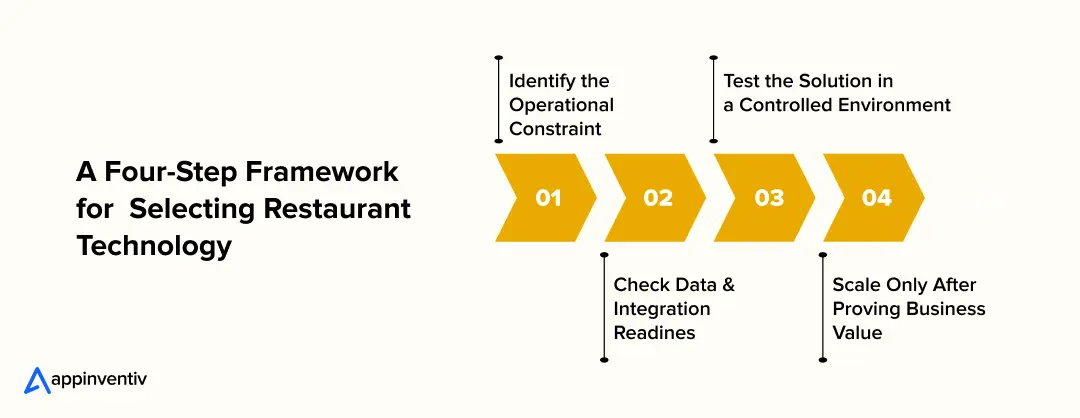
Identify the Operational Constraint
Start by locating the issue that is having the greatest commercial or operational effect. It may be slow order handling, inaccurate inventory, excessive food waste, high labour costs, equipment downtime, or weak customer retention.
The restaurant should establish the current performance level before introducing technology. For example, if the goal is to improve delivery, record the existing assignment time, delivery duration, failure rate, refund volume, and cost per order.
This baseline prevents teams from selecting an attractive solution for a problem that has not been clearly defined.
Check Data and Integration Readiness
The proposed system must work with the restaurant’s existing POS, kitchen, menu, payment, inventory, delivery, and customer platforms. If these systems contain conflicting information, adding automation may spread errors more quickly.
Restaurants should assess:
- Data availability and accuracy
- API and integration support
- Ownership of customer and operational data
- Security and permission requirements
- Compatibility across locations
- Reporting and export options
- Dependence on a particular vendor
Smart restaurant apps or software technology requires a reliable operational foundation. An AI forecasting system, for instance, cannot produce dependable estimates when sales, inventory, or product records remain incomplete.
Test the Solution in a Controlled Environment
Restaurants should validate new systems through a limited pilot before extending them across the business. The initial test may involve one location, ordering channel, kitchen station, or customer segment.
The pilot should reflect normal operating conditions as well as peak periods and unusual situations. Teams need to observe how the system handles unavailable products, payment failures, sudden demand, delayed deliveries, network disruption, and employee overrides.
Feedback should come from customers and the employees who use the system during service. A tool may perform well technically while creating additional steps for restaurant teams.
Scale Only After Proving Business Value
A successful technical implementation does not automatically justify wider deployment. Restaurants should compare pilot results with the original baseline and determine whether the system improved the intended outcome.
Before scaling, confirm that the technology:
- Reduced cost, errors, or service time
- Improved revenue or customer retention
- Worked during high-volume periods
- Integrated reliably with existing systems
- Gained acceptance from employees
- Met security and compliance requirements
- Can support differences between locations
Restaurants can then expand in stages while continuing to monitor performance. This approach keeps investment tied to measurable value and prevents unproven tools from being deployed across the entire organization.
Turn transactions into better forecasts, tighter inventory, faster kitchens, and stronger customer intelligence.
Measuring the Business Value Created by Restaurant Technology
Usage figures alone do not show whether an investment is working. Employees may log into a system every day because it is mandatory, while the restaurant continues to experience delays, waste, payment failures, or falling retention.
A proper measurement model should connect technology performance with commercial results, restaurant operations, customer experience, and employee workload.
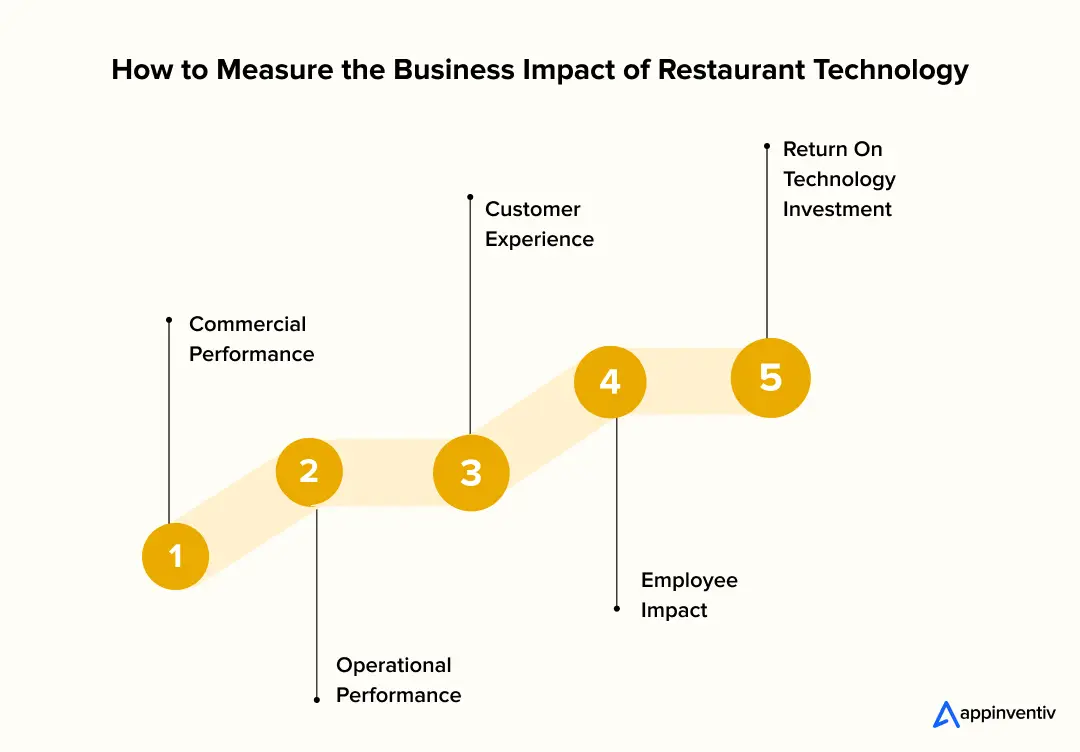
Commercial Performance
Commercial metrics show whether the investment is strengthening revenue and margins. Restaurants should track revenue by channel, average order value, contribution margin, repeat purchases, promotion profitability, customer acquisition cost, and delivery commissions.
These measures must be reviewed together. An ordering platform may increase sales while also raising discounts, refunds, packaging costs, and support requests. Revenue growth alone would hide that impact.
Operational Performance
Operational measures reveal whether technology is making the restaurant easier to run. Relevant indicators include preparation time, order accuracy, inventory variance, food waste, stockouts, delivery delays, equipment downtime, and manual interventions.
Restaurants should compare results across locations and service periods. If one outlet improves while another struggles with the same system, the problem may involve training, configuration, integration, or local workflows rather than the technology itself.
Customer Experience
Customer metrics help determine whether the system has removed friction from ordering and service. Restaurants can review conversion rates, cart abandonment, payment failures, complaints, satisfaction, repeat-order intervals, loyalty participation, and support-resolution time.
Customer feedback should accompany numerical data. A higher conversion rate does not indicate a successful experience if diners repeatedly complain about inaccurate estimates, unavailable products, or difficult refund processes.
Employee Impact
Technology should reduce unnecessary work rather than transfer it to restaurant employees. Operators should monitor task completion time, manual entry, schedule stability, overtime, training requirements, system adoption, employee turnover, and staff feedback.
Managers should also examine how frequently employees bypass or override the system. Repeated overrides may indicate that its recommendations do not reflect real restaurant conditions.
Return on Technology Investment
The final assessment should compare the total value created with the complete cost of ownership. This includes software licenses, development, integrations, hardware, training, support, maintenance, security, and future upgrades.
Restaurants can calculate return using improvements such as:
- Additional contribution margin
- Lower food and labour costs
- Reduced refunds and order errors
- Lower delivery commissions
- Less equipment downtime
- Higher repeat-order revenue
- Time saved through automation
The restaurant industry technology trends worth scaling are those that deliver sustained improvement without harming service quality or increasing pressure on employees. If a system generates more digital orders but also increases delays, refunds, and operational costs, the restaurant should refine the implementation before expanding it.
How Appinventiv Helps Restaurants Turn Technology into Measurable Growth
Technology is changing restaurants across ordering, preparation, staffing, inventory, delivery, and financial planning by connecting systems that once operated separately. The leading restaurant industry technology trends 2026 point toward unified ordering, live operational data, predictive planning, controlled automation, and contextual customer engagement.
However, successful restaurant innovation must begin with a clear operational problem and reliable data. Restaurants that measure results and connect the right technology with the right decisions will create more value than those simply adopting the greatest number of tools.
As a restaurant app development services partner, we help restaurant brands define the right product roadmap, modernize legacy systems, connect data, develop customer and management applications, and introduce AI with appropriate controls.
Our experience includes collaborations with major restaurant brands:
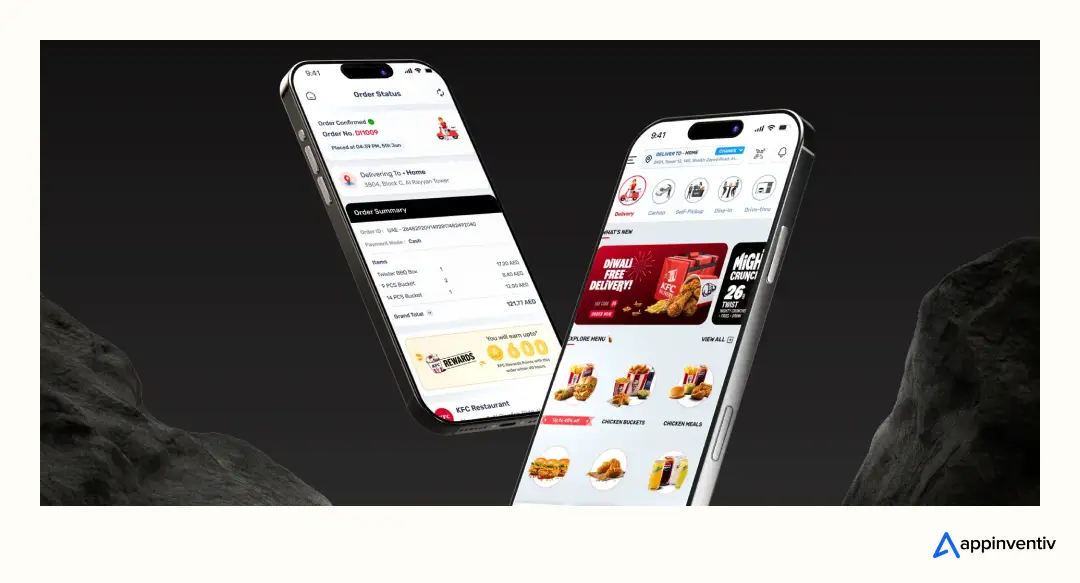
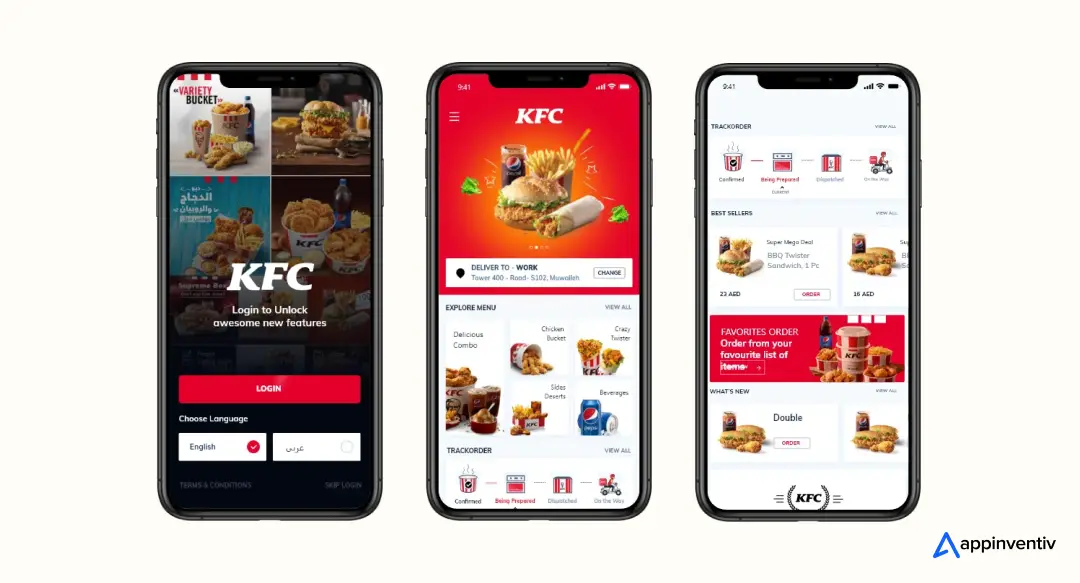
- KFC: We developed and launched seven applications across multiple markets. The platform introduced delivery, self-pickup, drive-thru, dine-in, carhop, QR ordering, and analytics. It processes more than 30,000 orders daily and contributed to a 22% increase in conversion.
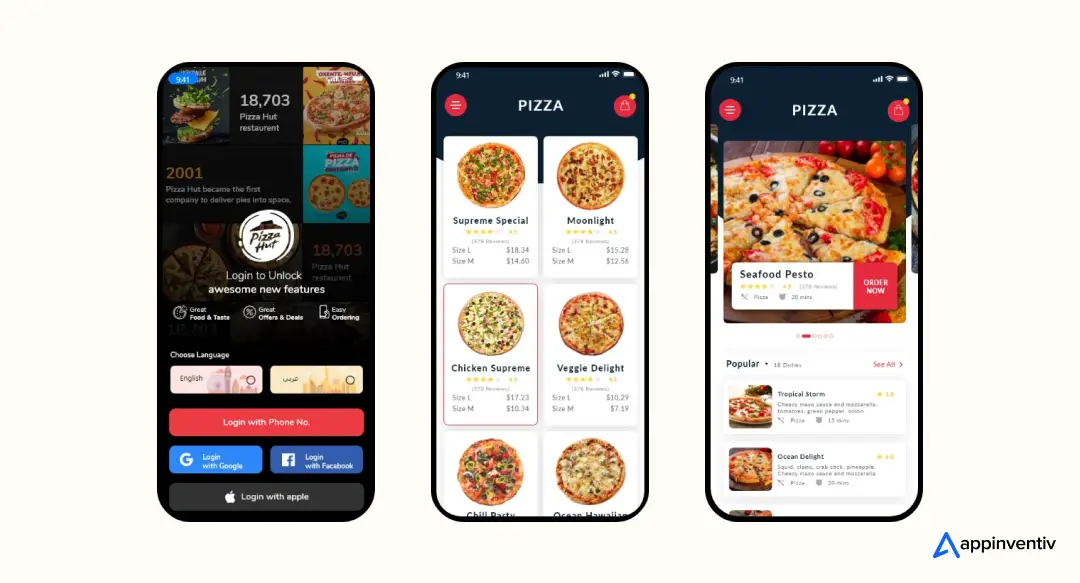
- Pizza Hut: We redesigned and developed food delivery applications for multiple MENA markets, generating more than 50,000 downloads and contributing to a 30% increase in conversion.
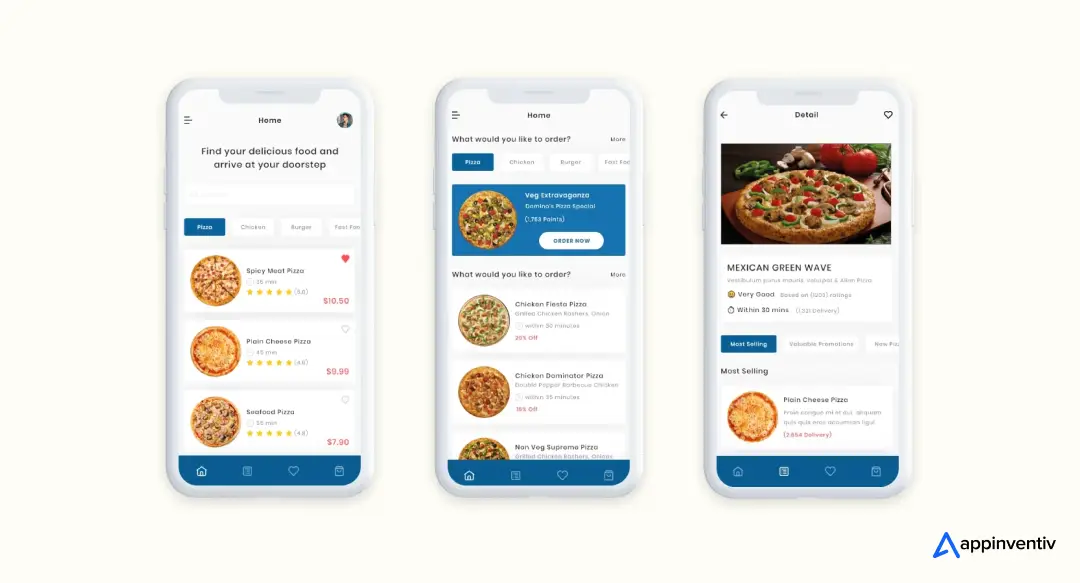
- Domino’s: Our UI/UX transformation simplified the ordering journey and contributed to a 23% increase in conversion.
We can also help businesses integrate POS, ordering, payments, kitchens, inventory, delivery, loyalty, and analytics into one scalable ecosystem. Our teams also support cloud engineering, cybersecurity, data platforms, automation, AI development, testing, and post-launch optimization.
This approach allows restaurants to invest in technology around real operational priorities rather than adding disconnected tools that employees and customers must work around.
FAQs
Q. What are the latest 2026 restaurant technology trends transforming customer experience?
A. The latest restaurant technology is reducing friction across discovery, ordering, payment, and support. The most important developments include:
- Omnichannel ordering across apps, websites, kiosks, and tables
- AI voice ordering and conversational assistance
- Personalized menus, recommendations, and loyalty offers
- Contactless and pay-at-table transactions
- Real-time reservations and digital waiting lists
- Live order and delivery tracking
These technologies deliver greater value when menus, customer accounts, availability, and rewards remain consistent across every channel.
Q. What are the most impactful innovations transforming the restaurant industry?
A. AI demand forecasting, connected kitchens, automated inventory management, smart equipment monitoring, workforce intelligence, and unified analytics are among the most impactful innovations.
These systems help restaurants plan demand, improve order accuracy, reduce food waste, manage labour, and identify operational problems earlier. Their value comes from connecting customer activity with kitchen, inventory, staffing, and delivery operations.
Q. What are the benefits of using AI-powered inventory management in a commercial kitchen?
A. AI-powered inventory management helps commercial kitchens move beyond periodic stock counting. It compares sales, recipes, purchases, waste records, and actual ingredient usage to identify issues earlier.
Its main benefits include:
- More accurate purchase recommendations
- Fewer stockouts and emergency orders
- Reduced overordering and food waste
- Earlier detection of unusual ingredient usage
- Better inventory visibility across locations
Managers should still review recommendations when menu changes, supplier problems, or local events make historical patterns less reliable.
Q. What risks should restaurants consider when adopting AI and automation?
A. AI and automation can spread errors quickly when they use inaccurate data or have excessive permissions. Major risks include unreliable forecasts, inappropriate recommendations, customer-data exposure, unauthorized refunds, employee resistance, and dependence on a particular vendor.
Restaurants should use verified data, restrict system access, define approval limits, maintain audit trails, and provide a clear path to human intervention. Food-safety concerns, allergen questions, pricing changes, employee decisions, and sensitive complaints should always receive human review.
Q. How can restaurants measure the ROI of a technology investment?
A. Restaurants should begin by documenting performance before implementation. They can then compare improvements in:
- Revenue and contribution margin
- Order value and repeat purchases
- Preparation time and order accuracy
- Food waste and stockouts
- Labour costs and overtime
- Delivery performance
- Customer complaints and refunds
The calculation should include software, development, integrations, hardware, migration, training, security, maintenance, and support. A system creates real ROI only when its sustained commercial and operational value exceeds its complete ownership cost.
Q. How much does it cost to implement restaurant technology?
A. Costs can range from a few thousand dollars for a standard ordering, reservation, or inventory product to $100,000-$500,000 or more for a custom enterprise platform.
The final investment depends on the number of locations, applications, user roles, integrations, hardware, data migration, security requirements, and AI capabilities. Multi-brand or multi-country platforms generally cost more because they must support different menus, taxes, currencies, languages, and operating workflows.


Fast 2-minute response, fully NDA-protected.

Restaurant Digital Transformation Driving 25%+ of Sales Across Over Half of Brands
Key Takeaways Per the survey, digital channels generate over 25% of sales for 57% restaurant brands. Higher digital sales do not guarantee better margins once fees, discounts, and fulfillment costs are included. Connected ordering and kitchen systems help reduce delays, cancellations, and manual work. Successful modernization starts with a focused pilot and measurable business results.…

Capture 22% More Restaurant Visits With Restaurant Loyalty App Development
Key Takeaways An enterprise loyalty app requires rule engines, POS synchronization, event-driven APIs, and auditable ledgers to protect the accuracy of transaction data. Custom versus white-label app choices depend on data rights, integration depth, extensibility, scalability, differentiation, and lifetime cost. POS, ordering, payment, CRM, and CDP connections construct unified customer profiles across restaurant store channels…

Building a Restaurant Inventory Management System to Stop Food Cost Leaks
Key Takeaways A restaurant inventory system connects purchasing, receiving, recipes, sales, waste, transfers, and stock counts. Theoretical-versus-actual inventory reveals overportioning, unrecorded waste, missing stock, and inaccurate recipes. POS, ERP, supplier, kitchen, and IoT integrations create a dependable flow of inventory data. AI can strengthen demand forecasting, purchasing, anomaly detection, expiry management, and outlet benchmarking. Development…