




















Restaurant Digital Transformation Driving 25%+ of Sales Across Over Half of Brands

 Share -


- 01What the 25% Digital Sales Milestone Actually Means for Restaurant Leaders
- 02Why Restaurant Businesses Need Digital Transformation in 2026
- 03Where Restaurant Technology Digital Transformation Investments Can Deliver the Most Value
- 04How Digital Transformation Priorities Change Across Restaurant Models
- 05What Should Your Restaurant Modernize First?
- 06Restaurant Digital Transformation Strategies: How to Modernize Without Disrupting Service
- 07How to Decide Whether Your Restaurant Pilot Is Ready to Scale
- 08Restaurant Digital Transformation Cost: What Should Businesses Budget?
- 09Where AI Fits in Restaurant Operations and What to Prove Before Scaling
- 10How to Choose a Restaurant App Development Firm for a Connected Business
- 11How Appinventiv Helped Leading Restaurant Brands Improve Digital Performance
- 12Build Your Next Phase of Restaurant Growth With Appinventiv
- 13FAQs




Key Takeaways
- Per the survey, digital channels generate over 25% of sales for 57% restaurant brands.
- Higher digital sales do not guarantee better margins once fees, discounts, and fulfillment costs are included.
- Connected ordering and kitchen systems help reduce delays, cancellations, and manual work.
- Successful modernization starts with a focused pilot and measurable business results.
- The full investment includes integrations, rollout, training, and ongoing support alongside app development.
- Restaurant AI needs reliable operational data and proven outlet-level results before wider adoption.
In 2025, 57% of restaurant brands surveyed generated more than a quarter of their sales through digital channels, up from 49% in 2024. Qu’s 2026 State of Digital & Beyond report draws on 168 quick-service and fast-casual brands with at least 20 locations each. For these operators, digital ordering already carries a substantial share of the business.
But a digital sale tells you where an order started. It says little about what the restaurant earned from it.
An app promotion might fill the order queue while overwhelming the kitchen. A delivery order can add revenue while commissions and discounts eat into its margin. A loyal customer might receive an offer for an item their nearest outlet has already sold out. These are the problems restaurant leaders need their next technology investment to solve.
That gives restaurant digital transformation a more demanding brief. Ordering systems need to understand kitchen capacity. Promotions need to account for item availability and profitability. Customer data needs to help teams earn another visit without automatically offering another discount.
The investment questions are changing, too. Can existing systems support those decisions? Where can AI produce a measurable return? Which capabilities should a brand buy, build, or connect? And how can a successful pilot work across hundreds of outlets with different operating conditions?
This blog examines those decisions through the economics of a restaurant order. We will explore capacity-aware ordering, connected data, practical AI applications, and the architecture behind them, alongside implementation costs and measures of success. The goal is to help restaurant owners, operations leaders, and technology teams turn growing digital demand into profitable, dependable service.
Share your ordering setup and operational challenges. Get a focused assessment of what to prioritize for your restaurant’s digital transformation!
What the 25% Digital Sales Milestone Actually Means for Restaurant Leaders
Once digital channels account for a quarter of sales, decisions about ordering technology affect the entire restaurant. A checkout update can change kitchen demand. A loyalty campaign can increase pressure on a short-staffed outlet. An inaccurate pickup estimate can leave customers waiting even when their food was prepared correctly.
The next stage of restaurant digitization therefore requires a closer look at how orders move, where costs accumulate, and which systems control those decisions.
Digital Sales Share Does Not Prove Additional Growth
A customer who previously ordered at the counter may now use a kiosk. The transaction becomes digital, but the restaurant has not necessarily gained another visit or a larger order.
This distinction matters when approving technology budgets. A rising digital sales percentage can reflect customers switching channels rather than spending more.
Leaders should separate three outcomes:
- Channel migration: Existing customers move from staffed ordering to digital channels.
- Incremental demand: Technology brings additional orders, visits, or customers.
- Operational improvement: The restaurant serves existing demand with fewer errors, less effort, or better margins.
Each outcome has value. However, each needs a different business case. A kiosk investment might succeed by reducing queues, while a direct-ordering app might justify its cost through repeat purchases.
Every Ordering Channel Needs Its Own Profit Calculation
Two orders with the same bill value can produce very different returns.
Consider an illustrative $30 order. If a marketplace charges a 20% commission, $6 goes to that fee before accounting for food, packaging, labor, or promotions. A direct order avoids that particular commission but still carries payment, software, and customer acquisition costs.
The useful question is how much each order contributes after its associated costs.
Restaurant digital transformation strategies should connect channel reporting with financial data so leaders can examine:
- Contribution per order after channel fees, discounts, and fulfillment costs.
- Repeat purchases after an introductory offer expires.
- Refunds, missing items, and remakes by ordering source.
- Whether digital demand increases total outlet sales or shifts existing purchases.
Without this view, a successful campaign can look better on the marketing dashboard than it does in the outlet’s accounts.
Kitchen Capacity Must Influence What Customers Can Order
Digital channels can accept orders faster than a kitchen can prepare them. Adding another ordering option does not add another grill, packing station, or employee.
Qu’s report reflects this pressure: 62% of surveyed brands identified improving order flow across channels as an operational priority for 2026, while 48% prioritized more accurate ready and pickup times.
A practical response is to make ordering decisions sensitive to current conditions. Pickup estimates should adjust to the queue. Unavailable items should disappear across channels. Large scheduled orders should count toward capacity before the lunchtime rush begins.
For restaurant leaders, this changes the purchasing brief. Beyond asking whether software accepts orders, they need to ask whether it helps each outlet make promises its team can keep.
Why Restaurant Businesses Need Digital Transformation in 2026
Digital channels now carry a significant share of restaurant sales. The investment question has shifted: can the business serve that demand profitably, consistently, and across more locations? Five pressures make restaurant digital transformation a priority in 2026.
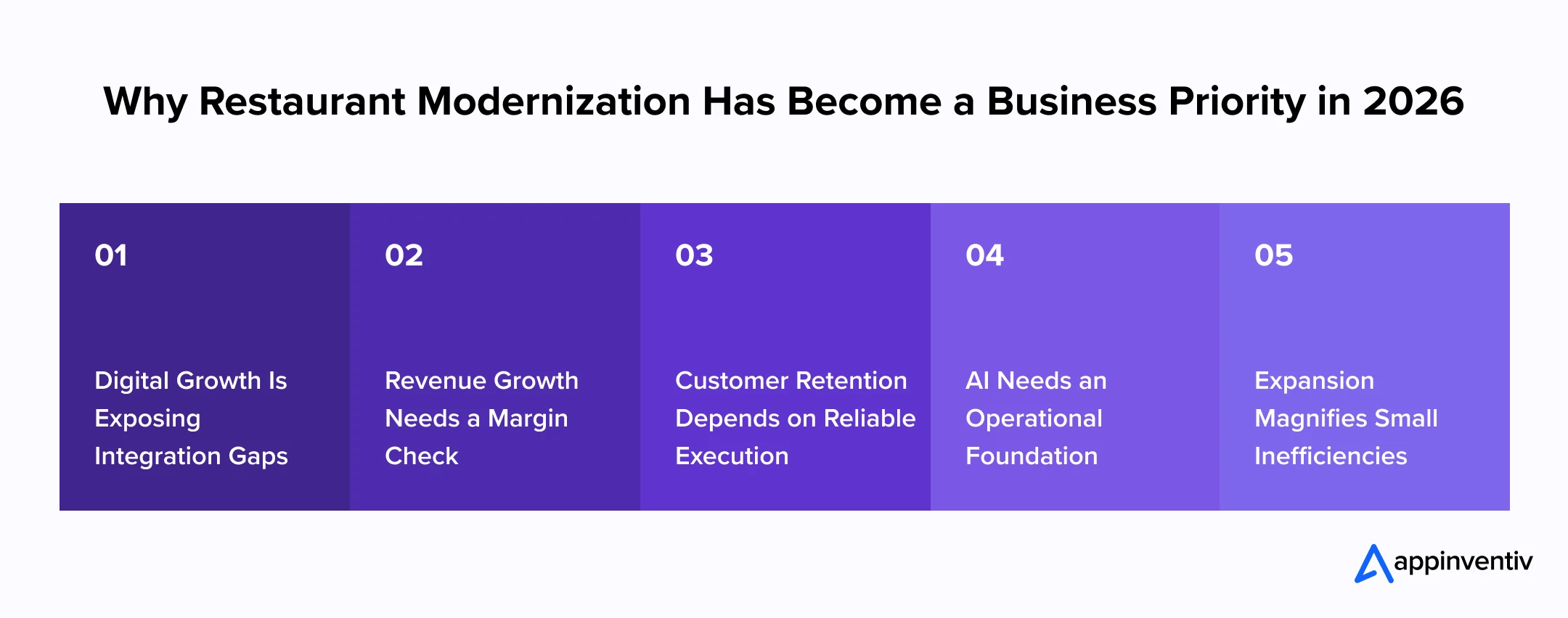
Digital Growth Is Exposing Integration Gaps
Orders arrive through apps, kiosks, websites, and delivery platforms, but staff often reconcile them manually. Every disconnected handoff adds work and room for error. Connecting ordering, payments, and kitchen systems helps outlets handle higher volumes without increasing administrative work at the same rate.
Revenue Growth Needs a Margin Check
Higher sales can hide expensive discounts, delivery fees, and refunds. Leaders need contribution visibility by channel, outlet, and campaign to see which orders are worth acquiring. That information should guide promotional spending and channel investment.
Customer Retention Depends on Reliable Execution
An attractive app cannot compensate for unavailable items or missed pickup times. Customers judge the complete order experience. Synchronizing menus, rewards, and order status helps restaurants deliver the service they promise and gives customers a reason to return.
AI Needs an Operational Foundation
Forecasting and personalization depend on accurate records. If systems cannot distinguish an item stockout from weak demand, AI recommendations may mislead teams. Connecting sales, availability, and promotion data gives businesses a stronger foundation for testing AI against measurable outcomes.
Expansion Magnifies Small Inefficiencies
A manual menu update is manageable at one outlet. Across dozens, it becomes a control problem. Shared menu management, access controls, and consistent reporting help brands expand while preserving local flexibility and reducing the effort needed to oversee each location.
The priority is to identify which gap is costing the business most, then build the technology roadmap around closing it.
Where Restaurant Technology Digital Transformation Investments Can Deliver the Most Value
The next step is choosing restaurant technologies that address those business pressures. Effective restaurant digital transformation strategies start with a measurable problem, such as repeat-order costs, peak-hour delays, or food waste.
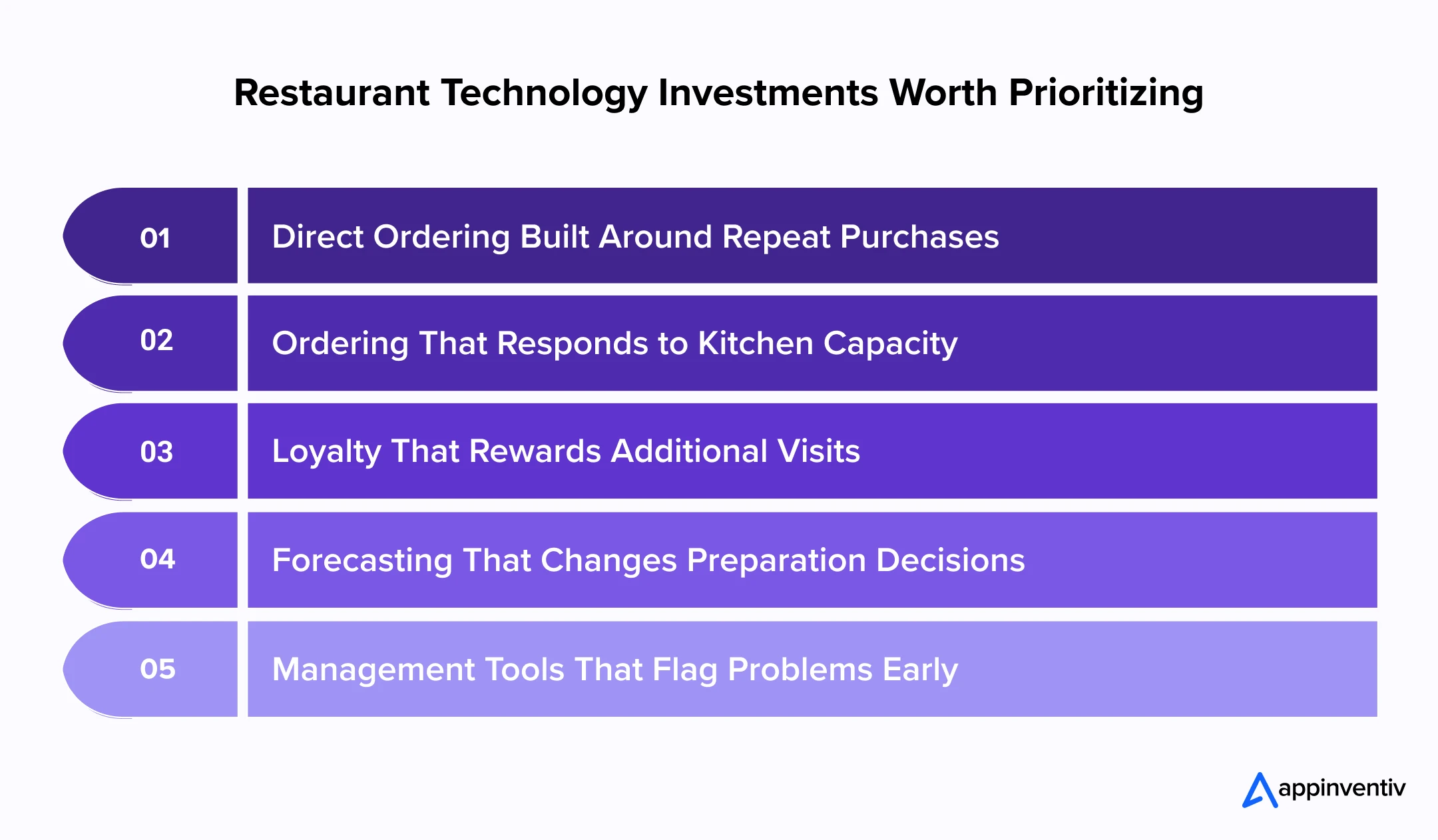
Direct Ordering Built Around Repeat Purchases
A branded app needs to earn its place on a customer’s phone. Quick reordering, reliable pickup slots, and rewards available across participating locations give customers practical reasons to use it.
Investment focus: Connect direct ordering with POS, loyalty, and customer profiles.
Success measure: Repeat purchases and contribution per order after acquisition costs and rewards.
Ordering That Responds to Kitchen Capacity
An outlet should not promise a 15-minute pickup when its preparation queue already exceeds that window. Ordering systems need to account for workload across delivery, takeaway, dine-in, and scheduled orders.
Investment focus: Connect kitchen status with pickup estimates, item availability, and order-slot limits.
Success measure: More on-time handoffs, fewer cancellations, and higher completed order volumes during peak periods.
Loyalty That Rewards Additional Visits
Sending every customer the same coupon wastes opportunities to target spending. A first-time buyer, a weekly regular, and a customer who has stopped visiting need different approaches.
Investment focus: Use purchase history to trigger relevant offers, then test whether those offers generate additional visits.
Success measure: Incremental contribution after discounts, measured against customers who did not receive the offer.
Forecasting That Changes Preparation Decisions
A demand forecast becomes useful when managers can act on it. Item-level predictions should inform preparation quantities and purchasing, with adjustments for promotions, local events, and recorded stockouts.
Investment focus: Start with high-waste or frequently unavailable items and keep managers involved in reviewing recommendations.
Success measure: Lower waste costs and fewer stockouts without routinely overproducing.
Management Tools That Flag Problems Early
Leaders should not have to search multiple dashboards to discover that one outlet’s refunds have doubled. Exception alerts can direct attention to unusual cancellations, payment failures, or preparation delays.
Investment focus: Build a shared performance view with outlet-level alerts and clear responsibility for follow-up.
Success measure: Faster issue resolution and fewer recurring service failures.
Digital transformation of a restaurant platform should allow it to connect these capabilities around shared data. Prioritize the one with the clearest financial case, prove it in selected outlets, and expand once the results justify the investment.
How Digital Transformation Priorities Change Across Restaurant Models
A faster checkout can improve almost any restaurant experience. What happens after checkout varies considerably. Your platform should reflect how food is prepared, served, and handed over in your business.
| Restaurant Model | Main Operating Pressure | Technology Priority | Measures That Matter |
|---|---|---|---|
| Quick-Service Restaurants | Keeping queues moving without creating a kitchen backlog. | Connected kiosks, POS, kitchen routing, and order-status displays. | Order accuracy, peak-hour throughput, and time to handoff. |
| Fast-Casual Restaurants | Managing customized meals alongside dine-in and pickup demand. | Accurate modifiers, preparation sequencing, and capacity-aware pickup slots. | Remakes, preparation time, and on-time pickup. |
| Full-Service Restaurants | Coordinating tables, servers, kitchen courses, and payment. | Connected reservations, table management, handheld ordering, and course timing. | Order-entry errors, payment wait time, and guest feedback. |
| Delivery-First Restaurants | Coordinating multiple ordering channels, packing, and courier collection. | Channel integration, preparation scheduling, packing checks, and dispatch coordination. | Missing-item refunds, courier waiting time, and contribution per delivered order. |
For brands operating several formats, a shared backend can support common menus, customer records, and reporting. Staff workflows still need to match each format.
A full-service outlet may need servers to control when courses reach the kitchen. A delivery-first operation may need preparation timed around courier arrival. Those differences belong in the initial scope because they affect integrations, testing, and training.
What Should Your Restaurant Modernize First?
The right starting point depends on what your business can already do reliably. A restaurant handling orders manually needs a different roadmap from a chain with connected systems but weak customer retention. Use the constraint affecting performance most to set the first priority.
| Your Current Situation | Prioritize Next | What This Should Improve |
|---|---|---|
| Staff re-enter orders or update menus across several screens. | Connect ordering channels, POS, and menu management. | Fewer manual corrections, missed orders, and availability mismatches. |
| Systems are connected, but peak-hour delays persist. | Link kitchen workload with order routing and pickup estimates. | More realistic promises and better on-time fulfillment. |
| Orders run smoothly, but repeat purchases depend on discounts. | Connect customer purchase histories with targeted loyalty journeys. | Better retention and clearer evidence of which offers generate additional visits. |
| Managers spend hours compiling reports and investigating issues. | Standardize outlet reporting and introduce exception alerts. | Faster investigation and less manual reporting. |
| Reliable data and stable workflows are already in place. | Pilot AI for a specific decision, such as preparation quantities. | Measurable improvements in waste, availability, or staff effort. |
These priorities can overlap. One outlet may need better capacity controls while another needs basic integration fixes. Set shared standards across the brand, then sequence the work around local needs and dependencies.
Before approving development, ask the firm offering digital transformation in the restaurant industry to identify what must work first. Personalization, for example, needs dependable customer records; automated preparation planning needs accurate item and availability data.
Keep menus accurate, pickup times realistic, and customers coming back.

Restaurant Digital Transformation Strategies: How to Modernize Without Disrupting Service
The right capabilities still need a workable rollout. Effective restaurant digital transformation strategies start with a defined business problem, protect day-to-day service, and make further investment dependent on results.
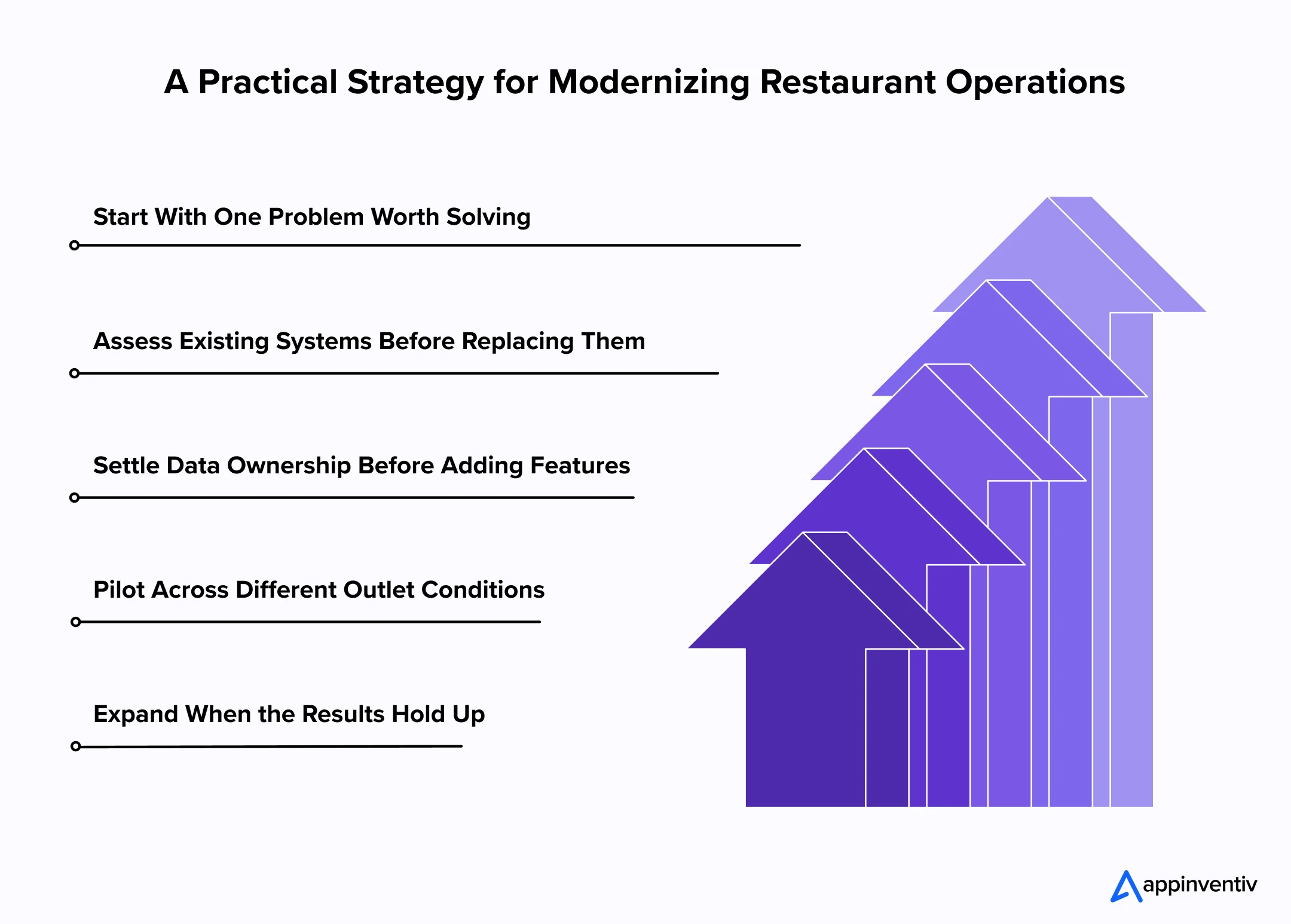
Start With One Problem Worth Solving
“Improve the customer’s digital experience” is too broad to guide a budget. Reduce failed checkouts, shorten pickup delays, or increase second purchases instead.
Choose a problem with a measurable cost and an accountable owner. Record the current performance before development begins. Otherwise, teams may launch successfully without knowing whether the investment changed anything.
Assess Existing Systems Before Replacing Them
Your POS may work well while its ordering integration causes delays. Replacing both could add expense without improving the outcome.
Ask your restaurant app development firm to assess integration access, data quality, support limitations, and reliability. Keep systems that meet operational needs. Replace those that prevent necessary improvements or cost too much to maintain.
The deliverable: A clear map of what stays, what connects, and what needs rebuilding.
Settle Data Ownership Before Adding Features
Decide which system controls menu prices, availability, customer permissions, and order status. Conflicting records can undermine even a well-designed application.
Apply the same discipline to the development agreement. Confirm ownership of code, access to business data, documentation, and export options. These decisions affect how easily the restaurant can expand or change partners later.
Pilot Across Different Outlet Conditions
A pilot at the best-equipped location can hide problems elsewhere. Include outlets with different order volumes, staffing patterns, and delivery demand.
Test busy periods, refunds, unavailable items, and connectivity interruptions. Train staff on those exceptions, then use their feedback to simplify the workflow.
The rollout gate: Agreed targets for service quality, transaction reliability, and business performance, plus a tested recovery plan.
Expand When the Results Hold Up
Review results over comparable trading periods. Separate the effect of the technology from discounts, seasonal demand, and extra launch support.
A restaurant platform should become easier to deploy as the rollout progresses. Reuse tested configurations and training materials, while allowing necessary outlet-level differences.
Fund the next phase when performance supports it.
How to Decide Whether Your Restaurant Pilot Is Ready to Scale
A successful launch proves that the software runs. Expansion needs evidence that it improves service and business performance under normal operating conditions.
Agree on a pilot scorecard before development starts. Record the baseline at participating outlets and set targets around the problem you are funding the project to solve.
| Pilot Measure | What to Track | What the Result Tells You |
|---|---|---|
| Order Accuracy | Share of completed orders fulfilled without missing items, incorrect modifiers, or duplicate tickets. | Whether connected systems reduce avoidable errors. |
| On-Time Handoffs | Share of orders ready within the promised pickup window. | Whether customer promises reflect actual kitchen capacity. |
| Refunds and Cancellations | Frequency, value, and recorded cause by channel. | Whether service failures are falling or shifting elsewhere. |
| Contribution per Order | Revenue retained after discounts, channel charges, and attributable fulfillment costs. | Whether improvements produce financial value. |
| Staff Adoption | Share of eligible orders or tasks completed through the intended workflow. | Whether teams use the system or rely on workarounds. |
| Manual Interventions | Corrections, re-entry, and staff minutes required per order or shift. | Whether automation removes work rather than moving it. |
Compare Like-for-Like Trading Conditions
Review comparable weekdays, dayparts, and order types. Account for promotions, seasonal demand, and extra staff assigned during launch. Otherwise, a temporary sales lift or unusually well-supported pilot can distort the result.
Where practical, compare pilot outlets with similar locations that have not received the change.
Agree on Expansion Criteria Before Reviewing Results
Decide which targets justify expansion and which failures require more work. A faster checkout should not offset duplicate charges or lost kitchen tickets.
Before rollout, confirm that:
- Improvements hold during busy periods.
- Staff can operate without constant project-team support.
- Failure recovery and escalation procedures work.
- The next group of outlets can adopt the setup at an acceptable cost.
Scale when the operational and financial evidence supports it. If results are mixed, resolve the specific weakness before repeating it across more locations.
Restaurant Digital Transformation Cost: What Should Businesses Budget?
There is no single price for transforming a restaurant business. A direct-ordering app and a multi-location program connecting kitchens, inventory, loyalty, and reporting involve different levels of work.
As a reference point, the cost of custom restaurant app development can vary from approximately $40,000 to $500,000 or more, depending on features and resources. That is an application development range, not an all-inclusive transformation budget.
Separate the Build Budget From the Rollout Budget
A useful restaurant digital transformation cost estimate should show where the money goes.
| Budget Component | What It Should Cover |
|---|---|
| Discovery and planning | Process assessment, system audit, requirements, and success measures |
| Software development | Customer interfaces, staff tools, backend services, and testing |
| Integrations and data | POS, payments, kitchen systems, loyalty, migration, and data cleanup |
| Outlet rollout | Configuration, equipment where needed, staff training, and launch support |
| Ongoing operation | Hosting, software subscriptions, maintenance, monitoring, and support |
Ask for these costs separately. A low development quote can become expensive if essential integration and rollout work sits outside its scope.
Identify What Will Move the Estimate Most
The number of screens rarely tells the whole story. Costs depend heavily on what happens behind them.
- Existing systems: Limited integration access may require additional engineering or replacement.
- Outlet variation: Different menus, taxes, currencies, and operating rules increase configuration and testing.
- Data readiness: Inconsistent item records and customer histories add cleanup work.
- Service continuity: Offline functions, recovery procedures, and peak-load testing require dedicated effort.
- AI scope: Data preparation, evaluation, usage charges, and monitoring extend beyond initial feature development.
A useful proposal states its assumptions and identifies which findings could change the price.
Compare Three-Year Ownership Costs
Compare proposals over the same period and against the same requirements. Include the initial build, subscriptions, transaction-linked charges, support, equipment replacement, and planned upgrades.
Request estimates at both current and expected order volumes. A pricing model that works for a pilot may become costly across dozens of outlets.
Tie Payback to Net Financial Improvement
Use additional contributions and realizable savings to assess payback. Revenue growth alone overstates the return, while staff time saved does not automatically become a cash saving.
For illustration, a $120,000 investment producing $8,000 in monthly net benefit has a simple payback period of 15 months. That benefit must already account for ongoing technology costs. This example excludes financing, tax, and rollout delays.
Share your outlet count, existing systems, and planned features. Get a preliminary estimate with integration and rollout costs identified.
Where AI Fits in Restaurant Operations and What to Prove Before Scaling
AI-enabled digital transformation in restaurant operations should improve a specific decision or remove recurring work. Start with one use case, such as preparation planning or voice ordering. Test it under real outlet conditions and measure the results before expanding.
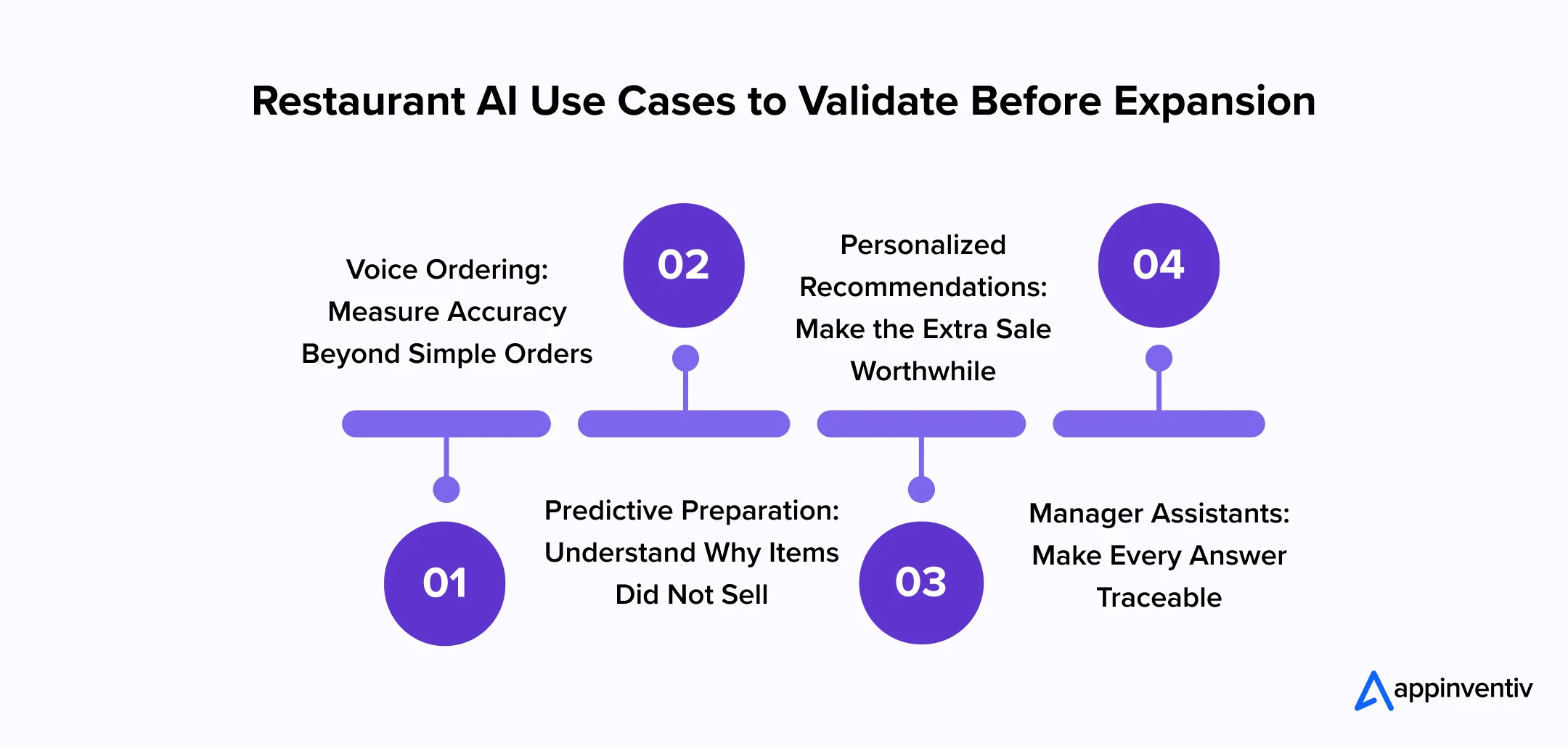
Voice Ordering: Measure Accuracy Beyond Simple Orders
A voice assistant must handle substitutions, accents, background noise, and customers changing their minds. A fluent conversation means little if the kitchen receives the wrong order.
Your restaurant app development firm should connect AI-based voice ordering to live menus, prices, and availability, with an easy handoff to staff.
Before scaling: Track order accuracy, abandonment, staff intervention, and cost per completed order.
Predictive Preparation: Understand Why Items Did Not Sell
Low sales do not always indicate low demand. An item may have been unavailable or removed from delivery channels during a rush.
Forecasting should account for stockouts, promotions, and outlet-level patterns before recommending preparation quantities. Managers should be able to adjust recommendations and record their reasons.
Before scaling: Confirm that waste falls without increasing stockouts or emergency preparation.
Personalized Recommendations: Make the Extra Sale Worthwhile
An add-on should suit the customer, be available at that outlet, and contribute enough margin to justify its preparation.
Connect AI recommendations to item availability and profitability. Where kitchen data supports it, account for workload before promoting items that could delay the order.
Before scaling: Measure contribution per order alongside checkout completion and preparation time.
Manager Assistants: Make Every Answer Traceable
A manager asks, “Why did refunds rise yesterday?” The assistant retrieves relevant transactions and summarizes recorded reasons, helping the manager investigate faster.
Answers should link back to supporting records. Start with read-only access and require approval for actions involving refunds, prices, staffing, or purchasing.
Before scaling: Check answer accuracy, evidence quality, and time saved during actual shifts.
Choosing your development partner: Ask your restaurant app development firm to demonstrate these capabilities using your menu, existing systems, and outlet workflows. Agree on pilot targets for accuracy, cost, and service quality before funding a wider rollout.
[Also Read: AI in the Restaurant Industry: Use Cases, Cost, and Development Guide]
How to Choose a Restaurant App Development Firm for a Connected Business
Once the scope and budget are clear, assess potential partners against the way your restaurants operate. Screens and feature lists show only part of the solution. The firm needs to explain how orders, payments, kitchen workflows, and customer data will work together.
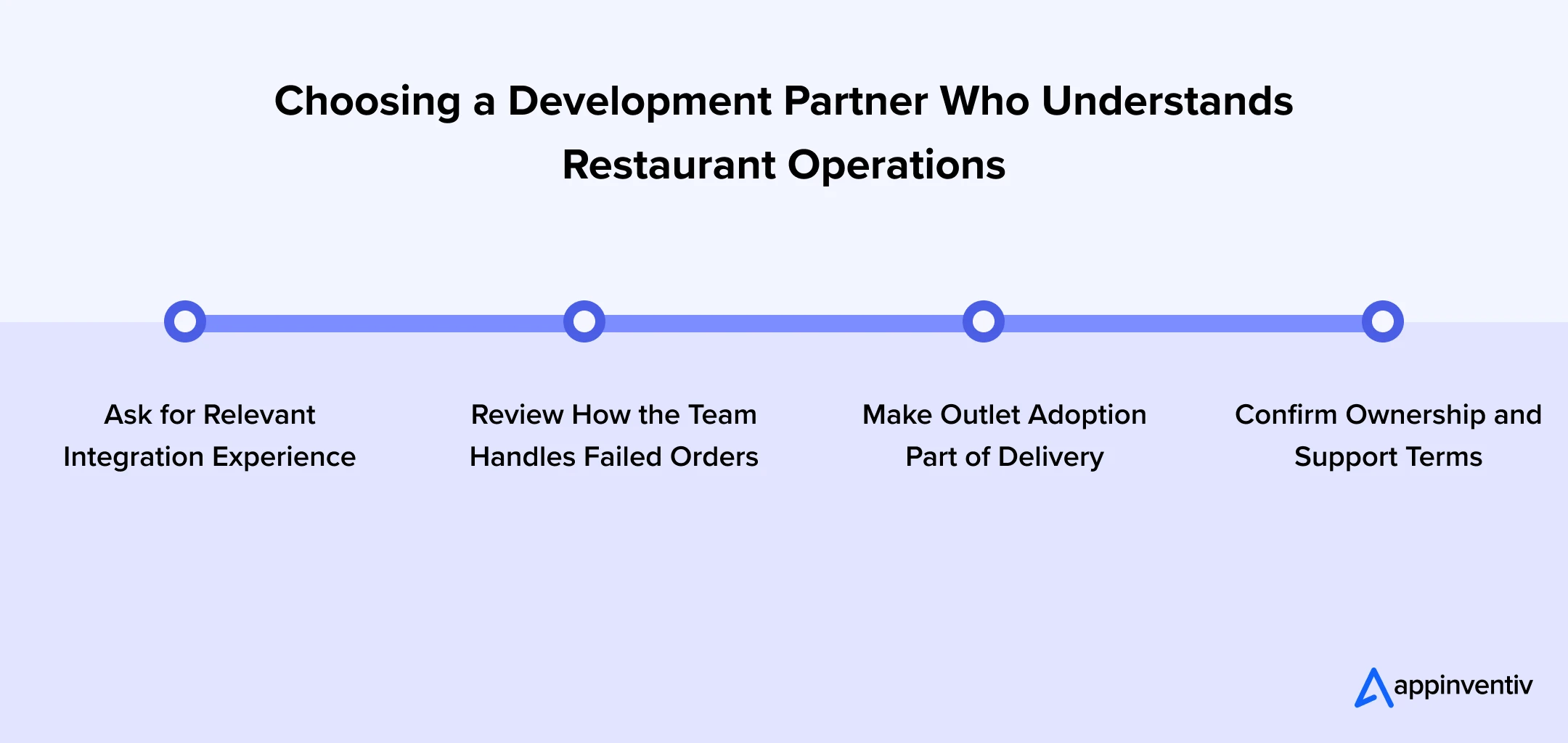
Ask for Relevant Integration Experience
Look beyond whether the firm has built a food-ordering app. Ask which POS, payment, loyalty, and kitchen systems it has connected, and what responsibilities it handled.
Ask: “How would you confirm compatibility with our existing systems before committing to a development estimate?”
A credible proposal should identify integration dependencies, access requirements, and unresolved questions early.
Review How the Team Handles Failed Orders
Ask the firm to walk through a payment that succeeds while order submission fails. Then discuss duplicate requests, unavailable items, refunds, and a disconnected outlet.
Ask: “How will staff detect the issue, recover the transaction, and explain its status to the customer?”
The answer should cover recovery procedures and staff visibility, with clear responsibility for resolving failures.
Make Outlet Adoption Part of Delivery
A system can pass technical testing and still slow down service. Restaurant digital transformation services should include workflow validation with the people who will use the product.
Ask: “How will outlet managers and frontline staff participate in testing, training, and rollout?”
Look for practical training, a supported pilot, and a way to address staff feedback before expansion.
Confirm Ownership and Support Terms
Establish who owns the code, where business data resides, and how your team can access documentation. Agree on support coverage, incident priorities, and escalation procedures.
Ask: “What will we receive at handover, and who takes responsibility if ordering fails during peak service?”
These commitments belong in the agreement, alongside delivery milestones and acceptance criteria.
Choose the firm that can turn your operating requirements into a testable delivery plan. Its proposal should make the costs, dependencies, responsibilities, and measures of success clear before development starts.
How Appinventiv Helped Leading Restaurant Brands Improve Digital Performance
Our work with Americana Group, KFC, Pizza Hut, and, separately, Domino’s shows how targeted engineering can address different restaurant challenges. For Americana, we connected fragmented delivery operations through a shared last-mile platform. For the individual brands, our work focused on multi-market ordering and easier customer journeys, with reported improvements in automation, conversion, and app adoption.
Build Your Next Phase of Restaurant Growth With Appinventiv
When digital channels contribute a substantial share of sales, the systems behind them deserve closer scrutiny. Can customers order reliably? Can kitchens keep pace? Can leadership see which channels generate profitable repeat business?
As a restaurant app development company, we can help translate those priorities into a seamless roadmap, with customer-facing features and operational integrations planned together.
We Help You Prioritize the Restaurant Problems Worth Solving
We work with your team to identify where orders lose value, whether through checkout abandonment, pickup delays, or manual reconciliation. From there, we define the development scope, integration needs, and success measures around your priorities. You get a roadmap tied to business outcomes and a clearer basis for budget decisions.
We Connect Your Ordering Experience With Your Existing Systems
Our team assesses your POS, payment, loyalty, and kitchen systems to determine what can stay and what needs attention. We build the connections that keep menus, transactions, and order updates consistent across channels, helping your outlets fulfill the promises customers see on screen.
We Help You Validate Performance Before Expanding Across Outlets
We plan the pilot with your operations team, test real service conditions, and address staff feedback before wider deployment. Together, we assess reliability, adoption, and commercial results. Those findings guide the next rollout and show where additional capabilities, including AI, could justify further investment.
FAQs
Q. Why is digitalization crucial for the restaurant industry?
A. As orders spread across apps, websites, kiosks, and delivery platforms, restaurants need a reliable way to manage them together. Disconnected systems leave staff correcting menus, re-entering orders, and resolving payment issues manually. Restaurant digitization helps connect these tasks while giving owners clearer visibility into customer behavior, service delays, and order profitability. The value comes from using that information to improve daily decisions.
Q. How much does restaurant digitization cost?
A. The budget depends on whether you need a customer-facing app, operational integrations, or a broader transformation across locations. For instance, you can expect the restaurant app development range around approximately $40,000 to $300,000 or more. A complete digitization program may require additional investment beyond the app.
When estimating restaurant digital transformation cost, account for:
- POS, payment, kitchen, and inventory integrations.
- Data cleanup and migration from existing systems.
- Equipment, outlet configuration, and staff training.
- Hosting, subscriptions, maintenance, and ongoing support.
Ask your restaurant app development firm to separate initial development costs from rollout and recurring expenses.
Q. How can businesses integrate online ordering with existing restaurant operations?
A. Start by checking how your current POS receives external orders and shares menu information. Then map the full journey from checkout to preparation, collection, and reconciliation. Each stage needs a clear source of information and a recovery process when something fails.
A practical integration plan should:
- Synchronize prices, modifiers, and item availability across channels.
- Route paid orders to the correct outlet and kitchen workflow.
- Adjust pickup estimates to reflect preparation capacity.
- Keep payments, cancellations, and refunds linked to the original order.
- Test duplicate requests, connection failures, and peak-hour volumes before rollout.
Pilot the integration in selected outlets before expanding across the business.
Q. What strategies help restaurants build an effective loyalty program using digital tools?
A. Start with the customer behavior you want to encourage, such as a second visit or a return after several weeks. Then choose rewards that customers value and the restaurant can afford. A successful program needs straightforward redemption and a clear financial purpose.
Useful strategies include:
- Connect identifiable purchases across the app, website, and participating outlets.
- Tailor offers to visit frequency and purchase preferences.
- Keep earning rules simple and show progress clearly.
- Test targeted offers against a comparable group receiving no offer.
- Measure additional visits and contribution after rewards, alongside enrollment.
Regular customers should find the program useful without needing a discount on every purchase.
Q. Can restaurants modernize without replacing their existing POS system?
A. Often, yes, provided the POS supports the required integrations and remains reliable. A restaurant app development firm should assess its APIs, data access, support arrangements, and ability to handle expected order volumes. You may be able to add ordering, loyalty, or reporting capabilities around it. Replacement becomes worth considering when integration limits, reliability issues, or maintenance costs prevent the improvements your business needs.


Fast 2-minute response, fully NDA-protected.

Capture 22% More Restaurant Visits With Restaurant Loyalty App Development
Key Takeaways An enterprise loyalty app requires rule engines, POS synchronization, event-driven APIs, and auditable ledgers to protect the accuracy of transaction data. Custom versus white-label app choices depend on data rights, integration depth, extensibility, scalability, differentiation, and lifetime cost. POS, ordering, payment, CRM, and CDP connections construct unified customer profiles across restaurant store channels…

Building a Restaurant Inventory Management System to Stop Food Cost Leaks
Key Takeaways A restaurant inventory system connects purchasing, receiving, recipes, sales, waste, transfers, and stock counts. Theoretical-versus-actual inventory reveals overportioning, unrecorded waste, missing stock, and inaccurate recipes. POS, ERP, supplier, kitchen, and IoT integrations create a dependable flow of inventory data. AI can strengthen demand forecasting, purchasing, anomaly detection, expiry management, and outlet benchmarking. Development…

Build Your Own: A Complete Guide to Menu Engineering Software Development (2026)
Key takeaways: Menu engineering works best when treated as a decision system, not a one-time analysis exercise. Accurate menu decisions depend on real cost data, clean POS mappings, and continuous analysis. Building custom menu engineering software makes sense when complexity, scale, and control matter. Most menu engineering software built in 2026 falls between $40,000 to…