


































Restaurant App Development Cost: A Complete 2026 Breakdown

 Share -



- 01What Makes Restaurant App Development a Strategic Investment
- 02A Comprehensive View of the Costs Involved in Restaurant App Development
- 03Key Factors That Influence Restaurant App Development Costs
- 04Hidden Costs to Consider in Restaurant App Development
- 05How to Optimize Restaurant App Development Costs
- 06Restaurant Brands We Helped Drive Digital Growth
- 07Bring Your Restaurant Operations into One Digital Ecosystem with Appinventiv
- 08FAQs

Key Takeaways
- The restaurant app cost can range from about $30,000 for basic apps to $400,000+ for more advanced or enterprise-level apps, depending on the breadth and complexity of the app.
- Menus, payments and other core features are more affordable, while real-time tracking, POS integration, loyalty programs and AI functionalities cost more.
- The total consists of design, development, testing, and deployment, and most often, that includes frontend and backend development.
- Post-launch costs such as hosting, app store fees, maintenance, compliance and third-party services continue to impact long-term ownership costs.
- Starting with core features ensures cost control, validates demand and allows for additional functionality to be added over time.
A lot of restaurant businesses have important customer and operational information spread across various platforms like POS, delivery, reservations, and loyalty systems, as well as payment apps. This disjointed arrangement restricts visibility into customer behavior, order performance and operational gaps.
A restaurant app can bring it all together in one ecosystem, providing businesses with more control over data and processes. Depending on its complexity, integrations, and functionality, the restaurant app development cost can range from $30,000 to $400,000+.
A simple application that is based on digital menus, ordering and payment costs less, whereas a large-scale application with multi-location operations, real-time delivery tracking, POS and inventory integration, loyalty programmes, analytics and AI-powered features will cost significantly more.
Whether or not to create an app is no longer just a question for many restaurants. The question is whether they’ll have the digital framework in place to pursue their own customer connections and streamline their processes as they expand. With a well-designed restaurant app, ordering, customer engagement, delivery coordination and operational information can be gathered and streamlined into a single, connected ecosystem, minimizing reliance on stand-alone third-party systems.
Before defining the project scope, therefore, it is necessary to know how much the project will cost for development. In this blog, we’ll discuss the expenses of developing a restaurant application feature-wise, how the price is determined and how to budget your app effectively.
Share your requirements with us, and we will help you understand the likely scope and investment.

What Makes Restaurant App Development a Strategic Investment
Data and technology are increasingly becoming a problem for restaurants. Usually, the information on the websites is separate from each other, for instance: customer information, orders, reservations, loyalty activity and payments. It is hard to understand the entire customer journey or act on the operational data on the websites. This challenge is magnified as the number of digital channels increases.
The change is also affecting how restaurants manage their relationships with customers. 64% of consumers would like an app to coordinate the delivery, pickup and reservation process (Source: DoorDash News).
It also revealed that 65% would eat at a restaurant more often if they were remembered for their preferences, and 63% had come back after being recommended or followed up on their preferences.
Again, according to McKinsey’s survey, despite a prolonged period of low consumer confidence, full-service restaurants led transaction growth in 2025.
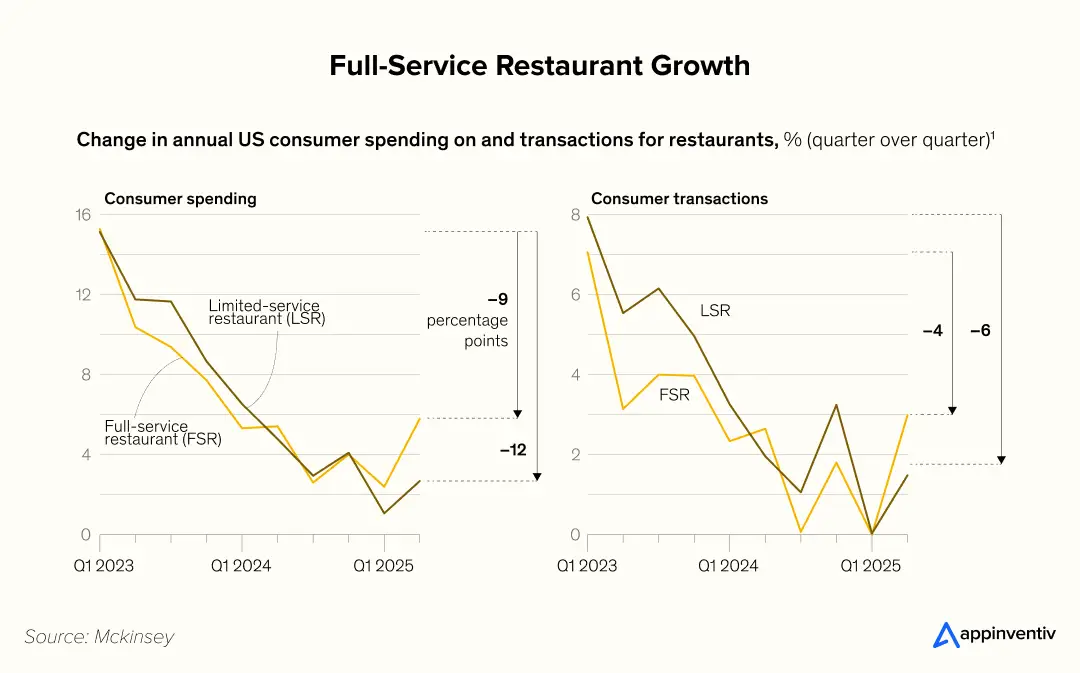
However, spending growth across both full-service and limited-service restaurants has slowed at roughly twice the rate of transaction growth, showing that diners are still visiting but spending more cautiously. For operators, this makes balancing affordability with margin protection an increasingly pressing challenge.
Fragmented systems are still a real problem for restaurant owners. These functions can be consolidated in a unified restaurant app that streamlines technology management and enables businesses to access the data they need for everyday and strategic business decisions.
This is what makes restaurant app development a strategic investment. A carefully engineered platform can integrate ordering, reservations, payments, loyalty, delivery, and customer data with existing cloud-based or legacy POS systems. This helps restaurants connect new digital capabilities without necessarily replacing their core operational infrastructure.
It provides a direct line of communication for businesses to interact with their customers and a single source of information to enhance their services, personalization, and operational decisions.
Also Read: Why Should You Develop an App for Your Restaurant?
A Comprehensive View of the Costs Involved in Restaurant App Development
The restaurant app development cost varies depending on a range of factors, such as app complexity, features, user roles, integrations, platform requirements, and the needs after the app is launched. The entire cost estimation is broken down into layers as mentioned below.
Breakdown of Costs by Level of Complexity and Scope
The complexity of a restaurant app depends on the number of features, user roles, integrations, and operational workflows it supports.
| Level of Complexity/ Scope | Scope Description | Estimated Cost |
|---|---|---|
| Basic | Digital menu, restaurant information, table reservations, basic user accounts, a simple admin panel | $30,000 to $50,000+ |
| Moderate | Online ordering, payment gateway, push notifications, order tracking, customer profiles, and restaurant management features | $50,000 – $80,000+ |
| Advanced | Multi-location support and loyalty programs, delivery tracking, POS integration, advanced analytics, and personalized recommendations | $80,000 to $150,000+ |
| Enterprise | Multi-restaurant marketplace, real-time delivery management, multiple integrations, AI-powered features, advanced analytics, and scalable cloud infrastructure | $150,000 to $400,000+ |
The larger the scope, the more design, engineering, integrations, testing, security and infrastructure efforts will require the restaurant app development cost to rise.
Breakdown of Costs by Development Stages
The restaurant app development process is a well-defined life cycle, and the different phases of the development will contribute to the overall project cost.
| Development Stage | Activity Description | Cost Contribution |
|---|---|---|
| Discovery and Planning | Requirements analysis, feature planning, user journeys, technical architecture | 5% to 10% |
| UI/UX Design | Wireframes, prototypes, visual design and interfaces for customers, restaurant staff and administrators | 10% to 15% |
| Frontend and Backend Development | App development, server-side architecture, databases, APIs and core restaurant workflows | 40% to 50% |
| Third-Party Integrations | Payment gateways and POS systems, maps, delivery platforms, notifications and more | 10% to 15% |
| Testing and Quality Assurance | Functional, Performance, Security, Device Compatibility, User Acceptance Testing | 10% to 15% |
| Deployment and Launch | App store submission, cloud setup, production deployment, and production launch support | 5% to 10% |
The restaurant application development cost should take into account the work spread over these phases, especially if the app is complex and needs to be integrated with various systems or custom workflows, or tested extensively.
Restaurant App Development Cost Estimation Formula
Estimating the restaurant mobile app development cost involves assessing the project’s scope, feature requirements, development effort, integrations, and supporting infrastructure. The majority of software development firms use the feature-based estimation methodology along with effort analysis to arrive at a project budget that is realistic.
Feature-Based Cost Estimation
One way to do this is to approximate the effort needed in each phase of development and multiply by the hourly rate.
Formula:
Total Development Cost = (Estimated Development Hours x Hourly Rate) + Infrastructure + Third Party Integrations + Maintenance
Where:
- Development Hours include planning, UI/UX design, frontend and backend development, API development, testing, and deployment.
- Hourly Rate can differ with regard to the location of the development team, their expertise and technology needs.
- Additional costs cover payment gateway, pos integration, mapping and delivery service, third-party tools, cloud infrastructure and support after launch.
Three-Point Estimation (PERT)
Teams can employ PERT for more complex restaurant applications to factor in uncertainty when planning a project when it comes to development, integrations, and technical needs.
Formula:
Estimated Effort = (O + 4M + P) ÷ 6
Where:
O = Optimistic estimate
M = Most likely estimate
P = Pessimistic estimate
Using these estimation models together helps businesses estimate the cost to build a restaurant app more accurately and plan their budget while reducing the likelihood of unexpected cost overruns.
Breakdown of Costs by Restaurant Business Model
The development of a restaurant app can vary depending on several factors such as the restaurant model, size, number of restaurant outlets, and the amount of digital features needed. Most restaurant or food delivery application development and workflows are more complex and will need more investment.
| Restaurant Business Model | Scope Focus | Estimated Development Cost |
|---|---|---|
| Single Restaurant | Digital Menu, Online Ordering & Reservations, Payment, and Customer Account Management | $30,000 – $80,000 |
| Restaurant Chain | Multi-location management, centralized menus, loyalty programs, location-based ordering | $80,000 – $180,000 |
| Multiple virtual brands | Order management, kitchen workflow and delivery integrations | $70,000 – $200,000 |
| Fine Dining | Table reservations, waitlist management, digital concierge and personalized guest experiences | $40,000 – $120,000 |
| Food Delivery Marketplace | Multi-restaurant operations, customer and delivery apps, real-time tracking, commissions, and payouts | $150,000 – $400,000+ |
The final investment is dependent on the number of workflows and platforms that are used. For instance, the restaurant ordering app development cost might go much higher if real-time order management, delivery tracking and management through multiple third-party systems are included in the scope.
Breakdown of Costs As Per Restaurant App Integrations
An important consideration is the integration budget, which can be a big percentage of the application development costs when the application needs to exchange information with other restaurant and operational systems “in real-time.”
| Integration Type | Development Focus | Estimated Cost Impact |
|---|---|---|
| Payment Gateway | Payment processing, refunds, transaction management and status updates | $30,000 – $60,000+ |
| POS Integration | Order sync, menu changes, inventory and sales data syncing | $40,000-100,000+ |
| Delivery Platform Integration | Order dispatch, delivery status, tracking of riders and connecting with partners | $40,000 – $120,000+ |
| Maps and Location Services | Restaurant discovery, address validation, route tracking, and location-based services | $30,000 – $70,000+ |
| CRM and Loyalty Integration | CRM and loyalty integration | $40,000 – $90,000+ |
| Inventory Management Integration | Ingredient ingredients, stock update and order-based inventory adjustment | $50,000 – $120,000+ |
These costs may be similar depending on the applications as a whole. In a restaurant app development cost estimation, it’s important to consider integrations within the larger system, not as standalone costs.
Infrastructure-Wise Restaurant App Development Cost
Infrastructure requirements have a bearing on the application’s capacity to handle order volumes, peak traffic, real-time updates, as well as expansion across multiple locations.
| Infrastructure Type | Scope | Estimated Development Cost |
|---|---|---|
| Standard Cloud Architecture | Cloud hosting, databases, back-end services, application monitoring | $30,000 – $70,000+ |
| Scalable Cloud Infrastructure | Auto-scaling, load balancing, managed databases and performance monitoring | $70,000 – $150,000+ |
| Multi-Location Infrastructure | Centralized systems that provide support to multiple outlets, menus and processes | $100,000 – $220,000+ |
| Microservices Architecture | Independent services for ordering, payment, menus, delivery and customer management | $150,000 – $300,000+ |
| High-Availability Infrastructure | Multi-region deployment, failover, backups, disaster recovery, and continuous monitoring | $250,000 – $400,000 + |
Application engineering, application integrations, testing, security, and deployment are typically other components of the restaurant app development price.
AI-Powered Restaurant App Development Cost
Data preparation, model integration, back-end processing, testing, and continuous monitoring are all areas that add to development effort when integrating AI into a restaurant app. It will vary based on the third-party AI services employed or if the application needs to be built using custom models and data pipelines.
| AI Feature | Scope | Estimated Development Cost | |
|---|---|---|---|
| AI Chatbot | Automated support for menu queries, reservations, orders and customer assistance | $30,000 – $80,000+ | |
| Personalized Recommendations | Menu Suggestions Based on Preferences, Order History, and Customer Behavior | $50,000 – $120,000+ | |
| AI-Powered Demand Forecasting | Order volume and demand pattern forecasting for operational planning | $70,000 – $180,000+ | |
| Smart Inventory Management | Demand-based stock forecasting and ingredient requirement predictions | $80,000 – $200,000+ | |
| Dynamic Menu Optimization | An analysis of menu performance, customer preferences and item availability | $60,000 – $150,000+ | |
| AI Voice Ordering | Voice ordering and conversational customer support | $80,000 – $200,000+ | |
| Analysis of reviews and feedback to identify recurring service and food quality issues | $40,000 to $100,000+ |
When many AI features are added to enterprise infrastructure, multi-location operations, real-time integrations, and above all, highly customized workflows, the cost of a custom restaurant app can go up to $400,000 and more.
Region-Wise Restaurant App Development Cost
The expenses of a restaurant app may differ depending on the location of the development team. The local availability of talent, technical skills, experience with restaurant technology, and project complexity will all affect hourly rates. The cost of a white label restaurant mobile app can also vary according to the amount of customization and the rate at which the app is developed in various regions.
| Region | Average Hourly Rate | Estimated Development Cost |
|---|---|---|
| North America (USA & Canada) | $120 to $250/hr | $150,000 to $400,000+ |
| Western Europe | $90 to $180/hr | $120,000 to $350,000+ |
| Eastern Europe | $40 to $90/hr | $60,000 to $200,000+ |
| Asia (India, Vietnam, Philippines) | $25 to $60/hr | $30,000 to $150,000+ |
| Latin America | $35 to $80/hr | $50,000 to $180,000+ |
While there are regional variations in development costs, other factors related to the application include its complexity, requirements, number of platforms, third-party integrations, and the expertise of the development team.
From product strategy to development and scaling, we help turn restaurant technology requirements into practical digital solutions.

Key Factors That Influence Restaurant App Development Costs
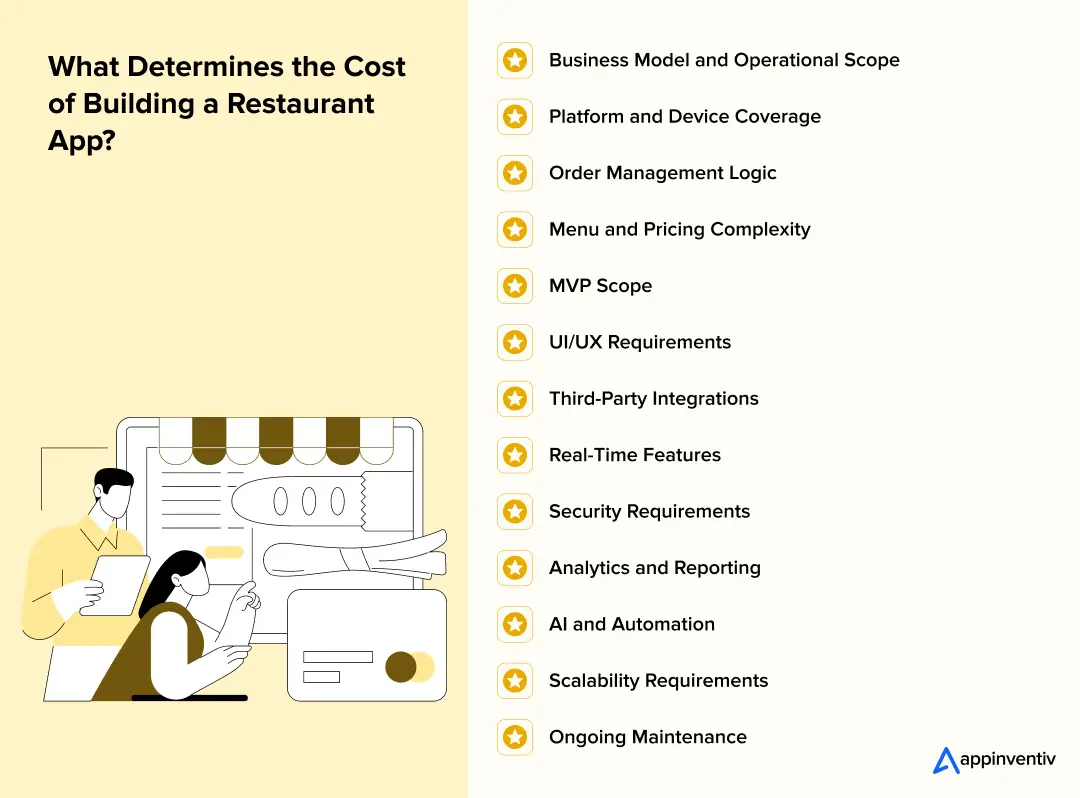
The restaurant app development costs depend on the size of the app, technical requirements, integrations and complexity. From these considerations, the total amount of the investment can vary from $30,000 to $400,000 or more.
Business Model and Operational Scope
The number of workflows needed for a restaurant app will be smaller compared to restaurant chains, cloud kitchens, and delivery platforms. Development efforts are compounded by multi-location management, multiple user roles, central operations, and commissions.
Estimated cost impact: $30,000 to $400,000+
Platform and Device Coverage
The wider the scope of development, the more touchpoints that support it, such as iOS and Android apps, web ordering systems, restaurant dashboards, kitchen systems like Kitopi and delivery apps. Design, development, testing and deployment are required for each platform.
Estimated cost impact: $30,000 to $200,000+
Order Management Logic
There is significant backend logic and system coordination that needs to be put in place for supporting complex order workflows like dine-in, pickup, delivery, scheduled order fulfillment, cancellations, refunds, split payments, and real-time tracking. More order scenarios would increase the level of complexity involved with the development.
Estimated cost impact: $40,000 to $180,000+
Menu and Pricing Complexity
The amount of data and business logic to be considered increases with modifiers, combos, location-specific pricing, promotions, time-based menus and real-time availability.
Estimated cost impact: $30,000 to $120,000+
MVP Scope
The MVP cost of resturant app is based on the fact that the initial release will consist of basic features like menus, ordering, paying and notifying or other advanced features.
Estimated cost impact: $30,000 to $80,000+
UI/UX Requirements
Development effort can increase with custom interfaces and user journeys, accessibility requirements, custom animations, multilingual support, and the creation of dedicated design systems.
Estimated cost impact: $30,000 to $100,000+
Third-Party Integrations
The custom restaurant app development cost can increase with payment gateways, POS systems, delivery platforms, maps, CRM tools, loyalty systems, and inventory software.
Estimated cost impact: $40,000 to $150,000+
Real-Time Features
For live order tracking, kitchen updates, delivery status, driver assignment, and instant notifications, the real-time data processing and powerful backend restaurant app features are essential.
Estimated cost impact: $40,000 to $140,000+
Security Requirements
Other aspects of development include access control, role-based access, data encryption, payment security, fraud prevention, and security testing.
Estimated cost impact: $30,000 to $100,000+
Analytics and Reporting
Advanced sales dashboards, customer insights, order trends, menu performance, and multi-location reporting require additional data processing and visualization capabilities.
Estimated cost impact: $30,000 to $120,000+
AI and Automation
Personalized recommendations, AI chatbots, demand forecasting, inventory planning, menu optimization, and AI-based voice ordering can significantly affect the restaurant mobile app development cost.
Estimated cost impact: $50,000 to $250,000+
Scalability Requirements
High traffic volumes, peak-hour demand, auto-scaling, load balancing, database optimization, and high availability require more robust infrastructure.
Estimated cost impact: $50,000 to $250,000+
Ongoing Maintenance
The cost to maintain a restaurant app depends on bug fixes, security updates, OS compatibility, API changes, infrastructure monitoring, and new feature releases.
Estimated annual cost impact: 15% to 25% of the initial development cost.
Hidden Costs to Consider in Restaurant App Development
Other hidden costs that could be incurred during the launch of the restaurant app, its operation and future updates should also be taken into consideration when estimating the cost of the restaurant app. Not all of these costs are part of the basic development cost and should be taken into account when planning the budget.
| Hidden Cost Area | What It May Include | Estimated Cost Impact |
|---|---|---|
| App Store/Developer Fees | Apple Developer Program, Google Play program registration, app publishing fees | $100 to $500 per year |
| Third Party API Usage | Dependent on the service used, such as payment processing, maps, SMS, email, push notifications, etc. | $500 to $10,000+ annually |
| Cloud Infrastructure | Including hosting, databases, storage, backups, monitoring, and traffic costs | $1,000 to $20,000+ per year |
| Payment Processing Fees | Per transaction charges and Payment Gateway Fees | Varies with transaction volume |
| Content and Data Migration | Menu data, customer information, restaurant records and migration from legacy system | $2,000 to $20,000+ |
| Security and Compliance | Security audits, payment related requirements, security vulnerability testing, privacy controls | $5,000 to $30,000+ |
| Training and Change Management | Staff onboarding, administrator training, documentation and operational procedures | $2,000 to $15,000+ |
| Post Launch Optimization | Performance Tuning, Bug Fixes, user feedback implementation, conversion improvements | $5,000 to $30,000+ |
These costs should be included in the first budget as it gives a better idea of the application’s cost of ownership and prevents any unexpected costs when the application is launched.
How to Optimize Restaurant App Development Costs
By establishing priorities and guiding away from technical complexity, businesses can manage development costs. To maximize overall budget, the following measures can be considered:
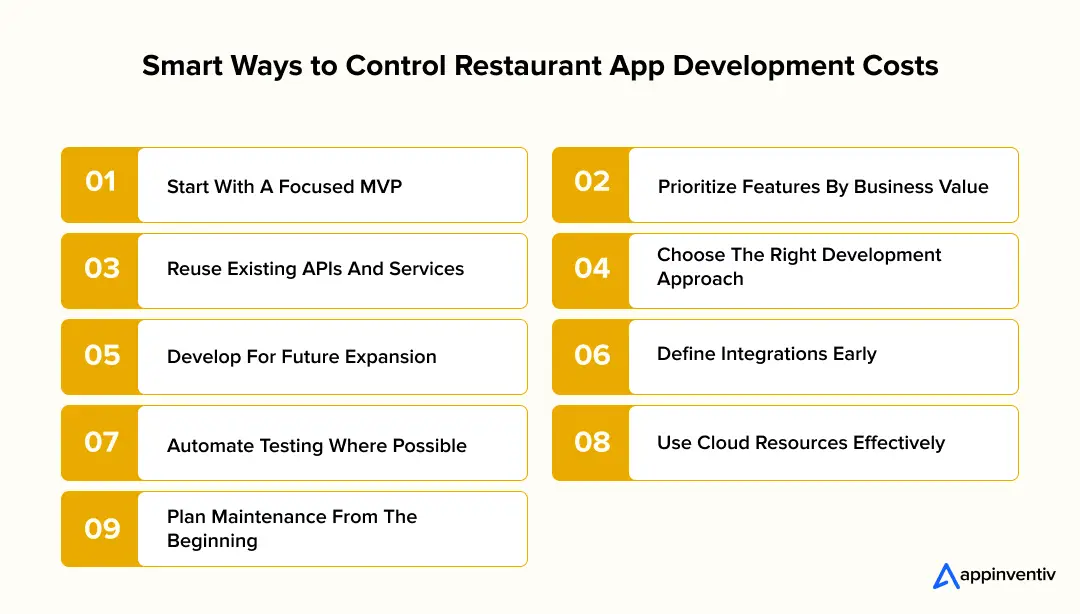
Start With a Focused MVP
Include only the simplest features in the initial release, like order tracking, payments, customer accounts, ordering and menu management. Advanced features can be planned for future releases to improve management of the restaurant app’s MVP cost.
Prioritize Features by Business Value
Decide which features are needed for launch and which can be added later. This helps to manage the restaurant application development cost as the main scope will be limited to the features that will help the core business work.
Reuse Existing APIs and Services
Where appropriate, leverage conventional third-party services for payments, maps, push notifications, multi-factor authentication and other common services. This can reduce the cost to develop a restaurant app by avoiding unnecessary custom development.
Choose the Right Development Approach
Choose among native, cross-platform and web technologies, depending on the specific requirements of the application. However, when it comes to restaurant mobile app development costs, selecting the right technology stack can help minimize overall costs, especially if the app targets both iOS and Android.
Develop for Future Expansion
Develop an application with a modular design so that new features, integrations, and locations can be added without having to rebuild the application.
Define Integrations Early
Define POS, payment, delivery, CRM and inventory systems prior to development. Prevent costly changes due to integration problems later on in the project through early technical assessment.
Automate Testing Where Possible
Automated testing can lessen repetitive manual testing effort and help to manage costs throughout the various releases of the application.
Use Cloud Resources Effectively
Choose infrastructure based on traffic and operational needs. Proper resource monitoring and scaling can help prevent recurring costs.
Plan Maintenance From the Beginning
Have a budget for security updates, bug fixes, API changes, and platform updates. Smaller issues can become big technical problems if not addressed through regular maintenance.
We help prioritize essential features for launch, allowing you to defer lower-priority capabilities until there is a clear business need

Restaurant Brands We Helped Drive Digital Growth
Appinventiv is a platform that empowers restaurant companies to craft digital products that align with their business goals and growth plans, while ensuring it is scalable. Our experience with global QSR brands shows what type of business challenges we can solve:
- Pizza Hut was a project where we redesigned the app experience to make it easier, faster and engage customers in a competitive delivery environment. The update increased orders by 30% and led to 50K+ app downloads.
- We developed a scalable digital platform to support KFC’s business in 7 international markets with a consistent ordering experience. This platform now processes 30K+ orders each day and has seen a 22% increase in conversion rate.
- The UI/UX was redesigned to minimize friction at key customer touchpoints with Domino’s and simplify a complex ordering process. Its better experience led to a 23% conversion growth and a 4.4-star rating in the app.
- We integrated and streamlined last-mile deliveries into a single platform, automated order assignment from 42% to 82% and achieved a successful delivery of 60.45M+ orders without platform downtime at Americana Restaurants.
Bring Your Restaurant Operations into One Digital Ecosystem with Appinventiv
More automation, connected operations, and intelligent use of customer data will be the characteristics of the future of restaurant technology. Recommendations based on AI, predictive analytics, AI-driven customer service and improved integration with ordering, point of sale, stock and loyalty systems will become more common features of restaurant apps. As these capabilities develop, there will be a need for scalable platforms that can adapt without repeated overhauls of the system.
But the first step in cost optimization is the proper development strategy. High-impact features can be prioritized for investment with the idea of building a minimum viable product (MVP) before adding more features; scalable cloud infrastructure can help manage investment levels; and considering the right third-party integrations, rather than custom development, can help manage investment levels while still providing room to grow.
Appinventiv, as a reliable restaurant app development company, assists food businesses in planning, designing, and developing applications that meet their operational needs and future goals. Whether it’s product discovery, UI/UX design, custom development, AI integration, system modernization, or post-launch support, our teams work to build scalable restaurant platforms that tie the dots between customer experiences and restaurant operations.
From building a new restaurant app to upgrading an old system, we can guide you in the technology direction and the investment plan. Talk to us about your restaurant app development needs today.
FAQs
Q. How much does it cost to make a restaurant app?
A. The restaurant app development cost varies widely, from $30,000 to $400,000+ based on the complexity and features of the app, the websites it will connect to, user experience and design, and if it will utilize advanced features like AI. There are basic restaurant apps and enterprise-grade applications with delivery management, real-time tracking, loyalty and AI capabilities, both of which will cost more.
Q. What are the factors that influence the restaurant app development pricing?
A. Here are some of the factors that influence the overall pricing of a restaurant app:
- Complexity and scope of the application
- Number and type of features
- UI/UX design requirements
- iOS, Android or cross-platform development
- Custom-designed backend and admin panel
- Third-party API integrations
- API integration of online payment gateways
- The ability to monitor both orders and delivery in real-time
- Cloud Infrastructure and hosting services
- AI and automation features
- Data security and compliance needs
- Development team size and location
- The process of testing and quality assurance
- Post-launch maintenance and updates
Q. How long does it take to build a restaurant app?
A. The time to develop a restaurant app will depend on the complexity and needs of the application, and can take between 3 and 12 months or even longer. Browsing, ordering, and payment of a basic app will take 3-5 months. For more sophisticated platforms that offer delivery tracking, loyalty programs, multiple user roles, AI capabilities, and intricate integrations, the implementation can take between 9 and 12 months or longer.
Q. What features impact the cost of restaurant app development?
A. The cost to build a restaurant app can vary significantly based on advanced and custom features such as:
- Table reservation and waitlist management
- Real-time order tracking
- Delivery management and GPS tracking
- Loyalty and rewards programs
- AI-powered recommendations
- AI chatbots and automated customer support
- Inventory and kitchen management
- Advanced analytics and reporting dashboards
- Multi-location and franchise management
- Dynamic menu and pricing management
- Personalized offers and promotions
- Third-party POS and ERP integrations
Q. How much does it cost to develop an app with AI features?
A. The price of an AI-powered app will vary according to the complexity and type of the AI features. Simple AI functions like chatbots or recommendation engines can cost as much as $20,000 to $50,000+ per year, with more sophisticated solutions featuring custom AI models, predictive analytics, computer vision, or AI agents pushing the price to $100,000 or greater.


Fast 2-minute response, fully NDA-protected.

Restaurant Digital Transformation Driving 25%+ of Sales Across Over Half of Brands
Key Takeaways Per the survey, digital channels generate over 25% of sales for 57% restaurant brands. Higher digital sales do not guarantee better margins once fees, discounts, and fulfillment costs are included. Connected ordering and kitchen systems help reduce delays, cancellations, and manual work. Successful modernization starts with a focused pilot and measurable business results.…

Capture 22% More Restaurant Visits With Restaurant Loyalty App Development
Key Takeaways An enterprise loyalty app requires rule engines, POS synchronization, event-driven APIs, and auditable ledgers to protect the accuracy of transaction data. Custom versus white-label app choices depend on data rights, integration depth, extensibility, scalability, differentiation, and lifetime cost. POS, ordering, payment, CRM, and CDP connections construct unified customer profiles across restaurant store channels…

Building a Restaurant Inventory Management System to Stop Food Cost Leaks
Key Takeaways A restaurant inventory system connects purchasing, receiving, recipes, sales, waste, transfers, and stock counts. Theoretical-versus-actual inventory reveals overportioning, unrecorded waste, missing stock, and inaccurate recipes. POS, ERP, supplier, kitchen, and IoT integrations create a dependable flow of inventory data. AI can strengthen demand forecasting, purchasing, anomaly detection, expiry management, and outlet benchmarking. Development…