
































Steps To Identify The Right AI Implementation Consultant In ME

 Share -


- 01Step 1: Define Business Outcomes Before Evaluating Vendors
- 02Step 2: Assess Their Enterprise AI Implementation Experience
- 03Step 3: Evaluate Their Technical Architecture Capabilities
- 04Step 4: Examine Their Data Engineering and AI Readiness Approach
- 05Step 5: Assess Their Governance, Security, and Compliance Expertise
- 06Step 6: Evaluate MLOps and Long-Term Operational Support
- 07Step 7: Validate Their Industry and Domain Expertise
- 08Step 8: Examine Their Talent, Team Structure, and Delivery Model
- 09Step 9: Evaluate Scalability and Future-Readiness
- 10Step 10: Assess ROI Measurement and Business Value Realization
- 11Questions Every Enterprise Leader Should Ask Before Hiring an AI Consultant
- 12Common Mistakes Enterprises Make When Selecting an AI Implementation Consultant
- 13Why Enterprises Are Moving Toward End-to-End AI Implementation Partners
- 14How Appinventiv Helps Enterprises Build and Scale AI Solutions
- 15Frequently Asked Questions




Key takeaways:
- Define business outcomes before evaluating vendors, and demand proof of actual production experience.
- Evaluate their technical architecture capabilities and assess their data engineering approach during discovery.
- Verify strict security and compliance expertise, and demand clear plans for long-term operational support.
- Validate their specific industry knowledge, and examine the actual delivery team running the project.
- Confirm the proposed architecture scales beyond a single pilot, and establish clear ROI metrics.
Enterprise AI spending is rising. Every AI implementation consultant in the Middle East sees this daily. AI shares the boardroom agenda with cloud modernization and cybersecurity in Saudi Arabia and the UAE. Budgets pass, and pilots launch. Many projects still fail to create business value.
Productivity in AI-exposed industries grew fourfold since 2022. The reason is simple. Companies compare models for months. They spend less time evaluating the deployment team.
A proof of concept looks promising. Real environments tell a different story. Data lives across ERP platforms, CRM systems, and aging business applications. Security reviews take time. Integration work expands. New data issues surface. Many AI programs slow down here.
The right consultant does more than provide technical guidance.
They assess data readiness, design architecture, and connect AI services with business systems. They establish governance controls and support deployment through MLOps. They help enterprises in Saudi Arabia and the UAE address data residency, sector regulations, and risk controls.
Partner selection is a long-term business decision. This guide explains what to evaluate before signing an AI consulting engagement. It shows how to identify a partner who can take an AI initiative from pilot to production.
Many AI projects still stall before production. Find the delivery gaps before they delay business outcomes.

Step 1: Define Business Outcomes Before Evaluating Vendors
Enterprises often start the vendor search early. Leaders decide to invest. Firms present capabilities. Someone demonstrates a chatbot. The discussion shifts to technology. This sequence creates problems. The first discussion must target business outcomes.
- What needs to improve?
- What metric must move?
- What process is the biggest bottleneck?
An AI consultant cannot recommend a path without clear business goals. In most enterprises, AI investments usually target one or more of the following areas:
| Business Goal | Example Target |
|---|---|
| Cost Reduction | Reduce manual processing effort |
| Operational Efficiency | Shorten cycle times |
| Revenue Growth | Increase sales or retention |
| Customer Experience | Improve response and resolution times |
| Risk Reduction | Detect fraud or compliance issues earlier |
This sounds obvious, yet many projects skip this step. A retailer may ask for a Generative AI assistant. What they actually need is better inventory planning.
Identify High-Impact Enterprise AI Use Cases
Across the Middle East, many AI budgets now sit inside larger transformation programs. Saudi Vision 2030 and Dubai 2040 Vision initiatives, alongside smart government programs and large-scale modernization efforts, have increased executive scrutiny around AI spending. That means every use case needs a business case.
Some examples include:
| Industry | Common Starting Points |
|---|---|
| Banking | Fraud monitoring, AML reviews and credit assessment |
| Healthcare | Clinical documentation, claims review |
| Retail | Demand forecasting, inventory management |
| Manufacturing | Equipment monitoring, quality checks |
| Logistics | Route planning, warehouse operations |
The strongest consultants bring Dubai’s AI strategy consulting into the conversation early, spending more time understanding where the business loses money, time, or customers than talking about models. That conversation usually reveals where AI can create value fastest.
Step 2: Assess Their Enterprise AI Implementation Experience
A firm can know AI and be the wrong partner. Clear AI consultant evaluation criteria in the Middle East prevent this. Most vendors discuss use cases and data strategy easily. The real test is delivery.
- Can they build the system?
- Can they deploy it?
- Can they support it six months later?
The gap appears here.
Separate Strategy Firms from Implementation Firms
Not every AI consultant does the same job. Some firms spend most of their time in workshops and planning sessions. Others focus on technical delivery.
A simple way to think about it:
| Provider Type | What They Usually Do |
|---|---|
| Advisory firms | Business cases, AI strategy, roadmap planning |
| System integrators | Infrastructure, enterprise software, implementation work |
| End-to-end partners | Strategy, development, deployment, and support |
Many large organizations across Saudi Arabia and the UAE now prefer fewer vendors. One partner owns the strategy. Another owns delivery. A third manages support. That model often creates delays and disagreements. Responsibility becomes difficult to track.
Validate Production-Level AI Deployments
One question cuts through the marketing quickly. What happened after the pilot? Many consulting firms have proof-of-concept projects. Fewer have production deployments running at enterprise scale.
Look for evidence such as:
- AI systems are currently used by employees or customers.
- Deployments across multiple countries or business units.
- Work completed for banks, healthcare providers, insurers, or government entities.
- Integrations with SAP, Oracle, Salesforce, Microsoft, or legacy platforms.
- Ongoing support after launch.
Step 3: Evaluate Their Technical Architecture Capabilities
Many AI projects fail long before users interact with the model. The issue often sits behind the scenes.
The model works. The integration does not. Data arrives late. Security reviews uncover gaps. Business systems cannot exchange information correctly. The AI application becomes another disconnected tool.
That is why architectural experience matters.
Can They Integrate AI Into Existing Enterprise Systems?
Enterprises run complex environments. AI rarely replaces them. Enterprise AI integration in the Middle East means AI must work with existing systems. Ask vendors where they have completed integrations.
Look for experience with SAP, Oracle, Salesforce, Microsoft Dynamics, ServiceNow, and custom legacy systems. This matters deeply for enterprise AI consulting in the UAE and the broader Middle East.
Many large organizations operate a mix of modern cloud platforms and older enterprise systems. A consultant may have strong AI expertise but limited experience working inside these environments.
Review Their AI Architecture Framework
Ask vendors to explain how data moves through the system. The answer should be practical and detailed.
A typical enterprise AI architecture often includes:
| Architecture Layer | Purpose |
|---|---|
| Data pipelines | Collect, clean, and move data between systems |
| APIs | Connect AI services with enterprise applications |
| Vector databases | Store and retrieve contextual information for AI applications |
| RAG architecture | Ground model responses using enterprise data |
| Model orchestration layer | Manage prompts, workflows, tools, and model interactions |
| Hybrid cloud infrastructure | Support workloads across cloud and on-premise environments |
Pay attention to the discussion. Strong teams explain architecture decisions clearly. They can describe trade-offs, integration challenges, security controls, and deployment constraints without relying on generic diagrams.
A useful follow-up question is simple:
“Can you walk us through an AI system you deployed in production?”
The quality of that answer often reveals more than a technical proposal. A team with real implementation experience can explain the architecture in plain language and connect every technical decision back to a business requirement.
Step 4: Examine Their Data Engineering and AI Readiness Approach
Many AI projects run into trouble before model development begins. The issue is usually data.
Customer records sit in multiple systems. Business teams use different definitions for the same metric. Historical data contains gaps. Access controls limit data availability. The AI model becomes the easiest part of the project.
A consultant should identify these issues early, not after development starts.
Start With an AI Readiness Assessment
Ask the consulting team how they assess whether your organization is ready for AI deployment. A useful AI readiness assessment should go beyond checking whether datasets exist. It should examine data quality, accessibility, governance, security, infrastructure, and the systems that will support the final solution.
This matters across Saudi Arabia, the UAE, and Qatar. Organizations often operate across multiple business units and technology environments. Data may sit in separate ERP systems, cloud platforms, and legacy applications.
Your partner must answer these questions:
- Is the data accessible?
- Who owns the data?
- What are the known data issues?
- Can the data support production workloads?
- Do governance policies support the use cases?
- Are security rules defined?
A sign of maturity is simple. Strong teams evaluate data first. Poor data delays projects for months. Clean data gets projects into production.
Step 5: Assess Their Governance, Security, and Compliance Expertise
For an AI implementation consultant in the Middle East, the AI model is not the problem, but the security review is.
Their project team spent months preparing the use case. The pilot works without any issues. Business teams like the results. However, the project reached legal, compliance, and security stakeholders.
New questions appeared.
- Where will the data sit?
- Who can access it?
- Can someone trace how the model produced an answer?
The team did not have clear answers. The deployment slowed down. That story is common.
Responsible AI Must Be Built Into Every Deployment
Most consultants enjoy talking about models. Ask them about governance instead. Pay attention to how detailed the answer becomes.
A team with real implementation experience should discuss:
- Governance reviews before deployment.
- Model monitoring after launch.
- Human review for high-risk decisions.
- Audit records for prompts and outputs.
- Processes for handling model errors.
If the discussion stays vague, keep asking questions. Governance work often determines whether a project reaches production.
Enterprise Compliance Areas to Evaluate
Most enterprise reviews focus on a few recurring areas.
| Area | What To Verify |
|---|---|
| Data Privacy | Readiness for local and regional regulations |
| Security | Encryption, access permissions, identity controls |
| Governance | Human oversight and approval processes |
| Risk Management | Monitoring, testing, and incident handling |
Ask for examples from completed projects. The examples matter more than the checklist.
Special Considerations for Middle East Enterprises
Saudi Arabia and the UAE invest heavily in AI. National programs drive these investments. Data location is a primary concern. Healthcare providers need strict patient data controls. Financial institutions demand specific storage rules. Government entities apply stricter requirements.
These rules change architecture decisions immediately. Experienced consultants raise these topics early. Inexperienced teams find them halfway through the project. Late discoveries cause delays and higher costs. Executives often judge vendors by model capabilities.
The better question is simple. Can this team pass security, compliance, and governance reviews without creating new problems?
Step 6: Evaluate MLOps and Long-Term Operational Support
Many AI projects receive plenty of attention before launch. The attention often drops after launch. That is usually where the real work begins.
A model that performs well in January may deliver different results six months later. Customer behavior changes. Market conditions change. New data enters the system. Accuracy starts to decline.
Production AI systems need ongoing management. They cannot operate on autopilot.
AI Success Depends on Post-Deployment Operations
Ask consultants what happens after the system goes live. Their answer should cover monitoring, maintenance, updates, and issue resolution. Strong post-implementation AI support helps ensure the system continues to perform as business conditions and data change.
Look for experience in areas such as:
- Model monitoring to track performance over time.
- Drift detection to identify changes in data patterns.
- Retraining pipelines for updating models with new data.
- Version control for managing model updates and rollbacks.
- Observability tools that track system health, latency, and failures.
Many enterprises discover these requirements after deployment. By that stage, fixing operational gaps becomes more expensive and disruptive.
This becomes even more important across industries such as banking, healthcare, retail, and logistics, where AI systems support daily operations and business decisions.
Signs of a Mature AI Delivery Partner
A mature AI partner treats deployment as the start of the lifecycle, not the finish line.
Look for indicators such as:
| Maturity Indicator | What It Suggests |
|---|---|
| Dedicated MLOps team | Long-term operational ownership |
| Automated monitoring processes | Faster issue detection |
| Model retraining strategy | Better long-term performance |
| Incident response procedures | Faster recovery from failures |
| Production support agreements | Ongoing operational accountability |
| Performance reporting dashboards | Visibility into business and technical metrics |
A useful question during vendor discussions is simple. Ask them to describe an AI system that has been running in production for more than a year.
Experienced teams usually discuss monitoring challenges, model updates, unexpected issues, and lessons learned. Less experienced teams often return to the original deployment story. That difference is usually easy to spot.
Many AI systems degrade gradually and create business risk without strong MLOps controls.

Step 7: Validate Their Industry and Domain Expertise
During vendor evaluations, many consulting firms claim industry experience. Ask a few follow-up questions.
- Which core systems did they work with?
- Which business teams were involved?
- What happened after deployment?
The answers usually separate real experience from marketing claims.
Domain Knowledge Reduces AI Failure Rates
A consultant can be highly skilled in AI and still struggle in a new industry. Take banking as an example.
The rise of AI agents in finance across the Middle East has made this clearer. Building a fraud detection model is only part of the work, and teams must also understand transaction monitoring, compliance reviews, and audit requirements.
The same pattern appears in every sector.
| Industry | Typical AI Priorities |
|---|---|
| Banking | Fraud detection, AML reviews and credit risk |
| Healthcare | Clinical records, claims processing and patient triage |
| Retail | Inventory planning, demand forecasting and personalization |
| Energy | Asset monitoring, maintenance planning |
| Telecom | Customer churn, network performance, service operations |
The technology may look similar on paper. The business environment is not.
Why Industry Context Matters for AI Performance
AI projects often slow down for reasons outside the model. The issue is the process. The shift of AI in retail across the Middle East shows this pattern. A retailer wanted better inventory forecasts. The project team focused on model accuracy.
Store operations teams cared about replenishment cycles. This disconnect delayed adoption. This happens across regulated industries.
Healthcare providers handle records differently from telecom operators. Banks store data differently from energy companies. Workflows and reporting requirements differ. This matters in the Gulf region.
Organizations in Saudi Arabia and the UAE operate across multiple regulatory environments. Experienced consultants identify risks early. They ask better questions. Industry knowledge does not replace technical expertise. It makes that expertise useful.
Step 8: Examine Their Talent, Team Structure, and Delivery Model
One overlooked question during vendor selection is simple. Who will build the system? Building AI agents for digital transformation in the Middle East requires specific skills.
Enterprises spend weeks reviewing proposals. Leaders sign the contract. A different team appears during the project kickoff.
That can create problems quickly. Technical decisions made during discovery often shape the project for months. The people making those decisions should remain involved after delivery begins.
Who Will Actually Deliver Your AI Program?
This question matters more than ever. AI-skilled professionals commanded a 56% wage premium, reflecting the growing value of experienced AI talent.
Ask vendors to introduce the people who will work on the engagement, not just the leadership team. A production AI project usually requires expertise across several areas:
| Role | Primary Responsibility |
|---|---|
| AI Architects | System design, model selection, technical direction |
| Data Scientists | Model development, testing, and evaluation |
| ML Engineers | Deployment, scaling, and production operations |
| Data Engineers | Data pipelines and data preparation |
| Cloud Architects | Infrastructure, security, and platform design |
| Security Specialists | Access controls, risk reviews, and compliance support |
The structure matters as much as the individual roles.
For example, a bank in Saudi Arabia may require close coordination between AI engineers, security teams, compliance teams, and infrastructure specialists. When it comes to AI consulting for enterprises in the UAE, a healthcare provider may place greater emphasis on data governance and privacy controls. Different environments require different delivery models.
Step 9: Evaluate Scalability and Future-Readiness
A retail company launches an AI assistant for customer support. The project works. A few months later, another team wants a sales assistant. Then, finance asks for document automation. Then, operations request forecasting tools.
Suddenly, the original architecture starts showing cracks. The first project succeeded. The next five projects became harder. That situation is common.
Can the Partner Scale Beyond a Single Use Case?
Most consultants can help build one AI application. The stronger question is, can their AI integration solutions scale to support the business three years from now?
Look for experience in:
- Multi-model environments.
- Agentic AI deployments.
- Enterprise AI platforms are used across departments.
- Global rollouts across multiple countries.
- Shared governance and monitoring structures.
This matters across the Gulf region. Large organizations in Saudi Arabia and the UAE often start with a single use case. Expansion usually follows quickly.
A successful pilot inside customer service often leads to requests from operations, finance, compliance, and supply chain teams. The original architecture needs room to grow.
Future-Proofing AI Investments
One question reveals a lot during vendor discussions. Ask what happened after their client’s first AI deployment. Did the client stop there? Or did the work expand into new departments and new use cases? The answer tells you how the consulting team thinks.
| Project-Focused Delivery | Platform-Focused Delivery |
|---|---|
| One use case at a time | Multiple use cases supported |
| Separate tools for each project | Shared services and infrastructure |
| New setup for every initiative | Reusable components and controls |
| Growth becomes harder over time | Growth becomes easier over time |
Technology changes quickly. The challenge is not building the first AI application. Mature AI software development in the UAE is built around environments where the second, third, and tenth applications do not require starting from scratch.
Step 10: Assess ROI Measurement and Business Value Realization
An AI project can launch on time and still disappoint the business. The model works. Users log in. Dashboards look healthy. Then leadership asks for results. How much time did teams save?
How much money did the company save? Did customer satisfaction improve? Those questions often expose a gap. The project team tracked technical metrics. The business expected business outcomes.
AI Must Deliver Measurable Outcomes
A strong AI consultant should discuss business metrics early, not after deployment. The conversation should move beyond model accuracy and response times.
Look for metrics such as:
- Productivity gains across teams.
- Cost reductions from automation.
- Percentage of work handled without human intervention.
- Customer satisfaction improvements.
- Revenue growth linked to AI-driven processes.
For enterprises in the region, understanding agentic AI ROI in Dubai before deployment begins is what separates consultants who track business outcomes from those who only track technical metrics.
The exact metrics will vary by industry.
A telecom provider may focus on customer churn. A retailer may focus on inventory costs. A bank may focus on fraud losses and investigation time.
The principle stays the same. Every AI initiative should connect to a measurable business outcome.
Ask Vendors for an AI Value Realization Framework
A useful question during vendor discussions is straightforward. How do you measure success after deployment? The answer should include both technical and business KPIs.
| Executive KPI | Business Impact |
|---|---|
| Productivity Improvement | Faster task completion and reduced manual effort |
| Cost Savings | Lower operating expenses |
| Automation Rate | More work was completed without human intervention |
| Customer Satisfaction | Better customer experience and service quality |
| Revenue Impact | Increased sales, retention, or conversion rates |
This discussion has become more important across the Middle East. Many AI investments now sit inside larger transformation programs. Executive teams want measurable outcomes, not experimental projects.
Budget approvals often depend on projected business value and post-deployment results.
A consultant who cannot explain how value will be measured usually struggles to prove value later. That conversation should happen before the project begins, not after the budget has already been spent.
Questions Every Enterprise Leader Should Ask Before Hiring an AI Consultant
Keep this list handy during vendor discussions. You do not need all the answers immediately. You need to know which vendors answer clearly and which ones avoid the question.
AI Consulting Partner Evaluation Checklist
About Experience
- What is the largest AI project your team has delivered?
- How many AI systems are live today?
- Which industries make up most of your work?
- Can we speak with a client from a similar project?
About Delivery
- Can you support our AI strategy from the initial roadmap through production deployment?
- Who will run the project day-to-day?
- What parts of the work do you outsource?
- What usually causes delays during implementation?
- What did you learn from a project that struggled?
About Technology
- Have you integrated AI with SAP, Oracle, Salesforce, or Microsoft systems?
- How would you integrate AI with our existing enterprise systems?
- How do you handle poor-quality data?
- What happens when model performance declines?
- How do you support AI systems after launch?
About Risk
- How do you handle compliance requirements when an AI system operates across multiple markets?
- How do you handle governance and compliance reviews?
- What security controls do you recommend?
- How do you address data residency requirements?
One thing worth watching. Some vendors answer every question with a future plan. Others answer with a story from a project they already completed. The second answer is usually more useful.
Common Mistakes Enterprises Make When Selecting an AI Implementation Consultant
Ask enough CIOs, CTOs, and transformation leaders about AI projects, and similar stories start appearing. The project looked promising. The vendor looked capable. The business case made sense. Then problems surfaced months later.
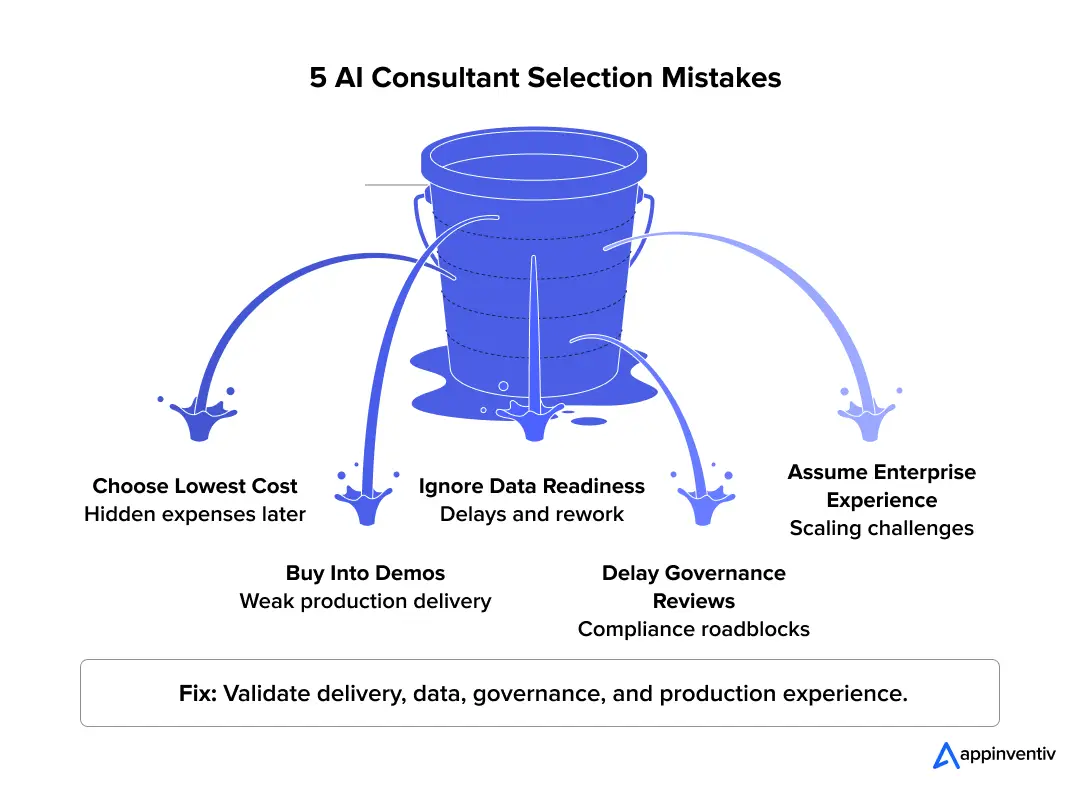
The Cheapest Proposal Wins
This happens more often than people admit. One vendor comes in 30% below everyone else. Procurement likes the number. The project moves forward. A few months later, new costs appear.
Integration work was not included. Governance work was not included. Support was not included. The original savings disappear quickly.
Resolution: Compare the total delivery scope, not just the project cost.
Understanding AI consultant costs in the UAE helps set realistic budget expectations before vendor discussions begin.
The Demo Becomes the Decision
Good demos are persuasive. That is what they are designed to do. The issue is that enterprise AI projects spend far more time in production than in demonstrations.
A polished demo does not reveal how a team handles integrations, security reviews, data issues, or deployment delays.
Resolution: Spend more time reviewing delivery history than presentation material.
Data Gets Ignored Until It Becomes a Problem
Many teams discover data issues after contracts are signed. Customer records do not match. Data sits in multiple systems. Definitions vary across departments. Then timelines start slipping.
Resolution: Review data readiness before implementation planning begins.
Governance Arrives Late
The project progresses smoothly. Then, legal, security, risk, or compliance teams join the conversation. New requirements appear. Architecture changes follow. The launch date moves again.
Resolution: Bring governance, security, and compliance stakeholders into the discussion early.
Enterprise Experience Gets Assumed
A vendor may have completed several successful pilots. That does not mean they can manage a large deployment. Enterprise AI projects involve change management, monitoring, integrations, support processes, and operational ownership. Those challenges rarely appear during a pilot.
Resolution: Ask for examples of production deployments, not proof-of-concept projects. Most AI implementation failures are not caused by the model. The decisions that create problems usually happen much earlier.
Weak partner selection often leads to stalled deployments, rising costs, and missed targets.

Why Enterprises Are Moving Toward End-to-End AI Implementation Partners
Many enterprise AI programs start with multiple vendors. One firm creates the strategy. Another handles engineering. A third supports deployment. The model looks good on paper.
In practice, accountability often becomes difficult. Delays appear. Teams disagree on priorities. Problems move from one vendor to another. That is one reason many enterprises now prefer end-to-end AI implementation partners.
A strong partner can connect strategy, data engineering, model development, integration, deployment, and post-launch support through a single delivery structure. This creates a clearer path for strategy-to-deployment AI implementation, while reducing handoffs between teams.
The AI strategy consulting benefits become clearer when a single partner connects strategy, data engineering, model development, integration work, deployment, and post-launch support. This reduces handoffs and shortens delivery timelines.
The demand for an AI consulting partner GCC is visible across transformation programs in Saudi Arabia and the UAE. Organizations want measurable business outcomes on strict timelines.
Leaders want to move from idea to production faster and maintain clear ownership. Firms combining consulting, engineering, and long-term support deliver the most value. Appinventiv follows this model. We help enterprises move from strategy to production under a single delivery structure.
Also Read: Software Development in the Middle East
How Appinventiv Helps Enterprises Build and Scale AI Solutions
There is a reason this article focused so heavily on implementation. Most enterprise teams can identify AI opportunities on their own. The harder part starts later.
Data sits in different systems. Security teams ask new questions. Business units want different outcomes. A pilot that worked for 500 users suddenly needs to support 50,000.
That is usually where partner selection starts to matter.
Over the last few years, our conversations with enterprise leaders across Saudi Arabia, the UAE, Europe, and North America have sounded remarkably similar. The technology is rarely the main concern. Delivery risk is.
- Can the platform connect to existing systems?
- Can the data be trusted?
- Can governance teams sign off?
- Can the business scale beyond the first use case?
Those are the questions our teams work on every day.
| Our AI Delivery Experience | Scale |
|---|---|
| AI-powered solutions delivered | 300+ |
| Custom AI models deployed | 150+ |
| Enterprise AI integrations completed | 75+ |
| Bespoke LLMs fine-tuned | 50+ |
| Industries supported | 35+ |
| Strategy and transformation engagements | 2,000+ |
| Global consulting partnerships | 8+ |
Recent engagements have helped enterprises achieve:
- Up to 75% faster decision-making
- Up to 98% AI prediction accuracy
- Up to 10x faster time-to-market
If your organization is evaluating AI implementation partners, start with the checklist covered in this guide. Then compare the answers.
The right partner should be able to discuss data readiness, integration challenges, governance requirements, production deployment, and long-term operations with the same level of confidence.
That is the standard we hold ourselves to. Whether you are planning your first AI initiative or expanding existing programs across business units, our AI implementation consultants in the Middle East can help you assess readiness, identify delivery risks, and build a practical execution plan.
Speak with Appinventiv’s AI specialists to explore your next step.
Frequently Asked Questions
Q. How can an AI implementation consultant help me?
A. Most organizations do not fail at finding AI ideas. They fail during execution. Teams run into data issues. Integrations take longer than expected. Security reviews raise concerns. An AI implementation consultant in the Middle East helps remove those roadblocks and keeps the project moving.
Q. How to choose the right AI implementation consultant for my business?
A. Look past the proposal deck. Ask what they have deployed in the last two years. Ask what is still running today. A firm with real implementation experience talks about operations, adoption, and maintenance, not just project plans.
Q. What questions should you ask an AI consulting firm before hiring them?
A. Ask where their systems are live. Ask who manages deployment. Ask how they handle governance reviews. Ask how many projects moved from pilot to production. Those answers usually reveal more than a capability presentation.
Q. How to evaluate an AI consultant’s expertise?
A. Start with evidence. Review client references, deployment examples, and integration work. Then look at the complexity of the environments they support. Enterprise AI looks very different from a standalone proof of concept.
Q. Why is industry experience important when selecting an AI consultant?
A. Business context matters. A banking workflow differs from a healthcare workflow. Retail data differs from telecom data. Teams with sector experience spend less time learning business processes and more time delivering results.
Q. How important is AI governance when choosing an AI implementation partner?
A. Governance affects every stage of deployment. Legal teams review it. Risk teams review it. Auditors review it. If governance enters the conversation late, projects often slow down, and budgets start to expand.
Q. What challenges can an AI implementation consultant help solve?
A. Data quality problems appear often. Legacy systems create integration issues. Teams disagree on priorities. Production deployments expose gaps that were not visible during testing. Experienced consultants have worked through these situations many times.
Q. What should Middle Eastern businesses look for in an AI consulting partner?
A. Regional experience matters. Many organizations in Saudi Arabia and the UAE must address data residency requirements, sector regulations, and local compliance obligations. Previous experience in those environments reduces project risk.
Q. How can an AI implementation consultant help maximize AI ROI?
A. Strong consultants start with business metrics. They identify where costs can drop, where revenue can grow, and where manual work can shrink. That creates a clear target before development starts and makes results easier to measure later.
Q. What are the key AI strategy consulting benefits for enterprises?
A. The biggest AI strategy consulting benefits come from better decision-making before money is spent on technology. A consulting team helps identify high-value use cases, assess data readiness, estimate ROI, prioritize investments, and reduce delivery risks. This often prevents costly pilot projects and creates a clearer path from AI planning to enterprise-wide adoption.


Fast 2-minute response, fully NDA-protected.

AI Data Integration: How to Connect, Clean and Prepare Data for AI
Key takeaways: AI initiatives fail when fragmented, poor-quality data reaches models without sufficient context, controls or ownership. AI-ready pipelines must connect, clean, enrich, govern and continuously monitor data across its lifecycle. Real-time processing matters when AI decisions depend on current transactions, events, inventory or operational conditions. Data architecture should follow the AI use case, balancing…

AI-Native SDLC: Foundational 90-Day, 5R AI SDLC Adoption Playbook
Key takeaways: Why AI coding tools accelerate coding and software delivery How AI-native SDLC shifts engineering from code to intent, context, and outcomes The role of specifications, AI agents, and continuous verification in enterprise delivery How to redesign engineering teams for human–agent collaboration The platform, governance, and guardrails required to scale AI-native development A practical…
AI Agent Governance: How to Govern Autonomous AI Across Business Systems
Key takeaways: AI agents require controls at the action, identity, data, tool, and workflow levels. Every enterprise agent should have a registered owner, an approved purpose, and a defined risk tier. Access must be based on the agent’s task rather than inherited from a human user or shared service account. High-impact actions need real-time policy…