
- InventivAI
- Featured Insight
 Leader in AI-First Product Engineering Read Full Article
- About
- Services
 IT Managed & Outsourcing
 - Industries
- Portfolio
- Resources RECOMMENDED BlogsView All Blogs
-
 Contact Us
Leader in AI-First Product Engineering Read Full Article IT Managed & Outsourcing Contact Us

Compass India operates food services at scale, across sites that function very differently. A corporate cafeteria follows a different pattern than an institutional kitchen, and even within one location, demand can change with little warning. Each day comes down to a simple question: how many meals will be served tomorrow? Planning once relied on past averages, local judgment, and quick adjustments. That worked, to a point.
Overestimates led to waste and higher costs. Underestimates disrupted service and procurement. Compass India needed more than a standard forecasting tool. It needed a system that could learn from historical POS data, adapt to each site’s behavior, and still allow human override when context mattered. The outcome was an AI-driven demand forecasting system built for real operations, where accuracy supports decisions, and trust sustains them.

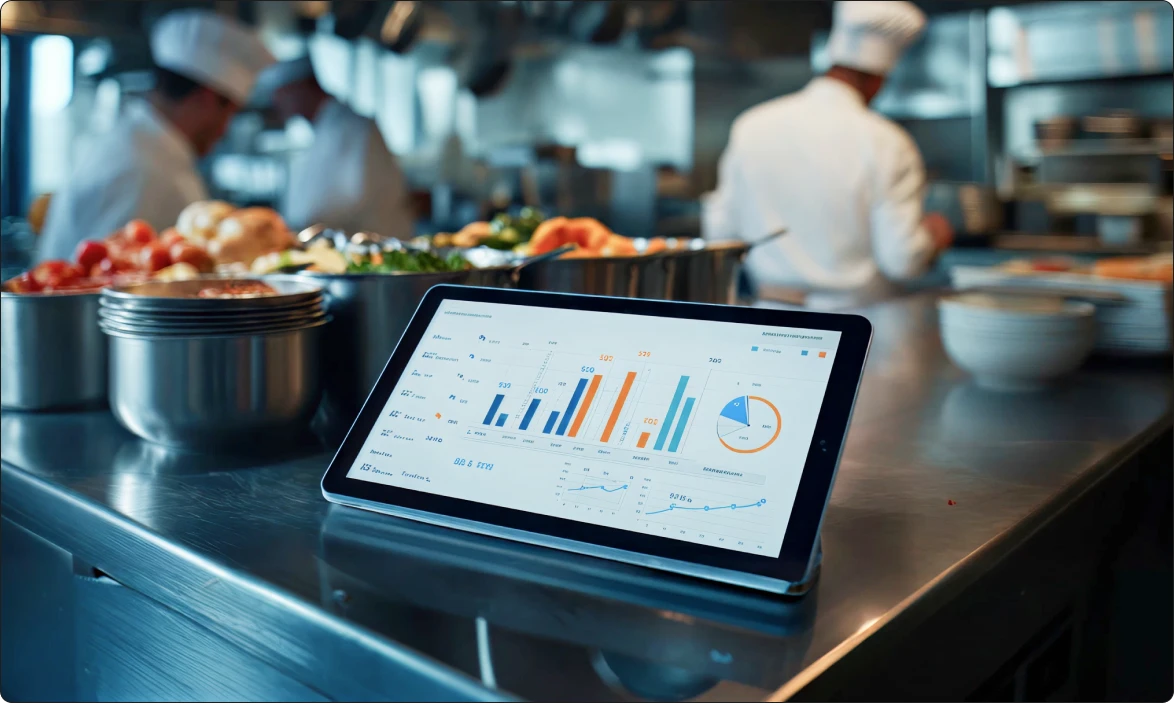
At Compass India, meal demand rarely followed a set pattern. Each site behaved differently, and daily volumes shifted without warning. Events and attendance swings made averages unreliable. The aim was to forecast next-day meals accurately while keeping planning clear and trustworthy.
The platform needed to:
Predict demand per site and meal with enough reliability for operational planning.

Adapt to unique patterns across locations instead of forcing uniform rules.

Flag predictions for human review when confidence was low, letting planners step in.

Improve over time through retraining cycles without disrupting daily operations.

We used multiple machine learning models rather than a single predictor. Prophet captured recurring patterns and seasonality where historical rhythms were stable. AutoGluon ran many models in parallel and picked the best one for each site and meal period.
High-confidence outputs went straight into operational plans, and low-confidence predictions were flagged for review with planner corrections recorded. The result: meal planning moved from reacting to waste to anticipating needs with real-world predictive insights.
Move beyond averages and last-minute adjustments with models
that learn from
real demand patterns.





Meal demand differed sharply across sites and meal periods. Local events, workforce rotation, and attendance swings made historical averages unreliable, requiring models that could adapt site by site rather than follow uniform rules.
Forecasts needed to drive daily planning without removing the planner's judgment. The system had to automate routine decisions while clearly flagging uncertain predictions for review, ensuring accuracy without slowing operations.
POS data quality varied between sites, with gaps and uneven history affecting reliability. The forecasting approach had to remain stable and accurate even when inputs were incomplete or irregular.
We began with how meal planning works on the ground at Compass India. Demand changes often and not always for clear reasons. Planners trust data, but they also trust experience. The system had to respect both and adapt by site without hiding uncertainty.


Key solution features













The forecasting platform helped align food preparation and procurement with real demand, shifting planning from reactive adjustments to data-backed foresight.
Pilot deployments achieved over 92% forecast accuracy, validating the use of machine learning for large-scale planning.
Confidence scoring enabled operational teams to review and adjust low-confidence forecasts, strengthening adoption and long-term accuracy.
Build an enterprise forecasting and planning
solution driven by real consumption
data.


Each site is treated on its own. Forecasts are built from that site’s historical POS data, not pooled averages. Local habits show up quickly, and over time, the forecasts reflect how each location actually behaves.
Yes, by design. Every forecast carries a confidence level. When confidence is low, the numbers are flagged for review. Planning teams can adjust or override them, and those decisions feed back into the learning loop. This balance made machine learning useful for operations planning instead of something teams had to work around.
For now, yes. Next-day meal counts were the immediate need at Compass India. The broader enterprise forecasting and planning solution is set up to support rolling forecasts, calendar-based adjustments, and event-driven demand spikes as the system expands.
Forecasts that track real demand give procurement clearer signals. Stock levels stay tighter. Vendor planning improves. Emergency purchases drop. Over time, this supports predictive analytics for procurement planning without adding extra process.
It can. Models are trained per site, so new locations adapt using their own data. There is no manual tuning required, and each site benefits from shared learning across the network while keeping local behavior intact.