
























On-Demand Beauty Services App Development: Connecting Customers With Beauty Professionals

 Share -


- 01The Market Opportunity for On-Demand Beauty Services
- 02Business Benefits of On-Demand Beauty Services App Development
- 03Choosing the Right Business and Revenue Model Before Development
- 04How Your App Should Match Customers With the Right Beauty Professionals
- 05Essential Features Across Your On-Demand Beauty Services App Panels
- 06The On-Demand Beauty Services App Development Process: From Validation to Scale
- 07Choosing the Technology Stack for Beauty Services App Development
- 08How Much Does Beauty Services App Development Cost, and How Long Does It Take?
- 09Challenges in Beauty App Development and How to Address Them
- 10Future Trends of Beauty App Development Worth Planning For
- 11How Appinventiv Can Help Build Your Beauty Services Platform
- 12Frequently Asked Questions

Key takeaways:
- Match customers by service expertise, availability, and travel feasibility to turn searches into appointments your business can fulfill.
- Define who controls pricing, service quality, cancellations, and payouts before choosing features or estimating development.
- Connect customer, professional, partner, and admin panels through shared booking records and role-based access.
- Use AI to improve matching, scheduling, and rebooking, with results measured against completed appointments and repeat business.
- Plan an indicative development budget of $20,000–$200,000, then validate demand and appointment economics through a focused MVP.
Every appointment on a beauty platform commits three things: a professional’s time, a customer promise, and a margin. Your technology needs to account for all three before it confirms the slot.
That gets harder when you expand across locations, service categories, and independent professionals. A calendar may show availability while ignoring travel time. A highly rated stylist may lack the expertise a booking requires. An appointment may generate revenue but leave little margin after travel, incentives, and support costs.
For enterprise leaders, on-demand beauty services app development is an opportunity to build these decisions into the platform. Matching, scheduling, payments, and service operations need to share accurate data so the business can accept bookings it can reliably fulfill.
The investment question is therefore specific: can your platform grow booking volume without increasing manual coordination at the same pace?
This guide examines the operating models, architecture, features, development costs, and launch priorities that shape that answer.
Let’s map how your platform will match professionals, manage appointments, and support growth before you commit your development budget.
The Market Opportunity for On-Demand Beauty Services
For businesses entering the beauty services market, the opportunity comes from connecting substantial consumer spending with a booking experience that still leaves demand unserved.
Grand View Research estimates the global professional beauty services market at $299.6 billion in 2026, reaching $495.5 billion by 2033, at a 7.5% CAGR. This includes hair care, skincare, nail care, and massage and spa services, providing broader market context rather than an estimate of app-based bookings alone.
Booking friction creates a more immediate opening. According to Zenoti’s 2025 Salon and Spa Consumer Survey:
- 71% of salon and spa regulars had skipped a booking because reaching someone or using the online system was too difficult.
- 73% said easier booking and communication would make them more loyal to a business.
Established platforms also show that digital beauty bookings can support significant commercial activity. StyleSeat reports processing more than $12 billion across 250 million appointments. These are cumulative platform figures, not annual company revenue. Its offering combines booking with subscriptions and payment processing, illustrating how professional business tools can support monetization alongside customer discovery.
Glamsquad has also raised more than $28 million funding with their at-home service opportunity, offering hair, makeup, and nail appointments at homes, hotels, offices, and event venues. Its group, bridal, and corporate services demonstrate how a platform can address several booking occasions within one delivery model.
For businesses considering beauty app development, the opportunity needs to be defined locally: which customers struggle to find suitable professionals, which services remain difficult to book, and where enough professional capacity exists to fulfill demand. Those answers should shape the platform model.
| Platform Type | How It Works | Business Opportunity | Core Development Priority |
|---|---|---|---|
| At-Home Beauty Services Platform | Professionals travel to customers’ homes, hotels, or event venues. | Serve customers who value convenience, privacy, or event preparation at their location. | Match expertise and availability while accounting for travel, equipment, and service duration. |
| Beauty Professional Marketplace | Independent professionals list services, portfolios, prices, and appointments. | Connect fragmented professional supply with customers seeking specific expertise. | Support verification, relevant search results, individual calendars, and payouts. |
| Salon and Spa Booking Platform | Customers discover establishments and reserve appointments across participating businesses. | Help customers find suitable appointments while giving partners another booking channel. | Connect service menus with branch availability, staff schedules, and existing booking systems. |
| Single-Brand Beauty Services App | One beauty business offers direct booking across its professionals or locations. | Strengthen direct customer relationships, repeat bookings, and membership usage. | Maintain consistent customer records, pricing rules, memberships, and service standards. |
| Hybrid Beauty Services Platform | Customers choose between salon visits and services delivered to them. | Address different customer occasions through a shared brand and booking experience. | Coordinate distinct pricing, availability, and fulfillment rules across both formats. |
These categories can overlap. A salon chain might add home appointments, while a professional marketplace could specialize in bridal services. Define the initial segment and service area before expanding scope, then validate demand, professional availability, and margin per completed appointment.
Business Benefits of On-Demand Beauty Services App Development
The business case for beauty services app development rests on what happens after customers find your platform. More completed appointments, productive professional hours, and repeat bookings should guide investment decisions.
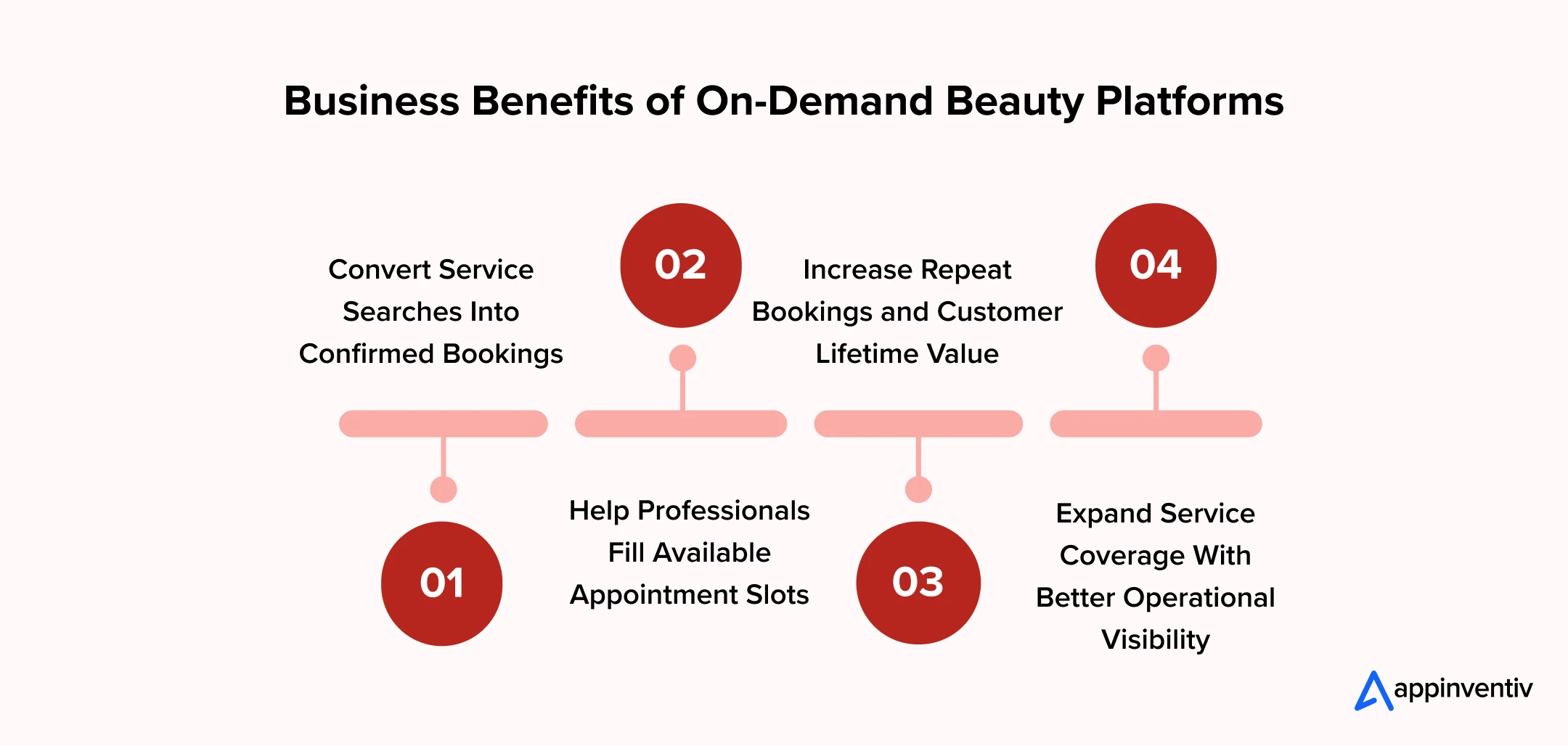
Convert Service Searches Into Confirmed Bookings
A customer searching for a facial on Saturday should see professionals who can deliver that service at the requested location and time. Showing unavailable options adds friction and creates avoidable support work.
Connect discovery with bookable inventory, clear service inclusions, and upfront pricing. Track search-to-booking conversion alongside searches that return no suitable availability. Together, these measures help distinguish booking problems from gaps in professional coverage.
Help Professionals Fill Available Appointment Slots
An empty hour between appointments is useful only if another service can realistically fit. For home visits, that calculation must include travel, setup, and cleanup.
Scheduling rules can help expose usable slots and prevent impractical bookings. Measure completed service hours against available working hours, with travel tracked separately. This gives operations teams a clearer view of capacity than calendar occupancy alone.
Increase Repeat Bookings and Customer Lifetime Value
Once a customer finds a professional they trust, booking again should take less effort. Saved preferences, appointment history, and direct access to that professional’s availability can shorten the return journey.
Introduce reminders around relevant service intervals and offer memberships where repeat demand supports them. Track repeat bookings and retained margin to establish whether these features generate worthwhile business without excessive discounts.
Expand Service Coverage With Better Operational Visibility
Expansion decisions need evidence at the service-area level. Unfulfilled searches may reveal demand for nail technicians in one neighborhood, while frequent cancellations expose unreliable coverage elsewhere.
A shared operations dashboard helps teams identify where to recruit professionals, adjust service boundaries, or resolve quality issues. Businesses investing in on-demand beauty app development can use this visibility to plan expansion around demand, delivery capacity, and appointment economics.
Choosing the Right Business and Revenue Model Before Development
Your operating model determines who sets prices, accepts appointments, resolves complaints, and carries the cost of cancellations. Settle these responsibilities before starting on-demand beauty services app development.
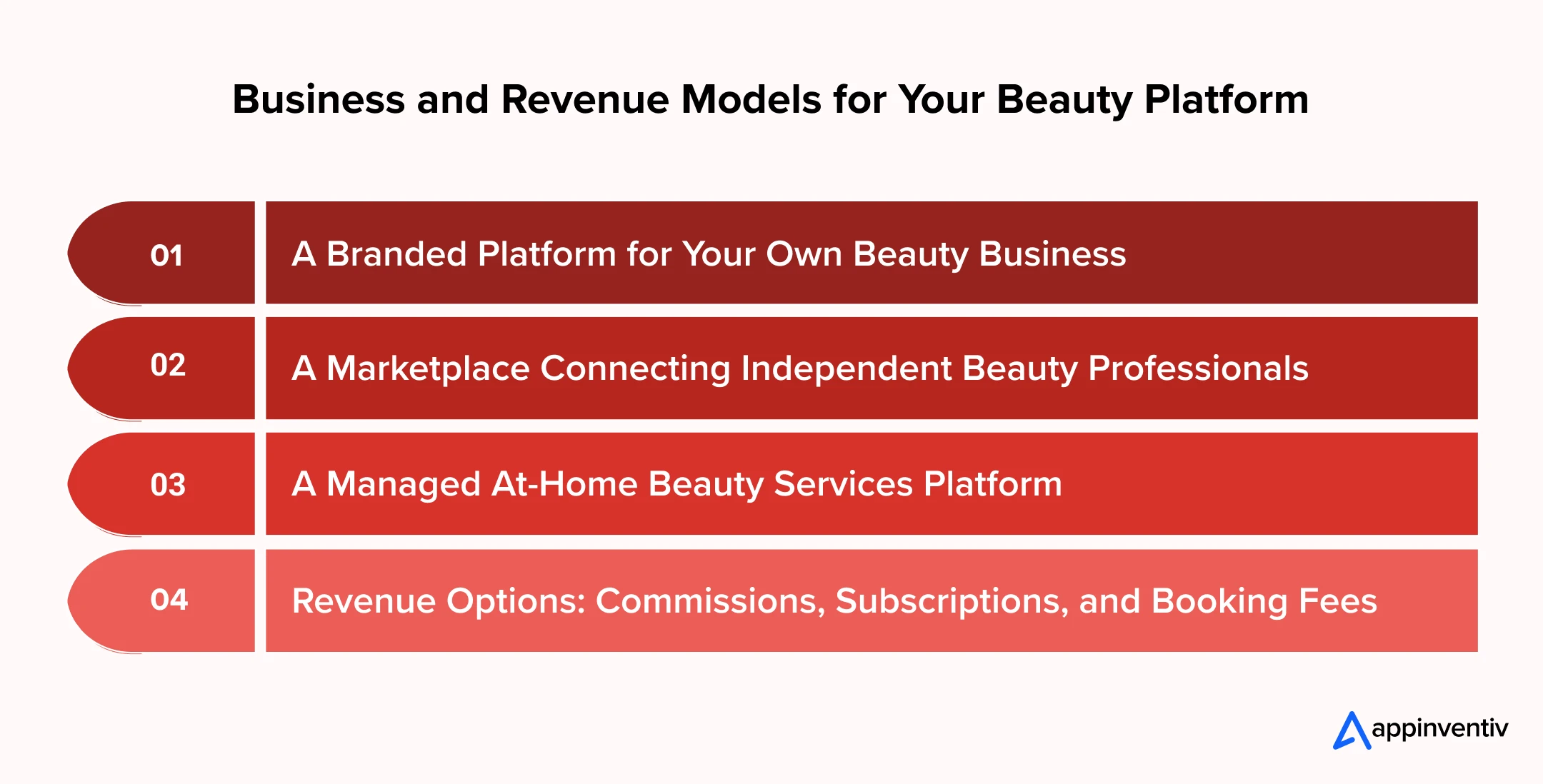
A Branded Platform for Your Own Beauty Business
A salon chain or beauty brand can control the service menu, customer relationship, and booking policies across locations. Revenue comes primarily from completed services, memberships, and relevant product sales.
The platform needs branch-level permissions alongside central oversight. Local teams manage daily schedules while leadership monitors pricing, service quality, and performance.
A Marketplace Connecting Independent Beauty Professionals
Independent professionals manage their offerings and availability, while your business provides discovery, booking, and transaction infrastructure.
Define which decisions belong to professionals and which platform standards everyone must follow. These boundaries affect onboarding, pricing controls, dispute handling, and customer expectations.
A Managed At-Home Beauty Services Platform
A managed model gives your business greater responsibility for service standards, assignment, and fulfillment. The platform must account for professional coverage, travel time, equipment, and replacement capacity.
That additional control requires operational investment. Recruitment, training, quality checks, and customer support belong in the business case alongside software.
Revenue Options: Commissions, Subscriptions, and Booking Fees
Choose app monetization techniques that reflect the value delivered:
- Commissions: Charge a share of completed service transactions.
- Professional subscriptions: Charge for scheduling, customer management, or business tools.
- Booking fees: Apply a clearly disclosed customer transaction charge.
- Memberships: Offer recurring customer benefits with sustainable redemption terms.
Model professional earnings and platform margin together. A commission structure that discourages reliable professionals can weaken the service customers receive.
How Your App Should Match Customers With the Right Beauty Professionals
Matching determines which appointments your business can confidently accept. In on-demand beauty services app development, this requires explicit eligibility rules before any recommendation or ranking system.
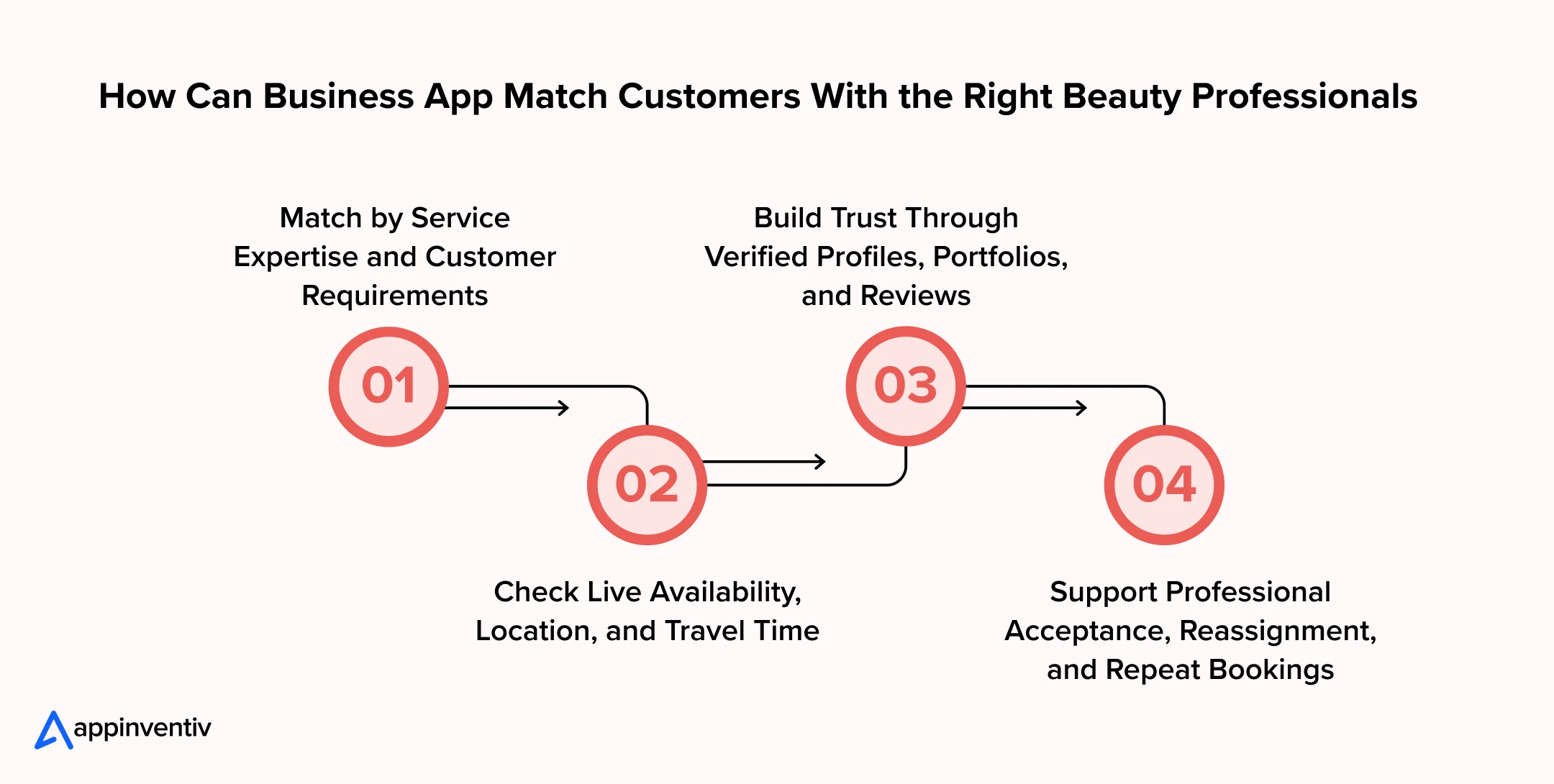
Match by Service Expertise and Customer Requirements
Use structured service attributes: specialization, treatment duration, supported techniques, and equipment requirements. A general “hair stylist” category cannot explain whether someone offers bridal styling or works with particular hair textures.
Filter out unsuitable professionals first. Rank eligible options using customer preferences, availability, relevant reviews, and previous booking history.
Check Live Availability, Location, and Travel Time
A free calendar slot does not guarantee that a professional can reach the customer. Calculate availability using the previous appointment, expected travel, setup, and service duration.
For example, a 60-minute treatment requiring 30 minutes of travel cannot fit into a one-hour gap. Recheck availability when confirming the appointment and reserve the slot during checkout.
Build Trust Through Verified Profiles, Portfolios, and Reviews
Show what verification actually covers, such as identity or reviewed qualifications. Present portfolios by service category and connect reviews to completed appointments.
Customers should understand why a professional fits their request. Clear evidence supports that decision better than an unexplained “best match” badge.
Support Professional Acceptance, Reassignment, and Repeat Bookings
Separate a pending request from a confirmed appointment. Set acceptance windows, release unanswered requests, and escalate failed assignments to operations.
If no suitable professional is available, offer another time or a waitlist. Reassignment should preserve the customer’s requirements and obtain approval for material changes in price or profession.
Essential Features Across Your On-Demand Beauty Services App Panels
The essential features of on-demand beauty apps should connect customer choices with professional availability and operational capacity. Each panel needs access to the same booking information, with permissions tailored to its users. AI integration can support discovery, scheduling, and service management when it draws on reliable data and works within defined business rules.
Customer Panel
The customer panel should help users find suitable professionals, understand the service, and manage appointments from discovery through rebooking.
- Advanced Service Discovery: Let customers filter by treatment, location, budget, appointment time, and professional specialization. Results should reflect service coverage and actual availability, including whether the customer wants an at-home appointment or salon visit.
- AI-Assisted Professional Matching: Rank eligible professionals using the requested service, stated preferences, previous appointments, and relevant reviews. Explain useful matches, such as experience with bridal makeup or a particular styling technique, while keeping availability and qualification requirements mandatory.
- Detailed Professional Profiles: Display service-specific portfolios, experience, pricing, verified credentials where applicable, and reviews from completed appointments. Explain what each verification badge represents so customers can assess the professional confidently.
- Conversational Search and Booking: Allow customers to describe requests such as “hair and makeup at my hotel before 10 a.m.” An AI assistant can identify requirements, ask follow-up questions, and retrieve suitable options. Customers should approve the final service, price, and appointment details.
- Booking and Digital Consultation: Collect reference images, style preferences, access instructions, and relevant treatment information before the appointment. Support professional follow-up when the request needs clarification or could change the expected duration and price.
- Transparent Pricing and Secure Payments: Show service charges, travel fees, add-ons, discounts, and applicable taxes before checkout. Support deposits, digital payments, tips, receipts, and visible refund status through connected payment workflows.
- Appointment Updates and Communication: Provide confirmation, preparation reminders, delay alerts, and arrival updates. In-app messaging should preserve appointment context and allow customers to reach support without repeating the issue.
- Personalized Rebooking and Memberships: Offer direct rebooking with a preferred professional, relevant service reminders, and clear membership benefits. AI can help suggest suitable return intervals using appointment history, with customer controls over recommendations and notifications.
Beauty Professional Panel
Professionals need a practical workspace that helps them evaluate requests, prepare for appointments, and understand their earnings. For on-demand beauty services mobile app development, this panel must also accommodate limited connectivity and short breaks between services.
- Digital Onboarding and Verification: Collect identity documents, relevant qualifications, service areas, and payout information. Show application status and missing requirements, with a review process for rejected or unclear submissions.
- Portfolio and Service Management: Let professionals organize work samples by treatment, update specializations, and define service duration. Where the operating model permits, they should also manage prices, add-ons, and preparation requirements.
- Availability and Calendar Controls: Support working hours, breaks, leave, external commitments, and category-specific appointment lengths. Reserve time for travel, setup, and cleanup so apparently free slots do not create impractical bookings.
- AI-Assisted Schedule Planning: Suggest appointment sequences that reduce travel gaps and unused working time. Recommendations should respect service boundaries, breaks, customer commitments, and the professional’s ability to accept or reject changes.
- Booking Acceptance and Preparation: Present the location, requested services, consultation notes, expected duration, and earnings before acceptance. Flag incomplete requests and allow clarification before an appointment becomes confirmed.
- AI-Generated Appointment Summaries: Summarize customer messages, reference requests, and previous service notes into a preparation brief. Professionals should be able to inspect the original information and correct summaries before relying on them.
- Service Status and Incident Reporting: Let professionals record arrival, start, completion, delays, and customer-requested changes. Provide a clear route for reporting unsafe conditions, disputes, or appointments that cannot proceed.
- Earnings and Performance Dashboard: Show completed-service earnings, commissions, tips, refunds, adjustments, and payout dates. Include useful performance indicators such as repeat customers and cancellation patterns, with access to the underlying appointment records.
Salon or Business Partner Panel
This panel supports salons and spas that manage several professionals, branches, or shared resources. It should connect local scheduling decisions with the wider platform while restricting access to each partner’s business.
- Multi-Branch Management: Maintain location-specific opening hours, service menus, pricing, facilities, and booking policies. Central teams should control shared standards while authorized branch managers handle local updates.
- Staff and Resource Allocation: Match appointments with qualified staff and available chairs, treatment rooms, or equipment. A free professional alone should not make a service bookable when another required resource is unavailable.
- Unified Appointment Calendar: Bring app, website, phone, and walk-in bookings into a coordinated schedule. Where external systems remain in use, define synchronization rules and make unresolved conflicts visible to staff.
- AI-Based Demand Forecasting: Estimate booking demand by branch, treatment, day, and time using historical patterns. Managers can use these forecasts to plan shifts and service availability, while reviewing uncertainty around holidays, promotions, and new locations.
- Customer Retention Insights: Identify customers whose usual appointment interval has passed and suggest relevant follow-up segments. Staff should review outreach recommendations and apply communication preferences before launching campaigns.
- Product and Consumable Tracking: Track service-related supplies, minimum stock levels, and usage by location. Link bookings with expected consumable requirements where practical, helping branches prepare for scheduled treatments.
- Partner Reporting and Settlements: Show branch revenue, commissions, refunds, outstanding settlements, staff utilization, and repeat bookings. Allow managers to investigate performance changes through appointment-level records rather than relying only on summary charts.
Admin and Operations Panel
The admin panel should give platform teams the information and authority needed to manage service delivery across the network. Custom beauty services mobile app development should include approval controls and audit trails for financially or operationally sensitive actions.
- Account and Verification Oversight: Review professional applications, partner access, document status, and account restrictions. Use role-based permissions so support agents, finance teams, and verification reviewers access only the information their work requires.
- Marketplace and Matching Configuration: Manage service categories, geographic boundaries, eligibility criteria, commissions, and booking rules. Allow authorized teams to adjust matching priorities while preserving mandatory qualification, availability, and service-area requirements.
- Live Booking and Dispatch Management: Monitor pending requests, unanswered assignments, delayed arrivals, and appointments at risk. Give operations teams options to contact professionals, propose replacements, or reschedule with customer approval.
- AI-Assisted Cancellation Risk Alerts: Flag appointments that may need reconfirmation using relevant booking and historical signals. Use alerts to trigger supportive actions, such as reminders or backup planning, with human review before consequential restrictions.
- Payment Reconciliation and Fraud Review: Compare customer charges, refunds, commissions, and professional payouts. Anomaly detection can flag duplicate refund requests or unusual account activity for investigation; flags should include supporting transaction details.
- AI-Assisted Customer Support: Retrieve appointment information, summarize conversations, and suggest responses based on approved policies. Route disputed charges, safety incidents, and exceptions to authorized staff, with controlled permissions for any automated action.
- Quality Monitoring and Review Analysis: Group recurring complaints by professional, service, location, or issue. AI-assisted text analysis can help surface patterns, but operations teams should examine the underlying feedback before taking corrective action.
- Platform Analytics and AI Oversight: Track booking conversion, fulfillment, repeat usage, contribution margin, and support demand. Monitor AI recommendations for accuracy and uneven outcomes, retain decision logs, and provide a way to disable underperforming features.
Prioritize booking integrity, payments, scheduling, and service recovery in the first release. Add AI capabilities against specific goals, such as improving match acceptance or reducing scheduling gaps, and measure whether they achieve those goals.
The On-Demand Beauty Services App Development Process: From Validation to Scale
The beauty services app development process connects product planning, engineering, and service operations. Each stage should resolve the decisions needed to launch reliably and expand with control.
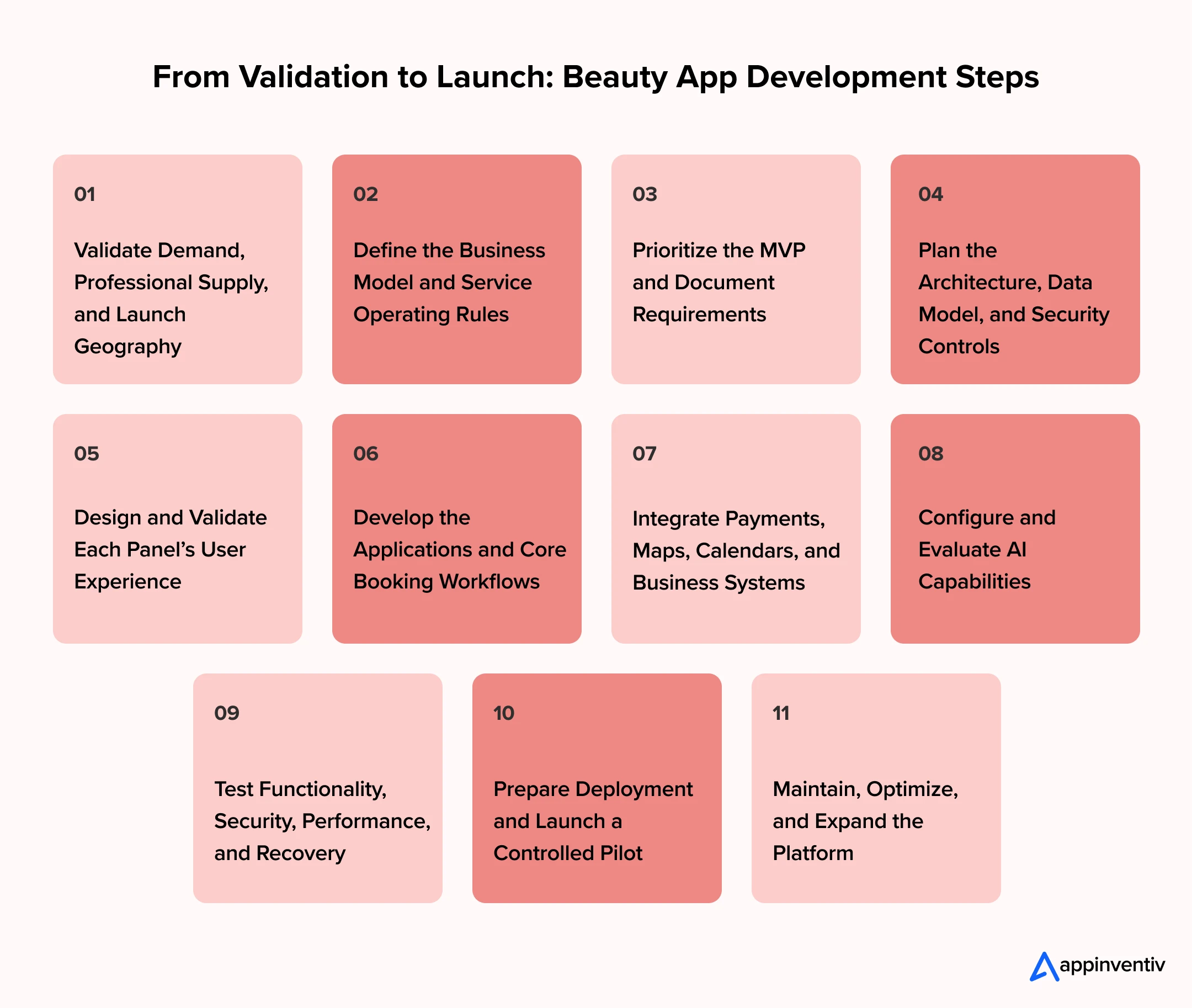
1. Validate Demand, Professional Supply, and Launch Geography
Define your initial customers, services, and geographic coverage. Assess booking habits, pricing expectations, competing options, and qualified professional availability. For at-home services, factor in travel and equipment requirements. Use these findings to establish launch boundaries, recruitment needs, and assumptions to test during the pilot.
2. Define the Business Model and Service Operating Rules
Establish who sets prices, accepts appointments, handles complaints, and funds refunds. Map the appointment lifecycle through completion and payout, including acceptance deadlines, cancellations, and reassignment. These rules give designers and engineers a consistent foundation for workflows across customer, professional, partner, and admin panels.
3. Prioritize the MVP and Document Requirements
Translate the operating model into panel-specific MVP, separating launch essentials from later additions. For beauty application development, prioritize a complete booking lifecycle with exception handling. Document acceptance criteria, integration dependencies, performance expectations, and ownership before estimating the delivery scope.
4. Plan the Architecture, Data Model, and Security Controls
Define how apps, backend services, databases, and external systems exchange information. Establish authoritative records for bookings, availability, and payments. Design role-based permissions, data retention, backups, monitoring, and audit trails early, since these requirements affect implementation effort and ongoing support.
5. Design and Validate Each Panel’s User Experience
Test prototypes with customers, professionals, and operations teams. Check whether users understand prices, evaluate appointments, and resolve booking issues without confusion. Include unavailable slots, failed payments, and rescheduling so the design clearly distinguishes pending, confirmed, canceled, and refunded states.
6. Develop the Applications and Core Booking Workflows
Build customer and professional apps alongside the required dashboards, connecting discovery, scheduling, communication, and transactions through shared backend workflows. Review complete journeys incrementally. On-demand beauty services mobile app development should also handle interrupted sessions, restoring accurate booking and payment status when connectivity returns.
7. Integrate Payments, Maps, Calendars, and Business Systems
Connect payment, mapping, messaging, verification, and relevant salon systems. Define record ownership and conflict-resolution rules for synchronized calendars. Handle delayed responses, duplicate events, and failed requests, then validate checkout, reconciliation, and refunds to prevent inconsistent bookings or financial records.
8. Configure and Evaluate AI Capabilities
Define measurable goals for AI-assisted matching, conversational search, or appointment summaries. Keep qualification, availability, and pricing rules enforceable outside model responses. Test incomplete and unusual requests, and begin with rules-based matching where limited historical data makes predictive performance difficult to validate.
9. Test Functionality, Security, Performance, and Recovery
Test complete workflows across panels and integrations, including competing slot requests, cancellations, refunds, and payout failures. Assess permissions, peak booking loads, interrupted services, and backup restoration. Complete user acceptance testing with business and operations teams before approving release.
10. Prepare Deployment and Launch a Controlled Pilot
Prepare production infrastructure, monitoring, app-store submissions, support procedures, and professional onboarding. Launch within limited geography and service categories, tracking failed assignments, payment discrepancies, and customer feedback. Use agreed fulfillment, capacity, and margin targets to decide when the platform is ready for expansion.
11. Maintain, Optimize, and Expand the Platform
Resolve defects, update dependencies, and maintain security and integration compatibility. Review conversion, repeat bookings, cancellations, and support demand by service area. Use these findings to prioritize app maintenance, improvements and expand only when professional capacity and service economics support additional locations or categories.
Explore our capabilities across booking, professional management, payments, and connected service operations.
Choosing the Technology Stack for Beauty Services App Development
The beauty app development technology stack should support reliable transactions, maintainable integrations, and operational visibility. The following options are illustrative; final selection depends on existing systems and team capabilities.
| Platform Layer | Illustrative Options | Decision to Resolve |
|---|---|---|
| Customer and professional apps | Flutter, React Native, Swift, Kotlin | Shared development versus platform-specific requirements |
| Operations dashboard | React or an established enterprise web framework | Role-based workflows and reporting needs |
| Backend services | Node.js, Java, or .NET | Team expertise, transaction handling, and integration requirements |
| Transactional and location data | PostgreSQL with a geospatial extension | Booking integrity, service areas, and location queries |
| Background processing | Managed queues and worker services | Reliable notifications, retries, and asynchronous tasks |
| External services | Payment, mapping, identity, and messaging providers | Regional coverage, costs, reliability, and data handling |
How Much Does Beauty Services App Development Cost, and How Long Does It Take?
Beauty services app development cost can range from $20,000 to $200,000, depending on the operating model, number of panels, integrations, and booking complexity. A focused MVP sits toward the lower end, while a multi-market platform with advanced matching, AI capabilities, and enterprise integrations requires a larger investment.
MVP, Growth-Stage, and Multi-Market Platform Budgets
The following are indicative planning scenarios, not fixed quotes or independently measured market averages.
| Scope | Illustrative Budget | Indicative Timeline |
|---|---|---|
| Focused MVP: Limited geography, core customer and professional workflows, admin dashboard, standard payments | $20,000–$80,000 | 5–6 months |
| Growth platform: More advanced scheduling, partner management, memberships, reporting, and integrations | $80,000–$110,000 | 6–9 months |
| Multi-market platform: Localization, complex settlements, enterprise integrations, and broader operational controls | $150,000–$200,000+ | 9–12+ months |
These scenarios assume custom development and an available delivery team. Discovery should validate them against a documented backlog.
Features and Integrations That Increase Development Effort
Complexity rises with multi-professional appointments, external calendar synchronization, travel-aware scheduling, legacy integrations, and multi-country payments.
Custom beauty services mobile app development also requires more effort when branches operate different prices, memberships, and refund rules. Resolve those variations before estimating the overall cost of developing a beauty services app.
Ongoing Technology and Operational Costs
Budget separately for hosting, monitoring, maps, messaging, payment processing, maintenance, and security updates. Professional recruitment, verification, customer support, and service recovery are additional operating costs.
Evaluate these costs per completed appointment as well as monthly. Growing transaction volume can expose an expensive service model even when infrastructure spending remains modest.
Bring your service model, launch locations, and integration requirements. We’ll help translate them into a scoped development estimate.
Challenges in Beauty App Development and How to Address Them
The main challenges in beauty app development arise where software meets variable service delivery. Build controls for these situations before increasing booking volume.
| Challenge | Business Impact | Practical Response |
|---|---|---|
| Limited local professional supply | Customers find services but cannot book suitable appointments. | Track unavailable searches and recruit by category, area, and time window. |
| Double bookings and travel delays | Appointments fail despite appearing available. | Use one authoritative schedule, checkout reservations, and travel buffers. |
| Inconsistent service quality | Complaints and refunds undermine repeat business. | Define service standards, verify relevant credentials, and review recurring issues. |
| Customer and professional safety | Home visits create incidents requiring rapid intervention. | Provide identity controls, check-in workflows, incident reporting, and staffed escalation. |
| Sensitive information | Addresses, images, and consultation details reach inappropriate users. | Minimize collection, restrict access, and define retention and consent procedures. |
| Refund and payout disputes | Manual reconciliation delays resolution and damages trust. | Maintain transaction histories, explicit policies, and approval-based adjustments. |
| Location-specific requirements | Expansion introduces different service and business obligations. | Validate local requirements before activating each market and service category. |
| Off-platform repeat bookings | Acquisition spending fails to generate recurring platform revenue. | Make rebooking, payments, support, and professional tools valuable enough to retain usage. |
Future Trends of Beauty App Development Worth Planning For
The future trends of beauty app development deserve investment when they address a measurable constraint. Their value depends on reliable booking records, usable service data, and sufficient transaction history.
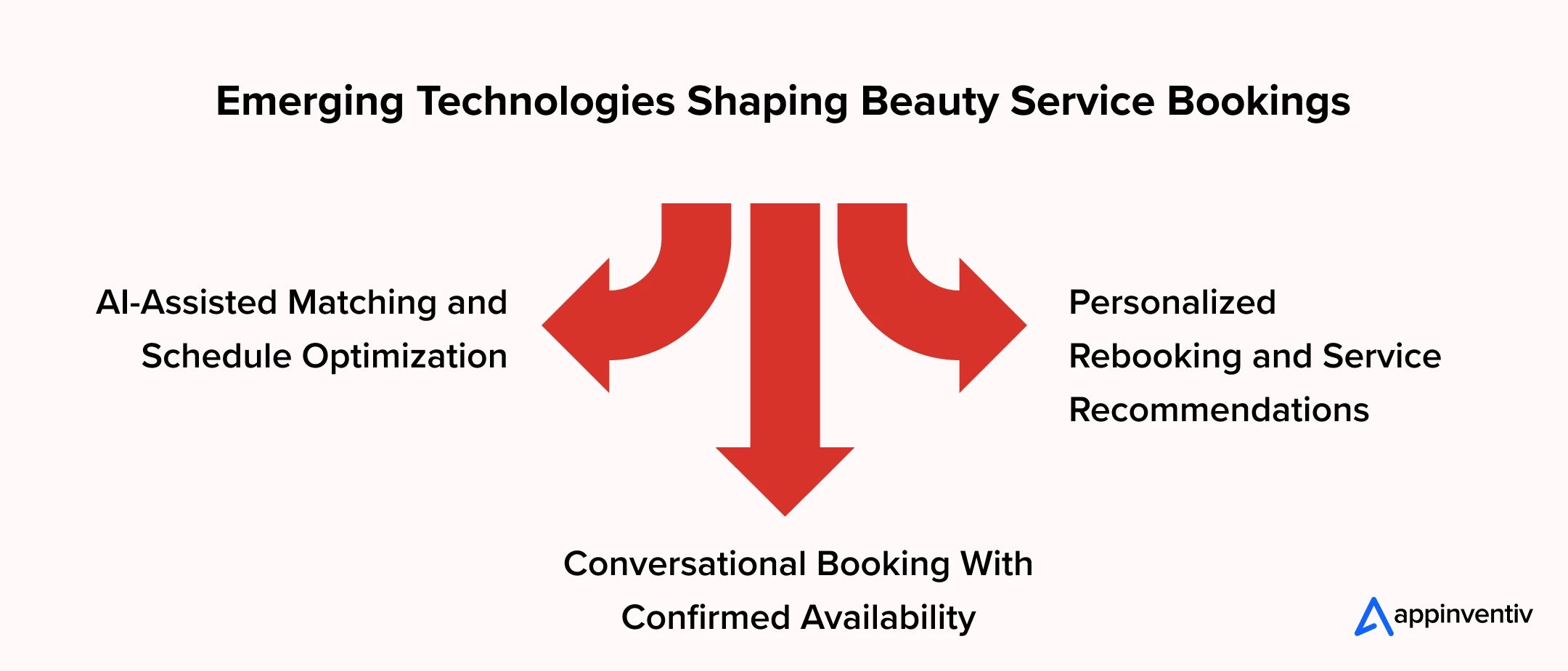
AI-Assisted Matching and Schedule Optimization
Once enough appointments exist, models can help estimate duration, anticipate cancellations, or rank eligible professionals. Keep firm rules around qualifications, service coverage, and working hours.
Evaluate improvements against completed appointments and customer outcomes, while checking whether new professionals receive reasonable visibility.
Conversational Booking With Confirmed Availability
Customers could describe a request in ordinary language, such as needing hair and makeup before an event. An assistant can translate that request into structured service searches.
Booking and payment systems must validate the resulting options. Require customer confirmation before committing an appointment or charge.
Personalized Rebooking and Service Recommendations
Recommendations can use previous appointments and stated preferences to suggest suitable return dates or complementary services.
For on-demand beauty app development, begin with clear, explainable rules. Introduce predictive models when they outperform those rules against repeat bookings and retained margin.
How Appinventiv Can Help Build Your Beauty Services Platform
As an on-demand app development company, we cover product discovery, application engineering, cloud architecture, and third-party integrations. Our published beauty offering includes service categorization, real-time availability, booking, and transaction workflows.
For your on-demand beauty services app development project, the first conversation should establish how services operate: who supplies them, who controls availability, and what happens when fulfillment fails.
From there, we can define the customer, professional, partner, and admin workflows within a shared delivery scope. That includes matching rules, appointment states, payment integrations, access controls, and operational reporting.
Our beauty services app development approach connects those engineering decisions with launch priorities. A focused first release gives your business a way to validate demand, professional participation, and service economics before committing to broader expansion.
Frequently Asked Questions
Q. What types of beauty apps can businesses build?
A. Businesses can build platforms around their service network, delivery model, and customers. Common options include:
- At-home beauty services apps.
- Independent beauty professional marketplaces.
- Salon and spa booking platforms.
- Single-brand apps for beauty businesses.
- Hybrid platforms supporting salon visits and home appointments.
The right beauty app development scope depends on who manages professionals, pricing, and service delivery.
Q. How can AI-powered beauty recommendations be added to an app?
A. Connect a recommendation engine with structured service listings, professional expertise, customer preferences, and booking history. Start with preference-based rules, then introduce machine learning as sufficient data becomes available. Recommendations should respect availability, budget, and service eligibility, with customers controlling how their information is used.
Q. How can a beauty app improve customer retention and repeat bookings?
A. Make returning easier and give customers practical reasons to keep booking through your platform. Useful features include:
- One-tap rebooking with a preferred professional.
- Relevant reminders based on previous appointments.
- Saved preferences and consultation details.
- Membership benefits and loyalty rewards.
- Accessible support when appointments go wrong.
- Track repeat bookings and retained margin to understand which features deliver value.
Q. How long does it take to develop a beauty services app?
A. As an indicative planning range, a focused MVP may take four to six months, while a broader platform can require six to twelve months. Complex on-demand beauty services app development involving multiple markets, advanced matching, and enterprise integrations may take twelve to eighteen months or longer.
Q. What is the difference between a beauty booking app and an on-demand beauty app?
A. A beauty booking app primarily lets customers reserve appointments with salons or professionals. An on-demand beauty app also coordinates service fulfillment, often at the customer’s location, through professional matching, travel-aware scheduling, and appointment updates. “On-demand” can include scheduled services; it does not necessarily mean immediate availability.
Q. Can I build an MVP for a beauty services app before launching a full platform?
A. Yes. An MVP lets you test customer demand, professional participation, and appointment economics within a limited service area. Prioritize:
- Service listings and professional profiles.
- Availability, booking, and confirmation.
- Payments and cancellation workflows.
- Professional scheduling and basic admin controls.
Expand your beauty services app development scope once the pilot demonstrates reliable fulfillment and repeat demand.


Fast 2-minute response, fully NDA-protected.

How Much Does It Cost to Build a Retail Delivery App Like Woolworths in Australia in 2026?
Do you know Woolworths, the on-demand retail delivery platform, captures a striking 37% share of the grocery market in Australia as of 2023? This impressive market share underscores the massive demand and reliance on the convenience that such platforms offer. As lifestyles continue to evolve, more consumers prefer shopping from the comfort of their homes,…

How Much Does It Cost to Build an On-demand Alcohol Delivery App Like Gopuff?
The global online alcohol market is experiencing significant expansion, akin to a premium vintage reaching its peak maturity. With just a few clicks, consumers can access a diverse selection of fine wines, craft beers, premium spirits, and services, all conveniently delivered to their doorstep. This digital transformation in alcohol sales has been driven by the…

How Much Does It Cost to Build a Service Delivery App Like Airtasker in Australia?
Key takeaways: Building a service delivery app like Airtasker in Australia ranges from $40,000 to $300,000 / AUD 62,400 to AUD 468,000, depending on complexity and features. Typically, development takes between 3 and 12 months, influenced by the app's complexity and feature set. Essential features include task posting, real-time chat, payment integration, ratings and reviews,…