























How to Hire a Cross-Platform Developer? All You Need to Know

 Share -


- 01The Modern Cross-Platform Development Scene
- 02Cross-Platform App Development Frameworks
- 03How to Hire a Cross-Platform App Developer: The Enterprise Vetting Strategy
- 04Staying Ahead of the Tech Curve: AI and Emerging Technologies in 2025
- 05Exploring the Best Hiring Model for Cross-Platform Development
- 06Understanding the Real Costs in 2025
- 07Factors that Affect the Cost to Hire Cross-Platform Developers
- 08Key Skills to Evaluate When Hiring Cross-Platform Developers
- 09Top Mistakes to Avoid When You Hire Dedicated Cross-Platform Developers
- 10Red Flags While Hiring Cross Platform Developers
- 11Advantages of Hiring Cross-Platform Developers
- 12Legal, Compliance, and IP Considerations
- 13Why Choose Appinventiv for Your Cross-Platform Development Needs
- 14FAQs

Key takeaways:
- Single Codebase = 50% Cost Savings. Cross-platform development builds iOS and Android apps simultaneously, cutting costs in half and accelerating market entry.
- AI Integration Is Essential in 2026. Hire developers with TensorFlow, OpenAI API, and cloud services experience to stay competitive and future-ready.
- Location Determines Budget Impact. Rates range from $20/hour (Asia) to $200+/hour (North America). Choose strategically based on quality needs.
- Cheap Hiring = Expensive Mistakes. Prioritize communication skills and proven experience over low rates to avoid costly project failures and delays.
Cross-platform app development has revolutionized how businesses approach mobile solutions, eliminating the traditional dilemma of choosing between iOS and Android. With a single codebase, companies can now reach both major platforms simultaneously, dramatically reducing development costs and accelerating time-to-market.
The numbers tell a compelling story: the global cross-platform app development framework market is projected to grow at 16.8% CAGR through 2032, to $ 369.2 million by the end of 2032. Over 42% of developers worldwide now leverage cross-platform frameworks, with React Native and Flutter leading the charge.
However, the challenge isn’t whether to adopt cross-platform development, but rather how to hire cross platform app developer who can deliver exceptional results. The growing demand has created a competitive talent market where technical expertise alone isn’t enough. Modern projects require developers who understand AI integration, cloud-native architectures, and emerging technologies.
Understanding how to hire cross platform app developer with the right blend of technical skills, business acumen, and innovative thinking has become critical for project success. The difference between mediocre and outstanding results often comes down to making informed hiring decisions.
Must Read: Top Cross-Platform App Development Frameworks in 2025
The Modern Cross-Platform Development Scene
Cross-platform development changed significantly after 2020. Skills that worked when you wanted to hire cross platform developers three years back may not suit current projects. Performance standards increased. Now, users expect apps to run as smoothly as native applications and only top cross-platform frameworks now deliver this experience.
Factors Driving Change in 2026
AI Advancements: AI shifted from optional features to user expectations, where customers want personalized recommendations and voice interactions in their apps. They also expect smart assistance features, which go beyond simple chatbots. Developers need to integrate machine learning algorithms properly to improve user experience without affecting app speed.
Evolving User Expectations: When you hire cross platform developers today, they must understand these changing expectations. They should have skills to create advanced solutions that meet current performance standards.
Cloud-Native Architecture: Furthermore, cloud-native architecture matters for modern development. Current apps must be able to handle real-time data and scale automatically. They also need to work well across different devices.
Progressive Web Apps (PWAs): Progressive Web Apps now compete seriously with traditional mobile apps. This applies especially to content-heavy applications and business tools.
Must Read: Core Cloud Native Platform Capabilities
Regulatory Compliance: Security requirements have become more complex. Regulations like GDPR and CCPA require careful attention. Developers must consider privacy from the project’s start.
Remote Work Collaboration: Since remote work has changed collaboration needs, development teams must work effectively across different time zones. They also need strong coding abilities.
When you hire cross platform developers, these modern requirements should definitely guide your selection decisions. Understanding the latest scene in cross platform app development will ensure that your app is built to meet today’s standards and tomorrow’s expectations as well.
Cross-Platform App Development Frameworks
Cross-platform development lets you build apps for multiple platforms using one codebase. This works for iOS, Android, and web applications. Now, more companies have begun to choose this method because it saves money and time. Developers must avoid creating separate apps for each platform. Considering the scenario, startups benefit most from this approach. They can launch products faster and various businesses also use it to improve their mobile app development process.
Here are some of the most popular cross-platform frameworks:
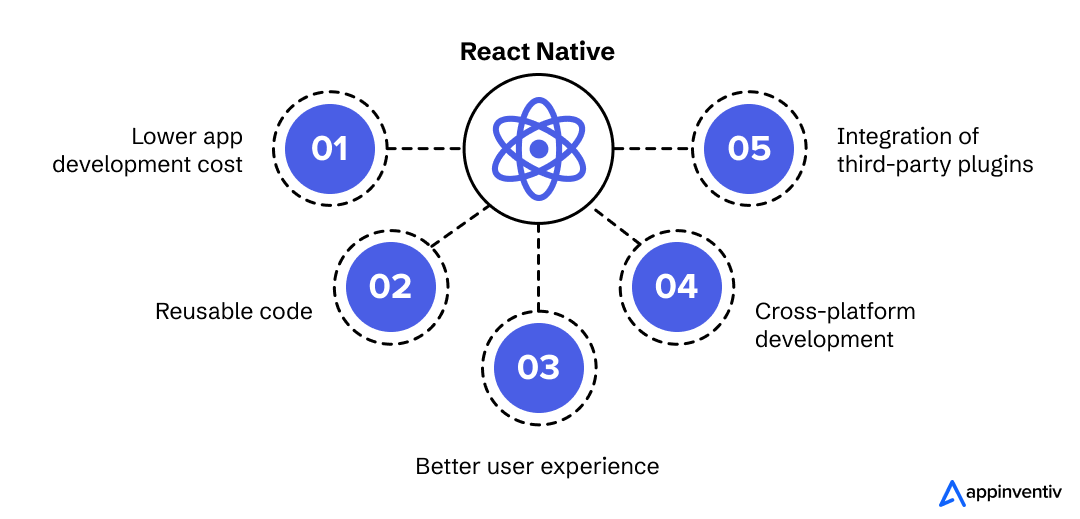
React Native: Framework created by Facebook, React Native is another popular framework for building apps that work seamlessly on iOS and Android. It uses JavaScript and React due to which web developers find it familiar since they already know these technologies, which makes the learning curve much shorter.
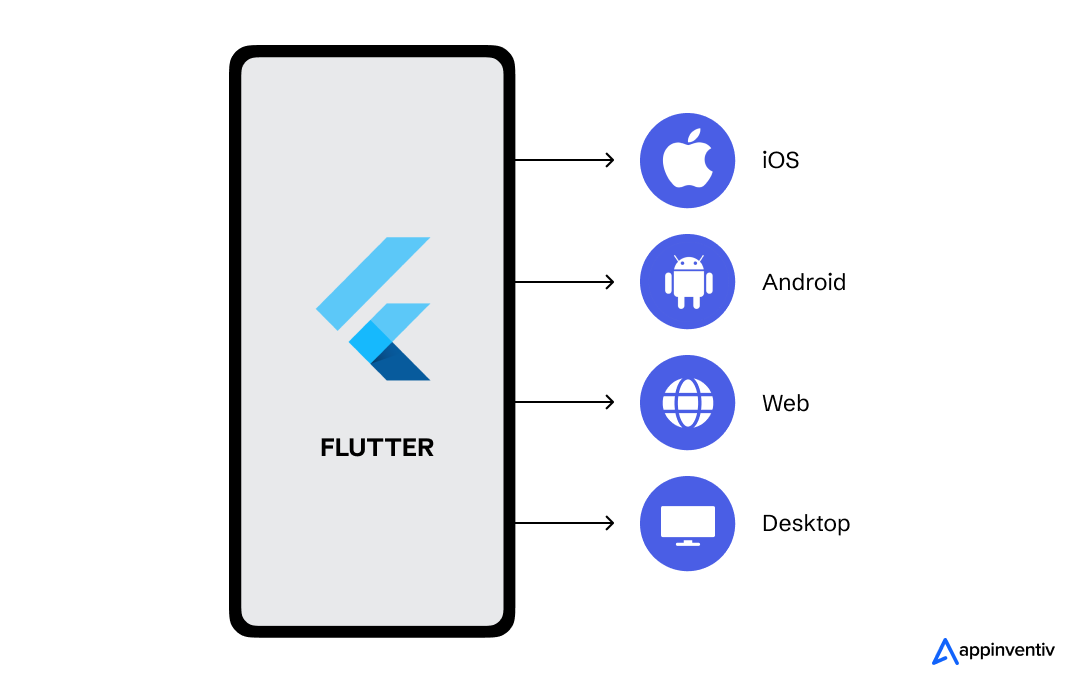
Flutter: Backed by Google, the Flutter framework is a top choice for bulding visually rich, high-performance apps that run on mobile, web, and desktop. Flutter uses customizable widgets that help developers build responsive designs, and it now works on all six platforms, including iOS, Android, Web, Windows, macOS, and Linux.
Xamarin: Owned by Microsoft, Xamarin works particularly well for businesses already using Microsoft products. Xamarin uses .NET and C# to build apps for iOS, Android, and Windows while providing strong performance and native API access. This combination helps developers create apps that integrate smoothly with existing business systems.
Progressive Web Apps (PWAs) :PWAs work well for certain projects. They provide app-like experiences through web browsers. These apps include offline features, push notifications, and device access. Current PWAs can use device cameras and send push notifications. They function offline and install from app stores. The acute advantage is that the development costs stay lower than other methods and the most thorough advantage is that you can update them instantly without app store delays.
Recommended Read: Top 10 Frameworks and Tools to Build Progressive Web Apps
Business advantages include several key points, which also include no platform fees or update delays. PWAs also provide SEO benefits naturally. You can reach users through web browsers and app stores. Many application types see strong returns with PWAs.
PWAs make sense for:
- Content and media applications
- E-commerce and retail experiences
- Internal business tools that need frequent updates
- Applications where web discoverability matters
| Framework | Pros | Cons | Best Use Cases | Performance |
|---|---|---|---|---|
| Flutter | Single codebase, 60fps performance, Google backing | Larger app size, Dart learning curve | Custom UI, multi-platform apps | Excellent |
| React Native | JavaScript/React skills, large community | Platform-specific code needed, bridge overhead | Rapid prototyping, React teams | Good |
| Xamarin | Native performance, Microsoft integration | Microsoft-centric, larger apps | Enterprise, business apps | Excellent |
| PWAs | Instant updates, lowest cost, cross-device | Limited device access, performance constraints | Content apps, e-commerce | Fair-Good |
How to Hire a Cross-Platform App Developer: The Enterprise Vetting Strategy
Hiring a cross-platform app developer isn’t just about looking for someone who can write code; it’s about finding the right partner who can minimize project risk and maximize delivery quality. It requires a strategic approach. This helps you check skills, experience, and team fit. You should look at factors beyond technical abilities. The following steps will help you hire a cross-platform mobile app development team:

Clarify Your Enterprise Requirements
Define your project with a focus on future scalability, not just current features.
- AI/ML: Is on-device processing required for speed/privacy? (e.g., Core ML, TensorFlow Lite).
- Cloud Architecture: Do you require multi-region deployment or integration with specific cloud services (AWS, Azure, GCP)?
- Security & Compliance: Specify non-negotiable standards (GDPR, PCI DSS, HIPAA compliance).
Knowing how to hire cross platform app developer with specific skills narrows your search. You can focus on candidates with relevant experience. Companies that hire efficiently gain competitive advantages in their markets.
Where to Find Cross-Platform Developers
Once you have a clear vision of your project needs, it’s time to begin the search for developers who can bring your idea to life. Here are some top sources to help you find the right talent:
Most Common Sources to Find Cross Platform Developers Are:
| Source | Risk Profile | Best For | Appinventiv Recommendation |
|---|---|---|---|
| Job Portals (LinkedIn, Indeed) | Medium: Varies with the quality of applicants. Risk of hiring unqualified developers. | Hiring for long-term, full-time roles. | Use for high-quality full-time hires. |
| Freelance Platforms (Upwork, Fiverr) | High: No IP protection, varying quality, no delivery guarantee. | Very small, low-risk, non-critical tasks. | Avoid for Core Products. |
| Staffing Agencies | Medium: Provides individuals, but responsibility for project management and delivery remains with you. | Team augmentation for defined roles. | Use for internal team growth only. |
| Professional Development Agency (Appinventiv) | Lowest: Managed teams, project ownership, legal guarantees, proven methodologies. | Complex, mission-critical, high-traffic enterprise applications. | Optimal Choice. Guaranteed delivery with post-launch support. |
These platforms provide a comprehensive list of cross platform developers for hire. However, the best bet is to leverage the expertise of a professional app development firm which has extensive experience in developing dedicated apps for a myriad of clients.
Effectively Evaluate Potential Candidates
Once you’ve narrowed down a list of potential candidates, it’s time to evaluate their skills. Check their portfolios for cross-platform app examples. Look at their experience with the frameworks you need. This includes React Native, Flutter, or Xamarin. Test their problem-solving skills and communication abilities. These abilities are critical for collaboration on complex projects.
Skill evaluation helps you understand how to hire cross platform app developer with real experience. Good evaluation methods help you pick developers who deliver strong results.
Enhanced evaluation criteria for 2026 are:
- Recent project portfolio (within last 2 years)
- AI integration examples
- Performance optimization case studies
- Security implementation experience
- Remote collaboration track record
Key Questions to Ask Your Prospects
Ask about their experience in solving complex challenges, their approach to cross-platform trade-offs, and how they handle collaboration and feedback.
Here’s a questionnaire to help you hire dedicated cross-platform app developers for your project.
| Standard Interview Question | Modern (2026) Technical Deep Dive |
|---|---|
| How do you manage performance trade-offs? | Describe your experience implementing Fabric/Impeller and quantifying the performance gain. |
| What are your preferred frameworks? | Detail your experience with CI/CD pipelines (Fastlane, App Center) for unified deployment to iOS/Android. |
| How do you approach testing? | How do you ensure accessibility (A11Y) and GDPR/CCPA compliance in a cross-platform environment? |
| Describe your cloud experience. | Detail an MLOps lifecycle: How did you deploy, monitor, and update an AI model (e.g., using Firebase ML) on a mobile app? |
Make the Final Call
Choosing the right developer involves more than technical skills. Make sure they fit your team culture and work well with others. Check their communication style and availability. See how they handle feedback. Good developers outsourced from reputed development companies write quality code and help team performance. They solve problems actively and think creatively.
Must Read: Guide to Find the Best Mobile App Developers
Staying Ahead of the Tech Curve: AI and Emerging Technologies in 2025
The landscape of cross-platform development has shifted dramatically, and developers who want to remain competitive need to embrace the AI revolution and emerging tech trends that are reshaping how we build applications.
Getting Smart with AI and Machine Learning
Developers need AI skills today. The best development teams integrate AI features into their apps smoothly. They use frameworks like TensorFlow Lite for mobile apps. Core ML works for iOS applications. ONNX handles cross-platform AI models.
Reputed developers also use AI services effectively. They connect to OpenAI APIs for language processing. Google AI helps with image recognition tasks. Azure Cognitive Services provides speech-to-text features. These integrations are now standard requirements instead of optional additions.
Recommended: Choosing the Right AI Tech Stack
Choosing between device processing and cloud AI matters significantly. Developers must consider privacy, speed, connectivity, and costs when building AI features. Understanding AI ethics and responsible practices has become necessary. This methodology also applies to legal and business requirements today.
Riding the Wave of Emerging Technologies
Technology changes quickly in 2025. Several new areas interest smart developers today. Web3 and blockchain skills create opportunities for decentralized apps and new business models. Internet of Things is also on the rise. This requires developers who understand device connections and edge computing.
AR and VR development improved greatly though 2025. ARKit and ARCore help build immersive experiences now. Voice interfaces do more than simple commands. Siri, Google Assistant, and custom voice systems integrate in complex ways and these integrations happen more often now.
Must Read: Latest AR & VR Trends Shaping the Future
Successful developers see these technologies as connected tools. They use them together to build better user experiences across different platforms.
Exploring the Best Hiring Model for Cross-Platform Development
You need to understand the hiring model to get the precise answer to your question about how to hire a cross-platform app developer. Selecting the right hiring model ensures project success when opting for cross-platform development. Whether you choose in-house, outsourcing, or freelancers, each model brings unique benefits that align with different business goals and requirements. The table below outlines these advantages, helping you determine the best fit.
| Hiring Model | What it Offers |
|---|---|
| In-House Hiring | It offers complete control over the project, easy communication, and alignment to company values. In-house teams are familiar with the company culture and available for quick collaboration. |
| Outsourcing | Outsourcing reduces costs while providing access to a global talent pool. It allows businesses to scale quickly and benefit from expert skills without recruitment overhead. |
| Freelancers | Provides flexibility and is cost-effective for short-term or specific tasks. Freelancers offer specialized expertise and can be brought in as needed without long-term commitments. |
| Outstaffing | This cost-efficient model combines external expertise with internal team control. It offers scalability and doesn’t require full-time staff, making it a flexible option. |
| Full Outsourcing | External teams manage all project tasks, allowing internal teams to focus on core functions. This model provides expertise and scalability while reducing internal resource burden. |
| Dedicated Development Teams | Offers specialized, undivided focus on a single project. Teams align closely with business objectives and offer flexibility and control, allowing businesses to scale up or down as needed. |
Understanding the Real Costs in 2025
The cost to hire cross platform developers changed due to AI tools, cloud systems, and remote work trends. These factors help with budget planning and return calculations.
Regional price differences stayed important but became more stable. North American developers charge $80-200+ per hour. European talent costs $50-150+ per hour. Eastern European developers ask $30-100 per hour. Asian markets offer $20-80 per hour. AI/ML experts and security specialists cost more everywhere. They charge $150-300+ per hour regardless of location.
Project Complexity Impact:
- Simple apps: $30,000-80,000 for basic CRUD functionality and standard features
- Medium complexity: $80,000-200,000 for real-time features, payments, basic AI
- Enterprise applications: $200,000-500,000+ for advanced AI, complex integrations, comprehensive security
Hidden Costs to Consider:
- Quality assurance setup: $5,000-20,000
- Ongoing maintenance: 15-25% of development cost annually
- Security audits: $5,000-25,000 per assessment
- Platform updates: $3,000-15,000 per major OS version
- Cloud infrastructure: $1,000-10,000+ monthly
- Third-party services: $500-5,000+ monthly
Technology Stack Impact: Framework choice tend to significantly affects costs. Flutter generally provides 10-15% faster development, React Native leverages existing web skills to reduce training costs, .NET MAUI offers higher initial costs but lower enterprise maintenance, and Ionic provides the lowest costs for web-centric applications.
Risk planning should include scope creep buffers (10-20%), technical risk mitigation (5-15%), timeline extensions, and quality issue remediation that can impact total costs by 20-40% if not properly managed.
Also Read: Which is Better for App Development: In-House or Outsourcing?
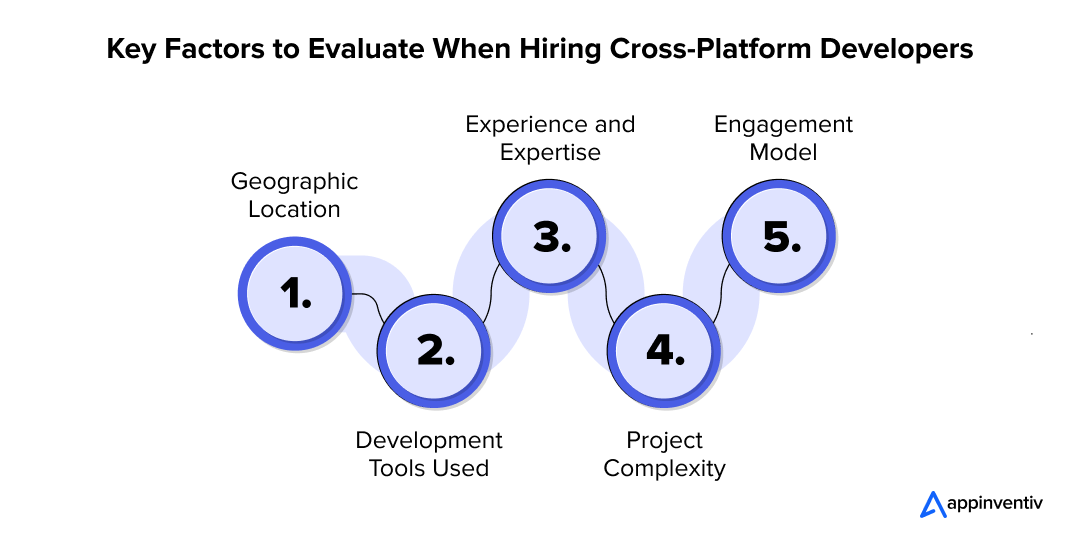
Factors that Affect the Cost to Hire Cross-Platform Developers
Check developer skills when hiring cross-platform talent. Look at their technical knowledge and framework experience. Make sure they can handle your specific project needs. Companies that hire cross-platform developers should review cost factors that affect project budgets. These key elements matter when hiring dedicated cross-platform developers:
Geographic Location
Developer rates change significantly across different regions. Economic conditions and job markets cause these differences. North America and Western Europe cost more because living standards are higher. These areas also have strong demand for skilled workers. Eastern Europe, Asia, and Africa offer lower-cost options. Many businesses hire globally to balance cost with skill quality.
The cost to hire cross platform developers varies widely based on geographic location, with rates typically ranging between $20-$100 per hour. Here’s a detailed regional breakdown:
| Region | Hourly Rate |
|---|---|
| North America | $70-$100 |
| Western Europe | $50-$80 |
| Eastern Europe | $30-$50 |
| Asia-Pacific | $20-$40 |
| South America | $25-$45 |
| Middle East | $30-$60 |
| Africa | $20-$35 |
| Australia/New Zealand | $60-$90 |
Development Tools Used
The choice of tools and frameworks significantly impacts the cost of hiring. Some tools, like Xamarin, may incur additional licensing fees, making them costlier in the long run. Open-source frameworks like Flutter or React Native reduce app development costs but may require highly skilled developers, which increases hiring expenses. Additionally, using specialized tools for testing or analytics can further influence the total project budget.
Experience and Expertise
Experienced developers who know advanced cross-platform frameworks charge more. They can solve complex problems and build better solutions. Senior developers create faster apps that scale well. They also need fewer revisions. This saves money over time despite higher upfront costs. Their advanced skills and problem-solving abilities help projects succeed.
Project Complexity
Your project’s complexity and other critical aspects play a pivotal role in determining costs. Projects requiring intricate features like real-time updates, advanced security, custom animations, or AI-driven functionalities demand additional development time and expertise. As complexity increases, developers must conduct more extensive testing and debugging, which adds to the cost. High complexity may also necessitate collaboration with specialized teams or tools.
Engagement Model
Engagement type affects costs in different ways. This includes freelance, full-time, or agency work. Agencies charge the most but provide complete solutions. They handle project management and quality checks. Freelancers cost less and offer more flexibility. However, they may lack reliability and consistency.
Full-time employees bring stability and lasting value. They also come with extra costs like benefits and training. Consider these factors when choosing your approach.

Key Skills to Evaluate When Hiring Cross-Platform Developers
When you plan to hire cross-platform mobile app development teams, looking for a combination of technical proficiency and strong interpersonal skills is important. Here are the core competencies and skills to hire cross platform app developer:

Technical Proficiency
The candidate should be well-versed in popular cross-platform frameworks and have a solid understanding of programming languages like JavaScript, Dart, or C#. Their ability to integrate APIs and work with third-party tools is essential to building a functional and scalable app.
Must Have Requirements:
- Modern framework expertise (Flutter 3.x, React Native New Architecture, .NET MAUI)
- AI/ML integration capabilities
- Cloud services proficiency (Firebase, AWS Amplify, Azure Mobile Apps)
- GraphQL and modern API development
Problem-Solving and Flexibility
Cross-platform development often involves addressing unique challenges and overcoming platform-specific issues. Companies that hire cross platform app developer with strong problem-solving skills ensure their projects can overcome technical hurdles efficiently, especially when optimizing apps or handling compatibility issues across different platforms.
Communication and Teamwork
Effective communication is key, as cross-platform developers often collaborate with designers, product managers, and other team members. They should be able to explain their technical solutions clearly and work seamlessly with others to meet project goals. When you hire cross platform app developers, ensure they can effectively communicate complex technical concepts to non-technical stakeholders.
UX/UI Sense
A skilled cross-platform developer understands the importance of user experience and design. They ensure the app functions well, intuitively, and visually appealing across different devices. They should also be able to apply platform-specific design principles without compromising the app’s consistency. When you hire cross platform app developers, prioritize those who understand both technical implementation and user experience design principles.
Related Read: Top 11 UX Design Principles for Startups
Testing and Debugging Expertise
Testing makes sure apps work well on different platforms. Developers should know how to use debugging tools and fix problems that happen across platforms. They need to solve these issues fast. Companies that hire cross platform app developer with good testing skills have fewer problems after launch and better app quality.
Dedicated Version Control Expertise
Developers need to know version control systems like Git for good teamwork. Good developers use version control to track code changes and work with others easily. This matters most in big, complicated projects. Companies that hire cross platform app developers with Git skills have fewer code problems and easier development processes.
Performance Optimization
Cross-platform apps may have performance problems because they work on multiple platforms. Good developers know how to improve app speed and responsiveness. They also manage resource use well. This ensures apps run smoothly on iOS and Android. Companies that hire cross platform app developer with optimization skills get better app performance and happier users. Look for developers with proven optimization experience when hiring.
Top Mistakes to Avoid When You Hire Dedicated Cross-Platform Developers
Avoiding a few common pitfalls or mistakes can ensure the success of your project, especially when you plan to hire dedicated cross-platform app developers. Here are some of those essential considerations and the fundamental skills to hire cross platform app developer. Business leaders who hire dedicated cross platform app developer must be vigilant about these potential issues to ensure project success:

Not Checking Reviews or Past Projects
Client reviews and past work show how developers actually perform. Check these to see if they meet deadlines and deliver quality results. This helps you choose better candidates. Make sure their previous projects match your needs and goals. This prevents problems later.
Skipping Experience With Cross-Platform Tools
It’s essential to hire developers with hands-on experience using cross-platform tools. These frameworks have unique challenges, and experienced developers can address them more efficiently, ensuring a smoother development process and better app performance in the long run.
Focusing Only on Cost
Cheap options look attractive but focus only on price hurts quality. Find the right balance instead. Get developers who have the skills and experience you need. This might cost more at first. Saving money now can create bigger problems later if projects fail to meet goals. Smart companies hire cross platform app developer who brings lasting value instead of just low prices.
Neglecting Maintenance and Support
Cross-platform apps require regular maintenance to stay compatible with new OS versions, address security issues, and introduce feature updates. Choosing a developer offering long-term support is crucial to ensuring your app remains functional and up-to-date. Regular updates also help fix bugs quickly and add new features to keep users engaged and satisfied.
Overlooking the Significance of User Experience (UX)
Cross-platform development often requires design compromises to ensure compatibility across different platforms. Hiring a developer who comprehends the intricacies of UX design for app development is essential.
A subpar user experience can lead to poor app ratings, fewer downloads, and, in the worst case, project failure. Ensure that the developer focuses on delivering an intuitive, consistent, and seamless experience across all platforms.
Neglecting Communication
Effective project management and clear communication are crucial for the success of any app development project. Hire cross-platform mobile app development team that is proficient in coding and excels at managing timelines, coordinating with your team, and maintaining open lines of communication. Poor communication can cause misunderstandings, delays, and unmet expectations, jeopardizing the overall success of your project.
Red Flags While Hiring Cross Platform Developers
Companies need to check candidates carefully when hiring cross-platform developers. Look for problems like unclear answers, impossible promises, or developers who won’t show their past work. Check these things when hiring cross-platform app developers.

- No Portfolio or Unclear Project Examples: Missing or bad portfolios usually mean the developer lacks experience or skills. This makes you wonder if they can do good work.
- Slow Response Times: Developers who reply late or communicate poorly are probably disorganized or don’t care much about your project. This causes confusion and delays.
- Won’t Share References or Pricing Details: Some developers hide their past client contacts or won’t explain costs clearly. They might charge extra fees later or provide bad service.
- Impossible Deadline Promises: Developers who promise very fast delivery without checking your project properly will rush the work, miss deadlines, or create poor apps.
- Won’t Sign Privacy Agreements: Developers who refuse privacy contracts might steal your ideas or share your private information.
- Teams Keep Changing: When developers constantly replace team members, your project loses consistency. This usually means the company has internal problems.
- No Future Help Plans: Developers who don’t explain how they’ll fix bugs, add features, or solve problems later will abandon you after launch.
Advantages of Hiring Cross-Platform Developers
Cross-platform developers for hire offer numerous benefits, including reduced development costs, faster time to market, and the ability to reach a wider audience with a single codebase. Let’s examine the advantages of hiring cross platform developers.
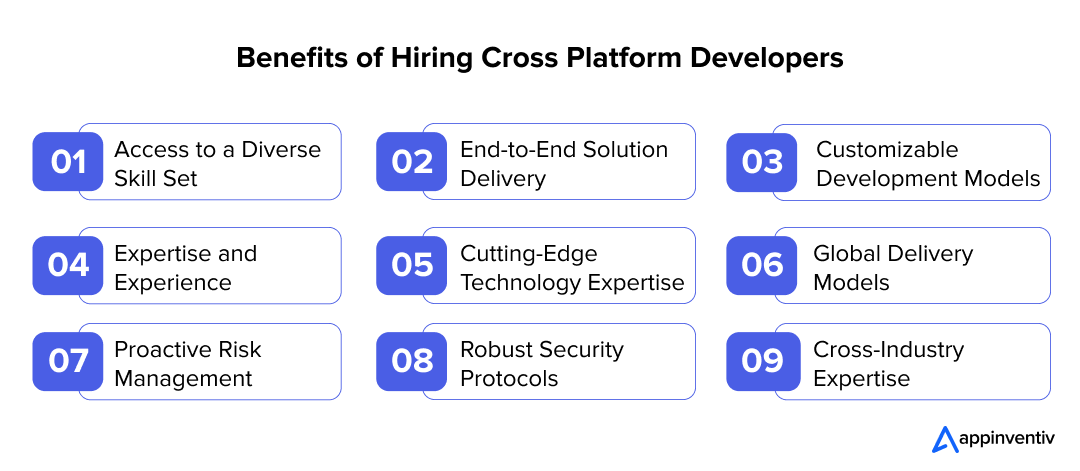
Access to a Diverse Skill Set
When it comes to deciding to hire cross-platform app developers, the first benefit you can leverage is their proficiency and skill set. These developers are technically competent and proficient in multiple programming languages, frameworks, and development platforms, allowing them to craft tailored solutions to your unique project requirements. Forward-thinking companies that hire cross platform app developer gain access to comprehensive expertise that traditional single-platform developers cannot provide.
End-to-End Solution Delivery
With comprehensive offerings that span ideation, design, development, testing, deployment, and ongoing maintenance, professional companies manage your project holistically, eliminating the hassle of coordinating with multiple service providers.
Customizable Development Models
One of the benefits of hiring cross platform developers from a professional firms offer adaptable engagement options, such as dedicated teams, time-and-material contracts, or fixed-price arrangements. These options empower you to select a structure that best aligns with your budget, timeline, and operational goals.
Expertise and Experience
Professional development companies employ seasoned developers with deep expertise across various technologies, ensuring your project benefits from their mastery of industry best practices and proven methodologies.
Cutting-Edge Technology Expertise
By staying at the forefront of emerging technologies like AI, blockchain, IoT, and cloud computing, these firms ensure your project leverages innovative tools and advanced integrations for competitive advantage.
Must Read: How can your business benefit from the merger of the Cloud and IoT?
Global Delivery Models
Leveraging a distributed workforce and international delivery centers, these companies provide round-the-clock development and support services, ensuring continuous progress and faster delivery timelines across time zones.
Proactive Risk Management
Professional development companies proactively identify and mitigate risks during development, keeping your project on schedule and within budget while addressing potential obstacles before they escalate.
Robust Security Protocols
With extensive experience managing sensitive data, these companies implement stringent security measures to ensure compliance with standards like GDPR, HIPAA, and PCI DSS, safeguarding your project against data breaches and regulatory penalties.
Cross-Industry Expertise
Having worked across diverse sectors like healthcare, FinTech, eCommerce, and manufacturing, professional development firms bring valuable cross-domain insights, helping them address industry-specific challenges and deliver effective solutions. This comprehensive experience represents the key advantages of hiring cross platform developers for your business growth.
Legal, Compliance, and IP Considerations
Legal and compliance issues matter when hiring cross-platform developers globally. Poor planning can cost you intellectual property or create regulatory problems. These issues often cost more than development itself.
Protect your intellectual property first. All developers need to sign IP agreements before starting work. This includes freelancers, agencies, and full-time staff. These agreements should cover final products and intermediate work, while also protecting documentation and project ideas. Global teams need agreements that follow local employment laws.
Data Protection and Privacy Compliance has become incredibly complex with regulations like GDPR, CCPA, and emerging regional privacy laws. Your development team needs to understand these requirements from day one, not during the final compliance review. Key considerations include:
- Data residency requirements – where customer data can be stored and processed
- Cross-border data transfer restrictions and appropriate safeguards
- Developer access controls and audit logging for sensitive information
- Right to deletion and data portability implementation requirements
Contracts need more than delivery dates and timelines. Add clauses for code quality, security needs, and documentation rules. Include ongoing support requirements too. Distributed teams need clear communication rules and problem-solving steps, thus account for different time zones and legal systems.
- Compliance rules change by industry and location
- Healthcare apps need HIPAA compliance
- Financial apps require PCI DSS certification
- Children’s apps must follow COPPA standards
Make sure your team knows these requirements and can build proper controls from the start. Adding compliance later costs much more.
Recommended: Top Legal Issues in Mobile App Development in 2025
Hire developers who understand legal and compliance needs early. This approach works better than fixing contracts afterward. These developers build safer, compliant apps from the beginning. They prevent expensive fixes later. You can find this expertise when you outsource cross platform app development projects.

Why Choose Appinventiv for Your Cross-Platform Development Needs
When it comes to delivering exceptional cross-platform solutions, Appinventiv stands out as a global leader in mobile app development services with over a decade of proven expertise. As a renowned mobile app development firm, our impressive client base includes global brands such as KFC, Domino’s, Adidas, 6th Street, and IKEA, each of whom has benefited significantly from our tailored development services.
Our cross-platform development prowess is particularly evident in our work with major brands. As a top-rated Flutter mobile app development company, we revolutionized the digital presence of the globally recognized fast-food brand KFC across 7+ countries. Appinventiv’s impressive track record includes successfully completing over 300 projects using React Native, with a remarkable client satisfaction rate of 95%.
Award-Winning Excellence & Industry Recognition:
- The Economic Times has named Appinventiv The Leader in AI Product Engineering & Digital Transformation
- Tech Company of the Year at the prestigious Times Business Awards 2023
- Consecutive Deloitte Tech Fast 50 Awards in 2023 & 2024
- App Development Company of the Year by Entrepreneur.com
- ISO-27001, ISO-9001, and CMMI Level 3 certifications
Backed by 1600+ experts and recognitions from Deloitte & Statista, we deliver secure, scalable, and compliant AI-powered mobile apps. Our comprehensive approach to cross-platform development leverages cutting-edge frameworks like Flutter and React Native, ensuring your applications deliver native-like performance across all platforms while maintaining cost efficiency and faster time-to-market.
Ready to transform your business with award-winning cross-platform solutions? Partner with Appinventiv today and join industry leaders like KFC, Domino’s, and IKEA in achieving digital excellence.
FAQs
Q. How to evaluate cross platform developers?
A. Start by diving into their portfolio – you want to see real cross-platform apps they’ve built, not just talk. Check if they’re comfortable with the frameworks you need, like React Native or Flutter. Don’t just focus on technical skills though. Can they explain complex stuff in simple terms? Do they handle feedback well? Look for developers who’ve tackled AI integration or performance optimization recently, since that’s where the industry’s heading.
Q. What are the factors to consider while hiring cross-platform developers?
A. Think beyond just coding skills. Sure, you need someone who knows their way around your chosen framework, but also consider where they’re located (it affects your budget big time). Can they handle your project’s complexity? If you’re building something with real-time features or need enterprise-level security, make sure they’ve done it before. Communication is huge too – you’ll be working together for months, so personality fit matters more than you’d think.
Q. How much does it cost to hire cross platform developer?
A. Honestly, it depends on where you look. You might pay $150+ per hour for a North American developer, but find solid talent in Eastern Europe for $30-100 per hour. Asian markets can be even more budget-friendly at $20-80 per hour. Here’s the thing though – if you need AI expertise or specialized skills, expect to pay premium rates ($150-300+ per hour) regardless of location. Remember, the cheapest option isn’t always the best value.
Q. Why should you hire cross-platform developers for your business?
A. Cross-platform development helps businesses build apps for multiple platforms using one codebase. This costs less than creating separate iOS and Android apps. Development time decreases significantly. You avoid managing multiple teams too. These developers often know advanced technologies like AI and blockchain. Most businesses benefit from this approach when investing in mobile apps.

Hire Expert Cross-Platform App Developers for Your Project

Fast 2-minute response, fully NDA-protected.

How Much Does It Cost to Develop a Remote Patient Monitoring App in the UAE?
Key takeaways: Feature scope and system integrations, not the app itself, determine your final development cost. DHA, DOH, and MOHAP compliance must be built into your architecture from day one. Wearables, EHRs, and health information exchanges are the biggest technical cost drivers. A successful RPM platform combines continuous monitoring, clinical workflows, and secure interoperability. Early…
How Much Does It Cost to Develop an App Like Herfy in 2026?
Key takeaways: Herfy-like app development costs SAR 150,000 to SAR 1,500,000 ($40,000 to $400,000). Costs rise with rider tracking, POS sync, kitchen displays, loyalty, and branch controls. Saudi apps need Arabic UX, Mada, STC Pay, VAT, and ZATCA-ready invoice flows. Peak loads during Ramadan, Eid, and weekends need strong backend and load testing. A phased…

Key takeaways: The operating model determines survival. The code does not. Compliance under PDPL in the UAE and SDAIA in Saudi Arabia must be engineered into architecture, not added before launch. A serious build costs between AED 147,000 and AED 1,470,000 (USD 40,000 to USD 400,000), depending on scope. The single largest cost most operators…