



























Offshore Mobile App Development in 2027: Benefits, Process & Costs

 Share -



- 01Onshore, Nearshore, and Offshore Mobile App Development: The Real Differences
- 02Key Benefits of Offshore Mobile Development: Where the Value Sits
- 037-Step Evaluation Framework For Hiring an Offshore Mobile App Development Company
- 04Technologies and Frameworks Used in Offshore Mobile App Development
- 05Offshore App Development Cost: A Quick Estimation
- 06Offshore Mobile App Development Challenges: Where Projects Actually Break
- 07Build Your Offshore Mobile App With a Partner You Can Verify
- 08FAQs

For CTOs and founders deciding where to build: what offshore really costs, where it pays off, and how to run it without losing control.
Your mobile roadmap is approved, the launch date is circled on the board’s calendar, and the iOS and Android roles you opened last quarter are still empty. Sounds familiar? You’re not alone. Globally, 73% of technology employers struggle to find qualified professionals, compared with 76% last year. The U.S. faces a similar challenge, with 74% of employers reporting difficulty filling technology positions.
That gap is why offshore mobile app development has moved from a cost conversation to a capacity strategy. It gives you a full product team, specialist skills and delivery that keeps moving while your in-house team is offline.
But here’s the catch. An offshore partner rarely fails on day one. The wrong choice shows up months later as rework, slipped releases or code you don’t fully own. So how do you tell a dependable partner from a polished pitch? This guide gives you a seven-step framework, plus realistic costs, timelines and the risks to settle before kickoff.
Key takeaways:
- Run a two to four week paid pilot on one real feature before you sign a master agreement.
- Make sure IP, code repositories and app store accounts are in your company’s name from the first commit.
- Budget $40,000 to $90,000 for an MVP, and $220,000 to $500,000+ for an enterprise or regulated app.
- Agree on a daily overlap window and two-week sprints that end in a device demo. Turn down status reports offered in place of working software.
- Set aside around 15% to 20% of the build cost each year for maintenance.
Access experienced mobile engineers, architects, and QA specialists who can take your product from initial planning to deployment and ongoing improvements.

Onshore, Nearshore, and Offshore Mobile App Development: The Real Differences
The difference is geography, and geography sets three things: hourly cost, time-zone overlap and legal recourse. Onshore means building in your own country, nearshore in a nearby time zone, and mobile app development offshore in a distant one.
Offshore mobile app development services offer the widest talent pool; nearshore gives the best real-time collaboration; and onshore gives the strongest legal certainty.
| Aspects | Onshore | Nearshore | Offshore |
|---|---|---|---|
| What it means | Team in your own country | Team in a neighbouring country or nearby time zone | Team in a distant country, usually 8–12 hours away |
| Typical locations | A US team for a US company | Latin America or Canada for US firms; Eastern Europe for Western European firms | India, the Philippines or Vietnam for US and European firms |
| Typical hourly rate* | $90–200 | $30–80 | $20–50 |
| Time-zone overlap | Full working day | 0–3 hours apart; most of the day is shared | 8–12 hours apart; usually 0–4 shared hours, and only if the team shifts its schedule |
| How decisions get made | Same day, in real time | Same day, mostly in real time | Daily hand-offs; without overlap, questions wait overnight |
| Talent pool | Limited and expensive; senior specialists are scarce | Moderate; strong for common stacks | Deepest; easiest place to find niche skills at scale |
| Legal recourse | Same jurisdiction and courts | Cross-border; enforcement is slower than onshore | Cross-border; protection comes from contract design (milestone payments, IP assignment) |
| Management load on you | Lowest | Low to moderate | Highest; needs a strong product owner and written specs |
| Main risk | Budget overruns and slow hiring | Higher rates than offshore, with a smaller pool | Rework, communication drift and slower issue resolution |
| Best for | Regulated, high-touch products | Teams making product decisions daily | Defined roadmaps, specialist skills, budget-bound builds |
Onshore, Nearshore or Offshore: When to Choose What
The right delivery model depends on how your teams work together and what your app needs to become, not on where developers sit on a map. Onshore development makes sense when the work has to happen on-site or when contracts require locally based staff with security clearances. Nearshore fits when you’re adding a few engineers to an in-house team and need them pairing live through most of your workday.
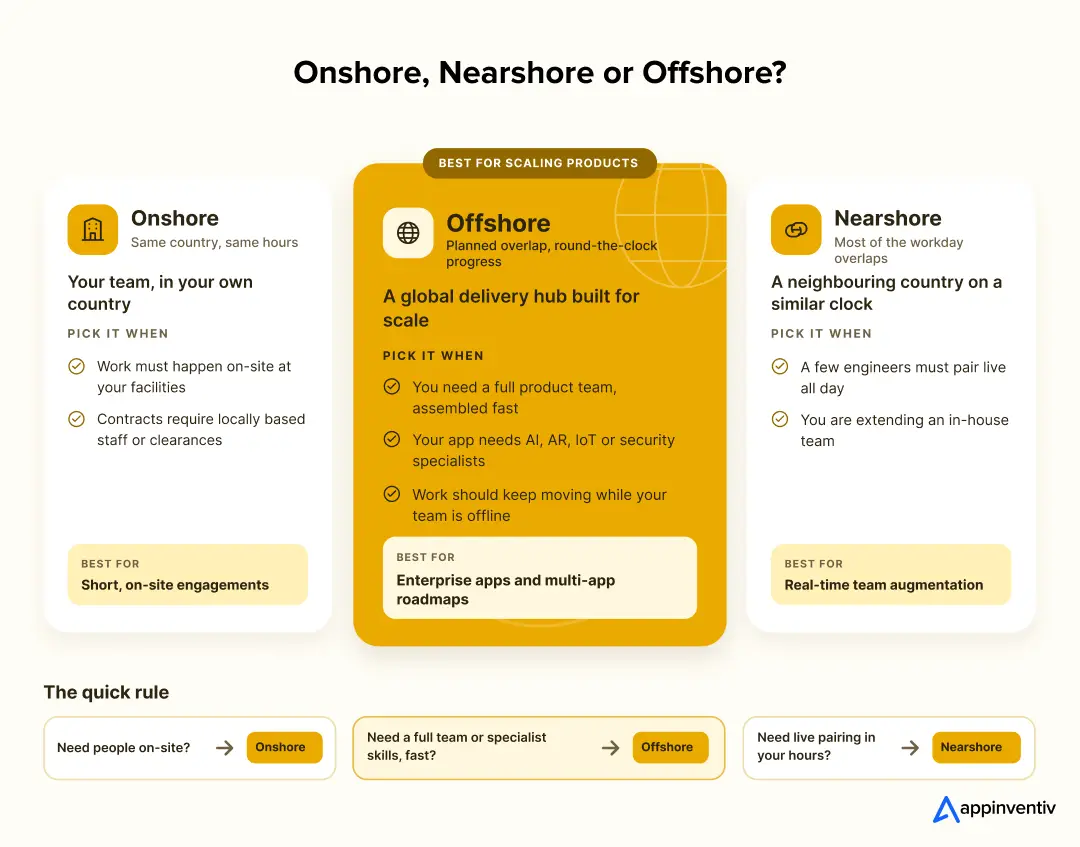
For most enterprises building or scaling a mobile product, offshore development is the strongest fit. It lets you assemble a full product team quickly, from strategy and UX to iOS, Android, backend, QA and DevOps. It also gives you access to specialist skills such as AI, AR, IoT and mobile security, and work keeps moving while your in-house team is offline.
Offshore works best when you agree on overlap hours, access controls, IP ownership and sprint reporting before the first sprint. With those in place, distance stops being a constraint and becomes a delivery advantage.
Also Read: Hire Mobile App Developers: Guide to Find the Best Team
Key Benefits of Offshore Mobile Development: Where the Value Sits
In offshore mobile application development, three benefits matter: cost leverage, talent access and delivery speed. Flexibility and focus follow from those. Each benefit is real, and each carries a condition you have to meet to capture it.
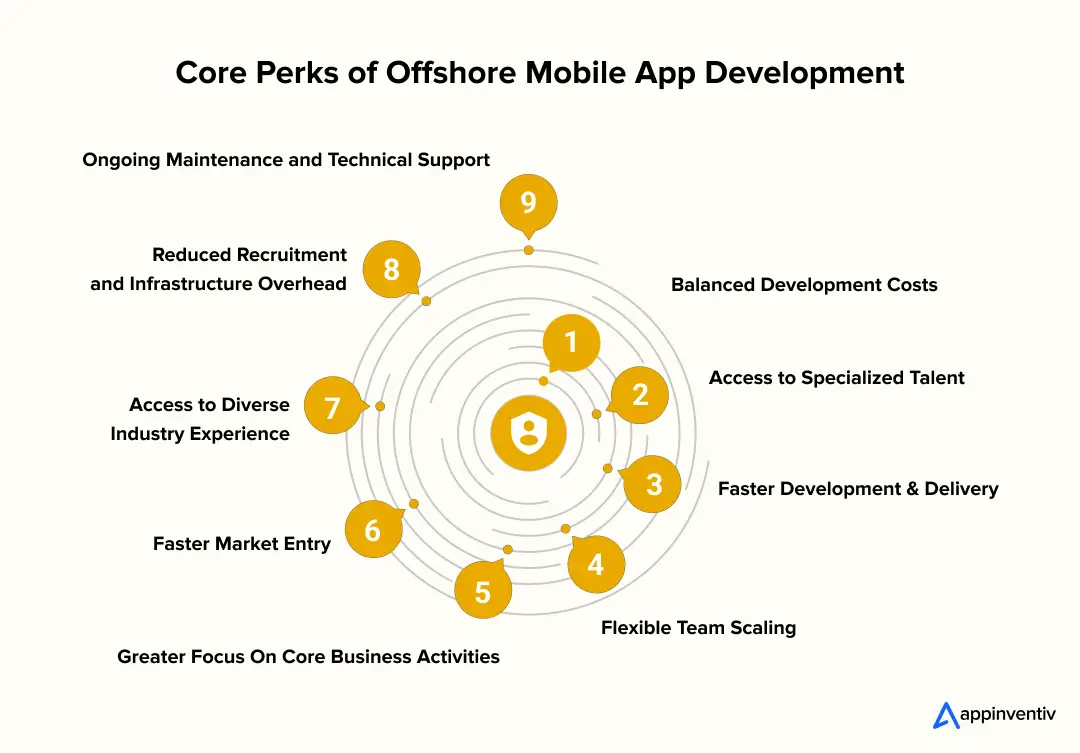
Balanced Development Costs
Offshore mobile app development can reduce engineering expenses through differences in regional salary structures and operating costs. Businesses can redirect savings towards additional features, testing, and product improvements.
Access to Specialized Talent
Businesses gain access to developers experienced in native iOS and Android development, cross-platform frameworks, cloud integration, AI, and other technologies without limiting recruitment to their local markets.
Faster Development and Delivery
Offshore app development allows businesses to add engineering capacity and run development activities in parallel. Time-zone differences can also extend working coverage and help maintain project momentum.
Flexible Team Scaling
Companies can expand or reduce team sizes according to project requirements. This gives them access to specific skills without the long-term costs of permanent hiring.
Greater Focus On Core Business Activities
With offshore mobile application development, internal teams can focus on core product-building principles, customer relationships, and business operations while external developers handle engineering responsibilities.
Faster Market Entry
Mobile app development offshore can help businesses accelerate product development by adding experienced developers and parallel workstreams, provided project requirements and decision-making processes are clearly defined.
Access to Diverse Industry Experience
Offshore development partners often work across industries such as healthcare, fintech, retail, and logistics. Businesses can draw on this experience to address industry-specific requirements and avoid common app development mistakes.
Reduced Recruitment and Infrastructure Overhead
Companies can avoid the time and expense involved in sourcing, hiring, onboarding, and maintaining an in-house engineering team. The offshore partner typically manages developer recruitment and operational infrastructure.
Ongoing Maintenance and Technical Support
Offshore teams can continue supporting the application after launch through bug fixes, performance monitoring, security updates, and feature enhancements. This helps businesses manage the app throughout its lifecycle.
7-Step Evaluation Framework For Hiring an Offshore Mobile App Development Company
To evaluate an offshore mobile app development company, work through seven steps: define scope, shortlist on verified evidence, test technical depth, verify security and IP ownership, assess the delivery model, run a paid pilot, and lock commercial and exit terms.
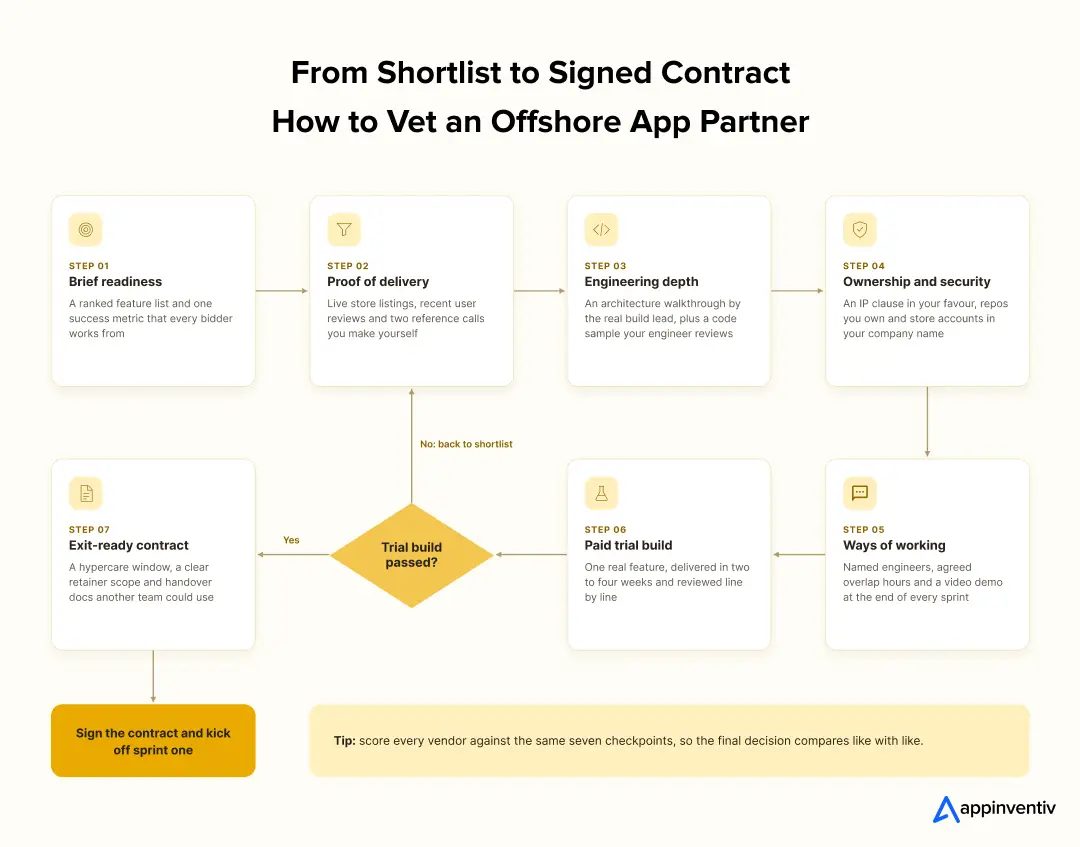
Step 1: Define Scope and Success Metrics Before You Talk to Vendors
Write a one-page brief covering users, core flows, platforms, integrations, compliance scope and the single metric that defines success. Rank features as must, should and could. Decide between native (Swift vs Kotlin) and cross-platform (Flutter vs React Native) early, or ask each vendor to argue their case. That choice shapes the team profile you will be evaluating. Offshore teams build what is specified, so gaps in the brief turn into rework later.
Pass if: three vendors can price and plan from the same brief.
Walk away if: a vendor quotes without asking a single clarifying question.
Step 2: Shortlist On Verified Delivery Evidence
Ask for two or three apps comparable to yours in domain, scale or integration complexity, then check them yourself. Download them, read recent store reviews, and see when each was last updated. Call at least two references and ask what went wrong and how the vendor handled it. Directory ratings help you find vendors, but they don’t prove a vendor fits your project.
Pass if: they show live, comparable apps and references who will talk.
Walk away if: case studies have no live app, no named client, or no one willing to take a reference call.
Step 3: Test Technical and Architecture Depth
Ask the engineers who would actually lead your build, not the presales team, to walk through a past project. Cover state management, offline handling, API design, CI/CD and test automation. Have your own engineer review a code sample. Ask how they apply OWASP MASVS, the mobile application security verification standard, on real projects.
Pass if: your actual delivery lead can defend the architecture under questioning.
Walk away if: answers stay at slide level, or the person presenting will not be on your project.
Step 4: Verify Security, Compliance and IP Ownership
Confirm that all IP is assigned to you, that the code lives in repositories you own and that your app store accounts are registered to your company. Check how access is revoked when an engineer leaves. For regulated work, ask how they have handled compliance like GDPR, HIPAA or PCI DSS before.
Pass if: IP, code and store accounts are yours from the first commit.
Walk away if: any clause lets the vendor keep your code or hold your store accounts.
Step 5: Assess the Delivery and Communication Model
Ask for a named team with a clear seniority mix, a daily overlap window and two-week sprints that end in a device demo. Check what happens if a key engineer leaves. Watch how they handle a changed requirement during the sales process, because it previews how delivery will go.
Pass if: you get named engineers, agreed overlap hours and demo-led sprints.
Walk away if: they offer status reports instead of working software.
Step 6: Run a Paid Pilot Before Signing the Master Agreement
Run a two-to four-week paid pilot with your top one or two vendors. It should be one real feature, built to your standards and reviewed by your own engineer. Score code quality, test coverage, responsiveness, and how the team copes with a change made mid-pilot. If the pilot fails, go back to your shortlist rather than renegotiating with the same vendor.
Pass if: code quality, speed and change handling hold up under your engineer’s review.
Walk away if: the pilot needs heavy rework or misses its own estimate with no clear explanation.
Step 7: Lock Commercial, Support and Exit Terms
Agree the engagement model (fixed scope, time and materials, or a dedicated team) and how change requests are priced. Set a 30 to 90 day hypercare window after launch. Then add a maintenance retainer for OS updates, bug fixes and monitoring, which many teams budget at around 15 to 20% of build cost per year. Require documentation current enough that a second vendor could take over without starting from scratch.
Pass if: a second vendor could take over without starting again.
Walk away if: handover, documentation or exit terms are vague. You would be locked in rather than in a partnership.
Build an offshore team with specialized iOS, Android, backend, and QA expertise to handle growing development demands.

Technologies and Frameworks Used in Offshore Mobile App Development
Most offshore application development runs on Swift for iOS, Kotlin for Android, or Flutter and React Native across both, backed by Node.js, Python or Java services on AWS, Azure or Google Cloud. The right stack depends on performance needs, hiring pool and total cost of ownership, not trends.
| Need | Typical choice | Why |
|---|---|---|
| Peak performance, deep device features | Native: Swift and Kotlin | Direct platform APIs, at the price of two codebases |
| One codebase, fast MVP | Flutter | Single codebase with consistent UI |
| Existing JavaScript team | React Native | Shares skills with your web team |
| On-device AI | Core ML, TensorFlow Lite, plus cloud LLM APIs | Balances latency against privacy |
| Backend and integrations | Node.js, Python or Java with REST or GraphQL | Mature talent pools, easy to hand over |
Offshore App Development Cost: A Quick Estimation
Most offshore mobile app projects cost between $40,000 and $500,000+ and take three to fifteen months to deliver. Hourly rates have less to do with where a project lands in that range than a few early product decisions do: which platforms you build for, what the app has to connect to, what data it stores and how the delivery team is run. Two apps with similar screens can end up with very different budgets once you account for what sits behind them.
| App scope | Budget range | Build time | Typical examples | Team shape |
|---|---|---|---|---|
| MVP or single-purpose app | $40,000–$90,000 | 3–5 months | Booking app, loyalty app, field inspection checklist | Product manager, UI/UX designer, 2 cross-platform developers, QA engineer |
| Multi-feature growth app | $90,000–$220,000 | 5–9 months | Marketplace, digital wallet, telehealth app, on-demand delivery | Adds backend engineers, native iOS and Android developers, DevOps |
| Enterprise or regulated app | $220,000–$500,000+ | 9–15+ months | Banking app, ERP-connected workforce app, fleet and logistics platform | Multiple squads, solution architect, security specialists, dedicated QA automation |
Key Cost Components of Offshore Mobile App Development
The final cost of offshore mobile app development depends on the features, technical architecture, integrations, and resources required. The following breakdown provides indicative estimates for individual components. Actual costs vary by project scope and should not be treated as fixed charges.
| Cost component | Estimated cost |
|---|---|
| Product discovery and planning | $3,000–$10,000 |
| UI/UX design | $5,000–$20,000 |
| Frontend app development | $10,000–$50,000 |
| Backend development | $10,000–$60,000 |
| Third-party integrations | $3,000–$20,000 |
| Advanced feature development | $5,000–$40,000 |
| Quality assurance and testing | $4,000–$20,000 |
| Cloud infrastructure and DevOps setup | $2,000–$12,000 |
| Security and compliance | $3,000–$25,000 |
| App deployment and launch | $1,000–$5,000 |
Ongoing Costs After Offshore App Development
The initial development budget is only part of the investment. Businesses should also account for recurring expenses once the application goes live.
| Recurring cost | Estimated monthly cost |
|---|---|
| App maintenance | $1,000–$5,000 |
| Cloud hosting and storage | $200–$3,000+ |
| Security monitoring | $200–$2,000 |
| Third-party API subscriptions | $100–$2,000+ |
| Ongoing technical support | $500–$3,000 |
Region-Wise Offshore Mobile App Development Costs
The location of the offshore development team has a direct influence on engineering rates. However, the final project cost also depends on developer experience, technology stack, engagement model, and project complexity.
| Offshore development region | Average hourly rate | Typical cost for a mid-sized mobile app |
|---|---|---|
| India | $20–$45 | $40,000–$120,000 |
| Southeast Asia | $25–$50 | $45,000–$140,000 |
| Eastern Europe | $35–$70 | $70,000–$180,000 |
| Latin America | $35–$65 | $65,000–$170,000 |
| Western Europe | $70–$120 | $120,000–$250,000 |
| North America | $80–$150 | $140,000–$300,000 |
Also Read: How Much Does Mobile App Development Cost?
Five Decisions That Move Your Budget the Most
- Native or cross-platform: A single Flutter or React Native codebase serves both iOS and Android and suits most business apps. Native builds need two codebases and two sets of specialists, but they’re worth it for apps that rely on heavy graphics, Bluetooth, AR or background processing.
- Offline capability: Apps that only work online are straightforward to build. Field service, logistics and healthcare apps that let users work offline and sync later need local storage and conflict resolution, which can add $15,000 to $50,000.
- System integrations: Payment gateway integration, maps, and push notifications plug in quickly through mature SDKs. ERP, CRM, core banking or legacy integrations need middleware and extensive testing, often costing $20,000 to $60,000+ each.
- Data sensitivity: Apps that hold payment, health or personal data must meet standards such as PCI DSS, HIPAA or GDPR. Budget $15,000 to $40,000+ for encryption, secure MFA, audit logs and OWASP MASVS testing.
- Offshore team governance: Agree on code ownership, access controls, overlap hours and IP transfer before the project starts. Secure repositories, SSO, MFA and role-based access protect your product, so count them as part of the build cost.
Assess the estimated cost, delivery timeline, and resource requirements for your mobile application before development begins.

Offshore Mobile App Development Challenges: Where Projects Actually Break
Offshore mobile application development projects rarely fail on talent. They fail on five predictable gaps: time zones, scope drift, security, quality visibility and ownership. Most fixes cost nothing if agreed before kickoff.
| Risk | Early warning sign | Fix |
|---|---|---|
| Scope drift | Requests arrive in chat instead of the backlog | Change-request log with priced impact; sprint caps on time-and-material work |
| Security and compliance | Shared credentials; production data used in testing | ISO 27001-certified partner, least-privilege access, no production data in dev, data residency settled in step 3 |
| Quality visibility | Skipped demos; the same defects reopened sprint after sprint | Sprint demos, a reopened-defect metric, senior review of every pull request |
| IP and ownership | Repositories or store accounts sit under the vendor’s name | IP assignment clause; repositories and store accounts in your name |
| Communication drift | Rework traced to misread requirements | Written acceptance criteria and short video walkthroughs |
| Key-person dependency | Only one engineer can explain a given module | Documentation standards, paired reviews and a named backup for every module |
Build Your Offshore Mobile App With a Partner You Can Verify
Choosing an offshore mobile app development company shapes every release that follows. It decides how fast you ship, who owns your code and how much rework you absorb along the way. A clear brief, ownership settled from the first commit, and a paid pilot are what turn that choice from a leap of faith into a verified bet.
If you’re shortlisting partners now, put Appinventiv through the same seven steps. Our 1,700+ technology experts have delivered 3,000+ projects, including various offshore mobile engagements.
That work ranges from KFC food delivery app fulfilling 30,000+ orders a day to JobGet, which passed 2 million downloads and raised a $52 million Series B. We’ve also built products for IKEA, Ility and AVATUS, and won the recognition for ET Industry Change Makers 2026.
Our mobile app consulting services can help you take the next step with a clear understanding of your technical requirements, delivery expectations, and ownership considerations. From evaluating the right technology stack to defining the offshore engagement model and development roadmap, we help you establish a sound foundation before development begins.
FAQs
Q. How much does it cost to hire an offshore mobile app development team?
A. Expect $20–50 per hour for South and Southeast Asian teams and $30–80 for Eastern Europe and Latin America. A full build typically lands at $40,000– $90,000 for a simple app, $200,000– $350,000 for a mid-complexity product and $500,000+ at enterprise scale, with maintenance at 15–20% of build cost per year.
Q. How do offshore teams handle time zone differences?
A. Strong teams shift part of their day to create two to four hours of overlap, keep a written trail for everything outside it, and send an end-of-day summary at every hand-off. Overlap is for decisions and blockers; asynchronous documentation handles the rest. Without a defined window, every question waits a full day.
Q. How long does it take to build an app with an offshore team?
A. A focused MVP takes about three to six months offshore. A complex product with integrations, compliance and several user roles takes six to twelve. Offshore rarely shortens calendar time on its own; it lowers cost per month and lets you add engineers without hiring delay.
Q. How do I choose the right offshore mobile app development company?
A. Shortlist on shipped apps similar to yours, then test with a paid pilot. Check four things: references from clients with comparable complexity, named engineers rather than a bench you never meet, security certification such as ISO 27001, and a written rework policy. A vendor that resists a pilot is giving you data.
Q. What should an offshore development contract include?
A. Five clauses: IP assignment on payment, milestone payments tied to accepted demos, a rework warranty, response-time SLAs, and an exit clause with a documented transition period. Add data-protection terms matching the laws that govern your users, such as GDPR.


Fast 2-minute response, fully NDA-protected.

How Much Does It Cost to Build a Field Service Management App?
Australian field operations cover long distances, patchy regional coverage and strict safety and privacy obligations. Many enterprises have outgrown generic scheduling tools that were never built for that reality. Most field service management app development costs range from AUD 70,000 to AUD 700,000 or more, depending on operational complexity, integrations and security requirements. That spread…

How Much Does It Cost to Develop a Remote Patient Monitoring App in the UAE?
Key takeaways: Feature scope and system integrations, not the app itself, determine your final development cost. DHA, DOH, and MOHAP compliance must be built into your architecture from day one. Wearables, EHRs, and health information exchanges are the biggest technical cost drivers. A successful RPM platform combines continuous monitoring, clinical workflows, and secure interoperability. Early…

How Much Does It Cost to Develop an App Like Herfy in 2026?
Key takeaways: Herfy-like app development costs SAR 150,000 to SAR 1,500,000 ($40,000 to $400,000). Costs rise with rider tracking, POS sync, kitchen displays, loyalty, and branch controls. Saudi apps need Arabic UX, Mada, STC Pay, VAT, and ZATCA-ready invoice flows. Peak loads during Ramadan, Eid, and weekends need strong backend and load testing. A phased…