

















How to Choose an AI Agent Development Partner: A 6-Step Guide for CTOs

 Share -


- 01Why Choosing an AI Agent Partner Differs From Hiring a Software Vendor
- 02Step 1: Define the Workflow and Success Metric Before You Talk to Vendors
- 03Step 2: Decide Which Type of Partner Your Stage Needs
- 04Step 3: Shortlist Partners on 8 AI Agent Vendor Selection Criteria
- 05Step 4: Compare Each AI Agent Development Partner With a Weighted Scorecard
- 06Step 5: Pressure-Test the Proposal, Costs and Red Flags
- 07Step 6: Start With a Paid Assessment and Lock Ownership Into the Contract
- 08How Appinventiv Builds AI Agents That Hold Up in Production
- 09Frequently Asked Questions

If you are working out how to choose an AI agent development partner, it comes down to one test: can they take an agent from prototype to monitored production with your data, your systems and your compliance rules intact? A polished demo proves none of that.
McKinsey’s State of AI survey found that 62% of organizations are experimenting with AI agents, yet in any single business function no more than 10% are scaling them. For a CTO running ERP, CRM and core platforms that were never built for autonomous software, the partner you pick decides which side of that gap you land on.
Key takeaways:
- Scope one workflow with a measurable target before you speak to a single vendor
- Match the partner type to your stage, because consulting firms, platforms and build partners solve different problems.
- Put 40% of your scorecard weight on governance and post-launch operations, where most agent projects break.
- Budget for running costs such as tokens, monitoring and model updates, not only the build
- Start with a paid two- to four-week assessment and contract ownership of code, prompts and fine-tuned weights.
Appinventiv scopes, builds and runs production-grade AI agents that connect to your existing systems from day one.
Why Choosing an AI Agent Partner Differs From Hiring a Software Vendor
Traditional software does exactly what it is coded to do, so you can judge a vendor on features, price and delivery dates. An AI agent is different because it reasons, decides and acts across your systems, and it can give two different answers to the same request. That shifts the risk from “will it be built on time” to “will it behave correctly six months after launch.”
The partner you choose has to engineer for uncertainty, which means testing failure modes, setting human approval points and monitoring the agent long after go-live. The six steps below are built around that difference.
Step 1: Define the Workflow and Success Metric Before You Talk to Vendors
The strongest vendor evaluations start with an honest look at AI readiness inside your own business, not in a sales call. Before you shortlist anyone, pick one workflow, name the systems it touches and write down the number that will prove the agent worked. That brief becomes the yardstick by which every proposal is measured.
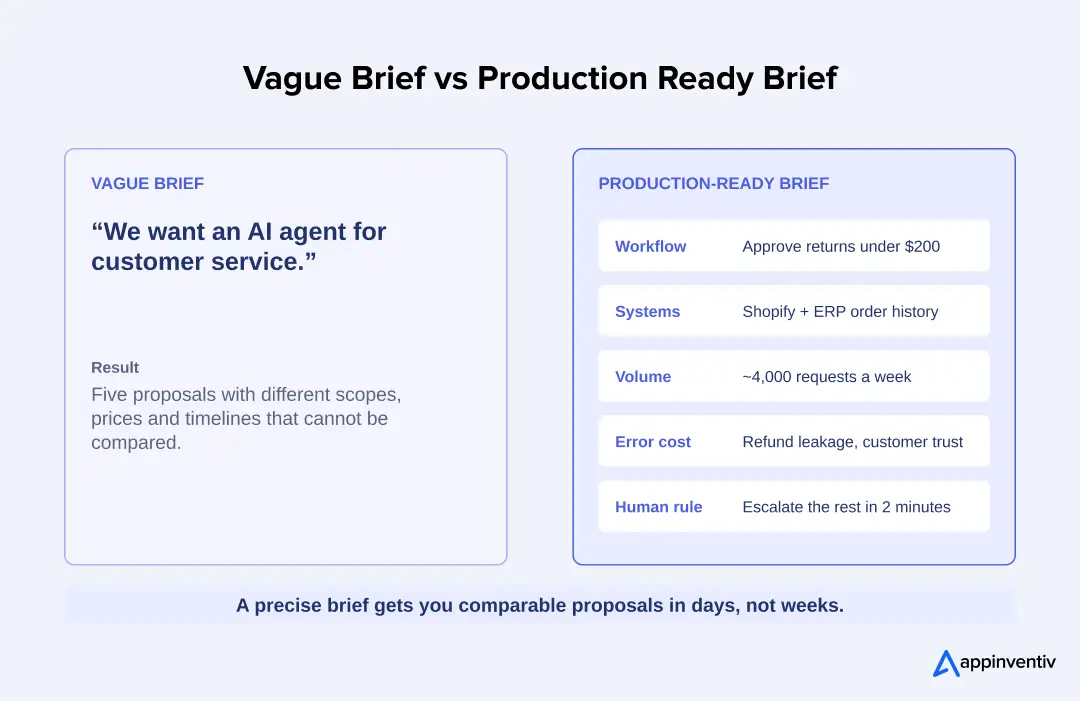
Compare two briefs. “We want an AI agent for customer service” invites five vague proposals you cannot compare. “An agent that approves returns under $200 in Shopify, checks order history in our ERP and escalates everything else to a human within two minutes” forces each vendor to show how they would actually build it.
It matters because Gartner predicts that over 40% of agentic AI projects will be canceled by the end of 2027, citing rising costs, unclear business value and weak risk controls. In our experience, those three causes usually trace back to the same root: nobody agreed on what success looked like at the start.
If you are evaluating partners for automation specifically, add three things to the brief:
- Volume: how many tasks the agent will handle each week
- Error cost: what one wrong action costs you in money, compliance or customer trust
- Human boundary: which decisions must always reach a person
The business payoff is simple. A precise brief shortens the evaluation by weeks, because weak vendors reveal themselves the moment they have to answer specifics.
Step 2: Decide Which Type of Partner Your Stage Needs
AI agent development partner selection gets easier once you accept that “AI agent partner” covers very different businesses. Some advise, some sell a platform you configure, and some engineer custom agents into your stack. Comparing them on one list is like comparing an architect, a prefab home supplier and a general contractor on price alone.
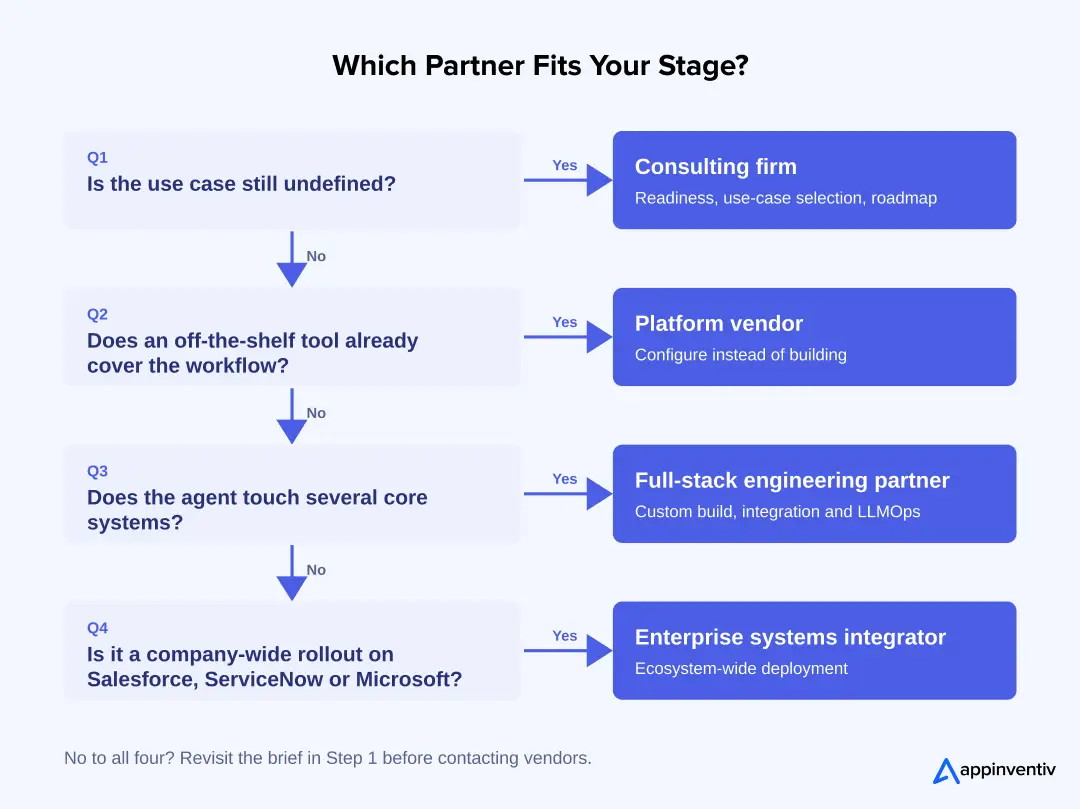
If you are still deciding where agents fit, start with a consulting partner focused on readiness and use-case selection. If the workflow is already defined and touches several core systems, you need an engineering partner who can build and run the agent.
| Partner Type | Best For | Trade-Offs | Indicative Budget and Timeline |
|---|---|---|---|
| Boutique AI Specialist | Fast prototypes and narrow, single-workflow agents | May lack depth in legacy integration and compliance staffing | $15,000 to $50,000; 4 to 8 weeks |
| Full-stack Engineering Partner | Agents embedded in existing apps, data platforms and multi-system workflows | Higher rates than boutiques; vet framework depth closely | $50,000 to $300,000; 3 to 9 months |
| Enterprise Systems Integrator | Company-wide rollouts on Salesforce, ServiceNow or Microsoft ecosystems | Slower cycles, rigid processes and higher overhead | $100,000 and up; 6 months or longer |
| Platform Vendor | Standard workflows a configurable tool already covers | Limited customization and a real risk of lock-in | Subscription-based; weeks to configure |
One warning before you shortlist anyone: Gartner estimates only about 130 of the thousands of vendors marketing AI agents offer genuine agentic capabilities. The rest practice “agent washing,” which means relabeling chatbots or RPA (robotic process automation) as agents. Ask every vendor to show an agent making a multi-step decision across two systems, live.
Also Read: Custom AI or Off-the-Shelf AI – Which Is the Right Solution for Your Business?
Step 3: Shortlist Partners on 8 AI Agent Vendor Selection Criteria
These eight criteria are factors to consider when selecting an AI agent development partner, as each maps to a reason agents fail after launch. Use the table in your first call; the notes below explain what a strong answer sounds like.
| Criterion | Ask This | Red Flag |
|---|---|---|
| Live Deployments | Which of your agents are in production today, and for how long? | Only demos or pilots |
| Data Readiness | How will you assess our data before choosing a model? | Model picked in the first meeting |
| AI Agent Architecture | Which frameworks do you use for orchestration and memory? | Prompt wrappers around one API |
| Legacy Integration | How will the agent read from and write to our core systems? | “We’ll figure out the APIs later” |
| Evaluation and Testing | How do you measure task accuracy before launch? | Uptime is the only metric |
| Security and Agent Identity | What can the agent access, and how is that logged? | Shared API keys |
| IP Ownership | Who owns code, prompts and weights on exit? | Prompts stored in the vendor’s account |
| Post-Launch LLMOps | Who monitors, retrains and fixes the agent? | Support ends at go-live |
Proof of Live Deployments, Not Demos
Ask for agents that have run for months, plus one documented failure and what the team changed after it. A partner with no failure stories has very little time for production.
Data Readiness Before Model Choice
A reliable partner audits data quality, access permissions and storage before recommending an LLM. Clean data usually moves results more than a bigger model does.
AI Agent Architecture and Framework Depth
Look for stateful orchestration (frameworks such as LangGraph, LangChain or native agent SDKs that track where a task stands), memory and human-in-the-loop fallbacks.
Appinventiv’s MyExec AI business consultant shows what this looks like in practice: a router agent sends each query to specialized document and strategy agents, grounded through a RAG (retrieval-augmented generation) pipeline and monitored with LangSmith.
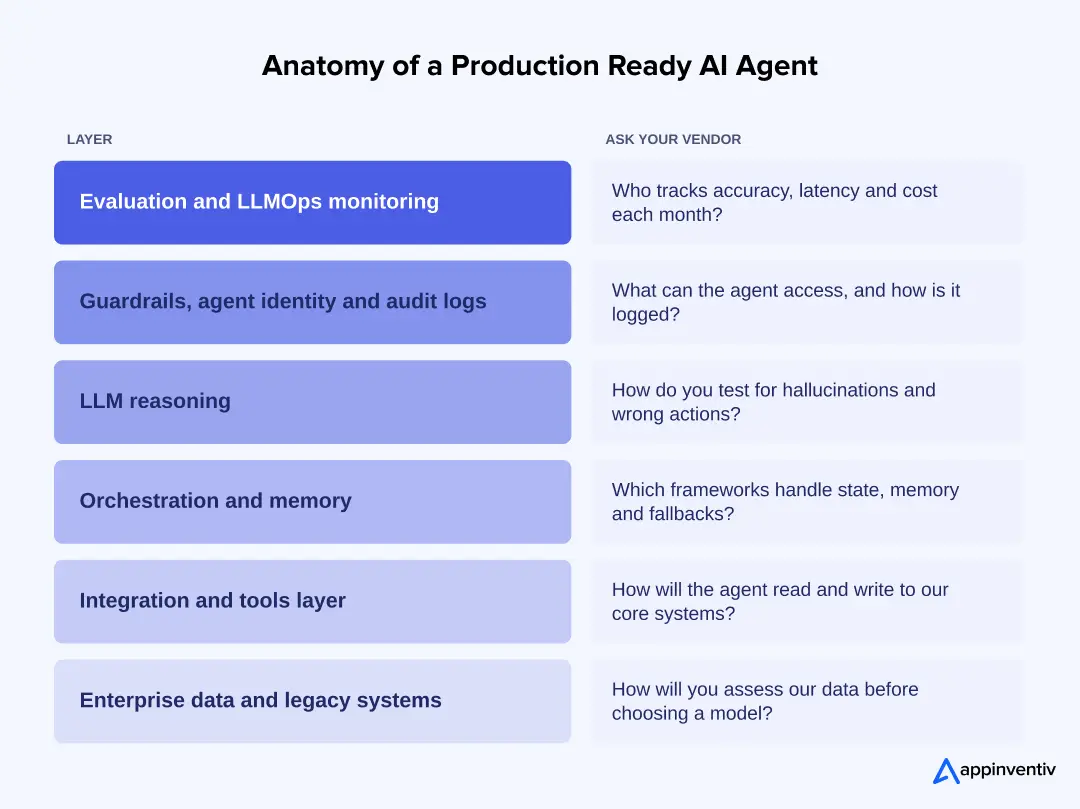
Integration With Legacy Systems
Gartner flags legacy integration as one of the most technically complex parts of agent deployment, often forcing costly changes to existing workflows. Your partner should explain exactly how the agent will connect to ERP, CRM, EHR or core banking systems, including authentication, rate limits and fallback when a system is down.
Teams that skip this end up with an agent that works in staging and stalls in production, which is why the integration plan deserves the same scrutiny as the agent itself.
Evaluation and Testing Rigor
Strong partners test task accuracy and failure modes, such as AI hallucinations or wrong actions, through automated evaluation pipelines rather than promising perfection.
Security and Agent Identity
Treat every agent like a privileged employee: its own identity, least-privilege access, audit logs and a kill switch. A sound AI agent governance model turns those rules into technical controls.
IP Ownership of Code, Prompts and Fine-Tuned Weights
Your contract should name code, prompts, fine-tuned weights and test sets as your property, with a documented export path.
Post-Launch LLMOps: Who Runs the Agent After Go-Live
Models update and business data shifts, so agents drift. Ask which LLMOps practices track accuracy, latency and token costs each month and how fast the team responds when performance drops.
Step 4: Compare Each AI Agent Development Partner With a Weighted Scorecard
A weighted scorecard turns an AI agent development partner comparison from a debate about who presented best into a decision your CFO and CISO can audit. Score each shortlisted vendor from 1 to 5 on each criterion, multiply each score by its weight, and sum the results.
| Criterion | Weight | What a 5 Looks Like | What a 1 Looks Like |
|---|---|---|---|
| Governance and Security | 20% | Agent identity, audit logs and approval chains built into the architecture | Security reviewed after launch |
| Post-Launch LLMOps | 20% | Named team, monthly accuracy and cost reporting | No support plan beyond go-live |
| Data Readiness | 15% | Data audit scoped before model selection | Model chosen before seeing data |
| Legacy Integration | 15% | Integration method named for each system | Integration left as an open item |
| Live Deployments | 10% | Agents running for months, with references | Demos only |
| AI Agent Architecture | 10% | Stateful orchestration, memory and fallbacks | Single prompt wrapper |
| IP Ownership | 5% | Code, prompts and weights assigned to you | Vendor retains prompts or weights |
| Commercial Clarity | 5% | Itemized build and run costs | One lump-sum quote |
Read the total this way: above 4.0, move to a paid assessment; between 3.0 and 4.0, ask for more evidence; below 3.0, walk away. In regulated sectors, further increase the governance weight. Healthcare buyers should test for HIPAA readiness, and BFSI teams for SOC 2 and GDPR controls, ideally against a documented AI agent governance framework.
Two habits keep the scorecard honest. Fix the weights before any proposal arrives, so a strong pitch cannot bend them, and have two or three people score independently before comparing notes.
The highest scorers rarely treat data engineering, integration and LLMOps as separate contracts. Partners offering end-to-end AI services and solutions carry one team’s accountability from the first data audit to month-twelve monitoring, which removes the handoff gaps where most production failures start.
Get AI agent systems engineered with governance, legacy integration and LLMOps built in from the first sprint.

Step 5: Pressure-Test the Proposal, Costs and Red Flags
The proposal is where most buyers get caught off guard, because a confident document can hide missing scope that later returns as change requests. A credible proposal names every system the agent touches, the integration method for each, a realistic data-preparation estimate and how the agent behaves when data is missing, records conflict or confidence is low.
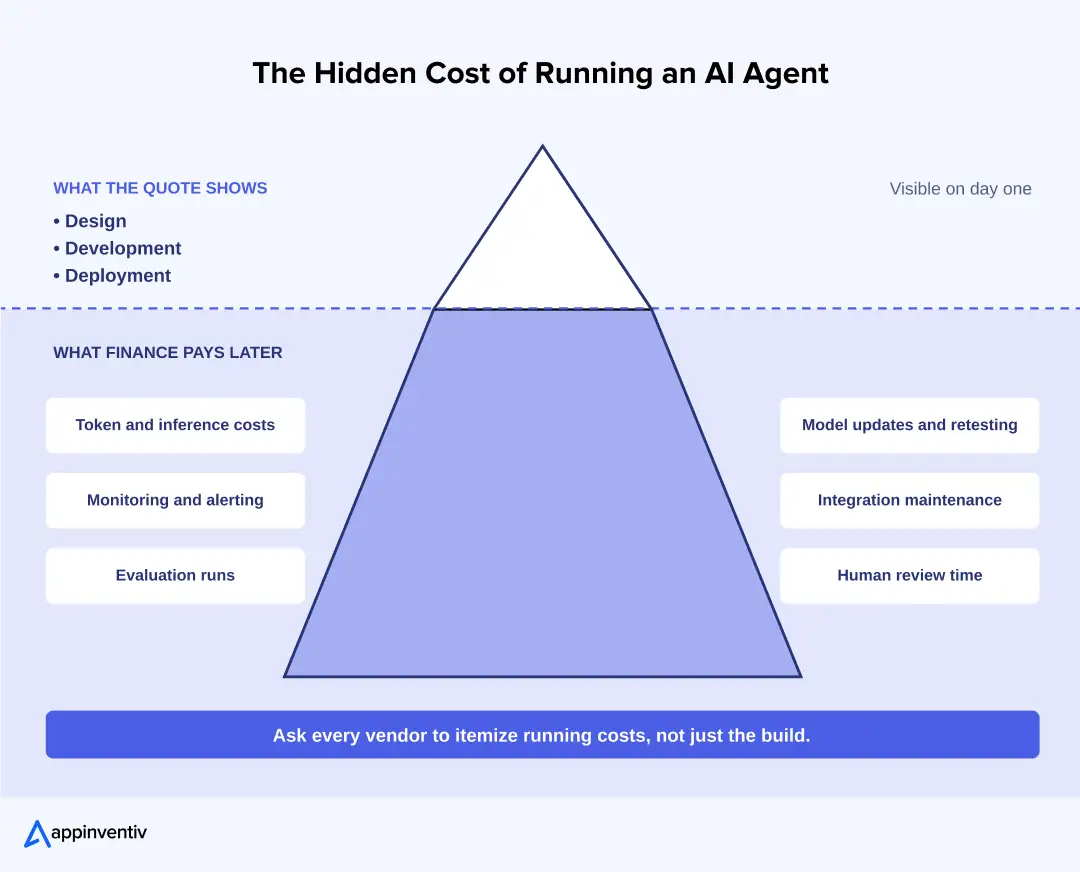
Costs deserve the same scrutiny. Build cost is the number every vendor quotes; running cost is the one that surprises finance in month six.
| Stage | What You Get | Indicative Cost | Indicative Timeline |
|---|---|---|---|
| Paid Discovery | Data audit, architecture plan and success metrics | $10,000 to $25,000 | 2 to 4 weeks |
| Pilot | One workflow on real data with human review | $25,000 to $60,000 | 6 to 10 weeks |
| Production Agent | Hardened, integrated and monitored agent | $50,000 to $150,000 | 3 to 6 months |
| Multi-Agent System | Several coordinated agents across functions | $150,000 to $300,000 and up | 6 to 14 months |
| Ongoing Operations | Tokens, monitoring, evaluation and model updates | Recurring monthly cost that scales with usage | Continuous |
Walk away from vendors that show any of these red flags:
- Promises of 100% accuracy or full autonomy from day one
- A black-box platform with no export path for your prompts and data
- No named engineers assigned to your project
- No plan for who runs the agent after launch
- No pushback on your scope, which means they have not thought about it
Then ask the two questions that expose the most. “What usually breaks when you put an agent into production?” shows whether they have shipped real systems. “When would you advise against using an agent here?” shows whether they will tell you something you do not want to hear.
For a deeper breakdown of what drives each number, see this guide to AI agent development cost.
Step 6: Start With a Paid Assessment and Lock Ownership Into the Contract
Before you sign a six-figure build, hire your top-scoring vendor for a two- to four-week paid assessment using your real data. It is the cheapest way to see how the team communicates, handles edge cases and estimates effort, and a good AI agent implementation partner will welcome it rather than push for the full contract.
Agree on what will be live at day 30, day 60 and day 90 before the work starts. Milestones written in advance stop a pilot from drifting into an open-ended research project.
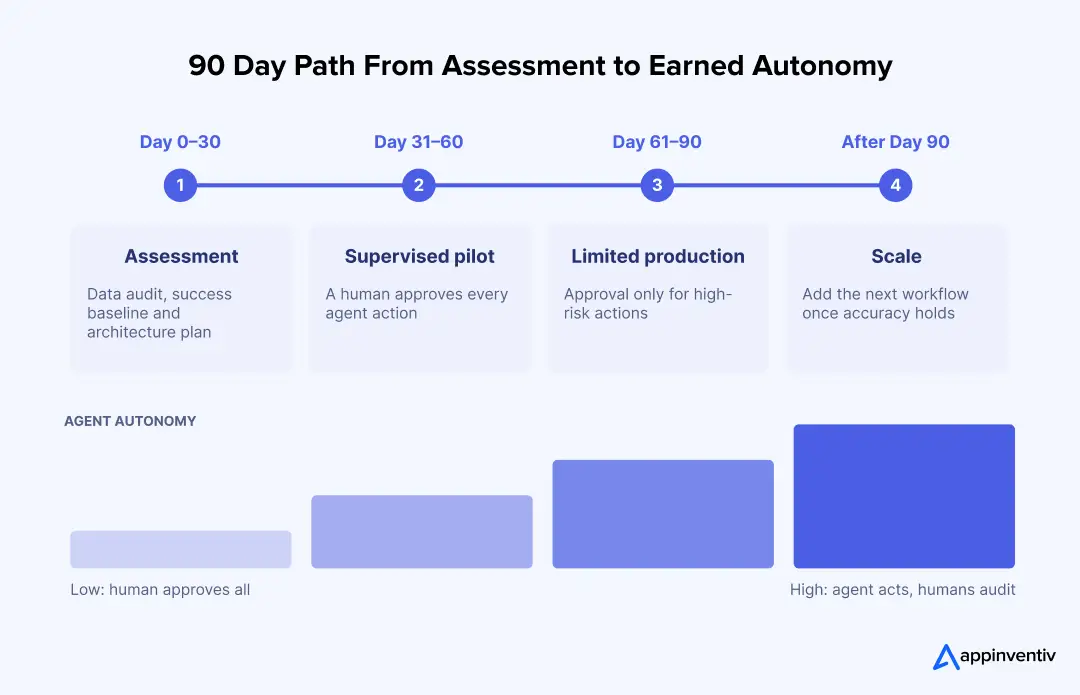
The contract should settle four questions in writing:
- Who owns the code, prompts, fine-tuned weights and test sets
- How your data and models are exported if the engagement ends
- Who monitors, fixes and updates the agent after go-live and how fast
- Which actions the agent may take alone and which need human approval
That last point shapes how you scale. Autonomy should be earned rather than granted: start with a person approving every consequential action, widen the agent’s permissions only as accuracy holds over several weeks, then add the next workflow.
Book a scoped assessment now and move your first agent into production before the next budget cycle closes.
How Appinventiv Builds AI Agents That Hold Up in Production
Appinventiv works as an AI agent development company that owns the full path, from the first data audit to the monthly LLMOps review, so there is no handoff between the team that designs the agent and the team that keeps it accurate.
The Tootle AI-powered intelligent agent demonstrates that approach in action. Tootle needed a travel assistant that could answer voice and text queries in real time without forcing users to switch apps.
The team built an LLM-powered agent on LangChain orchestration that pulls live data from Google Places, Yelp and Wikipedia, keeps context across the conversation and summarizes long reviews into usable answers.
The result was a 35% increase in user engagement and 10x faster responses, because multi-API orchestration replaced the manual lookups users had been doing themselves.
Governance, agent identity and human approval chains are designed into each build rather than added before launch, and clients keep full ownership of code, prompts and models. For regulated or legacy-heavy environments, one accountable team covers strategy, multi-agent architecture, orchestration and guardrails.
Frequently Asked Questions
Q. How do I choose an AI agent development partner for automation?
A. Start with one workflow, its weekly volume and the cost of a wrong action. Shortlist partners with live production agents, score them on governance, integration and post-launch operations, then run a paid two- to four-week assessment on your real data before committing to a full build.
Q. What are the essential qualities of a reliable AI agent development vendor?
A. A reliable vendor shows agents that have run in production for months, audits your data before choosing a model, builds agent identity and audit logs into the architecture, assigns named engineers and commits in writing to monitoring and fixes after launch. It also pushes back when your scope is unrealistic.
Q. What are the advantages of choosing the right AI agent development partner?
A. The right partner gets your agent past the pilot stage, which most projects never reach. You avoid rework from hidden scope, keep ownership of code and prompts, reduce compliance exposure through built-in governance and get predictable running costs because monitoring and model updates are planned from the start.
Q. How much does it cost to hire an AI agent development partner, and how long does a build take?
A. A paid discovery typically runs two to four weeks, a single-workflow pilot six to ten weeks, and a production agent three to six months. Indicative budgets range from about $40,000 for a pilot to $500,000 or more for multi-agent systems, plus recurring operating costs.
Q. Who owns the code, prompts and data after the project ends?
A. You should, but only if the contract says so. Before work begins, make sure ownership covers code, prompts, fine-tuned weights and test sets, with a documented export path. If you are still unsure how to choose an AI agent development partner, start here: a vendor that agrees to these terms without pushback is usually one you can trust long after launch.


Fast 2-minute response, fully NDA-protected.
Generative AI in Software Testing: How Enterprises Scale Quality With Humans in the Loop
For CTOs and QA heads deciding where to trust AI-written tests, a practical way to scale coverage without scaling risk. Somewhere in your organization, code is being written faster than it can be tested. Developers have AI assistants, release windows keep shrinking, and QA is expected to keep pace without lowering the bar. Generative AI…
AI-Native Security Maturity Model: Score Where Your Security Stack Stands
Key takeaways: If Human oversight scores below 2, you're at Level 3 at most, whatever your total score says. Moving to Level 3 starts with unifying your telemetry, which most teams can do with tools they already own. Define approval points before you automate response. Oversight added later costs more. Buy a platform when your…

The AI ROI Crisis: Why Enterprises Are Struggling to Prove Value and How to Fix It
Key takeaways: AI ROI is a capital-allocation question. Boards want payback periods and P&L impact. AI ROI challenges rarely have a single cause. Data, legacy systems, use-case choice, ownership and stalled pilots compound each other. Choose two or three outcome metrics per use case, set the baseline first, and report in dollars. Make every further…