


























How Much Does Wearable App Development Cost?

 Share -



- 01What Is the Average Cost to Develop a Wearable App in 2026?
- 02How to Estimate the Cost to Develop a Wearable App
- 03Wearable App Development Cost Breakdown by Components
- 04Feature-Wise Wearable App Development Cost
- 05Key Factors Affecting the Cost of Wearable App Development
- 06Cost Breakdown: Wearable App With vs Without AI Features
- 07Platform-Wise Wearable App Development Cost Overview
- 08Cost Variation for Wearable App Development by Location
- 09Build vs Customize: Cost Implications for Enterprises
- 10Hidden Costs of Wearable App Development
- 11Understanding the Total Cost of Ownership (TCO)
- 12How Development Timelines Influence the Cost of Wearable App Development
- 13How Appinventiv Helps Enterprises Build Scalable Wearable Applications
- 14Frequently Asked Questions

Key takeaways:
- Most wearable apps start at around $50K, but costs rise quickly once multiple devices and real-time data are involved.
- Early budgets often miss backend, storage, and compliance work that builds up after launch.
- Device choice matters more than expected, it affects build effort, testing time, and long-term performance.
- Features like live tracking or AI insights add hidden work across data handling and system design.
- Long-term spend comes from keeping systems stable as users, devices, and data volume continue to grow.
Wearable apps are no longer niche products. Before diving in, understanding wearable app development cost is essential, as these apps sit inside fitness plans, hospital systems, and factory floors where teams track real-time data from devices.
The global fitness tracker market is projected to reach $162.8 billion by 2030, underscoring how rapidly adoption is growing across use cases.
Yet, pricing a wearable app is not simple. A basic build can cost around $50,000. A large system with multiple devices and backend services can cross $500,000. The gap is wide for a reason.
A wearable app does not live on its own. It connects with sensors, mobile apps, cloud systems, and third-party platforms. Each connection adds work. Each layer adds cost. Teams must plan for data flow, device syncing, and secure storage from day one.
Many businesses focus only on building cost and miss the larger picture. Infrastructure, compliance, updates, and scaling shape the real spend over time.
This guide breaks down how these costs form. It explains wearable app development pricing factors, from feature-level pricing and platform impact to the key drivers that shape total budgets.
Health tracking is already mainstream. Delaying your wearable app means entering a crowded market late.
What Is the Average Cost to Develop a Wearable App in 2026?
Most wearable apps cost between $50,000 and $500,000. Understanding wearable application development cost starts with recognizing that the gap is wide because the build scope changes fast once devices and data enter the picture.
A basic version that logs steps or simple health stats, similar to a fitness app, takes less time and a smaller team. Costs rise once the app reads live sensor data, syncs across devices, and pushes updates to the cloud. Each added layer brings more engineering work.
Cost to Make a Wearable App: Complexity
| Complexity | Estimated Cost to Make a Wearable App | Timeline |
|---|---|---|
| MVP | $50k – $120k | 3–5 months |
| Mid-Scale App | $120k – $250k | 6–9 months |
| Enterprise-Scale App | $250k – $500K+ | 9–18 months |
The final number depends on how many devices the app supports, how often it processes data, and how the backend handles that load.
How to Estimate the Cost to Develop a Wearable App
Once a budget range is set, teams need a clearer way to map wearable application development cost to actual build effort. A simple model helps break the estimate into parts that engineering and finance can both track.
Wearable app cost formula
Total Cost = App Complexity × Hourly Engineering Rate × Development Phases + Infrastructure + Device Integration + Compliance
Each part shifts depending on the product’s scope. Costs rise as the app supports more devices, handles continuous sensor data, and stores large volumes of user information. Systems that handle health data or operate in regulated environments add another layer of effort.
Wearable App Development Cost Breakdown by Components
A wearable app is built in layers. One part handles the device. Another moves data to the phone or cloud. A third shows results to the user. Teams split the work this way to keep things stable as usage grows.
| Cost Component | What It Covers | Typical Cost Range |
|---|---|---|
| Product Design and UX | Layout for small screens, tap and swipe actions | $15K – $40K |
| Core Backend Development | Data flow, APIs, device communication | $40K – $120K |
| Mobile Integration | Sync with phone, alerts and user settings | $30K – $100K |
| Device and Sensor Integration | Steps, heart rate, GPS, device pairing | $25K – $80K |
| Compliance and Security | Data protection, encryption and access control | $15K – $50K |
| Infrastructure Setup | Servers, storage and uptime tracking | $15K – $50K |
| Analytics and Data Processing | Reports, usage data, trend tracking | $10K – $30K |
The total cost builds up across these parts. More devices and more data streams mean more work at each layer.
Feature-Wise Wearable App Development Cost
Feature choices of your wearable app shape a large part of the budget. Many actions look simple on a watch screen, but they depend on steady data capture, device sync, and background processing. As more features are added, the build effort grows across each layer.
Feature Level Cost Estimation
| Feature | Development Hours | Estimated Cost |
|---|---|---|
| User onboarding and profile | 80–150 hrs | $4k – $9k |
| Device pairing and setup | 120–250 hrs | $6k – $15k |
| Sensor data tracking (heart rate, steps) | 180–320 hrs | $10k – $25k |
| Real-time data sync | 200–400 hrs | $15k – $40k |
| GPS and motion tracking | 150–300 hrs | $10k – $28k |
| Alerts and notifications | 80–140 hrs | $3k – $8k |
| Health data reports and charts | 140–240 hrs | $8k – $20k |
Each added feature increases data handling and testing across devices, raising the total build cost.
Key Factors Affecting the Cost of Wearable App Development
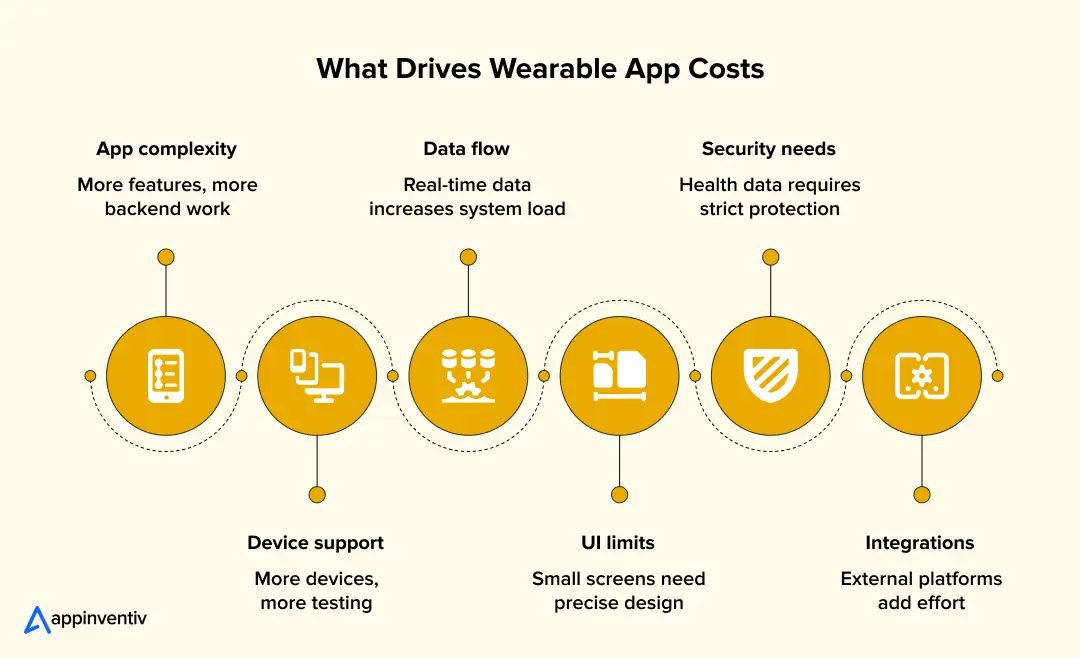
Understanding the key features that affect the cost of wearable app development starts here because cost quickly moves beyond the surface once the system handles devices, continuous data, and user activity at scale
App Complexity
Many wearable apps look simple on the surface. In practice, each feature adds background services that manage sensor data, syncing, and user interactions.
Core experience layers often include:
- User setup and device pairing
- Activity tracking (steps, sleep, heart rate)
- Notifications and alerts
- Basic data summaries
Advanced layers increase cost:
- Real-time health monitoring
- AI-based insights and predictions
- Multi-device synchronization
- Advanced analytics and reporting
As feature depth increases, systems need more processing, storage, and coordination.
Cost Impact Overview
| Factor | Technical Cost Driver | Cost Impact Range |
|---|---|---|
| Basic Tracking Features | Sensor reads and simple storage | Low to Medium |
| Advanced Health Insights | Continuous data processing, analytics | Medium to High |
| Multi-Device Sync | Cross-device coordination | Medium |
Device Compatibility
Wearable apps must work across different hardware types in a wearable technology revolution where each device has its own OS, sensors, and performance limits.
Typical compatibility layers include:
- Apple Watch (watchOS)
- Wear OS devices
- Fitness bands and custom hardware
More devices mean more testing and adjustments.
Cost Impact Overview
| Factor | Technical Cost Driver | Cost Impact Range |
|---|---|---|
| Single Device Support | Limited testing scope | Low |
| Multi-Device Support | Device-specific builds and testing | Medium to High |
| Custom Hardware Support | Firmware and integration work | High |
Data Processing Requirements
Wearables generate continuous streams of data. Systems must handle this flow without delay.
Typical data layers include:
- Real-time data capture
- Cloud storage
- Data syncing across devices
- Processing for reports and insights
Higher data volume requires stronger backend systems.
Cost Impact Overview
| Factor | Technical Cost Driver | Cost Impact Range |
|---|---|---|
| Basic Data Logging | Simple storage systems | Low |
| Real-Time Processing | Streaming and sync systems | Medium to High |
| Large Data Volumes | Scalable storage and compute | High |
UI/UX Constraints
Wearable screens are small. Every action must be clear and quick.
Design challenges include:
- Limited screen space
- Gesture-based controls
- Quick interaction flows
Design effort increases to keep the experience simple.
Cost Impact Overview
| Factor | Technical Cost Driver | Cost Impact Range |
|---|---|---|
| Basic UI | Simple layouts | Low |
| Interactive UI | Gesture handling and animations | Medium |
| Advanced UX Flows | Multi-step interactions | Medium to High |
Security and Compliance
Wearable technology in healthcare apps often handle sensitive healthcare user data, and systems must protect this data at every step.
Typical security layers include:
- Data encryption
- Access control
- Secure APIs
- Compliance with regulations such as HIPAA and GDPR
Stronger security increases development effort.
Cost Impact Overview
| Factor | Technical Cost Driver | Cost Impact Range |
|---|---|---|
| Basic Security | Standard encryption | Low |
| Health Data Compliance | Regulatory requirements | Medium to High |
| Advanced Security Systems | Monitoring and audits | High |
Third-Party Integrations
Wearable apps built on IoT wearables often connect with external platforms to extend functionality.
Common integrations include:
- Apple Health and Google Fit
- Cloud services
- Analytics platforms
Each integration needs setup and ongoing support.
Cost Impact Overview
| Factor | Technical Cost Driver | Cost Impact Range |
|---|---|---|
| Basic API Integrations | Simple data exchange | Low |
| Health Platform Integration | Structured health data sync | Medium |
| Multiple Integrations | Complex system coordination | Medium to High |
Cost Breakdown: Wearable App With vs Without AI Features
Some apps just record data. Others try to read patterns and give feedback. AI-based wearable app development cost reflects that difference clearly, and it shows up in both build effort and long-term system complexity.
Cost Comparison Overview
| App Type | What It Includes | Estimated Cost |
|---|---|---|
| Without AI | Tracking, sync, basic reports | $50k – $150k |
| With AI (Basic) | Pattern checks, simple insights | $120k – $300k |
| With AI (Advanced) | Predictions, behavior tracking | $250k – $500k+ |
An app without AI stores and shows data. That keeps the system simple. Once AI comes into play, with capabilities like wearable chatbots, the app needs additional layers to process and learn from that data.
More data handling, more testing, and more updates over time increase the cost.
Platform-Wise Wearable App Development Cost Overview
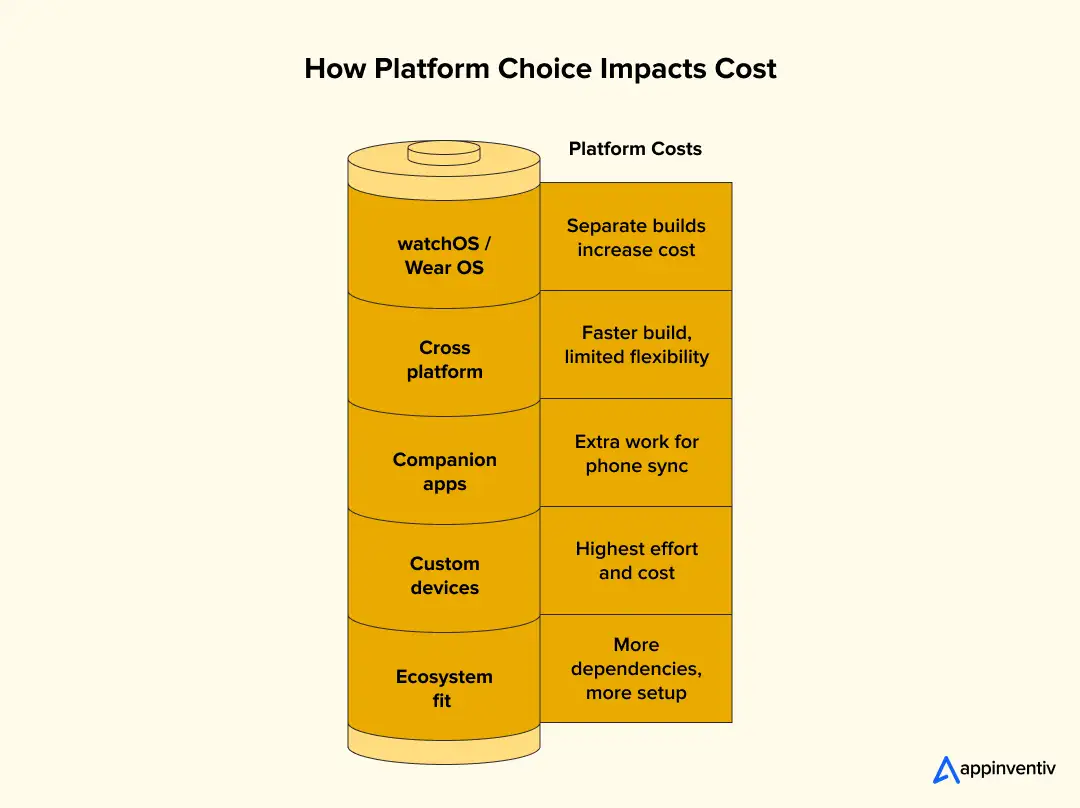
Platform choice often becomes clear once teams map where their first users will come from. Wearable smartwatch app development cost tends to be the first reference point, particularly for products starting with Apple Watch users. Others focus on Android wearables or a mix of both.
Platform Cost Overview
| Platform | Estimated Cost |
|---|---|
| watchOS (Apple Watch) | $70k – $220k |
| Wear OS (Android wearables) | $70k – $220k |
| Cross-platform (Flutter / React Native) | $100k – $260k |
| Companion apps (phone + wearable) | $120k – $300k |
| Custom device builds | $150k – $400k+ |
Native vs Cross-Platform Development
Teams that build for a single platform write separate code for each system. One version runs on watchOS. Another runs on Wear OS. This takes more time and budget, but the app fits the device well.
Some teams start with a shared codebase. This helps them release early and test the product with users. Later, they adjust parts of the app to match each device.
Bonus Read: How to Build a HIPAA-Compliant Medical Voice Assistant
Device Ecosystem Dependencies
A wearable app usually works with other systems. A watch may depend on a phone. Data may move to cloud storage or a health platform. Each link adds setup and testing work.
Impact on Cost and Performance
Platform decisions affect both cost and user experience. Apps built for a single device often run more smoothly. Shared builds reduce early effort but may need more fixes over time.
The right choice depends on how many devices the app must support and how closely it needs to connect with each one.
Cost Variation for Wearable App Development by Location
Where the team sits has a clear effect on wearable mobile app development cost. Hourly rates vary by region, which shifts the final budget even when the scope stays the same. Many companies mix internal teams with external partners to balance cost and delivery speed.
Regional Wearable App Development Cost Overview
| Region | Hourly Rate |
|---|---|
| United States | $120 – $200/hr |
| Western Europe | $90 – $150/hr |
| Eastern Europe | $50 – $100/hr |
| Australia | $30 – $70/hr |
| Middle East | $40 – $120/hr |
Teams with in-house engineers keep close control over architecture and data handling. This setup suits products that deal with sensitive data or custom device logic.
Others work with external partners to manage costs and accelerate delivery. This model helps when the product needs a quick rollout or access to specific skills.
The final cost depends on how teams split the work, how often they collaborate across time zones, and how long the product needs ongoing support.
Build vs Customize: Cost Implications for Enterprises
Teams under time pressure often look at ready-made platforms first. Custom wearable app development cost is higher at the start, but the cost picture changes once the app grows, adds devices, and handles more data. The cost picture changes once the app grows, adds devices, and handles more data.
Most enterprises building enterprise wearable apps weigh two paths when planning their apps.
Approach Comparison
| Approach | Upfront Cost | Long Term Cost | Cost Risk |
|---|---|---|---|
| Build (Custom) | Higher | More stable | Easier to manage at scale |
| Customize (Hybrid) | Medium | Can rise over time | Limits from existing systems |
Custom builds give full control over device support, data flow, and security rules. This helps once the app connects with multiple wearables or handles sensitive health data.
Pre-built or white-label options reduce early spend and speed up launch. They come with limits. As new devices, features, or integrations are added, teams may face additional work to accommodate those changes within the existing system.
The choice depends on how far the product needs to go because custom wearable app development costs offer more control over future changes, while pre-built options trade that flexibility for a faster launch.
Every delay at this stage increases future cost. Teams that make late decisions often spend more time fixing them than they would have if they had made them early.
Architecture and build decisions made now directly impact how much you spend as the product grows.

Hidden Costs of Wearable App Development
Early estimates of wearable mobile app development cost often focus on build effort alone. Costs continue after launch as devices stay active, data keeps flowing, and systems need regular updates. Planning these items early helps avoid budget gaps later.
| Hidden Cost Area | Why It Adds Cost Over Time |
|---|---|
| Cloud Infrastructure and Hosting | Continuous sensor data increases storage and compute usage |
| Device Testing and Maintenance | New devices and OS updates require repeated testing |
| DevOps and Deployment Pipelines | Monitoring, updates, and system checks run at all times |
| Security and Compliance Programs | Data protection and audits remain ongoing tasks |
| Data Processing and Storage | Large volumes of health and activity data are built over time |
| Feature Updates and Refactoring | Early design may need changes as usage grows |
Maintenance becomes a steady cost after launch. Teams need ongoing updates, performance fixes, and system checks to keep the app stable.
Planning for these costs early helps avoid gaps once the product begins to scale.
Understanding the Total Cost of Ownership (TCO)
Most cost discussions stop at the initial build, but the ROI of building a wearable app depends on the larger spend that shows up after launch, once devices stay active and data volume starts to grow.
A wearable app keeps running in the background. It collects data, syncs across devices, and stores results over time. As usage increases, systems need more storage, stronger processing, and closer monitoring.
3-Year Cost Ownership Curve
A clear TCO view separates early build effort from long-term operating cost.
- Build cost covers design, development, and initial release
- Operational cost, which mirrors app maintenance costs, includes hosting, data handling, monitoring, and security.
- Year one focuses on getting the product live
- Later years focus on keeping the system stable as usage grows
Typical TCO Behavior at Enterprise Scale
| TCO Phase | Cost Behavior Range |
|---|---|
| Year 1 (Build and Launch) | 40–50% of the total 3-year spend |
| Year 2–3 (Operate and Scale) | 50–60% of the total 3-year spend |
The pattern stays consistent. Early spending brings the product to market. Later spending supports data growth, device expansion, and system stability.
How Development Timelines Influence the Cost of Wearable App Development
Project timelines shape how spending appears during the build. The same product can cost more or less depending on how teams plan releases, testing cycles, and device support.
Common patterns seen in wearable projects include:
- Parallel teams speed up delivery but raise short-term spend
- Phased releases reduce early cost but extend the path to full features
- Device testing adds fixed checkpoints across each stage
- Late changes to architecture increase rework effort
These choices determine when and how costs appear during development.
Development Timeline Overview
| Stage | Duration |
|---|---|
| Discovery | 3–4 weeks |
| Design | 4–6 weeks |
| Development | 5–9 months |
| Testing (device + system) | 4–8 weeks |
Timeline Impact on Development Cost
| Delivery Approach | Typical Outcome | Cost Behavior |
|---|---|---|
| MVP First Rollout | Faster launch with limited features | Lower early cost, higher expansion cost later |
| Scale-Ready Build | System prepared for higher data and device load | Higher upfront spend, less rework later |
| Multi-Device Launch | Support for multiple wearables from the start | Highest early spend, smoother expansion later |
For leadership teams, the pattern is clear. Timelines change when costs appear across the project, not whether those costs exist.
Poor planning leads to rising costs in infrastructure, scaling, and data handling once usage begins.
How Appinventiv Helps Enterprises Build Scalable Wearable Applications
A wearable product does not stop at the app. It needs to stay in sync with devices, handle steady data flow, and remain stable as usage grows. These systems tend to show their real complexity after launch, not before.
That is where teams look for partners who offer wearable application development services and have worked with device-driven products in real conditions.
Appinventiv supports enterprises in shaping wearable products from the ground up. The work starts with system design, where teams map how devices, mobile apps, and backend services connect. From there, the focus shifts to handling sensor data, keeping sync reliable, and ensuring the system does not slow down as more users join.
The team also works on integrations with platforms such as Apple Health and Google Fit, as well as data handling practices that protect user information.
Wearable Capability Snapshot
- Wearable technology experts: 30+
- Wearable apps delivered: 120+
- App downloads across projects: 10M+
- Client satisfaction rate: 95%
Enterprises often choose experienced teams to avoid delays during later stages. Clear system planning and steady execution help reduce wearable app development cost, minimize rework, and keep the product stable as it expands.
Frequently Asked Questions
Q. How much does it cost to build a wearable app?
A. There is no single price tag. Some teams spend around $50,000 to release a basic version. Others cross $500,000 once the app connects to multiple devices and processes data continuously. The cost to develop a wearable tracker app is lower on the simpler end. A system that reads health signals and stores them over time takes far more work.
Q. How can you reduce the cost of wearable app development without affecting quality?
A. Start with what matters most. Many teams try to build everything at once, only to redo parts later. A smaller first release helps avoid that. Using ready-made tools for common tasks like logging in or data syncing can save weeks of work. Careful planning early often cuts more cost than any shortcut later.
Q. Does the timeline affect the cost of wearable app development?
A. Yes, mainly in how the work is spread. A short deadline means more people join the project at once, so costs rise early. A longer timeline keeps the team smaller but extends the work. The total effort does not change much, but the spending pattern does.
Q. How much does it cost to hire a wearable app development agency?
A. Rates differ a lot. Some teams charge around $25 per hour. Others charge $150 or more. The final cost depends on how long the team works and on the complexity of the app. A short project with a clear scope costs less than a long build that involves multiple devices and systems.


Fast 2-minute response, fully NDA-protected.
Sleep Tracker App Development: Features, Wearable Integration, AI, and Compliance
Key takeaways: Sleep tracking presents opportunities across consumer wellness, fitness, healthcare, employee wellness, senior care, and infant-care markets. Successful products combine actionable insights, wearable connectivity, user-friendly reports, privacy controls, and clearly differentiated experiences. HealthKit, Health Connect, and direct device APIs provide different data depths, costs, limitations, and maintenance requirements. AI supports sleep-stage estimation and personalization,…

Diet and Nutrition App Development: Process, Features, Cost, and Technology Stack
Key Takeaways Diet and nutrition tracking app development goes past basic calorie counters with verified food databases, custom meal schedules, AI tools, wearable device links, and corporate manager tools. Structure database models around raw food items, serving portions, nutrient facts, recipes, software links, and regional diet rules. Pair computer vision models, recommendation algorithms, language engines,…

eCOA Software Development Guide: Enterprise Architecture, Tech Stack, Development Process, and Cost
Key takeaways: Build an enterprise eCOA platform using cloud servers, AI tools, and compliant system design. Map the full eCOA development process, from trial workflow analysis to live system maintenance. Connect your platform with EDC, CTMS, eConsent, HL7 FHIR, and wearables to simplify trial data sharing. Compare custom software against off-the-shelf platforms to make smart…