

























How Much Does It Cost to Build a Field Service Management App?

 Share -


- 01FSM App Development Cost by Project Complexity
- 02What Factors Affect Field Service Management App Development Costs?
- 03How Much Does Each Field Service Management App Feature Cost?
- 04Custom FSM App vs Off-the-Shelf Software: Which Costs Less?
- 05How Much Do AI and Advanced Technologies Add to FSM App Costs?
- 06What Are the Hidden Costs of Building an FSM App?
- 07How to Reduce Field Service App Development Costs Without Limiting Growth
- 08How Should You Estimate the Total Cost of Ownership?
- 09How to Calculate the ROI of a Field Service Management App?
- 10What Is the Field Service Management App Development Process?
- 11Build a Field Service Management App with Appinventiv
- 12FAQs

Australian field operations cover long distances, patchy regional coverage and strict safety and privacy obligations. Many enterprises have outgrown generic scheduling tools that were never built for that reality.
Most field service management app development costs range from AUD 70,000 to AUD 700,000 or more, depending on operational complexity, integrations and security requirements.
That spread is the real problem for a CIO setting a budget. A basic application might handle job assignments and technician updates. But an advanced platform coordinates asset maintenance, connects with an ERP, supports regional teams working offline and provides intelligent scheduling.
Here we break down field service management app development cost by project complexity, feature, AI capabilities, hidden expenses and so on.
Key takeaways:
- FSM development costs typically range between AUD 70,000 and 700,000, driven mainly by project complexity.
- Start with job management, scheduling, and essential integrations before adding advanced features.
- AI native features can further drive up the cost but help you achieve measurable outcomes faster.
- Include hosting, third-party services, maintenance, security updates, and future enhancements in your budget.
Identify workflow gaps, integration requirements and the right investment for your field service platform.

FSM App Development Cost by Project Complexity
On average, field service app development costs fall between AUD 70,000 and 700,000, with timelines of 3 – 14+ months. Cost basically moves in three tiers defined by integration depth, offline capability and AI scope.
| Tier | Typical scope | Timeline | Indicative cost (AUD) |
|---|---|---|---|
| Foundation / MVP | Work orders, scheduling, mobile app, basic reporting | 3-4 months | 70,000-150,000 |
| Mid-market | Plus integrations, offline mode, asset history, customer portal | 5-8 months | 150,000-350,000 |
| Enterprise-grade | Plus AI dispatch, IoT, multi-entity, Essential Eight alignment, SLAs | 9-14 months | 350,000-700,000 |
The above ranges are indicative planning estimates, not fixed quotations. Actual costs depend on the delivery team’s location, project scope and technical constraints.
What Factors Affect Field Service Management App Development Costs?
Two FSM projects with similar feature lists can have substantially different budgets. The difference usually lies in operational rules, legacy systems and the conditions under which technicians work. Understanding these factors helps you distinguish essential investment from avoidable complexity before development begins.
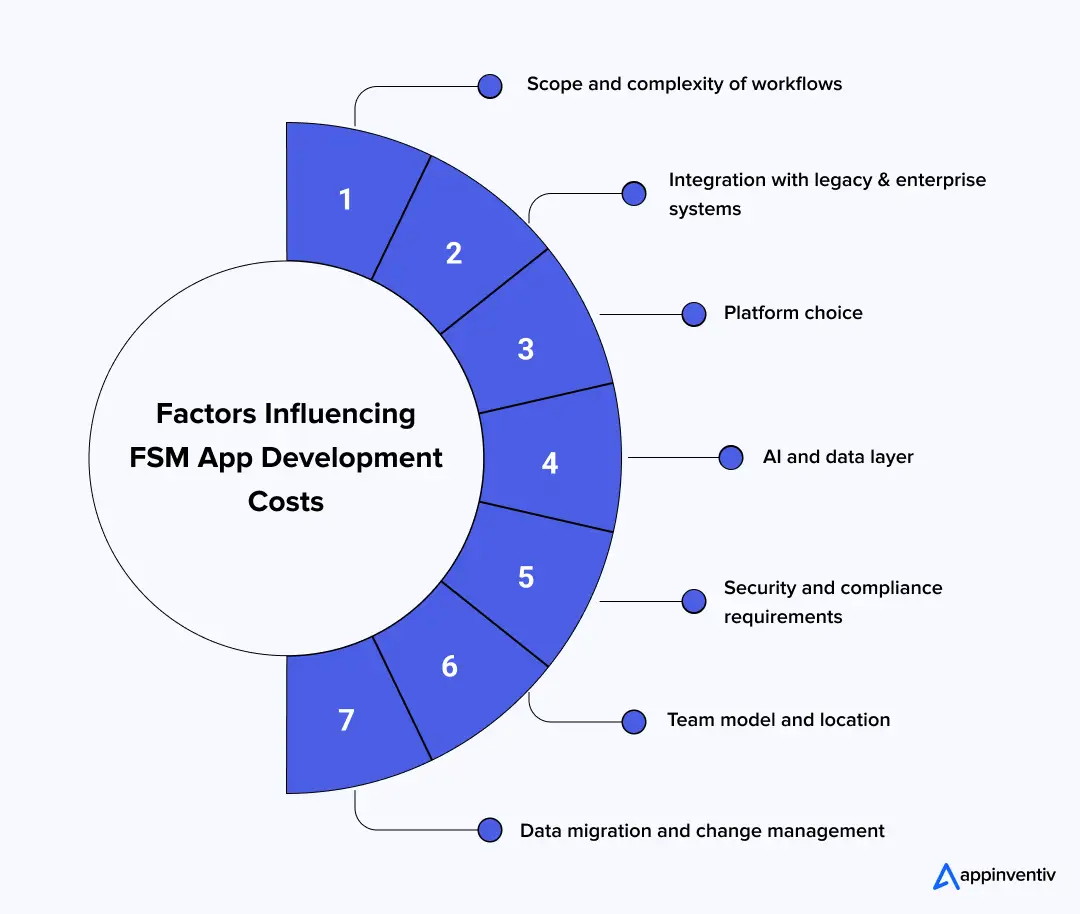
Scope and complexity of workflows
Apps managing routine service jobs cost less than platforms handling emergency dispatch, maintenance contracts, complex approvals, and service-level agreements across multiple sites.
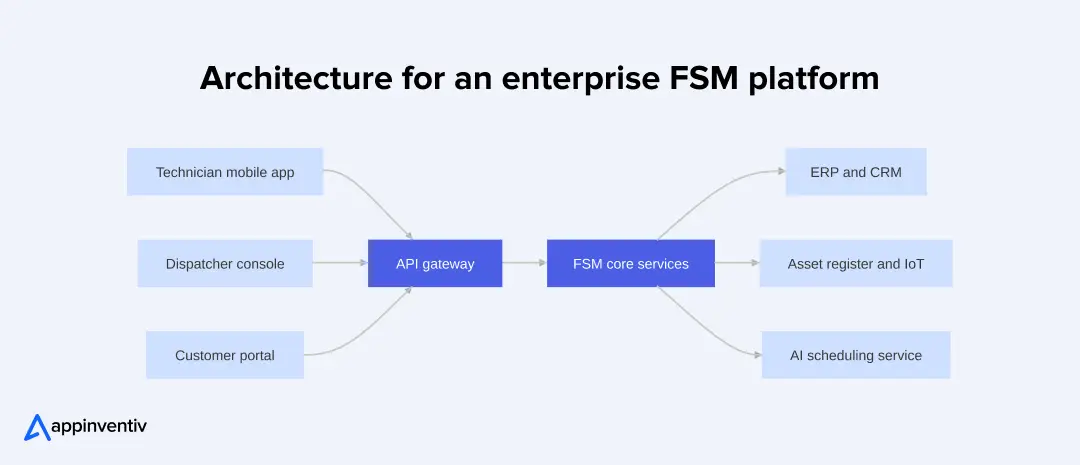
Integration with legacy and enterprise systems
Connecting to SAP, Dynamics 365, Salesforce or an old asset register can cost more than the mobile app itself, particularly where APIs are missing or undocumented.
Platform choice: Native vs cross-platform
Native iOS and Android apps require separate development. Cross-platform solutions can reduce duplicated work, while web dashboards and customer portals add design and testing requirements.
Offline access and regional connectivity
Technicians working in regional Australia or remote industrial locations may need to access job details without reliable connectivity. Offline storage, synchronisation and conflict resolution add development and testing effort.
Security and compliance
Features such as secure logins, access controls, audit logs, and security testing add to the budget. Applicable APPs, Essential Eight and industry-specific obligations can further add to the costs.
AI and data readiness
AI-assisted scheduling and predictive maintenance require suitable data, integration and ongoing monitoring. Introducing these capabilities before core operational data is reliable can increase costs without delivering meaningful value.
Team model and location
A local team may offer easier communication and stakeholder access but can cost more. Offshore teams lower rates but add coordination load. A hybrid model is often the practical choice.
Data migration and change management
Moving existing customer, asset, and job records takes time, especially when data is incomplete or inconsistent. Staff training and rollout support add to the overall cost.
How Much Does Each Field Service Management App Feature Cost?
Feature-level estimates help you understand where your budget may go, where you can cut cost and the investment is non-negotiable.
| Feature | Indicative cost allowance (AUD) | What it covers |
|---|---|---|
| Job and work order management | 8,000–20,000 | Job creation, assignment, status updates, and work records |
| Scheduling and dispatch | 12,000–30,000 | Technician availability, job allocation, and schedule changes |
| GPS and route planning | 8,000–25,000 | Location tracking or mapping and route support |
| Customer records and notifications | 5,000–15,000 | Customer details, appointment updates, and notifications |
| Asset and maintenance management | 10,000–30,000 | Asset histories, service records, and maintenance schedules |
| Offline functionality | 10,000–25,000 | Local data access and synchronisation after reconnection |
| Reporting and analytics | 8,000–25,000 | Operational reports, performance indicators, and dashboards |
| AI scheduling and recommendations | 15,000–50,000+ | Predictive suggestions, optimisation, and more advanced decision support |
Custom FSM App vs Off-the-Shelf Software: Which Costs Less?
Off-the-shelf software costs less to start. Custom development can cost less over time once licences, per-user fees and workarounds accumulate across a large field workforce. The answer depends on how far your processes deviate from a vendor’s model and how much control you need over data and integrations. So, when making a choice, you need to evaluate some key aspects between both:
| Consideration | Off-the-shelf FSM software | Custom field service app |
|---|---|---|
| Initial investment | Usually lower | Usually higher |
| Deployment | Often faster | Depends on scope and complexity |
| Pricing | Commonly subscription-based | Development cost plus ongoing operating costs |
| Workflow flexibility | Limited to available features and configuration | Can be designed around specific business processes |
| Integrations | Depends on supported connectors and APIs | Can be built around required systems |
| Ownership | Governed by the vendor’s terms | Greater control over the developed solution, subject to contract and IP terms |
| Ongoing costs | Subscriptions, add-ons, and vendor charges | Hosting, maintenance, support, and future development |
When does off-the-shelf make sense?
When workflows follow standard patterns, the workforce is modest and speed matters more than differentiation.
When is custom development worth considering?
When you have complex service agreements, specialist asset requirements, established ERP or CRM systems, or workflows that standard products cannot support.
The decision should account for the total cost of ownership. Compare subscription and configuration costs with custom development, integration, maintenance, and future change costs over the same period.
How Much Do AI and Advanced Technologies Add to FSM App Costs?
AI scheduling, predictive maintenance and IoT integrations increase development costs because they require additional data pipelines, integration work, testing and ongoing monitoring. The final price depends on the features you choose, the quality of your existing data, and the systems the app needs to connect with.
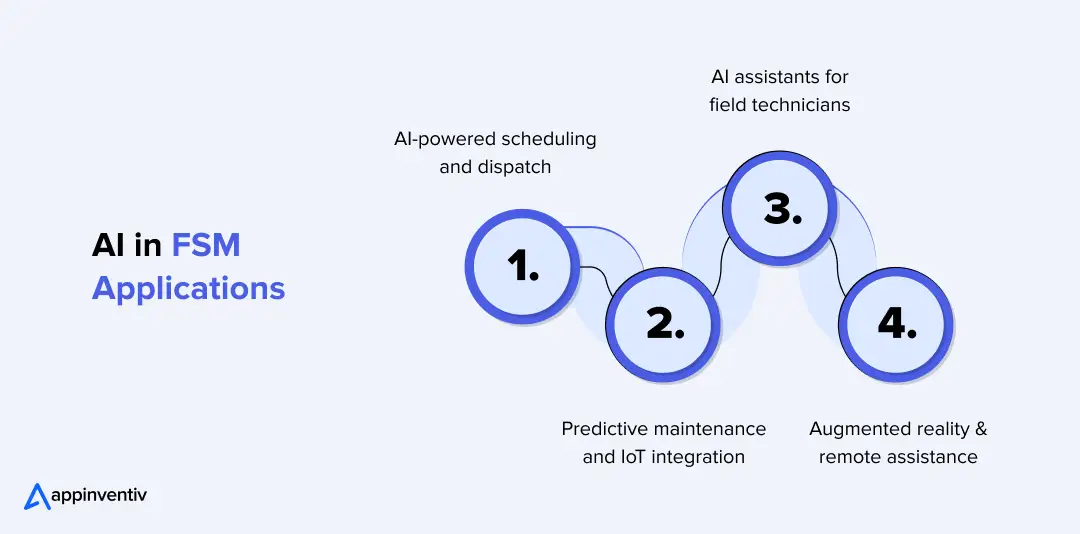
AI-powered scheduling and dispatch
AI implementation can recommend which technician should handle a job based on availability, location, skills, and job priority. The cost depends on how many constraints the system must consider and how frequently schedules change.
As per a McKinsey 2026 report, a water treatment company raised its technician capacity by 40 per cent and cut overtime by 6 per cent with AI-enabled scheduling
Predictive maintenance and IoT integration
Connecting equipment sensors to the app can help identify unusual performance and flag possible maintenance needs. Costs increase when the systems collect data from different devices, analyse equipment trends, and connect alerts to maintenance workflows.
AI assistants for field technicians
An AI assistant can help technicians find service manuals, review asset histories, and access troubleshooting guidance while on-site. Development costs depend on the data sources, assistant’s capabilities, and the controls needed to protect business information.
Augmented reality and remote assistance
Video, image analysis, or augmented reality features can display repair instructions over a live view of equipment, while remote assistance lets technicians consult specialists. These features may require compatible devices, video capabilities, and additional software integration, increasing development and testing costs.
What Are the Hidden Costs of Building an FSM App?
Development is only one part of the total cost. Hosting, licences, maintenance, security testing, training, cloud and API usage, and integration upkeep continue after go-live. Planning for these cost drivers early avoids mid-year budget requests. So, when evaluating field service management app development cost, you must account for the following costs:
- Hosting and infrastructure: Cloud services, storage, backups, monitoring, and data transfer.
- Third-party services: Mapping, messaging, identity verification, analytics, and other paid APIs.
- Maintenance and support: Bug fixes, operating system updates, security patches, and technical support.
- Data migration: Cleaning, mapping, and transferring customer, asset, employee, and job records.
- Training and rollout: User training, internal communications, process changes, and deployment support.
- Future enhancements: New workflows, additional integrations, reporting changes, and new business requirements.
The exact amount will depend on the application, usage levels, service agreements, and internal support capacity. Ask your mobile app development company in Australia to separate one-off delivery costs from recurring expenses.
How to Reduce Field Service App Development Costs Without Limiting Growth
The goal is to control unnecessary spending without creating a system that becomes difficult or expensive to extend. A clear first release, sound architecture, and early testing of key integrations can reduce rework while leaving room for new requirements as the operation grows.
- Start with high-priority workflows: Build the five job types causing most repeat visits or delays first.
- Develop an MVP with a clear expansion plan: Define hooks for scheduling intelligence, portals and IoT now, so later phases extend the data model.
- Reuse existing systems where practical: Keep your ERP, identity provider and mapping services, and integrate rather than rebuilding what already works.
- Choose the mobile architecture based on operational needs: Cross-platform development may suit most teams. Plan offline access early for regional crews to avoid costly changes later.
- Check integrations before full development: Check connections with ERP and CRM systems in test environments before finalising the development scope and price.
How Should You Estimate the Total Cost of Ownership?
Use a three- to five-year view rather than comparing projects only by their initial price.
Total cost of ownership (TCO) = Initial development + Hosting and licences + Maintenance and support + Training and rollout + Future enhancements
For a custom solution, also clarify who owns the source code, what documentation will be provided, and what it would take to move the application to another support provider.
We can build a TCO model that gives a clearer picture of hosting, maintenance, and ongoing support, besides your initial development estimate.
How to Calculate the ROI of a Field Service Management App?
A field service app can create value by reducing avoidable administration, travel, repeat visits, scheduling delays, and equipment downtime. The actual return depends on how your teams work today, which problems the app addresses, and whether staff adopt the new process.
Let’s consider a hypothetical operation with 50 technicians.
If the app saves each technician two hours per week, across 46 working weeks, at an assumed labour cost of AUD 55 per hour, the potential annual labour capacity value is:
50 technicians × 2 hours × 46 weeks × AUD 55 = AUD 253,000 per year
The value represents time that may become available for other work. Other potential benefits include:
- Fewer repeat visits caused by incomplete job information.
- Less time spent on manual scheduling and reporting.
- Better visibility into technician availability and job progress.
- Faster access to asset histories and maintenance records.
- More accurate service records and invoicing.
- Better tracking of service-level agreements.
How do you calculate payback?
A simple payback calculation is:
Payback period = Initial investment ÷ Net monthly benefit
For example, a AUD 200,000 project with a verified net benefit of AUD 20,000 per month would have a simple payback period of 10 months.
Which KPIs should you track?
Track a small set of relevant measures before and after launch, such as first-time fix rate, repeat visits, jobs per technician per day, travel time per job, schedule adherence, time to invoice and unplanned asset downtime.
What Is the Field Service Management App Development Process?
A production-ready platform moves through seven stages, and each stage involves a substantial investment. Cost shares below are indicative percentages of the initial build budget.
| Development stage | Key activities | Typical cost share |
|---|---|---|
| Discovery and planning | Workflow mapping, success metrics | 5-8% |
| UX/UI design | User journeys | 8-10% |
| Architecture and integration planning | System, API and security design | 8-12% |
| Development | App, backend, integrations | 40-50% |
| Testing and validation | Offline, load, security tests | 12-15% |
| Deployment | Pilot, rollout, training | 4-6% |
| Ongoing optimisation | Maintenance, enhancements | 15-20% of build per year |
Build a Field Service Management App with Appinventiv
Evaluating field service management app development cost starts with understanding how your teams work, where delays occur, and which systems need to connect. That is how we approach FSM app development, with a focus on your operational priorities, integration needs, and long-term plans.
Our credentials include ISO 27001, ISO 9001, and SOC 2, alongside participation in Queensland Government ICTSS and Local Buy procurement panels. These reflect our focus on structured delivery, quality management, and information security.
With 11+ years of APAC delivery experience, we have delivered over 3,000 digital assets across 35+ industries, including mining, logistics, manufacturing, and other sectors where field teams, asset performance, and timely service matter.
Our portfolio also includes an OT/IT platform for mining operators, reflecting our experience with complex operational systems relevant to field service management.
Planning a field service platform?
Let’s discuss your workflows, integration needs, and development budget.
FAQs
Q. How much does it cost to build a field service management app in Australia?
A. On average, field service management app development costs fall between AUD 70,000 and AUD 700,000. The cost varies, depending mainly on integrations, offline needs and compliance scope.
Q. How long does it take to develop a field service management app?
A. A foundation-level app may take 3 – 4 months, a mid-market solution often takes 5 – 8 months, and a complex enterprise platform often takes 9 – 14+ months. These timelines are indicative. Integration challenges, data migration, changing requirements, and delays in stakeholder decisions can affect delivery.
Q. What features should a field service management app include?
A. Core features of a FSM platform often include job and work order management, scheduling, technician profiles, customer and asset records, work completion forms, notifications, and reporting. Businesses operating in areas with unreliable connectivity may also need offline access. Advanced scheduling, predictive maintenance, and AI assistants can be added when there is a clear business case.
Q. Is custom field service software better than off-the-shelf software?
A. Not always. Off-the-shelf software may suit businesses with standard workflows and straightforward requirements. Custom development may be a better fit when the operation requires specialist workflows, complex integrations, or greater control over the product. Compare the total cost of ownership and operational fit before deciding.
Q. How much does it cost to maintain a field service management app?
A. A planning allowance of 15 to 20% of build cost per year is common, covering hosting, support and updates. However, maintenance costs vary with application complexity, hosting needs, third-party services, support arrangements, and the frequency of updates. Ask vendors to state maintenance scope in the estimate.
Q. Can AI reduce field service management costs?
A. AI helps reduce manual scheduling work, improve job allocation, identify maintenance risks, and give technicians faster access to service information. Results depend on data quality, system integration, and user adoption. AI also introduces costs for implementation, testing, monitoring, and service usage, so each capability should be assessed against a measurable business need.


Fast 2-minute response, fully NDA-protected.

How Much Does It Cost to Develop a Remote Patient Monitoring App in the UAE?
Key takeaways: Feature scope and system integrations, not the app itself, determine your final development cost. DHA, DOH, and MOHAP compliance must be built into your architecture from day one. Wearables, EHRs, and health information exchanges are the biggest technical cost drivers. A successful RPM platform combines continuous monitoring, clinical workflows, and secure interoperability. Early…

How Much Does It Cost to Develop an App Like Herfy in 2026?
Key takeaways: Herfy-like app development costs SAR 150,000 to SAR 1,500,000 ($40,000 to $400,000). Costs rise with rider tracking, POS sync, kitchen displays, loyalty, and branch controls. Saudi apps need Arabic UX, Mada, STC Pay, VAT, and ZATCA-ready invoice flows. Peak loads during Ramadan, Eid, and weekends need strong backend and load testing. A phased…

Key takeaways: The operating model determines survival. The code does not. Compliance under PDPL in the UAE and SDAIA in Saudi Arabia must be engineered into architecture, not added before launch. A serious build costs between AED 147,000 and AED 1,470,000 (USD 40,000 to USD 400,000), depending on scope. The single largest cost most operators…