








Restaurant App Development: Growth Lessons from KFC, Pizza Hut, and Domino’s

 Share -


- 01What Are the Business Benefits of Restaurant Mobile App Development?
- 023 Restaurant App Development Case Studies: KFC, Pizza Hut, and Domino’s
- 03What These Three Restaurant App Examples Reveal About Digital Success
- 04Some Must Have Features of a Restaurant Mobile App
- 05Advanced Restaurant App Features That Support Growth
- 06How to Develop a Restaurant App for an Enterprise Business
- 07Restaurant App Development Challenges and Strategies to Overcome Them
- 08What Is the Cost of Restaurant App Development?
- 09How Appinventiv Builds Restaurant Apps for Long-Term Growth
- 10FAQs



Here is a number most restaurant CFOs already know and almost nobody says out loud. On a $40 order placed through a marketplace, as much as $12 never reaches the business. The customer is yours. The food is yours. The margin belongs to someone else.
That arithmetic is why restaurant app development is now a board conversation. With 42% of US operators telling the National Restaurant Association they made no profit in 2025, and marketplace commissions hitting 30%, you cannot cost-cut your way across that gap. You must own the ordering channel.
In the current QSR landscape, food quality alone no longer guarantees enterprise survival. Customers expect fast, frictionless mobile ordering, accurate delivery estimates, and reliable checkout experience. Every failure risks churn. Third-party aggregators offer reach, but often at the cost of margins, customer ownership, and kitchen efficiency.
Large food chains like KFC, Pizza Hut, and Domino’s have tackled these challenges through different digital strategies. We’ve built ordering platforms for them. Three brands, three very different problems, three sets of numbers that moved. Here’s what worked, what it cost, and what matters before you invest.
Key Takeaways
- Restaurant apps create business value when they improve ordering, retention, and operational performance together.
- KFC, Pizza Hut, and Domino’s demonstrate different approaches to direct ordering, usability, and conversion.
- POS integration, kitchen capacity, and menu accuracy are essential to reliable restaurant app experiences.
- AI can improve personalization and forecasting when supported by reliable data and clear business objectives.
What Are the Business Benefits of Restaurant Mobile App Development?
A restaurant-owned application can create a direct relationship between the brand and its customers while giving the business greater control over ordering, promotions, and service experience. Some other reasons you must consider building a restaurant app are:
- Greater customer ownership: Direct ordering gives restaurants more control over customer relationships, preferences, and communication.
- Reduced aggregator dependency: An owned channel creates another revenue route and reduces reliance on third-party ordering platforms.
- Customer behavior insights: First-party data helps identify ordering frequency, popular products, and customer preferences.
- Operational coordination: Connected ordering systems can synchronize restaurant teams, delivery partners, and customer notifications.
- New revenue opportunities: Restaurant loyalty programs, bundles, subscriptions, and personalized promotions can encourage additional purchases.
- Expanded customer reach: Digital ordering allows restaurants to serve customers beyond traditional in-store interactions.
- Lower entry barriers: Cloud infrastructure and modular development make digital ordering more accessible to businesses of different sizes.
- Personalized experiences: Relevant recommendations and offers can improve customer satisfaction without overwhelming users.
- Higher engagement: Reordering, loyalty rewards, and order updates give customers reasons to return.
- Predictive analytics: Historical data can support AI powered demand forecasting, inventory planning, and staffing decisions.
Remember, a restaurant app does not automatically replace marketplace reach on day one. And if you assume it, you will most likely lose volume during the switch. Aggregators are genuinely good at discovery. Keep them for that. Just stop paying discovery prices for people who already know your name.
3 Restaurant App Development Case Studies: KFC, Pizza Hut, and Domino’s
Three programs, three completely different problems. KFC focused on expanding direct ordering across multiple markets. Pizza Hut addressed usability and scalability. Domino’s concentrated on simplifying an established customer journey. Together, these projects demonstrate why mobile app development for restaurants should begin with your business-specific problems.
KFC Case Study: From 90% Aggregator Dependence to Under 50%
KFC, a leading fast-food company with a global presence in 150+ countries, operates under Americana Group in the Middle East and is the world’s second-largest restaurant chain by sales.
Challenges Faced by KFC
- Nearly 90% of KFC’s total orders were arriving through aggregator apps, leaving the brand dependent on third-party platforms.
- That concentration raised operational costs and put the brand’s digital image largely in someone else’s hands.
- KFC’s own platform began collecting negative reviews, most of them tied to poor user experience.
KFC had a vision to develop seven mobile applications within a year across the UAE, KSA, Kuwait, Egypt, Qatar, Bahrain and Oman.
Our App Development Approach
We developed seven localized KFC mobile applications as part of Americana Group’s broader initiative to launch 18 applications across five brands. Our approach included:
- Personalized customer experiences, including order history and multiple payment gateway options.
- Multiple ordering modes, including delivery, self-pickup, drive-thru, dine-in, and carhop.
- QR-based ordering for in-restaurant customers.
- Advanced analytics to help administrators monitor application performance.
- A Build, Operate, Optimize, Transfer (BOOT) delivery model.
Our app experts first established a foundation with one KFC app, then extended the solution across additional markets. Localization helped address market-specific requirements without starting each application from scratch.
Results and Impact?
- 22% increase in conversion rate
- 4.5 average rating on the Google Play Store and App Store
- 50%+ of the total orders coming through the app
- 60%+ increase in repeat purchases across channels
- Highest customer lifetime value across all order modes
- Reduced resilience on aggregator apps from 90% to 50%
- 30,000+ orders filled through the app per day.
Key Takeaways for Business
Direct ordering becomes lucrative when the owned channel offers a better experience than the aggregators. Give customers a reason to choose your application: convenient ordering modes, relevant personalization and service they can rely on.
Pizza Hut Case Study: A 30% Conversion Lift That Started Seven Seconds Deep
Pizza Hut, one of the largest multinational restaurant chains, operates 19,000 restaurants worldwide as of 2026.
Challenges Faced by Pizza Hut
- The existing app had no extensible or scalable architecture, and the user experience suffered as a direct result.
- Large menu datasets across several countries slowed screen transitions enough that users left before reaching checkout.
- Operational issues at the start of the project, rooted in product management and the legacy system, held back early progress.
Pizza Hut needed an application that was not only fully functional but genuinely engaging, built to serve four markets: the UAE, Egypt, Bahrain and KSA.
Our App Development Approach
We delivered two Pizza Hut applications within the same Americana program. The approach included:
- A product discovery workshop to settle scope before any build work began.
- Extensive research and wireframing to establish structure and architecture ahead of interface design.
- User journey mapping to shape navigation around how customers actually order.
- Backend and architecture development built to carry large, multi-country menu data.
- Quality testing and post-launch maintenance as continuing work, with regular performance and consistency checks.
Fixing the foundation first is what allowed the interface improvements to hold up under real traffic.
Results and Impact?
- 50K app downloads
- 30% increase in conversion rates
- 7 seconds increase in screen transition time
Key Takeaways for Business
What presents as a design problem is frequently an architecture problem. Visual polish cannot rescue a slow screen. If transition times are measured in whole seconds, fix the layer underneath before spending on the one customers can see.
Domino’s Case Study: A 23% Conversion Lift Without a Full Redesign
Domino’s brings one of the world’s most loved pizza brands to customers on demand, through Android and iOS applications that let people order from their local store in minutes.
Challenges Faced by Domino’s
- Conversion was falling across both app and website, with bounce rates rising and no identifiable cause.
- Customer reviews had shifted from food and delivery times to the ordering experience itself.
- A complex user journey was obstructing checkout, with smaller issues such as location fetching making it worse.
- Users were already habituated to the existing UI/UX design, so an app-wide redesign carried real brand risk.
Our App Development Approach
We began with diagnosis rather than design. The approach included:
- Reading customer reviews at volume, then working through the app exactly as a user would.
- Pinpointing the design system as the root cause behind the complex ordering flow.
- A milestone-based design strategy, changing only the parts of the journey that were failing.
- A mood board and style guide to keep branding consistent across every screen.
- Rebuilt ordering features: category sorting, order customization, nearest-store lookup, in-app payment and real-time delivery tracking.
Targeting specific screens rather than the whole application protected the brand identity customers already trusted.
Results and Impact?
- 23% increase in conversion rate
- Measurable improvement in user sentiment across ratings and reviews
- Users shifting from abandoning the app to placing and tracking orders within it
Key Takeaways for Business
App modernization decisions should be guided by customer behavior, not assumptions about what looks modern. Businesses should identify the screens and interactions that create friction, then improve them without disrupting useful customer habits.
What These Three Restaurant App Examples Reveal About Digital Success
The three projects highlight a common principle: digital ordering performance depends on how technology supports customer behavior and restaurant operations. KFC prioritized direct ordering, Pizza Hut addressed usability and scalability, and Domino’s simplified an established journey. Enterprise leaders can apply these lessons when deciding where to invest in restaurant app development.
Customer Experience Directly Influences Conversion
Customers abandon orders when navigation, customization, or checkout becomes complicated. Simplifying these journeys reduces friction, encourages completed purchases, and improves conversion without requiring additional marketing investment.
First-Party Ordering Channels Create Greater Business Control
Restaurant-owned apps provide direct access to customer relationships, ordering data, and promotions. You can reduce aggregator dependency while strengthening loyalty through personalized experiences and convenient repeat ordering.
Analytics and Optimization Support Long-Term Growth
Conversion rates, repeat purchases, and customer feedback reveal where applications underperform. Data analytics helps businesses prioritize improvements, while AI can support forecasting and personalization when reliable data is available.
Localization Matters for Global Restaurant Apps
Global restaurant brands must adapt applications to local languages, payment methods, menus, and delivery expectations. A shared architecture with market-specific configurations supports expansion without rebuilding everything.
Scalability Must Be Built Into the Architecture
Restaurant applications must handle promotional surges, seasonal spikes, and geographic expansion without disrupting orders. Scalable infrastructure and reliable integrations help maintain performance as transaction volumes increase.
Some Must Have Features of a Restaurant Mobile App
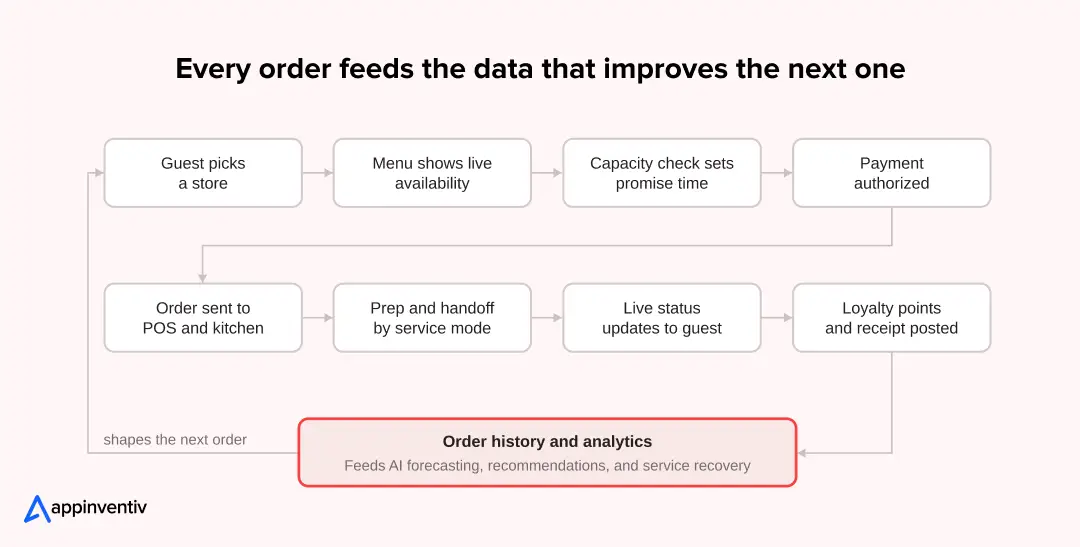
The baseline feature set for a restaurant mobile app is well established: accurate menus, structured customization, transparent pricing, flexible fulfillment, secure payments, live tracking, reordering, and loyalty. What separates successful apps is how tightly each feature is tied to store data, so that what customers see matches what kitchens can deliver.
We have covered the essential features in detail, including how to phase them across releases, in our guide to 22 must-have restaurant mobile app features.
Advanced Restaurant App Features That Support Growth
Advanced and AI powered capabilities of a restaurant application can improve personalization, operational planning, and customer engagement. Their value depends on reliable data, integration with existing restaurant systems, and clear business objectives.
AI-Driven Recommendation Engines
AI and ML models embedded within the checkout flow analyze item combinations, local weather conditions, time of day, and past ordering habits to present intelligent, personalized add-on suggestions. For example, suggesting a side item or beverage based on real-time cart contents increases Average Order Value (AOV) by nearly 12% to 18% without adding friction to the user experience.
Kitchen-Capacity-Aware Order Pacing
Sending a high volume of digital orders directly to a busy kitchen during peak hours can overwhelm kitchen staff, leading to long wait times and cold food. Modern app platforms feature dynamic order pacing algorithms that evaluate current Kitchen Display System (KDS) load. If prep times breach target thresholds, the application automatically adjusts estimated pickup times or throttles order intake, ensuring food quality and delivery accuracy remain uncompromised.
Omni-Channel Identity and Unified Loyalty Integration
Enterprise customers interact with brands across multiple touchpoints, including mobile apps, web browsers, drive-thru lanes, and self-service kiosks. A unified identity management system uses single sign-on (SSO) infrastructure to ensure customer profiles, loyalty points, and saved payment methods sync seamlessly across all channels. This visibility gives brands a complete view of guest behavior across both digital and in-person visits.
How to Develop a Restaurant App for an Enterprise Business
Restaurant mobile app development process starts with business and operational requirements. A structured process helps align customer experience, restaurant workflows, integrations, and scalability.
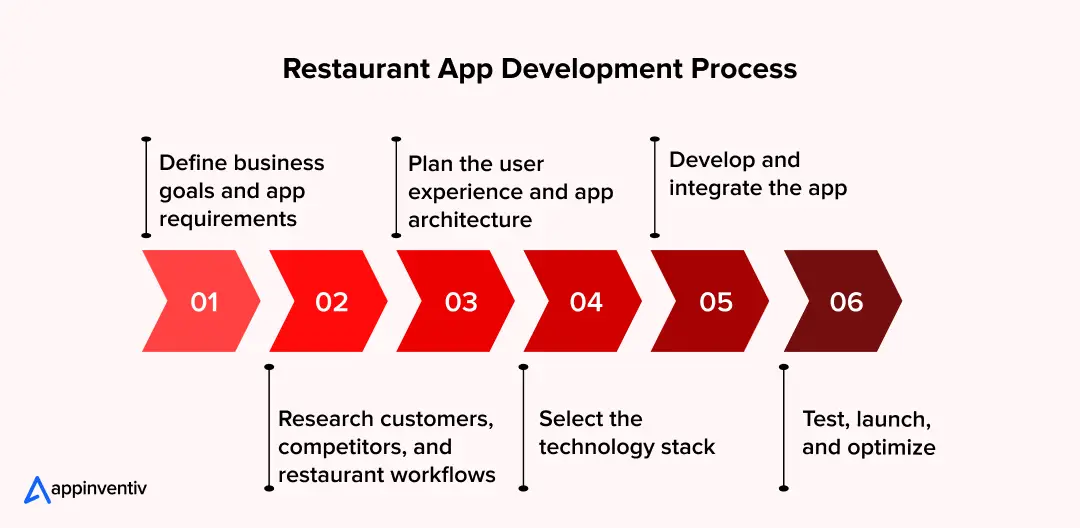
1. Define business goals and app requirements
Start with the number the app must move. For KFC it was the share of orders flowing through aggregators. For Domino’s it was conversion. Pick one or two primary metrics, record a baseline, and let them decide what goes into the first release. Requirements that do not move those metrics wait for a later phase.
2. Research customers, competitors, and restaurant workflows
Read your own app store reviews before commissioning new research. For Domino’s, they were the fastest diagnosis available. Then spend time in stores during a rush. Watch how orders reach the kitchen display, how drivers collect them, and where staff re-key orders by hand. Those observations will shape requirements more than any competitor feature list.
3. Plan the user experience and app architecture
Design UX and architecture together. Pizza Hut’s slow screens were an architecture problem that customers experienced as a design problem. For most food chains we recommend an orchestration layer between the app and back-office systems, so the app never talks directly to each POS, payment provider, or delivery partner. Swapping a vendor then becomes a contained change.
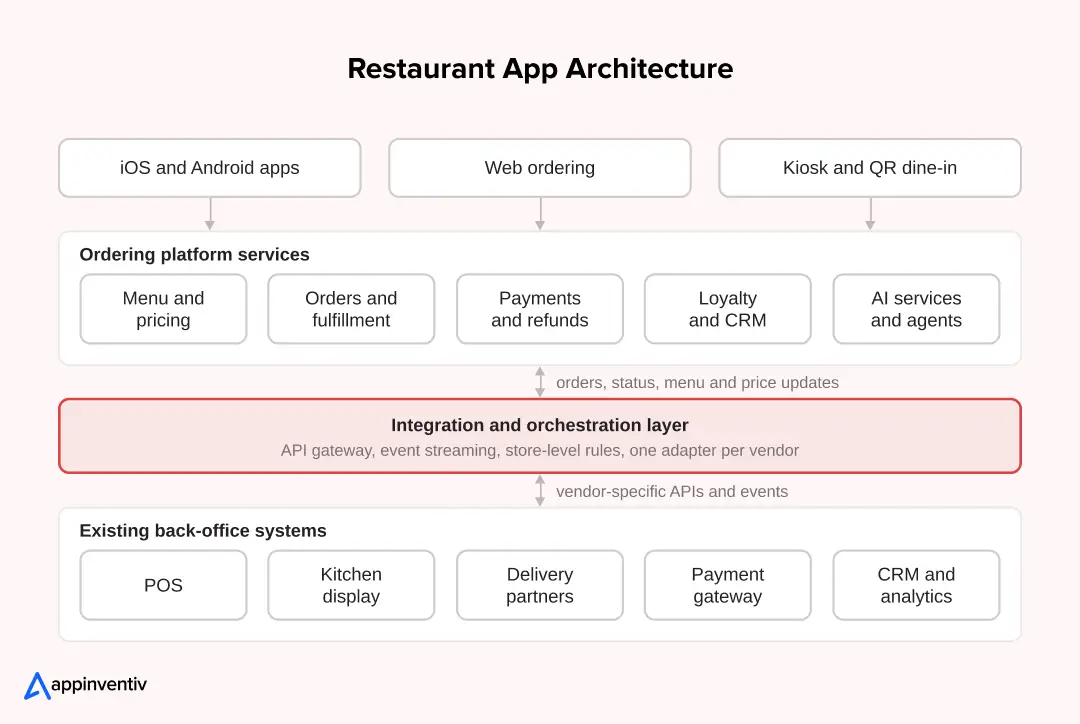
Each vendor connects through its own adapter in the integration layer, so replacing a POS or delivery partner does not touch the customer app.
4. Select the technology stack
Choose the tech stack for the integrations and peak load you actually have. Cross-platform frameworks such as Flutter or React Native suit most ordering apps; fully native builds make sense where device features or performance needs justify two codebases. On the backend, event streaming helps keep order status, kitchen updates, and notifications in sync. KFC’s build used Kafka Streams for exactly this kind of flow.
5. Develop and integrate the app
Integration is where enterprise timelines slip. Get POS, payment, loyalty, and delivery partner APIs into a test environment in the first sprints, loaded with real menu data from several stores, including the messy ones. Work in short cycles and demo each one to store operations as well as the product team.
6. Test, launch, and optimize
Load-test the app against your busiest day. For many US chains that means a national promotion or a major sporting event. Launch in a limited set of markets first, as KFC did, then expand from a proven template. After launch, review conversion, abandonment, and order defects every sprint, and remove features that do not earn their place.
Restaurant App Development Challenges and Strategies to Overcome Them
Restaurant apps often fail to deliver business value when customer-facing features are disconnected from restaurant operations. You need to address integration, data consistency, scalability, and adoption early.
| Operational Challenge | Recommended Approach |
|---|---|
| Legacy POS Integration | Build decoupled middleware API layers that abstract backend complexity, using edge-caching to sync store menus and orders reliably. |
| Inconsistent Multi-Store Menus | Implement a centralized content management engine that maintains global core menus while giving store managers authorized control over local item availability. |
| Peak-Hour Order Delays | Connect digital order intake to real-time Kitchen Display System (KDS) prep capacity, automatically adjusting fulfillment ETAs during sudden rushes. |
| Fragmented Customer Data | Unify online ordering, in-store sales, and loyalty channels into a central Customer Data Platform (CDP) under strict data governance and privacy policies. |
| App Adoption and Retention | Simplify checkout flows to fewer taps, integrate native digital wallets, and deliver contextual, value-add rewards based on user order history. |
| Multi-Market Expansion | Architect modular microservices that support internationalized dynamic UI layouts, multi-currency engines, and localized tax configurations. |
| Data Security and PCI Compliance | Implement end-to-end tokenized payments, encrypt sensitive payload data at rest and in transit, and mandate rigorous role-based access control (RBAC). |
Assess your POS, loyalty, payment, and ordering systems before disconnected workflows become a barrier to growth.
What Is the Cost of Restaurant App Development?
On average restaurant app development cost ranges between $40,000 and $500,000 or more. However, this is just a rough estimate. The actual cost varies, depending on integrations, feature complexity, locations, and real-time requirements.
| Scope | Typical capabilities | Estimated cost |
|---|---|---|
| Basic | Digital menu, store information, reservations, basic accounts, simple admin panel | $40,000 to $100,000+ |
| Moderate | Online ordering, payments, push notifications, order tracking, customer profiles | $100,000 to $200,000+ |
| Advanced | Multi-location support, loyalty, delivery tracking, POS integration, analytics, personalization | $200,000 to $350,000+ |
| Enterprise | Multiple integrations, real-time delivery management, AI features, scalable cloud infrastructure | $350,000 to $500,000+ |
Ranges are planning estimates from our restaurant app development cost breakdown, not quotes. Your number depends on scope, platforms, and where the team sits.
How Appinventiv Builds Restaurant Apps for Long-Term Growth
Restaurant mobile app development requires more than mobile engineering. It calls for an in-depth understanding of ordering behavior, restaurant operations, integration requirements, and the commercial goals behind the product.
Appinventiv, with 11+ years of industry experience, designs and develops secure and scalable restaurant applications. Our custom restaurant app development services bring together product strategy, customer journey design, integration planning, engineering, and ongoing optimization.
Our team of 1700+ tech experts brings hands-on expertise to complex restaurant technology challenges:
- Proven Scale: Our restaurant mobile app builder delivered over 200 food delivery and restaurant platforms handling millions of orders while maintaining 99.90% uptime SLAs.
- Operational Optimization: Custom backend app architectures have helped enterprise clients achieve up to a 40% reduction in operational and order-processing costs.
- Global Reach: Engineered multi-tenant, localized application architectures active across more than 20 countries, adapting seamlessly to regional payment, tax, and language requirements.
- End-to-End Delivery: Comprehensive engineering capabilities encompassing legacy POS integration, KDS orchestration, real-time delivery telemetry, and cloud infrastructure management.
Building or modernizing a restaurant app? Let’s discuss the operational challenges, customer experience goals, and technology decisions behind your next phase of growth.
FAQs
Q. How much does it cost to develop a restaurant app?
A. Restaurant app development cost typically runs from about $40,000 for a basic app to $500,000 or more for an enterprise platform. Integrations, the number of locations, real-time tracking, and AI features drive most of the difference. Budget roughly 15% to 25% of the total development cost each year for maintenance.
Q. What features are essential for a scalable restaurant mobile app?
A. Essential features include clear dynamic menu interfaces, fast payment processing, real-time order tracking, integrated loyalty programs, personalized upsell recommendation engines, and seamless Kitchen Display System (KDS) integration.
Q. How long does it take to develop an enterprise-grade restaurant app?
A. Building a restaurant platform typically takes 4 to 12+ months. Timeline variations depend on backend complexity, legacy POS integration scope, system architecture design, and required QA security compliance cycles.
Q. How to create a restaurant app that integrates with existing POS systems?
A. Creating a restaurant app that integrates smoothly with existing POS hardware requires building robust middleware API adapters. These adapters standardize data formats between modern mobile interfaces and legacy backend systems, ensuring real-time order and menu synchronization.
Q. How can AI improve restaurant mobile app performance?
A. AI engines optimize operations by analyzing historical ordering data to deliver personalized menu recommendations, predicting kitchen preparation times based on real-time load, and dynamic routing for delivery fleets.
Q. How to measure the business impact of a restaurant app?
A. You can measure restaurant app performance through customer, revenue, and operational metrics. Track conversion rates, repeat orders, direct-order revenue, customer lifetime value, order accuracy, and fulfillment time. Compare these KPIs against pre-launch benchmarks to assess whether the app improves profitability, customer retention, and restaurant efficiency.
Q. Should a restaurant develop its own food delivery app or use an aggregator?
A. Restaurant delivery app development decisions depend on customer reach, order volume, operating costs, and digital capabilities. Aggregators can provide visibility and access to customers, while restaurant-owned applications offer greater control over customer relationships and ordering experiences. Many enterprises benefit from maintaining both channels strategically.


Fast 2-minute response, fully NDA-protected.
Restaurant Digital Transformation Driving 25%+ of Sales Across Over Half of Brands
Key Takeaways Per the survey, digital channels generate over 25% of sales for 57% restaurant brands. Higher digital sales do not guarantee better margins once fees, discounts, and fulfillment costs are included. Connected ordering and kitchen systems help reduce delays, cancellations, and manual work. Successful modernization starts with a focused pilot and measurable business results.…

Capture 22% More Restaurant Visits With Restaurant Loyalty App Development
Key Takeaways An enterprise loyalty app requires rule engines, POS synchronization, event-driven APIs, and auditable ledgers to protect the accuracy of transaction data. Custom versus white-label app choices depend on data rights, integration depth, extensibility, scalability, differentiation, and lifetime cost. POS, ordering, payment, CRM, and CDP connections construct unified customer profiles across restaurant store channels…

Building a Restaurant Inventory Management System to Stop Food Cost Leaks
Key Takeaways A restaurant inventory system connects purchasing, receiving, recipes, sales, waste, transfers, and stock counts. Theoretical-versus-actual inventory reveals overportioning, unrecorded waste, missing stock, and inaccurate recipes. POS, ERP, supplier, kitchen, and IoT integrations create a dependable flow of inventory data. AI can strengthen demand forecasting, purchasing, anomaly detection, expiry management, and outlet benchmarking. Development…