


































AI for Demand Forecasting: How Businesses Use AI to Predict Demand Accurately

 Share -


- 01Why AI-Based Demand Forecasting is the Need of the Hour
- 02How AI Demand Forecasting Works
- 03Machine Learning Models Used in Demand Forecasting
- 04Real-World Examples and Use Cases of AI in Demand Forecasting Across Industries
- 05Unlocking the Business Benefits of AI-Based Demand Forecasting
- 06Addressing Implementation Challenges in AI Demand Forecasting
- 07How to Implement AI Demand Forecasting in Your Existing Process
- 08Cost of Implementing AI Demand Forecasting
- 09Factors That Influence the Implementation Costs
- 10Key Trends Shaping the Future of AI Demand Forecasting
- 11Appinventiv - Your Partner in AI-Based Demand Forecasting Implementation
- 12FAQs

Key takeaways:
- AI-based demand forecasting is more efficient and error-free due to the real-time analysis of multi-source data.
- Real-time AI insights allow businesses to adapt to the current market trends and meet the changing customer demands rapidly.
- The application of AI-powered forecasting results in improved inventory, reduced stockouts, and customer satisfaction.
- Adoption of AI in demand planning will help businesses in cost savings, thereby giving them a competitive advantage.
AI-based demand forecasting solutions are proving quicker and more effective in real business environments. As an example, Unilever has used AI in its supply chain to automate demand planning to save a lot of manual effort on forecasting and respond better to market shifts.
Simultaneously, research shows that AI could reduce forecasting error by up to 50%, a notable difference compared to conventional approaches.
In addition to speed and accuracy, AI systems are scalable to business. These models continue to adapt without proportional increases in manual input as data volumes grow and operations across regions or channels expand.
This change is an indication of a larger problem. The modern-day demand trends are influenced by numerous factors, including promotions, changes in prices, external shocks and herding customer behavior. Conventional forecasting techniques are unable to handle this level of complexity and often produce faulty forecasts.
This is solved using AI demand forecasting, which continuously learns based on the data, improves predictions and adapts to real-time changes. The end result is not only increased accuracy but also a more stable and responsive operation that can adapt to changes in market conditions.
This blog explores why AI-based demand forecasting has become essential, how it works in practice, the machine learning models behind it, and where it is being applied across industries. It also covers key benefits, implementation steps, and common challenges to help you understand what it takes to adopt it effectively.
Don’t get left behind, embrace AI-based demand forecasting today.

Why AI-Based Demand Forecasting is the Need of the Hour
The current demand planning is tighter and more volatile than in the past. Mistakes in forecasts directly lead to overstocking, missed sales, or wasteful capital utilization. Traditional forecasting techniques still have an error margin of between 20% to 50% in most industries, and this leaves a continuous disconnect between the demand as expected and actual demand.
The gap can be filled with AI-based demand forecasting that can be evaluated in terms of improvement. Organizations that transition between traditional models and AI models often are found to record improvements in forecast accuracy of 8% to 20% (with some higher returns realized in volatile categories). Even small increments in this level can have a significant impact on reducing stockouts and surpluses.
This difference is more evident when comparing the performance at the baseline in terms of methods:
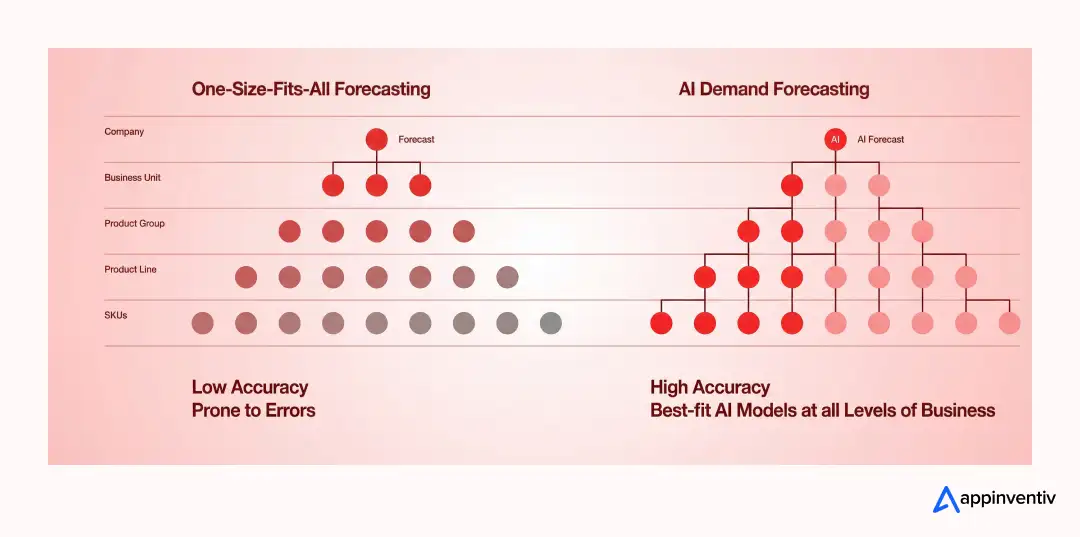
Source: https://c3.ai/products/c3-ai-demand-forecasting/
The average level of accuracy differed significantly both across the three states and among the participants within each state (see chart above).
These advancements can be attributed to the processing of data by AI. It does not consider sales solely on the basis of historical sales but also takes into account a combination of variables, such as pricing changes, promotions, external signals, and behavioral patterns. It then makes predictions continually as fresh data are made available.
Still unsure why AI for demand forecasting is a cut above traditional methods? Here is a brief table, highlighting the key differences between traditional methods and AI-based demand forecasting methods to help you make an informed decision:
| Aspect | Traditional Methods | AI-Based Forecasting Methods |
|---|---|---|
| Accuracy | Moderate | High |
| Data Handling | Limited data sources | Handles vast amounts of data efficiently |
| Complexity | Simple models | Complex algorithms for deeper analysis |
| Error Rate | Higher risk of manual errors | Zero to minimal risk of errors |
| Adaptability | Manual adjustments | Automatic adaptation to changing conditions |
| Prediction Precision | Basic patterns | Uses multiple variables and technologies for precise forecasts |
| Cost Efficiency | Higher operational costs | Reduces operational costs through automation |
| Speed of Analysis | Slower | Rapid analysis with real-time capabilities |
How AI Demand Forecasting Works
AI demand forecasting operates on the principle that patterns are learned from historical and real-time data, and then extrapolates future demand from those patterns. The system does not depend on a set of formulae, but modifies its predictions as more information is received.
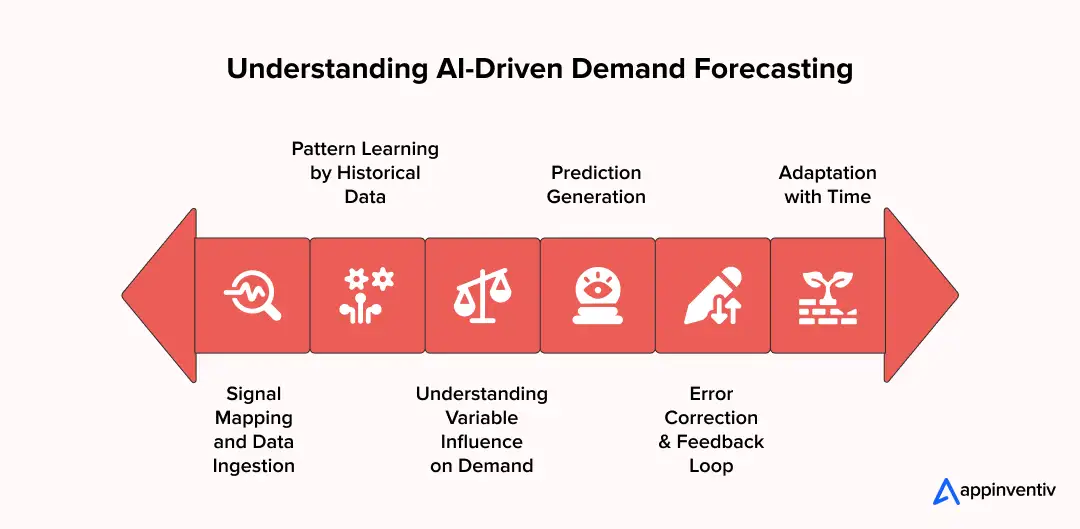
Signal Mapping and Data Ingestion
The system gathers information from various sources that include previous sales, prices, promotions and external indicators. All the inputs are signals that can impact demand, and the model determines the strength of each signal.
Pattern Learning by Historical Data
The model determines repetitive behaviors using historical records. It learns about seasonality, demand peaks, sluggish periods and how demand responds to certain stimuli, such as discounts or market changes.
Understanding Variable Influence on Demand
Not every input is created equal. The model assigns weights to variables based on their influence. In one instance, a price change can affect more than weather, whereas in another, weather can affect more than a price change.
Prediction Generation
After learning, the model uses the relationships on existing data. It computes the anticipated demand in a specific time period, product or region based on the current inputs and learnt trends.
Error Correction and Feedback Loop
Once predictions have been made, actual results are compared with forecasts. Any gaps are looped back to the system, enabling it to re-adjust weights and better future predictions.
Adaptation with Time
The model is not fixed. It constantly revitalizes its knowledge of demand behavior as new information arrives. This enables it to respond to both slow changes and abrupt changes in the supply chain automation patterns.
Machine Learning Models Used in Demand Forecasting
Machine learning algorithms and models form the analytical core of modern demand forecasting, enabling businesses to move beyond static predictions. Each model type serves a distinct role, helping organizations interpret patterns, adapt to change, and plan with greater confidence. Let’s have a look at those:
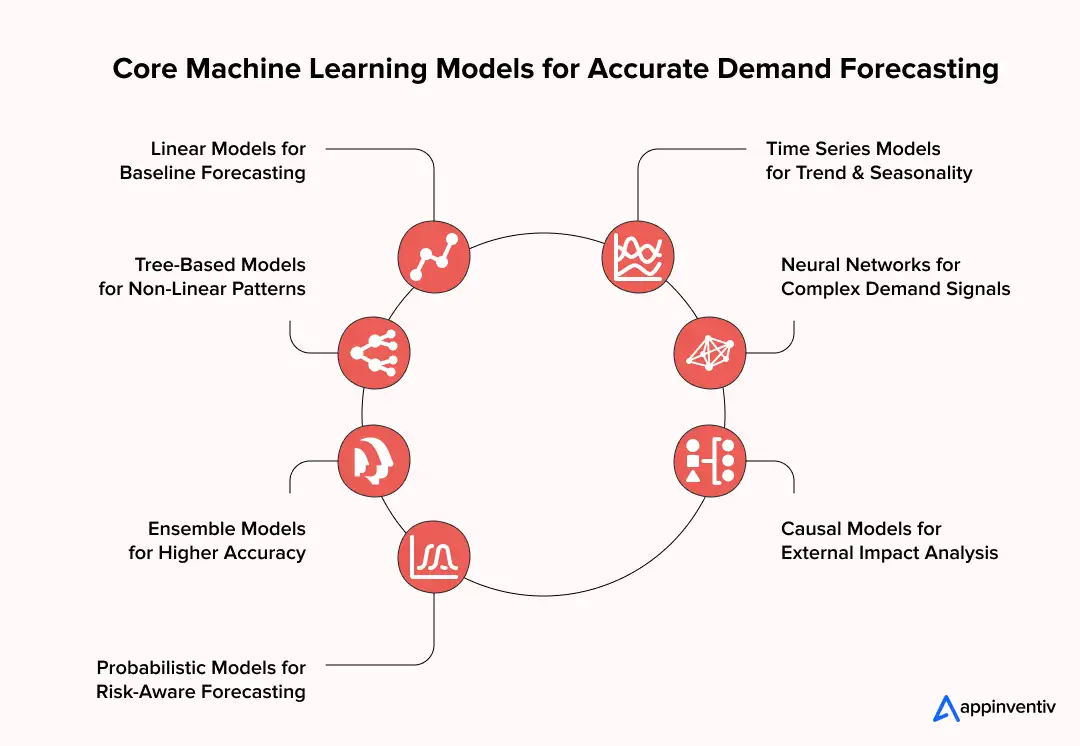
Linear Models for Baseline Forecasting
Simple regression techniques, like the linear regression, create a straightforward correlation between the demand and the major variables, namely, price, time, or promotions. These models often serve as a foundation layer within AI-powered demand planning software to benchmark performance.
Time Series Models for Trend and Seasonality
ARIMA and exponential smoothing are models designed to accommodate sequential data. They identify recurring patterns, seasonality, and long-term trends that constitute a fundamental component of demand forecasting using AI in predictable demand conditions.
Tree-Based Models for Non-Linear Patterns
Complex relationships between multiple variables are dealt with by algorithms such as decision trees, random forests, and gradient boosting. They are widely used in AI demand forecasting software to handle demand affected by various changing factors.
Neural Networks for Complex Demand Signals
Deep learning models, including recurrent neural networks (RNNs) and LSTM networks, process large and dynamic datasets. They capture intricate time-based demand patterns and adapt to rapidly changing data.
Ensemble Models for Higher Accuracy
Ensemble approaches combine predictions from multiple models to improve reliability. This helps balance model strengths and reduces prediction errors across varying demand scenarios.
Causal Models for External Impact Analysis
These models incorporate external drivers such as marketing campaigns, economic shifts, or weather conditions. They help explain demand fluctuations alongside predictions.
Probabilistic Models for Risk-Aware Forecasting
Instead of a single value, probabilistic models provide a range of possible outcomes with associated confidence levels. This supports better planning under uncertainty and improves risk management.
Real-World Examples and Use Cases of AI in Demand Forecasting Across Industries
AI-based forecasting offers innovative solutions for predicting future trends, streamlining processes, automating routine tasks, reducing costs, and improving productivity. Here are some industry-wise use cases, along with examples of the world’s leading organizations.
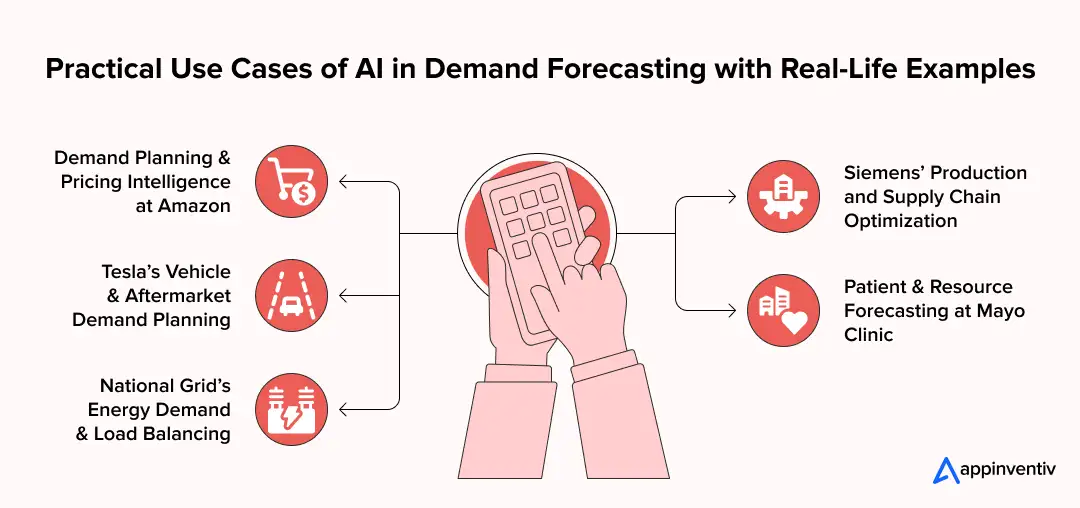
Demand Planning and Pricing Intelligence at Amazon
AI in retail has transformed demand forecasting into a continuous decision-making process rather than periodic planning. Premises can now monitor customer behavior, pricing changes, and external indicators in real time to ensure inventory and prices are maintained in line with demand.
One of the most famous instances is Amazon, where an AI model for demand forecasting is used to adjust prices dynamically based on competitors’ actions and purchasing trends. The same intelligence is used to position warehouses, minimize stock disparity, and enhance conversion by providing timely, customized offers.
Siemens’ Production and Supply Chain Optimization
Manufacturing environments require strict coordination of demand signals with production capacity. AI systems use past sales, supplier schedules and market changes to optimize production and raw material schedules.
In Siemens, the sophisticated demand forecasting algorithms would constantly update the production plans according to the real-time inputs. This minimizes the amount of time wasted on the shop floor, decreases the lead cycles and ensures that the output is always in line with the market demand without excessive production.
Tesla’s Vehicle and Aftermarket Demand Planning
The automotive industry is characterized by fluctuating demand in terms of geographical locations, products and service loops. AI assists manufacturers in predicting the number of vehicles to be sold, as well as downstream service needs, such as spare parts demand.
Tesla uses AI-powered demand-planning software to synchronize its production timetables with changing market demand for its car models. This can also be applied to service networks, where parts and repair requests are anticipated in advance, enhancing availability and minimizing customer wait time.
Patient and Resource Forecasting at Mayo Clinic
Demand forecasting in healthcare is closely related to patient outcomes. The AI models use historical admission data, trends in illnesses by season and local health indicators to predict patient inflow and resource needs.
At Mayo Clinic, predictive systems are employed to predict patient visits and staffing requirements. This makes the hospital capacity, medical supplies and personnel match the anticipated demand so as to maintain a consistent quality of care during peak periods.
National Grid’s Energy Demand and Load Balancing
Energy providers operate in an environment where even slight imbalances between supply and demand will have an impact. AI forecasting models compare consumption patterns, weather patterns, and grid performance in order to forecast energy consumption with high accuracy.
National Grid uses AI to predict electricity demand and create optimal distribution. This enhances the reliability of the grid, facilitates the integration of renewable energy sources, and ensures that power is allocated efficiently across all regions without wastage.
Unlocking the Business Benefits of AI-Based Demand Forecasting
AI for demand forecasting provides businesses with actionable insights, reduces operational costs, optimizes inventory management, and enhances overall efficiency. Let’s delve deeper to understand the transforming benefits of demand forecasting:
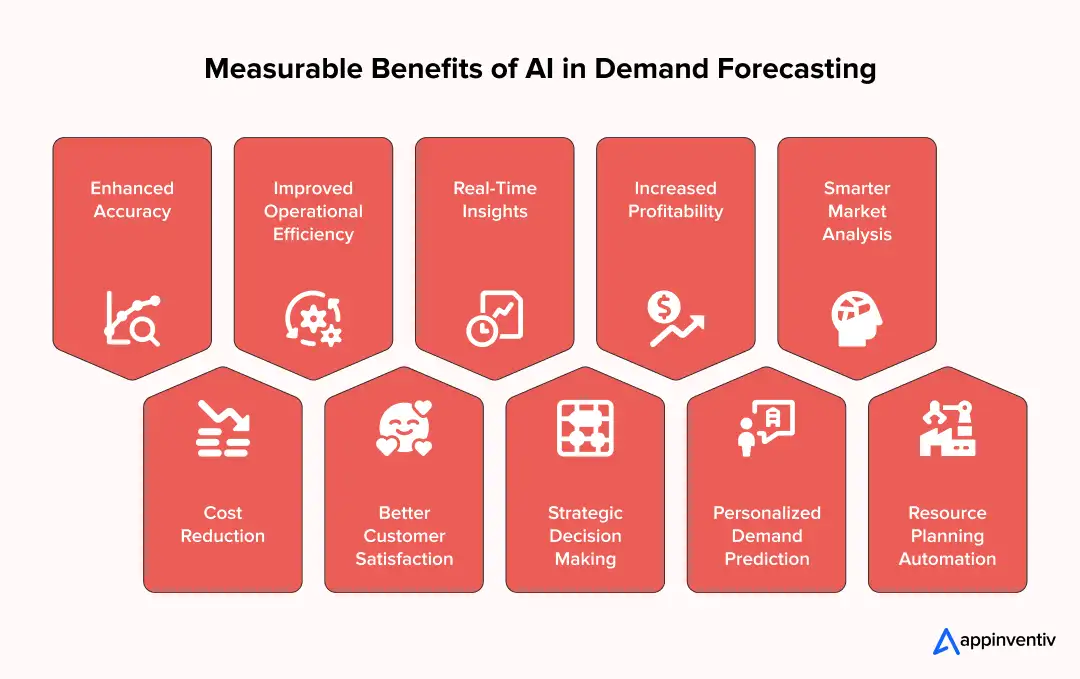
Enhanced Accuracy
Artificial intelligence forecasting methods in supply chain analysis use vast datasets and sophisticated algorithms to deliver highly accurate predictions. This precision helps companies reduce errors by up to 50%, ensuring that they meet customer demand more effectively.
Cost Reduction
By minimizing forecasting errors, businesses can significantly reduce costs associated with overstocking and understocking. For instance, it can help drop warehousing expenses by 5-10% and administration costs by 25-40%, leading to substantial savings.
Improved Operational Efficiency
AI demand forecasting automates many repetitive tasks, freeing up human resources to invest their energy in more value-added activities. This automation can cut down workforce management tasks by up to 50%, enhancing overall operational efficiency.
Better Customer Satisfaction
Accurate demand forecasting ensures that products are available when customers need them, minimizing the risk of lost sales and failure to meet evolving customer demands. It can decrease product unavailability by up to 65%, ensuring enhanced customer satisfaction, engagement, and retention rates.
Real-Time Insights
Artificial intelligence in demand forecasting enables real-time analysis of diverse data sources, including social media platforms, market trends, emails, and economic indicators. This continuous analysis equips businesses with up-to-the-minute insights, enabling them to respond quickly to changing market conditions.
Strategic Decision-Making
Demand planning with AI gives businesses valuable insights into market trends and consumer preferences. This insight empowers businesses to make data-driven decisions, helping them plan better and stay ahead in the competitive landscape.
Increased Profitability
The combined benefits of AI-based demand forecasting include cost savings, operational efficiency, customer satisfaction, etc., leading to increased profitability. Businesses can maximize their ROI while minimizing unnecessary expenses, unlocking the avenue of growth and innovation.
Personalized Demand Prediction
AI in demand planning tailors forecasts to individual customer preferences using historical data and real-time interactions. It helps improve customer segmentation strategies and enhances product recommendations to meet specific consumer needs effectively.
Incorporating AI in demand forecasting is not just a technological upgrade; it is a strategic move that can transform how businesses operate, making them more resilient, efficient, and competitive in the market.
Smarter Market Analysis
AI-based forecasting captures insights not just from internal data but also from external factors like customer sentiment, competitor activity, and economic trends, giving businesses a much fuller view of the factors that drive demand.
Resource Planning Automation
AI improves resource planning by aligning workforce, inventory, and logistics with actual demand patterns. It helps businesses plan staffing, procurement, and distribution more accurately, reducing last-minute disruptions. This leads to lower excess inventory, fewer shortages, smoother operations, and better cost control, ultimately improving overall returns.
Partner with Appinventiv to build next-gen AI platforms for unmatched precision in predictions

Addressing Implementation Challenges in AI Demand Forecasting
Implementing AI in demand forecasting often comes with practical hurdles, from data gaps to system integration issues. Addressing these challenges for your supply chain processes early helps avoid delays and improves the reliability of forecasts. Let’s have a look at those:
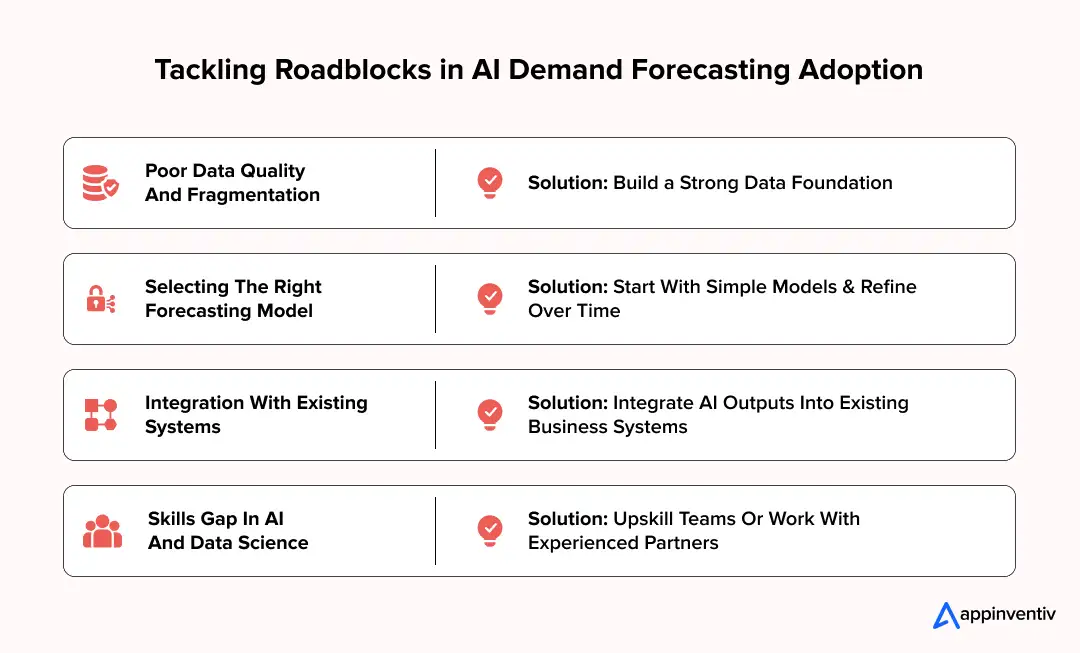
Poor Quality, Fragmented Data
When data is split up across several systems, different formats, or not fully captured, it creates uncertainty in forecast models. Uncertainty leads to reduced trust in forecast predictions and diminished forecast model performance.
Solution: To develop accurate, reliable demand forecasts through AI you must have access to complete data sets on all relevant factors, cleaned of errors, and standardized to create a reliable data foundation. With a strong data foundation, demand forecasting using AI becomes more precise and actionable.
Selecting the Right Model
Selecting the correct model for AI demand forecasting will also affect how accurately it predicts demand across supply chain scenarios such as seasonal demand shifts and regional distribution patterns. Using too simple a model could miss highly impactful trends, while choosing too complex a model could create an overly complicated solution that is difficult or troublesome to manage.
Solution: Start analyzing and understanding data trends with less-complex models and continue evaluating additional sophisticated models (such as neural networks or tree-based algorithms) on a trial basis. Ongoing, regular testing and backtesting of AI forecasting models will help companies develop a clear picture of which models consistently produce accurate demand forecasts in real-world demand forecasting scenarios.
AI-Integrated Existing Systems
AI predictions need to be linked to supply chain ERP, inventory and management systems to be helpful. Without a level of integration, predictions are isolated, and this slows down the operations decision making and limits its influence.
Solution: Introduce AI-powered APIs or middleware to connect AI outputs directly to business platforms. It is necessary to ensure that forecasts are integrated into the daily working processes so that the teams can take action on the information on a daily basis. This incorporation makes demand forecasting with AI a viable aspect of operations rather than an imaginary undertaking.
AI and Data Science Skills Gaps
The development of AI forecasting models, their maintenance, and interpretation require professional knowledge. Numerous organizations do not have the required data science resources, and this may act as a barrier to adoption and restrict the effectiveness.
Solution: Invest in training in-house teams or engage external experts. The AI-powered demand planning software offers easy-to-use interfaces and prebuilt models, so the staff can concentrate on the insights and planning, but not on technical implementation.
How to Implement AI Demand Forecasting in Your Existing Process
Implementing AI for demand forecasting involves a strategic approach to ensure efficient integration into the existing system and alignment with supply chain operations like procurement, inventory, and logistics. Here is a step-by-step implementation process:
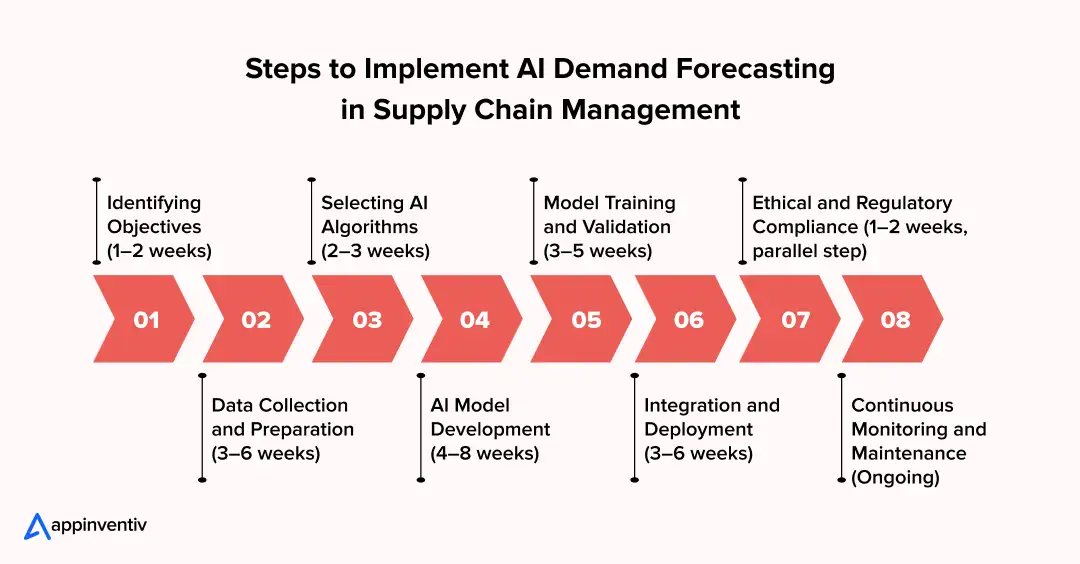
Identifying Objectives (1–2 weeks)
Identify and outline specific objectives for AI implementation, such as improving forecast accuracy, optimizing inventory management, or enhancing operational efficiency. Also, determine the areas, products, or services where you want to integrate AI-powered demand forecasting tools.
Data Collection and Preparation (3–6 weeks)
Collect data from various sources, including historical sales data, market trends, customer behavior patterns, and external factors like economic indicators or weather conditions. Also, cleanse and preprocess the data to ensure its reliability and relevance or address any other data quality issues.
Selecting AI Algorithms (2–3 weeks)
Choose the relevant AI algorithms based on the nature of the data and forecasting requirements including supply chain variability such as seasonality and demand fluctuations across regions. . ML models (e.g., regression, neural networks), linear regression, decision trees, and time series analysis techniques (e.g., ARIMA) are the most common AI algorithms.
AI Model Development (4–8 weeks)
Develop an advanced AI model that can efficiently analyze and process large volumes of data to generate accurate demand forecasts. Create compelling UI/UX and integrate advanced features into the application for enhanced predictive capabilities.
Model Training and Validation (3–5 weeks)
Train AI models using historical data to learn patterns, correlations, and underlying trends relevant to demand forecasting. Furthermore, validate its accuracy, reliability, and performance through rigorous testing and cross-validation methods.
Integration and Deployment (3–6 weeks)
To generate actionable predictions, integrate AI-powered demand forecasting tools into existing supply chain management systems or enterprise resource planning (ERP) platforms. You can partner with an AI development company to ensure seamless development and deployment of the AI model.
Ethical and Regulatory Compliance (1–2 weeks, parallel step)
Adhere to ethical guidelines for the responsible use of AI in your supply chain processes, including transparency, fairness, and data privacy considerations throughout the forecasting process. Also, comply with industry standards and relevant regulations like GDPR for ensuring data privacy and security.
Continuous Monitoring and Maintenance (Ongoing)
Continuously monitor the AI models to evaluate accuracy, detect anomalies, and gather user feedback. Use this analysis to make iterative improvements to the model, enhancing forecasting precision and adaptability over time.
Cost of Implementing AI Demand Forecasting
The cost of deploying AI demand forecasting in your existing processes is determined by the complexity of the use case, the readiness of the data, and how far the system would need to extend beyond current operations. The majority of organizations begin with a well-defined scope and then build on it as the first model is tested to be faithful in real-world situations.
| Project Scope | Estimated Cost Range | Normal Coverage |
|---|---|---|
| Small / Pilot Implementation | $25,000 – $75,000 | One use case, limited data sources, simple models, limited integration. |
| Mid-Sized Implementation | $75,000 – $250,000 | Multiple products or locations, moderate data complexity, system integration. |
| Enterprise-Scale Deployment | $250,000 – $700,000+ | End-to-end forecasting of supply chain, advanced models, real-time data integration. |
| Very Customized / AI-First Systems | $700,000 – $1,000,000+ | Completely customized models, big data pipelines, massive ERP and supply chain integration. |
Factors That Influence the Implementation Costs
Here are some of the key factors that play a decisive role in determining the final implementation costs:
Data Readiness and Quality: Supply chain companies whose data is clean, structured and centralized incur less time in preparation. Disjointed or piecemeal data adds time and expenditure.
Scope of Implementation: It is much cheaper to roll out in one product line or region rather than in a company-wide rollout. Increased scope presents complexity in modeling, testing, and deployment.
Model Complexity: Simple statistical models are simpler to run, whereas complex machine learning or deep learning models take more time, experience and fine-tuning.
Integration Requirements: Linking forecasting systems to ERP, inventory, and supply chain systems can have a considerable effect on cost, particularly in cases where real-time data interchange is needed.
Infrastructure and Technology Stack: Cloud-based solutions save upfront expenses and introduce recurring expenses. Physical or hybrid installations might cost more upfront.
Talent and Expertise: The employment of qualified data scientists and AI engineers or collaboration with third parties directly influences the cost. Specialization is usually expensive.
Maintenance and Scaling: Post-deployment costs include monitoring, model retraining and system scaling as data volume and business requirements increase.
See how your existing structure, forecasting goals, and system complexity shape the overall implementation cost before you begin
Key Trends Shaping the Future of AI Demand Forecasting
AI for demand forecasting is not just about leaving behind fixed prediction algorithms for systems that will dynamically change as new information is introduced. Over time, forecasting is becoming part of everyday supply chain operations rather than a separate analytical task handled at intervals. Let’s see how it will transform in the future:
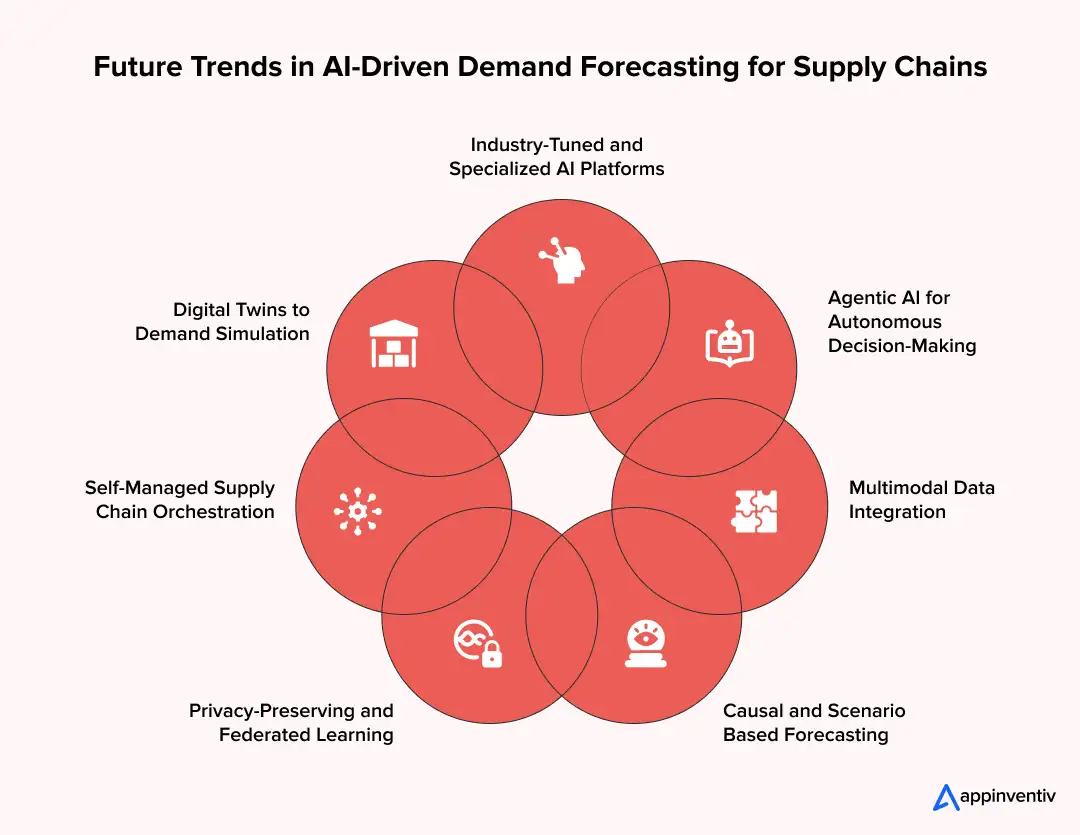
Agentic AI for Autonomous Decision-Making
The next shift towards agentic AI systems, which go beyond forecast generation. Such systems have the capacity to analyze situations, prescribe actions and in other situations they can initiate decisions throughout the planning processes. This alters the AI’s functioning in demand planning to a more autonomous approach, as opposed to the human approach to implementation.
Multimodal Data Integration
In future forecasting, data will be integrated with both structured and unstructured data, such as text, images, and real-time signals. This enables supply chain businesses to target demand drivers that have been overlooked in the past, e.g. social sentiment or visual trends, enhancing the richness of insights.
Causal and Scenario-Based Forecasting
Models are also being constructed to learn cause-and-effect relationships, rather than merely seeing patterns. This enables teams to model various situations, evaluate performance and make decisions. These developments are defining the new era of machine learning in demand forecasting, where prediction is no longer the most crucial aspect but reasoning.
Privacy-Preserving and Federated Learning
As data privacy increases, companies are considering how to train models without transferring sensitive information. Federated learning enables models to train on distributed data and facilitates data localization, which minimizes compliance risks.
Self-Managed Supply Chain Orchestration
Forecasting will become increasingly integrated with execution systems in a closed-loop manner. The predictions will not only provide information for decision-making but also enable actions in procurement, production, and logistics. This fosters a more dynamic and integrated supply chain environment.
Digital Twins to Demand Simulation
Organizations are starting to create online replicas or digital twins of supply chains environments. These models enable teams to experiment with on-demand conditions in a controlled space and then deploy them in actual operations to minimize risk and enhance planning accuracy.
Industry-Tuned and Specialized AI Platforms
The market is shifting toward industry-specific solutions, rather than generalized tools, such as in the retail, manufacturing, or healthcare industries. The use of the AI-powered demand planning software will persist, although with more customization and alignment to the industry.
Appinventiv – Your Partner in AI-Based Demand Forecasting Implementation
For businesses looking to leverage the full potential of AI in demand forecasting, partnering with Appinventiv, as your AI development services partner can be a strategic move. With our extensive experience and expertise in developing reliable AI-driven solutions, we can help streamline your supply chain processes, optimize resource allocation, and elevate your business to new heights of success.
As an example of our experience, we collaborated with a global manufacturing firm and increased the supply chain performance by 60%, making the supply chain more visible with the help of AI-based and analytics-based solutions.
Our team adopted a data-driven logistics and supply chain management system, leveraging AI-enhanced RPA and advanced analytics. This helped the organization to create actionable insights based on real-time supply chain data and make quicker and more informed decisions.
The solution enhanced the responsiveness to customer demand and minimized manual efforts in favor of higher-value operational activities leading to increased efficiency and productivity aligned to the supply chain.
- 60%
Increase in supply chain visibility
- 40%
Cost savings in transportation and logistics.
- 30%
Growth in the efficiency of operations.
What gives you more confidence in working with us?
Here are some other reasons why you should partner with Appinventiv for AI demand forecasting tool development and implementation:
- We have a proven track record of delivering 3000+ successful projects across 35+ industry verticals in 25+ countries.
- Our suite of AI services includes the development and implementation of AI applications, Generative AI solutions, smart AI assistants and chatbots, AI security, and more.
- We have a team of 700+ AI and ML experts who are dedicated to transforming your vision into life and driving innovation.
- Our expertise in AI product development is showcased through our work with clients like Americana ALMP, MyExec, YouComm, Mudra, Vyrb, and JobGet.
- We have been awarded by Clutch, Good Firms, Times Business, Deloitte, Economic Times, and other prestigious firms for our remarkable contribution to app and software development.
- We are globally recognized as the Fastest Growing Technology Company and Tech Company of the Year.
Contact us today to embrace the future of AI-based demand forecasting and stay ahead in today’s competitive age.
FAQs
Q. How is AI used in demand forecasting?
A. AI in demand forecasting leverages advanced technologies like predictive analytics, ML, NLP, image recognition, and IoT. These technologies analyze vast troves of data to identify patterns, predict future demand, and improve accuracy. This enables companies to improve forecasting accuracy, optimize inventory levels, save costs, and enhance customer insights.
Q. How can businesses benefit from AI demand forecasting?
A. The benefits of AI forecasting are profound and far-reaching for businesses. Here are some of the most notable advantages of AI-based demand planning:
- Enhanced Accuracy
- Cost Reduction
- Improved Operational Efficiency
- Better Customer Satisfaction
- Real-Time Insights
- Strategic Decision-Making
- Increased Profitability
To gain an in-depth understanding of these advantages, please refer to the above blog.
Q. How does AI demand forecasting work?
A. AI demand forecasting works by leveraging advanced algorithms and data analysis techniques to predict changing market trends and consumer demand for products and services. Here is a step-by-step process of how AI demand forecasting works:
Data Collection: AI collects extensive data from various sources, such as sales records, market trends, social media, economic indicators, and weather patterns.
Data Processing: After collecting the relevant data, the data is cleansed and processed to ensure accuracy and relevance for analysis.
Model Training: Based on this data, the AI models are trained to recognize factors influencing demand.
Prediction Generation: Once trained, the AI models generate demand forecasts by analyzing current and historical data.
Continuous Learning: AI systems continuously learn and adapt from new data, refining their predictions and becoming more accurate over time.
Decision Support: The generated predictions provide actionable insights for businesses to make informed decisions on inventory management, production planning, and resource allocation.
Q. How does AI improve demand forecasting accuracy?
A. AI enhances the quality of demand forecasting through the use of vast amounts of historic and real-time data to identify trends, seasonality and anomalies that would otherwise be overlooked by traditional approaches. It constantly receives new input and improves predictions as time goes on. This results in improved inventory planning, stockouts and enhanced efficiency in the supply chain, which enhances the overall benefits of demand forecasting across operations.
Q. How does appinventiv help businesses implement AI demand forecasting?
A. Here’s how Appinventiv, as a reputed AI consulting company, help businesses in implementing AI demand forecasting in supply chain management:
Business and Data Evaluation: We consider your supply chain framework, sources of data and forecasting objectives to create a clear implementation plan of AI demand forecasting software.
Data Preparation and Integration: We pull together, purify, and organize supply chain and business data so that it is prepared to be correctly forecasted in the development of a forecasting model.
Model Selection and Development: Our professionals create and develop AI models to align with your demand trends, enhancing prediction accuracy for the product and place.
System Integration: We combine man-artificial intelligence (AI) demand forecasting software with your ERP, inventory, and supply chain systems to support real-time decision making.
Testing and Optimization: Forecast models are tested on actual supply chain situations and constantly optimized to achieve higher accuracy and performance.
Continued Support and Scaling: We keep an eye on the performance of the system after its deployment and scale the solution to the increased level of complexity of your supply chain.


Fast 2-minute response, fully NDA-protected.

Retrieval Augmented Generation in Australia: Architecture, Implementation and Cost
Key takeaways: RAG grounds LLM answers in approved content, improving reliability without retraining a model. Data quality and access permissions decide production outcomes more than the model. Indicative build costs run from AUD 70,000 to 700,000, driven by data and integrations. Measure value against a pre-deployment baseline, separating realised benefits from projected savings. A general-purpose…

The Multiplier Effect of AI Agents: The Rise of AI Swarms
Key takeaways: AI agent swarms coordinate specialized agents to solve complex problems that may be difficult for a single agent to handle effectively. More agents do not automatically mean better outcomes. Swarms deliver value when work can be divided, executed in parallel, and coordinated toward a shared objective. Enterprise readiness depends on governance. Clear accountability,…

AI Data Integration: How to Connect, Clean and Prepare Data for AI
Key takeaways: AI initiatives fail when fragmented, poor-quality data reaches models without sufficient context, controls or ownership. AI-ready pipelines must connect, clean, enrich, govern and continuously monitor data across its lifecycle. Real-time processing matters when AI decisions depend on current transactions, events, inventory or operational conditions. Data architecture should follow the AI use case, balancing…