
































How to Choose the Right Financial Software Development Company?

 Share -



- 01Step 1: Define Your Business, Technology, and Compliance Objectives First
- 02Step 2: Look for Proven Financial Services Domain Expertise
- 03Step 3: Evaluate Technical Architecture and Engineering Capabilities
- 04Step 4: Assess Security and Compliance Readiness
- 05Step 5: Review Integration and Ecosystem Capabilities
- 06Step 6: Determine Whether the Company Can Support AI-Driven Financial Innovation
- 07Step 7: Evaluate Delivery Processes and Long-Term Support
- 08Step 8: Conduct Vendor Due Diligence Like an Enterprise Procurement Team
- 09Red Flags That Signal the Wrong Financial Software Development Company
- 10How Appinventiv Addresses the Key Requirements of Modern Financial Software Development
- 11FAQs

Key takeaways:
- Set your business, technology, compliance, and scaling goals before you review vendors. This action prevents expensive alignment mistakes later.
- Focus on deep financial industry experience. Your partner must know banking, payments, lending, compliance, fraud blocking, and reporting rules.
- Check their cloud-native design, integration skills, and scaling engineering. These technical features support your long-term growth and system strength.
- Review their security setups, compliance readiness, and AI tools. This protection guards your financial platform against new risks.
- Use a structured background check for every firm. Assess their delivery records, governance setups, support systems, and pricing plans before your final choice.
A few years ago, selecting a financial software vendor came down to development capacity and total cost. Today, the stakes are higher. McKinsey reports that fintech revenues reached $650 billion just last year, growing 21% year over year. Modern financial firms build massive platforms. These systems process millions of transactions and connect with payment networks.
They support open banking systems. They use artificial intelligence to detect fraud, analyze risk, and engage customers. In this market, selecting the right financial software development company directly affects operational strength. It impacts compliance and long-term business growth.
Many software vendors look identical on paper. They show polished portfolios and promise rapid delivery. They lack the deep engineering experience to build secure, scalable, and compliant financial systems.
Detailed questions about cloud-native architecture and API interoperability reveal clear differences. Standards such as PCI DSS compliance, data governance, and DevSecOps practices set these firms apart.
To learn how to choose a financial software development company, look beyond basic technical credentials. Enterprise leaders evaluate domain expertise, security structures, architecture, AI readiness, and long-term partnership potential. This financial software development company selection guide provides a clear framework for decision-makers. It helps you find a partner to deliver lasting value in a strict, fast-moving financial market.
Weak architecture and compliance decisions today can become costly transformation barriers tomorrow.

Step 1: Define Your Business, Technology, and Compliance Objectives First
Finding the right financial software development company starts not with a list of vendors, but with clarity. Enterprise leaders must first define clear goals. Then they can talk to development partners. They must know their current technical setup. They must identify the exact rules the new software must follow.
Compliance planning requires deep attention. Financial software operates under strict global rules. These include PCI DSS, GDPR, PSD2, PSD3, and DORA. Teams must track SOC 2, ISO 27001, and local financial laws. Missing these points early causes expensive rebuilds and delayed launches. This mistake increases audit risks later.
Gather your leaders first. Then pick a software firm. Align your business, tech, compliance, risk, and operations teams. Everyone must agree on the expected results of the project.
| Objective Area | Questions to Answer |
|---|---|
| Business | What targets do we want to hit? Consider revenue growth, lower costs, new customers, or modern operations. |
| Technology | Are we building a new platform or updating old systems? Will we move to the cloud or use APIs? |
| Compliance | Which rules, audit requirements, data laws, and security standards must the software comply with? |
| Operations | What transaction numbers, user totals, uptime rates, and scale targets must the platform manage? |
Enterprise Evaluation Checklist
Use this financial software development company checklist to ensure your team answers these key questions:
- What problem will the software solve?
- Who are the primary users and stakeholders?
- Which internal and external systems need to be connected?
- What are the expected transaction volumes and growth trends?
- Which compliance and security rules are mandatory?
- What update goals must the platform meet over the next five years?
Without these answers, a great vendor can build the wrong product. A clear strategy guides every choice you make next.
Step 2: Look for Proven Financial Services Domain Expertise
Understanding how to choose a financial software development company means recognizing that technical knowledge alone is not enough in financial services. A partner builds apps across industries but struggles with unique financial rules. They often stumble on transactions, risk controls, and compliance needs. You must check domain knowledge first.
Financial software requires absolute accuracy, high security, and strict compliance. A vendor building a banking platform needs to know specific everyday processes. They must understand account management, payment flows, and ledger matching.
They must track settlement cycles and cash management. Teams building wealth tools need to know portfolio management and automated advice. They must understand market data and investment reports.
Look past general fintech experience. Check what the vendor built in your exact field. Domain expertise matters. McKinsey estimates the payments segment alone generates $250 billion in annual fintech revenue.
| Financial Segment | Expertise to Look For |
|---|---|
| Banking | Core banking integration, digital onboarding, account management, payment processing |
| Payments | Payment modernization covering payment gateways, ISO 20022 messaging and real-time payments” |
| Wealth Management | Wealth management software covering portfolio tools, automated advice platforms and investment analytics |
| Lending | Digital lending tools, credit scoring engines and underwriting workflows |
| Insurance | Insurance transformation covering policy setup, claims processing and risk assessment platforms |
Domain knowledge is critical for compliance and risk management. A qualified software firm proves hands-on experience.
They should demonstrate experience with AML, KYC, fraud monitoring, sanctions screening, transaction monitoring, regulatory reporting, and audit trail management.
Enterprise Buyer Tip
Do not just ask vendors about past financial software. Ask for examples of real systems and clear facts.
Look for specific proof:
- Lower fraud losses from machine learning tools
- Faster customer sign-ups from automated KYC steps
- High transaction speeds and fast processing
- Smooth moves from old code to cloud setups
- Readiness for PCI DSS, GDPR, SOC 2, or regional rules
A partner understands the technology and the business mechanics. This firm delivers software that runs well under real regulatory demands. It satisfies your operational needs and your customer goals.
Step 3: Evaluate Technical Architecture and Engineering Capabilities
A portfolio shows what a vendor has built in the past. Architecture expertise shows whether that system will still work in five years.
Financial software handles extreme conditions. A payment platform processes thousands of transactions per second. A digital banking system serves millions of users across regions.
A lending platform makes credit choices in milliseconds. It must track audits and regulatory compliance simultaneously. These features require smart architectural choices before coding begins. Enterprise buyers must check how a software firm builds systems.
Cloud-Native Expertise
Modern financial platforms use cloud-native platform architectures for scale and resilience. Your development partner needs experience with AWS, Microsoft Azure, or Google Cloud Platform.
Look for specific skills, such as Infrastructure as Code with Terraform or CloudFormation, Cloud security and identity management, Auto-scaling environments, Managed database services, Serverless computing, Hybrid and multi-cloud setups, and Cloud tracking and monitoring.
A vendor matches cloud design with financial rules. They protect data residency and meet disaster recovery goals.
Modern Architecture Patterns
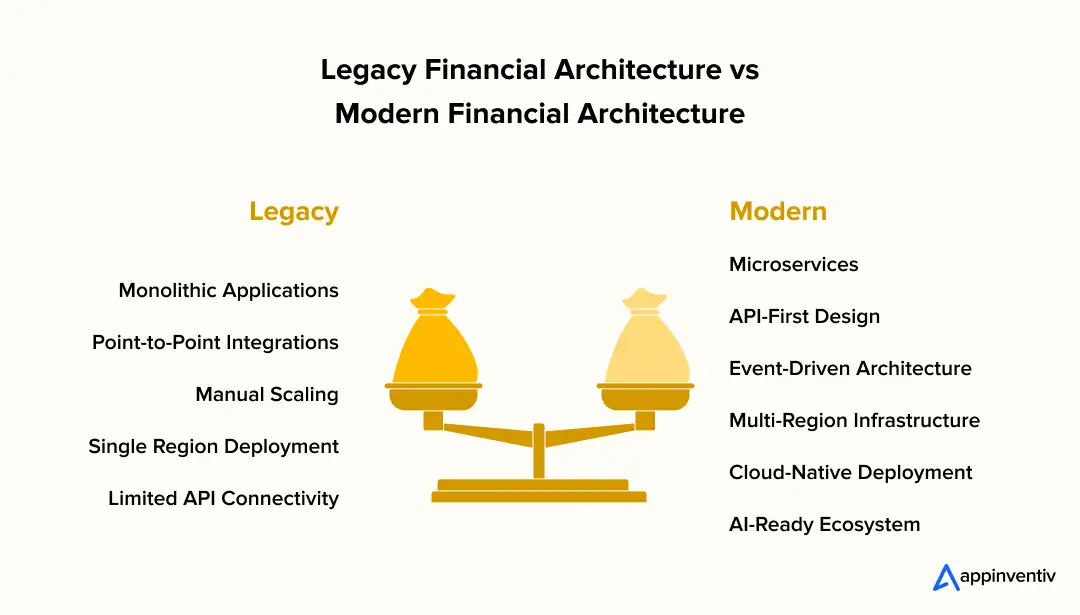
Old financial systems use monolithic code. These systems are hard to scale, update, and integrate. Modern enterprise platforms use modular, distributed designs.
| Capability | Why It Matters |
|---|---|
| Microservices Architecture | Allows independent scaling, flexible deployment, and fast feature updates. |
| Event-Driven Architecture | Supports real-time transaction processing and instant communication. |
| API-First Design | Simplifies connections with banks, payment firms, and third-party tools. |
| Containers & Kubernetes | Improves software portability, resilience, and system management. |
| Service Mesh Architecture | Enhances security between services, traffic management, and tracking. |
| CQRS & Event Sourcing | Improves audit tracking and transaction history for financial apps. |
Beyond these patterns, understanding technologies like blockchain in fintech can further inform your architectural evaluation for secure, distributed financial systems.
Scalability Engineering
Enterprises often try to fix scalability after launch. This is a massive mistake. Engineers must build scalability into the platform on day one.
Check the vendor’s experience with these practices:
- Performance and load testing
- High-availability architecture design
- Active-active and active-passive failover systems
- Disaster recovery planning
- Database replication strategies
- Multi-region deployments
- Capacity planning and traffic predictions
Ask how they validate performance under peak traffic conditions and whether they can demonstrate recovery point objectives (RPOs) and recovery time objectives (RTOs).
A strong software firm explains technical choices in business terms. A vendor must explain how its design supports scale, resilience, and compliance. If they cannot, they will struggle to support your long-term growth.
Step 4: Assess Security and Compliance Readiness
Financial security is not a feature you add right before launch. It belongs in every step of the software development lifecycle. A vendor can show impressive apps and technical skills. If security and compliance setups are weak, risks extend past project delays. Data breaches, regulatory fines, operational stops, and ruined reputations harm financial firms for years.
Security Practices Every Vendor Should Demonstrate
A mature software firm follows a Secure Software Development Lifecycle. This setup integrates security into planning, design, coding, testing, deployment, and upkeep.
Check for capabilities such as Secure coding practices, threat modeling, SAST/DAST testing, penetration testing, vulnerability management, and continuous monitoring.
Identity and access management is another critical field. Vendors must know how to use role-based access control and multi-factor authentication. They use privileged access tools and Zero Trust principles to guard sensitive financial data.
Look for experience implementing encryption, tokenization, key management, and payment data protection controls.
Evaluate Compliance Expertise
Compliance connects technology, security, and operations. The right partner knows how regulatory rules change system design, data handling, tracking, and daily workflows.
Do not ask if a vendor knows compliance rules. Ask how they built compliance controls into past projects.
| Compliance Framework | Why It Matters |
|---|---|
| PCI DSS | Protects card data and governs secure payment processing environments. |
| SOC 2 | Confirms security, availability, processing integrity, and privacy controls. |
| ISO 27001 | Sets up a clear information security management framework. |
| GDPR | Regulates the collection, processing, storage, and transfer of personal data. |
| DORA | Strengthens digital operational strength for financial firms in the EU. |
| PSD3 & Open Banking | Governs secure data sharing, API security, consent, and third-party access. |
| Regional Regulations | Supports compliance with specific laws across global markets. |
Compliance readiness goes deeper than paperwork. A capable vendor explains how they build audit logging, consent management, financial data warehousing, and data retention rules. They understand data residency, access controls, and incident response steps.
Ask for real examples of compliance builds. Teams with experience discuss security architecture, audit needs, and controls with confidence. This balance indicates true enterprise readiness.
Step 5: Review Integration and Ecosystem Capabilities
Advanced financial software causes bottlenecks if it fails to communicate with surrounding tools. Financial platforms rarely run as standalone apps in enterprise setups. They connect to core banking platforms, payment networks, ERP systems, and CRM solutions. They share data with regulatory reporting tools, fraud engines, and third-party data providers.
Enterprises that choose the right financial software development company recognize that success depends not just on what is built but also on how the application exchanges data and runs workflows across connected systems.
Evaluate Experience with Complex Financial Ecosystems
When evaluating potential partners, look for direct experience integrating with core banking systems, fintech ERP tools, customer relationship management (CRM) systems, payment gateways and processors, open banking APIs, credit bureaus, underwriting platforms, market data providers, and AML/fraud tracking tools.
Additionally, prioritize vendors with proven expertise in key integration technologies, including enterprise service bus (ESB) platforms, integration platform as a service (iPaaS) solutions, message brokers, event streaming platforms, and data synchronization frameworks.
Integration complexity increases with old infrastructure. Many firms rely on decades-old systems with limited APIs or proprietary protocols. A capable partner knows modernization strategies. They connect new applications to legacy code without stopping business operations.
Also Read: How to Set Up Payment Gateway Integration for Your App: A Simplified Roadmap
Assess API and Integration Architecture Expertise
Modern financial networks use API development best practices for secure, scalable, API-first setups. Check the vendor’s experience with these tools:
- REST and GraphQL APIs
- API gateways
- OAuth 2.0 and OpenID Connect
- API versioning and management
- Service orchestration
- Developer portals and API documentation
Strong API management matters for Open Banking, embedded finance, and Banking-as-a-Service models. A mature engineering team implements rate limiting, traffic controls, API tracking, and security measures to keep services running.
Evaluate experience with middleware, message brokers, and event-driven integration technologies such as Apache Kafka, RabbitMQ, Amazon EventBridge, and Azure Event Hubs. These technologies support real-time communication across modern financial ecosystems.
Assess Interoperability and Data Exchange Readiness
Interoperability matters for enterprises running across multiple regions or product lines. A qualified software firm should understand financial messaging standards such as ISO 20022, SWIFT, FIX, NACHA, Open Banking APIs, and decentralized finance protocols.
Ask vendors how they manage data mapping, schema updates, and real-time synchronization. Integration capability is more than a technical task. It affects operational speed, user experience, compliance reporting, and future scale. The best partners build software that functions smoothly within your broader financial ecosystem.
Modern financial ecosystems require API-first architectures, real-time integrations, and enterprise-grade scalability.

Step 6: Determine Whether the Company Can Support AI-Driven Financial Innovation
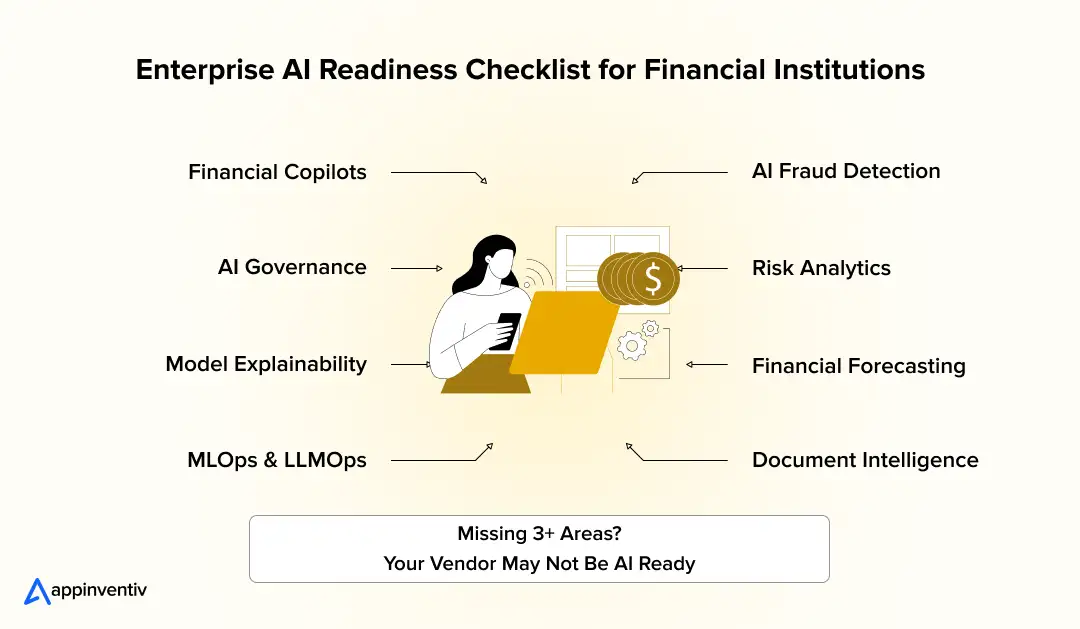
A complete vendor evaluation must include artificial intelligence capabilities. A complete vendor evaluation must include AI in fintech capabilities. Financial firms use machine learning to stop fraud in real time, automate risk reviews, and onboard customers.
Generative AI creates opportunities to improve worker productivity, customer service, and operational choices. The vendor you choose today must support your AI plans for the next several years. According to McKinsey, fintech could approach $2 trillion by 2030, with AI expected to be a major growth driver.
Evaluate Experience with Enterprise AI Use Cases
Many vendors claim AI expertise. True leaders prove they have deployed AI tools inside strict regulatory boundaries.
Look for direct experience with these systems:
- AI-powered fraud and anomaly detection
- Credit risk modeling and automated underwriting
- Predictive analytics and financial forecasting
- Customer churn tracking and behavior analysis
- Intelligent document processing
- RPA in finance for automated compliance tracking and workflow orchestration
- Financial recommendation engines
- Conversational AI and virtual assistants
An intelligent lending tool uses machine learning to analyze cash histories, spending habits, and credit data to generate instant risk scores. Fraud detection tools combine stream processing with behavioral and financial analytics to detect malicious activity before a transaction completes.
Also Read: 16 Ways Computer Vision Is Shaping the Future of Finance
Assess Generative AI and Financial Copilot Capabilities
Generative AI in finance is a major area of investment for financial institutions. Top firms deploy AI copilots to support key workers, customer-facing and operational teams.
A qualified partner understands fintech large language models, Retrieval-Augmented Generation, and financial agentic AI frameworks for autonomous workflows. They use prompt frameworks and secure AI designs.
When evaluating a vendor, ask if they build specific systems such as financial knowledge assistants, investment research tools, PCI DSS-compliant AI chatbots, customer service automation platforms, document summarization systems, and regulatory intelligence trackers.
Evaluate AI Governance and Risk Management Practices
AI adoption introduces unique regulatory and operational risks. AI governance is just as critical as software development.
A mature firm demonstrates clear expertise with model explainability and clarity, bias detection and tracking, model validation frameworks, AI audit trails and traceability, data lineage management, human-in-the-loop review setups, and continuous model performance monitoring.
An AI model that shapes lending choices requires clear explanations. Firms must show that choices are fair, transparent, and compliant with local laws.
Ask vendors how they manage model drift, retraining schedules, governance reviews, and risk checks. Mature teams use MLOps or LLMOps practices to handle model deployments, version controls, and governance. Choosing a partner with proven AI skills keeps your platform competitive, scalable, and ready for future demands.
Also Read: Role of AI in Banking Software: Transforming Banking Operations with Intelligent Solutions
Step 7: Evaluate Delivery Processes and Long-Term Support
A project can have the right architecture, strong security, and a clear roadmap, yet still fail due to poor execution. Delayed releases, low quality, persistent bugs, and system instability quickly destroy the value of a promising initiative.
Assess Engineering Delivery Maturity
A mature software firm uses established processes to ensure predictable delivery, quality assurance, and risk management.
Start by evaluating their Agile maturity. Look past basic sprint ceremonies. Seek clear evidence of structured backlog management, stakeholder collaboration, roadmap planning, and active feedback loops.
Teams working on financial systems must balance shifting business demands with strict compliance rules. This reality makes disciplined delivery practices essential.
Next, assess the vendor’s DevSecOps capabilities. Modern financial software requires security, testing, and deployment tools embedded directly into the development lifecycle.
Evaluate these core areas:
- CI/CD pipeline implementation
- Automated testing frameworks
- Infrastructure as Code setup
- Automated security scanning
- Vulnerability management workflows
- Release orchestration processes
- Configuration management practices
A strong DevSecOps culture drives faster software releases while maintaining security and compliance standards.
Review Quality Engineering Practices
Quality assurance in financial software goes far beyond functional testing. Look for specific expertise in these areas, including automated regression testing, API testing, performance and load testing, security testing, accessibility testing, user acceptance testing, and chaos engineering and resilience testing.
A payment processing platform requires validation under peak transaction loads. This testing ensures the system maintains performance during seasonal surges, promotional campaigns, or market volatility.
Ask which quality metrics the vendor tracks, including deployment frequency, MTTR, release stability, defect leakage, and automation coverage.
Evaluate Post-Launch Support and Operational Readiness
Enterprise financial software is never truly finished at launch. Regulatory changes, shifting user expectations, security threats, and business growth require continuous support. Post-launch capabilities matter just as much as development expertise.
Look for clearly defined SLAs, monitoring, incident response processes, infrastructure support, security patching, and continuous enhancement services. A true modernization partner extends this commitment beyond launch by supporting platform modernization initiatives, cloud optimization efforts, and feature expansion roadmaps.
Furthermore, they must ensure the system remains current through regular regulatory updates, diligent AI model maintenance, and ongoing scalability improvements to meet evolving business demands.
Financial institutions operate in rapidly changing markets. Choosing a vendor with strong delivery governance, operational excellence, and long-term support keeps your platform secure, fast, and aligned with business goals over time.
Step 8: Conduct Vendor Due Diligence Like an Enterprise Procurement Team
Most enterprises that want to choose the right financial software development company check technical skills, security practices, and industry expertise before the final stage. Large financial software projects still face problems later. These problems occur when teams skip deep background checks before signing contracts.
Enterprise procurement teams evaluate vendors through a risk, governance, and long-term sustainability lens. This focus is growing, driven by major fintech trends, as fintech investment has increased by approximately 40% since 2023.
Evaluate Organizational Stability and Business Risk
A skilled vendor introduces operational risk when its business fundamentals are weak.
- During your review, it is essential to evaluate the firm’s financial stability and long-term viability alongside its global delivery capabilities.
- Furthermore, deep dives into employee retention and talent depth, business continuity planning, and disaster recovery preparedness are required.
- Finally, assess the scalability of their delivery operations and the geographic distribution of their engineering teams to ensure they can sustain your partnership over time.
Verify Security Certifications and Governance Maturity
Security certifications prove organizational discipline and mature processes. It is vital to check whether the vendor holds relevant credentials such as ISO 27001, SOC 2, and PCI DSS compliance. Beyond these standard certifications, evaluate their internal secure development policies, data protection setups, and comprehensive vendor risk management procedures to confirm their commitment to protecting sensitive assets.
Look past certifications to evaluate governance practices. Ask these specific questions:
- How do you identify and report project risks?
- What executive governance structures do you use?
- How often do you conduct security audits?
- How do you track compliance tasks during production?
Mature firms use clear governance structures, executive sponsors, clear escalation paths, and regular reporting systems for enterprise projects.
Assess Legal and Contractual Readiness
Legal topics grow complex as project size and regulatory risks increase. Review data processing agreements, IP ownership, source code rights, data residency obligations, audit support provisions, liability clauses, and SLA commitments.
This step matters for firms operating across multiple regions. Privacy laws, financial rules, and cross-border data transfer demands differ across borders.
Use a Structured Vendor Evaluation Model
A weighted scoring model offers an effective way to compare vendors. Procurement, tech, compliance, and business leaders evaluate partners with a shared system. This method removes personal bias.
| Evaluation Area | Weight |
|---|---|
| Financial Domain Expertise | 20% |
| Security & Compliance | 20% |
| Technical Architecture | 20% |
| Delivery Capability | 15% |
| AI Readiness | 10% |
| Support & Maintenance | 10% |
| Commercial Fit | 5% |
For example, a vendor with low prices but weak compliance knowledge scores poorly. A provider with strong regulatory experience and mature architecture scores higher. This method keeps vital business goals ahead of raw cost.
Enterprise Buyer Tip
Involve multiple leaders in the final choice. Include tech executives, security teams, compliance officers, procurement specialists, and business owners.
Financial software choices affect many departments simultaneously. Strict checks reveal hidden risks and align your criteria. This work builds confidence that your vendor supports current goals and future changes.
Great enterprise partnerships do not depend on a single skill. They come from a balanced review of expertise, risk, governance, scale, and strategic fit.
Red Flags That Signal the Wrong Financial Software Development Company
Selecting the right fintech development company means learning to spot vendors that look good on paper but ultimately fail your business. Watch for specific warning signs during your review. These red flags cause project delays and compliance gaps. They lead to high long-term costs.
| Red Flag | Why It Matters | What to Look for Instead |
|---|---|---|
| Generic Industry Experience | Retail or healthcare experience does not match financial needs. Financial tasks require specialized skills. | Look for proven experience in banking, payments, lending, insurance, or wealth management. |
| No Financial Compliance Expertise | Poor regulatory knowledge causes compliance gaps and audit failures. It creates expensive rework. | Choose teams that work with PCI DSS, SOC 2, ISO 27001, GDPR, and DORA. |
| Weak Security Posture | Flawed security raises the risk of data breaches and fraud. It results in regulatory fines. | Find vendors that use Secure SDLC practices. They run penetration tests and apply Zero Trust tools. |
| Legacy Architecture Mindset | Monolithic code limits system scale and growth. It stops future update plans. | Seek skills with cloud-native, microservices, API-first, and event-driven designs. |
| No AI Roadmap | The platform fails to support intelligent automation later without an AI plan. | Select partners with clear records in machine learning, generative AI, and AI governance. |
| Lack of Scalability Expertise | New systems run well at first but fail under high transaction numbers. | Hire teams with experience in high availability, multi-region deployments, and resilience testing. |
| No Post-Launch Ownership | Bad vendors leave after deployment. Your team must manage code errors on its own. | Pick partners that offer clear SLAs, system tracking, incident response, and continuous updates. |
Also Read: How to Build a Personal Finance App
A single red flag does not remove a vendor from your list. Multiple warning signs indicate deep gaps in technical maturity and financial knowledge. They show weak partnership potential. Great software firms prove their skills in security, compliance, architecture, and AI readiness. They deliver ongoing support instead of just writing code.
Vendor mistakes compound quickly when compliance, security, and modernization requirements are overlooked.

How Appinventiv Addresses the Key Requirements of Modern Financial Software Development
Selecting a financial software firm requires more than checking technical skills. Enterprises need a partner to manage regulatory rules and update old infrastructure. This partner connects financial networks, supports AI innovation, and delivers long-term business value.
At Appinventiv, our fintech software development services help enterprises across banking, payments, lending, and wealth management build secure, scalable, and compliance-ready financial platforms aligned with evolving business and technology goals.
Our fintech experience shows in the results we deliver:
- 200+ FinTech products delivered
- 98% fraud detection accuracy
- 99.50% transaction security SLA
- 30% reduction in operational costs
- Up to 10x reduction in fraud exposure
- 65% faster query resolution
You might replace old financial systems or build a digital banking platform. Some firms launch payment networks or introduce AI services. Our teams combine domain knowledge with cloud engineering. We use compliance-focused development and AI skills to execute your strategy with confidence.
Transforming Customer Experience Through AI-Powered Banking
A leading European bank in multiple countries wanted to improve customer retention. They needed to smooth out customer service and support multiple languages at scale.
Action
Appinventiv built an AI banking system. This tool automated customer workflows and improved service delivery. It supported intelligent interaction across seven languages.
Impact
- 20% improvement in customer retention
- Better operational speed through automation
- Improved customer experiences across multiple markets
- Scalable AI banking infrastructure
Mudra: Building an AI-Driven Personal Finance Platform
The client needed a finance platform that could analyze transaction data, categorize expenses, and track personal goals in real time. The system also had to deliver tailored financial suggestions while maintaining strong security and compliance readiness.
Action
Appinventiv developed Mudra, an AI-driven personal finance platform that analyzed user transaction patterns and supported personalized financial insights. We built security controls into the platform from the start, aligned with PCI DSS and SOC 2 readiness standards.
Impact
- Adopted across 12+ countries
- Streamlined onboarding and expense tracking
- Stable, compliance-ready financial architecture
Financial institutions invest heavily in modernization, AI, and payment updates. Choosing a partner with proven financial experience matters. Appinventiv combines deep fintech knowledge with enterprise engineering skills. We understand regulatory rules and deliver excellent results.
As a trusted partner to choose the right financial software development company for your needs, our teams help you build financial software that is secure, compliant, scalable, and future-ready.
Don’t let the wrong vendor delay your financial transformation. Let’s connect and build secure financial platforms.
FAQs
Q. How do I choose the right financial software development company?
A. To choose the right financial software development company, it is important to look beyond technical skills alone. Evaluate the vendor’s financial knowledge and regulatory track record. Check their security setups, architecture designs, and integration skills.
Review their AI readiness, delivery steps, and support plans. Your ideal partner has a clear record of building secure, scalable, and compliant tools. They align perfectly with your business targets and growth plans.
Q. Why is compliance expertise important in financial software development?
A. Financial software must operate within strict regulatory rules. Compliance knowledge prevents severe legal issues. Experienced partners understand standards like PCI DSS, SOC 2, and ISO 27001.
They know GDPR, DORA, and Open Banking models. This experience lowers legal risks and speeds up audits. It protects data and stops expensive code rebuilds. Teams must embed compliance into architecture, security, and data workflows from day one.
Q. What security certifications should a financial software development company have?
A. Top software firms demonstrate their capabilities using standard frameworks. Look for ISO 27001, SOC 2, and PCI DSS credentials. Experience with GDPR, DORA, and PSD3 can add significant value, depending on your market.
Check their knowledge of Open Banking rules and regional laws. Look past certificates alone. Evaluate their secure SDLC practices and penetration tests. Inspect their access controls, encryption setups, and incident response plans.
Q. Can financial software development companies build AI-powered solutions?
A. Yes. Leading firms build AI systems to detect fraud and model risk. They create automated customer tools and financial forecasting code. They deploy intelligent document processors and financial copilots.
Evaluate the vendor’s work with AI governance and model clarity. Check their bias monitoring setups. Review their MLOps and LLMOps practices. These steps help ensure that your AI tools remain secure, transparent, and reliable.
Q. How does Appinventiv help enterprises build secure and compliant financial software?
A. Appinventiv designs, builds, and updates financial software. We focus deeply on security, compliance, scale, and modern features. Our teams have delivered over 200 fintech products. We possess deep experience in banking, payments, lending, wealth tools, and digital wallets.
We combine cloud-native engineering with secure coding practices. We deploy compliance-focused architectures and AI tools. Our enterprise delivery steps help you build secure financial platforms. These systems stay compliant, scalable, and ready for future needs.
Q. Why is a company’s track record important when choosing a financial software development partner?
A. A company’s track record reveals far more than technical capability. Strong case studies show whether teams have delivered financial software under real compliance and regulatory requirements. Look for domain knowledge, certified developers, security architecture documentation, and in-house compliance specialists.
Ask about team continuity commitments, succession planning, knowledge transfer procedures, and dedicated development teams. Vendors with a proven track record of success are more likely to deliver secure, compliant, and scalable financial platforms without introducing unnecessary operational or regulatory risk.
Q. What types of financial software solutions can a development company build?
A. A strong financial software development company should have experience across multiple financial products, not just one category. Look for expertise in core banking platforms, payment gateways, billing and payment software, financial planning software, expense management software, insurance software, stock finance platforms, asset finance systems, supply chain finance tools, property finance applications, crowdfunding platforms, and alternative finance products. This breadth of experience often reflects deeper domain knowledge and stronger technical capabilities.


Fast 2-minute response, fully NDA-protected.

Cost of Developing a Payment Gateway: A Complete Breakdown
Key takeaways: Custom gateway development requires $50,000 to $500,000 in upfront capital, and enterprise platforms cost more at scale. Core infrastructure, security compliance, and settlement logic consume far more budget than basic checkout screens. High transaction volumes require concurrency controls, failover systems, monitoring tools, and automated reconciliation engines. Platform ownership creates recurring costs for security…

How Much Does RegTech Software Development Cost in the UK in 2026?
Key takeaways: RegTech software development cost in the UK spans £40,000 to £400,000+, with regulatory scope and legacy integration depth driving the cost. High-performance systems deliver a 30% to 50% reduction in manual workloads, protecting enterprises from severe FCA penalties. Advanced AI features generally represent around 25–40% of the total project investment due to the…

Building Next-Generation Digital Payment Systems for Australia's NPP Economy
Key takeaways: Australia's NPP is approaching 1.82 billion real-time transactions annually; BECS decommissioning by 2030 creates a hard migration deadline that cannot be managed through incremental patches. The July 2026 Payday Super mandate makes real-time payment infrastructure a legal compliance requirement. Enterprises without NPP-capable payroll systems are already operating against a regulatory clock. NPP platform…