

































OTT App Development Cost: A Complete Breakdown for 2026

 Share -


- 01What Is the Average Cost to Develop an OTT App in 2026?
- 02Enterprise Cost Modeling for OTT Platforms
- 03OTT App Development Cost Breakdown by System Layers
- 04Cost to Make an OTT App: Features
- 05How OTT Platform Types Impact Development Cost?
- 06Key Factors Affecting the Cost of OTT App Development
- 07Platform-Based Cost Variation in OTT Development
- 08Revenue Generation Strategies That Influence Cost
- 09Technology-Based Cost Variation
- 10Cost Variation by Location
- 11Build vs Customize OTT Platform
- 12Hidden Costs of OTT Development
- 13Understanding Total Cost of Ownership (TCO)
- 14How Development Timelines Influence Cost
- 15How Appinventiv Helps Build OTT Platforms
- 16FAQ'S

Key Highlights:
- OTT platforms often start near $60K, but real costs rise fast as features and traffic grow
- Streaming and storage systems take a large share of spend, especially as content volume increases.
- Revenue models add pressure on backend systems, shaping how billing, ads, and access actually work.
- Early system choices affect stability later, and poor planning often leads to expensive rebuilds.
- Most of the spend comes after launch, as traffic, content, and system load keep increasing.
The idea usually starts in a product meeting. Teams review how users consume content today. Most of that attention goes to third-party platforms, not to channels the business owns.
That gap raises a clear opportunity. An OTT platform gives direct control over content, audience data, and engagement patterns. It creates a space where users return, not just visit once. Today, OTT platforms reach over 5.27 billion users worldwide, which shows how large this shift has become.
The discussion then shifts to OTT platform development cost. What will it take to build and run a platform like this?
The answer changes once real demands come into focus. Video streaming needs stable delivery across devices. Encoding systems must handle different formats and resolutions. Recommendation engines shape how users discover content. Infrastructure must support traffic spikes, storage, and playback without delay.
Each layer adds effort. Each decision changes the total cost.
Most OTT platforms fall between $60,000 and $600,000 or more. A basic version with limited content and simple playback sits at the lower end. A platform built for scale, with personalization and multi-device support, moves toward the higher range.
To plan this investment with clarity, teams need to understand the factors affecting the cost of OTT app development.
Most users already rely on streaming platforms. Delaying entry reduces visibility and long-term engagement potential.

What Is the Average Cost to Develop an OTT App in 2026?
The custom OTT app development cost usually falls between $60,000 and $600,000 or more. The price rises with features, user load, and streaming setup. A basic app stays on the underside. A large platform with recommendations and multi-device access costs much more.
Cost Breakdown by App Complexity
| Complexity | Estimated Cost | Timeline |
|---|---|---|
| MVP App | $60k – $150k | 3–5 months |
| Mid-Scale Platform | $150k – $350k | 6–9 months |
| Enterprise Platform | $350k – $600k+ | 9–18 months |
Enterprise Cost Modeling for OTT Platforms
Once teams agree on a rough custom OTT app development cost, they need a clear way to break it down. A simple model helps map cost across build stages and system layers.
Total Cost
=
Platform Complexity × Engineering Rate × Development Phases + Streaming Infrastructure + Governance
Each part adds weight to the final number. More features increase build effort. Higher traffic needs a stronger infrastructure. Governance adds cost through security, compliance, and control systems.
OTT App Development Cost Breakdown by System Layers
An OTT app development cost breakdown shows that a platform is not one build; it is a set of parts working together. The market is expected to grow to $462.90 billion by 2027, which pushes platforms to handle more scale and complexity. Each part adds its own cost based on how much load it needs to handle and how polished it needs to feel.
| Cost Component | What It Covers | Cost Range |
|---|---|---|
| UI/UX Design | Screen layouts, browsing flow, player experience | $15K – $50K |
| Backend Development | User accounts, content handling, API logic | $50K – $150K |
| Mobile/Web Apps | App screens, playback, navigation across devices | $40K – $120K |
| Video Processing | Converting videos, adjusting quality for bandwidth | $30K – $100K |
| Security & DRM | Access control, content protection, usage checks | $20K – $80K |
| Infrastructure | Storage, content delivery, server capacity | $25K – $100K |
| Analytics | Watch time, drop-offs, and user activity tracking | $10K – $40K |
These ranges shift with scale. A small library with limited users stays on the lower end. A platform with heavy traffic and high video volume moves toward the upper end of the range.
Also Read: Why You Need OTT Analytics for Your Business
Cost to Make an OTT App: Features
Features drive most of the build effort. Each feature takes time to design, build, and test. The numbers below reflect typical effort across mid to large-scale platforms.
| Feature | Hours | Cost |
|---|---|---|
| User Profiles | 120–200 hrs | $5k – $12k |
| Content Catalog | 200–300 hrs | $10k – $25k |
| Video Player | 250–400 hrs | $15k – $40k |
| Streaming Engine | 300–600 hrs | $30k – $100k |
| Recommendations | 250–500 hrs | $20k – $70k |
| Notifications | 80–120 hrs | $3k – $8k |
| Admin Panel | 200–300 hrs | $10k – $30k |
Time increases as feature depth increases. A simple catalog is quicker to build. A catalog with filters, search, and personalization takes longer to load. The same goes for streaming and recommendations. More complexity adds more hours.
How OTT Platform Types Impact Development Cost?
OTT platforms are not all alike. The model you choose changes how the system is designed and how much load it can handle over time.
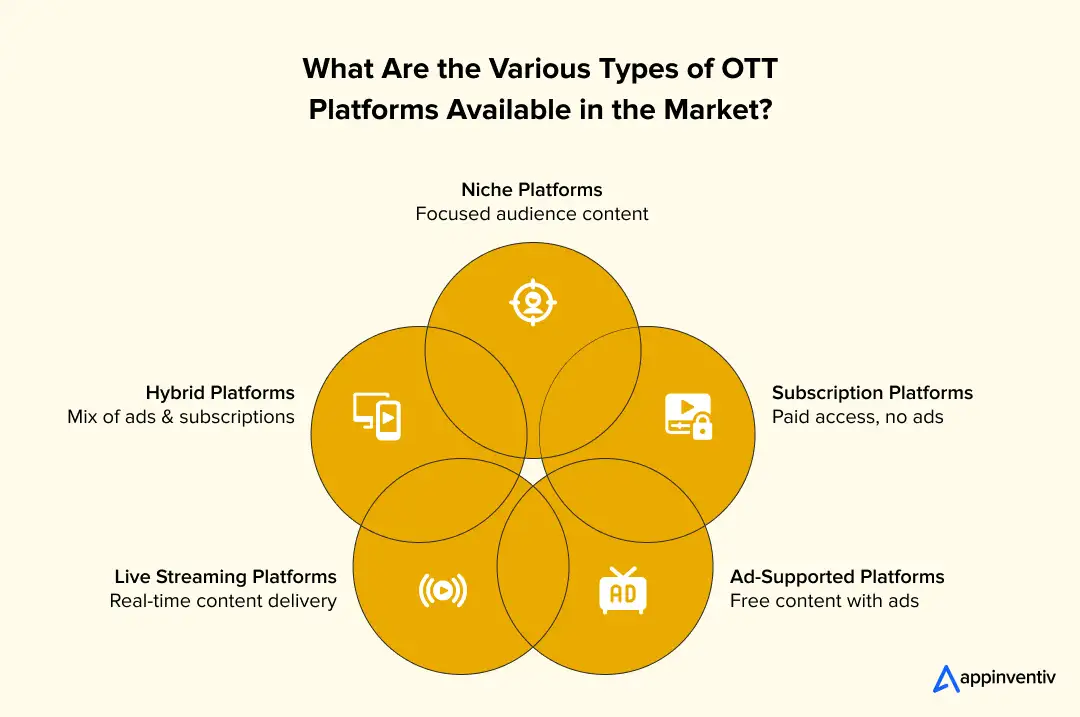
Subscription OTT Platforms
Estimated cost: $300K – $1M+
These platforms run on a paid access model. Much of this shift is driven by movie streaming apps, where users subscribe and expect smooth playback with no interruptions. The focus stays on content depth and ease of discovery.
Typical characteristics:
- User accounts with paid plans
- Large and regularly updated content library
- Personalized feed and suggestions
- No ads during playback
AVOD Platforms (Ad-Supported)
Estimated cost: $200K – $700K
Here, users watch content for free. Revenue comes from ads placed before or during videos. The system tracks user activity to show relevant ads.
Typical characteristics:
- Free access to content
- Ads placed within video playback
- Tracking user behavior for ad delivery
- Longer viewing sessions
Live Streaming OTT Platforms
Estimated cost: $300K – $1.5M+
These platforms stream content as it happens. There is no buffer for delay, so the system has to process and deliver video almost instantly.
Typical characteristics:
- Live video delivery without delay
- Systems built to handle traffic spikes
- Low-latency streaming setup
- Basic interaction during live sessions
Hybrid OTT Platforms
Estimated cost: $250K – $900K
This model mixes paid and free content. Some users subscribe to full access, while others watch limited content with ads.
Typical characteristics:
- Both subscription and ad-based access
- Flexible content access rules
- Combined billing and ad systems
- Balanced viewing experience
Niche OTT Platforms
Estimated cost: $100K – $400K
Knowing how to stand out in the entertainment app market matters most here since these platforms serve a specific, targeted audience
Typical characteristics:
- Limited but focused content library
- Audience built around a specific interest
- Lower system load compared to large platforms
- Faster setup and launch timeline
Key Factors Affecting the Cost of OTT App Development
Two OTT apps can look similar on the surface and still cost very different amounts to build. OTT use already covers about 68.07% of global users, increasing pressure on infrastructure and performance.
The difference shows up in how the system handles load, how content is delivered, and how much intelligence sits behind the scenes. These factors shape both effort and long-term performance.
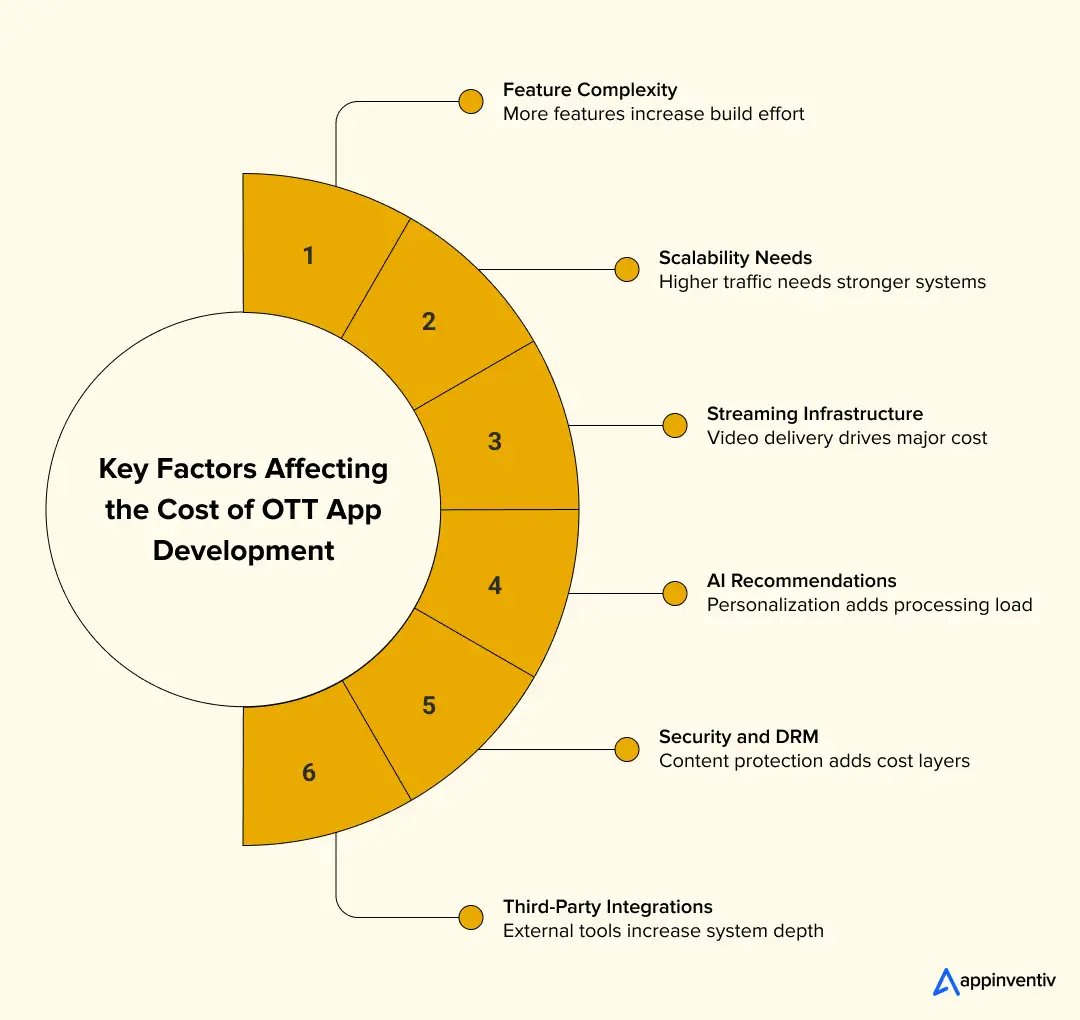
Feature Complexity
Every added feature increases build time and system depth.
- Basic features
Simple browsing, standard playback, limited controls. Faster to build and easier to test. - Advanced features
Offline viewing, multi-device sync, smart search, dynamic feeds. Each feature adds more logic and edge cases.
Scalability Requirements
The system must handle growth without breaking.
- CDN
Moves content closer to users so videos load faster. - Distributed streaming
Splits traffic across servers instead of relying on one system. - Load balancing
Routes requests so no single server gets overloaded.
Real-Time Infrastructure
Live features add constant pressure on the system. Users already spend around 17 hours per week streaming content, which keeps these systems active for long periods.
- Live streaming systems
Process and deliver video as it is created. - Event pipelines
Handle likes, comments, and updates the moment they happen.
AI Recommendation Systems
Personalization requires continuous data processing.
- Personalization engines
Adjust content based on user activity. - ML pipelines
Process large datasets to improve feed accuracy over time.
Also Read: 10 Powerful Ways AI is Transforming OTT Streaming Platforms
Security and DRM Systems
Content needs protection at every stage.
- Encryption
Protects data during transfer and storage. - Piracy prevention
Understanding common OTT security risks early helps restrict access and block unauthorized sharing before they affect your platform.
Third-Party Integrations
External tools add both capability and complexity.
- Payment gateways
Handle subscriptions and billing flows. - Analytics tools
Track user behavior and content performance. - Ad networks
Manage ad delivery and revenue tracking.
Platform-Based Cost Variation in OTT Development
Build cost shifts with the platform. Each one brings its own rules, inputs, and test cycles. The feature list may stay the same, but the work does not.
| Platform | Cost |
|---|---|
| iOS | $80k – $250k |
| Android | $80k – $250k |
| Smart TV | $100k – $300k |
| Web | $100k – $350k |
| Cross-platform | $120k – $300k |
iOS work centers on Apple’s review rules and device checks. Android takes extra time because devices vary widely in screen size and performance. Smart TV apps feel different to build. Users rely on a remote, so focus shifts to simple navigation and clear layouts.
The choice between a mobile app and a web build affects testing time since web versions must handle many browsers and large traffic at once. Cross-platform setups reduce repetitive work, but teams still have to adjust for each device.
Add more platforms, and testing grows fast. That is where the cost starts to climb.
Revenue Generation Strategies That Influence Cost
How a platform makes money shapes how it is built. Each model adds its own system needs. Billing, ads, and access control all change the backend and data flow.
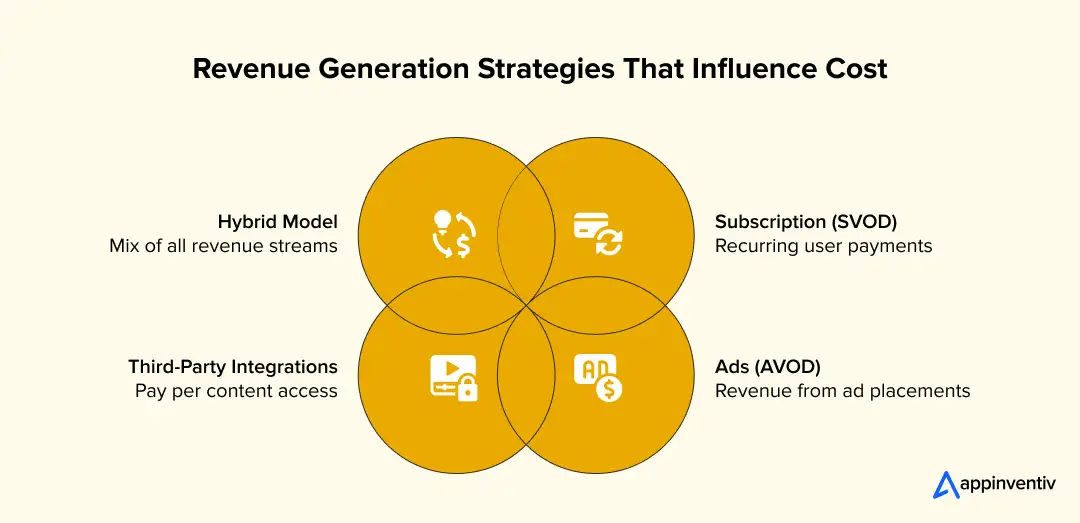
Subscription (SVOD)
Users pay a fixed fee for access.
- Monetization
Monthly or yearly plans with full content access - Infrastructure impact
Requires billing systems, subscription management, and user access control. The system must track active plans and restrict content based on payment status.
Ads (AVOD)
Users watch content for free, and revenue comes from ads.
- Monetization
Ads shown before or during video playback - Infrastructure impact
Needs ad servers, tracking systems, and user behavior analysis. The platform must decide which ad to show and when
Transactional (TVOD)
Users pay for specific content instead of a full subscription.
- Monetization
One-time payments for movies, shows, or events - Infrastructure impact
Requires payment processing for each transaction and content-level access control. The system must unlock content only after purchase.
Hybrid Model
Combines multiple revenue streams.
- Monetization
Mix of subscriptions, ads, and one-time purchases - Infrastructure impact
Brings together billing, ad delivery, and content access systems. This adds complexity since all systems must work together without conflict.
Subscriptions, ads, and transactions depend on stable systems. Weak backend setups disrupt billing, tracking, and user access flows.

Technology-Based Cost Variation
OTT app cost also shifts based on the technologies used under the hood. Some choices add heavy processing and infrastructure load. Others improve speed but still add setup and tuning effort.
| Tech | Role | Cost Impact |
|---|---|---|
| Streaming Protocols (HLS/DASH) | Break video into small chunks for smooth playback across devices | High |
| AI Engines | Power recommendations and content ranking | High (+$50k – $200k) |
| CDN | Deliver video from locations closer to users | High |
| Backend Systems | Handle APIs, user data, and content logic | Medium – High |
| Caching Systems | Store frequently used data to reduce load time | Medium |
Streaming protocols require encoding and delivery setup across multiple formats. AI engines add data processing and model training effort. CDN usage grows with traffic and video volume.
Backend systems scale with features and user activity. Caching reduces load, but it still requires planning for data flow and updates.
Cost Variation by Location
Development costs vary widely by location. Hourly rates vary by region, which directly affects the total budget. The same feature set can cost more or less depending on where the work is done.
| Region | Rate |
|---|---|
| US | $120 – $200/hr |
| Europe | $90 – $150/hr |
| Australia (AUS) | $100 – $160/hr |
| Middle East (ME) | $40 – $120/hr |
Teams in the US and Australia usually sit on the higher end. Europe varies by country and expertise. The Middle East offers a wider range, with both mid and high-tier teams available.
Cost is not just the hourly rate. Experience, delivery speed, and system quality also affect the outcome.
Build vs Customize OTT Platform
Teams usually face a clear choice at the start. Build the platform from scratch or adapt an existing product. The decision shapes OTT platform development cost and how much control you keep over the system.
| Approach | Upfront | Long Term | Risk |
|---|---|---|---|
| Build | High | Controlled | Predictable |
| Customize | Medium | Variable | Integration limits |
Building from scratch takes more time and budget at the start. It gives full control over features, performance, and future changes. This works well for platforms that expect scale or need custom behavior.
Teams looking for a faster start can explore an OTT accelerator, where a base product is already in place and features are adjusted rather than built from scratch. This reduces early cost but creates limits later. Changes depend on the base system’s flexibility.
Choices often come down to long-term plans. Short-term speed favors customization. Long-term scale favors building from the ground up.
Hidden Costs of OTT Development
Some costs do not appear at first. The OTT advertising market alone has reached $205.10 billion, which drives continuous investment in delivery and tracking systems. They appear after launch, once users start watching, and content grows. These costs often increase with usage, not just development.
| Area | Why Cost Increases |
|---|---|
| CDN usage | Video streaming consumes high bandwidth, and the cost rises with view count |
| Storage | Large video files need continuous storage as the content library grows |
| DRM | Licensing and content protection systems add recurring fees |
| DevOps | Systems need monitoring, updates, and uptime management |
| Refactoring | Code changes are required as the platform scales and new features are added |
These costs grow over time. More users, more content, and higher expectations push them up. Planning early helps avoid surprises later.
Understanding Total Cost of Ownership (TCO)
The initial build is only part of the total spend. Once the platform goes live, costs continue through hosting, updates, monitoring, and content growth. Over time, these ongoing expenses often match or exceed the initial build cost.
3-Year Cost Curve
Most OTT platforms follow a similar cost pattern over three years.
- Year 1: 40–50%
The largest share goes into building the product. This includes development, setup, and early infrastructure. Costs stay high during launch and initial growth. - Year 2–3: 50–60%
Spending shifts toward operations. Infrastructure expands as users grow. Storage increases with new content. Teams spend more time on updates, fixes, and performance tuning.
The pattern is simple. Early cost builds the system. Later costs keep it running and growing.
Long-term spend grows with users and content. Systems must support scale without constant rebuild and cost spikes.

How Development Timelines Influence Cost
Time and cost move together. A longer build means more engineering hours, more testing cycles, and more coordination across teams. Short timelines reduce early spend, but they often limit the system’s capacity later.
Typical Development Timeline
Each stage adds its own share of effort.
| Stage | Duration |
|---|---|
| Discovery | 3–4 weeks |
| Design | 4–6 weeks |
| Development | 5–9 months |
| Testing | 4–8 weeks |
Discovery sets the scope and system direction. Design shapes how users interact with the product. Development takes the largest share since it covers backend, frontend, and integrations. Testing checks stability before release.
Timeline vs Cost Impact
The way you plan the timeline affects how the MVP OTT app development cost accumulates, from the lower end to a full multi-region build.
| Approach | Cost Impact |
|---|---|
| MVP | Lower early cost, limited scale and features |
| Scale-Ready Build | Higher upfront cost, supports growth without major changes |
| Multi-Region Setup | Highest upfront cost, built for global traffic and performance |
A shorter path reduces initial spend. A deeper build costs more early but avoids major rework later.
Also Read: The Digestible Guide to Minimum Viable Products (MVP)
How Appinventiv Helps Build OTT Platforms
Building an OTT platform that operates under real-world traffic requires more than just feature delivery. As part of its OTT app development services, the focus stays on how the system behaves when users grow, content expands, and demand spikes.
How Appinventiv approaches OTT systems
- Architecture
Getting app architecture right from the start means distributed systems can separate streaming, users, and content layers without overload. - Streaming infrastructure
CDN-backed delivery and adaptive streaming reduce buffering across regions - AI recommendations
Content is ranked based on user behavior, which improves retention and session time
What this looks like in real projects
- Gully Beat (Movie promotion app)
- Built and launched in under 2 months
- Handled 20,000+ downloads on day one
- Maintained stable performance during peak traffic
- Reelmedia (Multi-app streaming platform)
- Designed for multi-platform content distribution
- Built to handle large media libraries and concurrent users
- Focus on consistent playback across devices
Scale and delivery track record
| Metric | Value |
|---|---|
| Solutions Delivered | 3000+ |
| App Downloads Achieved | 100M+ |
| Client Satisfaction | 95% |
| Experience | 10+ years |
Delays in architecture decisions often lead to higher rebuild costs later. Early design choices determine how well the platform performs under pressure.
If you are estimating OTT app development cost for a new platform, this is the stage where the foundation matters most. Let’s connect and start with a system that is built to handle scale from day one.
FAQ’S
Q. How does CDN and video delivery setup affect OTT app development cost?
A. CDN setup shapes both build cost and long-term spend. Video must be stored, processed, and delivered from multiple locations to avoid buffering. As traffic grows, CDN usage increases with every stream. High-quality playback across regions needs caching, edge delivery, and bandwidth planning, which adds to both setup effort and ongoing cost.
Q. Why do OTT platforms become expensive after launch, not just during development?
A. Most cost appears after users start watching content. Storage grows with every new video. Streaming traffic increases bandwidth usage. Systems need constant monitoring, updates, and scaling. As the platform expands, infrastructure, security, and performance tuning continue to add cost over time.
Q. How does development time affect the cost of building an OTT app?
A. Time and cost move together. A longer build means more engineering hours, more testing, and more coordination. Short timelines keep early costs low but limit scale. A system built fast may need rework later. A longer timeline adds upfront cost but reduces future fixes and performance issues.
Q. How do security measures impact the cost of OTT app development?
A. Security adds extra layers to the system. Encryption, DRM, and secure login flows all take time to build and test. These systems also have licensing and maintenance costs. Skipping them reduces early spend, but it increases risk. Strong security raises cost upfront but protects content and users over time.


Fast 2-minute response, fully NDA-protected.
Top 10+ OTT App Security Risks and How to Block Them
As the demand for on-demand content continues to surge, OTT platforms handle more than just high traffic; they manage vast amounts of user data, digital assets, and third-party integrations with significant security implications. What was once considered a niche service is now a critical infrastructure layer in the global media and entertainment landscape, making it…
OTT Analytics for Businesses: How Streaming Data Drives Revenue, Retention, and Scalable Growth
Key takeaways: OTT growth now depends on data maturity, not content scale, with billions of users driving complex, real-time decision needs. Platforms that act on user behavior in real time see measurable gains in retention, watch time, and revenue per user. A unified analytics architecture connects data, models, and actions, turning raw events into continuous…
10 Powerful Ways AI is Transforming OTT Streaming Platforms
Key takeaways: AI personalization and predictive analytics drive over 80 percent of viewing, increasing retention, watch time, and subscriber lifetime value. Adaptive streaming and AI-driven delivery reduce buffering, cut latency, and lower churn rates by up to 30 percent. Automated moderation and fraud detection reduce operational costs by 50 percent and protect revenue from piracy…














