
































AI in Fintech: Real-World Use Cases & Enterprise Adoption

 Share -


- 01The Strategic Convergence of AI and ML in Fintech
- 02How AI Works Across a Fintech Workflow?
- 03Core AI Technologies Powering Modern Fintech Systems
- 04Top 10 Use Cases of AI in Fintech: With Real Examples
- 05Why Fintech Businesses Are Investing in AI
- 06How to Approach AI Implementation and Integration in Fintech Solutions
- 07Challenges of AI Adoption in Fintech and Their Solutions
- 08
- 09How to Develop an AI Solution for Fintech Operations
- 10Understanding the Cost of Implementing AI in Fintech and its ROI
- 11How Fintech Businesses Can Accelerate Enterprise AI Adoption
- 12How Appinventiv Can Help in AI Implementation for Your Fintech Firm
- 13FAQs

Key takeaways:
- AI in fintech helps financial institutions detect fraud, assess credit risk, automate compliance, personalize services, and improve operational decisions.
- Machine learning, natural language processing, predictive analytics, generative AI, computer vision, and agentic AI support different parts of the financial workflow.
- The most valuable AI applications in fintech begin with a defined business problem, reliable data, measurable performance targets, and clear human-approval rules.
- AI integration in fintech requires secure connections with core banking, payment, CRM, KYC, data, and reporting systems; not merely a standalone model or chatbot.
- Regulatory compliance, explainability, bias, cybersecurity, data quality, and legacy infrastructure remain the main barriers to enterprise-scale adoption.
- The future of AI in fintech will move beyond prediction and content generation toward governed agents that can complete selected financial workflows.
Financial institutions have spent years digitizing transactions. The next competitive shift is about making those transactions, decisions, and customer journeys intelligent. AI in fintech is enabling that shift by helping businesses evaluate risk in real time, detect suspicious activity earlier, automate complex workflows, and personalize financial products at scale.
The commercial momentum is equally significant. The global AI in fintech market is projected to reach $100.5 Billion by 2034, growing at a CAGR of 18.34% between 2026 and 2034. This growth reflects a broader change in financial services: AI is moving from isolated experiments into underwriting, fraud operations, compliance, wealth management, customer support, and executive decision-making. [Source: IMARC Group]
Fintech artificial intelligence now spans predictive models that identify risk, generative systems that interpret documents and conversations, and autonomous agents that complete approved actions across multiple systems. For banks, lenders, insurers, payment companies, and digital wealth platforms, the question is no longer whether AI has a role. The real question is where it can deliver a measurable outcome without weakening security, fairness, or regulatory control.
This blog examines how AI works across the fintech value chain, the technologies behind it, leading applications, business benefits, implementation and integration requirements, adoption challenges, real examples, and the decisions enterprises must make before investing in fintech AI development.
Turn fragmented transaction, risk, and customer data into an AI roadmap tied to measurable business outcomes.
The Strategic Convergence of AI and ML in Fintech
AI and ML in fintech help financial institutions turn customer interactions, transaction data, market signals, and operational information into faster, more accurate decisions. These technologies enable a shift from reactive processes to predictive financial ecosystems.
The strategic impact of AI in fintech includes:
- Stronger fraud detection through real-time risk monitoring
- Faster credit underwriting and risk assessment
- Personalized financial products and customer experiences
- Intelligent automation that reduces costs and manual work
- Predictive analytics for portfolios, liquidity, and business planning
- Continuous regulatory compliance, governance, and reporting
- Improved operational efficiency and revenue opportunities
- Better executive decision-making across the financial services value chain
Together, AI and machine learning are becoming strategic assets for financial institutions competing with digital-native fintech companies. The following use cases show how these capabilities are transforming the financial services sector.
How AI Works Across a Fintech Workflow?
AI in fintech converts financial data into a prediction, recommendation, generated response, or approved action. The exact architecture changes by use case, but the operating flow generally follows six stages.
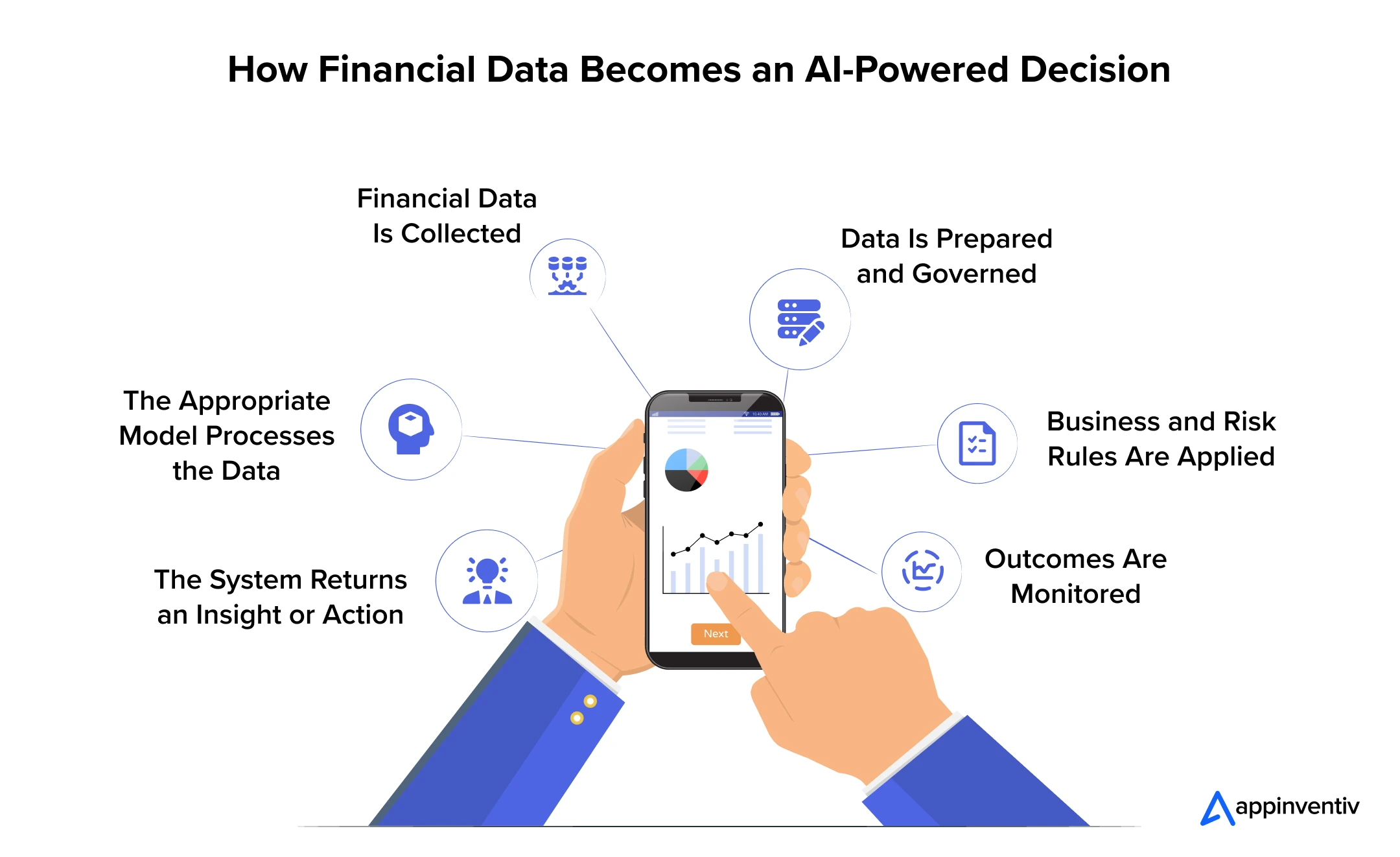
1. Financial Data Is Collected
The system receives structured and unstructured data from transaction ledgers, banking APIs, customer profiles, credit records, market feeds, support conversations, device signals, identity documents, and external risk databases. Data permissions and usage restrictions should be defined at this stage.
2. Data Is Prepared and Governed
Duplicate, incomplete, or inconsistent records are cleaned before use. Sensitive fields can be encrypted, masked, tokenized, or excluded. Data lineage records where information came from, how it changed, and which models may use it.
3. The Appropriate Model Processes the Data
Machine learning models identify patterns and calculate probabilities. Natural language systems interpret text and speech. Generative models summarize, explain, or draft content. Agentic systems use tools and APIs to complete an approved sequence of tasks.
4. Business and Risk Rules Are Applied
A prediction does not automatically become a financial decision. The output is checked against credit policy, transaction limits, fraud thresholds, compliance obligations, customer consent, and human-review requirements.
5. The System Returns an Insight or Action
Depending on its authority, the system may flag a payment, recommend a credit limit, summarize a KYC file, respond to a customer, route an investigation, or execute a low-risk task through a connected application.
6. Outcomes Are Monitored
Teams track accuracy, false positives, drift, fairness, response time, cost, overrides, and business results. New outcomes feed back into controlled model evaluation and retraining cycles. This monitoring layer is essential because financial behavior, fraud patterns, and regulatory expectations change continuously.
Core AI Technologies Powering Modern Fintech Systems
AI technologies in fintech do not perform the same job. Each technology is suited to a different type of financial data, decision, or workflow. Enterprises often combine several of them within one product.
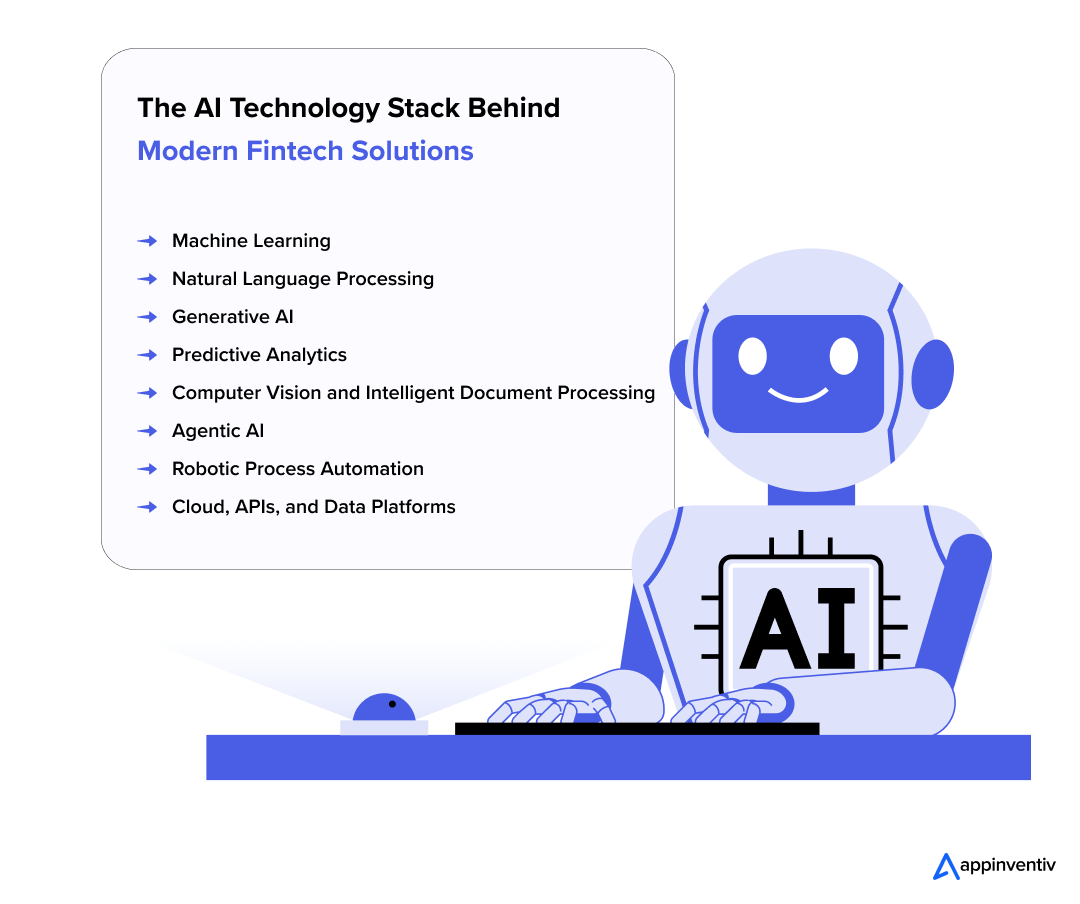
Machine Learning
Machine learning analyzes historical and real-time data to identify patterns that fixed rules may miss. It supports credit scoring, fraud detection, customer churn prediction, transaction categorization, pricing, and portfolio risk analysis. AI and machine learning in fintech become particularly valuable when decisions must adjust as new behavior emerges.
Natural Language Processing
Natural language processing helps systems interpret customer messages, contracts, policies, analyst reports, regulatory updates, and call transcripts. It powers document classification, sentiment analysis, complaint routing, compliance review, and conversational AI in financial services.
[Also Read: NLP Applications and Use Cases For Modern Enterprises]
Generative AI
Generative AI in fintech can summarize lengthy documents, draft customer communication, explain financial information, support analysts, generate reports, and retrieve answers from approved knowledge sources. Because generative models can produce inaccurate content, high-impact outputs require grounding, validation, and human review.
Predictive Analytics
Predictive analytics combines statistical techniques and machine learning to estimate future outcomes. Fintech companies use it to forecast defaults, cash flow, liquidity needs, churn, market movements, claims, and suspicious transactions.
Computer Vision and Intelligent Document Processing
Computer vision extracts and validates information from identity documents, bank statements, invoices, cheques, and application forms. When combined with OCR and fraud models, it can accelerate onboarding while detecting altered documents or mismatched identity details.
Agentic AI
Agentic AI in fintech moves from recommending an action to completing a controlled, multi-step workflow. An agent may collect missing application data, verify it through approved sources, update a case-management system, request human approval, and notify the customer. Its access must be limited by identity, permissions, transaction thresholds, audit logs, and escalation rules.
Robotic Process Automation
RPA in finance executes repeatable, rules-based tasks across older applications. It does not learn independently, but it can work alongside AI. For example, an AI model may classify a document while an RPA bot enters the approved information into a legacy core system.
Cloud, APIs, and Data Platforms
Cloud infrastructure supplies scalable compute and model services, APIs connect AI with financial applications, and modern data platforms provide governed access to usable information. These components are not AI models, but they determine whether AI integration in fintech can operate reliably at enterprise scale.
Top 10 Use Cases of AI in Fintech: With Real Examples
The most valuable use cases of AI in fintech address a clear risk, revenue, operational, or customer need. Here is how AI is improving critical financial workflows.
Algorithmic Trading
Algorithmic trading uses machine learning algorithms to study structured and unstructured market data, identify patterns, forecast prices, and execute trades with limited human intervention. It remains one of the leading use cases of AI in the fintech industry.
Real Example: XTX Markets
XTX Markets uses ML to analyze market data and develop statistical trading models. The firm also invested around $199 million in AI chips to strengthen its computing capabilities back in 2024.
Underwriting and Credit Scoring
The role of AI in fintech lending extends beyond conventional credit scores. AI can assess repayment history, income, rent, utility payments, and other approved data to support faster and more inclusive credit decisions.
Real Example: Zest AI
Zest AI provides AI-powered lending technology to more than 175 clients that collectively served over 110 million users in 2023. [Source: FINSMES]
Customer Service Automation
Virtual assistants handle routine requests, such as balance checks, account updates, and loan queries. More advanced AI use cases in fintech also include ticket routing, personalized responses, and human escalation when a request needs further review.
Real Example: Bank of America’s Erica
Bank of America’s Erica demonstrates how AI in financial services can deliver support at scale. The assistant has handled millions of customer interactions since its 2018 launch. [Source: PYMNTS]
Fraud Detection and Prevention
Traditional tools flag transactions using fixed rules. AI studies transaction, device, location, and behavioral data to spot suspicious activity and adapt to emerging fraud patterns. This makes fraud prevention one of the most important applications of artificial intelligence in fintech.
Real Example: Ally Financial
Ally Financial combines AI with RPA in finance to identify synthetic identity fraud in auto lending. Its system cross-checks applicant data against known fraud indicators, including dark-web information. [Source: Auto Finance News]
Personalized Banking
Applications of AI in finance include personalized spending insights, savings guidance, financial reminders, and suitable product recommendations. By interpreting customer behavior, AI can make digital banking more relevant to each user.
Real Example: Cleo
Cleo uses generative AI in fintech to deliver personalized budgeting insights and savings guidance. Its AI-led experience helped the company double its ARR to $185 million. [Sources: Cleo]
Compliance Automation
AI can extract information from documents, automate KYC checks, identify anomalies, and monitor customer activity. As AI integrations grow, businesses must also address evolving fintech cybersecurity risks across models, data, and connected systems.
Real Example: ING Bank
ING uses generative AI in the fintech market to support KYC analysis. Its large language models summarize customer information and help analysts evaluate geographical and product-related risks. [Source: Bank Automation News]
Portfolio Management
AI systems analyze market conditions, investor preferences, and risk tolerance to adjust asset allocation. Reinforcement learning can also help balance risk and return as conditions change.
Real Example: Schroders Capital
Schroders Capital introduced a generative AI analyst platform to accelerate investment research and reduce repetitive work. It also reflects the expanding role of conversational AI in financial services. [Source: Schroders Capital]
Also read: AI Portfolio Management for Large Enterprises
Anti-Money Laundering
AI applications in fintech can examine large transaction volumes and flag unusual fund movements, sudden international transfers, or activity that conflicts with a customer’s profile. This reduces false positives and helps investigators focus on higher-risk cases.
Real Example: HSBC
HSBC’s AI-powered Dynamic Risk Assessment system improved financial-crime detection by two to four times and reduced transaction-analysis time from weeks to days. [Source: HSBC]
Financial Forecasting
Fintech AI development allows businesses to combine historical records with market movements, economic indicators, social sentiment, and customer behavior. These models generate forecasts that support budgeting, investment, and liquidity decisions.
Real Example: Goldman Sachs
Goldman Sachs uses generative AI tools, including its GS AI assistant and Developer Copilot, to improve forecasting, productivity, and client service. [Source: Markets Media Group]
Climate Finance and Investment Tracking
AI and NLP help financial institutions examine emissions data, climate exposure, and green investments. These AI solutions in fintech can support ESG reporting, portfolio assessment, and net-zero planning.
Real Example: BNP Paribas
BNP Paribas uses NLP and large language models to estimate missing emissions data and strengthen climate-risk analysis. This application shows how the future of AI in finance may support both investment and sustainability decisions. [Source: BNP Paribas CIB]
As chatbots begin supporting loan approvals and insurance claims, businesses must understand how agentic AI in banking works across permissions, PCI DSS architecture, RAG controls, and compliance monitoring.
Now that you have looked into the multiple AI use cases in financial services, let us examine the business value driving fintech companies to invest in these technologies.
Prioritize the use case with the strongest data foundation, clearest control boundary, and fastest path to ROI.

Why Fintech Businesses Are Investing in AI
The benefits of AI in fintech become measurable when the technology improves a specific financial or operational outcome. For fintech businesses, this means faster decisions, lower processing costs, stronger risk controls, more relevant customer experiences, and the ability to scale without increasing manual effort at the same rate.
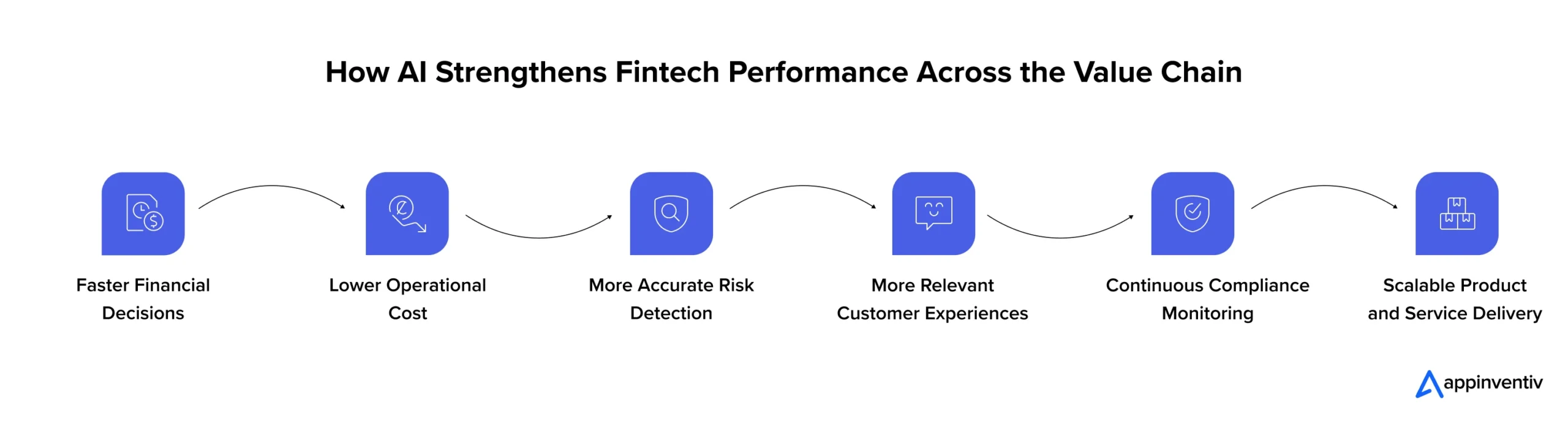
Faster Financial Decisions
AI can evaluate more signals in less time, allowing institutions to accelerate underwriting, identity verification, fraud screening, portfolio analysis, and customer support. Faster processing can improve conversion without removing controls from high-risk decisions.
Lower Operational Cost
Automation reduces time spent on document review, data entry, case triage, reconciliation, reporting, and repetitive customer requests. Employees can then focus on exceptions, complex investigations, and decisions that require judgment.
More Accurate Risk Detection
Models can identify subtle relationships across transaction, device, behavioral, and historical data. This improves the institution’s ability to detect suspicious activity, estimate default probability, and prioritize cases for review.
More Relevant Customer Experiences
Fintech AI can tailor insights, products, reminders, and support to a customer’s current financial context. This creates a more useful experience than broad segmentation or identical offers sent to every user.
Continuous Compliance Monitoring
AI solutions for fintech businesses can screen transactions, extract KYC information, identify missing documentation, monitor policy changes, and surface cases that require review. The compliance team remains responsible for policy, interpretation, escalation, and evidence.
[Also Read: Top 12 Compliance Pitfalls in FinTech App Development and How to Avoid Them]
Scalable Product and Service Delivery
Once the supporting data, controls, and integrations are in place, AI can help an institution serve more users and process higher transaction volumes without increasing manual effort at the same rate.
How to Approach AI Implementation and Integration in Fintech Solutions
AI implementation in fintech solutions should begin with the financial workflow, not with a model selected in isolation. The business must know which decision will improve, which systems are involved, what data can be used, and where human approval remains mandatory.
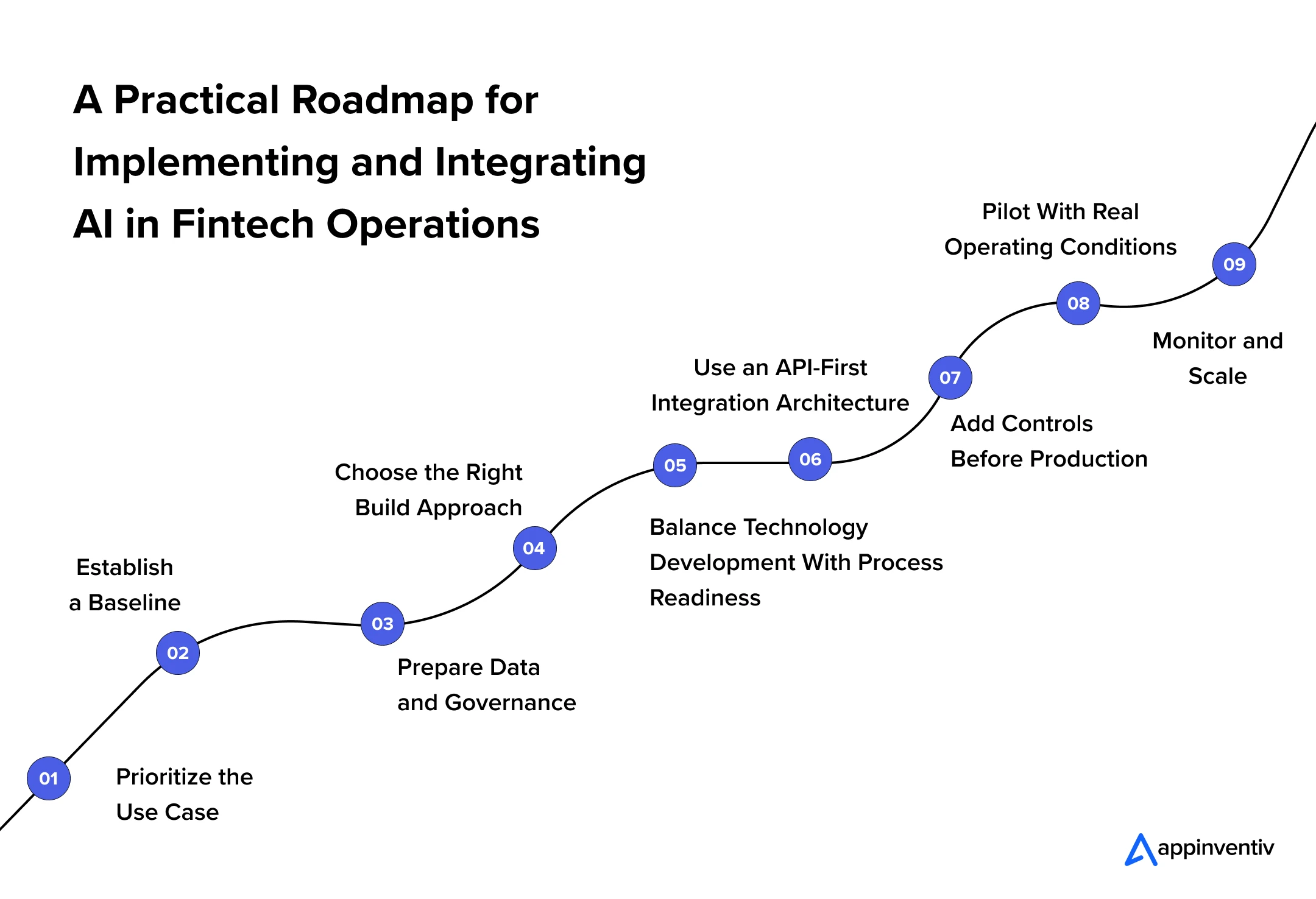
1. Prioritize the Use Case
Compare opportunities by business value, data readiness, regulatory exposure, integration effort, and time to measurable results. Fraud triage, document processing, internal knowledge retrieval, and service routing can provide practical starting points because their outcomes are easier to define.
2. Establish a Baseline
Record the current false-positive rate, approval time, cost per case, manual effort, conversion rate, loss rate, or customer resolution time. Without a baseline, the business cannot demonstrate whether AI created value.
3. Prepare Data and Governance
Define data ownership, consent, retention, residency, access, lineage, and quality standards. Training and evaluation datasets should represent the customers and scenarios the system will encounter.
4. Choose the Right Build Approach
A fintech company may use a commercial model, customize an existing foundation model, develop a specialized model, or combine these approaches. The decision depends on differentiation, explainability, latency, cost, intellectual property, and regulatory requirements.
5. Balance Technology Development With Process Readiness
A practical AI implementation plan should not focus entirely on model development. Fintech businesses can use the 30/70 approach as a planning principle, directing around 30% of the effort toward the model and supporting technology and 70% toward data preparation, integration, compliance, workflow redesign, testing, and employee readiness. The actual allocation will vary by project, but the principle helps teams account for the work required beyond building the model.
6. Use an API-First Integration Architecture
An API-first architecture allows AI systems to exchange approved data with core banking, payment, CRM, KYC, lending, and case-management platforms without creating tightly coupled dependencies. Secure API gateways can control authentication, permissions, request limits, monitoring, and data exposure across these connections.
Where APIs are unavailable, middleware, event streams, or RPA can connect AI with legacy financial systems. This allows institutions to introduce new intelligence without immediately replacing their entire core infrastructure.
7. Add Controls Before Production
Use role-based access, encryption, audit trails, model validation, explainability, transaction limits, human-in-the-loop approval, fallback logic, and incident-response procedures. Generative and agentic systems also need grounding, prompt-injection defenses, tool permissions, and output validation.
8. Pilot With Real Operating Conditions
Run the system on a limited customer group, product, geography, or internal workflow. Test ordinary cases, edge cases, attempted abuse, system failures, and regulatory exceptions before expanding access.
9. Monitor and Scale
Track model and business performance together. Accuracy, drift, bias, latency, token or infrastructure cost, false positives, manual overrides, customer complaints, and financial impact should determine whether the system is retrained, redesigned, expanded, or paused.
Challenges of AI Adoption in Fintech and Their Solutions
Implementing AI across financial operations introduces concerns related to data, regulation, infrastructure, cost, and accountability. The following measures can help fintech businesses address these challenges before scaling AI systems.
| Challenge | Impact on Fintech Businesses | Recommended Solution |
|---|---|---|
| Data Privacy and Security | Sensitive identity, credit, transaction, and behavioral data may be exposed. | Apply encryption, tokenization, data masking, role-based access, network segmentation, and continuous monitoring. |
| Regulatory Compliance | AI must meet privacy, AML, KYC, lending, consumer-protection, recordkeeping, and model-risk requirements. | Map regulations to each use case and involve legal and compliance teams throughout the AI lifecycle. |
| Bias and Unfair Outcomes | Biased data may produce unfair lending, pricing, underwriting, or fraud decisions. | Use representative data, fairness testing, explainability tools, independent validation, and appeal processes. |
| AI Hallucinations and Unreliable Outputs | Generative AI may produce incorrect financial explanations, summaries, or customer responses. | Ground outputs in approved data, apply business rules, show sources, and require human review for high-risk communication. |
| Legacy-System Integration | Older systems may lack real-time APIs and standardized data formats. | Use secure APIs, middleware, event streams, or RPA and modernize in phases. |
| High Costs and Capability Gaps | Fintech AI development requires expertise in data, AI, cybersecurity, compliance, cloud, and finance. | Start with one high-value use case, measure results, build capabilities, and use external specialists where needed. |
| Agent Autonomy and Accountability | Agentic AI in fintech can act across systems, making accountability harder. | Assign owners, restrict access and transaction limits, retain audit logs, add kill switches, and require human approval. |
How to Develop an AI Solution for Fintech Operations
Developing an AI-powered fintech solution requires more than training a model. The system must process financial data securely, connect with existing platforms, explain critical decisions, and remain reliable under changing market and customer conditions.
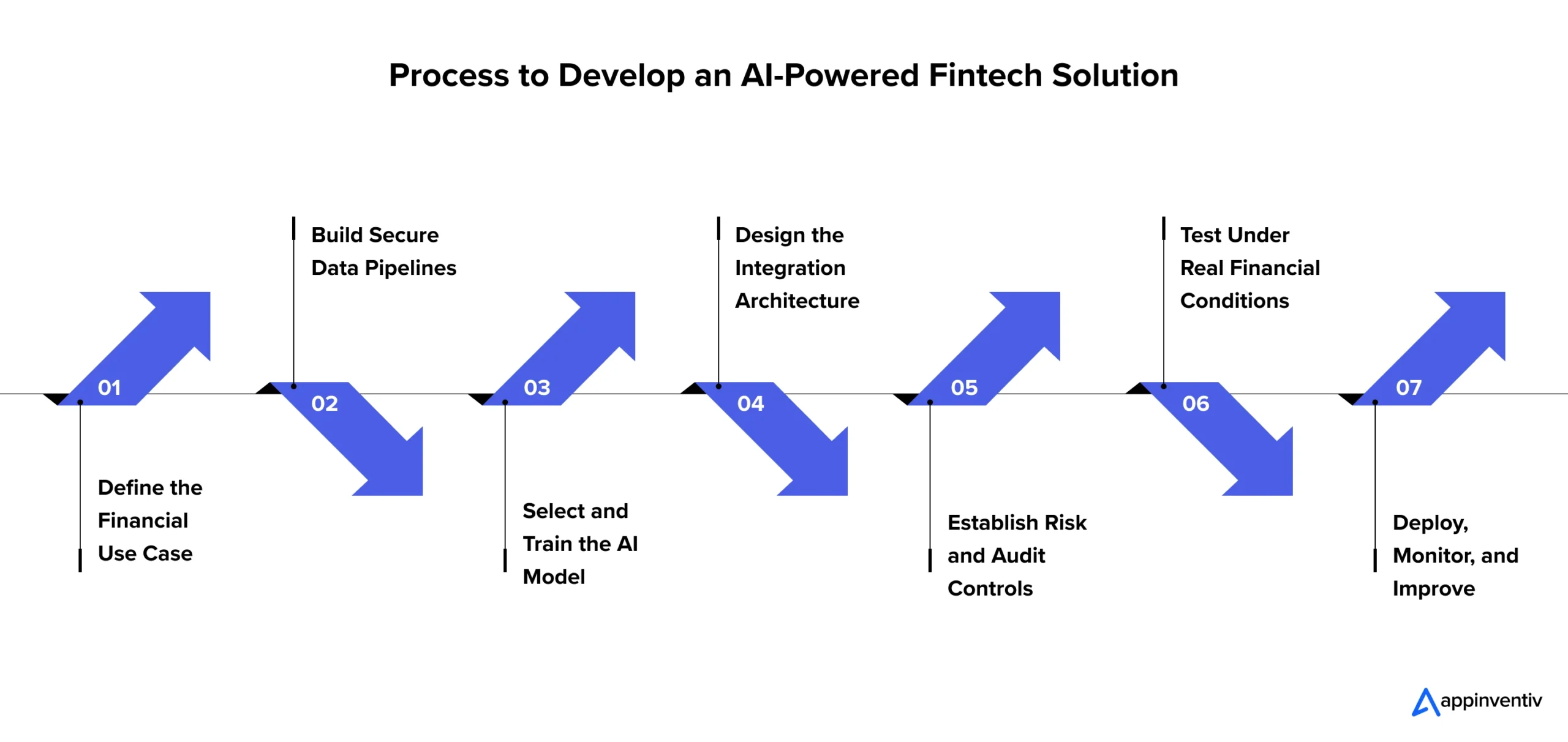
Define the Financial Use Case
Start with a specific problem, such as fraud detection, credit assessment, KYC automation, customer support, or financial forecasting. Define the expected outcome, required data, regulatory exposure, and success metrics before selecting the technology.
Build Secure Data Pipelines
Create pipelines that collect, clean, validate, and process data from transaction systems, customer records, market feeds, credit databases, and third-party sources. Apply encryption, masking, access controls, and data-retention rules throughout the pipeline.
Select and Train the AI Model
Choose predictive, generative, conversational, or agentic models based on the intended workflow. Train or customize the model using representative financial data, then evaluate its accuracy, fairness, explainability, and performance across different customer groups.
Design the Integration Architecture
Use secure APIs, middleware, event streams, or RPA to connect the AI system with core banking platforms, payment gateways, CRM tools, KYC providers, loan-origination systems, and case-management software.
Establish Risk and Audit Controls
Record the data used, model version, output, approval, override, and resulting action for every critical decision. Add explainability, transaction limits, human-review rules, rollback procedures, and complete audit trails.
Test Under Real Financial Conditions
Test normal transactions, incomplete records, unusual behavior, attempted fraud, model failures, system outages, and regulatory exceptions. A limited pilot can reveal operational issues before the solution reaches a larger customer base.
Deploy, Monitor, and Improve
Monitor accuracy, false positives, response time, model drift, bias, security incidents, infrastructure cost, and business outcomes after deployment. Retrain or revise the system when performance falls below approved thresholds.
Unify data, intelligence, and automation across your financial operations.
Understanding the Cost of Implementing AI in Fintech and its ROI
The cost of implementing AI in fintech typically ranges from $40,000 to $500,000 or more, depending on the use case, data readiness, model complexity, security requirements, and integration scope. A focused internal solution costs less than an enterprise platform operating across multiple financial systems and regulated workflows.
| Solution Type | Estimated Cost | Typical Scope |
|---|---|---|
| AI Proof of Concept | $40,000–$75,000 | One use case, limited data, basic model validation, and controlled testing |
| Production-Ready AI Solution | $75,000–$200,000 | Custom models, secure APIs, workflow integration, dashboards, and compliance controls |
| Enterprise Fintech AI Platform | $200,000–$500,000+ | Multiple use cases, legacy integrations, advanced governance, high availability, and continuous monitoring |
These are indicative ranges for availing dedicated fintech AI solutions. The final investment depends on several factors:
- Quality and availability of financial data
- Predictive, generative, conversational, or agentic AI model requirements
- Integration with banking, payment, CRM, KYC, lending, and reporting systems
- Security, explainability, audit, and regulatory controls
- Cloud infrastructure and transaction volumes
- Testing, model monitoring, maintenance, and retraining
- Degree of workflow automation and human oversight
How to Measure ROI From AI in Fintech
ROI should be measured against the business performance recorded before implementation. Depending on the use case, fintech businesses can track:
- Reduction in fraud losses and false positives
- Lower cost per transaction, case, or customer interaction
- Fewer manual review and processing hours
- Faster credit, KYC, and compliance decisions
- Higher approval, conversion, or customer-retention rates
- Fewer compliance exceptions and operational errors
- Increased transaction capacity without proportional workforce growth
A simple calculation is:
ROI = [(Financial Gains + Costs Avoided − Total AI Investment) ÷ Total AI Investment] × 100
The total AI investment should include data preparation, development, integration, infrastructure, compliance validation, employee training, monitoring, and ongoing maintenance. Fintech businesses can reduce investment risk by starting with a high-value use case, establishing baseline metrics, running a controlled pilot, and expanding only after measurable value is demonstrated.
How Fintech Businesses Can Accelerate Enterprise AI Adoption
Developing an AI solution is only the first step. Successful AI adoption in financial services depends on whether employees trust it, regulators can assess it, existing systems support it, and leadership can measure its business impact.
Turning Fintech AI Pilots Into Enterprise-Wide Adoption
Secure Executive and Regulatory Alignment
Business, technology, risk, compliance, and legal leaders should agree on the use case, acceptable risk, decision ownership, and regulatory requirements before development begins.
Prepare Teams for AI-Enabled Workflows
Employees must understand when to use the system, how to interpret its output, and when to override or escalate a decision. Role-specific training helps prevent both blind reliance and resistance.
Address Employee Resistance Early
Employees may resist AI when they do not understand how it affects their responsibilities or fear that automated recommendations will replace their judgment. Leaders should explain the intended role of AI, involve operational teams during workflow design, and show where human review remains essential.
Start With a Controlled Deployment
Launch the solution within one product, market, customer group, or internal workflow. A limited rollout allows teams to validate performance and correct operational issues before wider adoption.
Keep Humans in High-Impact Decisions
Credit declines, account restrictions, large transactions, and compliance escalations should retain appropriate human review. Clearly defined approval boundaries improve trust and accountability.
Measure Adoption Alongside Model Performance
Accuracy alone does not prove adoption. Teams should also track usage, employee overrides, processing time, completion rates, customer complaints, operational savings, and business outcomes.
Build an Operating Model for Scale
Assign clear ownership for model performance, data quality, security, compliance, incident response, and retraining. This prevents successful pilots from stalling when they move into production.
Expand Only After Proving Value
Once the first deployment meets its performance, compliance, and commercial targets, the institution can extend the foundation to other products and workflows.
How Appinventiv Can Help in AI Implementation for Your Fintech Firm
Successful AI implementation requires more than choosing a model. Fintech firms need a clear business case, reliable data, secure integrations, regulatory controls, and a practical plan for scaling. Through our AI consulting services, we help organizations prioritize the right AI use cases, assess data readiness, define governance frameworks, and align each initiative with business and compliance requirements.
Our AI development services turn these plans into production-ready AI solutions. We use advanced machine learning frameworks to develop systems for fraud detection, transaction monitoring, credit scoring, customer service automation, risk analysis, financial forecasting, and robo-advisory services.
Our capabilities extend from initial strategy and development to testing, deployment, integration, and continuous monitoring. This end-to-end approach enables us to deliver custom fintech software development that is secure, compliant, scalable, and built around measurable business outcomes.
FAQs
Q. How is AI used in fintech?
A. Artificial intelligence (AI) in financial services automates and personalizes financial services, thereby enhancing efficiency and user experience. AI in the fintech industry is used in fraud detection/prevention, credit scoring and risk assessment analysis, customer service automation via AI-powered chatbots, personalized financial recommendations, and predictive analysis for lending and insurance.
Q. Should a fintech company build a custom AI solution or use an existing model?
A. Existing models can reduce development time for general tasks such as summarization, document classification, and internal knowledge search. Custom models offer greater control when the workflow involves proprietary financial data, specialized risk logic, strict latency requirements, or a capability that differentiates the business.
Many fintech companies use a hybrid approach. They combine an existing model with their own data, rules, integrations, and security controls.
Q. How can AI be integrated with legacy fintech systems?
A. Secure APIs are the preferred option when existing systems support them. Middleware and event streams can manage data exchange between AI services and core financial applications. RPA may be used when older platforms lack modern integration capabilities.
A phased approach allows businesses to add AI without replacing the entire core system at once.
Q. How long does it take to develop and implement an AI fintech solution?
A. A focused proof of concept may take a few weeks, while a production-grade system can take several months. The timeline depends on data readiness, model complexity, integration requirements, regulatory reviews, security testing, and the number of financial workflows involved.
Projects usually take longer when data is fragmented or core systems lack secure integration options.
Q. How much does it cost to implement AI in fintech?
A. The cost of implementing AI in fintech typically varies between $40,000 and $500,000 or more. A proof of concept may range from $40,000 to $75,000, a production-ready solution from $75,000 to $200,000, and an enterprise AI platform from $200,000 to $500,000+.
The final cost depends on data readiness, model complexity, system integrations, security, compliance, cloud infrastructure, monitoring, and ongoing maintenance.
Q. How can a fintech business measure whether its AI investment is working?
A. Model accuracy is only one measure. Businesses should compare the system against the performance recorded before implementation.
Relevant metrics may include:
- Fraud losses and false positives
- Credit-decision turnaround time
- Cost per processed case
- Manual review hours
- Customer-resolution rates
- Employee overrides
- Compliance exceptions
- Revenue or conversion improvement
Q. What is required to scale agentic AI safely in fintech?
A. Every AI agent needs a defined owner, limited system identity, approved tools, transaction boundaries, and clear escalation rules. The institution should be able to trace every action and stop the agent immediately if it behaves unexpectedly.
High-impact activities such as credit declines, account restrictions, large transfers, and regulatory submissions should retain human approval.
Q. Why should fintech businesses choose Appinventiv for AI development?
A. Appinventiv brings fintech consulting, AI engineering, product development, system integration, cloud, security, and compliance expertise into one delivery model. We help businesses move from an initial AI opportunity to a production-ready solution connected with their existing financial infrastructure.
Our fintech AI development capabilities cover:
- Fraud detection and transaction monitoring
- Credit scoring and underwriting
- KYC and AML automation
- Conversational financial services
- Predictive analytics and forecasting
- Generative and agentic AI systems


Fast 2-minute response, fully NDA-protected.

Cost of Developing a Payment Gateway: A Complete Breakdown
Key takeaways: Custom gateway development requires $50,000 to $500,000 in upfront capital, and enterprise platforms cost more at scale. Core infrastructure, security compliance, and settlement logic consume far more budget than basic checkout screens. High transaction volumes require concurrency controls, failover systems, monitoring tools, and automated reconciliation engines. Platform ownership creates recurring costs for security…

How Much Does RegTech Software Development Cost in the UK in 2026?
Key takeaways: RegTech software development cost in the UK spans £40,000 to £400,000+, with regulatory scope and legacy integration depth driving the cost. High-performance systems deliver a 30% to 50% reduction in manual workloads, protecting enterprises from severe FCA penalties. Advanced AI features generally represent around 25–40% of the total project investment due to the…

Building Next-Generation Digital Payment Systems for Australia's NPP Economy
Key takeaways: Australia's NPP is approaching 1.82 billion real-time transactions annually; BECS decommissioning by 2030 creates a hard migration deadline that cannot be managed through incremental patches. The July 2026 Payday Super mandate makes real-time payment infrastructure a legal compliance requirement. Enterprises without NPP-capable payroll systems are already operating against a regulatory clock. NPP platform…