

































How Agentic AI is Revolutionizing the Financial Sector: A Deep Dive for the C-Suite

 Share -



- 01From Automation to Autonomy: The Operating Model Shift in Finance
- 02How Agentic AI Systems Work in Enterprise Finance Environments
- 03Key Applications and Benefits of Agentic AI in Finance
- 04Top AI Finance Tools and Platforms Enabling Agentic Workflows
- 05Impact on Finance Professionals and Enterprise Performance
- 06Key Considerations for Enterprise Adoption
- 07Implementation Roadmap for C-Suite Leaders
- 08Challenges Enterprises Must Address
- 09The Future of Autonomous Finance (2026–2030 Outlook)
- 10Why Appinventiv for Agentic AI in Finance
- 11FAQs

Key takeaways:
- Agentic AI executes end-to-end financial workflows, reducing cycle times, errors, and manual dependencies across enterprise finance systems.
- Continuous finance operations replace batch processing, enabling real-time reconciliation, reporting, and decision-making across integrated financial ecosystems.
- Enterprises adopting agentic systems achieve measurable gains in cost reduction, forecasting accuracy, and operational efficiency across core finance functions.
- Agentic AI shifts finance teams from execution roles to strategic oversight, improving risk control, planning accuracy, and business alignment.
- Early adopters will gain a competitive advantage through faster decision cycles, stronger compliance control, and scalable, system-driven financial operations.
Agentic AI in finance is reshaping how enterprise finance operations run. Finance teams no longer operate on delayed monthly cycles while payments, market signals, and compliance demands move in real time. Yet most enterprises still rely on AI-powered automation in finance, built on fixed rules.
These systems process invoices, match entries, and generate reports, but they cannot decide the next step or execute workflows independently. That gap slows reconciliation, reporting, and risk management across financial systems.
Agentic AI in financial services introduces a different operating model. These systems analyze incoming data, determine what requires attention, and act across ERP platforms, banking APIs, and internal data systems without step-by-step instructions.
Adoption is accelerating quickly, with 57% of finance teams already implementing or planning to implement agentic AI capabilities.
As compliance pressure and operational complexity grow, enterprises are moving toward systems that continuously reconcile transactions, detect anomalies earlier, and support real-time financial decision-making.
Enterprises have already cut delays and reduced costs using agentic AI systems. Waiting now increases operational and competitive risk.

From Automation to Autonomy: The Operating Model Shift in Finance
Artificial intelligence in financial services has evolved in clear stages. Each stage increased speed through intelligent automation, but control still stayed with humans. That is now changing.
Early systems followed fixed rules. They processed entries based on predefined logic. Later, predictive models added pattern recognition. These models could flag risk or forecast trends, but they still depended on human action.
Agentic systems go a step further. They do not wait for instructions. They decide what to do, then execute tasks across systems.
How Finance Systems Have Evolved
| Stage | Core Function | Limitation |
|---|---|---|
| Rule-based systems | Execute predefined workflows | No adaptability |
| Predictive AI | Identify patterns and risks | No direct execution |
| Agentic systems | Decide and act across workflows | Requires governance and control |
This shift in artificial intelligence in financial services changes how finance operates at a system level.
Agentic AI vs Traditional AI in Finance
| Capability | Traditional AI | Agentic AI |
|---|---|---|
| Role | Assists decision-making | Executes workflows end-to-end |
| Workflow | Single-step or isolated tasks | Multi-step, cross-system execution |
| Data usage | Analyzes historical data | Uses real-time + contextual data |
| Action | Requires human intervention | Acts autonomously across systems |
| Integration | Limited system interaction | Deep integration with ERP, APIs, and data layers |
Traditional systems help teams analyze data. Agentic systems take the next step and act on that data across workflows.
What Changes in Practice
- AI agents in finance no longer just assist with tasks. They complete them.
- Workflows run across tools without manual handoffs.
- Decisions happen during execution, not after reports are generated.
A reconciliation process is a good example. Earlier systems matched entries and flagged mismatches. A human reviewed and resolved them. An agentic banking system detects mismatches, pulls missing data, validates entries, and closes the gap on its own.
Core Capabilities That Enable This Shift
- Goal-driven execution
Systems receive an objective, such as closing books or validating transactions, and plan steps to achieve it. - Multi-step reasoning
Tasks are broken into smaller actions. Each step depends on the result of the previous one. - Tool and API interaction
Agents connect with ERP systems, banking APIs, and data platforms to fetch and update information. - Context-aware decision-making
Systems track past actions, current financial state, and external signals before acting.
This is the core distinction in agentic AI vs. traditional AI in finance; one follows instructions, the other turns finance into a connected system that runs continuously.
How Agentic AI Systems Work in Enterprise Finance Environments
Agentic AI in financial services does not sit on top of finance stacks as a simple tool. It operates inside the flow of data, decisions, and execution. They connect systems that usually work in isolation and act across them in real time.
At a system level, they follow a repeatable loop and rely on a set of tightly connected layers.
The Agent Execution Cycle
Every agent follows a simple cycle:
- Input: The system receives data. This can include transactions, ledger updates, alerts, or queries.
- Reasoning: The agent evaluates the data against rules, historical context, and current financial state.
- Action: It performs tasks such as posting entries, validating records, or triggering workflows.
- Feedback: The system records outcomes, updates its state, and prepares for the next step.
This loop runs continuously. It allows AI agents in finance operations to move from batch execution to real-time handling.
Core System Layers
Agentic systems depend on a layered structure. Each layer has a clear role.
- Orchestration layer: This layer manages planning and decision flow. It uses LLMs and task planners to break goals into steps.
- Data layer: It handles structured and unstructured data. Sources include transaction logs, ledgers, and external feeds.
- Tooling layer: This layer connects with ERP systems, banking APIs, and compliance tools. It executes actions across systems.
- Memory layer: It stores context such as past transactions, decisions, and system states. This supports consistent execution.
- Governance layer: It enforces policies, tracks actions, and maintains audit logs. It defines access and control boundaries.
These systems rely on a set of core building blocks that work together during execution.
Large language models handle reasoning and task planning. Retrieval mechanisms pull data from internal systems and external sources when needed. This includes retrieval-augmented generation, where the system combines stored knowledge with live data before taking action.
Different agent types handle different responsibilities. Orchestrator agents manage workflow and decide the sequence of steps. Utility agents perform specific tasks such as validating data, updating records, or triggering system actions. Multi-agent orchestration allows these components to operate together across workflows.
Guardrails define the boundaries within which the system operates. They enforce policies, control access, and ensure every action is recorded through audit logs. This allows systems to act on their own while staying within defined limits.
Integration Across Financial Ecosystems
Agentic systems depend on deep integration, often running on cloud computing infrastructure. They do not replace core systems. They coordinate them.
- ERP systems: Handle accounting, procurement, and financial reporting.
- Core banking platforms: Manage transactions, accounts, and payment flows.
- Data warehouses: Store large volumes of historical and analytical data.
- External data providers: Supply credit data, market feeds, and regulatory inputs.
An agent may pull transaction data from a banking system, validate it against ERP records, check compliance rules, and update financial reports. All of this can happen within a single execution cycle.
This level of coordination allows finance operations to run as a connected system instead of isolated processes.
Key Applications and Benefits of Agentic AI in Finance
AI agents in finance show their value in execution. They do not just analyze data. They act on it across financial workflows. These agentic AI use cases in finance show how core functions change day to day.
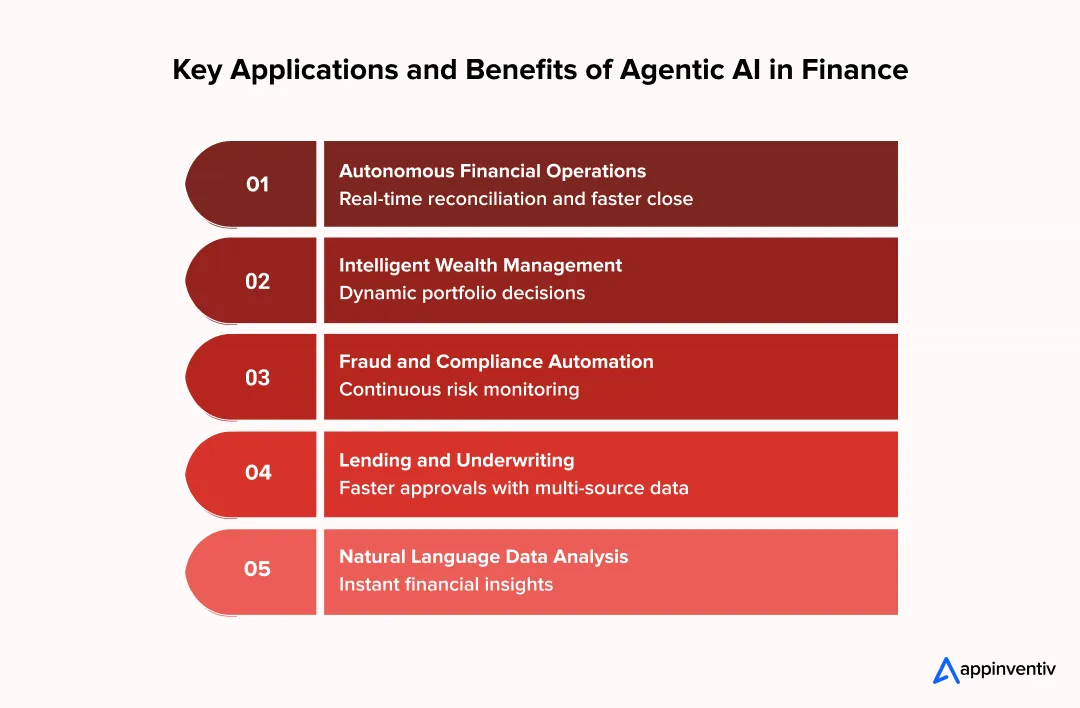
Here are some of the top benefits of AI agents in the finance industry:
Autonomous Financial Operations
Agentic AI in finance and accounting handles routine work — the kind that consumes time and introduces errors — without constant oversight.
- Accounts payable and receivable processing
- Continuous reconciliation across ledgers
- Faster financial close through real-time updates
Outcome:
- Shorter closing cycles
- Fewer manual interventions
- Higher data accuracy
A system can match transactions, resolve mismatches, and post entries without waiting for review.
Intelligent Wealth Management
Investment decisions depend on timing and context. Agentic systems track both in real time.
- Behavioral analysis based on transaction history and risk profile
- Portfolio rebalancing triggered by market changes
- Tailored investment actions for each client
These systems adjust portfolios as conditions change, not at fixed intervals.
Fraud Detection and Compliance Automation
Static rules miss evolving risks. Among the most critical agentic AI applications in finance are those that adapt as fraud patterns shift.
- Real-time anomaly detection across transactions
- Continuous updates to compliance checks
- Automatic generation of audit-ready reports
This reduces response time and improves traceability.
Lending and Credit Underwriting
Agentic AI applications in finance, like intelligent lending, pull data from multiple sources; manual collection no longer slows the process.
- Aggregation of banking data, credit history, and alternative inputs
- Real-time risk scoring based on the current financial state
- Faster approval or rejection decisions
This reduces processing time and improves decision accuracy.
Natural Language Financial Data Analysis
Access to financial data often depends on technical teams. Agentic systems remove that barrier.
- Convert plain language queries into structured database queries
- Generate dashboards and reports instantly
- Allow leadership teams to explore data without intermediaries
A finance leader can ask for cash flow trends or variance analysis and receive results instantly, a capability that aligns with smart data discovery principles
These use cases show a clear shift in how AI in fintech is redefining execution. Finance functions move from manual coordination to continuous execution across systems.
Top AI Finance Tools and Platforms Enabling Agentic Workflows
Artificial intelligence in financial services relies on existing financial tools to execute tasks. These platforms handle data extraction, reporting, risk checks, and spend control. They form the execution layer that agents use.
Each category supports a different part of the finance function.
Financial Close, Audit, and Compliance Platforms
These platforms focus on accuracy, traceability, and regulatory alignment. They support audit workflows, reporting, and risk detection across financial data.
- DataSnipper: Extracts data from documents and links it to audit workflows. Reduces manual review effort.
- Workiva: Manages reporting, controls, and compliance processes. Keeps records aligned across teams.
- MindBridge: Detects anomalies in financial data using pattern analysis. Flags high-risk transactions early.
Financial Planning and Analysis Platforms
These tools support AI-driven financial planning, forecasting, budgeting, and performance tracking, helping finance teams plan and evaluate outcomes using structured data.
- Datarails: Connects spreadsheets with financial systems. Supports forecasting, budgeting, and reporting.
Spend Management and Autonomous Finance Operations
AI agents in finance operations use these platforms to manage expenses, payments, and policy enforcement, bringing control and visibility to company-wide spending.
- Ramp: Tracks expenses, enforces policies, and automates approvals.
- Brex: Manages corporate cards, payments, and expense controls in real time.
Where These Platforms Fit in an Agentic Stack
These platforms act as execution points within a broader system. They handle specific functions, but they do not coordinate workflows on their own.
They support key financial tasks:
- Data extraction from documents and systems
- Financial reporting and consolidation
- Risk detection and anomaly analysis
- Spend tracking and policy enforcement
They operate within defined scopes. They do not plan actions or move data across systems without direction.
Agentic systems connect these tools. They decide what actions to take and execute workflows across platforms. This coordination turns separate systems into a connected financial operation.
Also Read: AI in Product Development
Impact on Finance Professionals and Enterprise Performance
Agentic systems change the day-to-day rhythm of finance work. The change shows up first in how teams spend their time, then in how fast the business moves.
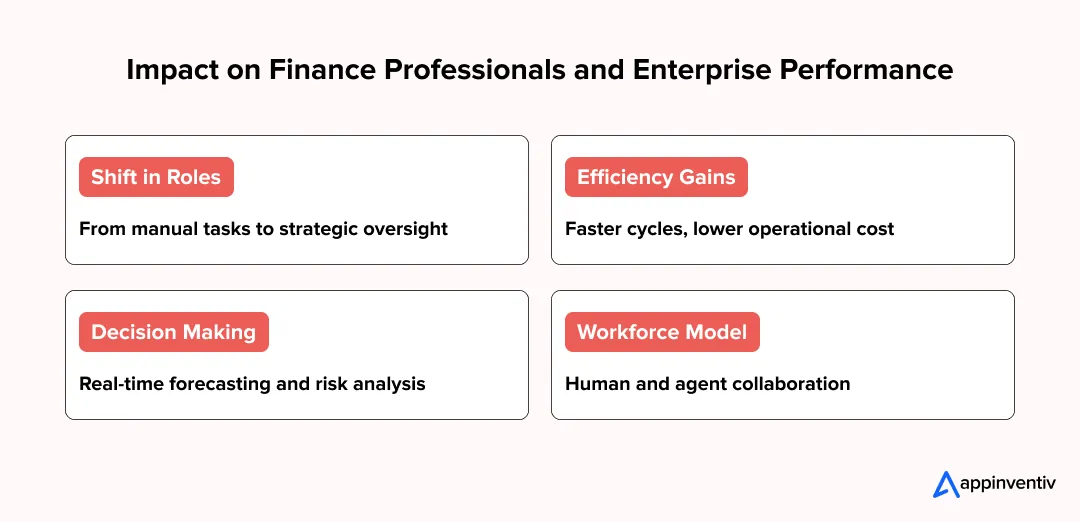
Shifting Roles in Finance Teams
Agentic AI in finance and accounting is changing this reality; most finance teams still spend large blocks of time on invoice entry, ledger matching, and exception checks, but that is shifting.
Agentic systems take over these steps.
- Data entry and reconciliation run without manual input
- Exceptions get flagged and resolved within the workflow
What changes for the team?
- More time for planning budgets and tracking performance
- Closer attention to risk and controls
- Direct involvement in business decisions
The work moves from processing numbers to understanding what those numbers mean.
Efficiency and Cost Gains
The impact becomes visible in cycle times and cost.
- AI agents in finance shorten financial close as entries update during the day, improve audit prep since records stay current and traceable, and move loan decisions faster as data is collected and checked in one flow.
- Audit prep improves since records stay current and traceable
- Loan decisions move faster as data is collected and checked in one flow
A European bank faced similar pressure across customer operations and support workflows. The system handled multiple regions and languages, which increased manual effort and response time.
Appinventiv deployed an AI-driven system that automated customer interactions and connected directly with core banking systems. The system handled routine queries, routed complex cases, and reduced dependency on manual processing.
This led to a 20% increase in customer retention and a clear reduction in operational load.
For large finance operations, even small reductions in processing time and manual effort can translate into millions in annual savings. The impact compounds as workflows scale across systems and regions.
Enhanced Decision-Making Capabilities
Better data timing leads to better financial decisions. AI-driven financial planning means:
- Forecasts update as new transactions come in
- Cash positions reflect actual inflows and outflows, not delayed reports
- Scenario models adjust when inputs change
A finance leader does not need to wait for a report to understand exposure or performance. The data is already current.
Organizational Change and Workforce Implications
Agentic AI changes how work is structured across finance. It is not only about automation. It reshapes roles, workflows, and ownership.
- AI agent deployment introduces new execution layers across systems
- AI agent ecosystems support coordinated workflows across finance, risk, and operations
- Decision-making authority shifts, with systems handling routine actions and humans focusing on oversight
- A human-and-agent workforce becomes the standard operating model
This requires changes at the process level:
- Process reengineering aligns workflows with system-driven execution
- Cross-functional teams replace siloed operations
- Pre-built AI agents support faster rollout across use cases
At scale, enterprises must plan for operating model change and organizational restructuring.
- Multi-agent orchestration enables workflows to run across systems
- Change management ensures teams adapt to new ways of working
- Workforce change includes training and role realignment
Without these shifts, systems remain isolated and fail to deliver full value. This shift is practical. Teams spend less time fixing data and more time acting on it.
Automate complex financial workflows with agentic AI while keeping critical decisions under human oversight.

Key Considerations for Enterprise Adoption
Agentic AI in financial services can run financial workflows with little manual input. That does not remove risk. It shifts where control must sit. Understanding the risks of agentic AI in financial services is essential; teams need clear answers on data handling, system fit, and decision control before rollout.
Security and Privacy
Financial data moves across systems and environments. Any gap can create serious fintech cybersecurity risks.
- Data stays isolated by role and function
- Access follows strict identity controls
- Encryption protects data at rest and in transit
Agent actions must be logged. Each step needs a clear record that can be traced during audits or reviews.
Integration Across Systems
Most enterprises run a mix of old and new systems. This creates friction.
- Legacy platforms may not support modern APIs
- Data sits in separate systems with no shared structure
- Real-time access is limited in batch-driven environments, and the choice of cloud platform can determine how quickly these gaps close.
Agentic systems depend on clean data flow. Without it, execution slows down or breaks. Integration work often takes more time than model setup, which is why enterprises turn to agentic AI development services to assess legacy APIs and data flows before any agent is built.
Trust and Control Mechanisms
Finance leaders need to trust system decisions before handing over execution.
- Decisions must be explainable in plain terms
- Key workflows need human checkpoints where risk is high
- Audit trails must show what the system did and why.
A simple rule helps here. The system can act on routine tasks. It should pause when decisions carry financial or regulatory impact.
Adoption succeeds when control is clear. Without that, speed becomes a risk instead of an advantage.
Implementation Roadmap for C-Suite Leaders
Rolling out agentic systems in finance works best as a controlled build. Teams that rush into full deployment often hit issues with data, access, and audit trails. A phased plan avoids that.
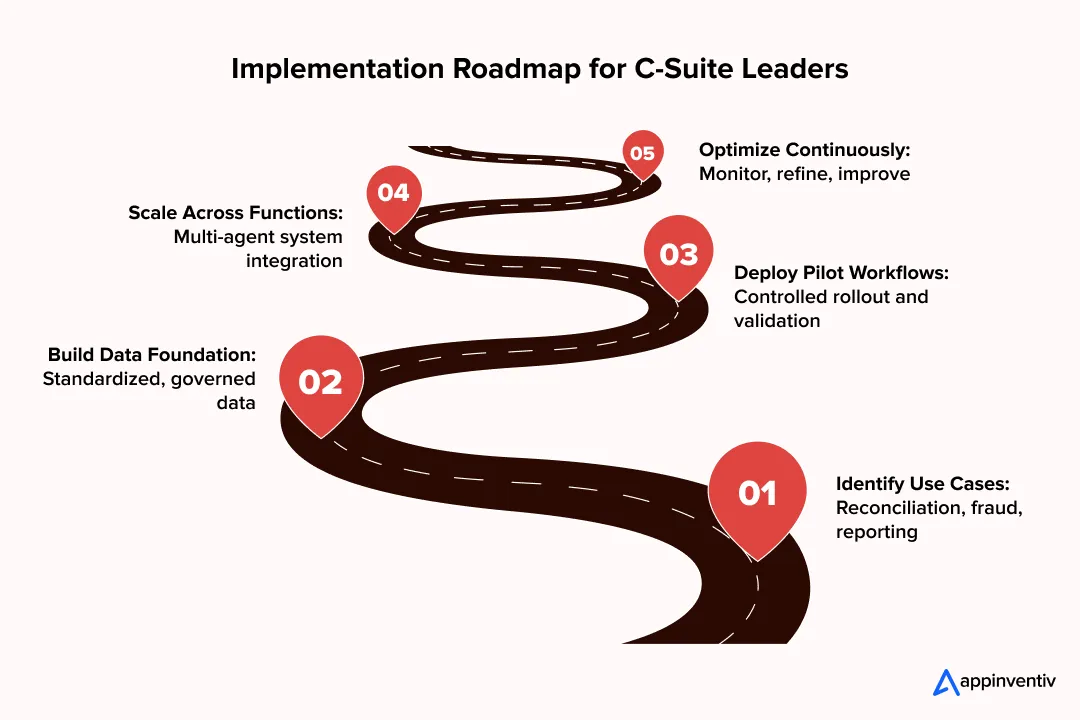
Phase 1: Identify High-Impact Use Cases
Start by mapping agentic AI use cases in finance that already follow a clear pattern. Reconciliation is a strong candidate. It uses structured data and repeatable checks.
- Match entries across sub-ledgers and the general ledger
- Scan payment streams for unusual patterns
- Generate standard financial reports
Break the workflow into steps. List where data comes from, where decisions happen, and which system executes each step. This gives a clear scope for the first agent.
Phase 2: Build a Unified Data Foundation
Agents fail when the data is inconsistent. Many enterprises still run separate data models across systems.
- Align data fields across ERP, banking systems, and warehouses
- Set up pipelines to move data at fixed intervals or in near real time
- Define ownership for each dataset
Basic validation rules should run before any action. A missing field or wrong format can break downstream steps.
Phase 3: Deploy Pilot Agent Workflows
Partnering with providers of AI agent development services at this stage helps run a clean pilot in a limited environment. It also:
- Connect the agent to systems through existing APIs
- Log every action the system takes
- Compare results with the current manual output
Track simple metrics. Measure how long the workflow takes and how often errors appear.
Also Read: Complete Guide to API Development
Phase 4: Scale Across Financial Functions
Once the pilot is up and running, AI agents in corporate finance can be extended to related workflows.
- Link reconciliation with reporting and compliance checks
- Allow systems to pass data without manual handoffs
- Add coordination so one action triggers the next
This stage often exposes gaps in older systems. Some may need API support or data restructuring.
Phase 5: Continuous Optimization
After rollout, the work continues.
- Review logs to spot delays or repeated errors
- Adjust rules and workflows based on new data
- Keep records ready for audit checks
Set regular review points. Finance systems change as business conditions change.
A steady rollout builds trust. Each phase proves that the system works before the next one expands its role.
Challenges Enterprises Must Address
Most issues with artificial intelligence in financial services show up after the first pilot. They sit in data, models, rules, and people. Teams that plan for them early avoid rework.
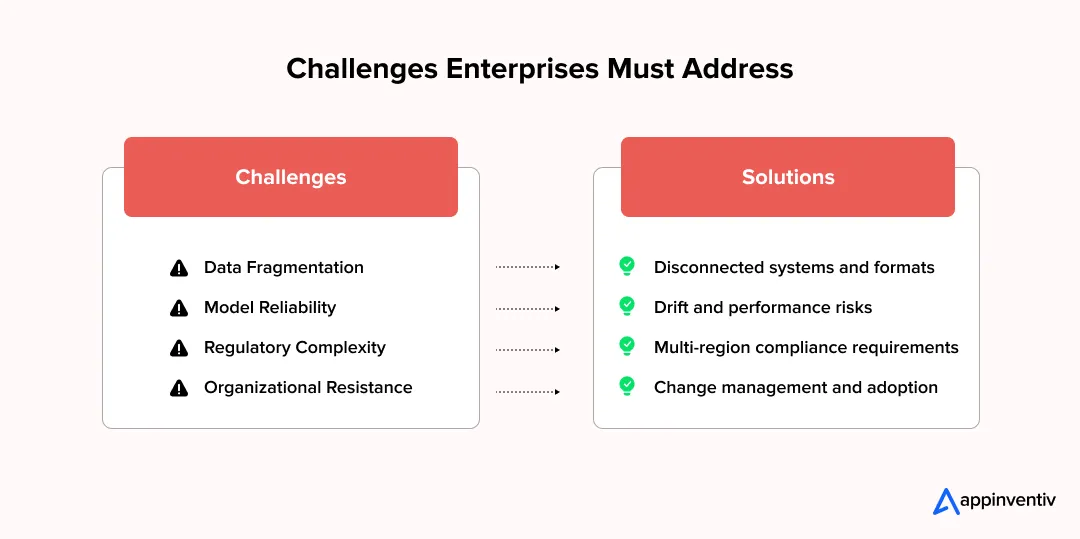
Data Fragmentation
Finance data lives in many systems. Each system stores it in its own format.
- The same fields are named differently across ERP and banking systems
- Updates that land at different times
- Missing links between invoices, payments, and ledger entries
An agent needs clean joins and consistent keys. If records do not match, tasks stall. Start with a small, well-mapped dataset. Fix naming, formats, and IDs before expanding.
Model Reliability and Drift
Patterns change. Payment behavior shifts. New products add new data shapes.
- Rules that worked last quarter stop matching current data
- Errors repeat if checks are weak
- Outputs vary when inputs fall outside known ranges
Track basic signals. Watch error rates and processing time. Run test cases on recent data. Keep a rollback option for each update.
Regulatory Complexity
The risks of agentic AI and Fintech AI services multiply across regions; rules, reporting formats, retention requirements, and checks all vary.
- Local rules for reporting and disclosure
- Clear logs for every action
- Access controls by role
Each step needs a record, especially given the evolving AI regulation & compliance rules around AI systems. Who acted, what changed, and why it changed must be easy to trace.
Organizational Resistance
Teams trust what they can see and verify.
- Concern about losing control over approvals
- Existing workflows are built around manual checks
- New roles that are not clearly defined
Start with a limited scope. Keep human review on high-risk steps. Share logs and results with the team. Trust builds with consistent output.
These issues are practical. Address them early, and the rollout stays on track.
Legacy systems create bottlenecks and compliance gaps. Agentic AI removes these constraints through system-driven execution.

The Future of Autonomous Finance (2026–2030 Outlook)
Agentic AI in financial services is pushing finance away from fixed cycles toward continuous operation, where data, controls, and decisions update without waiting for period-end processes.
Continuous Accounting Systems
Among the most important agentic AI in finance trends is continuous accounting — financial records will update as transactions occur, not at the end of the day or month.
- Ledger entries post in near real time
- Reconciliation runs alongside transaction flow
- Financial positions stay current throughout the day
This reduces the gap between actual activity and reported numbers.
AI-Driven Compliance Ecosystems
Compliance will shift from periodic checks to constant monitoring.
- Rules apply at the time of each transaction
- System logs capture every action automatically
- Reports are generated from live data, not compiled records
This allows teams to detect issues early instead of after reporting cycles.
Autonomous Financial Operations
AI-powered automation in finance will handle routine workflows without manual input:
- Invoice processing, validation, and posting are handled within one flow
- Exception handling is built into the workflow itself
- Financial close becomes a continuous process
Teams step in for review, not for execution.
Convergence with Emerging Financial Systems
Agentic systems will work alongside other financial technologies.
- Real-time payments: Transactions settle instantly, and systems update records at the same speed.
- Embedded finance: Financial functions integrate into non-financial platforms, such as retail or logistics systems
- Blockchain: Transaction records are stored in shared ledgers with built-in validation
These systems will connect through APIs and shared data layers.
These agentic AI trends point in one direction: finance systems will run continuously, with fewer delays between activity and decision. The role of teams will shift toward oversight, control, and planning as execution becomes system-driven.
Why Appinventiv for Agentic AI in Finance
Enterprises face the same barriers when they move toward agentic finance. Data sits across systems. Legacy platforms limit access. Compliance rules demand strict control. Most internal teams solve one part at a time, but the gaps remain.
Appinventiv’s AI services and solutions address these gaps at the system level, building agent workflows that integrate ERP platforms, banking systems, and data stores into a single execution layer. Each workflow includes access control, audit logs, and policy checks from the start.
Delivery scale supports this approach.
- 100+ autonomous agents for finance deployed
- 150+ custom AI models in production
- 200+ data scientists and AI engineers
- 75+ enterprise integrations delivered
- 200+ fintech products across 10+ years
The ROI of AI agents in finance is measurable through efficiency gains, risk reduction, and faster operations, especially when built with AI development expertise.
- 50% reduction in manual processes
- 90%+ task accuracy across agent workflows
- 30% lower operational cost in finance functions
- 98% fraud detection accuracy
- 99.50% transaction security SLA
These systems do not replace core platforms. They connect and coordinate them. That is what removes delays, improves control, and keeps records audit-ready.
Enterprises that put agentic AI in finance into production early will move faster, reduce costs, and maintain tighter control over risk and reporting.
Let’s connect and eliminate reporting delays across finance systems.
FAQs
Q. What is agentic AI in finance?
A. Agentic AI in finance refers to systems that can carry out financial tasks without step-by-step human control. They read transaction data, decide what needs attention, and act across connected systems. For example, they can reconcile accounts, update records, or flag risks. These systems work with ERP platforms, banking APIs, and data stores, and they keep logs so every action can be reviewed later.
Q. How does agentic AI work in finance?
A. AI agents in finance work through a continuous cycle. The system receives data such as transactions or ledger updates. It checks this data against rules and past records, then decides what action to take. It may fetch missing data, validate entries, and update systems. All actions run through APIs, and each step is recorded. This allows finance workflows to move without pauses between systems.
Q. What are the benefits of agentic AI in the financial sector?
A. The benefits of AI agents in the finance industry include reduced time on routine work like reconciliation, reporting, and data checks. Tasks finish faster and follow the same logic each time, which lowers errors. Teams gain access to current financial data instead of waiting for reports. This supports better planning and risk tracking. It also lowers operational costs by reducing manual effort across finance processes.
Q. How does agentic AI revolutionize banking operations?
A. It allows core banking tasks to run in one continuous flow. Fraud checks, loan reviews, and transaction monitoring happen as data comes in. There is no need to wait for batch processing or manual review at each step. This reduces delays and improves response time. It also helps banks manage higher transaction volumes without increasing operational load.
Q. How does agentic AI support financial institutions?
A. AI agents in corporate finance connect systems that often work separately, such as core banking, ERP, and reporting tools. It handles data movement, validation, and updates across them. This keeps records consistent and reduces manual coordination. It also supports compliance by keeping detailed logs and applying rules during execution. Teams can focus on oversight and planning instead of routine processing.
Q. What impact will agentic AI have on the future of finance?
A. Artificial intelligence in financial services will move financial operations away from fixed reporting cycles. Systems will update records as transactions occur. Forecasts, risk checks, and reports will rely on current data instead of historical snapshots. This shortens the gap between activity and decision. Teams will spend less time correcting data and more time reviewing outcomes and guiding financial strategy.


Fast 2-minute response, fully NDA-protected.

Retrieval Augmented Generation in Australia: Architecture, Implementation and Cost
Key takeaways: RAG grounds LLM answers in approved content, improving reliability without retraining a model. Data quality and access permissions decide production outcomes more than the model. Indicative build costs run from AUD 70,000 to 700,000, driven by data and integrations. Measure value against a pre-deployment baseline, separating realised benefits from projected savings. A general-purpose…

The Multiplier Effect of AI Agents: The Rise of AI Swarms
Key takeaways: AI agent swarms coordinate specialized agents to solve complex problems that may be difficult for a single agent to handle effectively. More agents do not automatically mean better outcomes. Swarms deliver value when work can be divided, executed in parallel, and coordinated toward a shared objective. Enterprise readiness depends on governance. Clear accountability,…

AI Data Integration: How to Connect, Clean and Prepare Data for AI
Key takeaways: AI initiatives fail when fragmented, poor-quality data reaches models without sufficient context, controls or ownership. AI-ready pipelines must connect, clean, enrich, govern and continuously monitor data across its lifecycle. Real-time processing matters when AI decisions depend on current transactions, events, inventory or operational conditions. Data architecture should follow the AI use case, balancing…