
































Cost of Developing a Payment Gateway: A Complete Breakdown

 Share -



- 01Why Understanding Payment Gateway Development Costs Matters
- 02A Comprehensive View of Payment Gateway Development Cost: Detailed Breakdown
- 03Payment Gateway Development Cost Estimation Formula
- 04Payment Gateway Development Timeline
- 05Factors Affecting Payment Gateway Development Cost
- 06Payment Gateway Total Cost of Ownership: Hidden Expenses
- 07How to Optimize Payment Gateway Development Costs
- 08Initiate Your Payment Gateway Development Journey With Appinventiv
- 09Frequently Asked Questions

Key takeaways:
- Custom gateway development requires $50,000 to $500,000 in upfront capital, and enterprise platforms cost more at scale.
- Core infrastructure, security compliance, and settlement logic consume far more budget than basic checkout screens.
- High transaction volumes require concurrency controls, failover systems, monitoring tools, and automated reconciliation engines.
- Platform ownership creates recurring costs for security audits, cloud hosting, risk tools, support, and network fees.
- Teams control initial spending by limiting early processor integrations, target markets, payment options, and card data exposure.
Companies process transactions quickly by connecting Stripe or Adyen through standard APIs. Building a custom payment gateway requires a completely different investment strategy, as costs rise rapidly during development. This work includes transaction routing, tokenization, fraud checks, settlement, reconciliation, and processor integrations.
Large platforms with high transaction volumes benefit from full infrastructure ownership. Marketplaces need split settlements across thousands of sellers. Global enterprises require multiple acquirers, local payment options, and regional routing. Fintech companies demand direct control over margins, data flows, and processor dependencies.
Engineering teams spend most of their time behind the checkout screen. API design, transaction state management, PCI DSS compliance, webhook processing, failover systems, and risk scoring define the engineering scope.
So, how much does it cost to build a payment gateway? The answer comes down to the infrastructure, security, integrations, and payment capabilities the enterprise chooses to own.
A gateway designed without scale can create costly failures across processing, routing, reconciliation, and infrastructure.

Why Understanding Payment Gateway Development Costs Matters
Payment gateway build cost can shift sharply based on what the enterprise decides to own. A gateway that connects to a single processor has a very different cost profile from a platform that manages routing across multiple acquirers.
Transaction volume adds another layer. Higher volumes demand stronger concurrency, fault tolerance, observability, and recovery controls. Supporting multiple processors also adds connector development, certification, error handling, and settlement logic. Visa reported 329 billion Visa-branded transactions in fiscal 2025, averaging 901 million transactions per day, with total payments and cash volume reaching $17 trillion.
Card data handling can also change the compliance scope. Tokenization can reduce exposure to sensitive card data, while deeper ownership of the cardholder data environment brings stricter security controls and audit work. Fraud detection, multi-currency processing, local payment methods, and merchant settlements add further engineering effort.
Geographic expansion introduces another layer of costs through local regulations, payment rails, banking APIs, and data requirements. McKinsey expects global payments revenue to grow by about 4% annually through 2029, reaching roughly $3 trillion. A realistic estimate must account for these factors before development begins. That is why a $50,000 integration project cannot be compared with a $500,000 proprietary platform.
A Comprehensive View of Payment Gateway Development Cost: Detailed Breakdown
The cost of developing a payment gateway varies according to direct infrastructure ownership needs. Connecting an existing processor demands minimal engineering resources.
Building a proprietary gateway requires transaction engines, routing logic, security layers, reconciliation tools, and hosting environments.
So, how much does it cost to build a payment gateway? The tables below break down the financial investment across the core development areas.
Costs as Per Gateway Complexity
Payment gateway build cost scales directly with system complexity and operational scope. Simple processor connections require minimal funding, while proprietary architectures demand substantial capital.
| Gateway Complexity | Scope Description | Estimated Development Cost |
|---|---|---|
| Third-Party Integration | Existing PSP integration into an application or platform | $5,000–$30,000 |
| White-Label Gateway | Branded payment experience using existing infrastructure | $20,000–$80,000+ |
| Custom Gateway MVP | Core transaction processing, limited processors, tokenization, basic merchant capabilities | $50,000–$150,000 |
| Production-Grade Gateway | Multi-processor support, fraud controls, reconciliation, stronger infrastructure and compliance | $150,000–$500,000+ |
| Enterprise Payment Platform | Multi-region processing, intelligent routing, advanced risk, complex settlements and extensive compliance | $500,000+ |
Ownership scope and transaction scale create the price gap in the cost to build custom payment gateway solutions, from basic gateways to full platforms. Minimum viable products rely on single-processor connections, external tokenization, and basic payment options. Enterprise systems require complex routing rules, multi-acquirer integrations, uptime resilience, broad compliance coverage, and split settlement routines.
Also Read: How Payment Gateway Integration Works
Breakdown of Costs by Development Stage
The cost of developing a payment gateway varies across project phases, from initial planning to final release. Core engine development absorbs most engineering resources, while design and launch require smaller shares.
| Development Stage | Activity Description | Estimated Cost Contribution |
|---|---|---|
| Planning & Architecture | Requirements, payment ecosystem analysis, architecture and PCI scope assessment | 8%–12% |
| UX/UI & API Design | Checkout flows, merchant dashboard, API and developer experience | 5%–10% |
| Gateway Core Development | Transaction engine, APIs, states, routing, retries and refunds | 35%–45% |
| Security & Compliance | Tokenization, encryption, access controls, fraud controls and compliance implementation | 10%–15% |
| Integrations | Processors, acquirers, banks, wallets, fraud and identity providers | 10%–20% |
| Testing & QA | Functional, security, performance, failure-recovery and integration testing | 10%–15% |
| Deployment & Launch | Cloud deployment, monitoring, production hardening and rollout | 3%–5% |
Core engine development demands the highest share of engineering hours. This component tracks transaction states, retry loops, duplicate requests, refunds, routing, and processor responses reliably.
Solid API development practices reduce the effort needed across differing structures, certification processes, error responses, and settlement files. Security protocols and QA testing require deep focus to protect revenue streams and user trust.
Breakdown of Costs as Per Payment Ecosystem Model
Chosen operational models determine baseline budgets and ongoing engineering commitments. Organizations must select architectures that align with immediate technical requirements and long-term financial goals.
| Payment Ecosystem Model | Scope Focus | Estimated Development Cost |
|---|---|---|
| Self-Hosted Payment Gateway | Custom checkout, payment data capture, tokenization, APIs, and greater control over the payment environment | $80,000–$200,000+ |
| Payment Aggregator | Shared payment infrastructure for onboarding multiple merchants and routing their transactions through supported payment rails | $100,000–$300,000+ |
| Payment Orchestration | Multi-PSP connectivity, routing, retries and failover | $75,000–$250,000+ |
| Custom Payment Gateway | Proprietary transaction processing, security, integrations and reconciliation | $50,000–$500,000+ |
| PayFac Platform | Merchant onboarding, KYC/KYB, underwriting, payouts, risk and payment infrastructure | $500,000+ |
Each operational model fulfills distinct structural roles within payment app development and processing. Gateways manage secure request transmissions between clients and processing networks. Processors handle transaction routing and settlement across card brands and banks.
Payment orchestration platforms link multiple payment providers to direct traffic and manage failure recovery. Payment facilitators manage merchant onboarding, underwriting checks, risk monitoring, and automated payouts directly.
Also Read: White-Label vs Custom Development: Which Should You Choose
Compliance-Wise Payment Gateway Development Cost
Security standards and regulatory mandates dictate required baseline compliance spending. Directly handling card details expands security requirements and increases ongoing assessment costs. PCI SSC says PCI DSS v4.x introduced 64 new requirements, with 51 becoming effective on March 31, 2025.
| Compliance Requirement | Development Focus | Estimated Cost Impact |
|---|---|---|
| PCI-DSS | Cardholder data security, tokenization, access controls and validation | $20,000–$100,000+ |
| 3-D Secure/SCA | Strong authentication and transaction-risk controls | $15,000–$50,000+ |
| GDPR/CCPA | Privacy, consent, data handling and user rights | $15,000–$60,000+ |
| KYC/KYB & AML | Identity verification, merchant onboarding and risk controls where applicable | $30,000–$120,000+ |
| Security Testing & Audit Readiness | Penetration testing, vulnerability assessments and remediation | $15,000–$50,000+ |
Compliance expenditures shift based on selected architecture and data boundaries. Systems keeping cardholder details offsite maintain smaller PCI DSS audit scopes. Storing payment details directly expands security requirements and infrastructure controls. Regional data privacy laws, merchant verification steps, funds flow tracking, and audit preparation demand dedicated engineering hours.
Infrastructure-Wise Payment Gateway Development Cost
Hosting choices and uptime requirements determine overall payment infrastructure expenditures. Higher transaction volumes require redundant architectures, regional deployments, and continuous system tracking.
| Infrastructure Type | Scope | Estimated Cost |
|---|---|---|
| Cloud-Native Infrastructure | AWS, Azure or Google Cloud deployment with managed services | $30,000–$120,000+ |
| High-Availability Infrastructure | Redundancy, failover, load balancing and disaster recovery | $75,000–$250,000+ |
| Multi-Region Infrastructure | Regional deployment, cross-region resilience and data architecture | $150,000–$400,000+ |
| PCI-Scoped Infrastructure | Isolated cardholder-data environment, monitoring and security controls | $50,000–$200,000+ |
| Legacy Banking Integration | Middleware, APIs and modernization of existing financial systems | $100,000–$400,000+ |
Higher transaction volumes and strict uptime targets increase hosting expenses. Global platforms require multi-region hosting built on strong cloud-native capabilities, database replication, and message queuing, disaster recovery protocols, and continuous system tracking.
Connecting legacy banking requires dedicated payment process modernization work, including custom middleware, modern API layers and data transformation services.
AI-Powered Payment Gateway Development Cost
The growing role of machine learning and AI in payments introduces advanced risk features alongside distinct operational development costs. Building smart risk tools requires continuous data pipelines, training routines, and operational monitoring.
| AI Capability | Scope | Estimated Cost |
|---|---|---|
| AI Fraud Detection | Transaction anomaly detection and automated risk alerts | $30,000–$100,000+ |
| ML Risk Scoring | Real-time transaction scoring and adaptive risk assessment | $60,000–$200,000+ |
| Chargeback Prediction | Identifying transactions likely to become disputes | $40,000–$120,000+ |
| Behavioral Risk Analytics | Device, behavioral and transaction intelligence | $50,000–$150,000+ |
| AI-Powered Transaction Intelligence | Advanced analytics, adaptive models and decision support | $75,000–$250,000+ |
Artificial intelligence implementations extend beyond initial model training into ongoing operational costs. Engineering teams must build data pipelines, feature pipelines, inference engines, model tracking, retraining schedules, and governance frameworks. Standard rule engines require lower investment than real-time adaptive scoring systems that update decision logic during active transaction flows.
Also Read: The Rise of Agentic Payments for Enterprises
Region-Wise Payment Gateway Development Cost
Geographic developer rates shift overall labor expenses across key global engineering regions. Strategic hiring balances hourly rates with payment domain expertise and regulatory knowledge.
| Region | Average Development Rate | Indicative Development Cost |
|---|---|---|
| North America (USA) | $120–$250/hr | $200,000–$800,000+ |
| Western Europe | $90–$180/hr | $150,000–$650,000+ |
| Eastern Europe | $40–$90/hr | $100,000–$400,000+ |
| Asia | $25–$60/hr | $50,000–$300,000+ |
| Latin America | $35–$80/hr | $75,000–$350,000+ |
Geographic location influences hourly engineering fees without dictating overall project spending. Domain expertise, security capabilities, regulatory familiarity, processor relationships, and regional coverage shape final budgets. Lower hourly billing rates cannot compensate for engineering teams lacking payment infrastructure experience.
Payment Gateway Development Cost Estimation Formula
Building an accurate payment gateway budget requires looking beyond simple hourly engineering rates. Financial models must account for development hours, compliance checks, hosting environments, quality testing, and ongoing transaction scale. Three distinct calculation methods help finance leaders project capital requirements.
Bottom-Up Estimation Method
This approach breaks down the cost of developing a payment gateway by dividing total scope into individual work components and assigning direct expenses to each task.
Estimated Development Cost = (Development Hours × Blended Rate) + Integrations + Security/Compliance + Infrastructure + Testing + Contingency
For instance, a project requiring 4,000 engineering hours at a $50 hourly rate yields $200,000 in direct labor. Adding $40,000 for integrations, $30,000 for compliance, $20,000 for QA, and $10,000 for infrastructure establishes a $300,000 total estimate.
Three-Point Estimation Method (PERT)
Payment projects face schedule uncertainty due to external acquirer testing, audit cycles, and partner dependencies. PERT addresses operational variance by weighting optimistic, expected, and conservative scenarios.
Expected Cost = (Optimistic + 4 × Most Likely + Pessimistic) ÷ 6
Engineering managers apply this weighted formula to unpredictable work items like acquirer certifications or security audits. This calculation produces balanced cost targets rather than assuming best-case operational timelines.
Parametric Volume-Based Method
Proprietary payment systems require ongoing operational models tied directly to annual processing volumes. Total transaction volume drives recurring expenditure across cloud hosting, fraud tooling, system tracking, and client support.
Annual Operating Cost = Fixed Costs + Engineering + Compliance + (Transactions × Variable Cost per Transaction)
A platform processing 10 million transactions yearly has $300,000 in fixed costs and $0.03 per-transaction costs. The final operating expense equals $600,000 per year. This formula calculates long-term costs before platform development.
Payment Gateway Development Timeline
Payment gateway development timelines range from three months to over a year. Delivery schedules depend on payment rails, processor connections, regional markets, security controls, and operational scope.
Development Timelines by Scope
The cost to build an MVP payment gateway correlates directly with the timeline, as engineering schedules scale with platform complexity and required features. Project teams deliver initial prototypes quickly, but custom enterprise platforms require extended technical commitments.
| Development Level | Typical Timeline | Typical Scope |
|---|---|---|
| MVP | 3–6 months | Core payment flows, limited processor coverage, basic fraud controls, tokenization, and merchant APIs |
| Production-Grade Gateway | 6–12 months | Multiple integrations, reconciliation, advanced security, fraud controls, monitoring, and production hardening |
| Enterprise Payment Platform/PayFac | 12–18+ months | Multi-region processing, intelligent routing, merchant onboarding, advanced risk, complex settlements, and broader compliance |
Enterprise payment gateway development cost carries timeline dependencies driven by external factors outside engineering control. Acquirer onboarding, processor certification cycles, PCI audits, penetration testing, and regulatory filings add weeks to launch schedules.
Production testing requires dedicated engineering allocation before launch. Teams must test system recovery, duplicate requests, processor timeouts, settlement differences, refunds, dispute flows, and peak transaction volumes under real conditions. Starting compliance reviews and processor discussions during architecture planning prevents costly technical delays later.
Factors Affecting Payment Gateway Development Cost
Payment gateway budgets change based on financial logic, security rules, partner connections, and operational demands. Ten core technical elements dictate direct engineering effort and long-term operating costs.
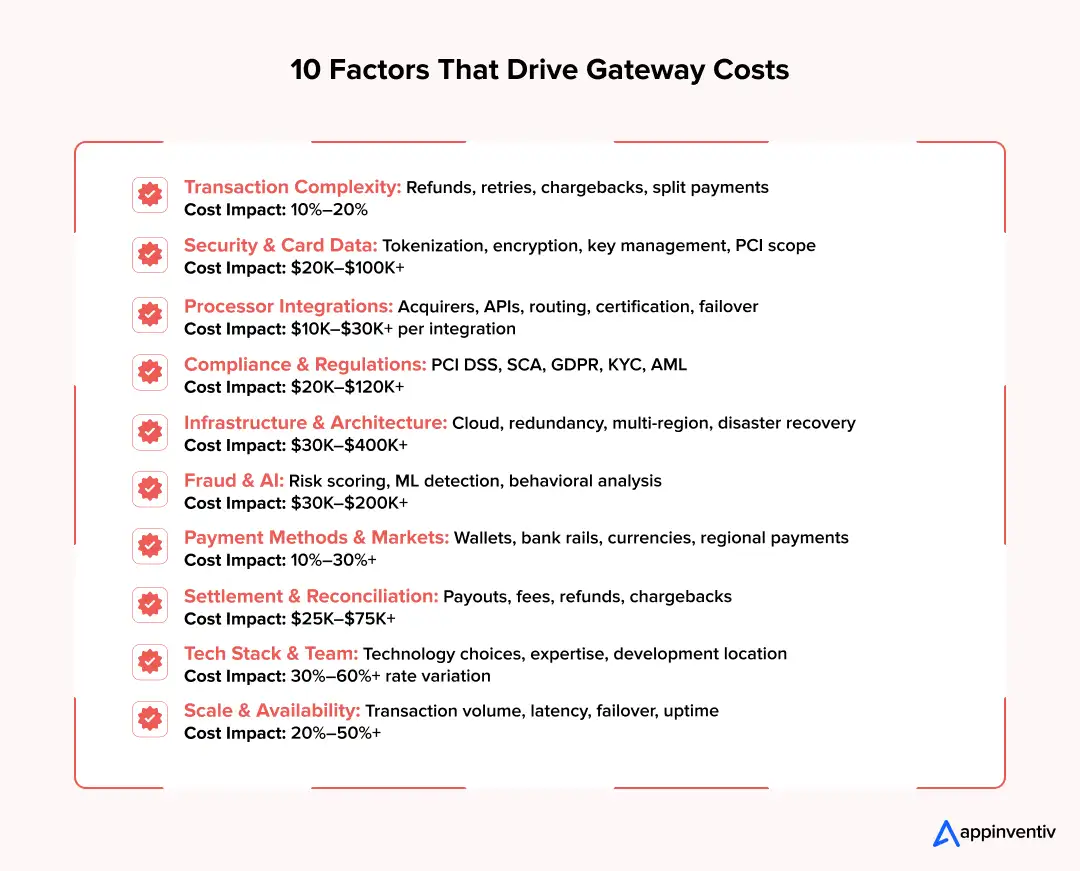
1. Payment Flow and Transaction Lifecycle Complexity
Standard gateways, such as those used by a P2P payment app, process simple authorization and capture commands. Enterprise platforms manage delayed capture, partial payments, voids, refunds, reversals, retries, and chargeback claims.
Every payment requires explicit state tracking across its operational life. Idempotency logic prevents duplicate charges during network failures. Adding complex transaction states increases backend database logic, API endpoints, and system testing.
Cost impact: Complex payment flows can add 10%–20% to development costs.
2. Security and Card-Data Scope
The cost to build a secure payment gateway depends heavily on card data management, which directly controls system architecture and compliance workloads. External tokenization tools keep sensitive primary account numbers away from core application environments.
Storing card details directly forces strict encryption standards, key management protocols, access rules, network segmentation, and detailed audit logging. These security mandates require substantial engineering time and annual validation audits.
Cost impact: Broader card-data scope can add $20,000–$100,000+.
3. Processor, Acquirer, and Financial Integrations
Every processor uses distinct API structures, authentication flows, error codes, settlement files, and certification procedures. Supporting multiple processing partners multiplies development and quality assurance work.
Multi-processor gateways support intelligent payment routing and failure recovery. Building this capability requires custom health monitoring, routing rules, retry scripts, response translation, and state synchronization across external systems.
Cost impact: Major processor integrations can add $10,000–$30,000+ each.
4. Compliance and Regulatory Requirements
Compliance obligations shift based on payment roles, business models, data flows, and regional operations. Payment card industry rules dictate data protection standards, and local privacy frameworks apply in specific jurisdictions.
Expanding into new markets introduces regional licensing requirements, localized rails, authentication protocols, and strict reporting duties. Each new rule demands dedicated effort across software, security, and legal teams.
Cost impact: Compliance work can add $20,000–$120,000+.
5. Infrastructure and System Architecture
Payment systems require infrastructure capable of processing routine traffic and sudden transaction surges. Cloud deployment setups, database replication, load distribution, recovery plans, and telemetry systems require engineering hours.
Multi-region infrastructure requires active traffic routing, cross-region database replication, automated failover routines, and continuous system monitoring. Payment-scoped workloads require separate hosting environments and strict administrative access barriers.
Cost impact: Infrastructure can add $30,000–$400,000+ depending on scale and architecture.
6. Fraud and AI Implementation
Fraud prevention tools range from basic static rules to machine learning systems that score transaction risk in real time. Rule engines analyze purchase values, velocity limits, device signatures, and payment failure patterns. Mastercard found that organizations lost an average of $60 million globally to payment fraud in a year, based on its 2025 research.
Advances in AI for fraud prevention require structured data pipelines, real-time decision models, performance tracking, and retraining processes. Mastercard estimates the global financial impact of fraud exceeded $485 billion in 2024, showing why risk controls carry a large business cost. Advanced dispute prediction features raise long-term development and maintenance costs.
Cost impact: Fraud capabilities can add $30,000–$200,000+. Visa identified nearly $1 billion in scam-related activity between July and December 2025.
7. Payment Methods and Geographic Coverage
Credit card support represents only a fraction of global checkout requirements. Adding digital wallets, bank transfers, real-time payment rails, and buy-now-pay-later services requires custom APIs, authentication flows, and testing.
Global operations add multi-currency processing, foreign exchange conversions, regional acquiring networks, and localized payment options. Entering additional countries expands technical requirements and long-term testing demands.
Cost impact: New payment methods and markets can add 10%–30%+ to development costs.
Also Read: How Web3 Is Shaping the Future of Payments
8. Settlement, Reconciliation, and Chargeback Complexity
Payment workflows continue long after initial authorization approvals. Gateway software matches captured charges against processor settlement files, transaction fees, customer refunds, and merchant payouts.
Managing multiple processors or foreign currencies increases reconciliation logic complexity. Marketplace models add calculation routines for platform commissions, reserve funds, and split merchant payouts.
Cost impact: Advanced settlement and reconciliation can add $25,000–$75,000+.
9. Technology Stack and Development Team Location
Technology choices affect processing speed, system security, maintainability, and total hiring costs. Payment teams select enterprise languages, transactional databases, message queues, container frameworks, and cloud platforms based on scale.
Developer location determines hourly billing rates, but domain expertise governs delivery speed. Engineers experienced with idempotency, distributed systems, card security standards, and processor certifications eliminate costly rework.
Cost impact: Team location can create a 30%–60%+ difference in engineering cost.
10. Scalability, Performance, and Availability Requirements
Gateways handling thousands of monthly transactions operate under different requirements than platforms managing millions daily. High volume demands stronger database capacity, message queue management, caching layers, and concurrency controls.
Strict speed targets require resilient software design. Payment systems must resolve processor timeouts, network drops, and traffic spikes without losing transaction state. Meeting high availability targets requires redundant hosting and automated failover pathways.
Cost impact: High-volume and high-availability requirements can add 20%–50%+ to the project budget.
Uncontrolled processor integrations, PCI scope, fraud systems, and reconciliation complexity can push enterprise gateway budgets higher.

Payment Gateway Total Cost of Ownership: Hidden Expenses
Initial build budgets cover system launch, but the total cost to build custom payment gateway software includes ongoing operations that require continuous capital investment. Long-term budgets must include server capacity, audit cycles, transaction network fees, risk management, maintenance teams, and market expansion. Operating expenses accumulate across every year of active transaction processing.
Infrastructure Growth and Scaling
Transaction traffic increases over time, and higher processing loads demand expanded technical resources. Platforms require additional server capacity, larger databases, cloud storage, monitoring tools, and redundant recovery systems.
| Infrastructure Activity | Estimated Cost |
|---|---|
| Cloud resource scaling | $10,000–$60,000 annually |
| Database scaling and optimization | $10,000–$40,000 annually |
| Monitoring and observability | $5,000–$30,000 annually |
| Disaster recovery expansion | $15,000–$80,000 annually |
Capacity planning aligned with growth targets prevents unexpected hosting expenses.
Compliance Renewals and Security Audits
Security validation requirements repeat every year. Operating teams perform regular vulnerability scans, penetration testing, code remediation, policy updates, and payment audit checks.
| Compliance Activity | Estimated Cost |
|---|---|
| Security assessments | $10,000–$40,000 annually |
| Penetration testing | $10,000–$30,000 annually |
| PCI validation and audit support | $20,000–$100,000+ annually |
| Compliance remediation | $10,000–$50,000+ annually |
Final spending reflects card data boundaries, regulatory status, hosting architecture, and operating regions.
Processor, Acquirer, and Network Fees
Building your own gateway does not eliminate processor, acquirer, or card-network fees. Payment processors, acquiring banks, and card networks assess processing fees against every transaction.
| Cost Area | Typical Cost Structure |
|---|---|
| Processor fees | Per transaction or negotiated pricing |
| Acquirer fees | Processing and merchant-service charges |
| Card-network fees | Assessment and network charges |
| Currency conversion | Percentage or spread per transaction |
| Settlement services | Transaction or account-based charges |
Finance teams incorporate these network fees when evaluating custom infrastructure against third-party providers.
Fraud and Chargeback Operations
Risk management demands continuous operational updates. Technical teams adjust rule thresholds, update scoring algorithms, investigate suspicious orders, and process dispute claims. In the US, consumers reported $15.9 billion in fraud losses in 2025, according to the FTC.
| Fraud Activity | Estimated Cost |
|---|---|
| Fraud-rule management | $10,000–$40,000 annually |
| Risk-model monitoring | $20,000–$80,000 annually |
| Chargeback operations | $15,000–$60,000 annually |
| Fraud service fees | Volume-dependent |
Growing payment scale increases fraud risk exposure and monitoring overhead.
Post-Launch Engineering and Support
The cost to maintain a payment gateway includes permanent engineering resources after production release. Software developers patch security holes, update partner APIs, resolve processing bugs, tune software performance, and answer support tickets.
| Maintenance Activity | Estimated Cost |
|---|---|
| Security patches and updates | $10,000–$40,000 annually |
| Feature enhancements | $20,000–$100,000+ annually |
| API and processor maintenance | $15,000–$60,000 annually |
| Technical support and monitoring | $15,000–$75,000 annually |
Annual maintenance budgets average 15% to 25% of initial build expenses.
New Processor and Payment Method Integrations
Expanding platforms add alternative acquiring banks, digital wallet connections, direct bank rails, and local checkout options. Building new connections requires software design, quality testing, network certification, and user guides.
| Expansion Activity | Estimated Cost |
|---|---|
| New processor integration | $10,000–$30,000+ |
| New payment method | $10,000–$40,000+ |
| Routing or failover expansion | $20,000–$60,000+ |
| Integration testing and certification | $10,000–$30,000+ |
Modular connector architecture reduces software development hours during future integration projects.
Geographic and Regulatory Expansion
Global expansion involves broader technical scope than simple currency conversion. Operating in new countries requires localized payment options, regional banking partners, data residency controls, legal assessments, and local compliance updates.
| Expansion Activity | Estimated Cost |
|---|---|
| New regional payment integration | $20,000–$75,000+ |
| Regional compliance work | $20,000–$100,000+ |
| Local banking integration | $30,000–$150,000+ |
| Data and infrastructure changes | $20,000–$100,000+ |
Geographic scaling forms a major recurring expense for global architectures. Multi-year financial plans account for regional expenses before building custom software platforms.
How to Optimize Payment Gateway Development Costs
Expense reduction starts with system scope and core architecture decisions. Targeted engineering roadmaps prevent unnecessary development hours and preserve budget for core platform needs.
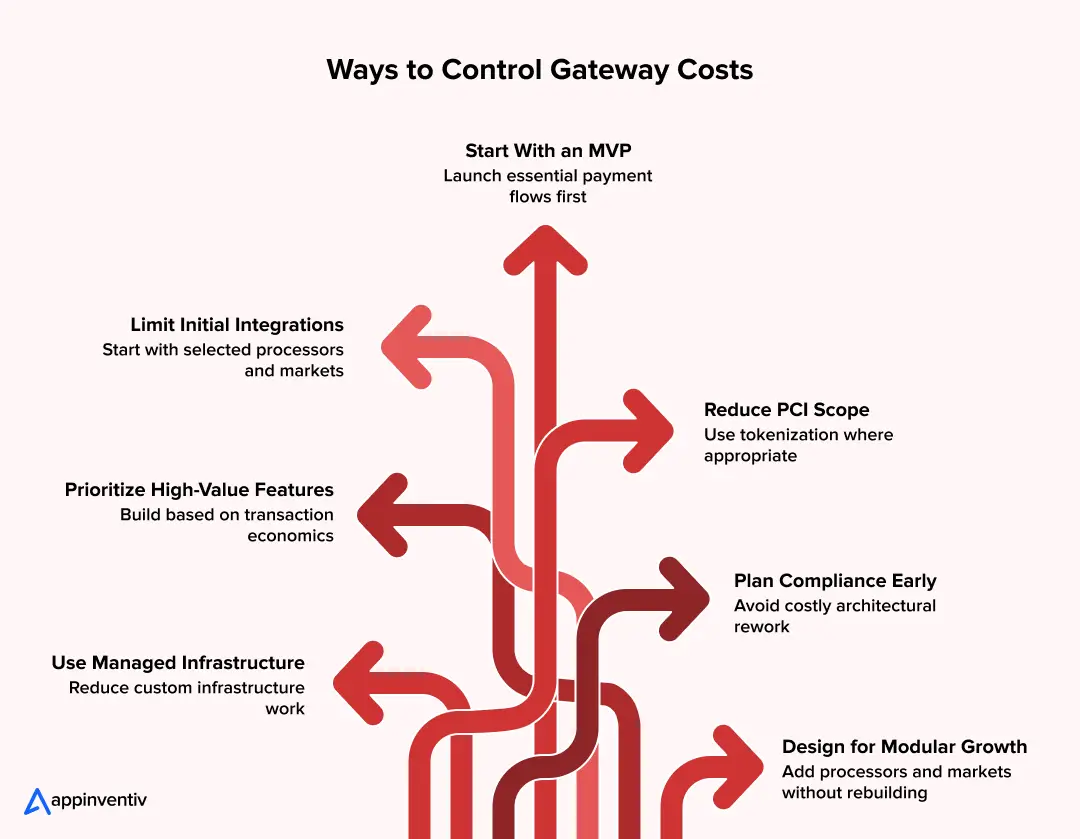
Start With a Focused Initial Release
Launch initial releases using primary payment flows first. Limit early releases to basic payment options, single processor connections, merchant APIs, and baseline transaction processing. Engineering teams add complex routing rules, regional markets, and advanced features after the primary platform processes live volume.
Cost Benefit: Lowers payment gateway build cost by shortening initial development schedules and cutting early software expenses.
Externalize Card Data Processing
Use third-party tokenization services to store sensitive card details outside internal networks. Offloading cardholder data reduces the technical scope covered by security audits. This strategy reduces required security controls and cuts software setup hours.
Cost Benefit: Shrinks audit scope and reduces infrastructure and security expenses.
Limit Initial Processor and Market Connections
Connecting a single processor keeps integration and certification workloads manageable. Geographic expansion follows the same technical rule. Engineering teams add extra processors, payment rails, and country connections after transaction volume justifies expansion spending.
Cost Benefit: Cuts initial integration spending and avoids early regional compliance costs.
Rank Features Using Transaction Revenue
Payment features require distinct engineering priorities. Technical leads rank new payment methods, foreign currencies, risk engines, and payout options against transaction volume and actual customer demand.
Cost Benefit: Prevents capital spending on software features that lack immediate financial returns.
Embed Compliance Rules During Initial Design
Define security parameters, data flows, user permissions, audit logs, and regulatory rules during early architectural planning. Late security adjustments force expensive redesigns across APIs, cloud infrastructure, and core database layers.
Cost Benefit: Prevents software redesigns, project delays, and unexpected engineering fees.
Select Managed Infrastructure Services
Managed databases, messaging queues, monitoring tools, tokenization platforms, and security software reduce required custom development. Engineering teams select external cloud services based on processing volume, data rules, and uptime targets.
Cost Benefit: Lowers custom infrastructure coding and reduces ongoing maintenance labor.
Build Systems For Modular Growth
Design core payment services to accept extra processors, payment methods, processing volume, and target regions without full architectural rebuilds. Independent software connectors and clear service boundaries simplify future platform expansion.
Cost Benefit: Cuts future redevelopment expenses as processing scale and market reach expand.
Recurring infrastructure costs, PCI validation, fraud management, network charges, and regional expansion can materially affect your TCO.

Initiate Your Payment Gateway Development Journey With Appinventiv
Building custom payment software requires more than checkout forms and basic APIs. Growing platforms require transaction systems that manage routing, fraud prevention, settlement, reconciliation, security, and traffic spikes.
Appinventiv brings 10 years of financial technology experience and has delivered 200 software products for global clients. Engineering teams build core processing engines, secure transaction pathways, acquirer integrations, risk tools, settlement logic, and cloud environments.
Past engineering projects achieved 98% fraud-detection accuracy, 99.50% transaction uptime, and 30% operational cost reductions. These technical capabilities help enterprises build payment systems that match specific processing volumes, compliance targets, and growth goals.
As a payment gateway software development company, our engineering teams guide projects from early gateway prototypes to global payment platforms. Dedicated specialists define system architectures, calculate development budgets, and build project roadmaps for custom enterprise builds.
Contact Appinventiv and calculate your true payment infrastructure cost.
Frequently Asked Questions
Q. How much does it cost to build a payment gateway?
A. The answer depends on the gateway’s scope, integrations, compliance needs, infrastructure, and transaction volume. A basic custom payment gateway can cost around $50,000–$100,000, while a mid-scale gateway may reach $250,000. Enterprise payment gateways can cost $500,000 or more when they require multi-region infrastructure, advanced fraud controls, multi-bank integrations, and high availability.
Q. How long does it take to develop a payment gateway?
A. Building a minimum viable product requires three to six months of development time. Standard production-grade systems demand six to twelve months of active engineering work. Complex enterprise payment platforms or facilitator software, where the cost of building a payment gateway matters most, take 12 to 18 months or longer. External partner onboarding, technical certifications, security audits, penetration testing, and compliance approvals lengthen these completion timelines.
Q. How much does it cost to add AI features to a payment gateway?
A. Artificial intelligence capabilities add $30,000 to over $200,000 to total project costs. Basic anomaly detection systems sit near the lower price threshold. Machine learning risk engines, behavioral analytics, dispute predictions, and real-time transaction tools increase expenses. These advanced systems demand data pipelines, custom inference software, dedicated monitoring tools, and governance frameworks.
Q. What tech stack is used for payment gateways and how does it affect cost?
A. Payment platforms rely on Java, Go, .NET, Node.js, PostgreSQL, message queues, containers, and cloud environments. Language choice influences baseline budgets less than structural security requirements, processing throughput, and integration scope. Specialized software developers charge higher hourly rates, but domain experience prevents expensive software architecture redesigns. Experienced payment engineers accelerate processor integrations and minimize technical delays.
Q. How do security and compliance requirements affect payment gateway development cost?
A. Regulatory guidelines and security standards demand substantial engineering labor and validation testing. Card tokenization, encryption protocols, access permissions, isolated network segments, audit logs, and fraud rules expand development work. Specific compliance demands shift based on processing roles, data flows, business operations, and target regional jurisdictions.
Q. How much cost does PCI DSS compliance add to payment gateway development?
A. Payment card industry compliance implementation adds $20,000 to over $100,000 in total technical expenses. Card data boundaries and underlying system architectures determine final audit costs. Third-party tokenization tools isolate primary account numbers and shrink security boundaries. Direct storage of cardholder details forces expanded infrastructure controls, penetration testing, and regulatory validation tasks.
Q. How should enterprises choose a payment gateway software development company?
A. Choose a partner with proven technical expertise in secure transaction flows, real-time processing, and scalable architectures. Conduct due diligence across payment projects, security practices, and compliance requirements. The team should align development with your business objectives, use an MVP-based development strategy, and provide a clear cost estimate. Review their technical support and long-term support plans for ongoing updates, security fixes, and compliance changes.
Q. What are the key features and components of a payment gateway?
A. A payment gateway typically includes secure checkout screens, data encryption, and tokenization for payment data protection. Core capabilities include multiple payment methods, mobile payment support, multi-currency support, and recurring billing. Enterprise gateways can add a fraud detection mechanism, real-time analytics, and merchant dashboards for transaction monitoring and management. Integrations with ecommerce platforms connect payment processing with existing commerce systems, while customer support helps resolve payment issues and transaction failures.
Q. What is a payment gateway and how does it work?
A. A payment gateway connects a merchant’s application with the wider online payment ecosystem. It securely sends card-not-present (CNP) payment data through a payment processing network for authorization. The flow involves card networks and issuing banks, with fraud detection systems checking transactions before approval.
Businesses can connect gateways through API integration or use hosted payment gateways that handle the payment interface externally. Self-hosted payment gateways give businesses more control over the checkout experience but require greater security responsibility. White-label payment gateways provide branded payment experiences on existing infrastructure. Modern gateways can support multiple currencies, online payments, and digital point-of-sale (POS) terminals through connected payment systems.


Fast 2-minute response, fully NDA-protected.

How Much Does RegTech Software Development Cost in the UK in 2026?
Key takeaways: RegTech software development cost in the UK spans £40,000 to £400,000+, with regulatory scope and legacy integration depth driving the cost. High-performance systems deliver a 30% to 50% reduction in manual workloads, protecting enterprises from severe FCA penalties. Advanced AI features generally represent around 25–40% of the total project investment due to the…

Building Next-Generation Digital Payment Systems for Australia's NPP Economy
Key takeaways: Australia's NPP is approaching 1.82 billion real-time transactions annually; BECS decommissioning by 2030 creates a hard migration deadline that cannot be managed through incremental patches. The July 2026 Payday Super mandate makes real-time payment infrastructure a legal compliance requirement. Enterprises without NPP-capable payroll systems are already operating against a regulatory clock. NPP platform…

كم تكلفة تطوير تطبيق BNPL مثل Tabby في السعودية والإمارات؟ (2026)
لنتحدث بشفافية تامة ونبتعد عن التنظير والمثاليات الفارغة. الدفع عند الاستلام كان يوماً ما ملك الساحة في دبي والرياض وعموم منطقة الشرق الأوسط، لكنه اليوم يمثل عقبة تشغيلية وكابوساً لوجستياً ينهش هوامش الأرباح. التجارة الإلكترونية الحديثة تعتمد بالكامل على المرونة، التجربة الخالية من الاحتكاك (Zero Friction)، والسرعة. هنا يبرز أي تطبيق اشتر الآن وادفع لاحقاً…