


























Payment Process Modernization: Enterprise Strategy, Architecture, and Implementation Roadmap

 Share -



- 01How Payments Transformation Is Reshaping Enterprise Payment Operations
- 02Core Components of a Modern Payment Processing Architecture
- 03Core Payment Process Modernization Strategies for Enterprises
- 04Key Business Benefits of Payment Process Modernization
- 05Major Challenges and Fixes During Payment Modernization
- 06Enterprise Payment Process Modernization Plan: Steps to Modernize Payments in Large Organizations
- 07How Much Does Payment Process Modernization Cost?
- 08Future Trends Shaping Payment Process Modernization
- 09How Appinventiv Updates Large Corporate Payment Systems
- 10Frequently Asked Questions

Key takeaways:
- Old payment tools raise daily operating bills and make legal compliance harder to manage. These slow setups fail to support instant global transfer networks.
- A successful update connects specific modern software parts across the platform. It combines cloud servers, central routing hubs, and new ISO 20022 message codes.
- Combining different networks into a single central hub reduces project deployment risks. Doing the software work in clear steps protects the daily corporate cash flow.
- New platforms process customer payments within seconds and quickly spot transaction fraud. The software grows easily with user traffic and tracks every corporate transaction.
- Companies that delay their system upgrades face heavy coding debt over time. They pay higher maintenance bills and miss out on building better financial tools.
Corporate payment managers navigating payment modernization face intense new operational pressures from global markets today. These internal payment systems impact immediate customer satisfaction and corporate cash flow.
One late financial settlement hurts the overall health of the entire business. A single failed international transfer causes major operational trouble for the management team.
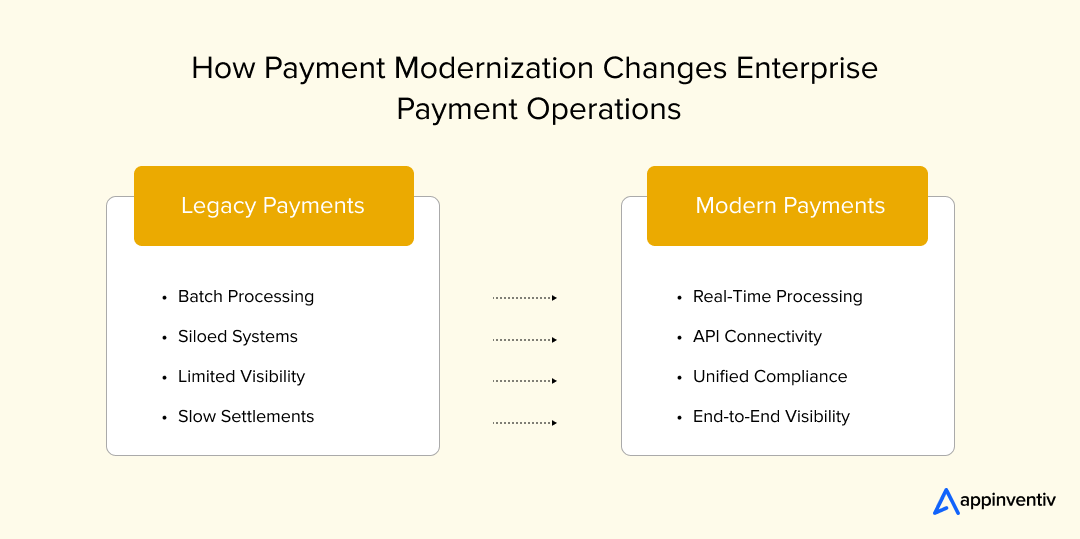
Many large enterprises still use outdated, slow payment technology today. These isolated systems run daily corporate financial data in separate batches. Old corporate tools fail with instant payments and global data rules.
They cannot handle new real-time data feeds from external bank partners. Active retail customers want their cash within seconds during the business week.
This major shift moves basic technology updates into important executive board meetings. 76% of businesses expect trading-partner demand to accelerate the adoption of instant payments, making payment modernization a business priority rather than a technology initiative.
Corporate directors care deeply about these specific financial track records right now. Large company leaders need a new setup for daily wholesale money transfers. The new tracking system sends automated financial records directly to multiple corporate bank platforms.
This guide covers the specific tools, plans, problems, and costs. It shows the clear operational setup steps for large corporate systems.
Trading partner demand is driving the adoption of instant payments. Legacy infrastructure is becoming a competitive liability.

How Payments Transformation Is Reshaping Enterprise Payment Operations
Updating payment systems is a top goal for companies today. Instant bank networks and new rules show the flaws in old technology. Five factors cause this change.
Growing Demand for Real-Time Payments
Networks like RTP and FedNow increased the need for fast transfers. Research shows that more than 9 in 10 businesses are interested in faster and instant B2B payment use cases. This makes real-time processing a growing enterprise requirement rather than a future capability. They want clear tracking and fast error fixes.
Rising Cost of Old Payment Systems
Many companies keep separate software for ACH, wires, cards, and SWIFT transfers. Recent industry research found that 48% of retailers identify fragmented and outdated payment infrastructure as a major challenge. This pattern mirrors the broader push for banking modernization across all financial sectors.
This highlights the operational burden of legacy payment environments. This separation raises maintenance bills, echoing the broader challenges of legacy application modernization across industries.
Regulatory and Compliance Pressures
Rules like ISO 20022 codes and anti-money laundering checks require flexible tools, and sectors like social security payment modernization face the same mandate. Old systems lack the speed to handle these global laws.
Customer Expectations for Faster Payments
Buyers and partners want live status updates. They want quick cash settlement and tracking tools. Slow processing leads to angry phone calls and bad reviews.
Also Read: Payment App Development Guide
The Rise of Open Banking and Embedded Finance
Companies connect their payment tools to ERP software, treasury databases, and bank APIs. This setup requires API links. These links keep data safe and enable fast connections.
Traditional Payment Infrastructure vs Modern Payment Ecosystems
The table below compares old systems with new payment setups.
| Capability | Old Model | New Model |
|---|---|---|
| System Design | Massive locked databases | Small independent code blocks |
| Processing | Daily batch tracking | Live instant updates |
| Growth Limits | Fixed server space | Flexible cloud expansion |
| Connections | Single direct links | Open API networks |
| Legal Rules | Locked code laws | Central compliance tools |
| Buyer Experience | Poor tracking data | Live alerts and tracking |
Traditional payment systems focus on processing transactions. Modern payment ecosystems combine processing, visibility, compliance, intelligence, and speed into a single, centralized system.
Core Components of a Modern Payment Processing Architecture
Business leaders often view payment modernization as a corporate strategy decision. The technical setup determines if the plan actually succeeds.
Many update programs fail. Companies replace old software but leave slow data bottlenecks. A new platform must handle instant processing, multiple networks, legal rules, and fraud checks. It must manage high traffic without causing messy operational problems.
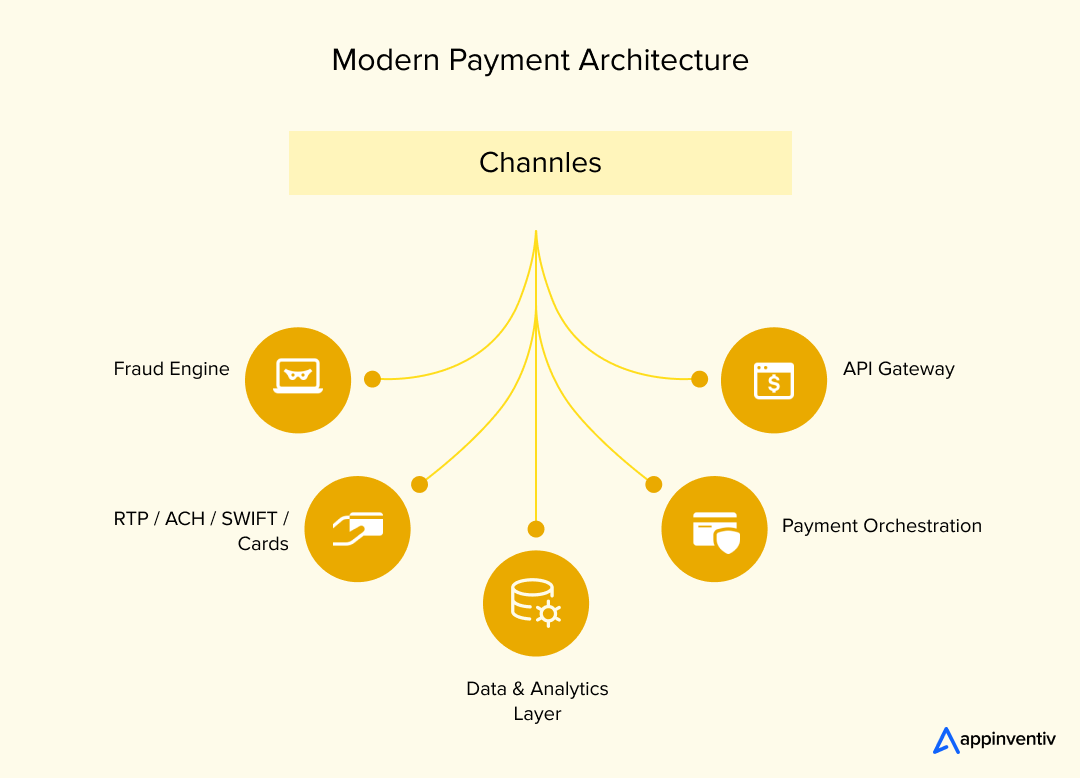
The layout below forms the base of most new payment setups.
Cloud-Native Payment Infrastructure
Old payment setups run on locked code blocks inside private servers, a core reason why payment application modernization has become essential for large enterprises. Growing these environments requires expensive new hardware. It forces lengthy testing cycles and requires extensive engineering support.
Modern platforms use cloud tools built with these parts:
- Independent code units
- Software containers
- Automated container management
- Service communication meshes
- Live data streaming tools
This microservice architecture lets individual payment tools grow on their own, and the same principles apply directly to payment gateway architecture, where authorization, routing, and settlement run as separate services. For example, fraud checks and balance tracking run as separate tasks. A sudden spike in buyer traffic affects only one specific tool. It does not crash the whole system. This design prevents total outages and reduces release risks.
API-First Integration Layer
Payments connect with many internal and external tools. These tools include:
- Core bank software
- ERP corporate systems
- Cash management databases
- Payment gateway integration
- Open banking systems
- Partner networks
An API data layer serves as the main communication highway between these networks. Key tools include:
- REST API connections
- GraphQL data feeds
- User login validation
- Traffic speed controls
- System performance tracking
- Code portals for developers
This setup removes direct custom links. Those old individual wires create massive maintenance headaches over time.
Payment Orchestration Engines
Payment orchestration tools form a critical layer in the new setup. The coordination engine sits directly between business apps and underlying bank networks.
Its main tasks include:
- Directing transaction paths
- Confirming transfer data
- Running step-by-step workflows
- Matching final settlements
- Handling data errors
- Running automated retry rules
Companies put all choices into this single layer. They do not write separate payment rules into five different systems. For example, the engine automatically moves money via RTP or ACH. It picks the path based on total cost, location, or speed requirements.
Real-Time Payment Processing Rails
Modern setups handle multiple financial networks simultaneously. Common options include:
- RTP networks
- FedNow transfers
- SEPA Instant networks
- SWIFT messages
- ACH transfers
- Bank wire transfers
- Credit card systems
Each network uses unique settlement rules and text standards. The new setup hides this messy variety behind simple interfaces. Corporate applications send plain payment commands. They do not need to know the specific rules of individual networks. This reduces coding effort and simplifies the addition of new networks.
ISO 20022 Messaging Infrastructure
The ISO 20022 format is a major requirement for global systems today. This standard adds detailed text data to every transaction. It creates clear tracking across the full life of a transfer.
A proper ISO 20022 setup contains specific tools:
- Text translation tools
- Data addition services
- Format validation engines
- Code mapping parts
- Schema tracking tools
These tools translate legacy message formats into ISO 20022-compliant files. They keep data uniform across different networks. This layer keeps international companies safe during government audits and cross-border transfers.
Fraud Detection and Risk Intelligence Systems
Security checks cannot happen after a transaction ends anymore. Instant payment setups require instant fraud choices.
Modern security tools judge transfers using these items:
- User activity tracking
- Hardware data checks
- Transfer speed counts
- Risk score math
- Legal list checks
- Anti-money laundering tracking
Many companies combine basic rules with machine learning tools to spot weird transfer patterns. The scanning must happen within milliseconds. Quick checks avoid payment delays and maintain tight safety rules.
Data, Analytics, and Observability Layer
Payment tools create massive piles of daily data. Teams cannot spot errors, delays, or fraud without a central dashboard. This challenge is reflected in industry surveys, where 54% of retailers cite access to payment and customer data as a key obstacle to modernization.
This visibility layer includes:
- Live transaction tracking
- Code path tracing
- Software speed monitoring
- Team dashboards
- Audit logs
- Real-time reports
Payment data flows directly into central platforms such as Kafka, Snowflake, Databricks, or BigQuery. This data layer helps with specific business needs:
- Payment trend math
- Cash tracking reports
- Daily balance balancing
- Fraud investigations
- Government data filings
- Executive status dashboards
A new payment setup does not rely on one single tool. It depends on how these parts connect. Together, they form a safe, growing network that easily handles instant cash and new global rules.
Core Payment Process Modernization Strategies for Enterprises
There is no single blueprint for payment modernization. There are multiple factors, such as the complexity of legacy systems, volume of transactions, regulatory requirements, business needs, and acceptable operational risk, that determine the right approach.
The transition to modernity is a process that takes several years in some organizations. Some people even swap out whole platforms.
The goal is the same: to create a payment ecosystem that supports future growth without disrupting critical payment operations.
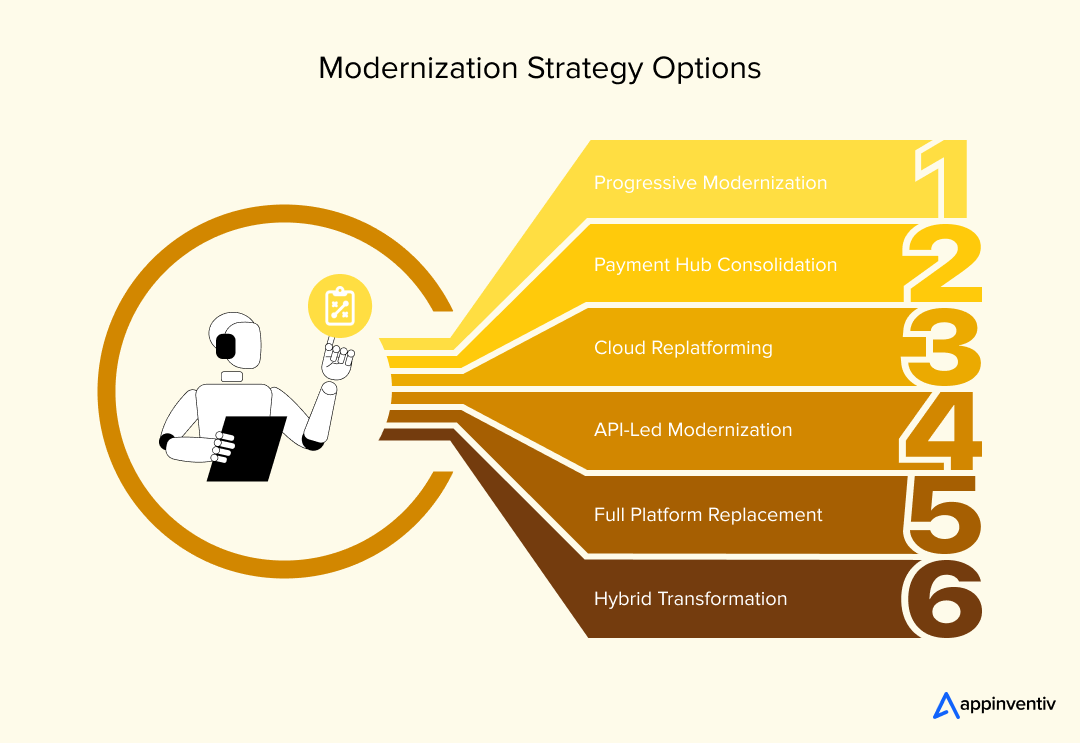
Progressive Modernization (Strangler Pattern)
Progressive modernization replaces legacy capabilities one component at a time rather than rebuilding the entire payment environment.
A typical example is adding a new payment orchestration layer, which still processes payments but also handles the new layer. Other services are then incrementally moved to the new platform, including fraud screening, reconciliation and routing.
Best for:
- Large enterprises
- Global banks
- Organizations running mission-critical payment systems
Advantages:
- Lower implementation risk
- Faster delivery of business value
- Easier stakeholder adoption
- Reduced operational disruption
Challenges:
- Longer modernization timelines
- Temporary coexistence of old and new platforms
- Increased architectural complexity during transition
Payment Hub Consolidation
Many enterprises operate separate systems for ACH, wires, RTP, SWIFT, and card payments. Each platform often maintains its own workflows, compliance controls, and reconciliation processes.
Payment hub consolidation centralizes these functions into a single processing and orchestration layer.
Best for:
- Enterprises managing multiple payment rails
- Financial institutions operating across regions
Advantages:
- Reduced operational complexity
- Unified payment visibility
- Centralized compliance controls
- Consistent payment workflows
Challenges:
- Large-scale integration effort
- Complex data migration requirements
- Potential process redesign requirements
Cloud-Native Replatforming
This strategy focuses on rebuilding payment infrastructure using modern cloud technologies.
Core architectural components often include:
- Microservices
- Containers
- Kubernetes
- Event-driven workflows
- Distributed databases
- Streaming platforms such as Kafka
Unlike monolithic architecture, each service in this model scales and deploys independently. Instead of scaling an entire payment platform, individual services scale independently.
Best for:
- Organizations seeking greater scalability
- Enterprises modernizing aging infrastructure
Advantages:
- Elastic transaction processing capacity
- Faster software releases
- Reduced infrastructure management
- Improved platform resilience
Challenges:
- Governance and operating model changes
- Security architecture redesign
- Regulatory approval requirements in some markets
API-Led Modernization
Many enterprises cannot immediately replace core payment systems. This form of payment application modernization places an abstraction layer around legacy infrastructure. Existing payment services become accessible through standardized APIs.
This strategy supports:
- Open banking initiatives
- Embedded finance programs
- Partner integrations
- Mobile payment channels
Best for:
- Organizations seeking rapid innovation
- Enterprises with stable but aging payment systems
Advantages:
- Faster third-party integrations
- Improved developer productivity
- Faster product launches
- Lower disruption to core systems
Challenges:
- Legacy bottlenecks remain
- Core platform limitations continue to affect performance
- Technical debt still requires long-term resolution
Full Platform Replacement
Some payment environments reach a point where incremental modernization is no longer practical.
In these situations, organizations replace legacy infrastructure with a modern payment platform.
The transformation typically includes:
- New payment processing engines
- New settlement workflows
- Modern orchestration capabilities
- Updated compliance services
- New reporting and analytics platforms
Best for:
- End-of-life systems
- Organizations facing severe scalability constraints
Advantages:
- Maximum modernization impact
- Long-term technology alignment
- Reduced technical debt
Challenges:
- Highest implementation risk
- Large investment requirements
- Longer deployment timelines
- Complex change management efforts
Hybrid Modernization Strategy
Most large enterprises do not follow a single modernization strategy.
They combine multiple approaches based on business priorities, regulatory constraints, and budget availability.
A typical modernization program often includes:
- API enablement around legacy systems
- Payment hub deployment
- Progressive migration to cloud-native services
- Gradual retirement of legacy platforms
This reduces risk while allowing modernization initiatives to deliver value earlier.
Example Modernization Journey
| Phase | Modernization Activity |
|---|---|
| Phase 1 | Legacy core payment systems |
| Phase 2 | API enablement layer |
| Phase 3 | Payment hub deployment |
| Phase 4 | Cloud migration |
| Phase 5 | Real-time payment enablement |
| Phase 6 | AI-driven payment operations |
This model has become increasingly common among global enterprises because it balances innovation with operational stability.
Choosing the Right Payment Modernization Strategy
The best modernization strategy depends on the enterprise’s current environment and future objectives. The table below provides a simple decision framework.
| Enterprise Scenario | Recommended Strategy |
|---|---|
| High regulatory complexity | Progressive modernization |
| Multiple payment rails and fragmented systems | Payment hub consolidation |
| Need rapid innovation and partner integrations | API-led modernization |
| Legacy platform approaching end of life | Full platform replacement |
| Global transformation across multiple regions | Hybrid modernization |
The best payment transformation programs are less about technology selection than about sequencing. A business-oriented approach involves making architectural decisions aligned with the enterprise’s goals and requirements, risk tolerance and regulatory requirements, which often yields better results than a large-scale replacement project without a phased approach.
Fragmented payment rails and outdated integrations continue to increase operational overhead and risk.

Key Business Benefits of Payment Process Modernization
Payment modernization brings real financial results beyond faster transactions. The benefits of adopting real-time payment systems extend across operations, customer experience, and compliance, as shown in the table below. Compliance becomes simpler, and revenue grows.
| Benefit | Business Impact |
|---|---|
| Quick Money Transfers | Moves money instantly. This change gives teams a clear view of daily cash. |
| Reduced Operating Costs | Cuts down on manual data entry. It removes duplicate systems and reduces maintenance costs. |
| Better Buyer Experience | Delivers faster transfers. Buyers see instant status alerts and face fewer broken transactions. |
| System Growth and Reliability | Manages sudden traffic spikes without slowing down. The platform stays online during busy hours. |
| Quicker Tool Rollouts | Speeds up the launch of new transfer choices. Modular code blocks open new markets quickly. |
| Tighter Security | Unites money-laundering checks and fraud tracking into one system. It simplifies audit reviews. |
| Live Data Tracking | Provides live numbers on transfer sizes. It tracks payment status, errors, and system speeds. |
Large corporations gain value beyond basic money transfers, especially when guided by expert FinTech consulting services. New platforms drop settlement times from days to seconds. They cut down on transaction errors. They process transfers without manual work. Teams spend less time launching new features.
Daily transfer numbers are rising fast. Corporate networks are expanding. Clients demand open, fast payments. These advantages matter now.
Also Read: How to Create a Payment Gateway
Major Challenges and Fixes During Payment Modernization
Most updated programs fail due to poor execution. Industry research shows that high costs (48%), security concerns (32%), slow processing (32%), and lack of automation (28%) remain the most common payment challenges organizations face today. Companies must keep daily operations running. They must add new security and legal steps simultaneously.
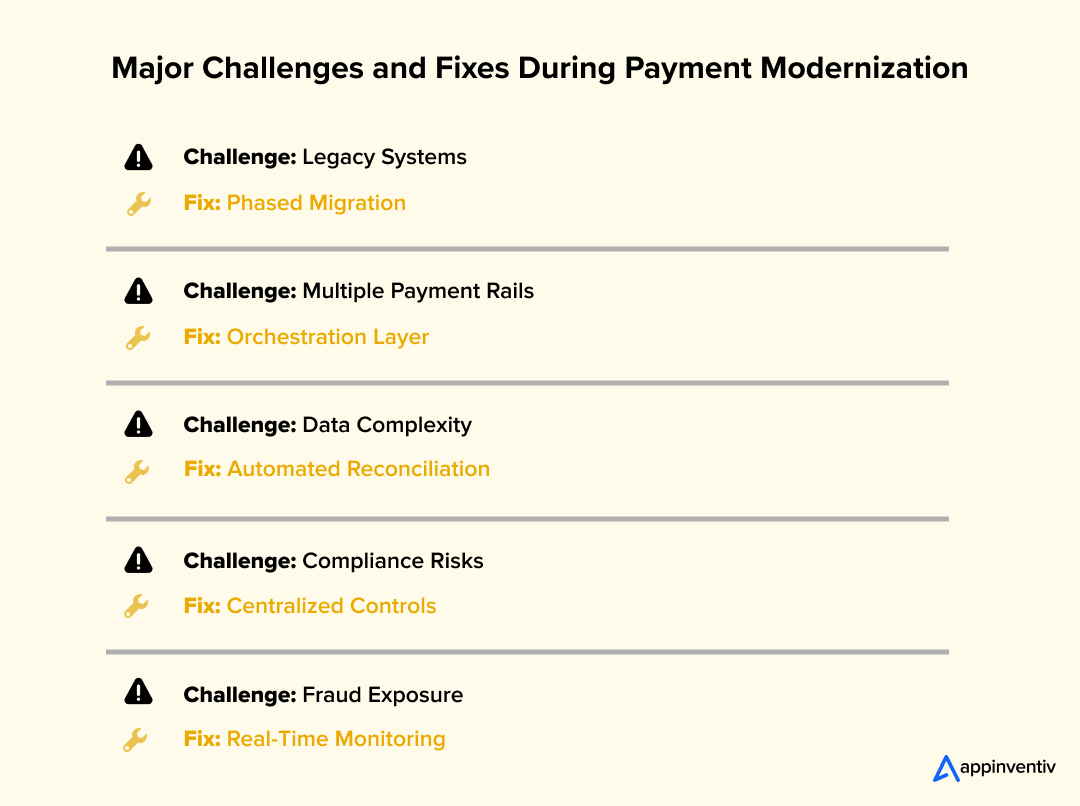
Moving From Old Systems Without Stopping Daily Traffic
Many systems process millions of daily transfers. Payment application modernization at this scale, without breaking balance sheets or stopping buyer payments, is hard.
The Fix: Run both the old and new software simultaneously. Test the new system completely. Shut down the old tools later.
Connecting Multiple Payment Networks and Banks
Companies link to ACH, RTP, SWIFT, card systems, and bank partners through separate wire connections.
The Fix: Use orchestration hubs and API gateways. These tools create standard links and remove messy custom code.
Also Read: Crypto Payment Gateway Development
Messy Data Transfers and Balancing Errors
Payment records live in different formats and separate databases. Mistakes during a data move lead to incorrect balances and major audit problems.
The Fix: Set strict data rules and automated checks. Run double balancing steps across both systems. Complete the final move later.
Regional Rules and Legal Requirements
Global payment teams, from private banks to agencies pursuing social security payment modernization, must meet financial software compliance requirements, including ISO 20022 standards, money-laundering checks, and local data privacy laws.
The Fix: Put legal checks directly inside the main system design. Do not treat law checks as an extra layer. Central tracking makes audit tasks simple.
Managing Security and Fraud Risks During Changes
System updates can create software gaps. Old safety tools allow fraud during these changes.
The Fix: Deploy live fraud tracking, data token blocks, and file encryption as part of a broader cloud data protection strategy.
Team Changes and Skill Gaps
New software requires fresh operational setups. Engineering teams need cloud skills and knowledge of API tracking.
The Fix: Teach current workers new skills. Hire outside payment experts. Clear leadership support helps teams learn the new tools fast.
Teams handle most update problems through step-by-step rollouts. Strict management and smart system choices protect daily operations. Teams add new features at the same time.
Enterprise Payment Process Modernization Plan: Steps to Modernize Payments in Large Organizations
Successful payment modernization programs follow a clear step-by-step plan rather than trying to replace technology overnight. The plan must reduce deployment risk while maintaining uninterrupted core corporate payments. This careful choice brings clear financial value to the company at each stage.
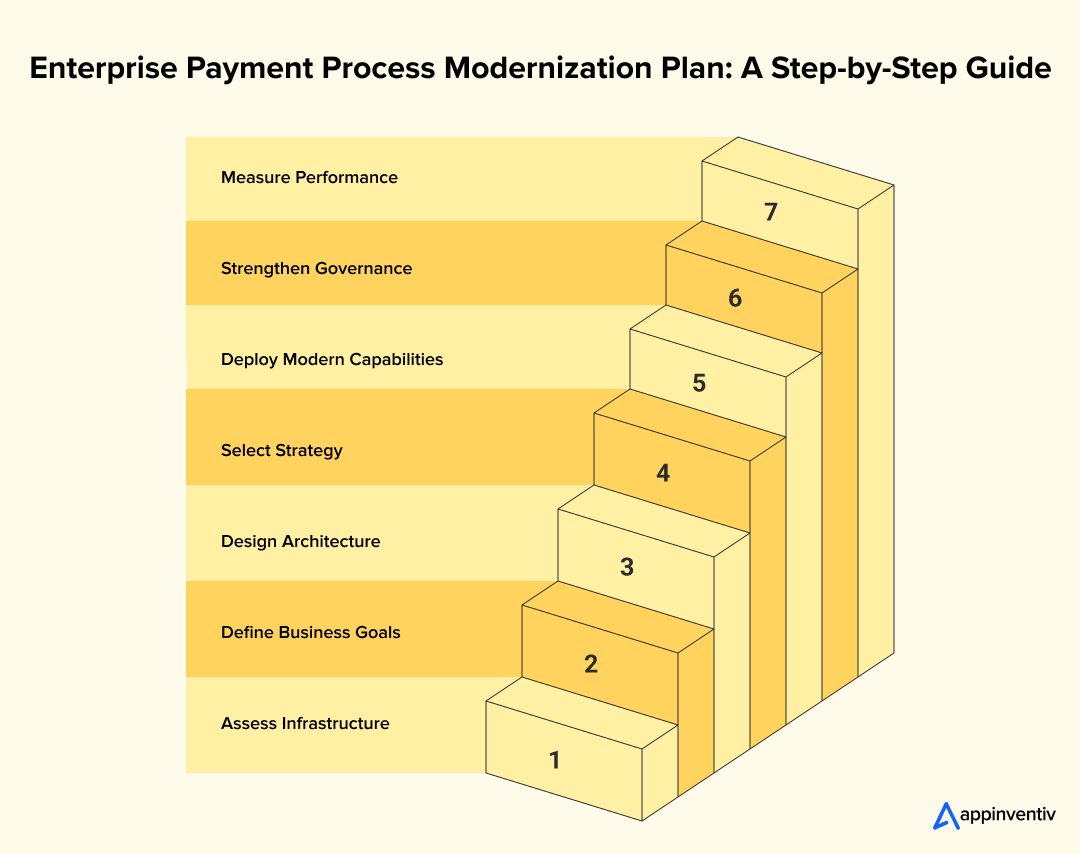
Step 1: Study Existing Payment Tools
Begin with a detailed review of the current payment setup.
Evaluate these items:
- Payment networks and processing systems
- Software connection dependencies
- Old code debt
- Operational bottlenecks
- Legal rule gaps
This review creates the starting line for future update choices.
Step 2: Define Business and Buyer Goals
Corporate technology choices must support clear business goals to justify the cost of the upgrade.
Common targets include:
- Faster cash transfer cycles
- Lower payment processing bills
- Live payment capabilities
- Clear views of transaction data
- Moves into new country markets
Clear targets help managers pick the best software investments.
Step 3: Design the Future System Setup
Map out the future payment setup before buying new tools.
The design must outline:
- Payment orchestration layers
- API plans
- Cloud setup models
- Data and tracking needs
- Security controls
- Bank network links
Step 4: Pick the Update Method
The update plan must match your comfort with risk and your current tool limits.
- Progressive Updates: Replace payment tools one small piece at a time.
- Parallel Run Setup: Run the old and new platforms together during the data move.
- Full Platform Replacement: Swap the entire old system stack with a new platform all at once.
- Hub Consolidation: Combine multiple payment lines into a single central processing layer.
Step 5: Deploy Cloud, APIs, and Live Features
Launch the core update parts to run your systems.
These parts include:
- Cloud-native servers
- API management platforms
- Live payment connections
- Event-driven processing tools
Step 6: Tighten Security, Laws, and Management
Put safety and legal checks straight into the platform code.
Key items include:
- ISO 20022 message readiness
- Anti-money laundering tracking
- Fraud block tools
- Audit trail records
- User access rules
Step 7: Track Performance Numbers and Fix Errors
Follow the updated results with clear performance numbers.
Track these data points:
- Automated processing rates
- Total cash transfer times
- Broken payment counts
- Day-to-day operational costs
- Total system uptime
The table below shows the full plan timeline.
| Stage | Objective | Deliverable |
|---|---|---|
| Review | Spot system gaps | Current system review |
| Design | Map the future setup | Modernization plan |
| Move | Reduce setup risks | Step-by-step move guide |
| Launch | Update payment operations | Live production rollout |
| Upgrade | Track business results | Performance dashboard |
Large companies that treat updates as a phased step-by-step plan get better results. They succeed far more than groups that swap massive technology setups without a clear guide.
How Much Does Payment Process Modernization Cost?
Total bills depend on your current systems and daily transfer counts. Legal rules and your upgrade path also affect the price. Most projects cost between $50K and $500K+. Large global updates cost far more.
The table below outlines the main price drivers.
| Cost Driver | Lower Complexity Tools | Higher Complexity Tools |
|---|---|---|
| Current Technology | A few old systems | Multiple old platforms and custom workflows |
| Payment Networks | ACH or card transfers only | ACH, RTP, SWIFT, wires, cards, and regional networks |
| Connection Needs | Few internal tools | ERP, treasury, bank, fraud, and partner systems |
| Rules and Security | Standard legal controls | Multi-region rules and reporting needs |
| Cloud Infrastructure Investments | Small cloud moves | Massive cloud-native platform setups |
| Upgrade Method | API-focused updates | Full platform replacement or central hub consolidation |
| Total Expected Cost | $50K to $150K | $150K to $500K+ |
Compare these upfront costs against future day-to-day savings. The updates cut old maintenance bills and lower coding debt. They let teams launch new features faster.
Organizations investing now gain faster innovation cycles and stronger operational resilience.

Future Trends Shaping Payment Process Modernization
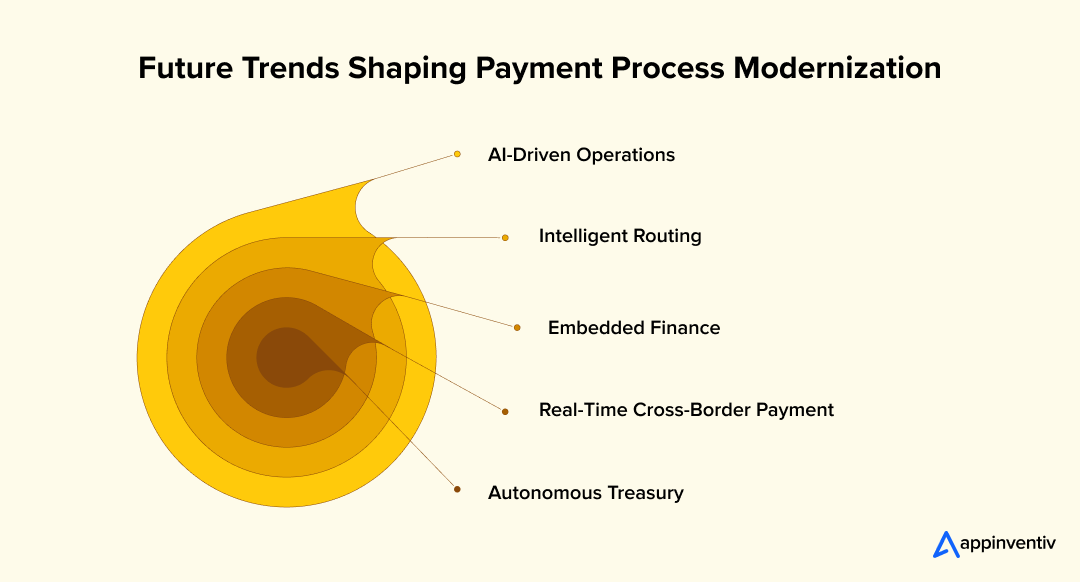
Recent trends driving this transformation point toward smart automation and AI-led tools instead of simple money moves. Global systems will talk to each other directly.
AI-Driven Payment Operations
AI in payments does more than stop fraud now. Industry surveys indicate that 85% of banks plan to use AI for instant fraud risk resolution, making it one of the most heavily funded areas of payment modernization.
Companies use smart models and data bots to fix errors. These tools automatically review missing transfers and balance books. They predict cash needs and watch daily traffic. This saves time for corporate workers.
Intelligent Payment Routing
Smart routing engines check fees and network speeds before they send a transfer. They look at past success rates across different networks. Then the system automatically selects the best bank path. This setup drops processing fees and stops dropped payments.
Embedded Finance Networks
Payments now live directly inside regular business software. Online storefronts and sales apps include built-in cash tools. API banking services and digital wallets accelerate this change.
Also Read: P2P Payment App Development
Cross-Border Real-Time Payments
International payments remain broken across different regions. Modernization leaders are already preparing for the next generation of payment infrastructure, with more than 50% actively building Web3 payment rails compared with only 6% of early-stage organizations.
New projects link local real-time networks together using ISO 20022 text standards to enable faster cross-border payments. These connections push the industry toward fast global transfers. Companies get clear tracking and lower fees.
Autonomous Treasury Operations
Cash management teams use automation more than ever. New systems integrate live transaction files with automated cash-tracking tools, a shift increasingly driven by agentic payments. They predict funding needs without human help. Over time, software will handle money routing, funding choices, and error correction on its own.
Companies that build open API architectures today will readily adopt these new tools as global systems evolve.
How Appinventiv Updates Large Corporate Payment Systems
Updating payment tools requires more than replacing old databases. Large companies must upgrade their payment networks. They need to connect different bank setups. Teams must tighten legal rules and stop fraud threats. They must process live transfers without stopping daily store sales.
Appinventiv provides strategic consulting for payment modernization, helping companies complete this work by leveraging new system designs and API integrations. We build cloud software and central routing engines. Our team automates legal checks and links systems to live payment networks.
| Service Type | Proven Results |
|---|---|
| Old Systems Rebuilt | 500+ |
| Financial Tools Delivered | 200+ |
| Strategy Projects Completed | 2,000+ |
| Years of Industry Experience | 10+ |
| Fraud Spotting Accuracy | 98% |
| Transfer Safety Guarantee | 99.50% |
Proven Experience Across Modern Financial Tech Networks
Our payment-processing software developers build AI-powered money-tracking tools, digital cash wallets, asset platforms, and legal-tracking software.
For example, Appinventiv helped launch Mudra. This AI budget-tracking app operates in 12 countries today. Our team built secure digital wallets for strict legal frameworks. We also delivered wealth platforms with safe transfer steps, open API feeds, and new user sign-up tools.
Our background helps us solve the tough problems in this guide. We replace old databases and clear up messy bank connections. Our engineers handle rigorous audits, prevent fraud, and expand system capacity.
Live payments, ISO 20022 texts, and built-in cash tools are growing fast across the globe. Payment modernization is no longer optional.
Let’s connect and update your payment tools before old hardware stops your company’s sales.
Frequently Asked Questions
Q. What is payment process modernization?
A. Payment modernization means replacing legacy banking tools with new software. This update lets firms move cash instantly. It connects databases via cloud servers and complies with current laws. The work helps teams process money faster. It provides clear visibility into daily transfers and prevents systemic errors.
Q. Why is payment modernization important for enterprises?
A. Large companies need this change to send cash instantly. Buyers want fast mobile text updates now. The new setup stops reliance on slow databases. It cuts down messy office mistakes. Then it establishes a solid foundation for future artificial intelligence tools.
Q. What are the major components of modern payment systems?
A. Teams use cloud servers and small independent code blocks. They run API gateways and central routing hubs. The setup includes ISO 20022 message systems and live fraud checkers. These tools help platforms grow safely. They keep systems running day and night without major crashes.
Q. How long does payment modernization take?
A. The timeline changes based on your current database size. Simple API connections take a few months to finish. Replacing your entire system takes longer. Massive company updates require multiple steps. These big projects often last between one and three years.
Q. What are the biggest challenges of payment modernization?
A. The hardest part is moving financial records without stopping daily store sales. Firms must securely link different bank networks. They must maintain perfect balance sheets and block hackers during the transfer shift. Current staff need extra training to run the new cloud platforms.
Q. What is the role of ISO 20022 in payment modernization?
A. This code serves as a new global text standard for money transfers. It adds highly detailed data to every transaction file. The rich data makes international transfers simple and clear. It helps corporations pass government audits and match strict bank rules.
Q. How do payment hubs support modernization initiatives?
A. These hubs combine ACH, wire transfers, and credit cards into one central system. This setup eliminates the need for messy individual software tools. It gives managers a clear view of all the company’s cash. The central design simplifies government law checks and lets teams add new tools quickly.
Q. How can enterprises measure the ROI of payment modernization?
A. Firms track financial returns by checking cash transfer speeds and total processing bills. They look for higher automated tracking rates and fewer broken transfers. Safe legal audits and faster tool rollouts show clear value. These plain facts prove the worth of the software update.
Q. How does payment modernization improve refunds, disbursements, and incoming payments?
A. Payment modernization replaces paper-based and batch-driven processes with digital payment infrastructure powered by FedNow, Faster Payment Systems (FPS), direct deposits, and instant settlements. This improves refund delivery speed, payment traceability, anti-money laundering compliance, and consumer protection while supporting the shift away from paper checks and manual disbursement workflows.


Fast 2-minute response, fully NDA-protected.
Cost of Developing a Payment Gateway: A Complete Breakdown
Key takeaways: Custom gateway development requires $50,000 to $500,000 in upfront capital, and enterprise platforms cost more at scale. Core infrastructure, security compliance, and settlement logic consume far more budget than basic checkout screens. High transaction volumes require concurrency controls, failover systems, monitoring tools, and automated reconciliation engines. Platform ownership creates recurring costs for security…

How Much Does RegTech Software Development Cost in the UK in 2026?
Key takeaways: RegTech software development cost in the UK spans £40,000 to £400,000+, with regulatory scope and legacy integration depth driving the cost. High-performance systems deliver a 30% to 50% reduction in manual workloads, protecting enterprises from severe FCA penalties. Advanced AI features generally represent around 25–40% of the total project investment due to the…

Building Next-Generation Digital Payment Systems for Australia's NPP Economy
Key takeaways: Australia's NPP is approaching 1.82 billion real-time transactions annually; BECS decommissioning by 2030 creates a hard migration deadline that cannot be managed through incremental patches. The July 2026 Payday Super mandate makes real-time payment infrastructure a legal compliance requirement. Enterprises without NPP-capable payroll systems are already operating against a regulatory clock. NPP platform…