



















Build vs Buy: Licensed RAG Accelerators vs Ground-Up Custom Build

 Share -



- 01The Short Answer
- 02Build vs Buy an Enterprise RAG Solution
- 03Enterprise RAG Implementation Cost: Build vs License
- 04Build vs Buy AI: The Major Factors Compared
- 05The US Compliance Layer Most Comparisons Skip
- 06Contract Terms Procurement Should Negotiate
- 07Enterprise Evaluation Checklist
- 08Real-World Enterprise Scenarios
- 09How Appinventiv Helps Enterprises Build or Accelerate RAG Adoption
- 10FAQs

Key takeaways:
- Seventy percent of year-one build cost is payroll, not infrastructure.
- Licensing’s cash advantage is front-loaded: $680K in year one, $240K by year three.
- The build team never disbands 5–6 FTE, indefinitely.
- Scale flips the decision, not time. The crossover is roughly 40,000 seats.
- Builds die around month nine; licenses die as shelfware. Negotiate adoption ownership, not price.
Two-thirds of the money in a ground-up enterprise RAG program never touches a model. It goes to salaries, connectors, audit evidence, and the eighteen months of maintenance nobody scoped. That is the part the build-versus-buy debate keeps skipping — and the part that decides the outcome.
Gartner put the cost of a serious GenAI deployment at $5 million to $20 million, and predicted at least 30% of GenAI projects would be abandoned after proof of concept. The updated read is worse: by the end of 2025, Gartner reported that more than half were abandoned after the POC stage. MIT’s Project NANDA found something more specific and more useful — enterprises that bought and partnered reached deployment roughly twice as often as enterprises that built internally.
This is a decision about where your engineering years go, not a decision about software.
Not the vendor. Not the model. Not the vector database. Send those three, get a costed build-vs-license comparison.
The Short Answer
For most US enterprises, licensing a RAG accelerator beats building from scratch — but not for the reason vendors give.
The three-year cash difference in our model is $1.38 million, about 16%. That alone would not justify the decision.
What justifies it is eight months of earlier production value — worth roughly $2 million at an assumed $250K/month benefit — plus the transfer of SOC 2 and security-attestation burden to a vendor who already carries it.
Build from the ground up when three or more of these are true:
- Retrieval logic is the product you sell
- You are under an air-gapped or GovCloud mandate
- Your data types are genuinely outside what vendors index
- You are past roughly 40,000 seats, where per-seat licensing outruns fixed engineering cost
Everything else is a licensing decision. And most enterprises that “build” end up doing both anyway — licensing the retrieval and governance substrate, building the domain layer on top.
Build vs Buy an Enterprise RAG Solution
What “building” actually means in 2026
The phrase hides an enormous range. Nobody is writing an attention mechanism from scratch. When an enterprise says it is building RAG in-house, it means assembling and owning eight distinct systems:
- Ingestion and connectors — SharePoint, Confluence, Salesforce, S3, ticketing, email, and whatever the legal team keeps in a shared drive. Each with its own auth model, rate limits, and permission semantics.
- Document processing — Parsing, OCR, layout extraction, table handling, and the chunking strategy that determines whether retrieval works at all.
- Embedding and vector storage — Model selection, index tuning, re-embedding when models change, and replication.
- Retrieval and ranking — Hybrid search, reranking, query rewriting, metadata filtering. This is where quality is won or lost.
- Permission-aware access control — The hard one. Retrieval must respect source-system ACLs at query time, per user, without leaking through summaries.
- Evaluation harness — Golden datasets, regression testing, hallucination and groundedness scoring. Without this, you cannot tell whether a change helped.
- Observability and cost control — Token accounting, latency budgets, per-team chargeback.
- Governance and audit evidence — Logging, retention, model cards, and whatever your auditor asks for in month fourteen.
Roughly two of those eight are the interesting AI problem. Six are plumbing that every enterprise rebuilds identically.
What a licensed RAG accelerator actually gives you
A RAG accelerator is a retrieval platform you license instead of building. Six pieces come in the box:
- Connectors to your source systems
- Ingestion and document processing
- Permission-aware indexing
- Retrieval and reranking
- Evaluation tooling
- Governance and audit controls
It arrives as a licensed product with a defined implementation path, not a repo to clone. Microsoft, Databricks, AWS, Google, and a growing set of independent vendors all ship enterprise AI accelerator solutions of this kind.
What you get is the six plumbing systems, already built, already load-tested against other enterprises’ messy data, and already carrying a SOC 2 Type II report your auditor will accept. What you do not get is a finished application. Someone still has to connect your systems, tune retrieval to your vocabulary, define your evaluation criteria, and manage rollout.
The honest framing: a licensed RAG platform compresses the plumbing, not the domain work. Vendors who claim otherwise are the ones whose deployments stall.
Why the build vs buy AI question changed
Three years ago, there was no credible middle. You either wrote it, or you had nothing. In 2026, the category has matured enough that AI accelerators for enterprise deployment cover the substrate competently, which moves the real question from can we buy this to which layer do we own.
That reframing matters, because the failure mode has shifted too. Enterprises no longer fail because they picked the wrong vector database. They fail because the connectors drift, permissions leak, nobody owns evaluation, and the platform quietly stops being trusted. Gartner’s list of abandonment causes — poor data quality, inadequate risk controls, escalating costs, unclear business value — contains no model-selection problem at all.
Enterprise RAG Implementation Cost: Build vs License
This is the stage where the build vs buy RAG argument usually gets decided badly — through an infrastructure comparison that quietly ignores payroll. Everything below is a transparent model, not a survey. Substitute your own numbers; the structure is what matters.
Model assumptions. US enterprise. ~5,000 internal users at go-live, growing to ~12,000 by year three. ~15 million documents under retrieval. Multi-source ingestion across six enterprise systems. Regulated data in scope requiring SOC 2 Type II plus HIPAA or GLBA controls; no FedRAMP. Fully loaded cost per FTE — cash compensation, equity, payroll tax, benefits, allocated overhead, and BLS software developer means, blended up for employer burden. All figures USD, 2026 dollars.
Year one of a ground-up build
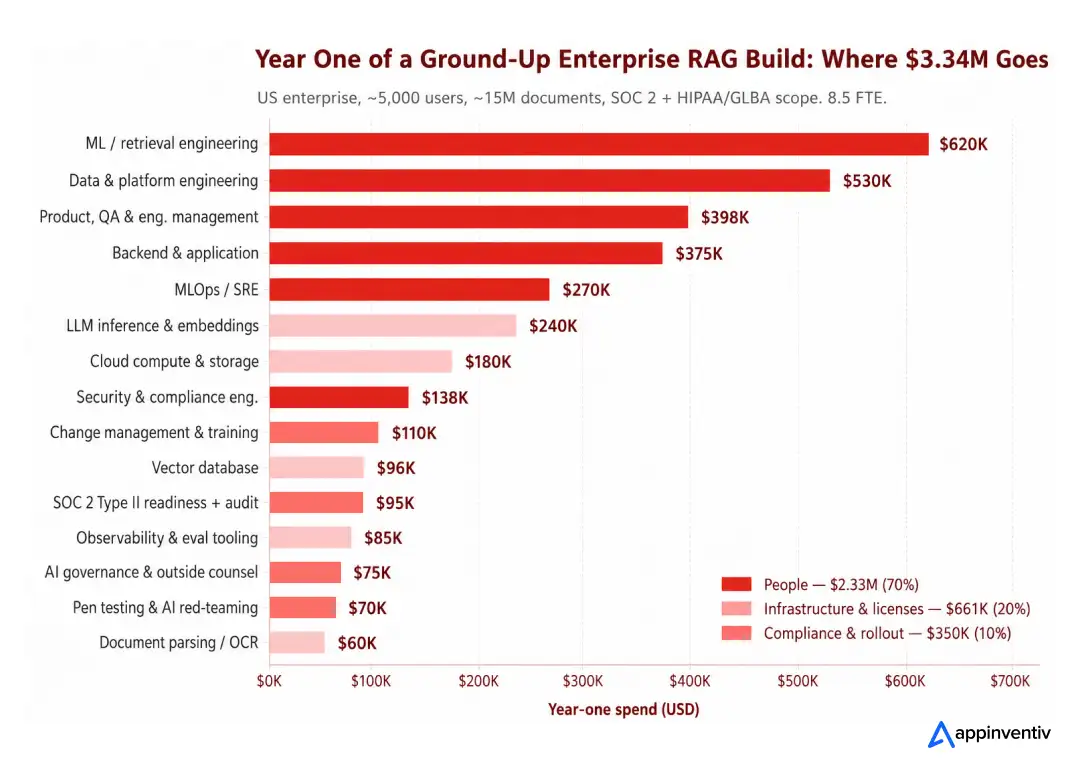
Year one totals $3.34 million across 8.5 FTE. The distribution is the point:
| Category | Year-one cost | Share |
|---|---|---|
| People (8.5 FTE) | $2,330,000 | 70% |
| Infrastructure and licenses | $661,000 | 20% |
| Compliance, security, and rollout | $350,000 | 10% |
| Total | $3,341,000 | 100% |
The cost of building enterprise RAG in-house is a payroll problem wearing an infrastructure costume. Cloud, vector storage, and inference together come to $516,000 — meaningful, but less than a quarter of what the team costs. Any business case built primarily on infrastructure comparison is measuring the wrong thing.
Two line items get cut from most internal estimates and should not be. The $350,000 compliance and rollout block is not optional in a regulated US enterprise: SOC 2 Type II readiness and first audit, penetration testing and AI red-teaming, outside counsel for AI governance review, and the change management without which adoption stalls at 8%. And the security engineer at half an FTE is the floor, not the plan.
Three-year total cost of ownership
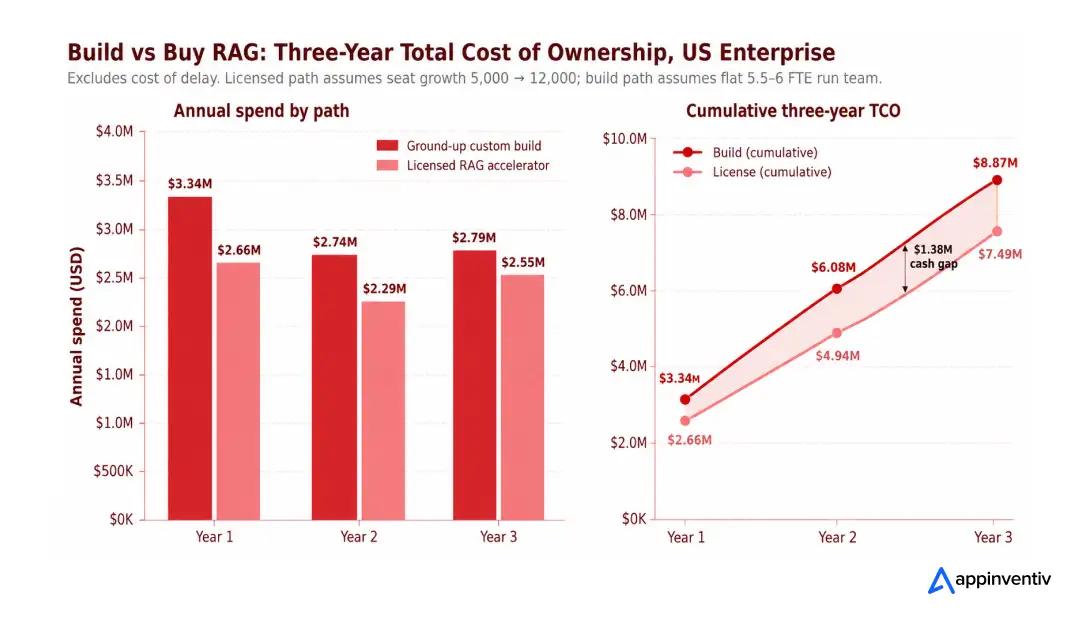
| Year 1 | Year 2 | Year 3 | Three-year total | |
|---|---|---|---|---|
| Ground-up custom build | $3.34M | $2.74M | $2.79M | $8.87M |
| Licensed RAG accelerator | $2.66M | $2.29M | $2.55M | $7.49M |
| Difference | $0.68M | $0.45M | $0.24M | $1.38M (16%) |
Both totals land inside the $5M–$20M range for GenAI deployment approaches, which is a reasonable sanity check on the model.
Notice what happens to the gap: it narrows every year. Year one is where licensing wins decisively, because the build path is paying full team cost while producing nothing. By year three, the annual difference is $240,000 — a rounding error at this scale. Anyone selling you a licensed accelerator on three-year cash savings is overselling. The savings are real but modest, and they are front-loaded.
The build path also never gets cheap. A common projection assumes the team disbands after launch. It does not. Connectors break when Salesforce ships an API change. Embedding models get deprecated. Retrieval quality regresses when the document corpus shifts. Our model holds 5.5–6 FTE indefinitely, which is the honest steady state.
The line item nobody models: cost of delay
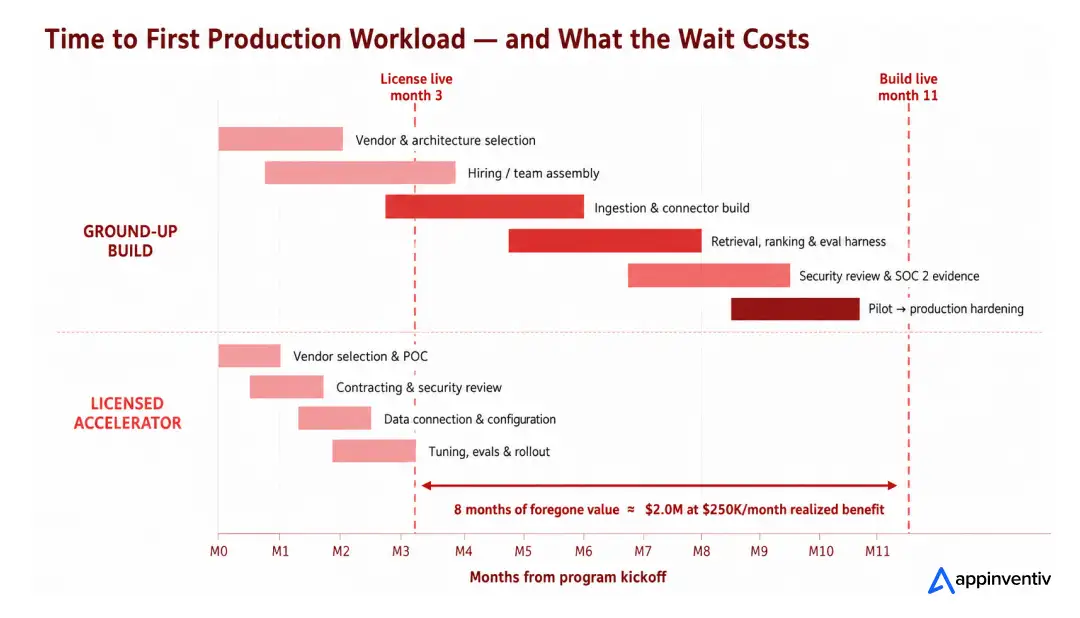
This is where build vs buy RAG is actually decided, and it almost never appears in a TCO spreadsheet.
The build path reaches its first production workload around month 11. Hiring alone consumes months one through four in the US market where median ML engineer total compensation sits near $260,000, and offers routinely take eight weeks to close. The licensed path reaches production around month 3.
Eight months of difference. If the platform delivers $250,000 per month in realized benefit — support deflection, analyst hours recovered, faster underwriting, whatever your use case produces — that delay costs $2.0 million in foregone value.
Add it to the cash gap and the effective difference becomes $3.38 million, not $1.38 million. The delay is worth more than the cash.
MIT’s NANDA research found the same pattern at the organizational level: mid-market firms move from pilot to full implementation in roughly 90 days while large enterprises take nine months or longer, and the enterprises running the most pilots convert the fewest. Speed is not a nice-to-have in this category. It is the variable most correlated with the project surviving at all.
When the math flips toward building
Time does not flip it. Scale does.
Run the model to five years and the licensed path is still ahead — $13.42M versus $14.87M — because build costs stay roughly flat while license costs grow with seats. So the crossover is not “eventually build pays for itself.” The crossover is a usage threshold.
Per-seat or per-query licensing scales linearly. Engineering cost scales sub-linearly: the team that runs 5,000 seats runs 40,000 seats with maybe 30% more headcount. Somewhere past roughly 40,000 seats, or at query volumes where metered inference dominates, annual license cost exceeds the fixed cost of a run team and the arithmetic inverts.
If you are confident you will cross that line, model it explicitly at year five, not year three. If you are not confident, you are not there.
Build vs Buy AI: The Major Factors Compared
Read this table row by row rather than scanning for the totals. The build vs buy AI decision is rarely lost on cost. It is lost on a single row somebody assumed away in month two.
| Factor | Ground-up custom build | Licensed RAG accelerator |
|---|---|---|
| Time to first production workload | 9–14 months | 8–16 weeks |
| Three-year TCO (model scenario) | $8.87M | $7.49M |
| Year-one cash | $3.34M | $2.66M |
| Peak team size | 8–12 FTE | 3–4 FTE |
| Steady-state team | 5–6 FTE, permanently | 2–3 FTE |
| Retrieval control | Total — every ranking decision is yours | Configurable within vendor architecture |
| Connector maintenance | You own every breakage | Vendor SLA |
| Permission-aware retrieval | Build and prove it yourself | Typically native; verify per vendor |
| SOC 2 / audit evidence | You generate it, ~$95K plus annual renewal | Vendor attestation, inheritable |
| Model portability | Complete | Depends on contract; negotiate it |
| Data residency and isolation | Absolute | Deployment-model dependent |
| Air-gapped / GovCloud | Achievable | Rare; a genuine build trigger |
| Failure mode | Program cancelled at month 9 with nothing shipped | Shelfware — licensed, never adopted |
| Exit cost | None, you own it | Re-platforming, 6–12 months |
Both columns have a failure mode, and both are common. The build failure is loud and expensive. The buy failure is quiet — a signed contract, a stalled rollout, and a renewal nobody wants to defend. Neither is a technology problem.
Licensed RAG Accelerator vs Custom Build: What Actually Decides It
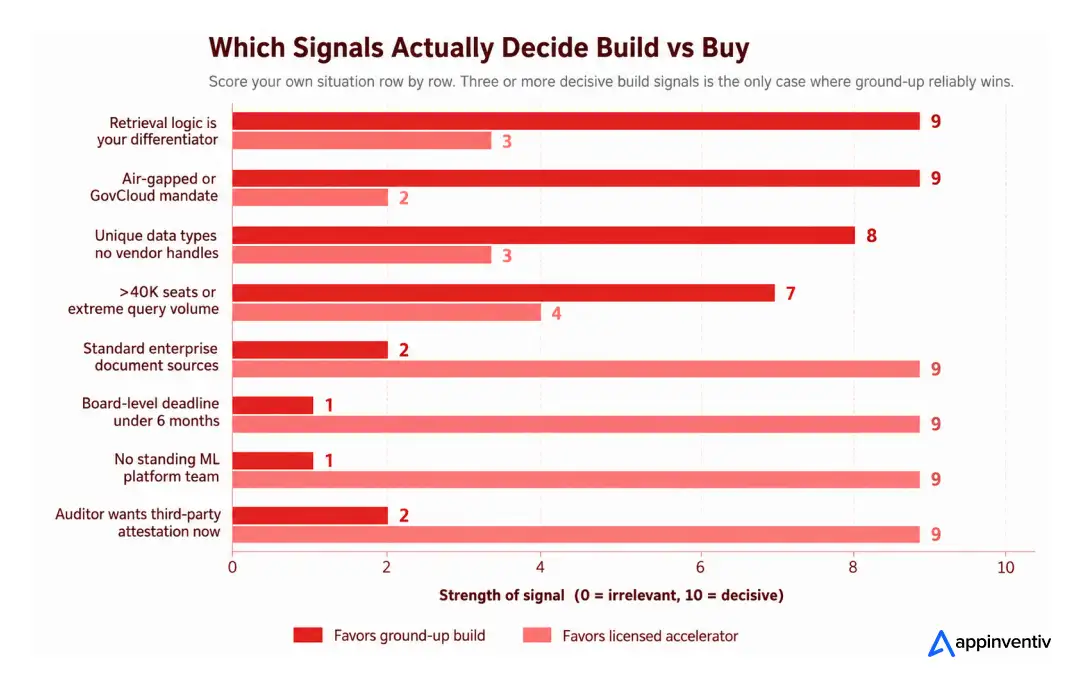
Score honestly. Most enterprises discover they have zero or one build signal and four buy signals, then build anyway — usually because the engineering organization wants to, or because a licensed platform feels like an admission that the team could not do it.
The signals that genuinely favor building:
Retrieval is your differentiator. If you sell a product whose value is how well it finds things, you cannot outsource that. This is rarer than teams believe. Internal knowledge search is not a differentiator; it is infrastructure.
Air-gapped or GovCloud mandate. Defense, intelligence, and some critical-infrastructure work requires deployment environments most vendors do not support. This is a hard constraint, not a preference.
Data types nobody indexes well. Seismic data, DICOM imaging with clinical context, proprietary CAD formats, structured claims with domain-specific relationships. If your corpus is genuinely outside what enterprise AI accelerator solutions handle, evaluate carefully — but test it before assuming, because vendors have gotten substantially better at this.
Scale past the crossover. Covered above.
The signals that favor licensing are less romantic and more common: your sources are standard enterprise systems, you have a deadline shorter than your hiring cycle, you have no standing ML platform team, or an auditor wants third-party attestation this fiscal year.
The third path most enterprises actually take
The licensed AI platform vs custom development framing is a false binary, and treating it as binary is how enterprises end up with the worst of both.
The pattern that works: license the substrate, build the layer that is yours. Take connectors, permission-aware indexing, evaluation tooling, and audit logging from a GenAI RAG accelerator. Build your domain ontology, your ranking signals, your prompt and guardrail layer, and your workflow integration on top.
This is not fence-sitting. It is a deliberate allocation of scarce engineering years to the 20% of the system that is actually differentiated. Under this model, our licensed-path figures shift — expect more internal engineering than the pure-license case and less than the build case — but time-to-production stays close to the licensed timeline, which is the variable that matters most.
The failure version of this pattern is worth naming: licensing a platform and then rebuilding its features inside it because the team disagrees with an architectural choice. That produces license cost plus build cost plus integration friction. If you cannot live with a vendor’s core architecture, do not license it.
The US Compliance Layer Most Comparisons Skip
Where a comparison written for a global audience gets vague, a US buyer needs specifics. Compliance is also the single most underestimated line item in custom RAG development, and in 2026 the ground moved.
Federal and standards baseline. There is no comprehensive federal AI statute. The operative baseline is the NIST AI Risk Management Framework — voluntary, but functioning as the de facto US standard, and increasingly the thing auditors and enterprise customers ask you to map to. SOC 2 Type II remains the commercial price of entry.
Build it yourself, and you are looking at roughly $95,000 for readiness and first audit, plus annual renewal, plus the engineering time to produce evidence. License it, and you inherit the vendor’s attestation for their layer — though not for your configuration, which is a distinction procurement should hold vendors to.
State law, as of mid-2026. Texas TRAIGA took effect January 1, 2026. It is intent-based — the prohibitions turn on whether you intentionally deployed AI to discriminate, manipulate, or harm — and it grants safe-harbor protection to organizations substantially complying with the NIST AI RMF. That safe harbor is the most actionable compliance fact in this article: NIST AI RMF alignment is no longer just good practice in Texas; it is a legal shield.
California’s SB 53 and AB 2013 also took effect January 1, 2026. Colorado moved the other way: Governor Polis signed SB 26-189 on May 14, 2026, repealing the Colorado AI Act before it ever took effect and replacing it with a narrower automated decision-making technology law effective January 1, 2027, centered on pre-use consumer notices, 30-day adverse-outcome explanations, and meaningful human review.
Sector rules that predate all of it. HIPAA if you touch PHI — and RAG makes this harder than classic search, because a grounded answer can synthesize identifiers that no single retrieved chunk contained. GLBA for financial institutions. SEC and FINRA recordkeeping if outputs inform advice or trading. CCPA/CPRA for California consumer data, including access and deletion rights that must propagate into your vector index, not just your system of record.
Who carries the evidence burden. This is the question to put to every vendor in writing: when our auditor asks how a specific answer was generated, which retrieved documents grounded it, and whether the requesting user was authorized to see each of them — who produces that record, in what format, and within what timeframe? Build, and the answer is you, and you should budget for it. License, and the answer should be in the contract. If a vendor cannot answer this crisply in a POC, that is disqualifying, and it is worth more than any benchmark score they show you.
Contract Terms Procurement Should Negotiate
Eight terms that determine whether a licensed RAG platform stays a good decision in year three. These are where deals are actually won, and where enterprises that skipped them end up trapped.
| Term | What to negotiate | Why it matters |
|---|---|---|
| Price protection | Cap annual uplift at 3–5%; lock the per-seat rate through a defined growth band | Uncapped renewal is the most common source of year-three regret |
| Seat elasticity | Contractual right to reduce seats at renewal, not just add | Prevents paying for a rollout that plateaued |
| Data egress | Full export of documents, embeddings, metadata, and configuration in documented formats, at no charge | Without this, exit cost is unbounded |
| Model portability | Right to substitute the underlying LLM, including self-hosted | Protects against vendor model changes and price moves |
| Audit cooperation | Defined SLA for producing retrieval and access records on request | Your regulator’s timeline, not the vendor’s |
| IP ownership | Your prompts, evaluation datasets, tuning artifacts, and domain configuration remain yours | Vendors sometimes claim derived work; strike it |
| Training data use | Explicit prohibition on using your data to train shared models, with audit rights | Table stakes, still absent from many first drafts |
| Performance SLA with teeth | Retrieval latency, uptime, and connector freshness with service credits | An SLA without credits is a statement of intent |
Two more worth adding when the deployment is regulated: a defined security-incident notification window measured in hours rather than “promptly,” and the right to your own penetration test against your tenant with reasonable notice.
Enterprise Evaluation Checklist
Before signing anything or approving a build, work through this. It is ordered so that the disqualifying questions come first.
Scope and value
- Which specific workflow does this serve, and what does an hour of that workflow cost today?
- What is the realized monthly value at full rollout? (This number sets your cost-of-delay figure — do not skip it.)
- Who owns adoption, and what happens to their compensation if usage stalls at 10%?
Data reality
- How many source systems, and does each expose permissions through its API?
- What percentage of your corpus is scanned, handwritten, or in formats requiring OCR?
- How stale can an answer be before it is harmful? That sets your re-index cadence and your cost.
- Who deletes a document from the vector index when it is deleted from the source?
Retrieval quality
- Do you have a golden dataset of 200+ real questions with verified answers? If not, build one before evaluating anything — you cannot compare vendors without it.
- What is your acceptable groundedness threshold, and who signs off when it regresses?
- How will you test permission leakage specifically, with adversarial queries from low-privilege accounts?
Compliance
- Which of HIPAA, GLBA, SEC/FINRA, CCPA/CPRA, TRAIGA apply to this workload?
- Are you mapped to the NIST AI RMF? (In Texas, this is a safe harbor, not just hygiene.)
- Who produces audit evidence, in what format, within what SLA?
Capacity
- Do you have a standing ML platform team, or would you be hiring one? Model the hiring timeline honestly.
- Can you commit 5–6 FTE indefinitely, not just through launch?
- What is your organization’s actual record on internal platform projects over the last three years?
Exit
- If this fails in 18 months, what does recovery look like, and what does it cost?
If questions 8, 13, and 15 do not have confident answers, neither path will work yet. Fix those first.
A structured build-vs-buy assessment settles the question in two to three weeks, with evidence.
Real-World Enterprise Scenarios
Composite scenarios drawn from common US enterprise patterns, illustrating how the same decision resolves differently.
A regional health system, ~9,000 clinical and administrative staff. PHI in scope, an auditor asking pointed questions, and no standing ML platform team. Every signal points to licensing — except that clinical document formats and the HIPAA minimum-necessary standard demand unusual retrieval controls.
Resolution: license the substrate for its inherited SOC 2 and HIPAA posture, build the clinical ontology and access layer internally. Time to first production workload, roughly four months rather than eleven. The deciding factor was not cost; it was that the compliance evidence burden alone would have consumed the security engineer’s entire year.
A commercial bank, ~4,000 seats across risk and operations. GLBA and SEC recordkeeping in scope, with a mature internal platform team already running ML in production. The build case is genuinely arguable here — the team exists, which removes the four-month hiring drag that dominates the timeline.
The question becomes whether retrieval is differentiating. For internal policy and procedure search, it is not. For proprietary credit-risk document analysis, it might be.
Resolution: license for the horizontal use case, build for the one that touches the P&L.
A logistics and distribution enterprise, ~18,000 employees. Standard document sources, a board-level deadline inside six months, and no ML team. Four decisive licensing signals and zero build signals. The only real risk is shelfware, which makes adoption ownership — checklist item 3 — the term to fight over, not price.
The pattern across all three: the decision is settled by compliance burden, team capacity, and deadline long before anyone compares feature matrices.
Logistics enterprises face high project collapse risks, with Gartner data indicating that over 60% of AI projects fail to deliver value, emphasizing that adoption ownership is critical for success. While GenAI budgets surge, 45% of CFOs report investments are lost to isolated productivity gains rather than strategic, board-level outcomes.
Permission leakage, connector drift, and silent quality regression are engineering problems, not vendor choices.

How Appinventiv Helps Enterprises Build or Accelerate RAG Adoption
Most of the enterprises we work with arrive having already framed this as a binary, and the first useful thing we do is take the framing apart — mapping which layers are genuinely differentiated for them and which are plumbing every enterprise rebuilds identically.
As an AI consulting company working with US enterprises across healthcare, financial services, and logistics, we approach it in three parts:
- Enterprise AI consulting. A structured build-vs-buy assessment against your actual data sources, seat projections, compliance scope, and team capacity — producing the cost model and decision record your CFO and your auditor will both accept.
- Custom RAG development and implementation. Whether the answer is a licensed accelerator, a bespoke platform, or the hybrid most enterprises land on, our RAG Development Services cover connector engineering, permission-aware retrieval, evaluation harnesses, and the domain layer that determines whether people trust the answers.
- Governance and security. NIST AI RMF mapping, SOC 2 evidence architecture, sector-specific controls for HIPAA, GLBA, and SEC/FINRA obligations, and the audit trail that answers the question in the compliance section above.
FAQs
Q. Is it cheaper to build or buy an enterprise RAG platform?
A. Buying is modestly cheaper over three years — $7.49M versus $8.87M in our model, a 16% difference — but the cash gap is not the real argument. Licensing reaches production about eight months sooner, worth roughly $2.0M in foregone value at $250K/month, bringing the effective difference to $3.38M. Building becomes cost-competitive only at very large scale, past roughly 40,000 seats, where per-seat licensing outruns fixed engineering cost.
Q. How much does it cost to build an enterprise RAG platform?
A. Roughly $3.34M in year one and $8.87M over three years for a US enterprise serving ~5,000 users across ~15M documents with SOC 2 and HIPAA or GLBA controls in scope. This is consistent with Gartner’s stated $5M–$20M range for GenAI deployment approaches. People account for about 70%, infrastructure 20%, and compliance and rollout 10%.
Q. How much does it cost to build a RAG system in-house?
A. For a single departmental workload with two or three data sources and no regulated data, expect $600K–$1.2M in year one with a team of two to three. The figure scales sharply with the number of source systems, the presence of regulated data, and permission complexity — not with document volume, which is the variable most teams anchor on. Understanding the cost of building enterprise RAG in-house means modeling connectors and compliance, not storage.
Q. Can a licensed RAG accelerator be customized?
A. Yes, within the vendor’s architecture. Retrieval parameters, ranking signals, chunking strategy, prompts, guardrails, and domain ontologies are typically configurable, and most platforms expose APIs for custom pre- and post-processing. What you generally cannot change is the core retrieval architecture and the indexing model. Test the limits during a POC against your hardest use case, and if you cannot live with the core architecture, do not license it — you will end up paying for both paths.
Q. How long does it take to implement an enterprise RAG solution?
A. Eight to sixteen weeks to first production workload with a licensed accelerator; nine to fourteen months building from scratch. The gap is dominated by hiring, not engineering — assembling a US ML platform team routinely takes four months before meaningful work starts. If you already have a standing platform team, the build timeline compresses to roughly seven to nine months.
Q. How do you calculate the ROI of an enterprise RAG implementation?
A. Take the realized monthly benefit at full rollout — hours recovered multiplied by fully loaded hourly cost, plus deflected volume, plus revenue acceleration where attributable — and net it against three-year TCO including the run team. Then add the term most models omit: the cost of delay, calculated as monthly benefit multiplied by the difference in time-to-production between paths. Discount your benefit estimate by expected adoption rate, because a platform used by 30% of its licensed seats returns 30% of its modeled value.
Q. What are the risks of building an enterprise AI platform from scratch?
A. Gartner predicted at least 30% of GenAI projects would be abandoned after proof of concept, and by the end of 2025 reported that more than half were. The named causes are poor data quality, inadequate risk controls, escalating costs, and unclear business value — none of them model problems. The specific build risks are key-person dependency in a market where median ML engineer compensation approaches $260,000, connector maintenance debt that compounds, evaluation infrastructure that gets deferred until quality problems are invisible, and compliance evidence discovered late. MIT’s Project NANDA found internal builds reached deployment roughly half as often as vendor partnerships.
Q. What should enterprises evaluate before buying a RAG platform?
A. In order: permission-aware retrieval verified with adversarial queries from low-privilege accounts; connector coverage and maintenance SLA for your actual source systems; evaluation tooling and whether you can bring your own golden dataset; audit evidence generation and the SLA attached to it; contract terms covering price protection, data egress, model portability, and IP ownership; and deployment model against your data residency requirements. Run the POC on your hardest use case, not the one the vendor suggests.
Q. Can a RAG accelerator integrate with existing enterprise systems?
A. Standard systems — SharePoint, Confluence, Salesforce, ServiceNow, Google Workspace, S3, major databases — are covered by pre-built connectors on any credible GenAI RAG accelerator. The questions that matter are whether the connector preserves source-system permissions at query time rather than at index time, how quickly it reflects changes, and what happens when the upstream API version changes. Legacy mainframe systems, proprietary document management, and industry-specific platforms usually require custom connector work regardless of which path you choose.
Q. Licensed AI platform vs custom development: which is right for regulated industries?
A. Regulated industries usually favor licensing, which is counterintuitive to teams who assume regulation demands control. The reason is evidence: a vendor with an existing SOC 2 Type II report and sector-specific controls gives your auditor something to accept immediately, while a custom build means generating that evidence yourself over 12 to 18 months. The exception is air-gapped or GovCloud mandates, where vendor options thin out and building becomes the practical path.
Q. What are AI accelerators for enterprise use, and how do they differ from frameworks?
A. Frameworks like LangChain and LlamaIndex are libraries — you assemble the system, you own every operational concern. AI accelerators for enterprise deployment are licensed products with connectors, permission-aware indexing, governance, and support already built and attested. The practical difference is what happens at 2 a.m. when ingestion fails: with a framework, your team responds; with an accelerator, an SLA does. Frameworks are excellent for prototyping and for teams building genuinely novel retrieval; they are not a shortcut to production.


Fast 2-minute response, fully NDA-protected.

Retrieval Augmented Generation in Australia: Architecture, Implementation and Cost
Key takeaways: RAG grounds LLM answers in approved content, improving reliability without retraining a model. Data quality and access permissions decide production outcomes more than the model. Indicative build costs run from AUD 70,000 to 700,000, driven by data and integrations. Measure value against a pre-deployment baseline, separating realised benefits from projected savings. A general-purpose…
The Multiplier Effect of AI Agents: The Rise of AI Swarms
Key takeaways: AI agent swarms coordinate specialized agents to solve complex problems that may be difficult for a single agent to handle effectively. More agents do not automatically mean better outcomes. Swarms deliver value when work can be divided, executed in parallel, and coordinated toward a shared objective. Enterprise readiness depends on governance. Clear accountability,…
AI Data Integration: How to Connect, Clean and Prepare Data for AI
Key takeaways: AI initiatives fail when fragmented, poor-quality data reaches models without sufficient context, controls or ownership. AI-ready pipelines must connect, clean, enrich, govern and continuously monitor data across its lifecycle. Real-time processing matters when AI decisions depend on current transactions, events, inventory or operational conditions. Data architecture should follow the AI use case, balancing…