































Building Next-Generation Digital Payment Systems for Australia’s NPP Economy

 Share -



- 01The True Cost of Legacy Systems: Why Legacy BECS Architecture Is Bleeding Business Value
- 02Understanding Australia's NPP Economy
- 03What Are Business Benefits of NPP-Enabled Payment Platforms?
- 04Payment Rails and Methods Enterprises Must Support in an NPP Environment
- 05What Are the Essential Features of NPP-Ready Digital Payment Systems?
- 06What Are the Technical Architecture of an NPP-Enabled Payment Platform?
- 07Building for PayTo: Australia's Next Major Payment Innovation
- 08The July 2026 Payday Super Mandate: Are Your Payroll Systems Ready?
- 09Security in Milliseconds: Fraud Detection and Regulatory Compliance
- 10What Is the Cost of Building a Next-Generation Digital Payment System in Australia?
- 11How to Implement Digital Payment Platform for Australian Enterprises?
- 12What Is the Future of Australia's NPP Economy?
- 13Executive Checklist: Is Your Payment Infrastructure Ready for the NPP Economy?
- 14Why Enterprises Partner with Appinventiv for Digital Payment System Development in Australia?
- 15FAQs

Key takeaways:
- Australia’s NPP is approaching 1.82 billion real-time transactions annually; BECS decommissioning by 2030 creates a hard migration deadline that cannot be managed through incremental patches.
- The July 2026 Payday Super mandate makes real-time payment infrastructure a legal compliance requirement. Enterprises without NPP-capable payroll systems are already operating against a regulatory clock.
- NPP platform architecture requires deliberate design across six layers: initiation, orchestration, settlement, fraud detection, compliance, and data. Gaps in any layer create either operational or regulatory exposure.
- PayTo represents the most significant opportunity to reduce direct debit cost and dishonour rate while improving customer payment experience.
- Cost of developing a digital payment system in Australia ranges between AUD 70,000 and AUD 700,000 or more.
Australia’s payment landscape is at a genuine inflection point. Regulatory deadlines, legacy system failure rates, and accelerating real-time volumes are converging simultaneously, forcing boards to treat payment modernisation as a strategic infrastructure decision, not an IT upgrade.
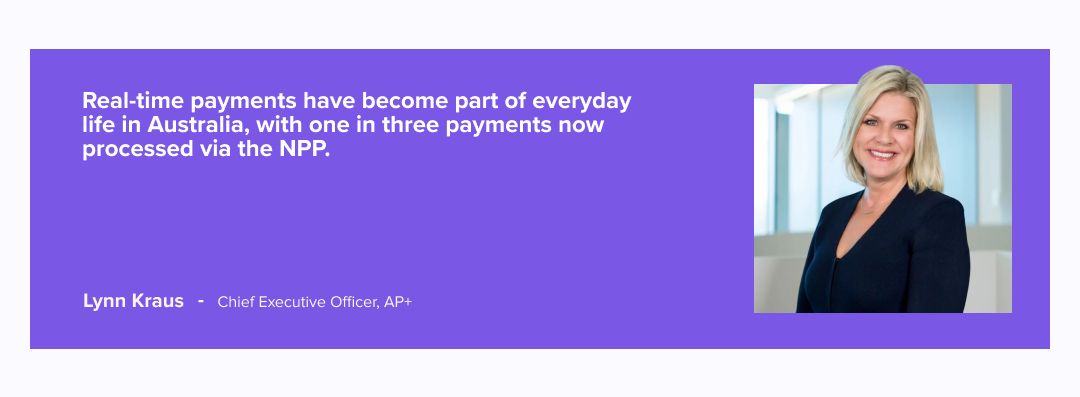
The shift is already visible in transaction volumes. Australia processed close to 1.82 billion real-time transactions through the New Payments Platform (NPP) in the twelve months to October 2025, a 14% year-on-year increase, according to RBA Retail Payments data cited by Australian Payments Plus (AP+).
At the same time, two significant forces are accelerating payment modernisation across Australia. The first is the ongoing transition away from legacy payment rails such as Bulk Electronic Clearing System (BECS). The second is the introduction of Payday Super reforms from July 2026, which will require every employer to remit superannuation contributions alongside wages, a change that makes real-time payment capability a legal compliance requirement, not a competitive aspiration.
It simply means that organisations can no longer rely on software built for an era of three-day settlement windows. They need investing in robust digital payment system development in Australia that can efficiently address the dual pressures: maintaining regulatory compliance while optimising treasury operations to support continuous capital flow. The architecture decisions made now will determine compliance posture, working capital performance, and platform scalability for the next decade.

The True Cost of Legacy Systems: Why Legacy BECS Architecture Is Bleeding Business Value
The core BECS problem is timing. Batch processing operates on a one-to-three business day clearing cycle. For treasury teams managing payroll, supplier payments, or collections, that lag creates predictable working capital gaps. It also means payment failure notifications arrive hours or days after the event, by which point manual intervention is the only remediation path.
Beyond the operational drag, BECS carries architectural limitations that make it incompatible with modern platform expectations:
- No real-time settlement capability; funds movement is fixed to batch windows
- Minimal remittance data payload, making automated reconciliation unreliable
- No native API-first connectivity for integration with ERP, TMS, or payroll systems
- Absence of Confirmation of Payee, leaving authorised push payment fraud largely unchecked
- Planned decommissioning by 2030, creating a hard deadline for migration regardless of business preference
The technical debt extends beyond the platform itself. Every custom integration built on BECS connectivity represents a future migration liability. The longer an enterprise defers modernisation, the more brittle and costly that migration becomes.
Also Read: Modernising Core Banking Systems in Australia: 2026 Guide
Understanding Australia’s NPP Economy
The NPP is not simply a faster version of BECS. It is a fundamentally different payments architecture, built on ISO 20022 messaging, real-time gross settlement, and a layered overlay service model that enables entirely new payment product categories.
What the NPP Actually Is?
Launched in 2018 and operated by Australian Payments Plus (AP+) under RBA oversight, the NPP provides always-on, real-time gross settlement between participating institutions. Over 114 million accounts were enabled to send or receive NPP payments by late 2024. The platform uses the ISO 20022 messaging standard, which accommodates rich remittance data within each transaction, enabling payment classification by type (payroll, tax, invoice) and supporting straight-through reconciliation in treasury environments.
Key Components of the NPP Ecosystem
- Fast Settlement Service (FSS): The infrastructure layer providing real-time gross settlement 24/7/365
- PayID: A directory service enabling payment by phone number, email, or ABN instead of BSB and account number
- Osko: The consumer-facing overlay enabling real-time transfers between bank accounts
- PayTo: A modern payment initiation service replacing direct debit for recurring and mandated payments
- Mandated Payments Service: The mechanism through which PayTo mandates are created and managed
- ISO 20022 messaging framework: Carries structured, data-rich payment information across all NPP transactions
NPP vs Traditional Payment Systems
| Dimension | Traditional Payments (BECS) | NPP Payments |
|---|---|---|
| Settlement speed | 1-3 business days | Near-instant, 24/7/365 |
| Processing model | Batch processing | Real-time gross settlement |
| Payment data | Minimal remittance fields | Rich ISO 20022 data payload |
| Addressing | BSB + account number required | PayID-enabled (phone, email, ABN) |
| Reconciliation | Manual or semi-automated | Structured data enables automation |
| Fraud detection window | 24-hour clearing window | Millisecond detection required |
| API connectivity | Limited, legacy interfaces | API-first, overlay-service model |
Partnering with a digital engineering firm experienced in digital payment system development in Australia ensures your infrastructure fully leverages these capabilities rather than simply mirroring old processes onto new rails.
What Are Business Benefits of NPP-Enabled Payment Platforms?
The business case for NPP-enabled digital payment platforms extends well beyond speed. For Australian CFOs and treasury leads, the measurable outcomes span cash flow, operational overhead, compliance readiness, and fraud exposure.
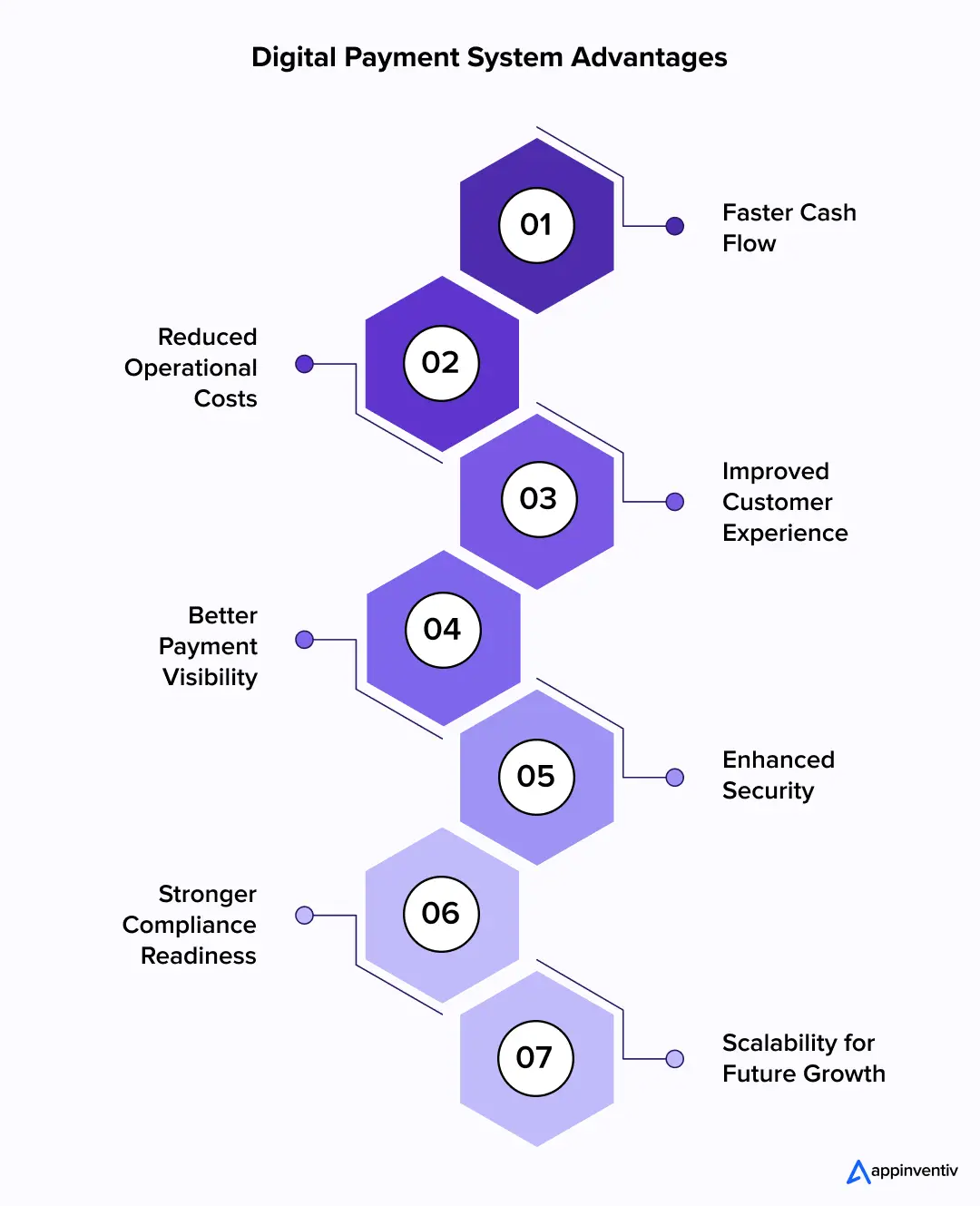
Faster Cash Flow: Real-time settlement eliminates clearing float, improving working capital position and reducing reliance on overdraft facilities
Reduced Operational Costs: Automated reconciliation via ISO 20022 rich data reduces manual processing overhead in accounts payable and receivable
Improved Customer Experience: Instant payment confirmation and PayID-enabled addressing reduce friction for both consumer and B2B payment flows
Better Payment Visibility: Structured transaction data enables real-time treasury dashboards and exception-based management workflows
Enhanced Security: Sub-second fraud detection, Confirmation of Payee, and biometric authentication at the gateway level reduce authorised push payment exposure
Stronger Compliance Readiness: NPP architecture natively supports APRA CPS 234 data security requirements, Consumer Data Right obligations, and Payday Super reporting
Scalability for Future Growth: API-first design supports PayTo adoption, embedded finance use cases, and cross-border instant payment expansion without infrastructure re-platforming.
Payment Rails and Methods Enterprises Must Support in an NPP Environment
As payment modernisation accelerates, Australian organisations are reassessing which payment methods should form part of their long-term digital strategy. The answer varies by industry, customer profile, transaction volume, and operating model. However, enterprise digital payment platforms in Australia must accommodate a spectrum of payment types across different business contexts.
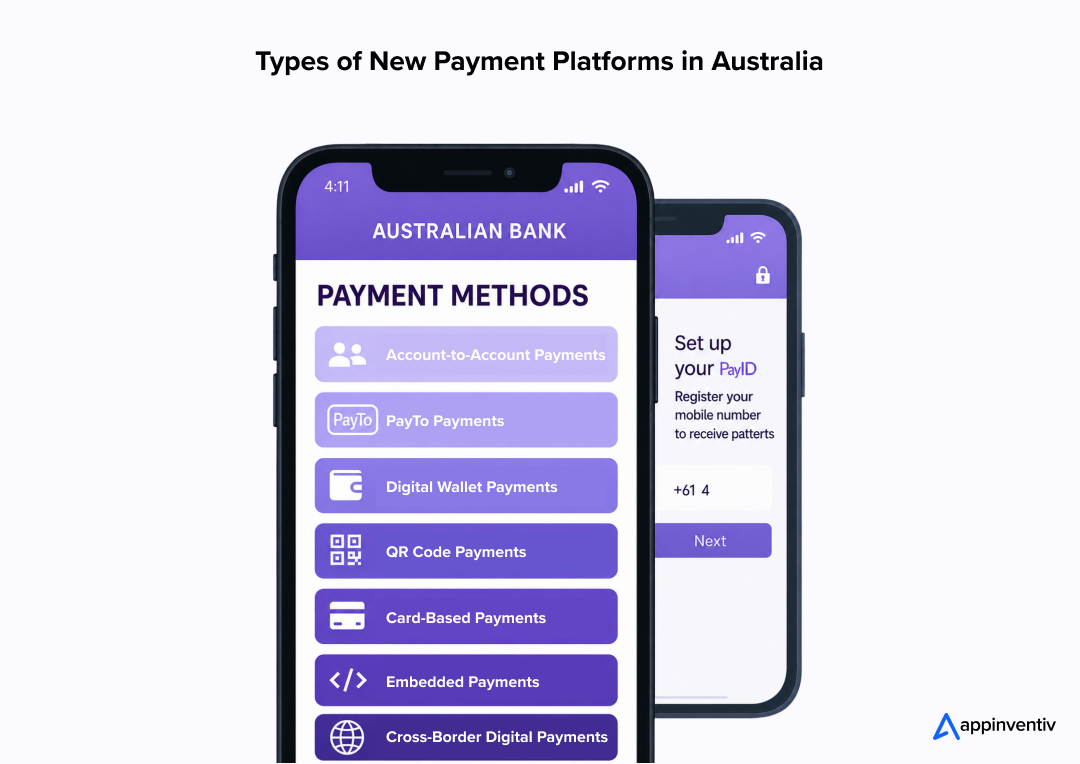
Account-to-Account (A2A) Payments
A2A payments allow funds to move directly between bank accounts without involving card networks. For businesses, this can result in:
- Lower transaction fees
- Faster settlement
- Reduced intermediary dependence
- Improved payment transparency
The rise of A2A payments is closely linked to the growth of the new payments platform in Australia and PayTo.
PayTo Payments
PayTo is emerging as one of the most significant payment innovations within Australia’s payments ecosystem.
Unlike traditional direct debits, PayTo allows customers to authorise and manage payment agreements digitally through their banking application. This provides:
- Greater transparency
- Improved customer control
- Faster dispute resolution
- Better payment visibility
Digital Wallet Payments
Consumer adoption of digital wallets continues to grow across retail, travel, hospitality, and eCommerce sectors. Supporting wallet payments allows organisations to deliver faster checkout experiences while reducing friction during payment initiation.
Mobile Payment Systems
The continued growth of mobile payment systems reflects broader changes in customer behaviour. Customers increasingly expect payment experiences that are:
- Instant
- Mobile-first
- Secure
- Frictionless
Organisations investing in online payments system development should prioritise mobile experiences from the beginning rather than treating them as secondary channels.
QR Code Payments
QR-based payment experiences have expanded significantly across retail, hospitality, healthcare, and event management sectors. Their simplicity makes them particularly attractive for businesses seeking lower-cost alternatives to traditional payment infrastructure.
Card-Based Payments
Despite the rise of newer payment methods, cards remain an important payment mechanism. Modern payment platforms should support card transactions while simultaneously preparing for increasing adoption of account-to-account alternatives.
Embedded Payments
Embedded payments integrate payment functionality directly into broader business workflows. Examples include:
- Marketplace platforms
- Subscription ecosystems
- Logistics solutions
- SaaS products
This trend is becoming increasingly important in enterprise-led digital payment solutions initiatives.
Cross-Border Digital Payments
Australian organisations operating internationally face growing pressure to improve cross-border payment experiences. Real-time settlement, transparency, and lower transaction costs are becoming critical competitive factors in international commerce.
What Are the Essential Features of NPP-Ready Digital Payment Systems?
Australian Organisations pursuing digital payment system development in Australia should evaluate payment capabilities across three key layers: customer experience, operational excellence, and security.

Customer Experience Layer
Instant Transfers: Real-time transfers are now a baseline expectation rather than a premium feature. Customers increasingly expect immediate confirmation and settlement visibility.
PayID-Based Payments: PayID simplifies payment initiation by removing the need to enter traditional account details. This reduces errors while improving convenience.
QR-Based Payments: QR based payment is an integral function of NPP, creating streamlined experiences for in-person and digital transactions.
Digital Wallet Integration: Wallet integration enables organisations to support customer payment preferences without creating additional complexity.
Recurring Payment Management: Subscription businesses require flexible payment authorisation and management capabilities. That’s why PayTo is increasingly becoming a preferred mechanism for these use cases.
Operational Layer
Real-Time Reconciliation: Automated reconciliation significantly reduces manual effort while improving financial visibility.
Transaction Monitoring: Continuous monitoring enables organisations to identify operational issues before they impact customers.
Merchant Management: Businesses operating marketplace or multi-vendor environments require centralised merchant administration capabilities.
Payment Analytics: Payment analytics provides insights into transaction performance, customer behaviour, payment failures, and fraud patterns.
Security Layer
Fraud Detection: You must consider integrating security mechanisms like biometrics, encryption technology and so on to prevent potential fraud in real time.
Behavioural Analytics: Behavioural models identify suspicious patterns before fraudulent transactions are completed.
Identity Verification: Strong identity verification like multi factor authentication supports both compliance and customer protection objectives.
Strong Authentication: Modern authentication frameworks balance security with user experience requirements.
What Are the Technical Architecture of an NPP-Enabled Payment Platform?
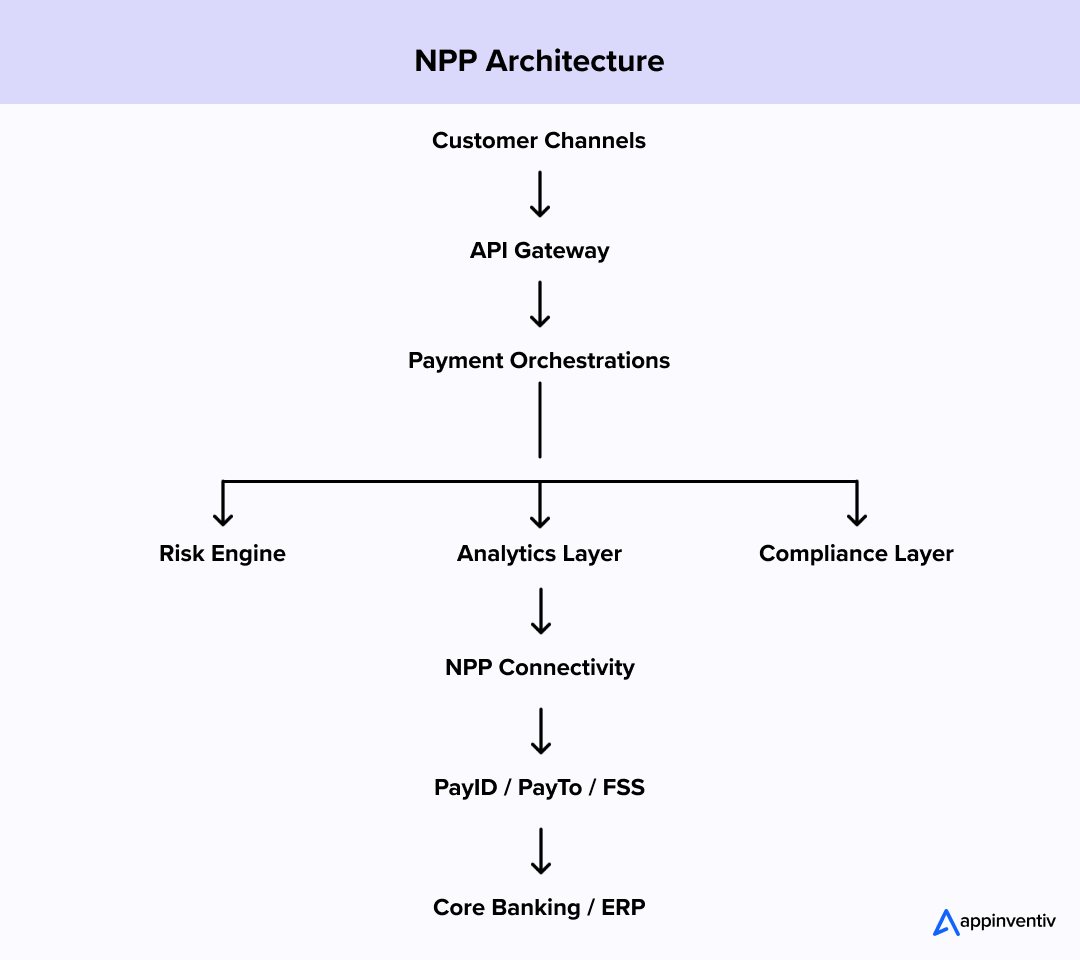
Modern digital payment platforms are not single-point solutions. They are layered architectures spanning initiation, orchestration, settlement, compliance, and analytics, each layer carrying distinct technical and governance requirements in the Australian regulatory context.
| Architecture Layer | Purpose | Key Capabilities |
|---|---|---|
| Front-End Channels | Customer and employee interaction layer | Mobile apps, web portals, merchant dashboards, payroll systems, customer self-service portals |
| API Gateway Layer | Secure entry point for all payment requests | Authentication, authorisation, traffic management, rate limiting, API security |
| Payment Orchestration Layer | Coordinates payment execution across different payment rails | Transaction routing, workflow management, exception handling, multi-rail support |
| NPP Connectivity Layer | Connects the platform to Australia’s NPP ecosystem | PayID integration, PayTo processing, real-time payment messaging, settlement coordination |
| Core Banking / ERP Integration Layer | Synchronises payments with enterprise systems | ERP integration, treasury systems, payroll platforms, accounting systems |
| Risk & Compliance Layer | Ensures regulatory and security controls are embedded into operations | AML monitoring, sanctions screening, audit logging, compliance reporting |
| Fraud Detection Layer | Identifies and prevents suspicious activity in real time | AI-based risk scoring, behavioural analytics, transaction monitoring, anomaly detection |
| Data & Analytics Layer | Provides operational and business intelligence | Payment analytics, reconciliation insights, customer behaviour analysis, reporting dashboards |
| Cloud Infrastructure Layer | Delivers scalability, resilience, and availability | High availability, disaster recovery, containerisation, auto-scaling, data sovereignty controls |
| Security Layer (Cross-Platform) | Protects every component of the payment ecosystem | Encryption, biometric authentication, tokenisation, API protection, identity management |
Architecture decisions made at the design stage determine whether a payment platform can scale to enterprise transaction volumes, satisfy APRA audit requirements, and absorb future NPP overlay services without structural re-engineering. The table below outlines the standard architecture for modern payment systems
How Payment Data Flows Through the Architecture: A Structured Approach
- Customer initiates payment through mobile, web, ERP, or payroll system
- API Gateway validates and authenticates the request
- Payment Orchestration Layer determines optimal payment route
- Fraud and Risk Engine performs real-time risk assessment
- NPP Connectivity Layer submits payment to the New Payments Platform
- Funds settle through the Fast Settlement Service (FSS)
- Confirmation is returned instantly to the customer and enterprise systems
- Analytics and reconciliation engines update operational and financial records
Building for PayTo: Australia’s Next Major Payment Innovation
PayTo is the NPP’s most consequential enterprise overlay service. For businesses running direct debit, subscription billing, or B2B collections, PayTo offers a materially superior alternative with real-time settlement, digital mandate management, and reduced dishonour rates.
What PayTo Delivers
PayTo enables businesses to initiate real-time debits from customer bank accounts following a digital authorisation process managed through the customer’s own banking app. Unlike direct debit, which relies on paper-based authorities and operates on a batch clearing cycle, PayTo mandates are created, verified, and managed in real time.
Real World Example of PayTo Adoption
Real-world adoption data demonstrates PayTo’s growing enterprise potential. Between October 2023 and April 2025, Zepto PayTo platform delivered nearly 800,409 settled transactions worth $511.71 million, while maintaining a 93.13% conversion rate and median settlement times of less than five seconds.
Business Use Cases for PayTo
- Subscription and recurring billing with real-time payment confirmation
- B2B invoice collections with reduced processing time and lower dishonour rates
- Marketplace and platform settlements with instant fund distribution
- Payroll automation with per-cycle payment initiation aligned to Payday Super obligations
- Utility and insurance billing with customer-controlled mandate management
PayTo vs Direct Debit Comparison
| Dimension | Direct Debit (BECS) | PayTo (NPP) |
|---|---|---|
| Mandate creation | Paper or unverified digital form | Real-time digital authorisation via banking app |
| Settlement speed | 1-3 business days | Near-instant, 24/7/365 |
| Dishonour rate | Higher, batch-era failure modes | Lower, with real-time account verification |
| Customer control | Limited visibility and revocation | Full mandate management in banking app |
| Data richness | Minimal | ISO 20022 structured data |
The July 2026 Payday Super Mandate: Are Your Payroll Systems Ready?
The Federal Government’s Payday Super legislation fundamentally alters corporate treasury operations. According to recent guidelines published by the Australian Taxation Office, starting from 1st July 2026, employers must transition away from quarterly superannuation processing. Contributions will need to reach the employee’s nominated fund within seven business days of the salary payment.
This regulatory shift requires deep technical changes. Legacy systems that rely on the Small Business Superannuation Clearing House or manual batch uploads will fail to meet these stringent timelines. Organisations must invest in digital payment system development to create automated API links between their payroll engines and the new payments platform in Australia.
We work with Australian clients to architect these direct integrations. By enabling Account-to-Account real-time routing using updated SuperStream data standards, we ensure that compliance is embedded directly into the software code, entirely removing the manual administrative burden and the risk of severe financial penalties.

Security in Milliseconds: Fraud Detection and Regulatory Compliance
Real-time payments do not wait for fraud checks to complete. A transaction that takes 500 milliseconds to settle must be scored, evaluated, and either approved or blocked within that window. Rules-based fraud detection systems built for overnight batch processing are structurally unsuitable for this environment.
The transition to machine learning-driven behavioural analytics is not optional for NPP-enabled platforms. Effective real-time fraud architecture incorporates:
- Confirmation of Payee (CoP) verification to reduce authorised push payment scams before transaction initiation
- ML models trained on entity-level transaction patterns to identify anomalies in real time
- Continuous API monitoring at the gateway layer to detect credential-based and injection attacks
- Biometric authentication integrated at mandate authorisation and high-value transaction confirmation
From a compliance standpoint, APRA CPS 234 binds all regulated entities, including banks, insurers, and superannuation trustees, to maintain information security controls proportionate to their risk profile. The standard covers information asset classification, control implementation, third-party security obligations, and incident notification requirements. Following the Cyber Security Act 2024, entities must also meet mandatory 72-hour ransomware reporting obligations.
Payment platforms handling NPP transactions must treat security architecture as a regulatory artefact. Every design decision, from API authentication to data residency, carries audit traceability requirements. Engineering for compliance from the outset is materially less costly than retrofitting controls after deployment.
What Is the Cost of Building a Next-Generation Digital Payment System in Australia?
The cost of developing a digital payment system in Australia ranges between AUD 70,000 and AUD 700,000 or more, depending on several factors.
An MVP payment platform focused on NPP connectivity and basic PayID functionality will land in a lower cost range to an enterprise-grade ecosystem integrating PayTo, real-time fraud scoring, and ERP integration. Transaction volume projections also drive infrastructure sizing and therefore ongoing operational cost.
Key Elements Driving Up the Online Payments System Development Cost in Australia Are:
- Platform Complexity
- NPP Integration Requirements
- Security and Compliance Scope
- AI Feature Requirements
- Cloud Infrastructure Costs
- Third-Party Integrations
- Transaction Volume Expectations
| Platform Type | Estimated Development Cost | Primary Use Case |
|---|---|---|
| MVP Payment Platform | AUD 70,000 to 150,000 | Mid-sized processors needing basic API gateway connectivity. |
| Mid-Market Solution | AUD 150,000 to 350,000 | Custom reconciliation, PayTo integration, and automated routing. |
| Enterprise Payment Ecosystem | AUD 350,000 to 700,000+ | High-volume processing, machine learning fraud detection, core banking integration. |
Investing in fintech software development services allows enterprises to phase these costs effectively, prioritising core revenue-generating features before expanding the architectural footprint.
Get a tailored estimate based on your transaction volumes, integrations, and compliance requirements.

How to Implement Digital Payment Platform for Australian Enterprises?
Payment modernisation projects succeed when organisations approach them as transformation programs rather than software deployments. Structured implementation reduces risk, improves stakeholder alignment, and accelerates business value realisation. Building digital payment systems in Australia successfully follows a phased approach.
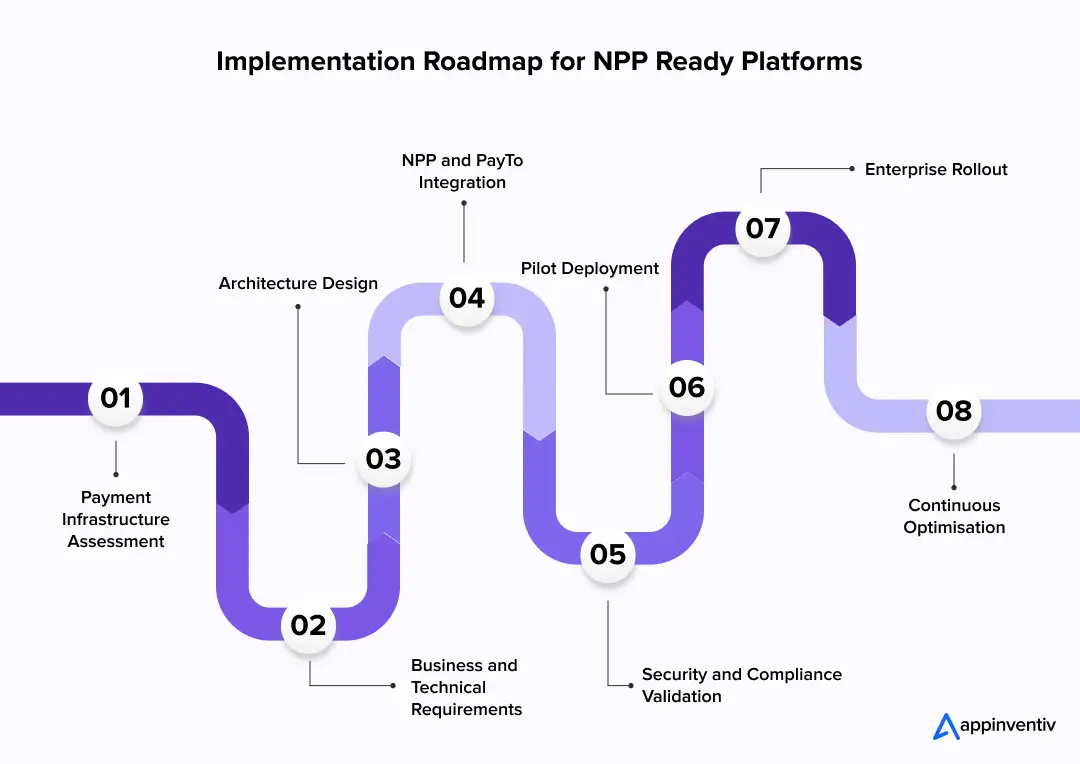
Payment Infrastructure Assessment – Audit existing BECS connectivity, direct debit volumes, ERP integration points, and fraud detection maturity
Business and Technical Requirements – Define payment product scope, regulatory obligations, and integration boundaries with legal and compliance input
Architecture Design – Select cloud infrastructure, API gateway framework, NPP access model, and fraud detection approach
NPP and PayTo Integration – Develop and test connectivity to NPP via accredited participant or sponsored access
Security and Compliance Validation – CPS 234 control mapping, penetration testing, data residency confirmation, and incident response playbook.
Pilot Deployment – Limited-volume production testing with real transactions, exception monitoring, and reconciliation validation
Enterprise Rollout – Full production cutover with parallel BECS running where operationally necessary
Continuous Optimisation – Monitor performance, customer behavior, fraud patterns, and operational efficiency metrics.
This cautious, phased strategy mitigates vendor risk and guarantees that digital payment system development in Australia delivers reliable, audit-ready capabilities from day one.
Also Read: How to Develop a FinTech App in Australia in 2026
What Is the Future of Australia’s NPP Economy?
The NPP’s 2030 horizon is not simply the retirement of BECS. It represents the foundation for a broader set of payment innovations that will unlock capabilities that fundamentally alter corporate business models.
AI-native payments will allow treasury systems to autonomously route funds across global networks based on real-time currency fluctuations and liquidity requirements.
There may be massive growth in embedded banking, where non-financial enterprises offer wallet and lending services directly within their proprietary applications.
Programmable payments driven by smart contracts will automate complex supply chain settlements upon delivery confirmation, eliminating manual invoicing entirely.
To capitalise on these digital payment trends in Australia, technical leaders must ensure their current platform architectures are highly composable. Systems locked into rigid codebases will struggle to adopt these emerging protocols, whereas cloud-native, API-first environments will seamlessly integrate future payment rails and digital identity frameworks.
Executive Checklist: Is Your Payment Infrastructure Ready for the NPP Economy?
A practical reference for CIOs and CFOs evaluating current payment system maturity:
- Real-time payment capability: Can your platform initiate and confirm NPP transactions 24/7/365?
- ISO 20022 readiness: Does your ERP or TMS consume structured remittance data for automated reconciliation?
- API maturity: Are your payment integrations API-first, or reliant on file-based batch interfaces?
- PayTo readiness: Have you assessed which direct debit volumes should migrate to PayTo by 2025-2026?
- Payday Super compliance: Can your payroll system initiate per-cycle superannuation payments via NPP from 1 July 2026?
- Security posture: Does your fraud detection operate within the sub-second NPP settlement window?
- CPS 234 mapping: Have you completed information asset classification and third-party control attestation?
- Scalability validation: Has your platform been load-tested against projected peak transaction volumes?
- Data sovereignty: Does your cloud infrastructure maintain Australian data residency for payment records?
- Audit readiness: Can you produce complete transaction audit trails on demand for APRA or ATO review?
Addressing these technical gaps proactively ensures a smoother transition and maximises the return on investment when engaging professional engineering teams.
Why Enterprises Partner with Appinventiv for Digital Payment System Development in Australia?
Payment modernisation in Australia requires expertise that spans architecture, compliance, integration, security, and long-term platform ownership. The choice of implementation partner often determines whether organisations achieve sustainable value or accumulate new technical debt.
At Appinventiv Software Pty Ltd, we help organisations navigate the complexity of digital payment system development in Australia through a combination of engineering expertise, domain knowledge, and enterprise delivery experience.
Our fintech software development services cover the full delivery lifecycle: payment architecture design, NPP and PayTo integration, AI-driven fraud detection, ERP connectivity, cloud infrastructure engineering, and regulatory compliance validation. We do not hand off security and compliance to the client after deployment. Those obligations are built into the delivery model from discovery through to ongoing optimisation.
In our 11+ years of APAC delivery experience, we have deployed over 3,000 digital products across 35+ Australian industries and maintained a 90% client retention rate. Our fintech delivery work spans digital payment platforms, open banking software development, and compliance-integrated payment management systems for FinTech clients including Mudra and Edfundo.
We hold ISO 27001, ISO 9001, and SOC2 certifications with a 99.5% security compliance SLA. Appinventiv is pre-qualified on the Queensland Government ICTSS panel and the Local Buy LGA procurement framework, enabling compliant vendor engagement for public sector payment modernisation programs.
With 5+ agile delivery centres across Australia and 1,600+ engineers, we are positioned to support enterprises at any stage of the BECS-to-NPP migration, whether that means a greenfield NPP-native platform or a staged modernisation of existing payment infrastructure.
Enterprises that are ready to assess their current payment architecture, model the cost of NPP migration, or begin scoping a custom digital payment solution can engage Appinventiv for a no-obligation technical discovery session.
FAQs
Q. How does the NPP work in Australia?
A. The NPP provides real-time gross settlement between participating financial institutions, operating 24/7/365 via the Fast Settlement Service. Payments are initiated through overlay services such as Osko, PayID, or PayTo, and use the ISO 20022 messaging standard to carry rich remittance data. Over 114 million accounts were enabled on the NPP by late 2024, with more than 155 million transactions processed monthly as of early 2026.
Q. How long does it take to create online payment platforms in Australia?
A. The timeline for building digital payment systems in Australia typically ranges from 3 to 18+ months.
- An MVP online payment platform with NPP connectivity typically takes three to five months from requirements to production deployment.
- A mid-market solution with ERP integration and PayTo support ranges from five to eight months.
- Enterprise-grade fintech platforms with AI fraud detection, multi-entity support, and full regulatory validation commonly require eight to twelve months or more.
Timeline is significantly influenced by the NPP access pathway and the extent of existing infrastructure that must be integrated.
Q. Why are real-time payments reshaping Australian businesses?
A. Real-time payments eliminate clearing float, automate reconciliation through ISO 20022 rich data, and enable entirely new payment product categories including PayTo-based collections and embedded finance. For CFOs, the working capital benefit of removing 1-3 day settlement delays is material. For compliance teams, NPP infrastructure supports Payday Super obligations, APRA CPS 234 requirements, and Consumer Data Right connectivity in ways that BECS architecture cannot.
Q. What industries benefit most from NPP-enabled payments?
A. Financial services, superannuation, healthcare billing, government services, retail and eCommerce, construction and trades, and any sector with high-volume recurring payments or B2B collections see the most immediate benefit from digital payment system development in Australia.
Payroll-intensive industries face the most urgent transition requirement given the July 2026 Payday Super mandate. Sectors with significant cross-border payment flows benefit from ISO 20022 interoperability as bilateral fast-payment corridors expand across APAC.
Q. How Australian Banks Are Rebuilding Payment Infrastructure for the NPP Era
A. Major institutions are actively decoupling their core banking modules from their payment layers. This microservices approach allows them to connect seamlessly to the new payments platform without disrupting legacy batched processes. By deploying cloud-native API gateways, they ensure continuous availability and adherence to the ISO 20022 messaging framework.


Fast 2-minute response, fully NDA-protected.

Cost of Developing a Payment Gateway: A Complete Breakdown
Key takeaways: Custom gateway development requires $50,000 to $500,000 in upfront capital, and enterprise platforms cost more at scale. Core infrastructure, security compliance, and settlement logic consume far more budget than basic checkout screens. High transaction volumes require concurrency controls, failover systems, monitoring tools, and automated reconciliation engines. Platform ownership creates recurring costs for security…

How Much Does RegTech Software Development Cost in the UK in 2026?
Key takeaways: RegTech software development cost in the UK spans £40,000 to £400,000+, with regulatory scope and legacy integration depth driving the cost. High-performance systems deliver a 30% to 50% reduction in manual workloads, protecting enterprises from severe FCA penalties. Advanced AI features generally represent around 25–40% of the total project investment due to the…

كم تكلفة تطوير تطبيق BNPL مثل Tabby في السعودية والإمارات؟ (2026)
لنتحدث بشفافية تامة ونبتعد عن التنظير والمثاليات الفارغة. الدفع عند الاستلام كان يوماً ما ملك الساحة في دبي والرياض وعموم منطقة الشرق الأوسط، لكنه اليوم يمثل عقبة تشغيلية وكابوساً لوجستياً ينهش هوامش الأرباح. التجارة الإلكترونية الحديثة تعتمد بالكامل على المرونة، التجربة الخالية من الاحتكاك (Zero Friction)، والسرعة. هنا يبرز أي تطبيق اشتر الآن وادفع لاحقاً…