

































AI-First Health Tracking App Development: Wearable Integration, Architecture, Cost and Key Considerations

 Share -


- 01How to Integrate Wearables Into an AI Health Tracking App
- 02AI-First Health Tracking App Architecture
- 03AI Capabilities and Features of a Health Tracking App
- 04EHR, EMR, and Healthcare System Integration
- 05Security, Privacy, Compliance, and AI Governance
- 06How to Validate AI Models in Health Tracking
- 07Technology Stack for AI-First Health Tracking App Development
- 08AI Health Tracking App Development Cost and Timeline
- 09Key Challenges in AI Health Tracking App Development
- 10Build vs Buy vs Partner for an Enterprise Health Tracking Platform
- 11Measuring ROI From an AI Health Tracking App
- 12Why Appinventiv for AI-First Health Tracking App Development
- 13Frequently Asked Questions

Key Takeaways
- Design your system architecture around clean sensor data, hybrid edge-cloud computing, medical record connections, and continuous algorithm monitoring.
- Handle diverse wearable devices using unified data schemas, real-time message channels, signal filters, and dedicated hardware adapters.
- Stream wearable metrics into hospital databases using FHIR standards, HL7 protocols, identity matching, and background middleware.
- Test AI algorithms across demographic groups, hardware models, false alarm rates, clinical procedures, and live performance shifts.
- Budget $40,000 to over $500,000 based on algorithm complexity, device support, medical integrations, legal compliance, and user scale.
The health tracking market has moved well beyond step counts, calorie logs, and static dashboards. With 57% of U.S. adults owning a wearable or connected device in 2025, enterprises now use wearables, biosensors, mobile health platforms, and clinical records to build a more continuous view of user health. (Source: Rock Health)
Wearable APIs often return different schemas, sampling rates, timestamps, and signal quality. The platform must clean and normalize that data before machine learning models can use it. Real-time workloads add another layer. Some events need low-latency processing on the device, while deeper analysis can run in the cloud.
AI health-tracking app development for healthcare businesses must integrate this pipeline with EHR systems, identity controls, audit logs, and privacy requirements. A survey published in 2026 found that 81% of physicians use AI in their professional practice. (Source: AMA). The same platform must support model validation, monitoring, and future device integrations without forcing a full rebuild.
This guide covers the AI-first health-tracking app development process, wearable integration, system architecture, AI capabilities, interoperability, compliance, validation, technology choices, development costs, timelines, and enterprise planning.
Appinventiv helps enterprises build AI-driven health-tracking platforms with wearable data pipelines, EHR integration, governance, and scalable architecture.
AI-First Health Tracking App Development
AI-first health-tracking app development starts deep in data architecture, never polished interfaces. Successful platforms demand concrete goals, clean biometric data, fitting models, rock-solid security, and proactive monitoring right away. Because every layer shapes the next, your team must map out these core requirements long before writing any actual code.
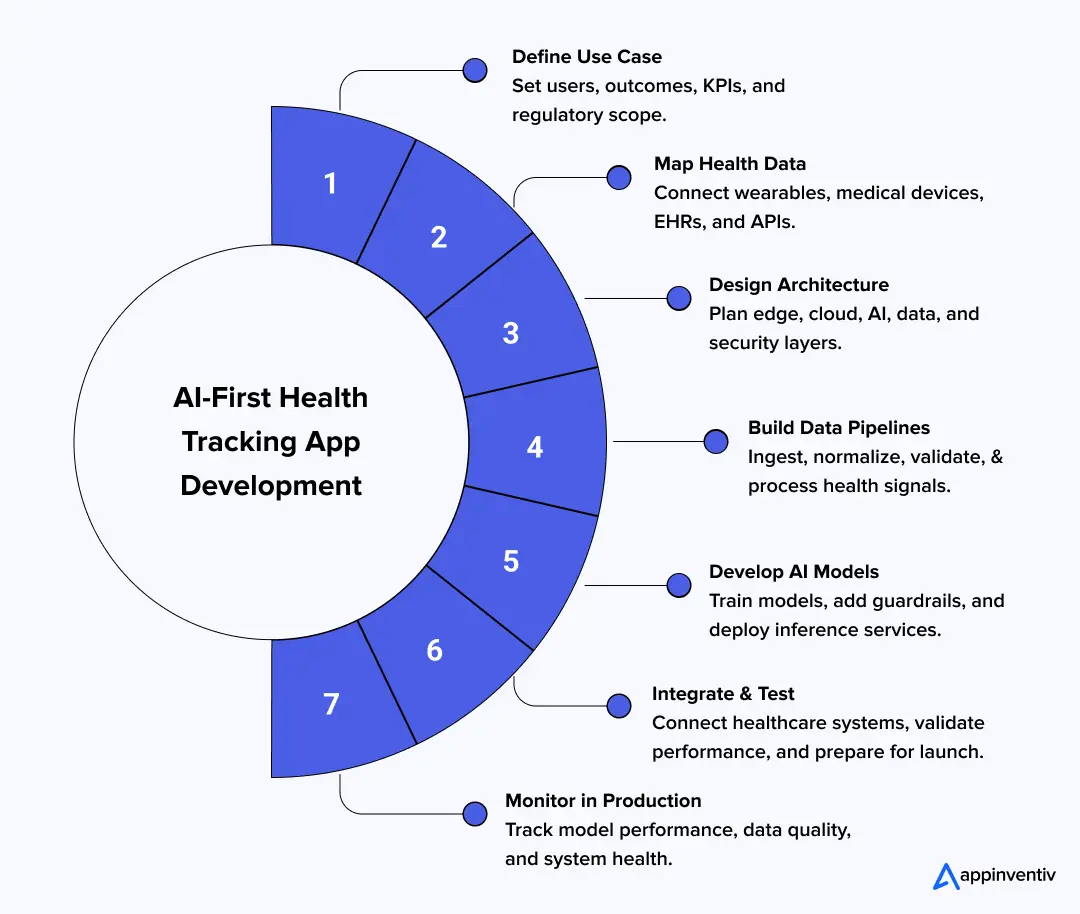
Step 1 – Define the Use Case and Enterprise Requirements
Nail down the exact business and health outcomes your product targets first.A general wellness or mental health app might center on movement, sleep, food, and recovery. Meanwhile, remote patient monitoring demands tighter controls around clinical alerts, care workflows, and biometrics.
Identify your target users, executives, care teams, and operational leaders early. Next, outline your geographic reach and regulatory boundaries. An app serving U.S. healthcare providers carries vastly different compliance demands than a global corporate wellness program.
Establish clear success metrics right now. Track essential metrics such as active users, protocol adherence, alert response speed, data quality, retention, and per-user cost. These concrete benchmarks will guide product choices throughout your journey.
Step 2 – Map Data Sources and Wearable Integrations
Map out every signal feeding your platform. Think smartwatches, fitness rings, ECG patches, glucose monitors, mobile phones, EHR databases, and third-party health data API feeds.
Every hardware vendor brings unique formats and sampling methods. A heart-rate stream from one wearable might sample at intervals that differ completely from those of another. Plus, device APIs vary wildly in field availability, permissions, and historical access.
Lock down data ownership and origin details right away. Your platform should log where every measurement originated, paired with exact timestamps, device IDs, and processing history. That detailed trail becomes essential for troubleshooting, analytics, and clinical auditing.
Step 3 – Design the AI-First Architecture
Smart system design in AI health monitoring and tracking app development keeps real-time tasks separate from heavy analytical processing. An on-device model can evaluate sensor signals instantly right on the user’s smartphone. Meanwhile, powerful cloud services handle longitudinal analysis spanning months of rich health data.
Clarify what each architectural layer does before picking a fancy tech stack. That covers API gateways, event processing, databases, model serving, and client interfaces. Enforce strict security boundaries between these layers to protect highly sensitive patient health information tightly.
A clean architecture makes adding future gadgets effortless. New wearables should plug directly into integration adapters without touching the core application’s business logic.
Step 4 – Build the Data Ingestion and Normalization Layer
Intelligent health tracking app development means you never dump raw sensor streams directly into AI prediction models. Your ingestion pipeline requires strict validation, unit standardization, timestamp checks, deduplication, and signal noise filtering routines.
Standardize measurement units and metric names across all hardware. Handle missing readings or spotty sampling intelligently, avoiding fake filler data. Establish a consistent internal schema for downstream machine learning services.
From there, extract meaningful features such as resting pulse trends, sleep stages, activity spikes, or shifts relative to personal baselines. In practice, smart feature engineering almost always boosts predictive power far more than throwing overly complex neural networks at messy sensor data.
Step 5 – Develop AI/ML Capabilities
AI-powered health tracking app development requires picking model families tailored to your clinical goals and dataset constraints. Time-series architectures thrive on continuous biometric streams, classification handles risk stratification, while recommendation engines customize daily health nudges to individual habits.
You can train custom models, fine-tune foundation platforms, or blend machine learning with deterministic medical rules. Always bake in clinical guardrails, confidence scores, and safety escalations so the system knows when human oversight becomes necessary.
Step 6 – Build the Application and Enterprise Dashboards
Building a smart health tracking app rarely succeeds with just one interface. Users need an intuitive mobile experience for daily tracking and feedback. Clinicians require patient-level views, targeted alerts, and historical trends. Enterprise leaders demand cohort analytics, reporting, and administrative control panels.
Anchor smart alerts directly to context instead of rigid static thresholds. An isolated anomalous metric shouldn’t trigger panic the same way a repeating multi-signal pattern should.
Step 7 – Integrate EHRs and Healthcare Systems
Link your platform seamlessly into provider systems using FHIR and HL7 standards. Map device readings precisely into data schemas that clinical workflows expect natively.
Identity resolution demands bulletproof design. Patient EHR records, hardware serial numbers, and app accounts require an airtight mapping. Smart middleware handles payload transformation, validation, routing, and error logging across systems.
Step 8 – Implement Security, Privacy, and Compliance
Weave granular access controls, user consent, encryption, audit trails, and data lifecycle rules straight into your underlying architecture. Compliance obligations shift depending on target regions, business models, and data sensitivity.
Audit vendor integrations just as strictly. Every external SDK, API, analytics tool, or AI vendor opens another sensitive data path. Map those routes before launching into production.
Step 9 – Validate, Deploy, and Monitor
Rigorously test software across hardware variations, stress loads, and failure scenarios. Thoroughly validate AI predictions using representative cohorts before surfacing machine insights to patients or clinical staff.
Live monitoring must track system uptime alongside model behavior. Monitor latency, broken integrations, data degradation, model drift, and notification spikes. Robust MLOps pipelines provide teams with a structured framework for versioning, auditing, retraining, and continuous model updates.
How to Integrate Wearables Into an AI Health Tracking App
Wearable integration requires more than linking hardware to a mobile app. Sensors transmit data in different formats, at different sampling rates, and with varying permission levels, reflecting the wearable app development trends shaping this space. Build an integration layer to collect raw feeds, standardize units, verify signal quality, and stream data downstream.
Wearables and Medical Devices to Support
AI-powered health-tracking app development starts by aligning your wearable technology in the healthcare ecosystem directly with clinical goals.
| Device Type | Typical Health Data |
|---|---|
| Smartwatches | Heart rate, SpO₂, activity, sleep |
| Fitness bands | Steps, calories, heart rate, sleep |
| Smart rings | Sleep, HRV, temperature, activity |
| ECG devices | Single-lead or multi-lead ECG readings |
| CGMs | Continuous glucose readings |
| Blood pressure monitors | Systolic and diastolic pressure |
| Medical patches | ECG, heart rate, respiratory signals |
| Smartphone sensors | Motion, activity, posture, exercise form |
Medical hardware requires stricter validation and data rules than consumer activity trackers. An AMA study found that 97% of physicians review wearable data, yet clinical integration remained below 6% across the surveyed countries.
APIs, SDKs, and Health Platforms
Connect hardware through platform APIs, native SDKs, or third-party data aggregators. Apple HealthKit exposes health metrics on iOS devices. Android applications connect using modern Android health frameworks and compatible device APIs.
Native SDKs give deep access to specific hardware features. Aggregator platforms consolidate multiple device feeds into a single setup. Pick integration methods based on data speed, permission controls, device coverage, and vendor support.
How Wearable Data Enters the Application
The mobile app gathers readings locally and syncs them to backend servers. Encrypted channels protect data during transit. Backend services validate every record before sending input to AI tools.
Build authentication, rate limits, automatic retries, and duplicate checks directly into your ingestion layer. This stops faulty hardware reads from corrupting your core health database.
Wearable Data Mapping and Normalization
Devices measure identical biometrics differently. One sensor outputs temperature in Celsius, but another records Fahrenheit. Sampling rates range from seconds to minutes.
Establish a unified data model before feeding it to AI algorithms. Map fields, units, timestamps, hardware IDs, and test types into that schema. Keep original metadata so teams can trace readings back to source hardware.
Handling Missing, Noisy, and Inconsistent Data
Sensor data often contains gaps, duplicate reads, sudden spikes, or bad readings. Flag these errors before sending data into machine learning pipelines.
Run real-time signal checks, range tests, duplicate removal, and outlier filters. Never unquestioningly fill missing values with zero. Record missing points separately and preserve raw audit logs. Hardware metadata helps teams identify whether bad data stems from dead batteries, lost connections, or improper wear.
Real-Time Data Synchronization
Continuous monitoring requires event-driven streaming. Message queues move device readings to background services without slowing down the user app.
Build your pipeline to support five core requirements:
- Local offline storage during network drops
- Retry logic with backoff delays
- Idempotent event processing
- Accurate event timestamping and sequence ordering
- Defined latency targets based on clinical urgency
Set latency rules based on risk profiles. A daily wellness report allows longer delays than an urgent cardiac alert.
AI-First Health Tracking App Architecture
An enterprise AI health monitoring and tracking app development platform uses a layered architecture. This structure divides device inputs, application logic, machine learning tasks, and core company databases.
Wearables → Mobile/Edge → API Gateway → Data Ingestion → Processing → Storage → AI/ML → Rules & Alerts → Applications → Healthcare Systems
Separating these operations protects data security. Engineering teams modify single layers without rebuilding the entire system.
Device and Sensor Layer
This layer collects raw body signals from smartwatches, rings, ECG sensors, glucose monitors, patches, and phones. Software manages hardware connections, user permissions, device readiness, and local readings.
Mobile and Edge AI Layer
Smartphones handle initial data tasks directly. Local software filters noisy signals, calculates baseline numbers, and runs small models locally.
Tools like Core ML and TensorFlow Lite run fast checks without network access. Edge processing reduces data delay and cuts total cloud transmission volume.
API and Integration Layer
An API gateway controls traffic across mobile apps, device services, databases, and third-party tools.
The gateway controls user authentication, security permissions, rate limits, request checks, traffic routing, and code versions. Dedicated services handle medical record systems, external platforms, and device APIs.
Real-Time Data Processing Layer
This layer processes continuous streams from connected hardware. Event queues and streaming software validate, transform, route, and organize incoming metrics. This layer routes and processes incoming events according to workload and priority.
Health Data and Storage Layer
Systems store data based on access frequency and data structure. SQL databases manage user profiles, application settings, and access rules. Time-series databases store high-frequency biometric logs. Large operations store historical records in data lakes for model training.
AI/ML and Model Serving Layer
This layer hosts trained models and prediction software. Different tasks require specific algorithm types.
Time-series models assess patient trends over time. Classification models assign risk levels. Recommendation algorithms tailor user activities. Language models process text notes and text entries.
Model hosting systems manage software versions, controlled launches, system rollbacks, and live performance monitoring.
Rules, Safety, and Alert Orchestration
Machine learning outputs must not trigger notifications directly. A separate rules engine evaluates numerical thresholds, confidence scores, repeated events, and emergency workflows.
This layer stops redundant alerts and routes critical events to care teams. The system logs the source data, rules, model version, and reasoning behind every alert.
User, Provider, and Enterprise Application Layer
Different user groups require tailored software views.
Patients track daily progress, view trends, and receive personal alerts. Doctors review patient history charts, abnormal metrics, and pending tasks. Executives inspect population metrics, system usage reports, and platform permissions.
Role-based access locks each screen down to mandatory data points.
Observability and MLOps Layer
Engineers monitor both system health and algorithm performance in real time.
Teams track API response times, connection drops, sensor errors, server loads, prediction delays, data quality, and model drift. Model registries and deployment pipelines manage software updates.
Automated warnings notify operators of system bugs before they impact users.
Edge AI vs Cloud AI
| Factor | Edge AI | Cloud AI |
|---|---|---|
| Latency | Minimal delay | Network dependent |
| Privacy | Data stays on device | Requires secure transfer |
| Connectivity | Works offline | Requires active network |
| Compute | Limited device power | Scalable server computing |
| Model Complexity | Runs smaller models | Runs complex models |
| Scalability | Device dependent | Scalable across users |
| Workloads | Signal filtering, fast checks | Long-term analysis, model training |
AI Capabilities and Features of a Health Tracking App
The strongest AI health monitoring and tracking app development platforms do more than just collect readings. They compare signals over time, detect changes, and return information that fits the user’s context. For enterprise products, these capabilities also need clear rules for alerts, clinical review, and data access.
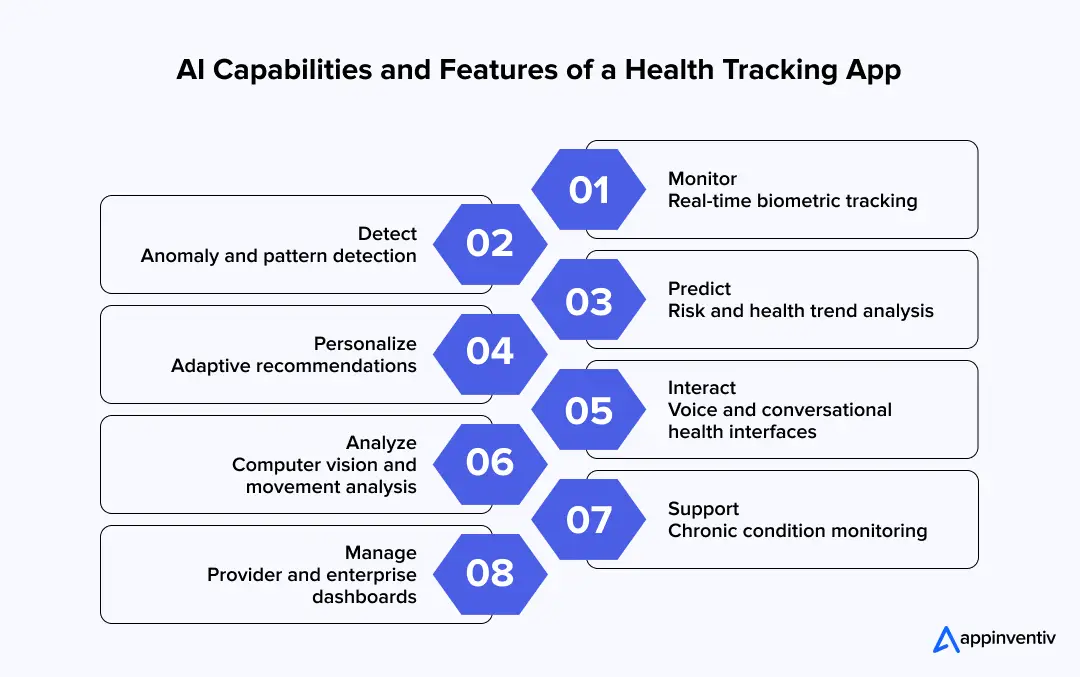
Real-Time Health Monitoring and Anomaly Detection
AI health monitoring app development enables the app to process heart rate, SpO₂, temperature, activity, and other supported signals as they arrive. Anomaly detection works better with a personal baseline than with one fixed threshold for every user.
Also Read: IoT-Based Remote Patient Monitoring System
Predictive Health Analytics
Predictive analytics in healthcare analyzes data over time rather than treating each reading as an isolated event. Time-series models can identify trends in metrics such as resting heart rate, sleep duration, glucose, or activity.
Risk scoring can combine several signals into a single probability or risk category. Trend detection can then flag sustained changes before they become obvious in a standard dashboard.
For healthcare use cases, predictive outputs should support defined workflows. A prediction should not be presented as a diagnosis unless the product has the required clinical basis and regulatory status.
Personalized Health Recommendations
Recommendation engines use user history, goals, preferences, and recent behavior to select relevant actions. The system can adjust recommendations as those inputs change.
For example, a recovery model can account for sleep, recent exercise, resting heart rate, and training load before suggesting another workout. A nutrition feature can combine food logs with activity and other available health signals.
The recommendation layer should record the inputs behind each recommendation. That gives product teams a way to review why the system produced a particular result.
Sleep, Recovery, and Lifestyle Intelligence
AI models can combine sleep stages, duration, heart rate patterns, HRV, activity, and user logs to assess recovery. The system can compare current patterns with the user’s own history rather than relying only on population averages.
Lifestyle intelligence can track activity balance, rest periods, stress indicators, and recurring behavior patterns. These signals can feed personalized recommendations without requiring users to review raw measurements themselves.
The value comes from combining signals that are difficult to interpret in isolation.
Conversational and Voice-Based Health Interfaces
NLP can turn natural-language input into structured health records. Users can describe meals, symptoms, exercise, or sleep patterns without filling out long forms.
Voice logging and AI chatbots in wearables can use speech recognition to capture these entries. A retrieval-grounded assistant can then answer questions using approved health records, product rules, and trusted content sources.
Health-related responses need strict boundaries. The system should distinguish recorded facts from generated content, avoid unsupported medical claims, and route high-risk situations to an appropriate human or clinical workflow.
Computer Vision for Fitness and Rehabilitation
Computer vision can use a phone or connected camera to analyze movement. Pose estimation models identify body landmarks and track changes across frames.
These capabilities can support exercise form checks, repetition counting, posture analysis, and selected rehabilitation workflows. The model can compare movement against defined patterns and return specific corrections.
Camera-based health features need careful handling of lighting, camera position, body variation, and movement speed. Model testing should cover these conditions before production use.
Chronic Condition Support
Longitudinal monitoring provides AI models with a broader view of patterns in chronic disease management. The platform can combine biometric readings, medication management app data where available, symptoms, activity, and historical trends.
Risk signals can trigger personalized alerts based on the user’s baseline and care plan. Escalation rules can route selected events to providers or care teams rather than sending every anomaly to the user.
The system should keep a clear record of the signal, model output, threshold, and action taken. This supports clinical review and audit trails.
Provider and Enterprise Dashboards
Provider dashboards should turn continuous data into a manageable review queue. Patient-level views can show recent measurements, trends, flagged events, and relevant history.
Cohort monitoring helps care teams identify groups that need attention. Risk segmentation can group users based on defined factors, rather than requiring staff to review every record manually.
Enterprise dashboards can add adoption, device coverage, data completeness, and operational metrics. Access controls should limit each role to the data it needs.
Population-Level Health Intelligence
Large health programs can aggregate de-identified or appropriately governed data to identify trends across populations. Models can segment cohorts by risk, behavior, adherence, or other approved factors.
Population analytics can help enterprises evaluate program performance, identify changes in engagement, and allocate operational resources. Reports should preserve privacy controls and avoid exposing individual health information through aggregate views.
EHR, EMR, and Healthcare System Integration
As part of custom healthcare app development services, an enterprise health tracking platform often needs to exchange data with systems that already support clinical care. That makes healthcare interoperability a core engineering task. The integration layer must map wearable measurements into accepted healthcare formats, maintain patient context, and preserve a clear record of every data exchange.
FHIR and HL7 Integration
FHIR provides a web-based standard for exchanging healthcare information through structured resources and APIs. HL7’s 2025 global survey found that 73% of respondents reported that FHIR was mandated or formally recommended in their country. HL7 Version 2 remains widely used for clinical messaging across healthcare facilities.
A health tracking platform can use SMART on FHIR APIs for newer application integrations while supporting HL7 integration where existing hospital systems still rely on them. The correct implementation depends on the systems already in place within the enterprise.
Teams should select the required FHIR version and implementation guides during architecture planning. Different markets and healthcare programs can impose different profiles and constraints. For example, current HL7 work includes implementation guides based on both FHIR R4 and R5.
Mapping Wearable Data to Clinical Data
Wearable measurements rarely arrive in a form that a clinical system can consume directly, which is why EMR integration needs a canonical data model that maps device readings to defined clinical concepts. The same process applies to sleep, glucose, temperature, activity, and other supported signals.
For FHIR-based systems, relevant resources such as Patient and Observation can represent core clinical data. FHIR R4 includes normative content for these resources and the RESTful API.
Integration Middleware and API Orchestration
Middleware sits between the health tracking platform and external systems. It can handle authentication, data transformation, routing, validation, retries, and error management.
This layer prevents external system differences from spreading into the core application. A hospital may expose FHIR APIs, another system may rely on HL7 messages, and an enterprise platform may expose REST APIs. Middleware gives the application a consistent interface across these systems.
It can also control data direction. Some workflows only send wearable observations into an EHR. Others need patient demographics, care plans, or clinical observations to flow back into the application.
Patient Identity and Context Matching
Correct patient matching is critical when combining wearable and clinical data. A device account, mobile account, and EHR record can use different identifiers.
The integration layer should maintain a controlled identity mapping process. It should validate patient identifiers before linking new measurements to an existing record.
Context matters too. The same measurement can mean different things depending on time, activity, encounter, device, or collection method. Preserving this context prevents downstream systems from treating every reading as an equivalent clinical observation.
Provider Workflow Integration
Sending data to an EHR is not enough. The information must reach the right workflow. Providers may need trend summaries, flagged observations, review queues, or patient-level timelines rather than thousands of raw readings, and EHR-CRM integration helps route data correctly. The application should group related events and present them in a form that fits existing clinical processes.
For large enterprises, integration should account for roles, access permissions, escalation paths, and response ownership. A health alert without a defined destination and action path has limited operational value.
Also Read: Telemedicine App Development Cost
Data Lineage and Auditability
Clinical and enterprise integrations need traceable data flows. The platform should record where a measurement originated, which transformations it passed through, and which system received it.
Maintain audit records for key actions, including data access, updates, exports, and model-generated outputs. Record relevant timestamps, system identifiers, user or service identity, and model or ruleset versions where applicable.
This creates a reliable history for debugging, security reviews, compliance checks, and clinical investigation, all of which should be planned during the EHR implementation process. HL7 continues to focus on real-time medical-device interoperability, including use cases involving AI-enabled care.
Security, Privacy, Compliance, and AI Governance
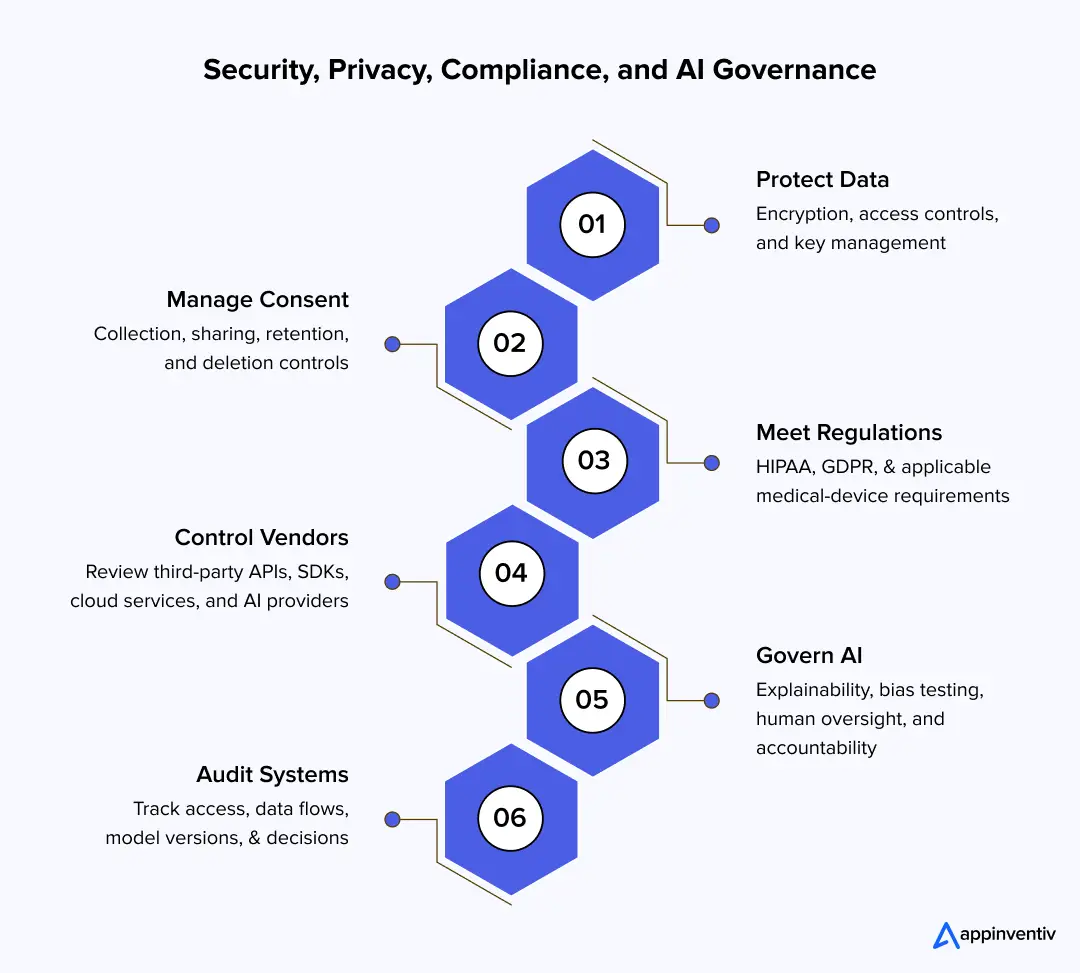
Security must be integrated into your platform architecture from the initial design review. Health tracking systems process protected health records, biometric signals, identity files, and machine learning outputs. Engineering teams must establish clear access rules, data ownership, and system controls across every network path.
HIPAA and Protected Health Information
HIPAA rules govern medical entities and business partners handling digital patient records. The Security Rule mandates technical, physical, and administrative safeguards.
Map every location where patient data enters, rests, runs, or leaves the platform. Align encryption, access controls, audit logs, and vendor contracts directly with data paths. Build compliance into cloud components, storage layers, and APIs right from the start of your HIPAA-compliant app.
GDPR and Global Privacy Requirements
Global privacy laws grant strict protections to personal health data. Platforms operating across borders must establish legal bases for processing, user consent workflows, storage limits, and cross-border transfer rules.
Collect metrics that match specific product features rather than gathering every available sensor signal. Maintain a regional compliance matrix mapping data types, storage nodes, and local privacy laws across target markets.
Medical Device and Regulatory Considerations
Product claims determine regulatory requirements. Simple fitness-tracking tools face different compliance requirements than software that makes medical diagnoses.
The FDA maintains a public list of AI-enabled medical devices. Research based on FDA records found 331 AI/ML-enabled medical devices were authorized in 2025 alone, bringing the total to 1,430 through December 2025. Define intended uses, user groups, target claims, and clinical workflows before selecting a regulatory path.
Identity and Access Management
Identity and access management enforces strict least-privilege access rules across patients, clinicians, administrators, microservices, and connected sensors.
Deploy multi-factor authentication, role-based controls, session timeouts, and centralized permission policies. Separate consumer screens from clinical interfaces. Hardware connections must use isolated service credentials without administrative permissions.
Encryption and Key Management
Encrypt health metrics during network transmission and database storage. Manage encryption keys outside target databases using strict access policies and automated key rotation schedules.
API traffic requires secure transport protocols. Database drives, system backups, and log files must follow enterprise healthcare data security rules. Store API credentials and passwords in dedicated secret management platforms rather than in source repositories.
Consent, Retention, and Data Governance
Consent screens must clarify what data the platform collects, why the app needs it, and where data travels. System backends must record consent status and enforce choices across data pipelines.
Set explicit storage limits for raw biometric streams, calculated trends, medical logs, and AI outputs. Enforce data governance policies within database software rather than in static strategy documents.
Third-Party and Vendor Risk
External SDKs, APIs, cloud platforms, and analytics packages introduce external security risks and network paths.
Audit third-party vendors for data retention rules, physical server locations, and security standards. Healthcare deployments require formal business associate agreements. Maintain a full inventory of external tools to streamline technical audits.
AI Governance and Responsible AI
AI governance spans the entire model lifecycle from training dataset selection to operational monitoring.
- Explainability: Log the exact inputs and model versions used to generate predictions so users understand the origins of the output.
- Human Oversight: Establish clinical escalation paths for automated outputs before system launch.
- Bias Controls: Test model accuracy across distinct patient demographics to spot performance gaps.
- Auditability: Record model versions, input values, timestamps, and user actions for technical reviews.
- Model Accountability: Assign clear team ownership for model approval, operational reviews, retraining, and retirement.
How to Validate AI Models in Health Tracking
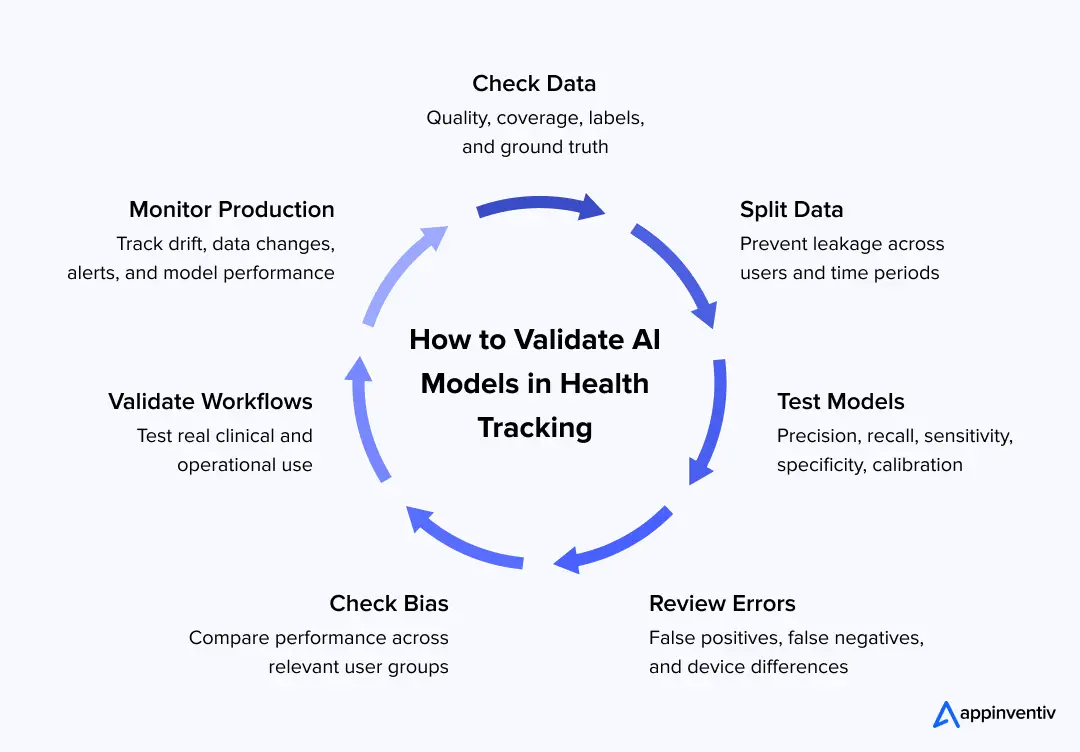
A health tracking model needs more than a high accuracy score. Its outputs must remain reliable across users, devices, health conditions, and real operating conditions. Validation should cover the data, model behavior, clinical workflow, and production performance.
Data Quality and Ground Truth
In intelligent health tracking app development, model quality starts with the data used for training and evaluation. Wearable datasets can contain missing readings, duplicated events, sensor noise, device-specific errors, and uneven sampling.
Create clear ground-truth labels for each prediction task. For some models, this can come from validated clinical records, laboratory measurements, or clinician-reviewed events. Keep the source and quality of each label traceable.
Check the dataset for demographic coverage, device coverage, missing values, and label imbalance. A model trained on a single wearable or population may perform poorly after deployment to a broader user base.
Training, Validation, and Test Strategy
Separate training, validation, and test data before model development. Keep the final test set isolated until model selection is complete.
Health data needs careful splitting. Randomly separating readings from the same person can produce leakage. A model may appear accurate simply because it has seen similar patterns from that user during training.
Use subject-level or time-based splits where the use case requires them. For longitudinal systems, testing on later periods can better reflect production behavior.
Choosing the Right Evaluation Metrics
The right metric depends on what the model is trying to predict.
For classification tasks, teams can track precision, recall, F1 score, sensitivity, specificity, and area under the ROC curve. Regression models can use metrics such as mean absolute error or root mean squared error.
Do not report one number without context. A risk model used for screening has different error priorities from a model that recommends workout intensity.
Set acceptance thresholds before production testing. Tie each threshold to the intended workflow and the cost of an incorrect prediction.
False Positives and False Negatives
False positives can create unnecessary alerts, provider workload, and user anxiety. False negatives can cause the system to miss a condition or delay an intervention.
The acceptable balance depends on the use case. A screening model may favor sensitivity. A lower-risk wellness feature may place more weight on precision and user experience.
Review error cases by device, user group, signal quality, and operating condition. This indicates whether errors arise from the model itself or from upstream data issues.
Calibration and Confidence
A model can rank users correctly and still produce poorly calibrated probabilities. Calibration checks whether predicted risk levels match observed outcomes.
For example, among cases assigned a 70% predicted risk, the observed outcome rate should be close to that level across a suitable evaluation set.
Confidence scores can also support alert handling. Low-confidence outputs can trigger additional data collection or human review instead of immediate action.
Bias and Subgroup Performance
Test model performance across relevant demographic and clinical groups. Compare error rates, calibration, sensitivity, and specificity across those groups.
Also test performance across device types and data collection conditions. Differences between devices can create hidden performance gaps even when demographic results look balanced.
Track these results across model versions. A new model should not move into production simply because its overall score improved.
Clinical and Workflow Validation
Technical testing does not show whether the system works inside a real healthcare process. Clinical validation checks whether outputs are useful, understandable, and appropriate for the intended workflow.
Run the model against realistic cases and review outputs with qualified clinical stakeholders where the use case requires it. Test alert volume, review time, escalation paths, and failure handling.
For clinical products, validate the complete workflow rather than the model alone. A technically accurate prediction still has limited value when the receiving team cannot act on it.
Post-Deployment Monitoring and Model Drift
In AI health monitoring app development, model validation continues after launch. User behavior, device firmware, sensor quality, population mix, and clinical practices can change over time.
Monitor:
- Prediction performance
- Input data distributions
- Missing-data rates
- Device-specific error rates
- Alert volume
- Calibration
- Population shifts
- Model drift
- API and pipeline failures
Set thresholds for investigation and retraining. Keep model versions, validation results, deployment dates, and rollback procedures documented.
Model accuracy and real-world safety are different measures. Accuracy describes performance against a defined test set. Safety and usefulness depend on data quality, operating conditions, user population, clinical workflow, and the system’s handling of uncertainty. A production health-tracking platform needs evidence across all these areas.
Enterprise models need validation across devices, populations, clinical workflows, and production conditions before they influence real healthcare decisions.
Technology Stack for AI-First Health Tracking App Development
The technology stack for AI-powered health-tracking app development should align with the product’s data volume, AI workload, device mix, compliance scope, and existing enterprise systems. There is no single stack that fits every health tracking platform. A consumer wellness app and a clinical monitoring platform can need very different infrastructure.
| Architecture Layer | Technology Options | Enterprise Purpose |
|---|---|---|
| Mobile | Swift, Kotlin, React Native, Flutter | User applications and device connectivity |
| Edge AI | Core ML, TensorFlow Lite | On-device inference and local signal processing |
| Backend | Python, Node.js, Java | APIs, business logic, and service orchestration |
| AI/ML | PyTorch, TensorFlow, scikit-learn | Model training, evaluation, and inference |
| Data Processing | Kafka, event queues, stream-processing services | Real-time health data pipelines |
| Database | PostgreSQL, time-series databases | Application records and biometric time-series data |
| Cloud | AWS, Azure, Google Cloud | Compute, storage, networking, and managed services |
| Interoperability | FHIR, HL7 | EHR, EMR, and healthcare data exchange |
| MLOps | CI/CD, model registry, monitoring | Model releases, versioning, and production monitoring |
| Security | IAM, KMS, secrets management | Identity, encryption, and credential protection |
AI Health Tracking App Development Cost and Timeline
AI health-tracking app development costs range from $40,000 to over $500,000. Project budgets scale with machine-learning complexity, hardware integrations, compliance requirements, and operational scope. A basic MVP costs less. Broad clinical platforms with custom algorithms, medical integrations, EHR feeds, and global deployments drive up costs.
| Development Scope | Estimated Cost | Typical Timeline |
|---|---|---|
| MVP | $40,000 – $90,000 | 3 – 5 months |
| Production App | $90,000 – $180,000 | 5 – 8 months |
| Enterprise Platform | $180,000 – $350,000 | 8 – 12 months |
| Advanced Clinical Platform | $350,000 – $500,000+ | 12 – 18+ months |
What Drives Development Cost and Timeline?
Key financial drivers include:
- Custom AI algorithms, dataset training, and server hardware
- Data ingestion pipelines, data cleaning, and real-time event streaming
- Total volume and types of supported wearable devices
- EHR, EMR, FHIR, and legacy medical database connections
- Native iOS, Android, web, and administrative dashboard screens
- Data security, privacy testing, compliance setup, and code audits
- Cloud servers, data storage tiers, and system monitoring tools
Clinical trial testing and FDA regulatory reviews push product schedules past typical software timelines.
Recurring Costs Enterprises Should Budget For
Building the initial application represents part of total ownership costs. Companies must budget for ongoing cloud server usage, AI model requests, hardware API fees, data storage, penetration testing, model retraining, continuous monitoring, system maintenance, and mobile OS updates.
How to Control Development Costs
Enterprises that want to develop an AI health-tracking app should focus their engineering work on core clinical features first. Limit initial device integrations. Pre-built cloud tools, phased EHR integrations, shared microservices, and foundational AI models reduce upfront development costs without limiting future software growth.
Key Challenges in AI Health Tracking App Development
Enterprise AI-powered health tracking app development projects encounter technical, legal, and operational obstacles. Clean system design mitigates these risks early.
Wearable Fragmentation
- Challenge: Connected devices use distinct APIs, schemas, sampling rates, and permission models.
- Enterprise impact: Adding new hardware increases integration workloads and results in inconsistent user experiences.
- Engineering response: Deploy an abstraction layer separating device-specific code from core health microservices.
Data Quality
- Challenge: Wearable feeds bring missing values, duplicate records, signal noise, and irregular sampling intervals.
- Enterprise impact: Corrupt inputs degrade model accuracy and generate faulty health metrics.
- Engineering response: Run automated validation, unit standardization, signal quality filters, and origin tracking before AI processing.
Alert Fatigue
- Challenge: Constant low-value notifications overwhelm patients and care teams.
- Enterprise impact: Patients ignore critical notifications, and clinicians waste hours reviewing routine logs.
- Engineering response: Combine baseline user data, confidence ratings, duplicate checks, and defined escalation rules.
Model Drift
- Challenge: Model accuracy changes as user demographics, hardware models, user habits, and data patterns shift.
- Enterprise impact: Systems performing well during initial testing lose reliability in production environments.
- Engineering response: Track input metric distributions, prediction accuracy, demographic splits, and model drift metrics. Retrain models through controlled release pipelines.
Real-Time Scale
- Challenge: Large deployments generate millions of continuous biometric events across connected sensors.
- Enterprise impact: Processing delays disrupt real-time notifications, clinician dashboards, and downstream backend tasks.
- Engineering response: Build event-driven pipelines using message queues, workload priority channels, and auto-scaling cloud servers.
EHR Interoperability
- Challenge: Healthcare systems use different data standards, database structures, and integration rules.
- Enterprise impact: Mismatched interfaces delay clinical workflows and increase engineering costs.
- Engineering response: Implement FHIR or HL7 standards using data transformation and validation microservices.
Legacy-System Integration
- Challenge: Large medical organizations depend on legacy software lacking modern web APIs.
- Enterprise impact: Replacing existing infrastructure incurs massive costs and breaks established clinical routines.
- Engineering response: Place middleware adapters, message queues, and isolated migration layers around legacy databases.
Privacy and Vendor Risk
- Challenge: External SDKs, APIs, analytics platforms, and AI models add hidden data pathways.
- Enterprise impact: Weak vendor security risks data leaks and creates compliance liabilities.
- Engineering response: Maintain vendor inventories, audit data access rules, restrict shared metrics, and enforce strict contract terms.
Regulatory Complexity
- Challenge: Compliance rules vary across geographic regions, intended uses, business models, and clinical features.
- Enterprise impact: Delayed regulatory planning forces late architectural redesigns and postpones market release.
- Engineering response: Define intended product claims, data classes, legal jurisdictions, and compliance rules during initial system planning.
User Adoption
- Challenge: Users abandon tracking apps that require heavy manual data entry or that display irrelevant feedback.
- Enterprise impact: Low user engagement reduces business returns and weakens longitudinal dataset quality.
- Engineering response: Automate data logging, personalize user interactions, suppress unnecessary alerts, and monitor engagement against numeric goals.
Build vs Buy vs Partner for an Enterprise Health Tracking Platform
Enterprises can choose between building internally, adopting an existing platform, or combining both models. The right option depends on the required control, integration depth, delivery speed, and long-term cost.
| Approach | Speed | Control | Customization | Integration | TCO |
|---|---|---|---|---|---|
| Build In-House | Slow | High | High | High | High |
| Buy Platform | Fast | Low | Low | Medium | Medium |
| White-Label | Medium | Medium | Medium | Medium | Medium |
| Development Partner | Medium | High | High | High | Flexible |
| Hybrid | Medium | High | High | High | Balanced |
Best fit: Enterprises that need to build custom AI health-tracking app solutions with complex wearable, AI, EHR, and security requirements often benefit from a healthcare AI consulting partner or a hybrid model. The final choice should account for IP ownership, integration depth, regulatory scope, internal engineering capacity, vendor lock-in, and long-term operating costs.
Build around your data, workflows, integrations, AI models, and compliance requirements instead of adapting your operations to a fixed platform.

Measuring ROI From an AI Health Tracking App
Enterprise return on investment combines user adoption, operational performance, financial returns, and clinical metrics. Global digital health funding reached $22.3 billion in 2025, up 19% year over year. Tracking these core areas gives leadership clear visibility into platform performance.
Product and Engagement Metrics
Track active user counts, retention rates, session frequency, feature usage, data completeness, and action adherence. High daily logins and completed health tasks signal real user value.
Operational Metrics
Monitor alert volume, response speeds, system uptime, data processing delays, integration errors, and clinician review workloads. Clear system performance logs help teams identify server bottlenecks early.
Business and Financial Metrics
Measure subscription revenues, enterprise contract values, customer retention rates, monthly cost per active user, acquisition costs, and customer lifetime value. Compare these figures directly against initial software development and monthly cloud costs.
Clinical and Health Metrics
Evaluate validated clinical measures like treatment adherence, medical intervention rates, hospital readmission numbers, and condition-specific health changes. Real medical benefits must be supported by verified evidence from clinical trials, not marketing claims.
Why Appinventiv for AI-First Health Tracking App Development
As an AI health-tracking app development company, Appinventiv integrates healthcare engineering, AI development, and enterprise product delivery into a single development cycle. Its healthcare work spans digital platforms, patient engagement, clinical assistance, and connected healthcare systems.
- AI and Healthcare Engineering Expertise: Through its AI services and solutions, Appinventiv has delivered 500+ digital health platforms and processes 10M+ healthcare data points annually. Its healthcare engineering work includes AI-enabled diagnostics and clinical assistance systems that have reduced initial patient assessment time by 38%.
- Wearable and IoT Integration: Health tracking products depend on reliable data from connected devices. Appinventiv can build the ingestion, synchronization, and processing layers needed to connect wearable and IoT data with mobile applications and backend systems.
- Healthcare Interoperability: Appinventiv works across patient-facing applications, provider systems, and healthcare data workflows. Its platforms have recorded 120K virtual healthcare interactions annually, helping organizations connect digital services with existing care processes.
- Security and Compliance Engineering: Healthcare systems need controlled access, protected data flows, and traceable operations. Appinventiv builds security controls into application architecture and data workflows rather than adding them after development.
- End-to-End Product Development: Appinventiv supports product development from planning and UX through engineering, testing, deployment, and ongoing support. Its healthcare platforms have contributed to 45% lower care coordination delays, 3x faster patient onboarding, and 32% higher patient response for multilingual engagement applications.
Let’s connect and get an enterprise AI health tracking development roadmap before competitors move faster.
Frequently Asked Questions
Q. How long does it take to build an AI-First health tracking app?
A. AI health monitoring and tracking app development usually takes 3 to 18 months, based on product scope. A basic MVP can take 3–5 months. A production platform with multiple wearables may need 5–8 months. Enterprise healthcare systems with custom AI, EHR integration, extensive validation, and regulatory requirements can take 12–18 months or longer.
Q. How much does it cost to develop an AI health tracking app?
A. AI health tracking app development can cost $40,000 to $500,000+. A focused MVP generally falls near the lower range. Enterprise platforms cost more due to custom AI, multiple wearable integrations, EHR connectivity, real-time processing, security, compliance, testing, and cloud infrastructure. Ongoing costs include AI inference, hosting, storage, monitoring, and maintenance.
Q. What are the essential AI features for a personalized health tracking application?
A. Core AI features include real-time biometric analysis, anomaly detection, predictive analytics, personalized recommendations, sleep and recovery analysis, conversational health interfaces, and adaptive alerts. Advanced platforms can add computer vision, chronic condition monitoring, risk stratification, and population analytics. Feature selection should follow the health use case, available data, clinical requirements, and enterprise workflow.
Q. How to integrate wearable device data into a new health tracking app?
A. Use device APIs, SDKs, health platforms, or approved integration providers to collect wearable data. Route incoming data through a secure ingestion layer, then validate, normalize, timestamp, and store each measurement. A canonical health data model helps handle differences between devices. The processed data can then feed analytics, AI models, dashboards, and healthcare systems.
Q. What are the key regulatory hurdles for launching a health tracking app in the US?
A. The regulatory path depends on the product’s intended use and data handling model. HIPAA requirements can apply when covered entities or business associates handle electronic protected health information. Software functions that meet the definition of a medical device may fall under FDA oversight. Teams should assess device classification, applicable controls, privacy, security, documentation, and validation requirements early.
Q. What are AI-first health tracking platforms with advanced biometric monitoring?
A. These platforms continuously process signals from connected devices, including heart rate, HRV, SpO₂, sleep, glucose, temperature, and activity. AI models can detect anomalies, identify trends, generate risk scores, and personalize recommendations. Enterprise platforms can integrate these outputs into provider dashboards, EHR systems, and operational workflows to support broader health monitoring programs.


Fast 2-minute response, fully NDA-protected.

AI Agent Governance: How to Govern Autonomous AI Across Business Systems
Key takeaways: AI agents require controls at the action, identity, data, tool, and workflow levels. Every enterprise agent should have a registered owner, an approved purpose, and a defined risk tier. Access must be based on the agent’s task rather than inherited from a human user or shared service account. High-impact actions need real-time policy…

'I.D.E.A.S.' - The Five Pillar Framework to Ace AI-Native Enterprise Apps in 2027
Key takeaways: AI-native enterprise apps are moving beyond AI agents toward intelligent, adaptive, autonomous and context-aware digital capabilities that can operate across mobile, web, voice, wearables and emerging interfaces. The I.D.E.A.S. framework for AI enterprise apps in 2027 - Interactive Intent, Decisioning Autonomously, Experiential System Design, Adaptive Execution, and Security Layered. Context intelligence and reusable…

Automated Decision-Making in Australia: Benefits, Cost and Implementation
Key takeaways: Automated decision-making combines rules, algorithms, AI and human oversight to improve high-volume decisions. ADM programmes require privacy, security, auditability and accountability to be designed into architecture. ADM implementation costs typically range from AUD 70,000 to AUD 700,000 or more. Implementation starts with decision mapping, then moves through development, testing, controlled pilots and monitoring.…