




















AI-Native Security Maturity Model: Score Where Your Security Stack Stands

 Share -


- 01AI-Native vs AI-Assisted Security: The Difference Is Unified Data, Not More AI Features
- 02The 4 Levels of AI-Native Security Maturity, and Where Most Enterprises Get Stuck
- 03The AI-Native Security Scorecard: Score 8 Areas to Find Your Real Maturity Level
- 04Level 2 to Level 3 in 90 Days: Unify the Data, Rank the Alerts, Then Automate
- 05Build, Buy or Integrate AI Security: Your Environment Should Decide, Not the Vendor
- 06How Appinventiv Moves You Up a Level Without Forcing a Platform Switch
- 07Frequently Asked Questions

Key takeaways:
- If Human oversight scores below 2, you’re at Level 3 at most, whatever your total score says.
- Moving to Level 3 starts with unifying your telemetry, which most teams can do with tools they already own.
- Define approval points before you automate response. Oversight added later costs more.
- Buy a platform when your stack is standard. Build or integrate when your data, products or compliance needs are specific to you.
- Most enterprises can move from Level 2 to Level 3 in 90 days without replacing their tools.
AI-native security is a setup where AI sits at the core of detection, investigation and response, working from unified telemetry under defined human oversight. Most enterprises are AI-assisted today: their tools have AI, but their analysts still connect the dots. This AI security maturity model shows where your setup sits across four levels and eight dimensions, regardless of which vendors you use.
Appinventiv unifies your security data and adds AI triage, so every alert gets ranked and reviewed.
AI-Native vs AI-Assisted Security: The Difference Is Unified Data, Not More AI Features
AI-assisted security puts AI inside individual tools, which is how most teams first adopt AI in cybersecurity. AI-native security builds the operating model around AI that works across all your telemetry. In an AI-assisted setup, a SIEM copilot summarizes alerts and an EDR tool scores threats, but each works on its own data, and an analyst stitches the results together.
Microsoft/Omdia’s State of the SOC 2026 counted an average of 10.9 security consoles per organization. Ten consoles with AI built in are still ten separate silos.
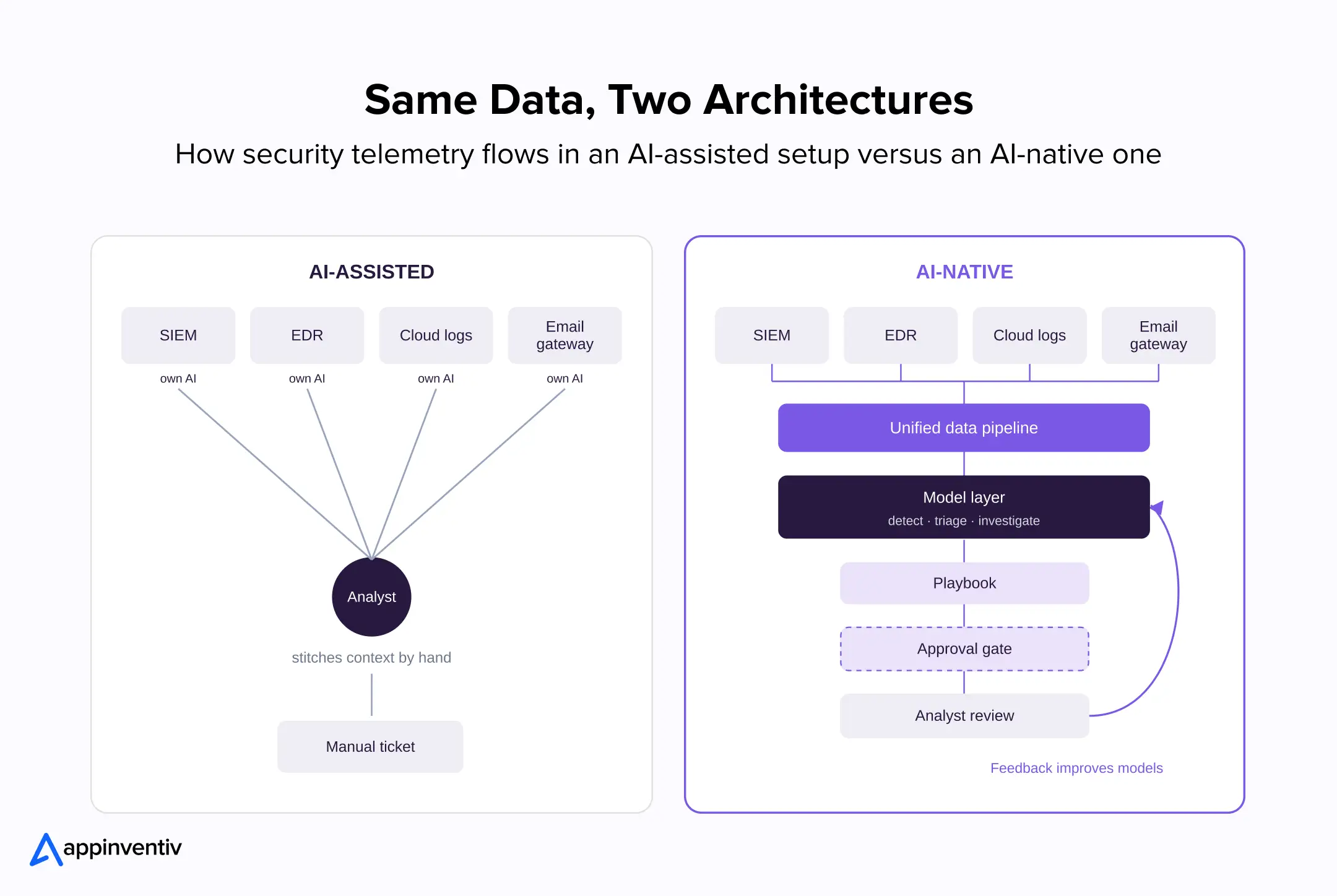
Follow each source to its output: on the left, everything stops at an analyst; on the right, only approved actions reach a person.
Use these three questions to test any “AI-native” claim:
| Question | AI-Assisted Answer | AI-Native Answer |
|---|---|---|
| Where does AI sit? | Inside individual tools | Across unified telemetry |
| Who correlates events? | The analyst | The model, with analyst review |
| What happens after a verdict? | A manual ticket | A defined playbook with approval gates |
What this means for you: before you evaluate tools, use AI consulting services to check whether your data can support AI-native operations. See how your data foundation scores →
The 4 Levels of AI-Native Security Maturity, and Where Most Enterprises Get Stuck
Each level is defined by where AI sits in the workflow and how much manual effort analysts still carry. The SOC-CMM 2026 Maturity Report found that roughly 65% of surveyed SOCs run off-the-shelf AI within an existing stack without customization, which corresponds to Level 2 in this model. Unlike a general security maturity model, which measures processes and staffing, this one measures the depth of AI’s embedding in your operations.
| Level | Name | What it looks like |
|---|---|---|
| 1 | Rule-Based | Signatures and static rules drive detection; analysts triage by hand |
| 2 | AI-Assisted | Tools have ML features, data sits in silos, analysts connect the dots |
| 3 | AI-Integrated | Unified telemetry; models drive detection and prioritization; triage automated with human approval |
| 4 | AI-Native | AI at the core of detection, investigation and response; playbooks run with oversight; models improve through feedback |
Level 1 – Rule-Based: You Only Catch Attacks You’ve Already Seen
Limits: rules catch only known patterns, and every new tool adds more alerts.
To move up: start data integration by centralizing your logs and pilot one behavioral detection use case, such as identity anomalies, which is often the first step toward AI-native identity security.
How Appinventiv builds it: a telemetry audit and a data pipeline designed around your environment. Check if you’ve moved past Level 1 →
Level 2 – AI-Assisted: Every Tool Has AI, but No Tool Sees the Whole Attack
Limits: each model sees only its own data, and 46% of alerts are false positives (Source: Microsoft/Omdia, 2026), so analysts spend their time chasing noise.
To move up: unify telemetry into one data layer and rank all alerts with one model.
How Appinventiv builds it: we design an AI-native security data pipeline architecture that brings your SIEM, EDR and cloud logs into a single shared layer and adds model-driven prioritization on top. Confirm whether you’re at Level 2 →
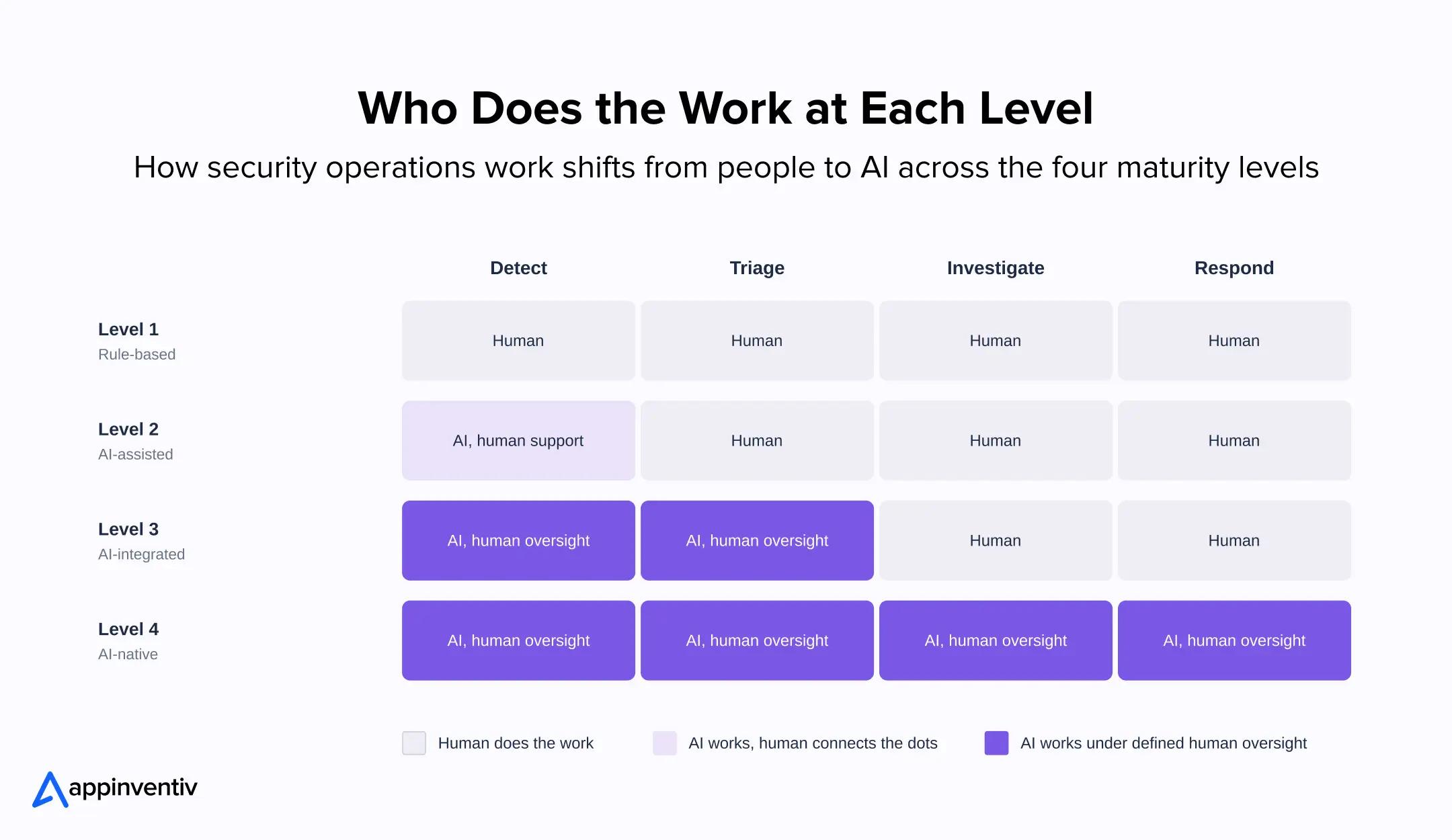
Read down each column to see when that stage moves from people to AI. The level where your colours stop changing is roughly where you are today.
Level 3 – AI-Integrated: One Data Layer, and a Model Ranks Every Alert
Limits: analysts still pull investigation context by hand, and most response steps are manual.
To move up: automate evidence gathering and write approved playbooks for your top five incident types.
How Appinventiv builds it: custom investigation agents that collect context across your systems, with built-in approval gates. Find your weakest area →
Level 4 – AI-Native: AI Runs the Workflow, and People Govern It
Limits: the biggest of the AI risks at this level is drift. Organizations often discover the real cost of an AI-native SOC only after a false containment action disrupts production.
To stay here: track false positives, retrain models on analyst feedback, and audit every automated action.
How Appinventiv builds it: custom MLOps platforms for detection models and explainable AI logs your auditors can read. Test whether you’re really at Level 4 →
Sort each automated action your team runs into one of the three tiers. Any action you can’t place yet needs an approval gate before it goes live.
The AI-Native Security Scorecard: Score 8 Areas to Find Your Real Maturity Level
The AI-native security scorecard rates your setup on eight areas, from data foundation to audit, each scored from 0 to 3. Your total out of 24 gives your maturity level, and your lowest scores show where to start. This AI-native security assessment takes about five minutes and needs no technical tools, only an honest view of how your team works today.
Vendor labels won’t tell you which level you are at. The SOC-CMM 2026 Maturity Report found that roughly 65% of surveyed SOCs run off-the-shelf AI without customizing it. Many of those teams would call themselves AI-driven, but on this scorecard most would land at Level 2.
How to score
- Pick the description in each row that best matches your current setup.
- Score only what is live in production today. Planned work and pilots don’t count.
- If a row applies to only part of your stack, score the weaker part.
- If you’re unsure, score 0. A gap you can’t see is still a gap.
| Area | 0 | 1 | 2 | 3 |
|---|---|---|---|---|
| Data Foundation | Security data sits in separate tools | Some sources feed a central log store | Most telemetry is unified in one store | All telemetry is unified and ready for models to use |
| Detection | Signatures and static rules only | Some tools have built-in ML, used alongside rules | Behavioral models run on most data sources | Models detect threats across unified data |
| Alert Triage | Analysts review alerts in arrival order | Basic severity rules sort alerts | Models rank the main alert types by risk | Models rank all alerts, and low-risk ones close automatically with review |
| Investigation | Analysts correlate events by hand | Some tools link related events | AI assembles context for most incidents | AI builds the incident story and suggests next steps |
| Response Automation | All response steps are manual | A few scripts run on request | Playbooks run automatically for low-risk incidents | Defined playbooks run automatically across incident types |
| Human Oversight | No defined approval points | Approval points exist informally | Approval points are defined for high-impact actions | Approval points are defined, logged and reviewed regularly |
| Model Operations | Models aren’t tracked after deployment | False positives are reviewed occasionally | False positives are tracked, and models are tuned on a schedule | Models are monitored, retrained on analyst feedback and tested before every update |
| Explainability And Audit | You can’t see why a tool flagged something | Some tools show a reason for alerts | Most AI decisions show the data behind them | Every AI decision and action is explained and logged for audit |
What your total means
| Total | Your Level | What It Means And Where To Start |
|---|---|---|
| 0 to 6 | Level 1: Rule-Based | Rules drive detection, and people do the rest. Start by unifying your security data. |
| 7 to 12 | Level 2: AI-Assisted | AI helps in some areas, but silos and manual triage limit its use. Fix detection and triage first. |
| 13 to 18 | Level 3: AI-Integrated | Models drive detection and triage on unified data. Next, automate response with clear oversight. |
| 19 to 24 | Level 4: AI-Native | AI sits at the core of detection, investigation and response. Keep models tuned and decisions auditable. |
The oversight rule: if you scored Human oversight below 2, count yourself at Level 3 at most, whatever your total. Automation without defined approval points poses a production risk and doesn’t count as AI-native.
Also Read: Responsible AI – Addressing Adoption Challenges With Guiding Principles and Strategies
Two businesses with the same total can need very different fixes, so treat any area scored 0 or 1 as your starting point, even when the total looks healthy.
What this means for you: the score turns “are we AI-native?” from a vendor’s claim into a clear read of your AI security posture you can take to your board, along with the gaps that justify the next budget line. For a deeper result, the full interactive scorecard scores each area with 24 questions.
Appinventiv’s cybersecurity services close your lowest-scoring areas first, from unified data to governed response automation.
Level 2 to Level 3 in 90 Days: Unify the Data, Rank the Alerts, Then Automate
Most enterprises can reach Level 3 within a quarter because the work connects data and decisions your current tools already produce. Staying at Level 2 costs you in triage, where the average alert takes 56 to 70 minutes against a benchmark of under 15 (Cybersecurity Insiders, 2025), and 42% to 63% of alerts go uninvestigated (Microsoft/Omdia 2026, Vectra AI 2026).
| Phase | Weeks | Focus | Output |
|---|---|---|---|
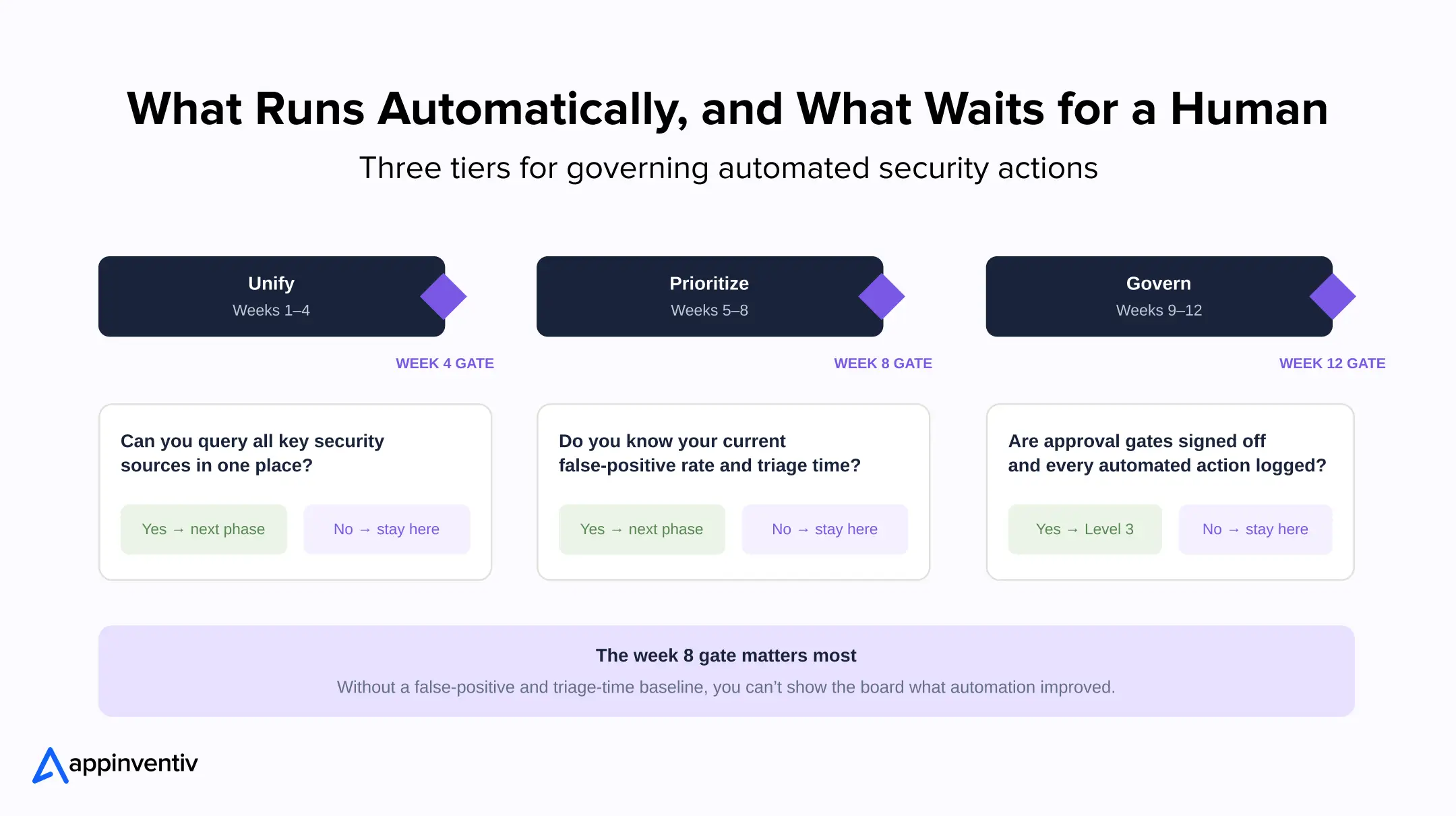
| Unify | 1 to 4 | Map telemetry sources; build one data pipeline | One queryable security data layer |
| Prioritize | 5 to 8 | Train or tune one model to rank alerts across sources | Ranked queue and a false-positive baseline |
| Govern | 9 to 12 | Automate triage for top alert types, with approval gates | Approved playbooks and an audit log |
The most common mistake is automating before you have a baseline. If you don’t know your current false-positive rate and triage time, you can’t show the board what improved.
Don’t move to the next phase until you can answer yes at its gate. Each gate is a yes-or-no check your project lead can run in a single review meeting.
Also Read: How can automation be used to ensure security and compliance in business?
What this means for you: the 90-day plan gives you a before-and-after you can measure, which is what a budget request needs. Appinventiv runs this as a fixed-scope AI automation services engagement on your existing stack
Build, Buy or Integrate AI Security: Your Environment Should Decide, Not the Vendor
The right path depends on how standard your environment is. Out-of-the-box AI and ML deployments without customization or a defined operational role often deliver limited value, so the real question is where your risk lies within your business.
| Path | Choose It When | Watch Out For |
|---|---|---|
| Buy an AI-native security operations platform | Your stack is mainstream, your team is small, and speed matters most | Lock-in; detection logic you can’t see or tune |
| Integrate AI into your stack | You’ve invested heavily in SIEM/EDR, and the gap is correlation | Integration debt if the data layer isn’t designed first |
| Build custom detection | Your products, data or compliance needs are unique (fintech, healthcare, OT) | You’ll need MLOps maturity to maintain the models |
Most enterprises end up with a mix: they buy commodity layers like EDR and build or integrate where their risk is specific. In fintech cybersecurity, a payments platform’s fraud signals rarely fit a generic model, and neither does a hospital’s device telemetry. The same test applies to AI-native application security platforms: buy for standard stacks, and build where cloud application security depends on logic a generic model can’t read.
What this means for you: if a vendor recommends its own platform for every gap, you’re hearing a sales pitch, not getting an assessment. Find out which path your score points to →
Appinventiv maps your environment to the right path, so your security budget follows your risk, not a pitch.
How Appinventiv Moves You Up a Level Without Forcing a Platform Switch
Appinventiv doesn’t sell a security platform, so our recommendations are based on your scorecard results. Our cybersecurity and AI engineering teams work together on all three paths: integrating AI into existing stacks, building custom detection into products and infrastructure, and helping teams choose a platform when buying is the better option.
In one engagement, a marketplace came to us after a breach. We delivered a security audit and DevSecOps services, and the business went on to grow users 3.2x and raise monthly GMV from about $38,000 to $240,000 within six months.
Our security, risk and governance work covers ISO/IEC 27001, SOC 2 Type II, NIST CSF, NIST SP 800-53 and NIS2, among other frameworks, so automated response can stay audit-ready.
Know Your Level Before You Spend on the Next Tool
Take the AI-native security scorecard, find your weakest area and fix that one first. If you’d like a second opinion on what the results mean for your budget, Appinventiv’s security and AI integration services teams will review them with you.
Let’s connect and make your SOC audit-ready for AI automation.
Frequently Asked Questions
Q. What is the difference between an AI-native SOC and a traditional SOC?
A. A traditional SOC relies on rules, signatures and analysts working each alert by hand. An AI-native SOC uses models across unified telemetry to detect, triage and investigate, then runs approved playbooks. Analysts move from handling alerts to reviewing decisions and approving high-impact actions.
Q. Will an AI-native security operations center replace SOC analysts?
A. No, it changes analysts’ work rather than removing it. AI takes over first-line triage and evidence gathering, while analysts review escalations, approve high-impact actions, tune models and hunt threats. Most SOCs carry backlogs and deferred work, so the time AI frees up goes into investigating more alerts.
Q. How do you build a business case for AI-native security?
A. Don’t build it on replacing analysts alone. That math rarely holds, especially for smaller teams. Build it on coverage and quality: the share of alerts that get fully investigated, false-positive reduction, triage accuracy and time to decision. Measure a baseline first so the board can see the change.
Q. Do we need to replace our SIEM to become AI-native?
A. Usually not, because most of the gains come from unifying data and adding a model layer on top of tools you already own. Replace the SIEM only if it can’t ingest or share the data you need.
Q. What new risks does AI-native security introduce?
A. Three risks stand out: a false containment action can disrupt production, models drift and lose accuracy over time, and decisions nobody can explain create audit problems. Defined approval gates, regular retraining based on analyst feedback, and a log of every AI decision help keep these risks in check.


Fast 2-minute response, fully NDA-protected.

The AI ROI Crisis: Why Enterprises Are Struggling to Prove Value and How to Fix It
Key takeaways: AI ROI is a capital-allocation question. Boards want payback periods and P&L impact. AI ROI challenges rarely have a single cause. Data, legacy systems, use-case choice, ownership and stalled pilots compound each other. Choose two or three outcome metrics per use case, set the baseline first, and report in dollars. Make every further…

Retrieval Augmented Generation in Australia: Architecture, Implementation and Cost
Key takeaways: RAG grounds LLM answers in approved content, improving reliability without retraining a model. Data quality and access permissions decide production outcomes more than the model. Indicative build costs run from AUD 70,000 to 700,000, driven by data and integrations. Measure value against a pre-deployment baseline, separating realised benefits from projected savings. A general-purpose…

The Multiplier Effect of AI Agents: The Rise of AI Swarms
Key takeaways: AI agent swarms coordinate specialized agents to solve complex problems that may be difficult for a single agent to handle effectively. More agents do not automatically mean better outcomes. Swarms deliver value when work can be divided, executed in parallel, and coordinated toward a shared objective. Enterprise readiness depends on governance. Clear accountability,…