































10 Ways AI Chatbots in Wearables Are Revolutionizing Human-Machine Interaction

 Share -




Key takeaways:
- Interaction happens without effort: You’re not opening apps or tapping through screens. It responds while you’re already in motion.
- Health data turns into timely action: It’s not just tracking anymore. You get useful nudges when something actually needs attention.
- What shows up is based on context: Prompts depend on your activity, location, and routine, so they feel relevant, not random.
- Wearables start connecting systems: One quick interaction can trigger actions across devices, tools, or environments.
- Less reacting, more anticipating: Over time, the system starts suggesting what you might need next based on your patterns.
You can see the shift in small moments. A quick glance at your smartwatch during a busy day. A subtle vibration that nudges you before you even think to check your phone. No apps, no typing, no friction. Just an interaction that happens quietly in the background.
Now here’s where it gets interesting. We’re not just moving interfaces onto smaller screens; we’re moving beyond screens altogether. AI chatbots in wearables are turning interaction into something continuous and context-aware. Instead of waiting for input, these systems read signals from voice, movement, and real-time data to respond instantly.
That’s what makes AI chatbot technology in wearables a new interaction layer. It shifts human-machine interaction from reactive commands to proactive, always-on assistance.
The momentum is already visible. The shift toward wearable chatbots is already underway. The wearable AI market is expected to reach $207 billion in 2030, driven by growing adoption of voice-based and conversational interfaces in devices such as smartwatches and AI-powered wearables.
What this creates is more than convenience. It changes how people engage with technology altogether. In this blog, we break down exactly how that transformation is unfolding.
Turn real-time data and context into meaningful interactions with AI chatbots in wearables.
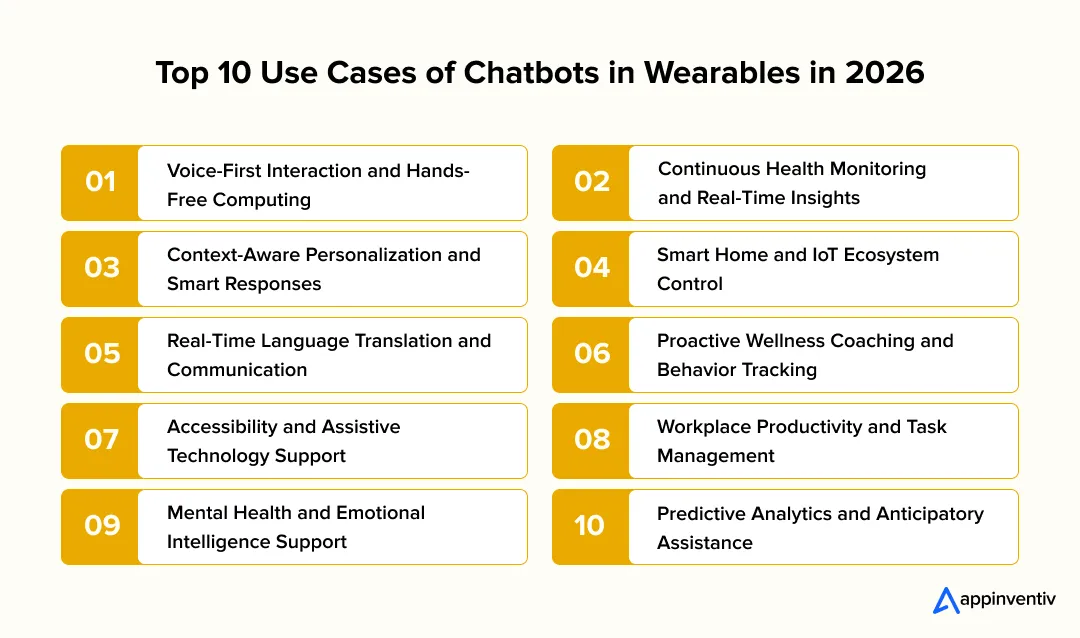
Top 10 Use Cases of Chatbots in Wearables in 2026
You notice it in small ways. You’re walking out of a meeting, hands full, and your watch nudges you about something you actually needed to do. You didn’t open an app. You didn’t ask. It just…knew.
That’s what’s changing with AI chatbot integration in wearables. The interaction is still there, but it’s happening quietly in the background, driven by systems that are doing a lot more than it seems.
1. Voice-First Interaction: The Rise of Hands-Free Computing
Think about moments where you can’t really look at a screen. Driving, cooking, walking into a meeting. That’s where voice becomes the default, not the alternative.
What makes it actually work:
- On-device speech processing: Lightweight ASR models run directly on the wearable, so basic commands don’t need a network round trip
- Always-on wake detection: A low-power DSP listens for triggers without draining the battery
- Split execution model: Simple intents handled locally, complex ones routed to the cloud with compressed context
With the Apple Watch Series 9, many Siri interactions now happen on-device. You can log health data or trigger actions instantly, even without a stable connection.
Why this feels different in real use:
- Response time stays low enough to feel natural
- You don’t break your flow to “use” a device
- It fits into movement, not against it
This is where AI chatbot technology in wearables starts becoming practical. It fades into the background while still doing real work.
Bonus Read: How Can Google Voice Assistant App Make Your Business Efficient?
2. Continuous Health Monitoring with AI-Powered Insights
Most people already track steps or heart rate. The real shift is what happens with that data over time. Instead of just logging numbers, AI chatbot-powered wearables keep reading patterns and responding when something changes.
What’s happening behind the scenes:
- Sensor fusion: Heart rate, electrodermal activity, motion, and temperature signals are combined into a single stream
- Pattern detection over time: Models look for deviations from your normal baseline, not just fixed thresholds
- On-device filtering: Quick anomaly checks happen locally before syncing deeper data to the cloud
- Chatbot feedback loop: Insights are translated into simple, timely prompts
With Fitbit Sense 2, stress signals from electrodermal activity are tracked continuously. If something spikes, you’ll get a nudge to pause or breathe, not just a graph to look at later.
What changes for the user:
- You act earlier, not after the fact
- Feedback feels personal, not generic
- The system responds while the moment is still relevant
That’s where the impact of building IoT wearables becomes clear, especially in everyday health decisions.
3. Contextual Awareness and Personalized Responses
Now think about how your device decides when to interrupt you and when to stay quiet. That’s not random anymore. AI-powered chatbots in wearable tech are constantly pulling in signals and making small decisions in the background.
Here’s how that comes together:
- Multiple inputs at once: Location, movement, calendar events, and usage history
- Context mapping: These signals are combined into a real-time “state” of what you’re likely doing
- Inference layer: Models rank what action or suggestion makes sense right now
- Decision logic: Notify, suggest, or do nothing
With the Samsung Galaxy Watch 6, the system can match your movement patterns with past routines. If it looks like your usual workout time, it prompts you. If you’re in a meeting, it holds back.
What this improves:
- Fewer irrelevant notifications
- Suggestions that actually match your habits
- Interaction that feels timed, not forced
These are real applications of AI chatbots in smart wearables where context drives the experience, not just commands.
Must Read: AI Personal Assistant App Development Cost
4. Seamless Integration with Smart Home Ecosystems
You’re heading out the door, and instead of opening three different apps, you just say something once, and everything adjusts. That’s where AI chatbot integration on wearables starts to connect beyond the device itself.
What enables that:
- Intent-to-action mapping: Natural language gets converted into structured commands
- API orchestration: Commands are sent across connected systems through IoT platforms
- Chained execution: One input triggers multiple actions across devices
- State awareness: The system knows what’s already on or off to avoid duplication
With Amazon Alexa connected to a wearable, a simple command can:
- Lock doors
- Turn off the lights
- Adjust temperature
Why this matters:
- You reduce interaction across multiple systems
- One action replaces several manual steps
- Wearable devices with AI chatbot support become a central control point
The integration extends beyond basic control to intelligent automation. This reflects broader trends in IoT and chatbot development, where conversational interfaces become central to device management. This is where things start to feel less like “using devices” and more like environments responding to you.
5. Real-Time Language Translation and Communication
Now imagine you’re in a conversation where language could slow things down, but it doesn’t. AI chatbots in wearables are starting to handle real-time translation in a way that feels almost continuous.
What’s happening technically:
- Streaming speech-to-text: Audio is transcribed as it’s being spoken
- Neural translation models: Optimized transformer models handle conversion with minimal delay
- Text-to-speech output: Translated responses are generated quickly enough to keep pace
- Edge + cloud split: Fast processing locally, heavier translation tasks handled in the cloud
With the Google Pixel Watch 2, you can access live translation features directly from your wrist. It’s not perfect, but it’s fast enough to keep conversations moving.
What this unlocks:
- Real conversations without switching tools
- Faster communication in travel or global work settings
- Less dependency on separate translation apps or devices
This is one of the more practical advantages of AI chatbots in wearable technology. It removes friction in moments where speed matters.
6. Proactive Wellness Coaching and Behavioral Modification
This is where wearables stop just tracking and start guiding. Instead of sending the same reminders every day, the system learns what you actually follow through on and adjusts over time.
What’s happening behind the scenes:
- Behavior tracking over time: The system logs how you respond to prompts, whether you act on them or ignore them
- Adaptive timing: Nudges are sent when you’re more likely to respond, not at fixed intervals
- Pattern learning: Sleep, recovery, and activity data are used to build a longer-term profile
- Closed feedback loop: Every action feeds back into future recommendations
With Whoop Strap 4.0, recovery and strain data aren’t just displayed. You’ll get suggestions like adjusting sleep or reducing intensity based on how your body has been responding over the past few days.
What changes in real use:
- Advice feels more relevant over time
- Timing improves, which increases follow-through
- It starts to feel like ongoing coaching, not reminders
This is where the benefits of AI chatbots on wearables show up: in habit-building, not just in daily tracking.
7. Enhanced Accessibility and Assistive Technology
For some users, this isn’t about convenience. It’s about making interaction possible in the first place. AI chatbot-powered wearables are reducing the need for screens, which opens up access for people with visual or mobility challenges.
How it works in practice:
- Voice-first control: Commands translate directly into actions without navigating menus
- Audio feedback loops: Information is delivered through sound instead of visuals
- Context-aware assistance: The system adjusts based on where you are and what you’re doing
- Camera + AI pairing: Visual input can be interpreted and explained through audio
With Ray-Ban Meta Smart Glasses, users can capture what’s in front of them and get spoken descriptions or interact hands-free. That removes a lot of friction in everyday situations.
What this enables:
- Less dependence on screens
- Faster interaction for users with accessibility needs
- More independence in daily tasks
These are strong applications of AI chatbots in smart wearables where the value is immediate and practical.
8. Workplace Productivity and Professional Assistance
Now shift to a work setting. You’re moving between meetings, trying to stay up to date without constantly checking your phone. This is where wearables start acting like lightweight assistants.
What supports this:
- Priority filtering: Only high-value notifications surface based on context
- Quick actions: Respond to messages, log notes, or adjust schedules through voice
- System integration: Connected with tools like calendars, messaging platforms, and task managers
- Context awareness: The system knows when you’re in a meeting and adjusts alerts accordingly
With the Samsung Galaxy Watch 6, you can handle quick replies, check schedules, and get timely reminders without breaking your flow.
Why it works:
- Fewer interruptions from low-priority updates
- Faster responses without switching devices
- Better continuity across tasks
This is also where many teams start evaluating the role of an AI chatbot development company, especially when integrating wearables with enterprise tools and workflows at scale.
9. Emotional Intelligence and Mental Health Support
This one is quieter, but important. The system isn’t just tracking physical data. It’s trying to understand how you’re doing overall.
What’s going on underneath:
- Signal tracking: Heart rate variability, sleep patterns, and stress indicators
- Pattern recognition: Looking for changes over time rather than one-off spikes
- Responsive prompts: Suggestions like breathing exercises or check-ins when needed
- Escalation awareness: If patterns continue, the system nudges toward deeper support
With Wysa, conversational AI support is available through simple interactions, helping users reflect or manage stress in the moment.
What this improves:
- Support shows up when it’s needed, not later
- Interactions feel more personal
- There’s continuity in how mental well-being is tracked
This highlights the growing impact of AI chatbot technology in wearables in areas that rely on timing and sensitivity. These advances represent significant technology innovations in mental health support, offering new ways to monitor and address psychological well-being.
Also Read: AI in Mental Health
10. Predictive Analytics and Anticipatory Computing
This is where things start to feel a step ahead. Instead of waiting for input, smart wearables with AI chatbots begin predicting what you might need based on past behavior.
How it works:
- Historical pattern analysis: Looking at trends across sleep, activity, and routines
- Probability-based suggestions: Estimating what action makes sense next
- Cross-device data flow: Combining inputs from your phone, wearable, and apps
- Pre-emptive prompts: Acting before you explicitly ask
With Oura Ring Gen3, readiness and recovery data are used to suggest how you should approach your day, whether to push harder or take it easy.
What this changes:
- Decisions feel easier because the system narrows options
- You rely less on manual tracking or analysis
- The interaction becomes more about guidance than control
This is where the advantages of AI chatbots in wearable technology become most visible. The system starts working alongside you, not just responding to you. This represents the future of integrating AI technologies for business intelligence and proactive decision-making.
Move from ideas to production-ready AI chatbot-powered wearables with the right architecture and integrations.
How Wearable Chatbots Actually Work Behind the Scenes
At a basic level, AI chatbot integration on wearables comprises three tightly connected layers. Each one handles a different piece of the interaction, so things feel fast and relevant.
1. On-Device (Edge) Layer
This is your watch or wearable doing the immediate work.
- Handles voice input, wake-word detection, and basic intent recognition
- Processes sensor data like heart rate, motion, and activity in real time
- Triggers instant actions like reminders or quick responses
Why it matters: You get near-instant responses without depending on the internet every time. That’s key for AI-powered chatbots in wearable tech, where delays break the experience.
2. Cloud Layer
When things get more complex, the wearable hands off the task.
- Runs heavier models for deeper understanding and multi-step requests
- Combines historical data with real-time inputs
- Powers’ advanced recommendations and predictions
For example, a quick command stays on-device, but something like planning your weekly fitness routine gets processed here. This is where AI chatbot technology in wearables adds real intelligence.
3. Context Layer
This is what makes everything feel timely instead of random.
- Combines location, activity, calendar, and past behavior
- Decides when to notify, suggest, or stay silent
- Keeps interactions aligned with what you’re actually doing
Edge vs Cloud in Practice
There’s a constant split happening:
- Edge: fast, private, low-latency tasks
- Cloud: complex reasoning and long-term learning
The system decides in real time where a task should run. That balance is what makes smart wearables with AI chatbots feel responsive instead of slow or intrusive.
In the end, it’s not one big system. It’s a set of small, coordinated layers that work together, so the interaction feels almost invisible.
Key Challenges of Integrating AI Chatbots in Wearables and How to Overcome Them
This is usually the part that looks straightforward on a slide and gets complicated the moment you start building. Small devices, constant sensing, and users who expect instant responses don’t leave much room for error.
Here’s how the challenges of integrating AI chatbot technology in wearables typically show up in real projects, and what teams do to make things hold up in production.
| Challenge | What’s Actually Happening | What Teams Do About It |
|---|---|---|
| Battery drain from always-on features | The device is quietly listening, tracking movement, and running small bits of logic all day. That adds up faster than expected. | Keep the always-on part on a low-power chip, wake the main processor only when needed, and use lighter models so each action costs less power. |
| Lag in voice and real-time responses | If there’s even a short delay, people stop trusting the interaction. Cloud calls can slow things down, especially on weak networks. | Handle basic device commands, process input as it comes in, and send only heavy requests to the cloud. |
| Tight compute and memory limits | You don’t have the luxury of running large models or storing large amounts of data locally. | Trim models using distillation and pruning, and load only what’s needed at that moment. Push deeper processing to external systems. |
| Disconnected sensor data | Heart rate, steps and location all exist, but without alignment, they don’t tell a clear story. | Combine signals through a sensor fusion layer so everything is read together, not in isolation. |
| Privacy and compliance pressure | You’re dealing with health data, voice input, and location, which raises immediate concerns. | Keep sensitive processing on the device where possible, encrypt data in transit, and mask anything that leaves the device. |
| Unstable connectivity | Wearables don’t always have strong or consistent internet access, especially on the move. | Build offline-friendly flows, store recent context locally, and sync later when the connection improves. |
| Limited screen space | There’s very little room to show information, and too much detail quickly overwhelms. | Rely more on voice and subtle haptics, keep responses short, and reveal more only when asked. |
| Integration with other systems | Connecting to home devices or enterprise tools can get messy, especially when systems don’t stay in sync. | Use structured APIs and event-driven setups so updates happen in real time without conflicts. |
If you step back, these aren’t separate problems. They’re all tied to the same thing, making AI chatbot technology in wearables work reliably within tight limits. The teams that plan for this early usually avoid the bigger issues later.
Fix performance, battery, and integration gaps early so your wearable AI works reliably in real-world conditions.
The Future of AI Chatbots in Wearables
If you look at where this is going from a product or enterprise standpoint, the shift is pretty straightforward. Wearables are moving from “assistive” to actually getting work done in the background.
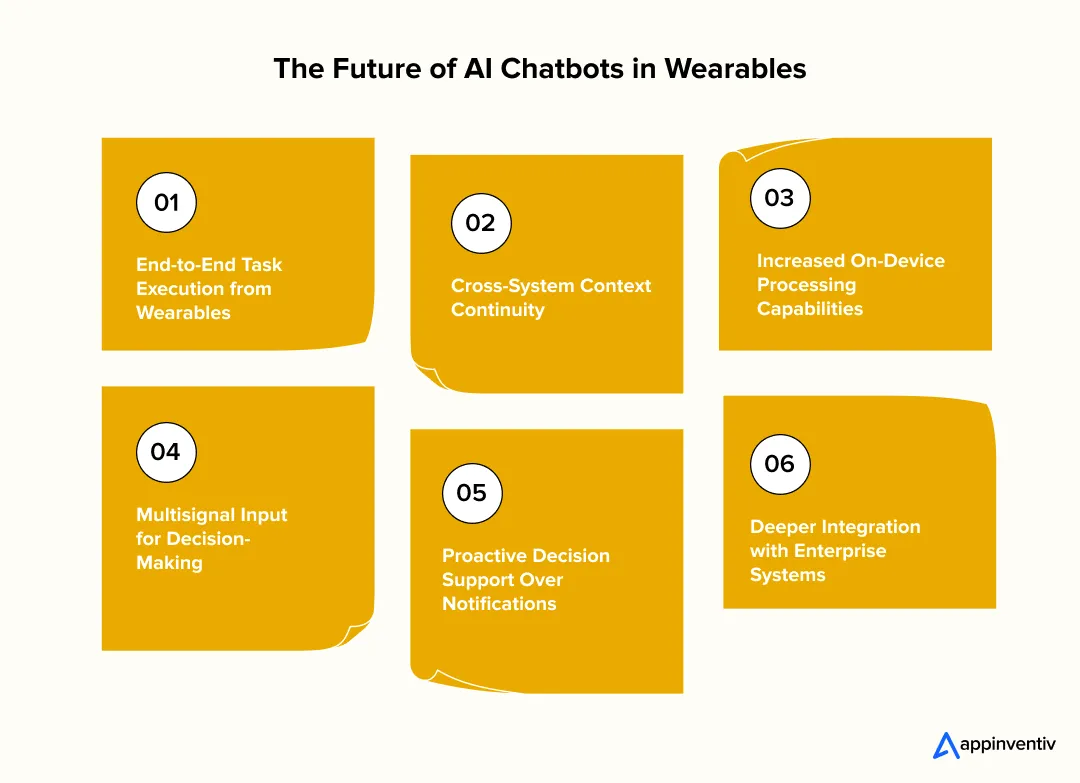
- End-to-End Task Execution from Wearables: Instead of just responding, systems will start handling actions end to end. Think approvals, updates, or triggering workflows directly from a quick interaction.
- Cross-System Context Continuity: Context will move across apps, tools, and enterprise systems, so users don’t have to restart interactions every time.
- Increased On-Device Processing Capabilities: Teams are pushing key logic closer to the wearable. This keeps responses fast, reduces dependency on connectivity, and supports better handling of sensitive data.
- Multisignal Input for Decision-Making: Decisions will factor in movement, behavioral patterns, and biometric data, not just what the user explicitly asks for.
- Proactive Decision Support Over Notifications: Instead of sending alerts, smart wearables with AI chatbots will start suggesting next steps based on context and past behavior.
- Deeper Integration with Enterprise Systems: The real value shows up when wearables connect with CRM, ERP, and internal tools, turning quick interactions into meaningful actions.
In the end, AI chatbot integration in wearables is moving closer to where decisions actually happen, right with the user, without needing constant input.
How Appinventiv Can Help You in Wearable App Development
By now, it’s clear this isn’t just about adding smarter features to devices. AI chatbot tech in wearables is becoming part of how decisions and actions happen in real time, whether it’s a quick approval, a health insight, or a workflow trigger. For enterprise teams, the real challenge is building systems that don’t just work in isolation but fit smoothly into existing tools, data pipelines, and user routines.
That’s where professional wearable app development services come in. Getting this right means thinking beyond the interface, focusing on architecture, context handling, and how these interactions scale across users and systems. Teams that approach it this way are the ones turning wearable experiences into something that actually drives operational value, not just engagement.
Our healthcare AI development services further support wearable products that handle sensitive health data, personalized insights, and real-time alerts. We build these capabilities around clear consent, secure data flows, reliable AI responses, and smooth connections with existing healthcare systems.
If you’re exploring how to bring AI chatbots into your wearable ecosystem, this is a good time to start shaping it with a team that’s already done it at scale.
FAQs
Q. What Are Chatbots in Wearables?
A. Chatbots in wearables are conversational systems built into devices like smartwatches or smart glasses, where interaction happens through voice or quick prompts instead of opening apps. You don’t really “use” them the traditional way. They respond as you go about your day.
What makes AI chatbots on wearables different is how they combine real-time signals such as movement, health data, and context with conversation. That’s why responses feel timely instead of generic.
Q. How Do Wearable Chatbots Improve Human-Machine Interaction?
A. The biggest shift is that interaction becomes almost invisible. You don’t pause to engage with a device; it fits into what you’re already doing.
That’s where the impact of AI chatbots in wearables shows up. Less effort, faster responses, and prompts that arrive when they actually make sense.
Q. How Do AI Wearable Chatbots Enhance User Experience?
A. Over time, the system starts picking up on patterns. It learns what you respond to and what you ignore.
These applications of AI chatbots in smart wearables focus on relevance. Instead of constant alerts, you get fewer but more meaningful interactions.
Q. What Is the Cost of Developing AI Chatbots for Wearables?
A. This usually depends on how far you want to go. A basic setup with limited features is very different from a system that handles voice, health insights, and enterprise integrations.
In most cases, building AI chatbot-powered wearables can range anywhere between $40,000 to $400,000. Teams that start with a clear scope tend to avoid overspending early and scale more effectively later.
Q. How Do AI Chatbots Work in Wearables?
A. At a simple level, the wearable handles quick inputs like voice or sensor data, while more complex processing happens in the background.
This is how AI chatbot integration in wearables works in practice. Fast actions stay on the device, while deeper tasks are handled without slowing the experience.
Q. Why Are AI Chatbots Better Than Traditional Automation in Wearables?
A. Traditional automation follows fixed rules. It works, but only within limits.
The advantages of AI chatbots in wearable technology come from adaptability. The system adjusts based on context and behavior, which makes it far more useful in real situations.
Q. What Are the Common Mistakes to Avoid When Deploying Chatbots in Wearables?
A. One common issue is trying to do too much too soon. Adding too many features without considering device limits often creates performance problems.
Another is ignoring context and relying too much on cloud processing. Addressing these challenges early in the integration of AI chatbots into wearables makes a big difference in how the final system performs.
Q. What are the advantages of AI chatbots in wearable technology?
A. AI chatbots in wearable technology offer numerous advantages, including hands-free, natural interaction that enhances user convenience. They provide real-time health monitoring with personalized insights, enabling proactive wellness management. These chatbots enhance productivity by providing instant access to information and enabling smart ecosystem control.
Q. How do AI chatbots in wearables handle compliance, security, and ethical concerns?
A. It mostly comes down to how data is handled from the start. Sensitive data, such as PII and PHI, is protected through encryption, controlled access, and clear user consent before anything is stored or processed. Teams also use audit logs to keep track of how data is used.
On the ethical side, the focus is on transparency. Users should know what’s being collected and have control over it. That includes simple privacy settings, consent aligned with local laws, and strong data governance to keep everything compliant without overcomplicating the experience.


Fast 2-minute response, fully NDA-protected.
How AI Chatbots Are Redefining Insurance Customer Service
Key takeaways: AI-powered insurance chatbots now support policy sales, claims, underwriting, fraud detection, and customer service, not just basic FAQs. Successful insurance chatbot development depends on seamless integration with policy, claims, CRM, billing, and other core insurance systems. Security, compliance, and AI governance should be built in from day one to protect customer data and…

Chatbot Integration With CRM - Benefits, Process, Features, Costs
Key takeaways: Integrating chatbots with your CRM automates routine tasks, delivers instant, personalized responses, and frees up human agents for complex issues, leading to faster resolutions and higher customer satisfaction. Every chatbot interaction is logged in the CRM, creating a unified customer view and generating actionable analytics that help refine marketing, sales, and support strategies.…
How to Build A Chatbot with Deep NLP?
Earlier,chatbots used to be a nice gimmick with no real benefit but just another digital machine to experiment with. However, they have evolved into an indispensable tool in the corporate world with every passing year. Developing and maintaining a chatbot is, of course, a time, effort and money draining job. Yet, compelling businesses, new and…














