
























The AI ROI Crisis: Why Enterprises Are Struggling to Prove Value and How to Fix It

 Share -



- 01Why AI Projects Fail to Deliver the Expected ROI?
- 02Prove AI ROI for Enterprises With These 5R Metrics
- 03Three Phases That Pave the Way to Value: Siloed, Structural and Systemic AI
- 04How to Maximise AI ROI: From Pilot to Production
- 05Generative AI ROI and Agentic AI ROI: Budget for Autonomy
- 06What’s Next Priority for Closing the AI ROI Gap?
- 07The Next AI Investment Needs a Clearer ROI Case
- 08Appinventiv: From AI Strategy to Measurable Returns
- 09FAQs

Key takeaways:
- AI ROI is a capital-allocation question. Boards want payback periods and P&L impact.
- AI ROI challenges rarely have a single cause. Data, legacy systems, use-case choice, ownership and stalled pilots compound each other.
- Choose two or three outcome metrics per use case, set the baseline first, and report in dollars.
- Make every further tranche of AI funding conditional on evidence of value.
The AI Investment Is Growing, but Where Are the Returns?
AI ROI for enterprises is now a capital-allocation question, not a technology one. Boards want payback periods, P&L impact and managed risk. Yet only about 25% of AI initiatives have delivered expected returns (Source: IBM). The question has moved from how much AI you can deploy to how much measurable value you can realise.
Not long ago, “we want more AI” was enough to unlock a pilot investment. That window has closed. Today, the conversation is “AI, but ROI first”. Once AI becomes capital allocation, boards ask sharper questions:
- What is the payback period?
- What business problem will it solve?
- How is AI contributing to the P&L?
- How does the business scale impact without scaling risk?
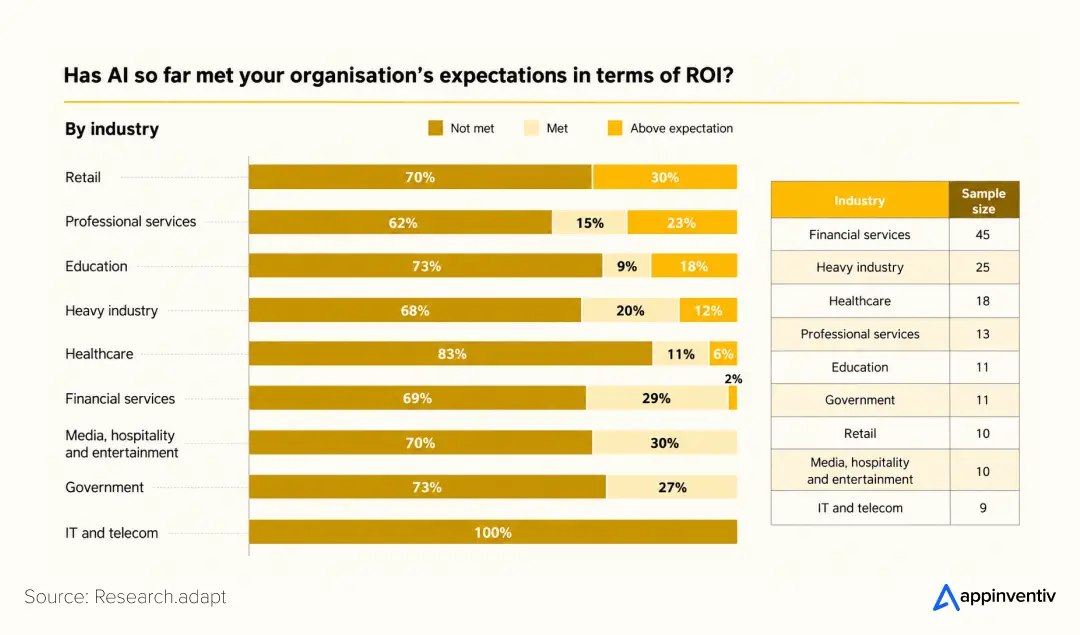
The challenge is already visible in Australian research. ADAPT’s 2025 research found that 72% of surveyed Australian CDAOs said AI had not met their ROI expectations. Reported shortfalls were also widespread across healthcare (83%), government (73%) and retail (70%).
The Reserve Bank of Australia’s 2025 research adds another dimension. Its survey of 105 businesses found that around two-thirds had adopted AI in some form, but nearly 40% reported only minimal use, mostly off-the-shelf assistants. Returns were described as mixed, and firms expect them to take time.
The issue is not that AI cannot create value. The problem is that many enterprise AI ROI conversations still begin with the most uncertain choices: which model, which vendor, which long list of use cases. That approach is incredibly difficult to justify when most enterprises do not have a balanced “portfolio” of AI projects. The priority should be to close that gap before committing more capital.
Identify ROI gaps, prioritise high-value use cases, and build a practical roadmap for measurable AI returns.

Why AI Projects Fail to Deliver the Expected ROI?
AI projects rarely fail for one reason. Data, legacy systems, use case choice, ownership and scaling plans all feed one business case, and weakness in any of them drains returns. These AI ROI challenges are structural rather than technical, which is why fixing a single issue seldom changes the outcome.
Here are the five common barriers that can prevent AI investments from delivering measurable value:
Fragmented Data Creates an Enterprise Context Gap
A model only works with the context it can see. When customer, finance and operational data sit in separate systems with different definitions, AI produces confident answers nobody trusts, and the savings go on reconciliation.
Fix: Build a unified data layer with shared definitions and ownership, starting with the datasets your highest-value use case depends on.
Legacy Systems Push Up the Cost of AI Implementation
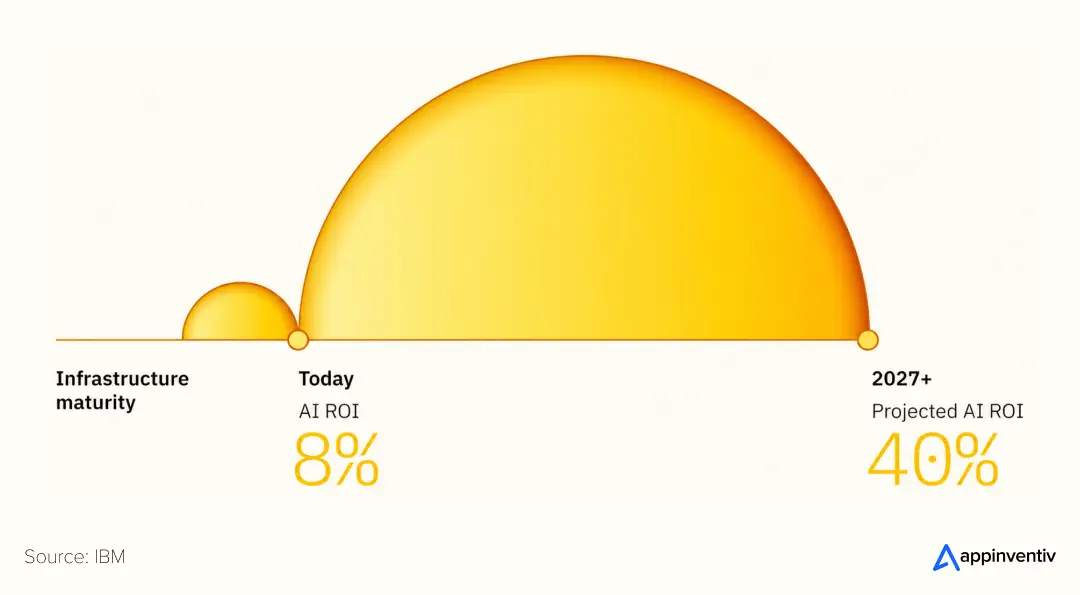
Many enterprises still run core ERP and CRM platforms built long before AI. Integrating modern AI capabilities around them can stall returns around 8% but by modernising legacy systems, the ROI bar can be substantially higher. For instance, once ERP is modernised, the projected ROI rises from 8 to 40%.
Fix: Modernise the systems your priority use case touches first, using APIs and integration layers rather than a costly full rip-and-replace.
Poorly Selected Use Cases Weaken the Business Case
Too many organisations deploy AI because they can, not because they should. Solving a $10,000 operational problem with a $500,000 custom generative AI solution is a fast track to negative ROI. When AI use cases aren’t aggressively tied to core business friction points, the resulting tools become expensive novelties rather than revenue drivers.
Fix: Score use cases on impact, feasibility and cost, then fund only those tied to a friction point and measurable target.
Unclear Ownership Makes ROI Difficult to Prove
Who owns the ROI of enterprise AI? When IT owns the model, operations own the process and finance owns the budget, nobody owns the result. When ownership is fragmented, tracking the financial impact becomes impossible. Without a named owner and an agreed baseline, value stays anecdotal.
Fix: Appoint one accountable business owner per use case, agree the baseline and target, and review results with finance every quarter.
The AI Pilot-to-Production Gap Adds Hidden Costs
Moving from a controlled pilot to full-scale production introduces massive, often unbudgeted costs. Pilot environments are clean and predictable. Production environments require robust cybersecurity strategy, continuous model monitoring, API maintenance, and change management training for staff. The AI pilot to production gap is where many promising business cases go to die, overwhelmed by the reality of enterprise-scale deployment.
Fix: Budget for production from day one: security, monitoring, integration and training. Release funding through stage gates tied to agreed targets.
Appinventiv’s AI experts run an assessment that traces each live or planned use case back to the data, integration and ownership gaps holding value back.
Prove AI ROI for Enterprises With These 5R Metrics
You cannot secure ongoing funding with vanity metrics. The board doesn’t care how many API calls your model made; they care about business impact. To shift the conversation, you need a robust AI ROI measurement framework.
Here are the five practical measures that connect AI performance to business outcomes.
| The 5Rs | Board question | Baseline to capture | How to measure AI ROI |
|---|---|---|---|
| Revenue growth | Is AI improving commercial outcomes? | Conversion rate, deal size | Track net-new revenue generated by AI-driven product recommendations, faster speed-to-market, or optimized pricing models. |
| Reduced cost | Is the cost of doing business changing? | Cost per case, labour cost per worker | Measure reductions in OpEx, decreased cost-to-serve per customer, or reduced vendor/software reliance. |
| Resource productivity | Is the business getting more done? | Output per FTE, cycle time | Look beyond “hours saved.” Measure the increase in throughput, faster resolution of customer tickets, or the ability to handle volume spikes without hiring. |
| Rapid time to value | How fast is it paying off? | Launch cycle, payback months | Calculate the payback period. How many months from the initial capital outlay until the AI solution breaks even? |
| Risk and quality | Better outcomes, no added exposure? | Error, rework, incident rates | Track error reduction rates, compliance breach prevention, and the cost avoided by catching anomalies early via AI monitoring. |
Choose two or three Rs per use case, set a baseline before launch and report in terms the board can act on.
Three Phases That Pave the Way to Value: Siloed, Structural and Systemic AI
AI value rarely arrives all at once. It often moves through three phases: siloed AI inside individual teams, structural AI built on shared data and platforms, and systemic AI embedded in core workflows. Knowing which phase you are in tells you what ROI to expect and what to fix next. Check out where does your enterprise stand today?
Siloed AI
One team builds a chatbot. Another trials a forecasting tool. Each works on its own terms, with its own data, vendor and definition of success. It is a sensible place to start, and it is also where most AI ROI stalls. Value stays local, costs get duplicated and nobody can add the wins into a number the board recognises.
Structural AI
The conversation shifts from “which tool?” to “what do all these tools stand on?” Shared data, integration layers, security controls and clear ownership get built once and reused. It is the least glamorous phase and often the one that pays back, because every later use case gets cheaper and faster.
Systemic AI
AI stops being a tool people open and becomes part of the workflow itself, in approvals, service, forecasting and collections. Outcomes are measured against a baseline and funding follows evidence. This is where the 5Rs reach the P&L, and where agentic systems can be considered with their full cost in view.
The RBA’s findings suggest many Australian firms sit in the first phase, with piecemeal adoption and general-purpose assistants. Moving up is less about buying or building more AI and more about connecting what already exists. Skipping the structural phase is where ambitious programs stall.
Shadow AI: A Risk Across All Three Phases
Before advancing from Siloed to Structural AI, enterprises must address Shadow AI – the unsanctioned use of third-party AI tools and personal accounts by employees seeking quick fixes.
It can undermine ROI for five reasons:
- Invisible value: Gains from unapproved tools never reach the P&L, so ROI is understated while the risk goes unrecorded.
- Data exposure: Customer or commercial data pasted into public tools can breach contracts and Privacy Act 1988 obligations.
- Duplicate spend: Teams buy overlapping licences, which inflates the cost of AI implementation.
- Unchecked quality: With no testing or monitoring, errors and rework go uncounted.
- No path to scale: Useful experiments stay stuck in the siloed phase.
How to Maximise AI ROI: From Pilot to Production
AI pilot-to-production success depends on operational readiness, not model performance alone. It means if you need to maximise AI ROI, you must start with a business case, fix foundations, design for adoption and scale only what proves out.
Start With a Business Case, Not a Model
Begin with a question: what is the business trying to improve? Whether you are aiming for high generative AI ROI (automating content and code) or exploring agentic AI ROI, the technology must serve the business case.
Fix the Foundations That Hold Back AI Value Realisation
You cannot build an intelligent enterprise on broken foundations. Before scaling, aggressively audit your data pipelines, modernise necessary ERP elements, and ensure your cloud infrastructure can handle the compute demands securely.
Build for Adoption, Not Just Deployment
A perfect algorithm with a 0% adoption rate has an ROI of zero. Change management is just as critical as technical deployment. Invest heavily in upskilling your workforce so they understand how AI can support their work, rather than an obscure IT tool forced upon them.
Scale What Works and Reassess What Doesn’t
The AI pilot-to-production decision should depend on evidence, not momentum. Before expanding a pilot, assess:
- Business value: Has the initiative improved the agreed metrics?
- Total cost: Do the economics still work at higher volumes?
- Operational readiness: Can existing systems and teams support it?
- Risk: Are security, privacy and oversight controls appropriate?
- Repeatability: Are results consistent beyond the original test environment?
The goal is not to scale every successful experiment. It is to scale initiatives whose benefits remain credible under real operating conditions.
Generative AI ROI and Agentic AI ROI: Budget for Autonomy
Generative AI ROI tends to show up first in drafting, summarising and knowledge work. Agentic AI ROI is harder, because greater autonomy adds integration, monitoring and risk-management costs.
Gartner predicts more than 40% of agentic AI projects will be cancelled by the end of 2027 because of unclear business value, escalating costs or inadequate risk controls.
For a closer comparison, check out our detailed blog agentic AI vs generative AI in Australia.
What’s Next Priority for Closing the AI ROI Gap?
To close the AI ROI gap and translate investment into impact, businesses must:
- Tie AI investments to measurable business outcomes.
- Fix data and integration gaps before scaling.
- Prioritise use cases with a credible payback case.
- Assign clear ownership and governance.
- Release further funding based on evidence of value.
The Next AI Investment Needs a Clearer ROI Case
Before committing the next AUD, leaders should define the outcome, count the full cost and tie funding to proven value. That discipline stops the board paying twice, once for the pilot and again for the rework, and gives the business a repeatable way to scale what works.
Before approving further investment, leaders must make three non negotiable questions:
- Define the business outcome and set a baseline. No baseline, no ROI.
- Account for full implementation and operating costs. Include data, integration, change management, monitoring and risk controls.
- Make further investment conditional on evidence of value. Release funding in stages against agreed metrics.
For enterprises, overcoming the AI ROI crisis starts with making these decisions part of the investment process, rather than treating measurement as a reporting exercise after deployment.
Appinventiv: From AI Strategy to Measurable Returns
Realising ROI requires the right partner. At Appinventiv, we bridge the gap between AI hype and AI reality. From strategic AI consulting and data engineering to seamless enterprise integration and deployment, we help organisations identify the barriers holding back their AI ROI.
In our 11+ years of APAC delivery experience, we have deployed over 3000+ digital assets, transformed 500+ legacy processes and successfully delivered 300+ custom AI solutions. Our 5+ delivery centres across the nation support clients from capital cities to regional and remote operations, including software that keeps working offline.
Looking to measure where your AI investment stands and build a roadmap that actually delivers to your bottom line? Book an AI investment assessment with us. We will identify the data, integration and ownership barriers standing between your current spend and measurable value.
FAQs
Q. How quickly can organisations see ROI from AI?
A. Organisations may see AI ROI within 2 – 3 months when the use case is focused, the data is ready, and the solution fits existing workflows. More complex enterprise implementations can take 6 – 12 months or longer to deliver measurable financial returns. The timeline depends on implementation costs, employee adoption, integration effort, and how clearly success is measured.
Q. How do you measure the ROI of AI implementation?
A. Set a baseline before launch, choose two or three metrics tied to one business goal and compare results with a control group or prior period. Report outcomes in dollars, days or risk reduction. On average, revenue and collection metrics can move within eight to 12 weeks.
Q. Why do AI projects fail to deliver expected returns?
A. AI projects often fail to deliver expected returns due to a mix of fragmented data, legacy integration costs, weak use cases, unclear ownership and underestimated production costs.
Q. How can enterprises move AI pilots into production?
A. Plan for production from day one by naming a business owner, budgeting for integration, security and support, and defining the metric that triggers scale-up. Fix the data and system constraints under that specific use case first. Then use stage gates so only pilots that beat their baseline receive more funding.
Q. How should government agencies measure AI ROI?
A. Government agencies can measure value through service delivery time, cost per case, processing accuracy, staff capacity, accessibility and compliance outcomes. They should also account for privacy, security, transparency, human oversight and public value. Faster processing alone is not enough if service quality or accountability declines.
Q. What is the ROI of enterprise AI automation?
A. The ROI of enterprise AI automation is the financial value gained through lower operating costs, faster workflows, fewer errors, and improved productivity compared with the total cost of implementation and ongoing operations. Returns depend on the use case, integration effort, employee adoption, and whether time savings translate into measurable business benefits.


Fast 2-minute response, fully NDA-protected.

Retrieval Augmented Generation in Australia: Architecture, Implementation and Cost
Key takeaways: RAG grounds LLM answers in approved content, improving reliability without retraining a model. Data quality and access permissions decide production outcomes more than the model. Indicative build costs run from AUD 70,000 to 700,000, driven by data and integrations. Measure value against a pre-deployment baseline, separating realised benefits from projected savings. A general-purpose…

The Multiplier Effect of AI Agents: The Rise of AI Swarms
Key takeaways: AI agent swarms coordinate specialized agents to solve complex problems that may be difficult for a single agent to handle effectively. More agents do not automatically mean better outcomes. Swarms deliver value when work can be divided, executed in parallel, and coordinated toward a shared objective. Enterprise readiness depends on governance. Clear accountability,…

AI Data Integration: How to Connect, Clean and Prepare Data for AI
Key takeaways: AI initiatives fail when fragmented, poor-quality data reaches models without sufficient context, controls or ownership. AI-ready pipelines must connect, clean, enrich, govern and continuously monitor data across its lifecycle. Real-time processing matters when AI decisions depend on current transactions, events, inventory or operational conditions. Data architecture should follow the AI use case, balancing…