



































Telemedicine App Development Cost: Features, Factors, and Pricing Guide

 Share -



- 01The Rise of Telemedicine Apps: A Booming Market
- 02How Much Does the Telemedicine App Development Cost?
- 03Factors Affecting the Telemedicine App Development Cost
- 04Unseen Expenses in Telemedicine App Development
- 05Developing an MVP: Optimizing the Cost of Telemedicine App Development
- 06Telemedicine App Cost Optimization Strategies
- 07Pricing Breakdown by Telemedicine App Development Phase
- 08Feature-Wise Telemedicine Mobile App Development Cost
- 09Developing a Telemedicine App With vs Without AI Features
- 10Custom Telemedicine App Development Cost vs Off-the-Shelf App
- 11Revenue Models That Help Recover Your Telemedicine App Development Cost
- 12Measuring the ROI of Telemedicine App Development
- 13How Appinventiv Builds HIPAA-Ready Telemedicine Apps Within Budget
- 14FAQs

Key Takeaways
- A custom telemedicine app can cost anywhere from $40,000 to $100,000 for a basic version, up to $100,000 to 300,000+ for a feature-rich, complex solution.
- The final cost of telehealth app development depends on the feature set, platform, team location, development hours, tech integrations, and compliance requirements.
- Beyond development, hidden or ongoing costs like cloud hosting, maintenance, regulatory compliance, and marketing/user acquisition must be budgeted from day one.
- Launching an MVP helps you validate your idea with essential features and control costs before scaling to the full-feature product.
- Strategic choices—such as focusing on essential features first, leveraging cross-platform frameworks, and engaging cost-effective development regions—can optimize cost without sacrificing quality.
When Teladoc Health launched its telemedicine platform, few expected it to conduct 50 million virtual consultations in 2024 alone. As more healthcare organizations invest in virtual care, understanding the telemedicine app development cost has become a priority for business leaders planning similar platforms.
The success of Teladoc, Amwell, and MDLIVE shows that digital healthcare has become a core part of modern care delivery.
Patient demand continues to grow. A study found that 73% of patients preferred telehealth for prescription refills, 45% for minor but urgent issues, and 43% for mental health visits. Rising patient expectations, physician shortages, AI adoption, remote monitoring, and government-backed reimbursement policies continue to drive telemedicine adoption.
For entrepreneurs and healthcare providers, the focus has shifted from why to invest in telemedicine. Development expenses vary based on telemedicine app features, security requirements, integrations, and platform complexity.
A basic telemedicine app may cost between $40,000 and $100,000. A feature-rich, AI-powered telemedicine platform can cost $100,000 to $ 300,000 or more.
This guide breaks down the cost of telemedicine app development, including hidden expenses, cost-optimization strategies, and monetization considerations. We will also examine the market growth shaping telemedicine app development and the competitors operating in this fast-growing sector.
Patient expectations have shifted permanently. Delaying your platform strategy risks losing future healthcare consumers.

The Rise of Telemedicine Apps: A Booming Market
What was once considered a backup option for in-person visits has now become a cornerstone of modern healthcare. Telemedicine apps are not just filling gaps in accessibility. They are redefining how, when, and where people receive medical care. The industry has witnessed an unprecedented shift, with virtual healthcare evolving beyond basic video consultations to AI-powered medical diagnostics, remote patient monitoring, and personalized treatment plans.
The market’s growth is staggering. As per a report by Grand View Research, the global telemedicine market is expected to surpass $514.2 billion by 2033, driven by rising demand for instant, affordable, and specialist care. The future of telemedicine lies in advanced telehealth EHR integration that enables healthcare providers to access comprehensive patient histories during virtual consultations.
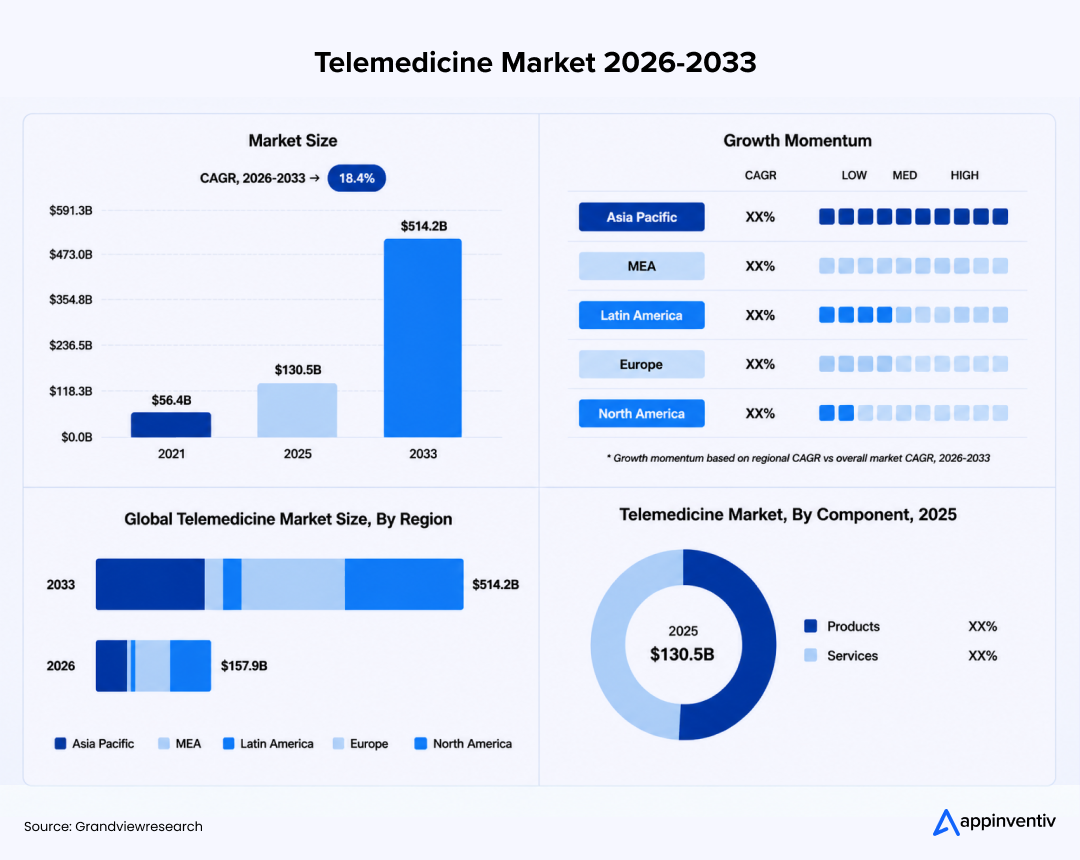
The push for hybrid healthcare models, where digital and in-person care work seamlessly together, further accelerates adoption. Meanwhile, insurance companies and healthcare systems are integrating telehealth into long-term care strategies, ensuring its permanence in the industry.
Beyond convenience, telemedicine addresses critical issues like physician shortages, chronic disease management, and healthcare costs. The next wave of growth will be fueled by AI, wearable tech, and real-time health analytics, making virtual healthcare not just an alternative but a preferred choice for millions. As innovation continues, businesses entering this space must focus on scalability, compliance, and user experience to stand out in this dynamic landscape.
How Much Does the Telemedicine App Development Cost?
The cost to develop a custom telemedicine app ranges from $40,000 to $300,000, depending on app complexity, UI/UX design, prototyping, developer location and hourly rates, chosen platform, and feature set. The more advanced the app, the higher the development cost.
Cost Breakdown by Platform Complexity
| App Type | Cost | Time Frame |
|---|---|---|
| Simple App | $40,000 to $70,000 | 2-3 Months |
| Medium Complex App | $70,000 to $100,000 | 3-6 Months |
| Highly Complex App | $100,000 to $300,000 | 9+ Months |
To help you understand the costs better, we have categorized the telemedicine apps based on their complexity and have included the time frame and costs of the development for the same.
Let us summarize the telemedicine app cost with an infallible formula:
Total Telemedicine App Development Cost = Total Number of Hours Taken to Complete App Development Processes X Hourly Rate of Developers
Now that you have a rough idea of the telemedicine app development cost, let us move ahead and discuss various factors that influence it.
Factors Affecting the Telemedicine App Development Cost
To apprehend the precise cost of a telemedicine app, you must understand the various factors that will affect it. Starting from an extensive feature list to the location and hourly development rates, the factors can influence the price of your app. Apprehending the factors logistically can help you make better monetary decisions while simultaneously alleviating the risks.
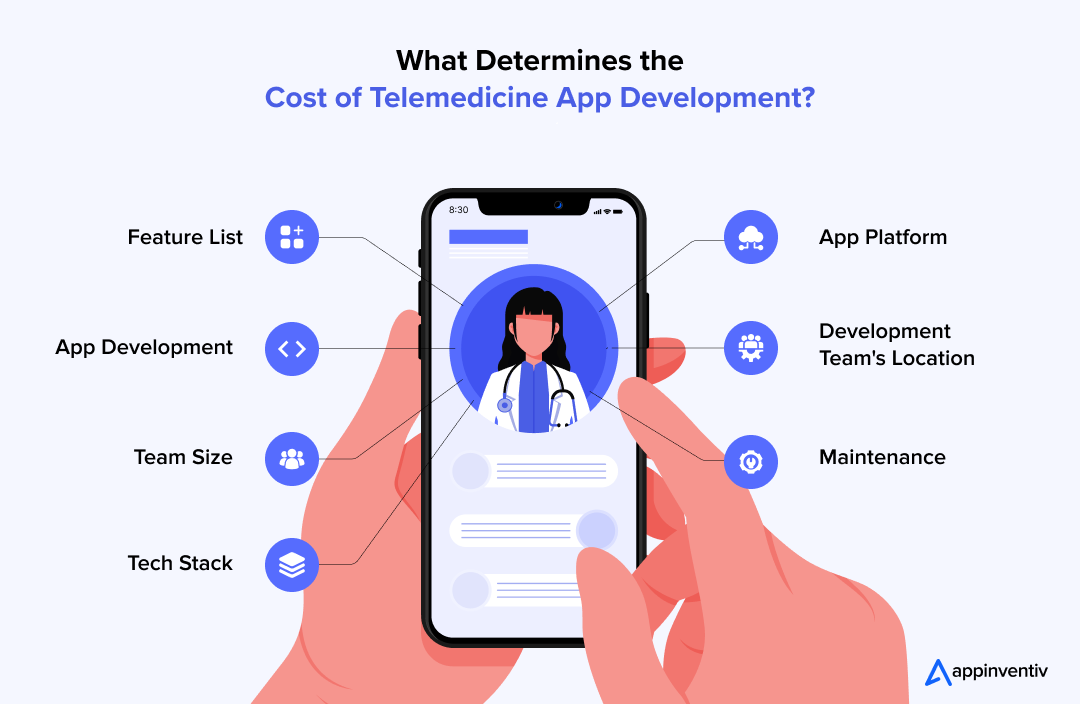
Feature List
The overall cost of a telemedicine app can be affected by the number of features it supports. For instance, a simple telemedicine app with a basic feature list and a nominal admin panel can cost you around $40,000 to $55,000. Increasing the number of telemedicine app features and functionalities can affect the overall gross price of telemedicine apps. Simply put, the more features integrated into the app, the more the cost associated with it.
A complex app with the highest functionalities and an extensive feature list can help put your business ahead in the digital space and will be worth all the investment.
App Platform
If you wish to develop a telemedicine platform for doctors, the underlying iOS or Android platform can affect its overall cost. The cost of developing an Android app is more than iOS, considering the former’s wide user base. To keep the budgets optimized, we usually recommend starting with a development for a single platform. As the app gains traction in the market, you can then switch to a cross-platform app custom to your requirements.
App Development
Telemedicine app development costs can be calculated based on the coding hours. The hourly rate of the developers, combined with the number of coding hours, can help you understand the development cost. In addition, the type of development team can also affect the overall cost of telemedicine software.
Here is a rough estimation of the telemedicine app development costs based on the type of team hired:
| Type of the Team | Estimated Telemedicine App Development Cost (Approx.) |
|---|---|
| In-House Team | $1500,000- $180,000 |
| Local App Development Company | $200,000- $230,000 |
| Outsourced App Development Company | $65,000- $80,000 |
| Freelancers | $35,000- $40,000 |
Analyzing the table can offer you a quick idea of how outsourcing a development team is your best option, considering an optimized budget. Outsourcing an experienced app development company can provide a full-fledged telemedicine app with multiple functionalities and a seamless interface.
Geographical Cost Variations in Telemedicine App Development
The location of the hired healthcare application development team also influences the overall telemedicine app development costs. The table below will offer you a preliminary idea of the cost of development in various regions of the world:
| Development Region | Estimated Cost (Approx.) |
|---|---|
| US | $190,000- $250,000 |
| UK | $190,000- $200,000 |
| Australia | $150,000- $155,000 |
| Western Europe | $140,000- $160,000 |
| Eastern Europe | $70,000- $100,000 |
| Asia | $50,000- $300,000 |
Team Size
Team size is another factor that shapes the custom telemedicine app development cost, since every added specialist adds billable hours. A professional team of project managers, developers, designers, and quality analysts can deliver an app that stands out from competitors, and while a full-fledged team raises the cost, it also lowers delivery risk.
Developing a white-label telemedicine app requires a team of:
- 1 Project Manager
- 2 Backend Developers
- 2 iOS/Android Developers
- 1 Designer
- 1-2 Quality Analysts
Maintenance
The maintenance costs for an app can be compiled at the very last stage and added to the overall development cost. For instance, maintenance costs can include:
- Upgrading the app to support a new platform.
- Updating apps based on new requirements.
- Changing marketing trends.
For all the parameters that require maintenance, the cost varies depending on the telemedicine application engineers hired on your end.
Tech Stack
The associated tech stack is an important factor that influences the overall telemedicine app cost. A robust tech stack that has the power to handle a large user base while offering them an optimum user experience is the need of the hour. Thus, the more technologies the app implements, the more the associated cost.
Now that you have gained insight into the various factors that affect the cost of telemedicine apps, let us analyze the unseen or hidden expenses involved in developing a telemedicine application.
Unseen Expenses in Telemedicine App Development
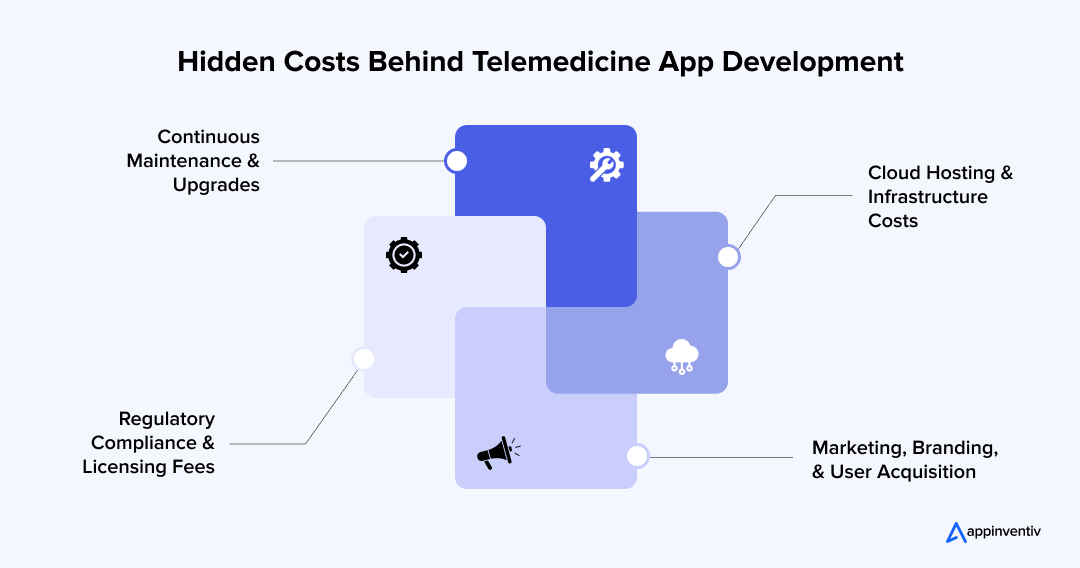
Developing a telemedicine app extends beyond initial design and coding; various hidden costs arise throughout its lifecycle that significantly impact the total investment. Awareness of these costs upfront helps businesses plan a sustainable budget and avoid unexpected financial crunches.
Continuous Maintenance and Upgrades
Estimated Cost: $15,000-$25,000+ annually
Maintaining a telemedicine app requires regular updates to fix bugs, enhance security, and introduce new telemedicine app features based on evolving user needs. As technology advances and healthcare regulations change, frequent updates ensure compliance and optimal performance.
Additionally, continuous monitoring, troubleshooting, and system optimizations are necessary to provide a seamless user experience, making maintenance a recurring and unavoidable expenses.
Cloud Hosting and Infrastructure Costs
Estimated Cost: $500-$5,000+ monthly
Reliable hosting is crucial for a telemedicine app to function smoothly, ensuring high-speed performance, data security, and scalability. Cloud service providers like AWS, Google Cloud, or Microsoft Azure charge based on storage, bandwidth, and processing power, meaning costs can rise with increasing user traffic.
Additional expenses may include cybersecurity measures, data backups, and redundancy solutions to prevent downtime and protect sensitive patient information.
Marketing, Branding, and User Acquisition
Estimated Cost: $2,000-$20,000+ monthly
Attracting users and gaining visibility in the crowded telehealth market requires a well-planned marketing strategy. This includes SEO efforts, paid advertising, influencer partnerships, and content marketing to reach potential patients and healthcare providers.
Beyond initial promotions, ongoing engagement through email campaigns, app updates, and loyalty programs is essential to retain users, making marketing an ongoing financial commitment.
Regulatory Compliance and Licensing Fees
Estimated Cost: $10,000-$50,000+ initially
Ensuring adherence to strict healthcare regulations like HIPAA, GDPR, and other regional laws involves substantial legal and licensing expenses. These costs cover compliance audits, security certifications, and legal consultations to prevent potential penalties.
Additionally, integrating third-party medical databases, e-prescription systems, and telecommunication services may require licensing fees, further adding to the overall expenditure.
Also Read: Why Telehealth Security is Non-Negotiable for Patient Trust and How to Achieve It
Developing an MVP: Optimizing the Cost of Telemedicine App Development
MVP for a telemedicine app is the app’s version with the most prominent features but doesn’t have all the advanced-level features. The basic idea behind opting for telemedicine app MVP development is to determine how multiple app users interact with your app and accept its overall concept. This will help you to get a clear idea of the audience before investing more money into scaling the MVP into a full-fledged application.
MVPs can allow you to have a good look at the app’s worth to your users without having to spend additional bucks. This is one of the most preferred ways for overall cost optimization of a telemedicine app.
Building an MVP gets you a working prototype of the app, which is test-ready. This development stage includes:
- A ready-to-implement design that includes all the key features
- The software architecture
- An app that real users can test
Let us look into the hours-wise breakdown of the time it usually takes to build the MVP of a telemedicine application.

Creating an MVP usually takes up to six weeks and costs a ballpark figure of $40,000 or more.
Once you have tested your MVP, it’s time to upgrade it into a full-fledged app. Here, the cost is dependent on several elements:
- App versions – doctor, patient, hospital, admin, etc.
- Deployment platform – mobile, desktop, both
- Technologies used – AI, Blockchain, IoT, etc.
- The complexity of the design
- The complexity of the feature-set
- The location of the development agency
A basic version of the application which consists of a simple design, no technology integration, mobile deployment, and three basic versions – a doctor app, a patient app, and an admin panel will cost you around $40,000 to $80,000.
If you decide to build a complex feature-heavy telemedicine application that has technological incorporation and is designed to support multiple features, the development costs can be around $150,000- 300,000. And the average development time can be between 3 to 12 months.
Prioritize high-value capabilities first to avoid budget overruns and delayed product launches.

Telemedicine App Cost Optimization Strategies
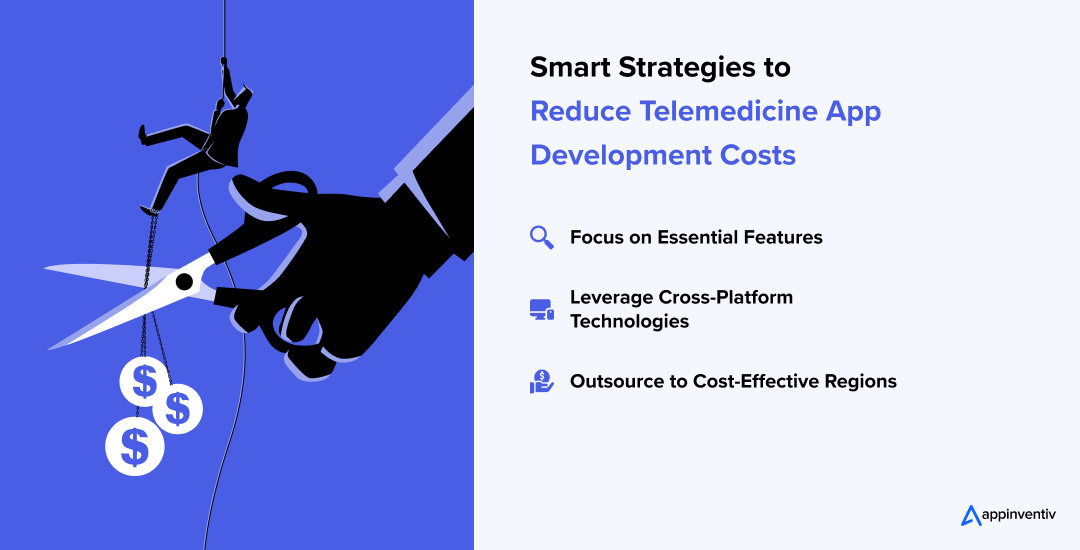
Developing a telemedicine app demands a well-planned approach to manage costs effectively while maintaining high quality and regulatory compliance. Beyond launching an MVP, several other strategies can help businesses minimize expenses. Here’s how:
Focus on Essential Features
Avoid adding excessive functionalities that can drive up development costs. Prioritize must-have features such as video consultations, appointment scheduling, secure messaging, and payment integration. Advanced features can be introduced later based on user demand and business growth.
Leverage Cross-Platform Technologies
Developing separate native apps for iOS and Android can be costly. Using cross-platform frameworks like Flutter or React Native allows a single codebase to work across both platforms, reducing development time, maintenance efforts, and overall expenses while ensuring a smooth user experience.
Outsource to Cost-Effective Regions
Hiring an in-house team in high-cost regions can strain your budget. Outsourcing to experienced development teams in cost-effective areas like Eastern Europe, India, or Southeast Asia can offer high-quality results at a fraction of the cost. Many of these firms specialize in healthcare technology and ensure compliance with regulations like HIPAA and GDPR.
Pricing Breakdown by Telemedicine App Development Phase
Splitting the cost of telehealth app development by phase shows where the money goes and which stages you cannot afford to cut. The figures below assume a mid-complexity build of about $100,000, and for the full build process, see our telemedicine app development guide.
| Phase | Share of Budget | Estimated Cost | Timeline |
|---|---|---|---|
| Discovery, Market, and Compliance Research | 8–10% | $5,000–$15,000 | 2–4 weeks |
| UI/UX Design | 10–15% | $8,000–$25,000 | 3–6 weeks |
| Development and Integrations | 45–55% | $25,000–$150,000 | 3–6 months |
| Testing and QA | 15–20% | $6,000–$40,000 | 3–6 weeks |
| Deployment | 2–5% | $2,000–$8,000 | 1–2 weeks |
| Maintenance (Yearly) | 15–25% of build cost | Ongoing | Ongoing |
Discovery and Compliance Research ($5,000–$15,000)
This phase defines who the app serves (general consultations, mental health, or specialty care) and which regulations apply: HIPAA and HITECH in the US, GDPR in the EU, and FDA rules if any feature qualifies as a medical device. Skipping it is the most expensive saving you can make, because compliance gaps found after launch mean rebuilding core architecture.
UI/UX Design ($8,000–$25,000)
Design costs scale with the number of user roles, since patient, doctor, and admin interfaces each need their own flows. Accessibility for older or less tech-savvy patients and responsive layouts across devices add hours here but cut drop-off later.
Development and Integrations ($25,000–$150,000)
This is where most of the budget goes: authentication, real-time video, secure messaging, and third-party APIs like Twilio for video, Stripe for payments, and Google Calendar for scheduling. HL7 and FHIR standards govern how your app exchanges records with EHR systems, while the platform itself needs to be built as a HIPAA-compliant app from the first sprint, not patched for compliance before launch.
Also Read: EHR Optimization Guide to Make Your Healthcare Offering Efficient
Testing and QA ($6,000–$40,000)
Comprehensive mobile app testing strategies cover unit, integration, security, and usability testing. Healthcare apps sit at the higher end of this range because penetration testing and PHI-handling checks are mandatory rather than optional.
Deployment and Maintenance ($2,000–$8,000, Then 15–25% Yearly)
Once tested, you deploy it on Google Play Store and Apple App Store, then shift into maintenance: bug fixes, security patches, and compliance updates. Real-time monitoring through Google Analytics or Mixpanel shows where users stall, but make sure PHI never reaches analytics tools that have not signed a BAA.
Feature-Wise Telemedicine Mobile App Development Cost
Features decide most of your custom telemedicine app development cost, because each one adds design, engineering, testing, and often compliance work. The ranges below are Appinventiv estimates for a US-market, HIPAA-ready build with a blended outsourced team, so treat them as planning numbers rather than quotes.
| Tier | What It Includes | Estimated Cost |
|---|---|---|
| Basic | Patient and doctor apps, scheduling, video calls, chat, payments, profiles, MFA | $40,000–$70,000 |
| Advanced | Basic tier plus EHR integration, e-prescriptions, virtual waiting room, insurance verification | $70,000–$150,000 |
| Enterprise-Grade | Advanced tier plus RPM/IoT devices, AI symptom checker, clinical note dictation, multi-language support | $150,000–$300,000+ |
Core Features and Their Cost
The core set is what every telemedicine app needs on day one, and it typically accounts for $35,000–$60,000 of the budget.
| Feature | Estimated Cost |
|---|---|
| Registration and Login (With MFA) | $3,000–$8,000 |
| Profile Management | $3,000–$6,000 |
| Search and Filters | $4,000–$10,000 |
| Video Conferencing | $10,000–$30,000 |
| HIPAA-Compliant Text Chat and Voice Calls | $10,000–$30,000 |
| Calendar and Scheduling | $4,000–$10,000 |
| Payments | $5,000–$15,000 |
| Notifications | $2,000–$5,000 |
Registration: Patients sign in through email, Google, or Facebook. Because the app holds PHI (protected health information, meaning any health data tied to an identifiable person), we recommend adding multi-factor authentication to the application from launch.
Video conferencing: This is the single biggest line item in the core set, because poor video quality means a physician cannot assess what the patient is showing. Our engineers use WebRTC and RTMP streaming protocols, and every third-party video vendor must sign a BAA (Business Associate Agreement, the contract HIPAA requires from any vendor that touches PHI).
Payments: A custom payment mechanism raises cost, while third-party gateways keep it lower. We usually integrate payment gateways in your app such as PayPal, Stripe, and Braintree, which are proven at healthcare transaction volumes.
Notifications: Appointment reminders, missed-call alerts, and payment updates run on Firebase Cloud Messaging. Keep PHI out of the message preview, since push notifications appear on locked screens.
Advanced Features and Their Cost
Advanced features are where budgets diverge most, because they depend on outside systems such as EHR vendors, pharmacies, insurers, and medical devices.
| Feature | Estimated Cost |
|---|---|
| EHR/EMR Integration | $10,000–$50,000+ |
| Remote Patient Monitoring (IoT) | $20,000–$100,000+ |
| AI-Powered Symptom Checker | $25,000–$80,000 |
| e-Prescriptions and Pharmacy Integration | $10,000–$30,000 |
| Insurance Verification and Claims | $15,000–$40,000 |
| Multi-Language Support and Live Captions | $5,000–$20,000 |
| Virtual Waiting Room | $5,000–$12,000 |
| Teletherapy Module | $10,000–$25,000 |
| Family and Caregiver Access | $4,000–$10,000 |
| Emergency SOS | $5,000–$15,000 |
| HIPAA and Data Security Setup | $5,000–$25,000 |
EHR integration: Costs range widely because Epic, Oracle Health (formerly Cerner), and smaller EHRs each expose different APIs and approval processes. A single read-only FHIR connection sits near the low end, while two-way sync across multiple systems pushes past $50,000.
Also Read: EMR Integration in Healthcare: Benefits, Features, & Costs
Remote patient monitoring: Each connected device, whether a BP cuff, glucometer, or wearable, needs its own integration and data validation, which is why RPM shows the widest range in the table.
AI-powered symptom checker: The tool collects symptoms and suggests the right specialist, but it should guide triage rather than diagnose. Any model trained on PHI must use de-identified data, and a checker that moves toward diagnosis may fall under FDA Software as a Medical Device (SaMD) rules, which adds regulatory cost.
Also Read: 11 ways AI is transforming the telemedicine sector
Emergency SOS: The feature should route users to emergency services rather than position the app as an emergency provider, and your legal team should review the in-app disclaimer before launch.
Developing a Telemedicine App With vs Without AI Features
Adding AI typically raises the build budget by $25,000 to $100,000+, depending on whether you call a third-party model through an API or train your own. The bigger question for leadership is whether the AI feature saves enough clinician time to pay for its compliance overhead.
| Factor | Without AI | With AI |
|---|---|---|
| Estimated Cost | $40,000–$150,000 | $80,000–$300,000+ |
| Timeline | 3–7 months | 6–12 months |
| Typical Features | Video, chat, scheduling, payments, EHR sync | Symptom triage, clinical note dictation, visit summaries, vitals anomaly alerts |
| Compliance Scope | HIPAA Privacy and Security Rules, BAAs with cloud and video vendors | All of the above plus de-identified training data, BAAs with LLM providers, audit logs of every AI–PHI interaction, possible FDA SaMD review |
| Ongoing Cost | Hosting, maintenance, security updates | All of the above plus model monitoring, retraining, and per-call inference costs |
In our experience, the AI features that pay back fastest are administrative: dictation and automated visit summaries cut documentation time without making clinical claims. Diagnostic-leaning AI carries far more regulatory exposure, so we usually recommend keeping a clinician in the loop on every AI-suggested decision and launching that layer after the core app has proven adoption.
Custom Telemedicine App Development Cost vs Off-the-Shelf App
The cost to develop a custom telemedicine app is higher upfront, while an off-the-shelf or white-label platform costs less to start but charges you every month you use it. The right pick depends on how much your platform needs to differ from what competitors already offer.
| Factor | Custom Telemedicine App | Off-the-Shelf App |
|---|---|---|
| Upfront Cost | $40,000–$300,000+ | Low setup fee |
| Ongoing Cost | Hosting and maintenance (15–25% of build cost per year) | Per-provider or per-visit license fees that rise with scale |
| Time to Launch | 3–12 months | Weeks |
| Customization | Full control over features, workflows, and branding | Limited to what the vendor roadmap allows |
| EHR and Third-Party Integrations | Built to your systems | Only the vendor prebuilt connectors |
| Data Ownership | You own the platform and the data architecture | Data sits on vendor infrastructure under their terms |
| Compliance Control | You define security controls and sign your own BAAs | Depends on the vendor BAA and audit history |
Off-the-shelf makes sense for a single practice that needs virtual visits running quickly. For a health system or a digital health startup whose product is the platform, license fees and integration limits usually overtake the custom build cost within a few years, which is why most scaled players own their stack.
Having looked into the features of telemedicine platforms for doctors and patients, the next logical step would be to determine how you can monetize your telemedicine app.
Revenue Models That Help Recover Your Telemedicine App Development Cost
Telemedicine apps bridge the gap between patients and doctors. Still, we have to take a business perspective and share all the details on how you can attract monetary benefits from your app. Deciding on the monetization strategies also depends on the telemedicine app development costs.
Fees
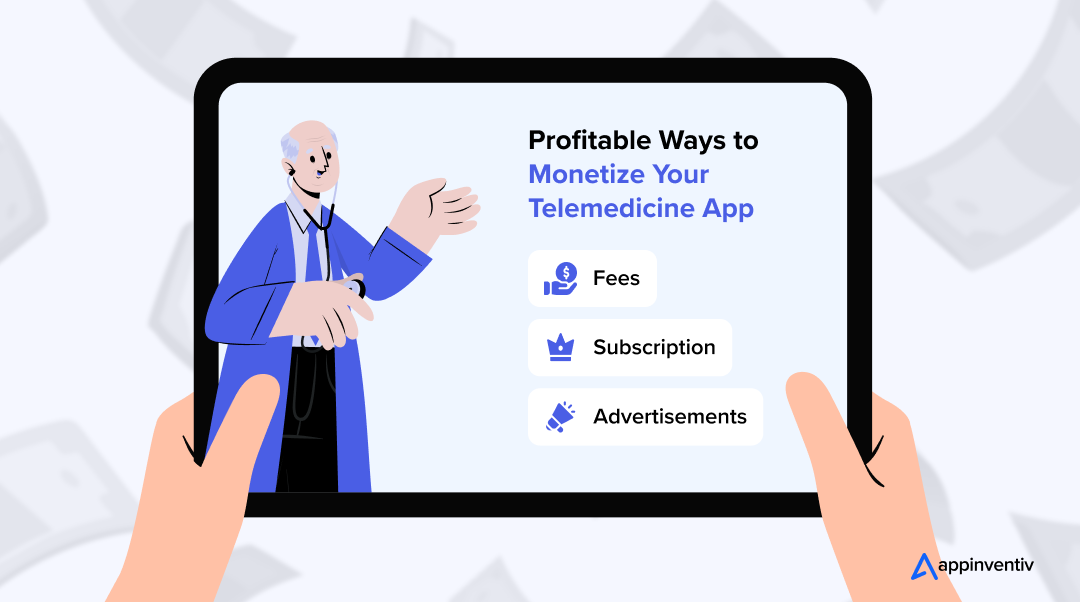
One of the most common ways of monetizing the telemedicine app is fees. In doctor on-demand app development, a revenue model is implemented where patients are charged a 25% fee to access features like doctor consultations. You can adopt a similar fee structure in your app to maintain a steady revenue stream while delivering essential healthcare services.
Subscription
You can also go with a membership model wherein the patients take a monthly subscription to the application and pay for accessing the different feature sets of the app at a discounted rate. Also, you can provide your product as a software-as-a-service where you can tie with corporations for their employees’ healthcare needs.
Advertisements
Usually, business owners offer their interactive app space for advertisements related to their niche. As soon as your app starts getting traction and retaining users, you can monetize with the help of generic advertisements displayed on your network.
With this, we have looked into the different facets of telemedicine platform costs. The only thing that remains is to enter the business.
Increasing compliance, infrastructure, and AI requirements continue pushing healthcare development budgets higher.

Measuring the ROI of Telemedicine App Development
Telemedicine software brings value beyond simple video calls. A good platform brings in more patients. It stops missed appointments and cuts down on paperwork. You can build steady monthly revenue through subscriptions and remote health tracking.
The software helps doctors find patients outside local areas. You can help more people without spending more money on office space. Automated tools speed up daily tasks. These facts help your company win back the build cost quickly.
Telemedicine ROI Snapshot
| ROI Driver | Business Impact |
|---|---|
| Virtual Consultations | More patients and higher revenue |
| Automated Scheduling | Less office paperwork |
| Digital Follow-Ups | Better patient loyalty |
| Subscription Plans | Steady monthly income |
| Remote Patient Monitoring | New care programs |
| Fewer Missed Appointments | Better doctor schedules |
How Appinventiv Builds HIPAA-Ready Telemedicine Apps Within Budget
At Appinventiv, we specialize in healthcare application development services, crafting innovative telemedicine solutions that deliver measurable RoI. Whether you need precise cost estimates, strategic feature integration, or insights into market traction, our team ensures a seamless development process tailored to your needs.
One of our success stories, Health-e People, revolutionized healthcare connectivity by unifying fragmented medical data. The app empowers users to manage their health records while contributing to advanced research for breakthrough treatments.
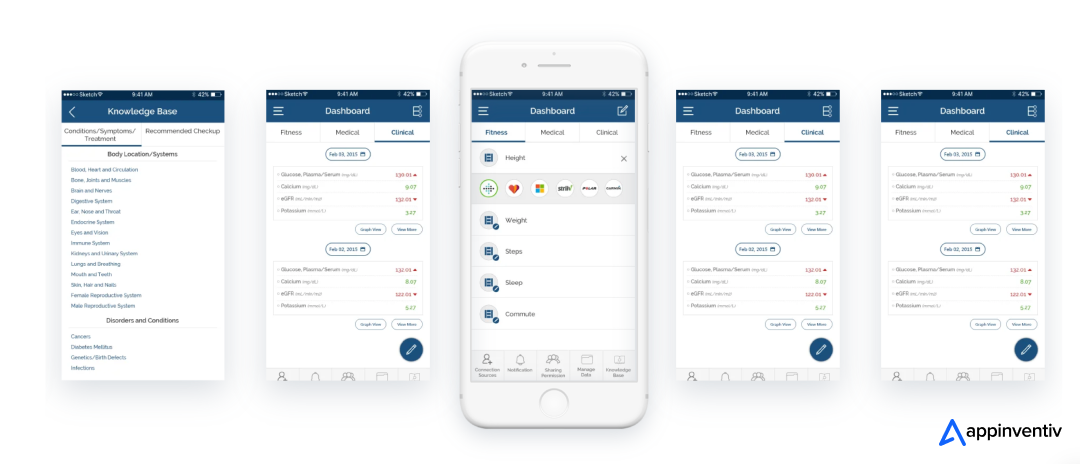
We created a solution that enhances patient care and scientific innovation by bridging gaps in the healthcare ecosystem. Similarly, we also worked on other healthcare projects like Soniphi and DiabeticU that justified our commitment to leveraging technology for better health outcomes.
By utilizing our comprehensive telemedicine app development services, the healthcare providers and startups can build future-ready digital solutions.
Share your telemedicine app idea, and we’ll transform it into a fully functional, high-performing solution.
Let’s collaborate to shape the next big thing in digital healthcare—contact us today!
FAQs
Q. What are the ongoing costs after launching a telemedicine app?
A. Launching is just the first step. Ongoing costs keep the app safe and running well. You will pay for cloud hosting, tech support, security checks, and regular updates. Features like video tools and EHR connections increase these numbers. Plan to spend 15% to 25% of your original build budget every year on maintenance.
Q. How to make a telemedicine app for doctors?
A. A telemedicine app for doctors can be made from scratch by deciding on the app platform. Moving forward with an interactive UI/UX design and integrating all the features, a dedicated app development company can help you choose the right tech stack and cater to regulatory health compliances.
Q. How much does it cost to develop a custom telemedicine app?
A. The telemedicine app development cost varies based on features and complexity. A feature-rich telemedicine app can range from $100,000 to $300,000, while a basic app with minimal features and a simple UI/UX typically costs between $40,000 and $100,000.
Q. What are the basic inclusions in the MVP of a telemedicine app?
A. An MVP of a telemedicine app consists of a mobile or a web platform, HIPAA Compliance, separate panels for the patient, doctor, and admin, integrated payment gateways, and video and text chat capabilities.
Q. What are some top telemedicine app benefits for patients and healthcare organizations?
A. Here are some of the top telemedicine app benefits for both parties:
For Patients:
- On-demand healthcare access
- Reduced medical expenses
- Faster doctor consultations
- Seamless chronic disease management
For Healthcare Organizations:
- Optimized operational efficiency
- Increased revenue opportunities
- Enhanced patient engagement
- Secure & compliant data management
Q. How do development timelines influence the cost of telehealth app development?
A. Timeline and cost move together because most of the budget is paid in team hours. Compressing a nine-month build into five months means adding parallel developers, which raises coordination and QA costs rather than saving money. Stretching a project out has its own cost, since requirements and compliance rules can change mid-build and force rework, so releasing the core app first and adding advanced features later keeps both timeline and spend predictable.
Q. What does HIPAA compliance add to telemedicine app cost?
A. Plan for roughly $5,000 to $25,000 for the initial HIPAA and security setup, covering encryption, access controls, audit logging, and a risk assessment under the HIPAA Security Rule. Hosting costs also rise because you need a cloud environment covered by a signed BAA, and recurring audits, penetration tests, and policy updates add to the yearly maintenance budget. This is a cost estimate, not legal guidance, so confirm your obligations with healthcare compliance counsel.
Q. Why are compliance costs rising when building telemedicine mobile apps?
A. Regulators are expanding what counts as health data and how it must be protected. HHS has proposed HIPAA Security Rule updates that would make controls such as MFA and encryption mandatory rather than addressable, state laws like Washington’s My Health My Data Act cover health data outside HIPAA’s scope, and the FTC Health Breach Notification Rule now reaches many health apps. For AI features, the EU AI Act classes most health AI as high-risk, and each of these adds documentation, testing, and legal review to the build.


Fast 2-minute response, fully NDA-protected.

Smart Ring App Development: BLE SDKs, Health APIs, and the Race for Connected Health
Key takeaways: The build path (a ring maker's API, a white-label ring or your own hardware) decides most of the budget. If last night's data is missing in the morning, people stop wearing the ring. One line of marketing copy can turn a wellness app into a medical device. Builds cost $50,000 to $500,000+, and…

Wearable Data Integration: Connecting Multiple Devices to a Unified Health Platform
Key takeaways: Device support should reflect the measurements your service needs, the people using it, and the decisions those readings inform. A unified health data platform must preserve source, timing, and measurement context while resolving duplicate records. Phone health platforms, manufacturer APIs, and direct device connections serve different integration needs. Clinical workflows require agreed review…

Sleep Tracker App Development: Features, Wearable Integration, AI, and Compliance
Key takeaways: Sleep tracking presents opportunities across consumer wellness, fitness, healthcare, employee wellness, senior care, and infant-care markets. Successful products combine actionable insights, wearable connectivity, user-friendly reports, privacy controls, and clearly differentiated experiences. HealthKit, Health Connect, and direct device APIs provide different data depths, costs, limitations, and maintenance requirements. AI supports sleep-stage estimation and personalization,…