









Smart Ring App Development: BLE SDKs, Health APIs, and the Race for Connected Health

 Share -


- 01What's driving the smart health ring market right now?
- 02What are the top smart ring health app development use cases?
- 03Should you build smart ring app hardware, or connect to an existing ring?
- 04How does a smart ring companion app actually work?
- 05How do you handle smart ring SDK integration and Bluetooth pairing?
- 06Which smart ring app development features matter in release one?
- 07Which integrations does a smart ring app need?
- 08How does AI-driven smart ring app development create insights users trust?
- 09What are the regulations and compliance requirements for smart ring health app products?
- 10How do you build a smart ring app, step by step?
- 11How much does smart ring app development cost?
- 12What are the biggest smart ring app development challenges?
- 13How can Appinventiv help you out?
- 14FAQs

Key takeaways:
- The build path (a ring maker’s API, a white-label ring or your own hardware) decides most of the budget.
- If last night’s data is missing in the morning, people stop wearing the ring.
- One line of marketing copy can turn a wellness app into a medical device.
- Builds cost $50,000 to $500,000+, and running the app for three years costs about as much again.
Smart ring app development is about turning a small sensor on someone’s finger into a product they’ll pay for every month. The ring itself is the easy part. After that, you have to pair with the ring and pull data off a tiny battery without draining it. Then the data has to be cleaned and scored, and the result has to reach someone who will actually do something with it.
In our experience, four things decide whether smart ring application development ships on time. Bluetooth, the data pipeline, the scoring models and compliance.
Bring us your build path, claims, and deadline, and get a scoped plan your board can act on.
What’s driving the smart health ring market right now?
A lot of this market comes down to one habit. People take their watch off at night to charge it, but they usually keep a ring on. And night is when resting heart rate, HRV and skin temperature are easiest to measure well. IDC expects smart ring shipments to climb 12.8% to 4.9 million units in 2026, while wristbands shrink.
Users are not the problem either. In a 2025 study in the Journal of Medical Internet Research, 78.4% of US wearable users said they’d share their data with a healthcare provider. But only 26.5% ever have. Why? Mostly plumbing. The numbers sit in a consumer app, and almost nobody has built the road from that app into a clinic’s systems.
The AMA ran its 2026 International Physician Survey with Medscape and asked 2,222 physicians in the US, Canada, the UK, France, Germany and Spain about wearables. 97% said they look at wearable data in some way. In no country did more than 6% have it built into clinical work.
So the benefits of smart ring app programs mostly come down to getting overnight data to someone who can use it. Who that person is depends on the use case.
What are the top smart ring health app development use cases?
Every use case has a different buyer and a different regulator.
| Use case | Who pays | Revenue model | Regulatory weight |
|---|---|---|---|
| Sleep and recovery coaching | Consumers | Subscription | General wellness |
| Employer wellness | Employers, benefits platforms | Per-member per-month | Wellness, plus privacy law |
| Remote patient monitoring | Providers, health systems | CMS RPM billing | FDA device definition |
| Hospital-at-home | Health systems, payers | Shared savings | Often SaMD |
| Women’s health | Consumers, payers | Subscription | Clearance for contraception claims |
Consumer and employer deals work a lot like fitness app development, with the same worries about churn. Provider programs are different. Once you only get paid when a clinician acts on the data, you’re running a clinical product, no matter what the pitch deck says.
Medicare wants data days and clinician minutes logged so an auditor can follow them, and that’s a big reason why remote patient monitoring software development cost ends up well above a consumer app’s.
Should you build smart ring app hardware, or connect to an existing ring?
If you skip this decision, you usually end up making it twice, and the second time includes a rebuild. All three options belong to the wider field of wearable application development.
| Factor | Path A: Integrate an existing ring | Path B: White-label ring + vendor SDK | Path C: Custom ring hardware |
|---|---|---|---|
| What you own | App, cloud, algorithms on summary data | Brand, app, cloud, some algorithms | Everything, including firmware and sensors |
| Data access | Daily summaries via cloud API | BLE commands, often raw data | Raw PPG, accelerometer and temperature |
| Time to first release | Fastest | Moderate | Slowest |
| Main risk | The ring maker’s API terms | SDK quality | Manufacturing, certification, capital |
| Best for | Monitoring and employer platforms | Brands and payers wanting their own ring | New sensors or medical claims |
We usually tell clients to start with A or B. Custom hardware only makes sense when a specific claim or sensor needs it. Otherwise a team can spend 18 months on silicon and then find out the value was in the scoring layer.
If you want to develop a smart ring app that can outlive its first hardware partner, keep the ingestion layer device-agnostic from day one. A second ring is then a few weeks of connector work, not a rewrite.
How do you evaluate a smart ring SDK before signing?
Demos always look good. The problems with a smart ring SDK show up later, usually on some Android phone nobody tested. So before signing we ask a few blunt questions, in writing. Can we get raw PPG and accelerometer data? Has the sleep staging been checked against polysomnography? Who controls firmware updates, and who keeps the data if the contract ends?
If the ring is FDA cleared, also ask whether your app stays inside the cleared intended use. If it doesn’t, you’ve signed up for medical device software development, design controls included.
How does a smart ring companion app actually work?
Take one night. The ring saves readings to its own memory while the person sleeps. In the morning the phone comes close, and the app pulls that data over Bluetooth Low Energy. Once there’s a connection, it goes to the cloud, where it gets checked, de-duplicated and scored. Only then do results go out to dashboards, the EHR or a coach.
We keep those steps separate on purpose, so one slow partner API can’t hold up someone’s morning score.
Nayan Sharma, AVP of Technology Presales at Appinventiv, puts it simply in his piece on building IoT wearables: “In our experience working on enterprise wearable deployments, latency rarely comes from the sensor itself.” That’s why a smart ring companion app needs as much attention as the firmware on the ring.
Which tech stack fits a smart ring app?
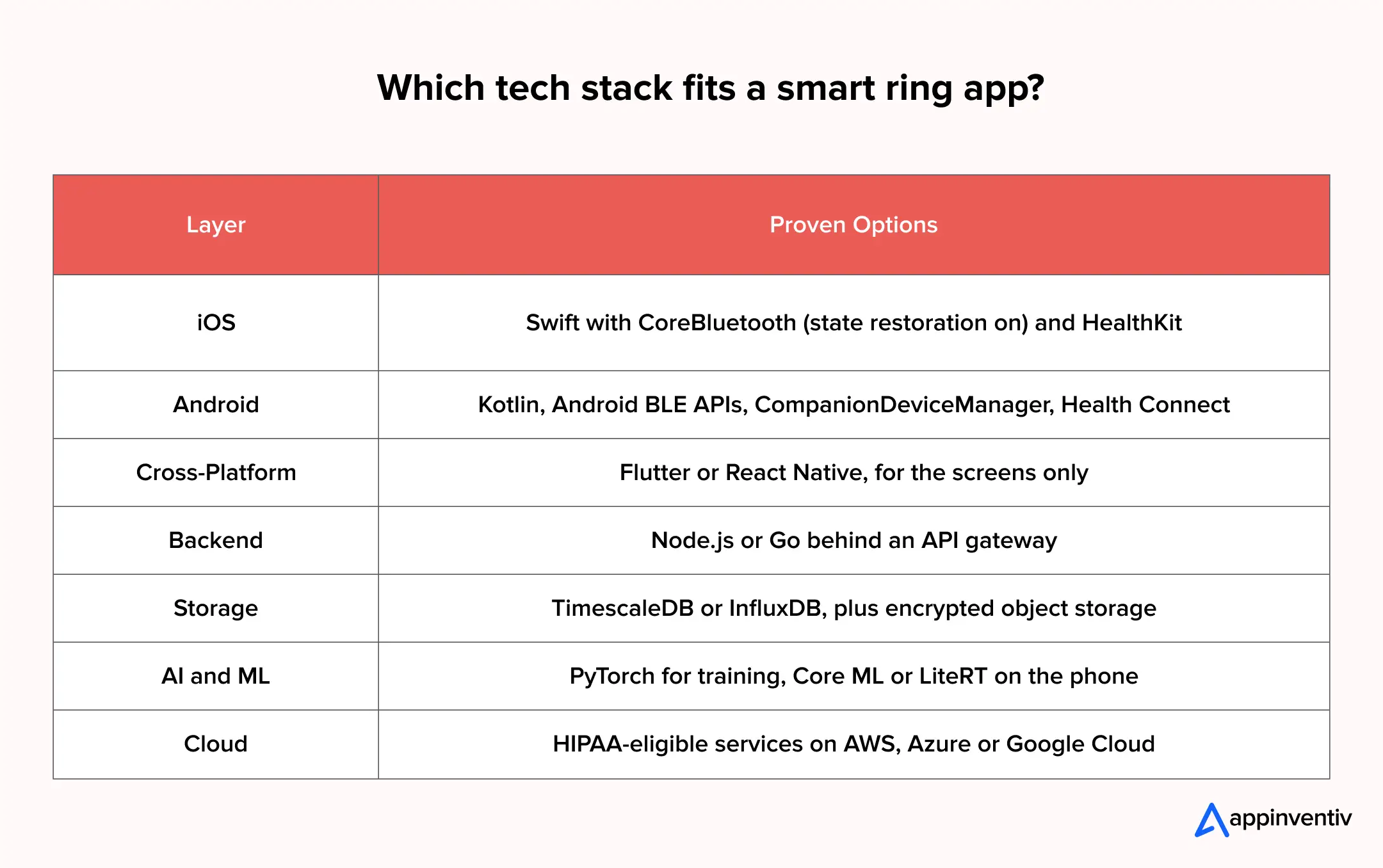
We still keep the Bluetooth module native, since iOS and Android handle background Bluetooth differently.
How do you handle smart ring SDK integration and Bluetooth pairing?
Every ring team we’ve worked with has the same story. The pairing demo goes great on the test bench, everyone high-fives, and then the first field pilot comes back missing about a third of its overnight data. Android just decided the sync service was wasting battery and killed it at 2:40 in the morning.
Luckily, most of this can be fixed. On Android we register the ring with CompanionDeviceManager. That tells the system the ring belongs to the app, so it stops shutting the sync down. On iOS you need CoreBluetooth state restoration turned on. Without it the phone frees up memory overnight and the sync just never comes back. We number the packets, too.
If a transfer dies halfway it picks up again at packet 412 or wherever it stopped, and nobody gets two copies of Tuesday night. Timestamps get fixed on each connection. Ring clocks drift, and a guy who flew LAX to JFK on a red-eye doesn’t want a sleep chart that’s three hours off. Firmware updates get signed builds and slow rollouts, because a bricked ring is a refund.
A smart ring bluetooth pairing app also has to survive rings that get resized or dropped down sinks, without anyone calling support. Whatever you budgeted for Bluetooth work, add some.
Which smart ring app development features matter in release one?
Scope creep sinks more ring programs than bad hardware does, so we’re stubborn about release one.
| Persona | Must ship at launch | Add after launch |
|---|---|---|
| Users | Sync status, sleep and readiness scores, trends, battery alerts, consent controls | AI coaching chat, challenges, cycle insights |
| Clinicians or coaches | Patient roster, trend views, threshold alerts, notes | Care-plan automation, population analytics |
| Admins | Device management, audit logs, role-based access | Cohort exports, payer reporting |
Alerts need rules too. A nurse should see the flagged trend, and the person wearing the ring gets a gentle nudge at most. Mix those up and you’ll hear about it, from a scared user or from a clinician who missed something.
What makes a smart ring sleep tracking app worth paying for?
Sleep is what sells rings, and it’s also where users get suspicious the fastest. Amardeep Rawat, VP of Technology at Appinventiv, names the trap in his guide to sleep tracker app development: “A single score is easy to understand but can become a black box.” What helps is showing people what’s behind the score.
We show how sure the model is and track sleep debt over weeks, not just last night. Temperature gets compared with the person’s own normal, and there’s always one plain sentence about why the score dropped. Do that well and a smart ring sleep tracking app keeps its subscribers.
Which integrations does a smart ring app need?
In most enterprise projects we’ve seen, the technological integrations in smart ring app development come down to the same short list. On the phone it’s HealthKit for iPhone and Health Connect for Android, which became the default after Google started retiring the Fit APIs. Then there’s the client’s EHR, usually through FHIR R4 and SMART on FHIR. And the LLM provider should sit behind a gateway that removes names before anything leaves your cloud.
Which one runs late? Almost always the EHR. Sandbox access alone can take three or four weeks, so we plan EHR integration as its own workstream with its own owner.
How does AI-driven smart ring app development create insights users trust?
A ring collects millions of readings per person per month. Users don’t look at any of it. They look at one number in the morning and decide if they should train hard or rest.
To get to that number we usually build five pieces. Bad readings get thrown out, like the ones from a night when the ring was loose. Each user gets a baseline made from their own last few weeks of data, and honestly that matters more than people think. The sleep, readiness and strain scores come from there.
We also run anomaly detection. If resting heart rate goes up, HRV goes down and temperature goes up on the same night, the person is often getting sick, sometimes a day before they notice.
The last piece is the AI coach that explains the numbers in normal language. This is where a smart ring AI health insights app can lose people’s trust very quickly, because a language model will happily say more than it should. So we limit it. The coach only uses content we approved, and every answer is logged. A second model also reads each reply first and stops anything that sounds like a diagnosis.
What are the regulations and compliance requirements for smart ring health app products?
US regulators care much more about what you claim than about what the hardware can do. The same ring with the same algorithm can be an unregulated wellness gadget or a Class II medical device, depending on one sentence in the app store listing.
IBM’s Cost of a Data Breach Report 2026 puts the average healthcare breach at $6.64 million, the highest of any industry. A smart health ring app sends sensitive data day and night, so our security work starts in sprint one.
| Framework | When it applies | What it means for your build |
|---|---|---|
| FDA general wellness policy | No diagnostic claims | Sleep, HRV, SpO2 or blood pressure trends without disease claims |
| FDA 510(k) or De Novo | The app detects or manages a disease | Design controls, IEC 62304, ISO 14971, cybersecurity files |
| HIPAA | Covered entities and business associates | BAAs, encryption, access controls, audit logs |
| FTC Health Breach Notification Rule | Health apps outside HIPAA | Breach notices, including for unauthorized sharing |
| State health privacy laws | Washington’s My Health My Data Act, CCPA/CPRA | Consent, deletion rights, sharing limits |
| CMS remote patient monitoring | Monitoring billed to Medicare | FDA device definition, data on 2+ days per 30 |
| GDPR, EU MDR, AI Act, Data Act | EU or UK users | Consent, DPIAs, CE marking, data access by design |
The worst compliance problems we’ve seen started in marketing, usually with a landing page nobody on the product team saw before launch. A shared claims matrix fixes most of that.
Wellness apps also don’t always stay wellness apps. Sooner or later an enterprise customer asks for “just one” clinical feature, so we sketch the software as a medical device pathway early, while the architecture is still easy to change.
How do you build a smart ring app, step by step?
The smart ring app development process we use puts engineers, QA, a compliance lead and a clinical advisor on one team from week one. It also helps to have someone who can get the ring maker’s firmware people on a call quickly. You’ll need them.
| Phase | Typical duration | What gets done |
|---|---|---|
| Discovery and claims strategy | 2 to 4 weeks | Build path, regulatory tier, claims matrix, SDK checks |
| UX and design | 3 to 6 weeks | Pairing flow, simple scores, “ring not found” screens |
| Core build (app, BLE, cloud) | 10 to 24 weeks | Sync and ingestion first, nice screens later |
| AI models and integrations | 6 to 14 weeks, in parallel | Baselines, scores, HealthKit, Health Connect, EHR |
| Testing, validation, launch | 4 to 8 weeks | Real-ring tests, security tests, PSG or ECG validation, staged rollout |
Teams that build smart ring app platforms for the first time often polish the screens before sync works. After launch we watch sync success rates closely, because an OS update can quietly break background Bluetooth.
How much does smart ring app development cost?
Most of the number comes from four things. The build path, the number of platforms, how much AI you need and the regulatory tier. The ranges below are for US builds and leave out hardware manufacturing, clinical studies and FDA fees.
| Scope | What you get | Estimated cost | Timeline |
|---|---|---|---|
| Integration-led companion app | Existing ring via cloud API, one platform, web dashboard | $50,000 to $120,000 | 3 to 5 months |
| Branded ring app with vendor SDK | iOS and Android, native BLE sync, HIPAA-ready cloud, AI scores | $120,000 to $250,000 | 5 to 9 months |
| Clinical-grade platform | SaMD pathway, EHR integration, clinician dashboards, guarded AI coaching | $250,000 to $500,000+ | 9 to 15+ months |
Native iOS and Android apps roughly double the Bluetooth work. AI costs vary a lot too, since baselines are cheap and validated anomaly models with LLM guardrails are not. If you plan to develop a smart ring app for the US and EU at the same time, budget for consent variants and data residency.
Costs don’t stop at launch either. Amardeep Rawat, VP of Technology at Appinventiv, splits it like this in his breakdown of wearable app development cost: “Year 1 (Build and Launch): 40-50% of the total 3-year spend” and “Year 2-3 (Operate and Scale): 50-60% of the total 3-year spend.”
We’ll size the BLE, cloud and compliance work for your device and your claims, based on 120+ wearable builds.
What are the biggest smart ring app development challenges?
Teams get burned by these when they assume the ring vendor already solved them.
| Challenge | Why it hurts | How to handle it |
|---|---|---|
| Unreliable sync | Missing nights kill trust quickly | Native BLE layer, state restoration, a sync health dashboard |
| Accuracy across users | PPG and SpO2 change with fit, movement and skin pigmentation | Validation on diverse groups, signal quality checks |
| Vendor lock-in | Your roadmap depends on someone else’s SDK | Device-agnostic data model, data rights in the contract |
| Claims creep | One marketing line can bring in the FDA | Shared claims matrix, reviewed by legal |
Most of them show up around month four, just as the pilot starts to look like a real business. Fixing them in the architecture costs far less than a rescue sprint.
Tell us which ring you’re using, who it’s for and what you want to claim. We’ll send back a costed plan with owners, milestones and risks.
How can Appinventiv help you out?
We’ve spent more than a decade building secure, compliance-heavy AI systems for healthcare and other regulated industries. Our wearable app development services team has shipped 120+ wearable projects, from Bluetooth companion apps to HIPAA-ready platforms with clinician dashboards.
We usually spend about two weeks looking at your ring vendor, your data rights and your claims before we give you a number. After that one team handles everything from BLE sync to the compliance paperwork, so bugs don’t get lost between vendors. Our partnerships with OpenAI and Anthropic give us direct technical backing for the coaching features, and clinical work brings in our healthcare AI development team.
We use AI on our own projects too, within limits. It drafts screens and runs the boring sync edge-case tests. Our senior engineers handle the BLE state machines and anything clinical, and patient data never goes into a prompt.
Where has this worked before?
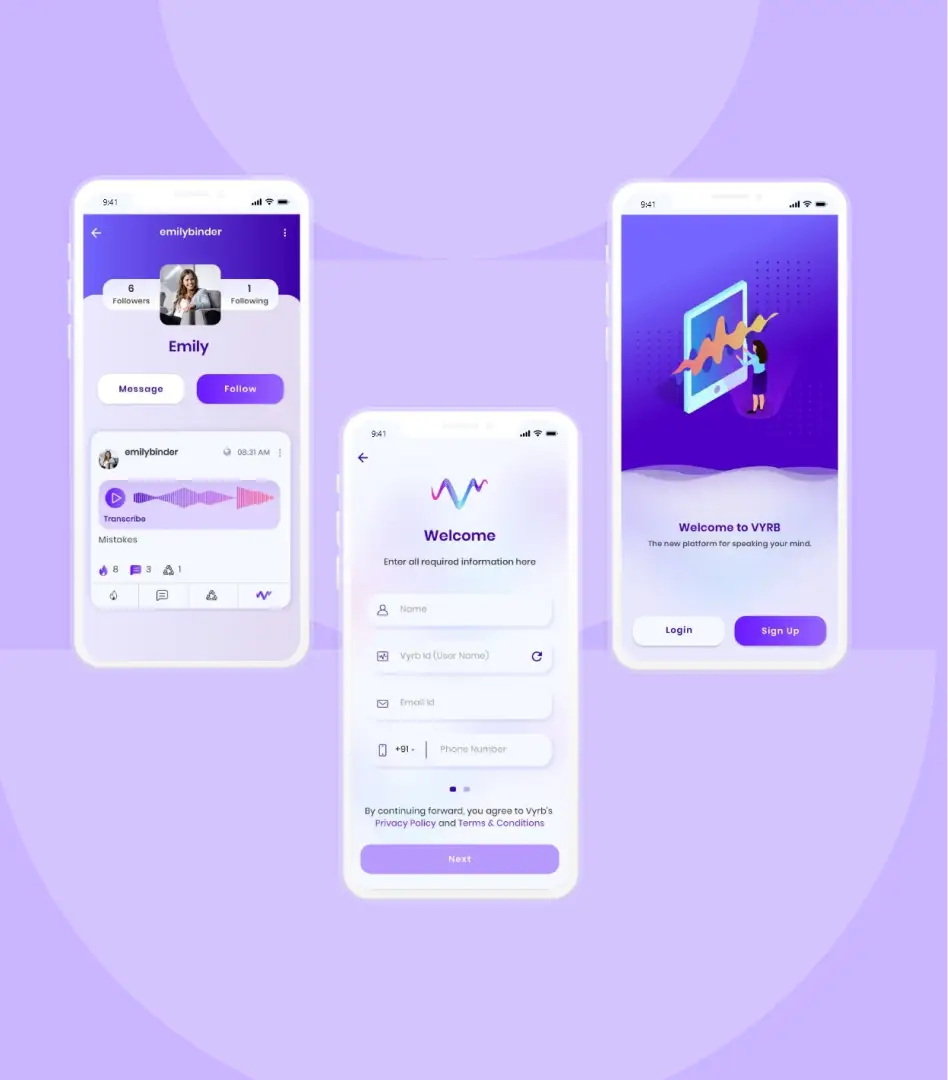
Vyrb

Hands-free posting had to work entirely through Bluetooth wearables, without a screen.


- 50,000+ app downloads
- $1M+ raised by the founders
- Siri and Google Assistant integration
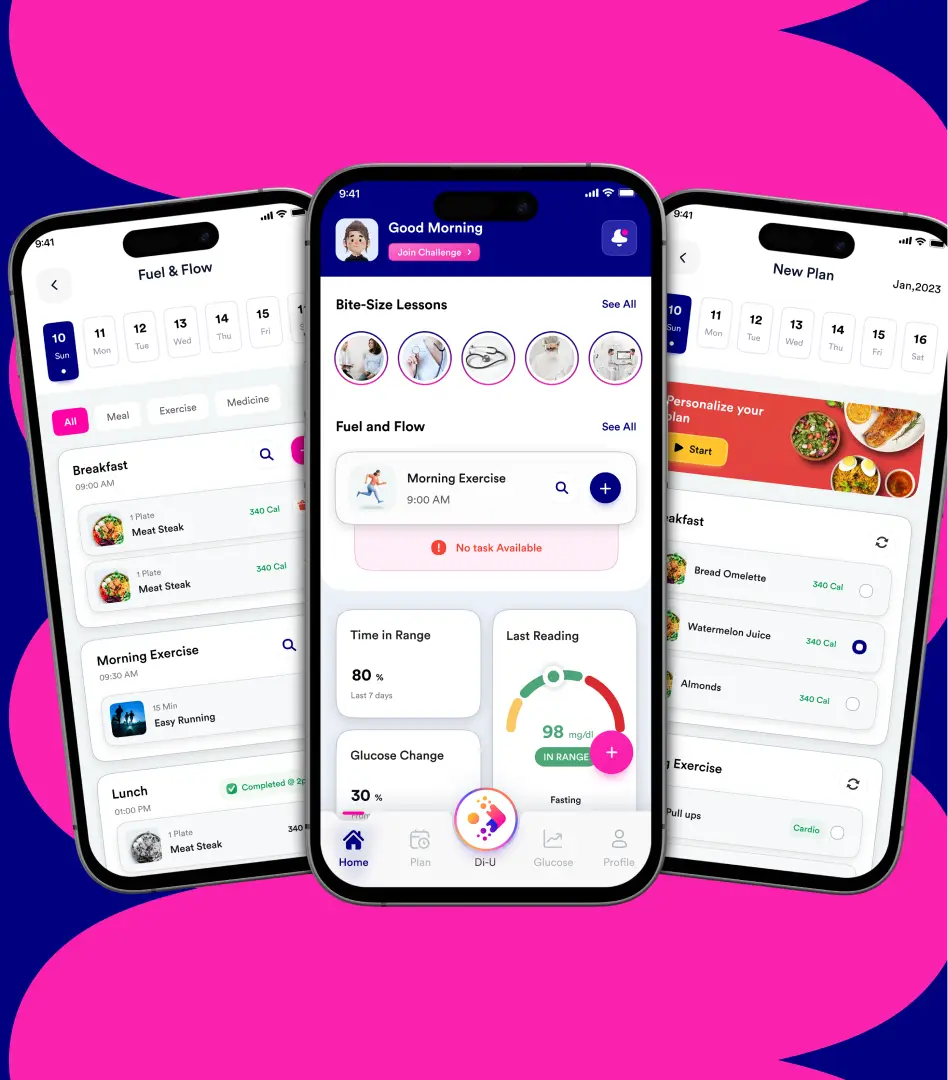
DiabeticU
- Infrastructure cost down 30%
- Zero data loss at cutover
- Secure environments in under 30 minutes
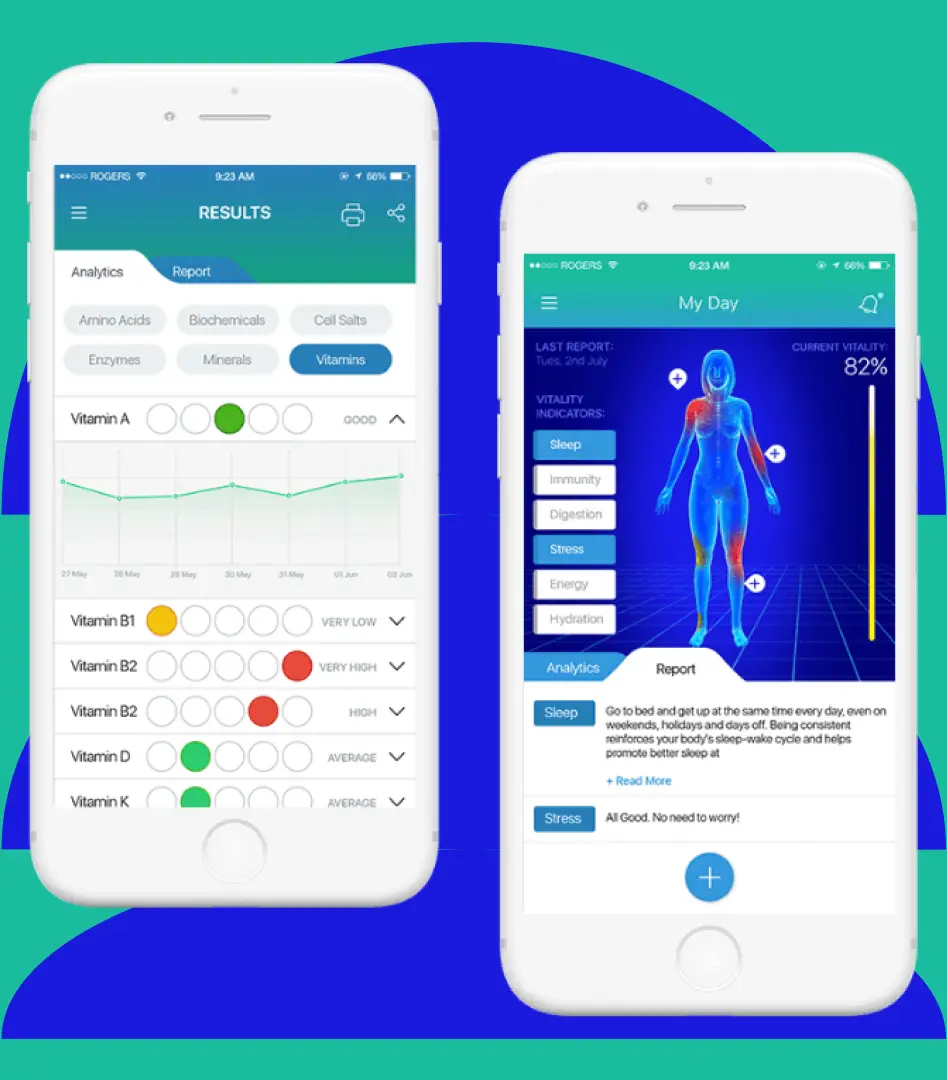
Soniphi
- Analyzes 94% of vocal information
- Algorithm trained on millions of records
- Clean output from messy input
If you want to build smart ring app features people keep using, we’d start by mapping your build path with you.
Before a team builds your smart ring app
A smart ring app succeeds or fails in the morning. If last night’s data synced, the score makes sense, and the app never claimed more than it should, people keep wearing the ring. So before any team starts writing code, settle three things. Pick your build path, whether that’s an existing ring, a white-label ring, or your own hardware. Decide what your app will claim because that sets your regulatory tier. And finally, agree on who owns the data if your ring vendor changes. With those answers in hand, the team you bring in can quote accurately, plan the Bluetooth work properly, and keep AI coaching and EHR integrations on track for later releases. Without them, you’ll likely pay for the same decisions twice.
FAQs
Q. How does a smart ring app work?
A. Overnight the ring logs PPG, motion and skin temperature to its own memory. In the morning the app grabs that data over Bluetooth Low Energy, fixes the timestamps and sends it to the cloud. A score shows up a few seconds later, and in clinical programs a nurse sees the same numbers too.
Q. Why focus on smart ring health apps now?
A. Mostly because people actually sleep in them. A watch tends to spend the night on the charger, so ring programs end up with far more complete overnight data. US reimbursement for remote monitoring keeps growing, too.
Q. How does a smart ring app calculate a readiness score?
A. Basically it compares you with you. The app looks at last night’s resting heart rate, HRV, temperature and sleep, and checks how far each one is from your own normal. Those get weighted into a 0 to 100 score. We always add a short line saying why it went up or down.
Q. How long does it take to build smart ring app?
A. For an app on an existing ring’s cloud API, we’d say 3 to 5 months. A branded ring with native Bluetooth sync is more like 5 to 9. Clinical-grade platforms take 9 to 15 months or longer, before regulatory review.
Q. Can AI be integrated into a smart ring health app?
A. Yes. Good ring apps already use AI to filter bad readings, build baselines, stage sleep and flag early warning signs. The part we’re careful with is generative coaching. If you’re not cleared, it can’t say anything that sounds like a diagnosis, and we log every reply.
Q. Does a smart ring health app need FDA clearance?
A. Only if you make medical claims. Sleep and heart rate trends normally sit under the FDA’s general wellness policy. Once your app says it detects sleep apnea or AFib, though, you’re looking at a 510(k) or De Novo submission.
Q. What is the difference between a smart ring SDK and a smart ring API?
A. The SDK lives inside your app and talks to the ring over Bluetooth, often with raw sensor data. The API lives in the ring maker’s cloud and only gives you processed summaries after their app has synced. So the SDK means more control, and the API means less work.
Q. Can we develop a smart ring app on top of an existing consumer ring?
A. Yes, as long as the ring maker has a cloud API and your users already own the ring. For monitoring and employer programs it’s usually the quickest way to start. The catch is less raw data, a bit of sync delay, and living with the vendor’s terms.


Fast 2-minute response, fully NDA-protected.
Wearable Data Integration: Connecting Multiple Devices to a Unified Health Platform
Key takeaways: Device support should reflect the measurements your service needs, the people using it, and the decisions those readings inform. A unified health data platform must preserve source, timing, and measurement context while resolving duplicate records. Phone health platforms, manufacturer APIs, and direct device connections serve different integration needs. Clinical workflows require agreed review…
Sleep Tracker App Development: Features, Wearable Integration, AI, and Compliance
Key takeaways: Sleep tracking presents opportunities across consumer wellness, fitness, healthcare, employee wellness, senior care, and infant-care markets. Successful products combine actionable insights, wearable connectivity, user-friendly reports, privacy controls, and clearly differentiated experiences. HealthKit, Health Connect, and direct device APIs provide different data depths, costs, limitations, and maintenance requirements. AI supports sleep-stage estimation and personalization,…
Diet and Nutrition App Development: Process, Features, Cost, and Technology Stack
Key Takeaways Diet and nutrition tracking app development goes past basic calorie counters with verified food databases, custom meal schedules, AI tools, wearable device links, and corporate manager tools. Structure database models around raw food items, serving portions, nutrient facts, recipes, software links, and regional diet rules. Pair computer vision models, recommendation algorithms, language engines,…