


































Pharmacy Software Development in the UAE: Cost, Features, Architecture & Compliance

 Share -



- 01Why is the UAE Driving Demand for Modern Pharmacy Software?
- 02Key Steps in the Pharmacy Software Development Process
- 03Must-Have Features for Pharmacy Software in the UAE
- 04Inside the Architecture of a Modern UAE Pharmacy Platform
- 05Pharmacy Software Compliance and Regulatory Requirements in the UAE
- 06How Much Does Pharmacy Software Development Cost in the UAE?
- 07Develop a Custom Pharmacy Platform for the UAE with Appinventiv
- 08FAQs

Key takeaways:
- Pharmacy software in the UAE must support prescriptions, inventory, billing, and compliance in one system.
- Enterprise pharmacy platforms need secure architecture, role-based access, and audit trails.
- UAE-specific integrations like e-prescriptions, insurance, and health exchanges are critical.
- Custom pharmacy software development in the region typically costs AED 80,000 to AED 800,000+, depending on features, integrations, and scale.
- A tailored solution gives pharmacy groups more control over growth, security, and workflows.
The UAE’s healthcare system is moving towards more connected, digital care, and pharmacies are becoming an active part of that shift. Pharmacy software development in the UAE now involves far more than managing medicine sales and stock. Modern platforms need to support digital prescriptions, patient information, inventory visibility, payments, and connections with the wider healthcare ecosystem.
The scale of this transition is already visible in Dubai. By June 2025, NABIDH had surpassed 10.41 million medical records, connecting 1,888 licensed healthcare facilities, 53,659 healthcare professionals, and 91 EMR systems (Source: Wam.ae). The figures highlight the growing volume of health information moving across connected systems and the need for secure, authorized data exchange.
Pharmacies sit directly within this environment. They manage prescriptions, medicine availability, patient interactions, payments, and, in many cases, delivery and multi-branch operations. Basic billing and stock software no longer covers every business need.
Government programmes point in the same direction. The UAE Digital Government Strategy 2025 promotes data-driven and digital-by-design services, while We the UAE 2031 includes projects for robotic pharmacy and automated medication dispensing within its future-ready healthcare agenda.
This guide examines the costs, features, architecture, integrations, compliance requirements, and development stages involved in building a modern pharmacy software platform. Let’s delve deeper to know more.
Let us assess your feature requirements, integrations, and business model to define the right development scope and budget.

Why is the UAE Driving Demand for Modern Pharmacy Software?
The UAE’s pharmacy market is becoming more digital, connected, and service-led. Demand for pharmacy management software development UAE services comes from healthcare digitisation, government technology programmes, changing patient expectations, and opportunities to expand across the GCC.
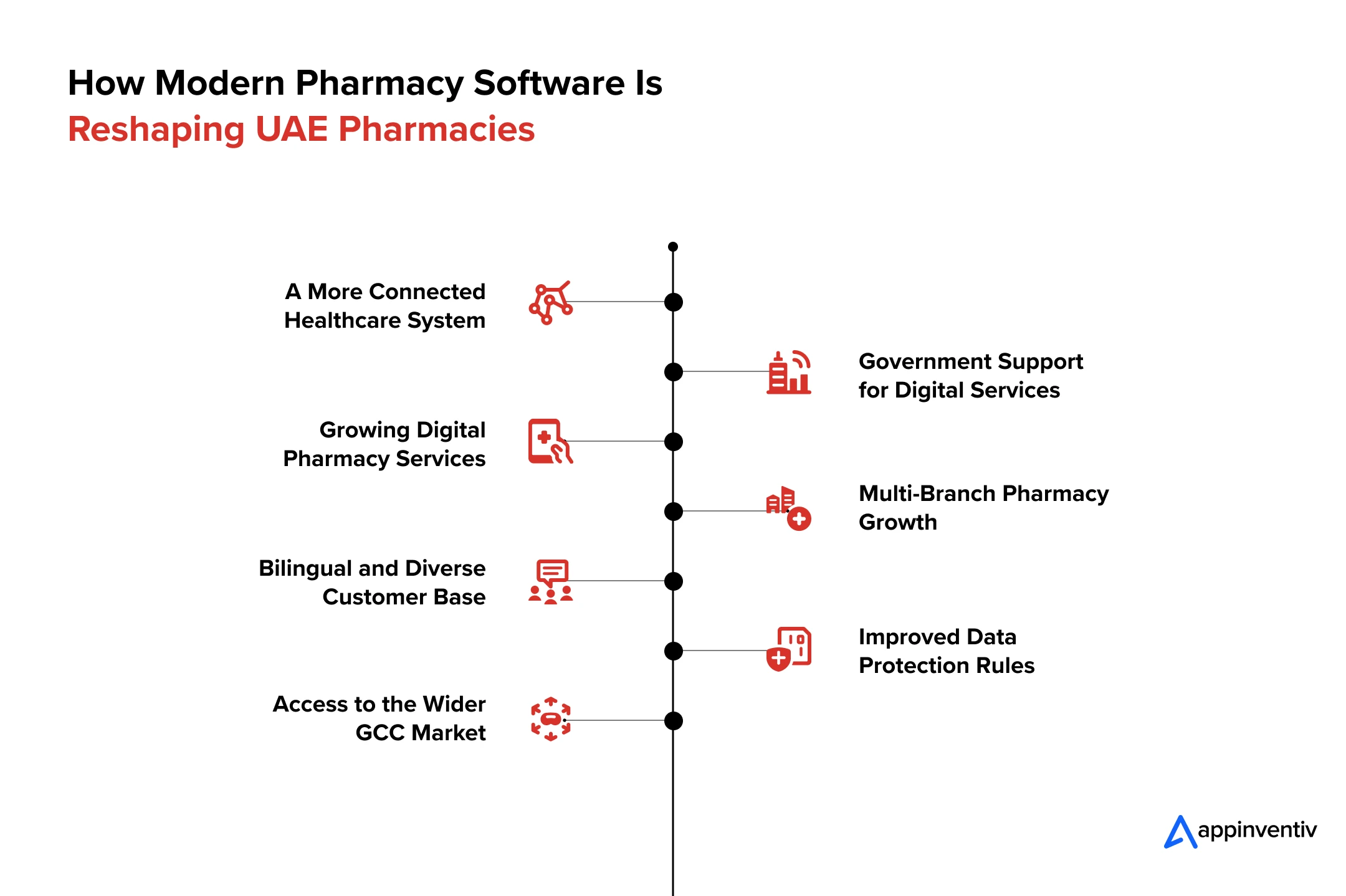
A More Connected Healthcare System
Pharmacies increasingly work within connected healthcare environments. Software must support electronic prescriptions, patient data workflows, inventory visibility, and authorized connections with other healthcare services.
Government Support for Digital Services
The UAE Digital Government Strategy 2025, We the UAE 2031 and Dubai Economic Agenda D33 are working to increase the use of technology. New smart city initiatives, regulatory sandboxes and government programmes further unlock opportunities for businesses to experiment with new digital services.
Growing Digital Pharmacy Services
For online medicine orders, upload of prescriptions, repeat orders, online payments and home delivery, systems need to integrate customer services with prescription, stock, billing and fulfillment.
Multi-Branch Pharmacy Growth
Pharmacy groups have operations spread across various Emirates and require central control of inventory, batch, expiry dates, stock transfers, user access and reporting at the pharmacy level.
Bilingual and Diverse Customer Base
The presence of Arabic and English in pharmacy apps, push notifications, receipts, and patient interaction services is common to meet the needs of the local and expatriate population in this country.
Improved Data Protection Rules
Prescription and patient information must be controlled, multi-factor authenticated, encrypted and subject to audit trails. Those requirements must be included in the software development phase.
Access to the Wider GCC Market
Companies looking for expansion in Saudi Arabia, Qatar and other GCC markets can make the UAE a base. A regional growth-oriented pharmacy platform enables future localization, integrations and region-specific requirements.
Key Steps in the Pharmacy Software Development Process
Crafting pharmacy software demands a systematic design and development methodology, taking into account various operational processes, regulatory mandates, technical frameworks, security measures, integrations, and scalability. The following stages are usually the steps.
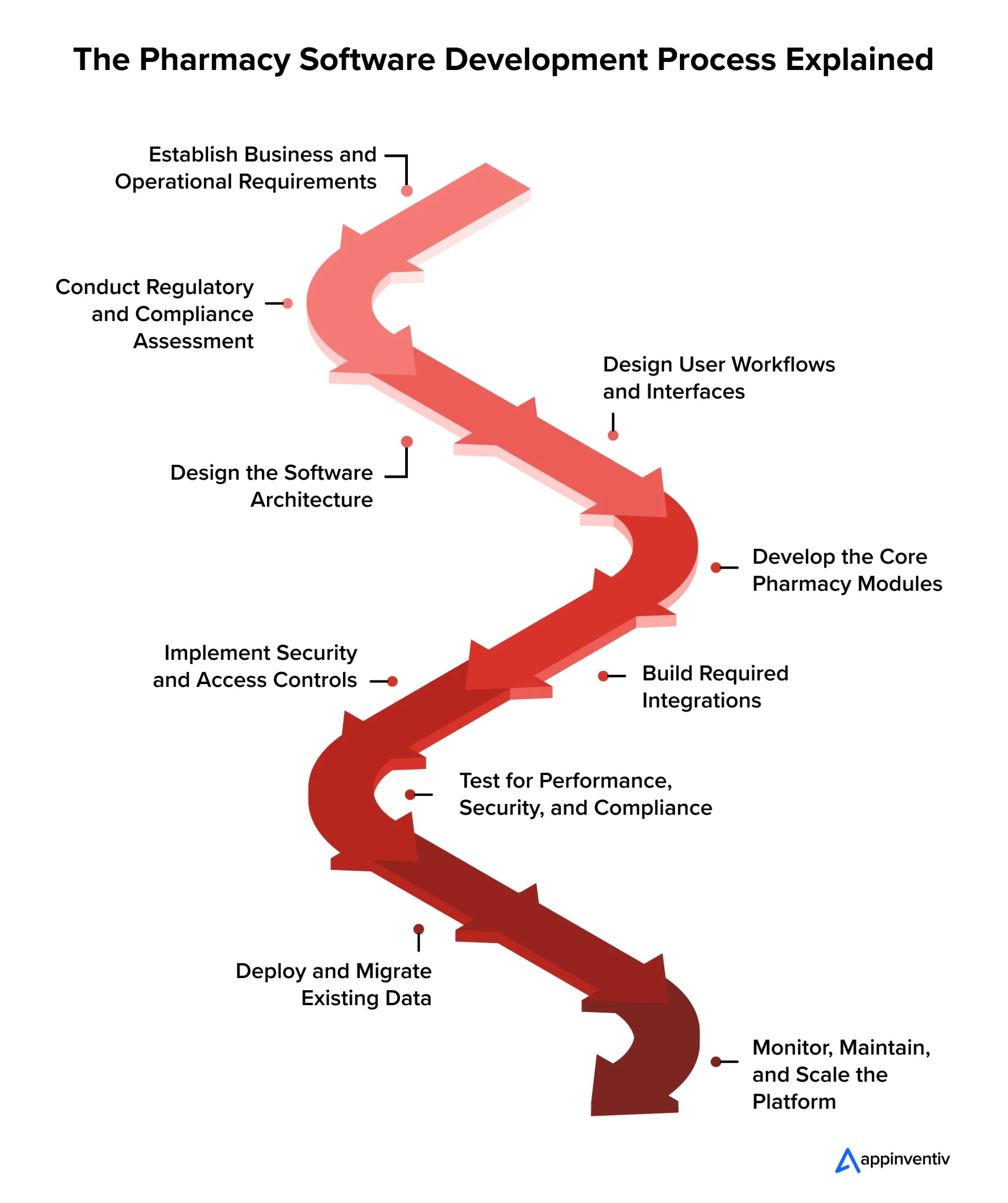
1. Establish Business and Operational Requirements
The first step in Pharmacy software development in the UAE is to understand the workings of the pharmacy and to determine the issues the software is designed to address. Current workflows, user roles, branch operations, prescription process, inventory process and patient services are evaluated by development teams.
Key requirements may include:
- Pharmacy type, size, and number of branches
- User roles and permission requirements
- Prescription and dispensing workflows
- Inventory, batch, and expiry management
- Billing, POS, and payment requirements
- Supplier and purchase order workflows
- Online ordering and delivery capabilities
- Reporting and analytics requirements
This stage helps define the project scope, feature priorities, expected integrations, and technical requirements before development begins.
2. Conduct Regulatory and Compliance Assessment
The development team should review the UAE regulations and standards that apply to the activities of the pharmacy and the types of data that the software will handle before finalizing the software requirements. This early assessment is particularly important when building MOHAP-compliant pharmacy software.
The assessment may cover:
- Pharmacy licensing and operational requirements
- Patient and health data protection requirements
- Prescription and medication record handling
- Data access and retention requirements
- Applicable federal and emirate-level regulations
- Healthcare system interoperability requirements
- Audit and reporting obligations
These requirements should be incorporated into the product and technical specifications early, helping prevent major changes during later development stages.
3. Design the Software Architecture
The next phase involves finalizing the interactions between the platform’s applications, core modules, databases, integrations, and security features. A well-planned pharmacy software architecture UAE is essential to building a stable and scalable platform.
The architecture planning process typically covers:
- Web, mobile, and desktop application requirements
- Backend services and business logic
- Database and data storage design
- API and integration architecture
- User authentication and access management
- Cloud, on-premises, or hybrid deployment
- Backup and disaster recovery planning
- Scalability and future expansion requirements
A clear architecture also makes it easier to add new branches, users, modules, and integrations as the pharmacy’s requirements evolve.
4. Design User Workflows and Interfaces
After identifying the functional and technical needs, the team traces the different user workflows and builds interfaces based on the activities in which they are involved.
This may involve creating workflows and prototypes for:
- Pharmacists processing and dispensing prescriptions
- Administrators managing users and pharmacy operations
- Staff handling inventory and purchase orders
- Cashiers processing sales and payments
- Patients placing orders and accessing prescriptions
- Delivery personnel managing fulfilment and order updates
The design process should reduce unnecessary steps and ensure users can complete critical pharmacy tasks accurately and efficiently.
5. Develop the Core Pharmacy Modules
For pharmacy management software development UAE projects, development then moves to the modules that support the pharmacy’s main operations. The exact scope depends on the project, but the core platform may include:
- Remote patient monitoring for tracking patient health data
- Prescription and refill management
- Patient profile and medication records
- Medicine and inventory management
- Batch, serial, and expiry tracking
- Billing and POS management
- Supplier and purchase order management
- Reporting and analytics
Developers can build these modules in phases, starting with essential functions and adding more advanced capabilities as the platform evolves.
6. Build Required Integrations
The software is then connected with external systems required for pharmacy operations. This stage is particularly important for e-prescription software development UAE, where secure data exchange with relevant healthcare systems may be part of the platform’s requirements.
Depending on the project scope, integrations may include:
- E-prescription and healthcare platforms
- Healthcare AI chatbots and virtual assistants
- Insurance and claims processing systems
- Payment gateway integrations like Telr, Amazon Payment Services
- ERP and accounting platforms
- Supplier and procurement systems
- Delivery and logistics platforms
- SMS, email, and messaging services
Integration testing should be carried out throughout this stage to identify data mapping, authentication, and communication issues before deployment.
7. Implement Security and Access Controls
Security measures should be implemented across the platform rather than treated as a final stage of pharmacy software development process. This is particularly important for software handling patient, prescription, and financial data.
The implementation may include:
- Role-based access controls
- User authentication and session management
- Multi-factor authentication
- Data encryption in transit and at rest
- Secure API communication
- Audit logs and activity tracking
- Data backup and recovery controls
- Vulnerability testing and monitoring
Access permissions should be configured according to each user’s role so that pharmacists, administrators, finance teams, and other users can access only the information and functions required for their work.
8. Test for Performance, Security, and Compliance
The development team tests the software prior to launch against the functional, technical, security, and applicable compliance requirements. Individual modules and complete end-to-end pharmacy workflows should be tested.
The testing process may include:
- Functional and workflow testing
- Integration and API testing
- User acceptance testing
- Performance and load testing
- Security and vulnerability testing
- Data accuracy and consistency checks
- Backup and recovery testing
- Compliance validation against applicable requirements
This stage helps identify issues that could affect prescription processing, inventory accuracy, data protection, or system availability after launch.
9. Deploy and Migrate Existing Data
After testing and final approval, the pharmacy management system UAE is prepared for production deployment. For pharmacies replacing an existing platform, this stage also includes migrating relevant historical data into the new system.
The deployment process may involve:
- Production environment configuration
- Database setup and validation
- User account and role configuration
- Migration of existing pharmacy records
- Data cleansing and mapping
- Backup verification
- Final integration checks
- Staff onboarding and system training
A phased rollout can also be used for larger pharmacy networks to reduce operational disruption and resolve issues before deployment across all branches.
10. Monitor, Maintain, and Scale the Platform
Pharmacy software development continues after the initial launch. The platform requires ongoing monitoring, maintenance, security updates, and improvements as operational requirements change.
Post-launch activities typically include:
- Application and infrastructure monitoring
- Bug fixes and performance optimisation
- Security patches and vulnerability management
- Backup and recovery monitoring
- Regulatory and compliance updates
- Integration maintenance
- Feature enhancements based on user feedback
- Infrastructure scaling for new branches and users
This ongoing process helps keep the platform reliable as the pharmacy expands its operations, introduces new services, and handles increasing transaction volumes.
Map your requirements before development starts, from pharmacy workflows and system architecture to integrations and compliance.

Must-Have Features for Pharmacy Software in the UAE
Pharmacy software in the UAE needs to support more than dispensing and inventory management. Depending on the emirate and pharmacy model, the platform may need to align with local compliance while supporting connected healthcare workflows.
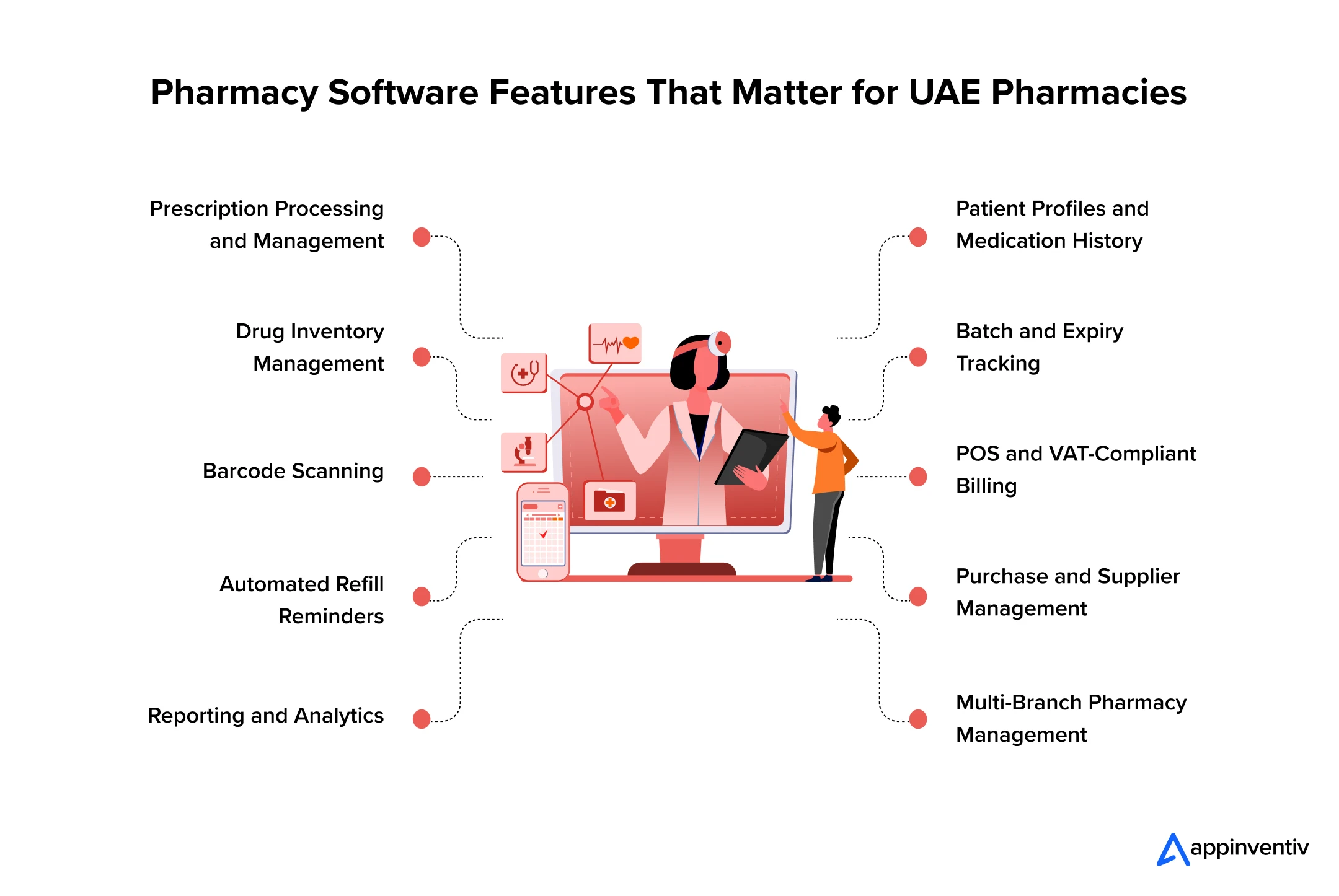
Prescription Processing and Management: Manages prescription review, pharmacist verification, dispensing, refills, and digital records, with workflows configurable according to the requirements applicable to the pharmacy’s emirate and regulator.
Patient Profiles and Medication History: Maintains patient profiles and medication histories while supporting controlled access to sensitive health information and Arabic-English data fields where required.
Drug Inventory Management: Provides real-time visibility into medicine availability across one or multiple locations, helping pharmacy chains coordinate stock between outlets in Dubai, Abu Dhabi, Sharjah, and other emirates.
Batch and Expiry Tracking: Tracks batch numbers and expiry dates to support stock rotation, traceability, and the timely identification of expired or recalled medicines.
Barcode Scanning: Allows pharmacy staff to verify medicine details and update inventory, dispensing, and billing records quickly, which is particularly useful for high-volume retail pharmacy operations.
POS and VAT-Compliant Billing: Processes over-the-counter sales, invoices, payments, and discounts while supporting VAT calculations and billing records required for business operations in the UAE.
Automated Refill Reminders: Sends refill reminders through channels commonly used by UAE consumers, including SMS, email, and mobile notifications, with configurable Arabic and English communication options.
Purchase and Supplier Management: Manages suppliers, purchase orders, stock receipts, and procurement workflows while providing visibility into medicine sourcing and incoming inventory.
Reporting and Analytics: Generates reports on sales, prescription volumes, stock movement, expiry losses, and branch performance, helping pharmacy groups monitor operations across different locations.
Multi-Branch Pharmacy Management: Connects pharmacy outlets through a central platform while allowing branch-specific inventory, pricing, users, and workflows to be managed independently.
Advanced Features That Strengthen Pharmacy Operations
Here’s an additional list of advanced features that can help local pharmacies improve efficiency, streamline workflows, and manage operations more effectively.
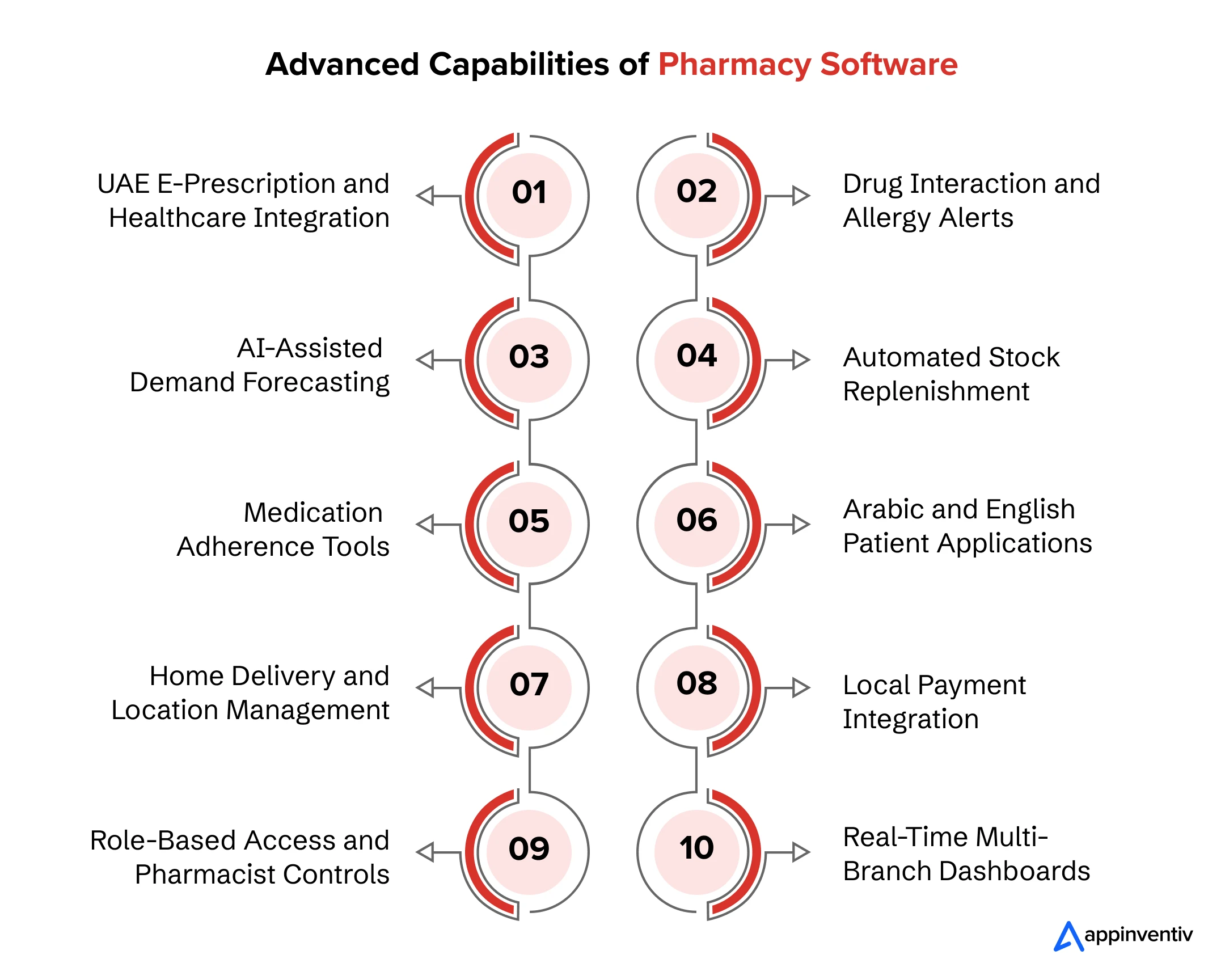
UAE E-Prescription and Healthcare Integration: Supports electronic prescription workflows and can be designed for authorised connectivity with UAE healthcare infrastructure such as Riayati, NABIDH, or Malaffi, depending on the emirate and integration eligibility.
Drug Interaction and Allergy Alerts: Flags potential drug interactions, duplicate therapies, and patient allergies to provide pharmacists with additional clinical information before dispensing medication.
AI-Assisted Demand Forecasting: Uses AI in UAE healthcare to analyze historical sales, seasonal demand, and purchasing patterns, helping pharmacies forecast medicine demand and prepare for predictable shifts during periods such as Ramadan.
Automated Stock Replenishment: Generates reorder alerts based on stock thresholds and consumption rates, helping pharmacies maintain medicine availability during high-demand periods and across multiple branches.
Medication Adherence Tools: Provides dosage schedules, refill reminders, and treatment notifications that can be delivered in Arabic or English based on patient communication preferences.
Arabic and English Patient Applications: Allows patients to access prescription services, medicine orders, refill requests, and delivery updates through interfaces designed to support the UAE’s multilingual population.
Home Delivery and Location Management: Supports medicine order fulfilment through delivery zones, address management, driver assignments, and order tracking across cities and service areas.
Local Payment Integration: Supports integration with relevant UAE payment methods and gateways, allowing patients to complete medicine purchases through locally preferred digital payment options.
Role-Based Access and Pharmacist Controls: Assigns different permissions to pharmacists, pharmacy managers, cashiers, and administrators, helping organisations maintain appropriate control over prescription and patient information.
Real-Time Multi-Branch Dashboards: Provides a central view of prescription queues, stock availability, sales, and branch performance, allowing pharmacy operators to monitor distributed UAE operations from one system.
Inside the Architecture of a Modern UAE Pharmacy Platform
A modern pharmacy platform must have a strong technical design to handle dispensing, patient records, inventory, payments and external services. In the UAE market, the architecture must be designed to meet local healthcare needs, support Arabic and English translations, accommodate AED transactions, include VAT, and ensure the safe processing of healthcare data.
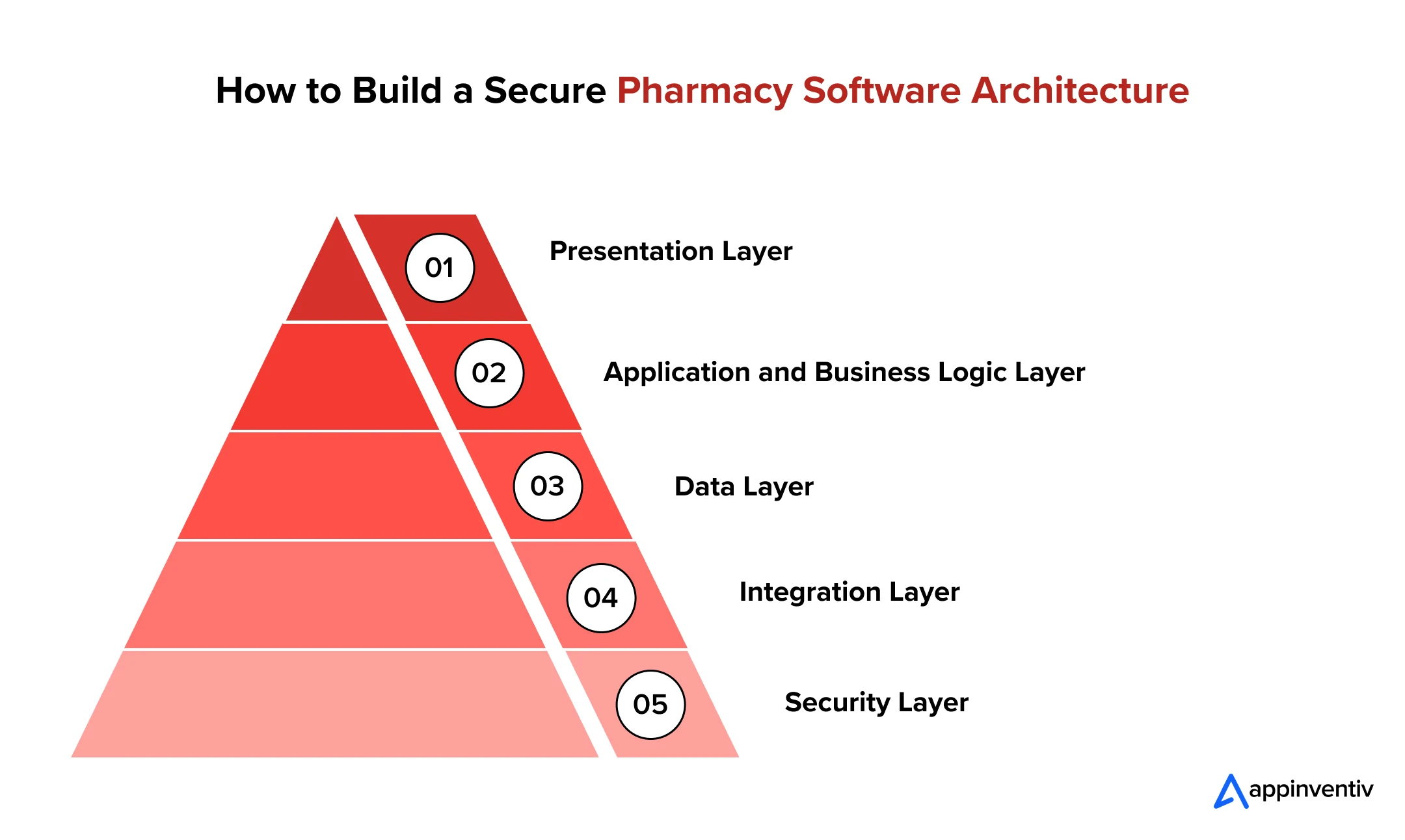
Presentation Layer
The presentation layer includes the pharmacist dashboard, admin portal, and patient-facing web or mobile applications. Each interface serves a different user group, with role-based access to relevant functions. Patient applications can support Arabic and English interfaces, prescription uploads, medicine orders, payments, and delivery tracking.
Application and Business Logic Layer
This layer manages the core processes behind pharmacy operations, including prescription management, inventory services, billing, payment processing, notifications, and workflow rules.
It connects these functions so that actions such as dispensing a medicine can update stock, transaction records, and order status through defined business rules. Prescription workflows can also reflect the requirements of the relevant health authority, such as MOHAP, DHA, or DoH Abu Dhabi.
Data Layer
The data layer stores patient and prescription records, medicine information, inventory data, audit logs, and other operational records. Its design should support controlled access, data accuracy, backups, and disaster recovery.
Data governance should also reflect the UAE Personal Data Protection Law and applicable healthcare requirements for the handling of sensitive information.
Integration Layer
The integration layer connects the pharmacy platform with authorised healthcare systems, insurance platforms, payment gateways, and delivery services. APIs and middleware manage authentication, data exchange, and error handling between these systems.
The payment architecture can support AED transactions, VAT-related records, and locally available payment providers, while healthcare integrations can connect with approved national or emirate-level systems where required.
Security Layer
The security layer provides encryption, identity and access management (IAM), multi-factor authentication (MFA), audit trails and threat monitoring throughout the platform. Role-based permissions provide access control based on staff roles, and MFA can help secure privileged accounts and sensitive areas of the systems.
Continuous monitoring and detailed logs enable pharmacy operators to identify abnormal activity and investigate security incidents.
Pharmacy Software Compliance and Regulatory Requirements in the UAE
A pharmacy platform must meet the legal and regulatory requirements that apply to its operations. For pharmacy software development in the UAE, this includes patient data protection, health information security, and relevant pharmacy regulations.
- UAE Personal Data Protection Law: Pharmacy software should apply appropriate controls for collecting, processing, storing, and protecting personal and patient information.
- Federal Law No. 2 of 2019 on ICT in Health Fields: The platform must protect the confidentiality, integrity, and availability of health data and support authorised access and interoperable health information systems.
- Cabinet Resolution No. 32 of 2020: The system should support authorised access, controlled health data processing, risk management, and business continuity measures for health information systems.
- UAE Healthcare AI Governance: AI-enabled pharmacy solutions should address data privacy, transparency, fairness, accountability, and patient safety under emerging UAE healthcare AI frameworks.
- MOHAP Requirements: Pharmacies operating under MOHAP jurisdiction should account for applicable pharmacy, healthcare, electronic record, and health data requirements.
- DHA and NABIDH Requirements: Dubai-based platforms should review applicable DHA standards and NABIDH requirements for authorised health information exchange and connected healthcare workflows.
- DoH Abu Dhabi Requirements: Pharmacy systems operating under DoH jurisdiction should follow applicable sector standards for patient data, healthcare information exchange, and regulated digital health services.
- ADHICS Standard: Healthcare entities and relevant systems in Abu Dhabi should address cybersecurity and healthcare data protection controls under the Abu Dhabi Healthcare Information and Cyber Security Standard.
- Health Information Exchange Standards: Systems connecting with authorised health exchanges should support the required patient identifiers, data formats, coding standards, and minimum data sets.
- Health Data Localization Requirements: The architecture should address federal rules governing the storage, processing, and transfer of health data outside the State.
How Much Does Pharmacy Software Development Cost in the UAE?
The cost of pharmacy management software development UAE can be from AED 80,000 to AED 800,000+ ( $40,000+ to $400,000+), depending on the scope and technical needs of the platform. The exact cost will be dependent on the number of pharmacy modules, branches, user applications, integrations, and security requirements.
A basic system for a single pharmacy requires a smaller investment. Costs rise for multi-branch platforms with bilingual interfaces, patient applications, local payment integrations, delivery management, advanced inventory controls, and custom workflows.
| Pharmacy Software Type | Estimated Cost in AED | Estimated Cost in USD |
|---|---|---|
| Basic Pharmacy System | AED 80,000 to AED 150,000 | $40,000 to $75,000 |
| Mid-Market Pharmacy Platform | AED 150,000 to AED 300,000 | $75,000 to $150,000 |
| Advanced Digital Pharmacy Platform | AED 300,000 to AED 500,000 | $150,000 to $250,000 |
| Enterprise Pharmacy Platform | AED 500,000 to AED 800,000+ | $250,000 to $400,000+ |
Cost Breakdown by Development Stage
The table below uses the overall project range of AED 80,000 to AED 800,000+ and $40,000 to $400,000. Actual spending across each stage will vary based on the platform’s scope and integration requirements.
| Development Stage | Share of Total Project Cost | Estimated Cost in AED | Estimated Cost in USD |
|---|---|---|---|
| Discovery and Requirements Analysis | 5% to 10% | AED 4,000 to AED 80,000 | $2,000 to $40,000 |
| UI/UX Design | 8% to 12% | AED 6,400 to AED 96,000 | $3,200 to $48,000 |
| Development | 40% to 50% | AED 32,000 to AED 400,000 | $16,000 to $200,000 |
| Integration | 8% to 15% | AED 6,400 to AED 120,000 | $3,200 to $60,000 |
| Testing and Quality Assurance | 8% to 12% | AED 6,400 to AED 96,000 | $3,200 to $48,000 |
| Security and Compliance Validation | 5% to 10% | AED 4,000 to AED 80,000 | $2,000 to $40,000 |
| Deployment | 3% to 5% | AED 2,400 to AED 40,000 | $1,200 to $20,000 |
| Post-Launch Maintenance | 15% to 25% annually | AED 12,000 to AED 200,000 annually | $6,000 to $100,000 annually |
Also Read: Healthcare Software Development in Middle East Cost Guide
What Affects Pharmacy Software Development Costs?
Let’s check out some of the critical factors that play a decisive role in determining the overall pharmacy software development cost UAE.
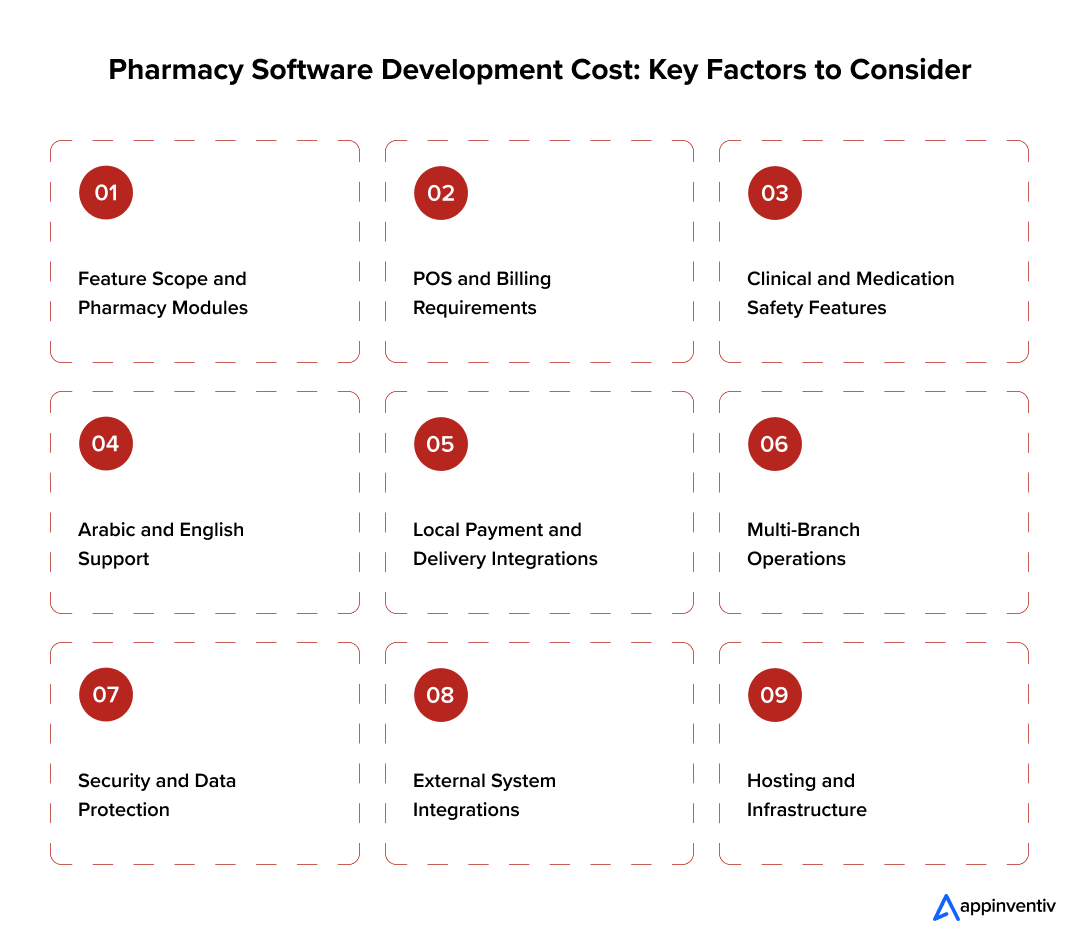
Feature Scope and Pharmacy Modules
The number and complexity of modules shape the development budget. A basic platform may include prescriptions, billing, and reporting. Adding pharmacy inventory management software increases the scope through batch tracking, expiry management, supplier records, purchase orders, and stock transfers.
POS and Billing Requirements
Pharmacy POS system development covers counter billing, barcode scanning, AED pricing, VAT calculations, discounts, refunds, receipts, and payment processing. Costs can increase further with hardware and local payment gateway integrations.
Clinical and Medication Safety Features
Drug interaction alert system needs structured medicine data, clinical rules, alert logic and detailed testing. There may be additional development work required for allergy alerts and duplicate medication checks.
Arabic and English Support
Pharmacy software is frequently required to cater to Arab-language users as well as the UAE’s expatriate population. This means that content must be translated, the layouts must be RTL, bilingual notifications must be provided, and testing must be performed on patient and staff interfaces.
Local Payment and Delivery Integrations
Integrations with UAE payment gateways, digital wallets, and delivery services add development and testing work. The scope may include AED transaction processing, order tracking, delivery zones, address handling, and customer notifications.
Multi-Branch Operations
Pharmacy groups with outlets across Dubai, Abu Dhabi, Sharjah, and other emirates may need central management with branch-level controls. Separate inventory, pricing, staff permissions, sales records, and reports increase backend complexity.
Security and Data Protection
The project budget should account for encryption, role-based access, MFA, audit logs, secure APIs, backups, and disaster recovery. These controls require development, testing, and continued maintenance.
External System Integrations
Each external connection adds to the project scope. Healthcare systems, insurance providers, ERP platforms, payment services, and delivery platforms require API development, authentication, data mapping, and testing.
Hosting and Infrastructure
Cloud infrastructure costs include cloud hosting, data storage, data backups, monitoring, and recovery. For larger groups of pharmacies, they might require multiple environments for development, testing, and production.
Get a detailed cost view covering software modules, integrations, security, testing, and deployment.

Develop a Custom Pharmacy Platform for the UAE with Appinventiv
Pharmacy software in the UAE is evolving from mere dispensing and stock management. With the UAE’s progress in digital initiatives like the UAE Digital Government Strategy 2025, We the UAE 2031, and the National Nutrition Strategy 2030, pharmacies will increasingly be linked to digital health solutions and patient care. Future pharmacy businesses are going to be defined by electronic prescriptions, automated dispensing, connected health records and digital patient services.
As a reliable healthcare software development company in Dubai, Appinventiv is reputed for helping pharmacy businesses prepare for this shift by building custom platforms around their operational needs.
Our team designs prescription systems, stocking systems, patient apps, multi-branch management systems and connects with healthcare systems, insurance providers, payment systems and delivery systems. We also integrate security, access control, audit and compliance into the development process, which is evident in our healthcare projects like Health-e-People, DiabeticU and Soniphi.
From new digital pharmacy start-ups to filling in the gaps of a disjointed legacy system, we can help you plan the technology roadmap and create a platform that’s right for your business. By choosing Appinventiv as your partner that aligns with Dubai 2040 Vision, you can build a future-ready pharmacy platform that supports your business goals and evolving digital healthcare needs.
Talk to us about your pharmacy software needs and obtain an estimate for your project.
FAQs
Q. How much does pharmacy software development cost in the UAE?
A. Pharmacy software development in the UAE can cost from AED 80,000 to AED 800,000+, or roughly $40,000 to $400,000+. The final price depends on feature scope, branch count, mobile applications, Arabic support, payment integrations, healthcare connections, security controls, and compliance requirements. A basic single-store platform costs less than a custom system built for large pharmacy chains.
Q. How long does it take to build pharmacy management software?
A. It typically takes 4-12 months to develop, depending on the project size. It takes about 4-6 months to develop a basic platform. A multi-branch pharmacy management system with inventory controls, POS, patient applications, integrations, bilingual interfaces and custom workflows can take 9 to 12 months or even longer. The timeline can also be impacted by discovery, testing, data migration and integration activities.
Q. What compliance requirements apply to pharmacy software in the UAE?
A. Requirements can include the UAE Personal Data Protection Law, Federal Law No. 2 of 2019 on ICT in Health Fields, and rules from the relevant health authority. For instance, pharmacy billing software development in the UAE must also account for VAT records, secure payment processing, access controls, audit trails, and applicable patient or prescription data requirements.
Q. Should I build custom pharmacy software or use an off-the-shelf solution?
A. Off-the-shelf software will fulfill the basic needs of pharmacies with regular operations. Custom software is designed for businesses with unique requirements, such as integrations, multi-branch management, bilingual options, local payment methods and workflows. While the development is more expensive initially, the benefit is that as the pharmacy grows, the features, data, integrations, and future changes are under its control.
Q. Can pharmacy software integrate with UAE insurance and EHR systems?
A. Yes. Authorized insurance and EHR, healthcare information, payment, and delivery systems can be linked with the pharmacy software via APIs. The actual integrations will vary based on the location, business model, permissions and technical standards that apply to the pharmacy. Before creating an external connection, review the API availability, authentication, data format, and regulatory compliance.
Q. What features should a pharmacy management system include?
A. The feature set should match the pharmacy’s size and operating model. Common features include:
- Prescription processing and dispensing
- Patient profiles and medication history
- Inventory and stock management
- Batch and expiry tracking
- Barcode scanning
- POS and billing
- VAT calculation and invoice management
- Supplier and purchase management
- Automated refill reminders
- Drug interaction and allergy alerts
- Multi-branch management
- Arabic and English language support
- Patient web or mobile applications
- Delivery management
- Role-based access controls
- MFA and audit logs
- Reporting and real-time dashboards
- Insurance and healthcare system integrations
Q. Does pharmacy software need to comply with UAE PDPL?
A. Yes, where the software processes personal data within the law’s scope. Pharmacy platforms handle sensitive patient information, so they should apply suitable controls for data collection, access, storage, processing, and protection. Other healthcare-specific laws and health authority requirements may apply based on the pharmacy’s location and licensed activities.


Fast 2-minute response, fully NDA-protected.

Wearable Data Integration: Connecting Multiple Devices to a Unified Health Platform
Key takeaways: Device support should reflect the measurements your service needs, the people using it, and the decisions those readings inform. A unified health data platform must preserve source, timing, and measurement context while resolving duplicate records. Phone health platforms, manufacturer APIs, and direct device connections serve different integration needs. Clinical workflows require agreed review…

Sleep Tracker App Development: Features, Wearable Integration, AI, and Compliance
Key takeaways: Sleep tracking presents opportunities across consumer wellness, fitness, healthcare, employee wellness, senior care, and infant-care markets. Successful products combine actionable insights, wearable connectivity, user-friendly reports, privacy controls, and clearly differentiated experiences. HealthKit, Health Connect, and direct device APIs provide different data depths, costs, limitations, and maintenance requirements. AI supports sleep-stage estimation and personalization,…

Diet and Nutrition App Development: Process, Features, Cost, and Technology Stack
Key Takeaways Diet and nutrition tracking app development goes past basic calorie counters with verified food databases, custom meal schedules, AI tools, wearable device links, and corporate manager tools. Structure database models around raw food items, serving portions, nutrient facts, recipes, software links, and regional diet rules. Pair computer vision models, recommendation algorithms, language engines,…