
































eCOA Software Development Guide: Enterprise Architecture, Tech Stack, Development Process, and Cost

 Share -



- 01Step-by-Step eCOA Software Development Process
- 02Enterprise Architecture of an eCOA Platform
- 03Technology Stack for eCOA Software Development
- 04Core Features of Enterprise eCOA Software
- 05Enterprise Use Cases of eCOA Software Across Clinical Research
- 06Benefits of Custom eCOA Software Development
- 07Integrating eCOA with the Clinical Trial Ecosystem
- 08Regulatory Compliance and Validation Requirements
- 09How Much Does eCOA Software Development Cost?
- 10Custom eCOA Software vs. Off-the-Shelf Platforms
- 11Common Challenges in eCOA Software Development (and How to Overcome Them)
- 12Future Trends in eCOA Software Development
- 13How Can Appinventiv Help You Build a Secure, Scalable, and Compliant eCOA Platform?
- 14Frequently Asked Questions

Key takeaways:
- Build an enterprise eCOA platform using cloud servers, AI tools, and compliant system design.
- Map the full eCOA development process, from trial workflow analysis to live system maintenance.
- Connect your platform with EDC, CTMS, eConsent, HL7 FHIR, and wearables to simplify trial data sharing.
- Compare custom software against off-the-shelf platforms to make smart technology investments for global studies.
- Review key engineering, compliance, and scaling steps for decentralized research platforms.
eCOA software development teams still see clinical trials produce thousands of patient data points daily. Research teams still struggle with missing entries, delayed reporting, and manual data fixes across separate systems. These gaps slow down database locks and increase site monitoring costs. Paper forms and older software cannot handle global trial demands today.
As clinical research becomes increasingly digital and decentralized, investment in eCOA platforms is accelerating. The global electronic clinical outcome assessment (eCOA) solutions market is projected to grow from $2.95 billion in 2026 to approximately $17.04 billion by 2035, at a CAGR of 21.50%.
This electronic clinical outcome assessment software gives sponsors and CROs full control over clinical data collection. Modern systems support ePRO, ClinRO, ObsRO, and PerfO assessments on mobile devices and web browsers. The software validates data instantly and syncs offline entries. It connects to EDC, CTMS, eConsent, and wearables through HL7 FHIR and CDISC standards.
This guide outlines how to build an eCOA system architecture end-to-end. We cover architecture, technical choices, development steps, costs, compliance rules, and key engineering decisions.
Modern clinical research requires scalable infrastructure. Build an eCOA platform designed for enterprise-grade trial execution from day one.

Step-by-Step eCOA Software Development Process
With Phase I–III interventional trials increasing 20% year over year to 6,071 initiated studies in the first half of 2025, building eCOA software requires far more than digitizing paper forms. Your platform must handle complex trial rules, collect clean patient data across regions, meet regulatory standards, and share data with other systems quickly.
Every design choice alters data accuracy, user adoption, and trial schedules. A step-by-step process lowers validation risks, adapts to protocol changes, and expands easily across global trials.
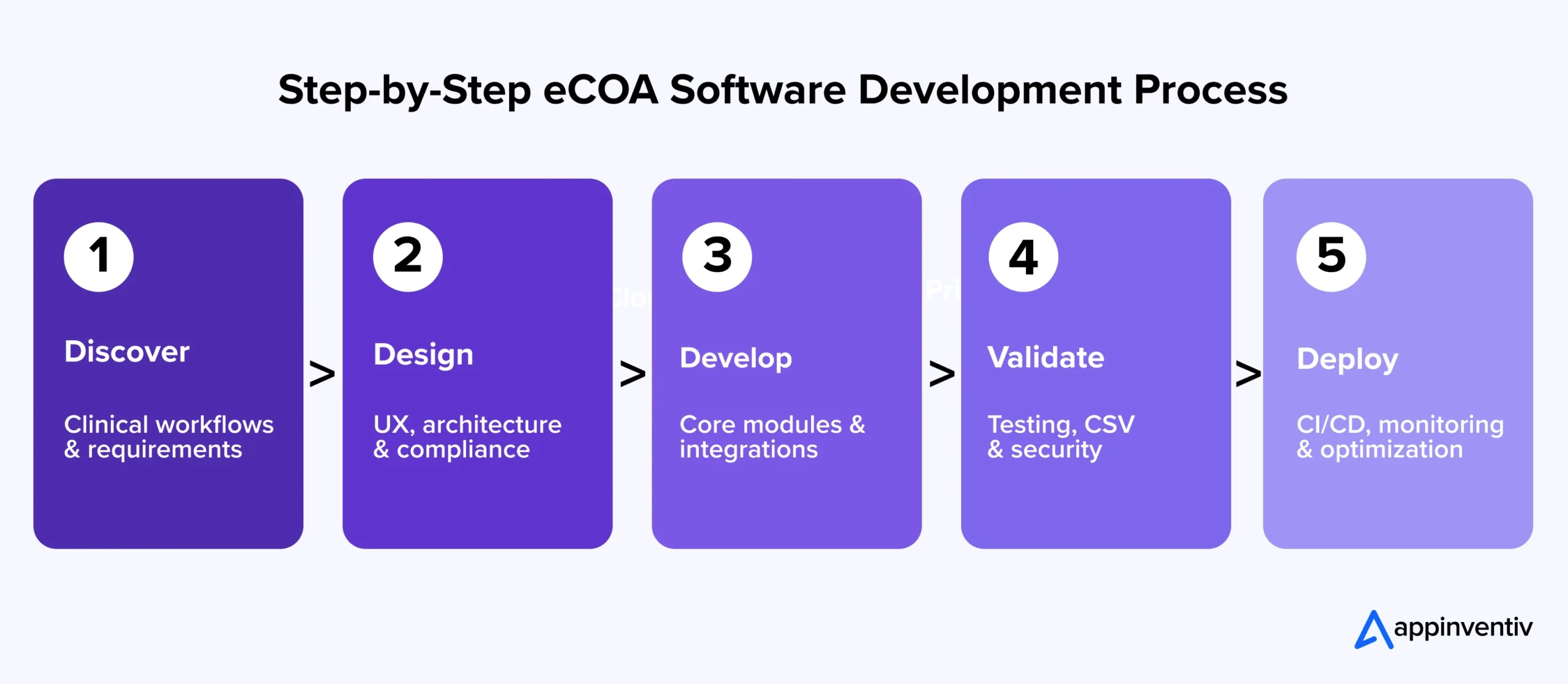
Step 1 – Discovery and Clinical Workflow Analysis
Teams that develop eCOA solutions start by reviewing trial operations rather than writing code. Product managers meet with sponsors, CROs, site staff, data managers, and regulators. They map every patient assessment directly into the trial schedule.
This stage sets core business and technical rules:
- Trial design, target endpoints, and visit schedules: Teams define when assessments trigger, how milestones are measured, and how patient visits match the study protocol.
- Assessment types including ePRO, ClinRO, ObsRO, and PerfO: Software teams plan features to support specific Clinical Outcome Assessment types based on study goals and patient populations.
- Personal device policies or provisioned hardware plans: Teams decide whether patients will use their own smartphones, study-issued hardware, or a hybrid model.
- Offline data entry rules: Teams set rules to capture survey data without internet access and sync records safely once connectivity returns.
- Translation and multi-language needs: Global studies list language needs early to support localization, cultural edits, and translated questionnaires.
- Connection points for EDC, CTMS, RTSM, eConsent, EHR, and wearables: Integration rules define how electronic clinical outcome assessment solutions share patient data across clinical trial software.
- Global regulatory obligations: Regional rules and study requirements shape data validation, security, audit logs, and electronic record management from day one.
This preparation creates product requirements, user stories, system workflows, integration maps, and a technical roadmap that guides the eCOA software development lifecycle.
Step 2- Functional and Regulatory Requirements
Regulatory compliance cannot wait for testing. Security, privacy, and validation rules guide platform design, build steps, and rollout from the start of the eCOA software development lifecycle.
Engineers define core platform features. These include custom forms, logic rules, evaluation schedules, automated alerts, reporting dashboards, audit logs, and digital signatures. They also align system rules with industry standards like FDA 21 CFR Part 11, HIPAA, GDPR, ICH E6(R3), and ALCOA+.
Teams set several key technical standards early:
- System uptime goals: Availability targets define how reliably the software runs during trials with few service drops.
- Disaster recovery plans: Recovery plans show how fast systems and data restore after network failures or power drops.
- Target response speeds: Speed benchmarks set clear response times for form loads, data posts, and API calls.
- Data encryption standards for storage and transfer: Encryption rules protect patient records in database storage and active system transfers.
- User access controls: Passwords and role-based permissions limit data access to specific staff duties.
- Data storage and archiving rules: Record retention rules dictate how long study files, audit logs, and digital forms stay in storage to pass inspection.
- Software validation requirements: Validation plans lay out the testing and documentation needed to prove that electronic clinical outcomes assessment software works accurately.
Setting these rules before coding starts prevents extra rework, speeds up validation, and protects projects from costly delays during official audits.
Step 3- Interface Design for Trial Users
Platform adoption depends on software ease of use. Confusing screens increase the risk of missed entries, incomplete forms, and protocol errors. During custom eCOA software development, designers build role-based interfaces. These layouts shorten training time and support consistent data collection throughout eCOA clinical trials.
Designers build tailored views for each user group:
- Patients: Clear screens, large buttons, translation options, offline modes, and medication alerts. These eCOA software features help participants complete forms easily. They work reliably on any device or internet connection.
- Site Staff: Fast patient registration, compliance tracking, study management tools, and live data views. Centralized dashboards help coordinators monitor participant progress, review missing assessments, and manage daily trial tasks.
- Study Managers: Tools to set up forms, visit schedules, languages, user roles, and trial workflows. Administrative controls allow study teams to configure protocols, manage users, and update study settings without changing application code.
Teams test interactive prototypes with patients, investigators, and site staff before coding begins. Early usability testing catches navigation issues and workflow gaps before engineers build the final electronic clinical outcomes assessment software.
Step 4 – Enterprise Software Architecture
Architects build the technical foundation after setting system requirements. Most enterprise platforms rely on cloud-native microservices. Independent services manage survey delivery, patient records, alerts, user access, reports, and data exchanges. This modular setup limits system failures, supports fast growth, and simplifies future updates during eCOA clinical trials.
The architecture includes:
- API gateways for external connections: Gateways route and secure data traffic between the platform and external clinical systems or third-party tools.
- Event messaging for background tasks: Asynchronous messaging processes alerts, data syncs, and scheduled jobs without slowing down screen interactions.
- Identity access management supporting OAuth 2.0, OpenID Connect, MFA, and role permissions: Access services verify users and restrict data views based on specific trial roles.
- Centralized logs for system audits: Audit logs track user actions and system events to help fix bugs and pass regulatory audits.
- Encrypted file storage: Encryption protects study files, attachments, and uploaded records during storage and file transfers.
- Database clusters with backup redundancy: Backup databases keep systems running and prevent data loss during server failures.
- Regional recovery systems: Disaster recovery systems restore study operations fast if a data center or cloud region goes offline.
Building these components early creates a firm foundation. It makes protocol changes and system updates easier to release across the eCOA software technology stack.
Step 5 – Core System Modules
Engineering teams write code in short cycles and deliver working modules for regular review. This step-by-step approach lets study leads check business requirements early and give feedback before teams start the next phase.
Key modules include:
- Survey builders with conditional logic: Study teams set up questionnaires, skip logic, required fields, and data checks without touching application code.
- Assessment scheduling engines: These systems trigger questionnaires based on clinic visits, treatment dates, or preset study events.
- Portals for patients and clinical sites: Custom portals help patients fill out surveys while doctors track study progress and participant completion rates.
- Alert systems for text messages, emails, and app notifications: Automated alerts remind patients about upcoming surveys and notify site staff when a patient needs help.
- Offline data sync engines: Surveys filled out without internet access stay safe on the device and sync automatically once a connection returns.
- Audit log systems: The platform records every user action and data edit to maintain clear history across all eCOA clinical trials.
- Language and translation controls: These tools manage multi-language forms and keep assessments consistent across international study sites.
- Reporting dashboards: Dashboards offer live views into patient completion rates, trial progress, and daily operational numbers.
- Admin consoles: Administrative tools control users, roles, study settings, and platform setup from one central dashboard.
- Device management tools: These features register, set up, track, and support both patient smartphones and study-issued hardware.
Flexible eCOA software features allow trial teams to update forms and schedules without writing new source code. This design makes protocol changes much easier to roll out during active trials.
Step 6 – Integration with External Clinical Systems
An enterprise eCOA tool never operates in isolation. It links directly with clinical software to move patient records securely across platforms. Engineers build integrations that share data with EDC, CTMS, RTSM, eConsent, lab systems, telehealth platforms, wearables, and health record databases.
Key integration technologies include:
- REST APIs: Standard APIs share patient records, survey results, and trial data across connected clinical tools.
- HL7 FHIR integrations: FHIR protocols support standardized health data exchange, simplifying connections with hospital databases during eCOA clinical trials.
- Webhooks: Automated alerts send instant updates as soon as patients finish surveys or trial events occur.
- Message brokers: Background messaging keeps records updated across multiple platforms without slowing down screen performance.
These tools synchronize patient records, study milestones, and trial results in real time. Direct links stop duplicate data entry, improve record accuracy, and cut operational errors across modern electronic clinical outcome assessment solutions.
Step 7 – Software Validation and Testing
Software testing serves as a central stage in the eCOA software development lifecycle. Enterprise platforms must perform reliably during eCOA clinical trials while meeting strict regulatory standards.
Validation activities include:
- Unit testing: Engineers test individual software units to verify that each piece works correctly.
- Integration testing: QA teams test connected modules to confirm accurate data flow across the platform.
- System testing: Testers review the complete application to verify end-to-end workflows before release.
- Load and performance testing: Engineers test the platform under high traffic to measure speed, stability, and system limits.
- Security testing: Specialists review login rules, data encryption, access controls, and security risks to protect patient data.
- Accessibility checks: Designers test screens to confirm that participants with varied physical needs can complete surveys easily.
- User Acceptance Testing (UAT): Sponsors, CROs, and study leads check that the software meets protocol rules and trial needs.
- Computer System Validation (CSV): Validation teams confirm that the electronic clinical outcomes assessment software works consistently according to written guidelines.
- Installation Qualification (IQ): Tech teams verify that the platform runs correctly in the target cloud or server setup.
- Operational Qualification (OQ): Testers confirm that the platform runs properly under specified trial conditions.
- Performance Qualification (PQ): Teams evaluate the software during live or simulated trials to prove long-term stability.
Engineers link user requirements, test files, code bugs, and validation logs in a single record. This documentation helps pass regulatory audits, supports software updates, and speeds up future study launches.
Step 8 – Deployment and Long-Term Operations
System deployment starts live operations. It does not mark the end of engineering work. Teams launch applications with automated CI/CD pipelines, infrastructure templates, container tools, and continuous monitors. These practices cut release errors and simplify software updates across study sites.
Operations teams track system health, data syncs, API speeds, user compliance rates, and security logs through central dashboards. User feedback guides future updates. The platform adapts as protocol rules, legal standards, and trial methods change over time.
Also Read: How to Prepare a Clinical Mobility Solution for Long-Term Success
Enterprise Architecture of an eCOA Platform
Enterprise eCOA platforms store patient records across global trials. A modular setup splits software functions into separate parts. This layout protects clinical data, simplifies updates, and prevents full system crashes.
- Presentation Layer: Shows custom screens to patients, doctors, site staff, and administrators. It handles survey forms, multiple languages, and offline entries. It sends data safely through API links.
- Application Services Layer: Runs daily operations like patient enrollment, survey delivery, alerts, and reports. Each service operates independently. Teams add features without breaking existing tools.
- Clinical Workflow Engine: Manages study rules, visit dates, logic jumps, form sequences, and protocol updates. It splits study rules from application code. This makes protocol changes fast and simple.
- Integration Layer: Connects the software to EDC, CTMS, IRT, eConsent, EHR, lab tools, and wearables. It standardizes data formats and protects core code from external software bugs.
- Data Management Layer: Stores survey answers, patient files, audit logs, and settings. It separates live daily activity from heavy reporting. This split maintains fast system speeds.
- Security and Identity Layer: Verifies user logins, grants access rights, encrypts files, and records digital signatures, forming the backbone of healthcare data security. It satisfies FDA 21 CFR Part 11, HIPAA, GDPR, and ALCOA+ rules.
- Cloud Infrastructure Layer: Supplies servers, storage, network access, and system backups. It adds power during peak usage and keeps uptime high across trial sites.
Also Read: How to Choose a Reliable Healthcare Cloud Provider
Technology Stack for eCOA Software Development
Your tech choices dictate how eCOA software features run under actual trial pressure. They shape app speeds, system uptime, data protection, and long-term costs. Engineering teams pick proven eCOA software technology frameworks. Auditors can review them without friction.
| Technology Layer | Recommended Tools |
|---|---|
| Frontend | React, Angular, Vue.js |
| Backend | Java Spring Boot, ASP.NET Core, Node.js (NestJS), Python (FastAPI) |
| Mobile Development | Flutter, React Native, Swift (iOS), Kotlin (Android) |
| Databases | PostgreSQL, Microsoft SQL Server, MongoDB, Redis |
| Cloud Infrastructure | AWS, Microsoft Azure, Google Cloud Platform (GCP) |
| API & Integration | REST APIs, GraphQL, HL7 FHIR, SMART on FHIR, Webhooks |
| Security & Identity | OAuth 2.0, OpenID Connect, Keycloak, Okta, Auth0, TLS 1.3, AES-256 |
| Analytics & Reporting | Power BI, Tableau, Apache Superset, Elasticsearch, Kibana |
| Monitoring & Observability | Prometheus, Grafana, ELK Stack, Datadog, Amazon CloudWatch |
| CI/CD & DevOps | GitHub Actions, GitLab CI/CD, Jenkins, Docker, Kubernetes, Terraform |
Trial size, patient numbers, and local laws guide these decisions. Large drug companies standardize their tools across existing cloud providers and security setups. Using set tools reduces testing work and keeps maintenance costs manageable across global studies.
Core Features of Enterprise eCOA Software
Enterprise eCOA platforms serve patients, site investigators, operations teams, and administrators. Patients need clear ways to complete study forms. Investigators need live trial progress. Administrators control security, compliance, and daily software tasks. These core capabilities form the foundation of enterprise eCOA software development.
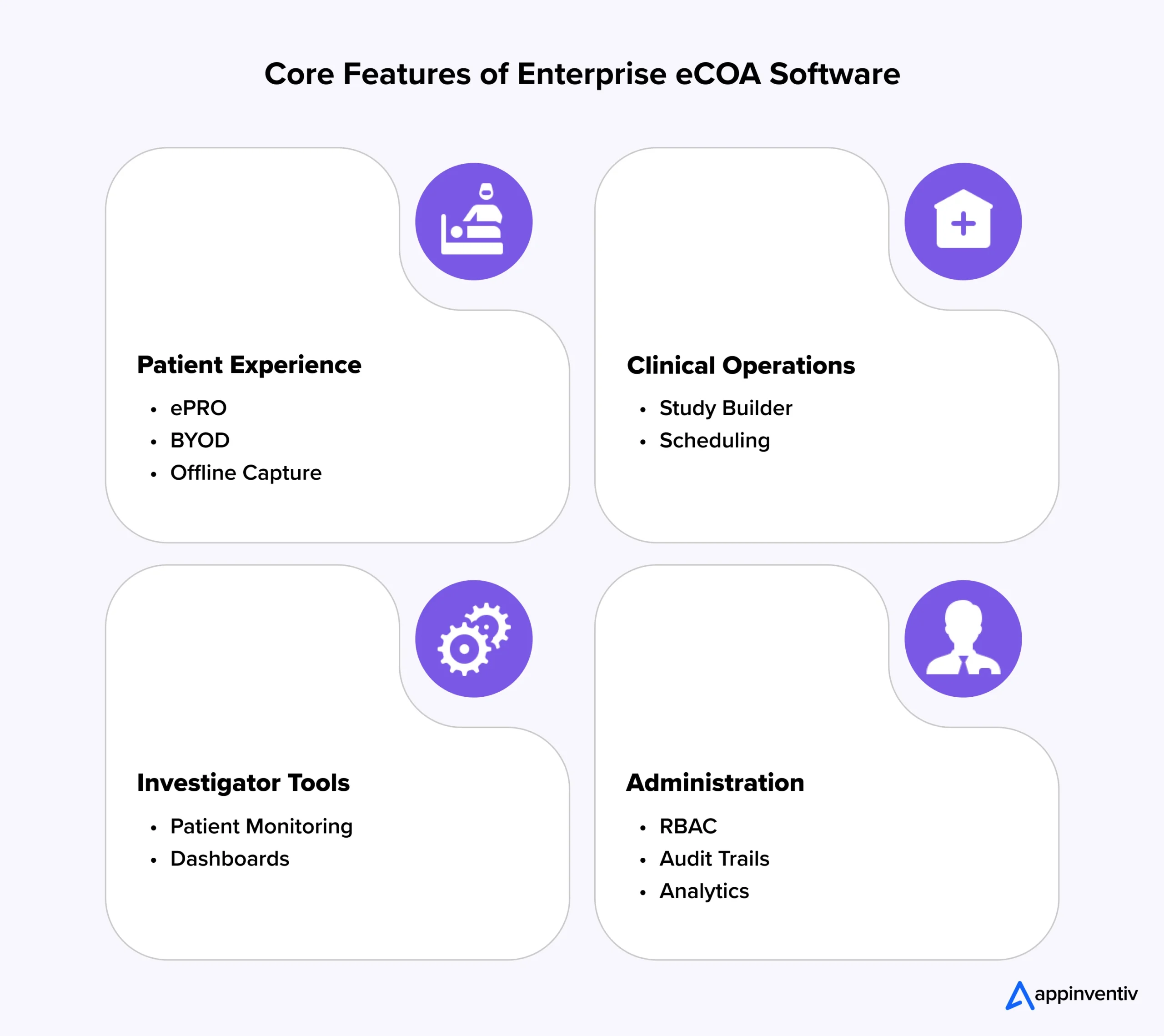
Patient Experience
The patient app keeps form completion simple and reliable on any device or network connection. This focus reflects market demand, with Electronic Patient-Reported Outcomes (ePRO) accounting for 48.45% of the eCOA market just last year.
- Electronic Patient-Reported Outcomes (ePRO): Participants fill out digital survey forms directly on mobile screens or web browsers.
- Offline Data Capture: The app saves answers locally without internet access. It automatically uploads saved entries upon network reconnection.
- Bring Your Own Device (BYOD): Participants run the app on personal iOS and Android phones. This option removes the need for extra trial hardware.
- Automated Reminders: System alerts reach patients through push notifications, text messages, or email. These messages keep daily entries on schedule.
- Accessibility Tools: The software offers multi-language options and WCAG-compliant layouts. These design choices help elderly or visually impaired participants complete forms easily.
Clinical Operations
Clinical operations teams need setup tools to build studies and manage survey steps without writing custom code.
- Study Builder: Operations teams configure trial protocols, visit schedules, and study milestones in a single interface.
- Questionnaire Builder: Teams build survey forms using pre-made templates and translation tools.
- Branching Logic: Forms display targeted follow-up questions based on previous answers.
- Assessment Scheduling: The system automates trial visits, recurring surveys, and reminder triggers based on protocol rules.
Investigator Tools
Investigators and site coordinators need fast access to participant records and study timelines.
- Patient Monitoring: Site staff track participant survey completion, visit attendance, and protocol adherence.
- Compliance Dashboards: Dashboards display protocol deviations and site completion rates in clear visual layouts.
- Clinical Data Review: Site teams verify patient answers, clear data flags, and resolve discrepancies quickly.
Administration and Governance
Admin features protect platform security, support compliance, and maintain control across global studies.
- Role-Based Access Management (RBAC): Admins set specific system rights for each user role and restrict sensitive data views.
- Audit Trails: The system records all user actions, system edits, and timestamped entries in unalterable logs.
- Reporting and Analytics: Analytics dashboards track trial operations, site performance, and data timelines across all study sites.
- AI-Assisted Data Validation: This growing use of AI in healthcare means algorithms flag missing entries, unusual data patterns, and protocol deviations before final processing.
These role-based capabilities connect patients, clinical staff, site investigators, and platform admins within one central system. This design preserves data accuracy and satisfies global regulatory requirements.
Enterprise Use Cases of eCOA Software Across Clinical Research
eCOA software fits many clinical research programs, from single-site trial designs to 50-country Phase III studies. Configurable forms and direct data collection adapt to different trial setups and strict study requirements. How does eCOA adapt across medical fields? The software addresses unique operational demands across major research areas.
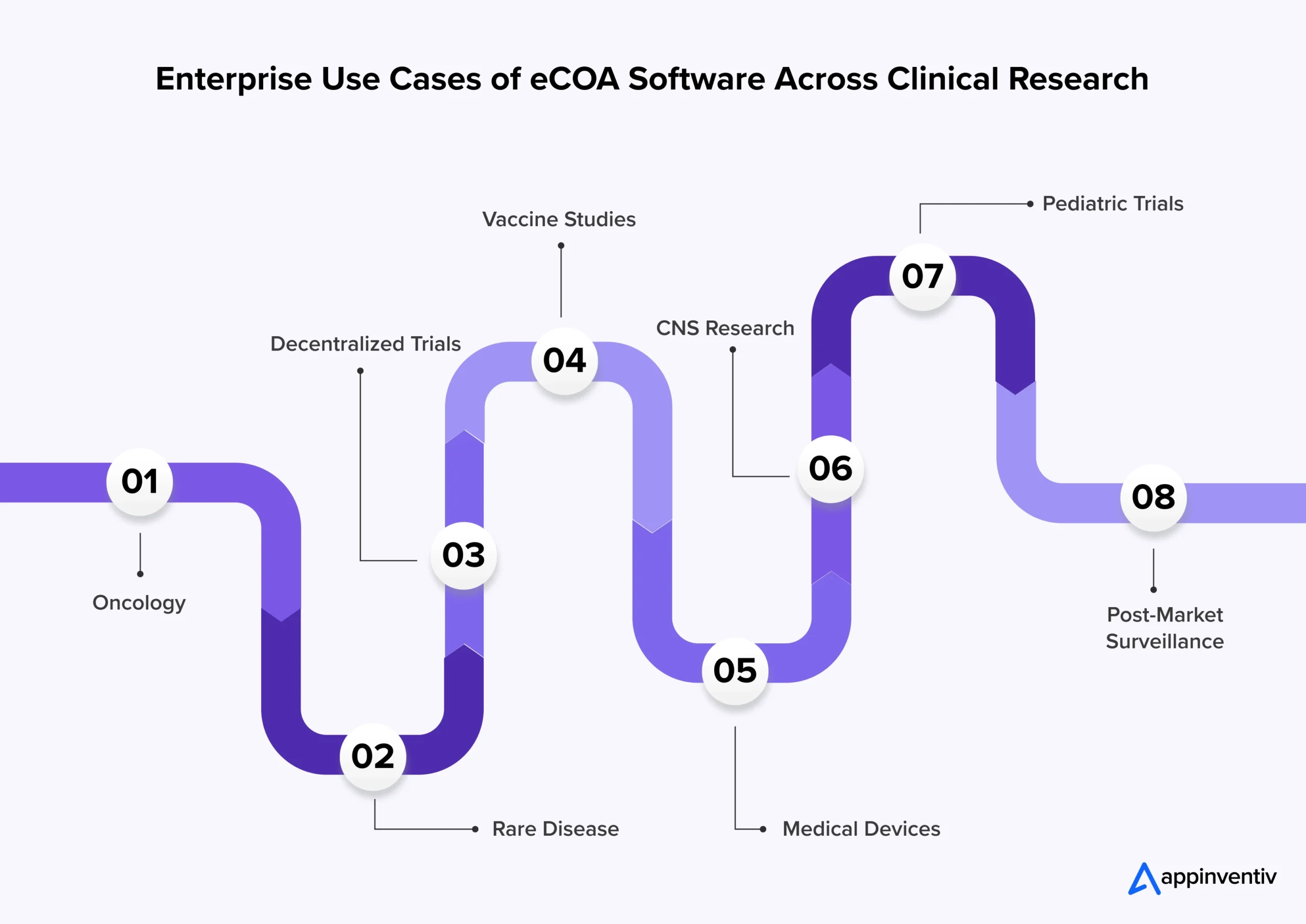
Oncology Clinical Trials
Cancer research studies last for months or years. Patients experience side effects, pain peaks and unexpected daily fluctuations between visits to the health centre. eCOA clinical trials in oncology enable participants to complete validated patient-reported outcome instruments such as PRO-CTCAE for treatment-related symptom monitoring and SF-36 (Short Form Health Survey) for quality-of-life assessment between site visits.
Disease monitoring and treatment plans are continually monitored and adjusted without waiting for quarterly visits to the clinic. AI in clinical trials can analyze patient-reported outcomes, identify unusual symptom patterns, and support faster clinical decision-making for investigators.
Rare Disease Research
Rare disease studies often recruit fewer than 100 participants across 20 countries. Distance makes site visits difficult for frail patients. Remote eCOA forms let participants submit clinical data in native languages from home. Sponsors develop eCOA solutions that collect complete patient records without forcing frequent travel.
Machine learning models also identify participants who are likely to miss future assessments, allowing site teams to intervene before missing data affects study endpoints.
Decentralized Clinical Trials
Remote trials eliminate reliance on physical hospital visits. eCOA connects with video health tools, heart monitors, eConsent portals, and remote tracking sensors. Patients submit survey entries on local phones, while site teams review live data from a central dashboard.
AI-powered validation reviews incoming responses, flags incomplete or inconsistent records, and reduces the time spent on manual data verification.
Industry forecasts suggest decentralized clinical trials could eliminate up to 80% of traditional research sites by 2028, increasing the need for robust eCOA platforms that support fully remote study execution.
Vaccine Studies
Vaccine-focused eCOA clinical trials require strict reporting across 7-day or 14-day observation windows. Participants track fever levels, arm swelling, and fatigue daily. Automated phone alerts prompt participants at 8:00 AM every morning.
Daily reporting rates stay high, and AI models monitor incoming reports for unusual adverse event patterns, helping safety teams investigate potential risks much sooner.
Medical Device Clinical Studies
Device trials evaluate physical product safety alongside clinical metrics. Participants and investigators record device usability, technical performance, and treatment outcomes using Performance Outcome (PerfO) measures such as the Six-Minute Walk Test (6MWT) where mobility is a primary endpoint.
Built on compliant medical device software, direct entry cuts paper errors and confirms accurate compliance data for FDA 510(k) submissions. Automated validation engines review incoming device readings and patient assessments before they move into downstream clinical systems, reducing manual verification effort.
CNS and Mental Health Research
Neurological and psychiatric studies commonly use validated instruments such as the Columbia-Suicide Severity Rating Scale (C-SSRS) and Clinical Global Impression (CGI) scales alongside patient mood diaries and cognitive assessments. eCOA platforms digitize these assessments and maintain consistent data collection across long-term studies.
Patients are asked to fill out cognitive testing and mood diaries via touchscreen tablet once a week. The system follows symptoms over 12-month study periods without gaps in survey completion. Some platforms also support voice-based reporting, and generative AI in healthcare can summarize longitudinal patient histories before investigator review.
Pediatric Clinical Trials
Childhood disease studies collect data from both young patients and parents. The platform supports validated observer-reported instruments such as the Pediatric Quality of Life Inventory (PedsQL), allowing parents and caregivers to submit standardized quality-of-life assessments alongside simplified visual surveys for children.
Automatic reminders keep families on schedule and prevent missed trial visits. Predictive adherence models highlight families at risk of missing future assessments, allowing study coordinators to follow up before compliance declines.
Post-Market Surveillance and Real-World Evidence
Data collection is ongoing after regulatory approval. Drug manufacturers leverage eCOA apps to monitor safety, treatment adherence, and patient quality of life using standardized instruments such as EQ-5D during long-term follow-up after product launch.
These are real-world data to feed into post-market safety monitoring and future regulatory submissions. These real-world datasets also help AI identify long-term safety trends, summarize patient outcomes, and support post-market surveillance throughout the product lifecycle.
Benefits of Custom eCOA Software Development
Custom eCOA software gives drug makers, CROs, and medical device teams full control over daily trial operations. Off-the-shelf platforms force research teams to alter study designs to fit software limits. Custom tools adapt directly to your protocols, legal requirements, and long-term digital plans. This flexibility delivers clear financial and operational gains throughout the trial lifecycle.
Cleaner Trial Data
Custom validation checks and automated edits stop data errors at entry. The software pairs digital audit logs with standard forms to reduce mistakes. Clean entries speed up regulatory reviews and protect data accuracy.
Higher Patient Retention
Custom alerts, offline survey forms, personal device choices, and clear screens help patients complete daily entries on time. Fewer missed visits give your team complete, consistent survey records.
Shorter Database Lock Timelines
Live data sync and direct connections to Electronic Data Capture tools eliminate manual data cleanup. The system flags bad entries right away. Teams resolve data questions faster. This cuts weeks off database lock timelines and speeds up final statistical reports.
Easy Protocol Updates
Mid-study protocol changes occur in almost every trial. Custom platforms allow quick updates to survey forms, visit calendars, and trial rules. Engineers do not need to rebuild base application code. You save development time and prevent site delays.
Direct System Connections
Custom software connects directly to CTMS, EDC, RTSM, eConsent, lab databases, and patient wearables. A unified software setup stops double data entry. Project leaders gain a clear view of trial operations across all sites.
Lower Long-Term Costs
Custom engineering requires higher upfront spending. You eliminate annual subscription fees, vendor change order charges, and software locks. Over several years, owning your platform costs less than paying recurring user licenses across multiple trial programs.
Global Trial Expansion
A single custom system runs multiple studies across dozens of countries, languages, and legal systems. Your research pipeline expands over time. You add new trial features and sites without replacing the core software framework.
Integrating eCOA with the Clinical Trial Ecosystem
eCOA clinical trials work best when the platform connects directly to your clinical software. Isolated tools create separate data piles and force extra work. Enterprise systems share data with other software instantly. Direct connections eliminate manual data entry, cut operational errors, and give study teams a complete view of participant progress.
Common system connections include:
- Electronic Data Capture (EDC): Sends finished patient forms and study records to a central database for clinical review.
- Clinical Trial Management Systems (CTMS): Syncs study timelines, site details, patient enrollment counts, and site tasks automatically.
- Randomization and Trial Supply Management (RTSM/IRT): Coordinates patient grouping, drug assignments, and site supplies without extra steps.
- eConsent Platforms: Links signed consent forms directly to patient profiles and study timelines.
- Electronic Health Records (EHR): Shares patient health records with hospital databases through standards like HL7 FHIR.
- Wearable Devices: This healthcare wearable technology collects daily health measurements, including step counts, heart rates, sleep patterns, and digital biomarkers.
- Laboratory Information Systems (LIS): This LIMS software imports lab results automatically to match patient survey responses.
- Telemedicine Platforms: Built on the same telemedicine app development principles, these support virtual check-ins and remote patient assessments for decentralized and hybrid trials.
This level of interoperability also reduces manual work, an important improvement considering clinical trial data managers lose around 12 hours every week to manual tasks that can affect data quality. Your trial data stays accurate and synchronized across every phase of the study.
Unify EDC, CTMS, eConsent, FHIR, and AI into one enterprise platform before fragmented systems slow your next trial.
Regulatory Compliance and Validation Requirements
Compliance forms the backbone of clinical software. Engineers design controls directly into the core system architecture. Early compliance design cuts software re-testing time. It speeds up regulatory audits.
| Category | Details/Standards |
|---|---|
| Core Global Standards |
|
| Data and Validation Guidelines |
|
| System Safety Controls |
|
Built-in security tools protect study data. They keep trials ready for regulatory audits.
How Much Does eCOA Software Development Cost?
The cost to build an eCOA system depends on feature depth, legal rules, software connections, and cloud setups. A simple pilot app costs far less than a global system with AI tools and enterprise links.
| Platform Complexity | Estimated Cost (USD) | Estimated Timeline | What’s Included |
|---|---|---|---|
| Basic eCOA System | $50K to $120K | 3 to 5 months | ePRO questionnaires, patient portal, basic scheduling, reminders, offline data capture, secure authentication, and EDC integration. Best for pilot studies or single-country trials. |
| Mid-Level eCOA System | $120K to $250K | 5 to 8 months | Everything in the Basic tier, plus ClinRO, ObsRO, multilingual support, configurable workflows, CTMS and eConsent integrations, analytics dashboards, and BYOD support. Suitable for multi-site Phase II and III studies. |
| Enterprise eCOA System | $250K to $500K+ | 8 to 15+ months | Full-featured platform with ePRO, ClinRO, ObsRO, PerfO, AI-assisted validation, advanced analytics, HL7 FHIR interoperability, RTSM/IRT, EHR integration, wearable connectivity, multi-region deployment, role-based security, audit trails, and regulatory validation support. Designed for global enterprise clinical trials. |
Main Factors Driving Costs
Your overall investment changes with several of the technical and operational decisions.
- Unique User Roles and Additional System Modules: Greater development hours for adding unique user views and additional software modules.
- Study Workflows and Survey Logic: Complex skip logic and protocol branching, custom schedules, and other requirements require additional coding.
- Third Party Integrations: The time required to integrate with EDC, CTMS, EHR, RTSM, and eConsent tools.
- Regulatory Rules and System Testing: Validating software for FDA 21 CFR Part 11 and local laws expands testing budgets.
- Offline Sync and Personal Devices: Engineering complexity is added by supporting offline entry and BYOD mobile apps.
- Specialized engineering for AI and Advanced Analytics: Automated validation, predictive algorithms and smart reporting.
- Multi-Language Support: Locale engines and translation management add to initial build costs.
- Cloud Infrastructure and Backups: Auto-scaling servers, regional data storage and disaster plans increase hosting costs.
- Long-term Platform Improvement, Bug Fixing, and Technical Support: These are ongoing tasks that necessitate budgets for platform improvements, bug fixes, and technical support.
Custom eCOA Software vs. Off-the-Shelf Platforms
Pre-built eCOA platforms launch quickly, but many teams still choose custom eCOA software development for complex protocols. They fit standard trials with simple needs. Custom software serves teams running complex protocols across multiple studies, unique legal environments, or custom technology networks.
| Feature | Custom eCOA Software | Pre-Built eCOA Platform |
|---|---|---|
| System Control | Built to match your specific trial rules and workflow goals. | Limited to vendor settings and standard features. |
| Compliance Rules | Matches your internal audit processes and local regulations directly. | Restricted by pre-set compliance options. |
| System Connections | Connects directly to existing software, databases, and site tools. | Depends on vendor support and pre-made connectors. |
| System Growth | Expands across studies, locations, and user bases without extra license fees. | Requires higher plan tiers or paid platform upgrades. |
| Code Ownership | You own the application code and full platform architecture. | Vendor controls the product roadmap, features, and pricing. |
| Financial ROI | Higher initial build investment with lower long-term operating costs. | Lower starting cost with recurring annual subscription fees. |
| Platform Upkeep | Managed by internal engineers or your chosen build team. | Handled entirely by the software vendor. |
Research organizations building multi-year study pipelines often select custom software. Direct code ownership and operational freedom outweigh the initial development costs.
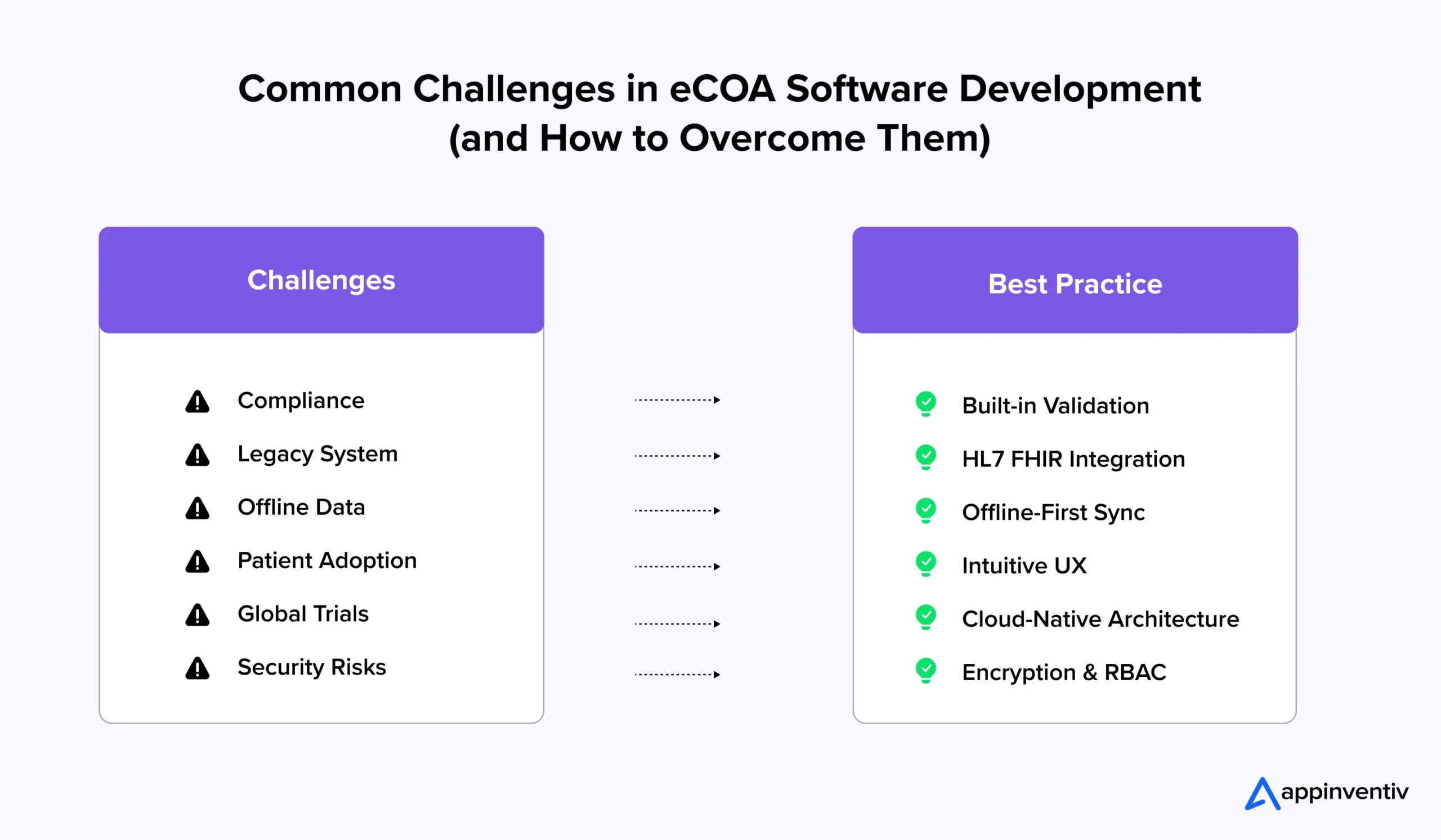
Common Challenges in eCOA Software Development (and How to Overcome Them)
Building enterprise eCOA software involves more than writing code. Engineering teams must manage regulatory rules, global trial logistics, software connections, and user adoption. Identifying these friction points early cuts deployment risks and protects data quality.
Maintaining Regulatory Compliance
The Challenge: Trial software must follow FDA 21 CFR Part 11, HIPAA, GDPR, and ICH E6(R3) rules. Non-compliance delays trial approvals and official regulatory submissions.
The Solution: Engineers build compliance directly into software architecture. Standard security features include digital signatures, audit logs, role permissions, data encryption, and risk-based testing under Computer Software Assurance (CSA) rules.
Managing Global Localization
The Challenge: International trials require multi-language questionnaires, regional date formats, local regulations, and translated forms.
The Solution: Build a flexible translation framework. This tool handles multiple languages, regional settings, and country-specific configurations without changing source code.
Offline Data Synchronization
The Challenge: Trial participants often fill out forms without internet access. Weak synchronization causes missing entries or duplicate records.
The Solution: Use an offline-first mobile design. The app saves entries in encrypted local storage, syncs data automatically upon reconnection, and resolves data conflicts instantly.
Connecting Legacy Systems
The Challenge: Sponsors and CROs often run separate healthcare legacy systems, including EDC, CTMS, RTSM, EHR, and laboratory tools. Connecting these tools takes time and creates technical bottlenecks.
The Solution: Use standard REST APIs, HL7 FHIR protocols, middleware, and modular connectors. Standardized tools simplify data transfers and cut custom coding work.
Patient Adoption and Usability
The Challenge: Confusing app screens and long survey forms lead to missed entries and incomplete trial records.
The Solution: Design clear screens with simple controls. Support personal devices (BYOD), offline entries, and automated text reminders to keep daily completion rates high.
Scaling Multi-Country Trials
The Challenge: Adding international trial sites increases patient counts, user roles, languages, and regulatory rules.
The Solution: Deploy a cloud-native architecture, informed by best practices in cloud computing healthcare, with flexible server scaling, independent microservices, and central study controls. This foundation handles growth without requiring system overhauls.
Security and Privacy Protection
The Challenge: eCOA systems in healthcare store personal health records, making them targets for cyber threats and unauthorized access.
The Solution: Proven healthcare cybersecurity solutions protect data with end-to-end encryption, multi-factor logins, role-based access limits, live security tracking, vulnerability checks, and immutable audit logs.
Modern clinical trials need platforms built for AI, decentralized studies, global compliance, and continuous protocol evolution.
Future Trends in eCOA Software Development
Next-generation eCOA systems focus on automated tasks, continuous patient tracking, and direct data links across trial software. These shifts cut daily administration costs, improve data accuracy, and support flexible trial protocols.
- Agentic AI: Autonomous AI agents handle study setups, read protocol documents, draft patient messages, and review entry logs. These tools perform routine operational tasks across study workflows without constant human intervention.
- Digital Biomarkers: Software pairs patient questionnaire answers with live physical metrics from linked devices. Combining survey responses with heart rate or movement data provides a complete picture of patient health.
- Passive Data Collection: Mobile apps collect health metrics directly from phones and body sensors in the background. Patients spend less time answering daily survey prompts, while site teams receive continuous objective data.
- Wearable-Driven Endpoints: Smartwatches, skin patches, and medical sensors measure primary and secondary trial outcomes. Continuous sensor data gives regulatory review boards clear proof of treatment safety and efficacy.
- FHIR-Native Platforms: Built-in HL7 FHIR standards support healthcare interoperability, connecting eCOA apps directly to hospital records, eConsent portals, and lab systems. Open data standards permit fast data transfers between separate clinical tools.
- Adaptive Clinical Trials: Live patient entries allow study managers to adjust dose groups, shift cohort sizes, and alter study rules on the fly. Teams modify active trials without stopping site operations or losing data flow.
- Edge AI: Machine learning algorithms run directly inside smartphone apps. Local AI checks survey entries, flags bad data, and runs safety rules without needing an active cloud connection.
- Real-World Data Integration: Enterprise platforms merge study survey results with hospital records, insurance claims, disease registries, and sensor logs. Combining these sources creates solid real-world evidence for regulatory filings and market access reviews.
How Can Appinventiv Help You Build a Secure, Scalable, and Compliant eCOA Platform?
Building an enterprise eCOA platform requires technical depth and clinical knowledge. Your software team must understand trial workflows, legal standards, data formats, and cloud security.
Appinventiv combines healthcare domain expertise with cloud engineering, custom AI tools, and healthcare solution development services. We build compliant, scalable digital health platforms for pharmaceutical sponsors, CROs, and MedTech companies.
Our engineering teams support every phase of product development. We handle product strategy, system architecture, compliant coding, software integration, rollout, and long-term updates. Whether you need a custom eCOA system built from scratch or want to upgrade an existing clinical setup, we deliver software built for your operational goals.
What Sets Our eCOA Engineering Approach Apart
- Specialized healthcare engineering: Our software engineers focus entirely on life sciences. We build compliant digital health software for pharmaceutical, MedTech, and biotechnology firms.
- Regulatory-first development: We build compliance rules into your software from day one. Our workflows follow FDA 21 CFR Part 11, HIPAA, GDPR, ICH E6(R3), and Computer System Validation standards.
- Broad system connectivity: We link your eCOA software technology with the rest of your study software. Our teams build data links across HL7 FHIR, EDC, CTMS, eConsent, EHR databases, and wearable sensors.
- Full product ownership: We manage the entire product journey when you build eCOA System infrastructure. Our team handles technical strategy, software design, deployment, updates, and long-term engineering support.
Proven Operational Impact
- 500+ digital health platforms delivered globally
- 10,000,000+ clinical data points processed annually
- 92% patient survey completion rate across supported apps
- 45% reduction in care coordination delays
- 3x faster patient registration and onboarding
- 38% drop in assessment processing times using AI tools
- 32% increase in patient engagement via multi-language support
We engineer software for high performance, regulatory compliance, and long-term scalability. Our platforms feature automated data validation, HL7 FHIR connections, cloud infrastructure, and enterprise security.
Ready to build a custom eCOA platform for your clinical programs? Contact our eCOA software development team today to discuss your project setup.
Frequently Asked Questions
Q. What is eCOA software?
A. eCOA software replaces paper questionnaires in clinical trials. Patients, doctors, and caregivers enter study data directly into tablets, phones, or web portals. The software captures ePRO, ClinRO, ObsRO, and PerfO entries right at the source. Direct data entry removes typing mistakes and cuts query backlogs. Research teams view patient progress immediately on central dashboards. Live tracking helps study leads catch compliance drops early and keep trials running on schedule.
Q. Why are compliance and testing essential in eCOA software development?
A. Regulators reject trial results if software security fails or patient data shows gaps. Testing verifies that electronic signatures, audit logs, data encryption, and access rights function properly under real study conditions. Engineering teams run system validation checks to align software with FDA 21 CFR Part 11, HIPAA, GDPR, and ICH E6(R3) mandates. Thorough testing prevents system outages and stops regulatory rejections. Built-in compliance controls protect patient privacy while giving auditors clear proof of data accuracy.
Q. How does eCOA software work in clinical trials?
A. Participants and clinical staff download the app onto personal phones or provisioned trial devices. Users complete scheduled health surveys directly on touchscreen displays. The app runs instant data validation checks to catch missing answers or conflicting inputs immediately. Saved data syncs automatically with central EDC and CTMS databases when connected to the internet. Study teams monitor compliance metrics, track patient visits, and review trial results in real time through web portals.
Q. How Much Does It Cost to Develop Custom eCOA Software?
A. Building electronic clinical outcome assessment solutions costs between $50,000 for a basic pilot platform and $500,000 or more for an enterprise global system. Your total investment shifts based on feature complexity, compliance validation needs, and custom software connections. Supporting offline data sync, personal devices, multi-language translation engines, and automated AI validation rules increases engineering hours. Ongoing cloud hosting, software updates, and technical maintenance also affect your long-term operational budget.
Q. How secure is patient data in eCOA systems?
A. Enterprise electronic clinical outcome assessment software guards patient information through multi-layered security protocols. Developers use end-to-end encryption for stored records and active network transfers. User logins require multi-factor authentication and strict role permissions. Unalterable audit trails record every system action, data edit, and digital signature with exact timestamps. Continuous security scans, penetration tests, and strict alignment with HIPAA, GDPR, and FDA rules protect sensitive patient files against cyber threats and unauthorized access.


Fast 2-minute response, fully NDA-protected.

Wearable Data Integration: Connecting Multiple Devices to a Unified Health Platform
Key takeaways: Device support should reflect the measurements your service needs, the people using it, and the decisions those readings inform. A unified health data platform must preserve source, timing, and measurement context while resolving duplicate records. Phone health platforms, manufacturer APIs, and direct device connections serve different integration needs. Clinical workflows require agreed review…

Sleep Tracker App Development: Features, Wearable Integration, AI, and Compliance
Key takeaways: Sleep tracking presents opportunities across consumer wellness, fitness, healthcare, employee wellness, senior care, and infant-care markets. Successful products combine actionable insights, wearable connectivity, user-friendly reports, privacy controls, and clearly differentiated experiences. HealthKit, Health Connect, and direct device APIs provide different data depths, costs, limitations, and maintenance requirements. AI supports sleep-stage estimation and personalization,…

Diet and Nutrition App Development: Process, Features, Cost, and Technology Stack
Key Takeaways Diet and nutrition tracking app development goes past basic calorie counters with verified food databases, custom meal schedules, AI tools, wearable device links, and corporate manager tools. Structure database models around raw food items, serving portions, nutrient facts, recipes, software links, and regional diet rules. Pair computer vision models, recommendation algorithms, language engines,…