


















Sleep Tracker App Development: Features, Wearable Integration, AI, and Compliance

 Share -


- 01Why Sleep Tracker App Development Is a Promising Investment
- 02Why Businesses Are Investing in Sleep Monitoring Products
- 03Features That Make a Sleep Tracking Product Valuable
- 04How Wearable Integration Works in a Sleep Tracking App
- 05The Role of Role of AI in Sleep Tracker App Development
- 06Technology Stack Required to Build a Sleep Tracking App
- 07Step-by-Step Sleep Tracker App Development Process
- 08Compliance Requirements for Sleep Tracker App Development
- 09A Brief Glimpse into the Sleep Tracker App Development Cost
- 10Major Challenges in Sleep Tracker App Development
- 11Future Trends Shaping Sleep Tracker App Development
- 12How Appinventiv Can Help Build a Future-Ready Sleep Tracking App
- 13FAQs

Key takeaways:
- Sleep tracking presents opportunities across consumer wellness, fitness, healthcare, employee wellness, senior care, and infant-care markets.
- Successful products combine actionable insights, wearable connectivity, user-friendly reports, privacy controls, and clearly differentiated experiences.
- HealthKit, Health Connect, and direct device APIs provide different data depths, costs, limitations, and maintenance requirements.
- AI supports sleep-stage estimation and personalization, but businesses must validate its accuracy and govern health-related recommendations.
- Product claims determine whether an application remains a wellness solution or enters regulated medical-device territory.
- Development costs can range from $40,000 for a focused MVP to over $500,000 to $1 million for a regulated clinical platform.
Sleep is no longer tracked only by noting bedtime and wake-up time. Smartphones, smartwatches, rings, mattress sensors, and connected health platforms can now capture movement, heart rate, heart rate variability, respiratory rate, blood oxygen trends, skin temperature, and nighttime sounds. Together, these signals help digital products estimate how long a person slept, when interruptions occurred, and how sleep patterns changed over time.
This growing data ecosystem has created a strong opportunity for healthcare providers, wellness brands, employers, researchers, device manufacturers, and digital health startups. However, turning raw sensor readings into a trusted product is far more complex than building a dashboard. The product must collect data reliably overnight, reconcile information from different devices, communicate uncertainty, protect sensitive health information, and provide guidance without making unsupported medical claims.
That is why sleep tracker app development requires product strategy, signal-processing knowledge, wearable integration, AI governance, security engineering, and regulatory planning from the beginning. A technically impressive app can still fail if users do not understand its scores, batteries drain overnight, synchronization breaks, or privacy terms allow data use that users never expected.
This blog explains how sleep tracking products work, which features create real value, how wearables and AI fit into the architecture, what compliance obligations businesses should consider, and how to take the product from concept to launch.
Validate the product architecture, wearable ecosystem, compliance scope, and commercial model before committing development capital.
Why Sleep Tracker App Development Is a Promising Investment
Sleep tracking has grown from a basic wellness feature into a significant connected-health opportunity. The fitness tracker for sleep monitoring market was valued at approximately $7 billion in 2025 and is projected to reach $23.1 billion by 2033, growing at a CAGR of 15.8%, according to Grand View Research.
The demand is supported by a widespread health concern. The National Heart, Lung, and Blood Institute reports that nearly one in three US adults does not get sufficient rest or sleep. Additionally, an estimated 50 to 70 million Americans experience chronic sleep disorders.
Businesses can address this demand through consumer wellness apps, fitness recovery platforms, employee wellness programs, infant sleep trackers, senior-care solutions, and remote patient monitoring tools. Integrations with Apple HealthKit, Android Health Connect, smartwatches, rings, and other devices can further expand the product’s functionality.
Sleep tracking apps can generate revenue through premium subscriptions, connected-device sales, enterprise licensing, healthcare partnerships, white-label solutions, and paid AI coaching. Their potential for daily interaction also supports stronger retention than wellness products users open only occasionally.
However, another basic sleep-recording application may struggle against established platforms. Businesses need a clear differentiator, such as specialized user journeys, better wearable connectivity, actionable recommendations, professional reports, or privacy-first monitoring.
Therefore, sleep tracker app development can become a promising investment when supported by a defined audience, differentiated capabilities, recurring revenue model, and responsible data strategy.
Why Businesses Are Investing in Sleep Monitoring Products
Sleep sits at the intersection of consumer wellness, preventive health, remote care, mental well-being, fitness, workplace performance, and connected devices. A well-designed product can create value for both users and the organization operating it.
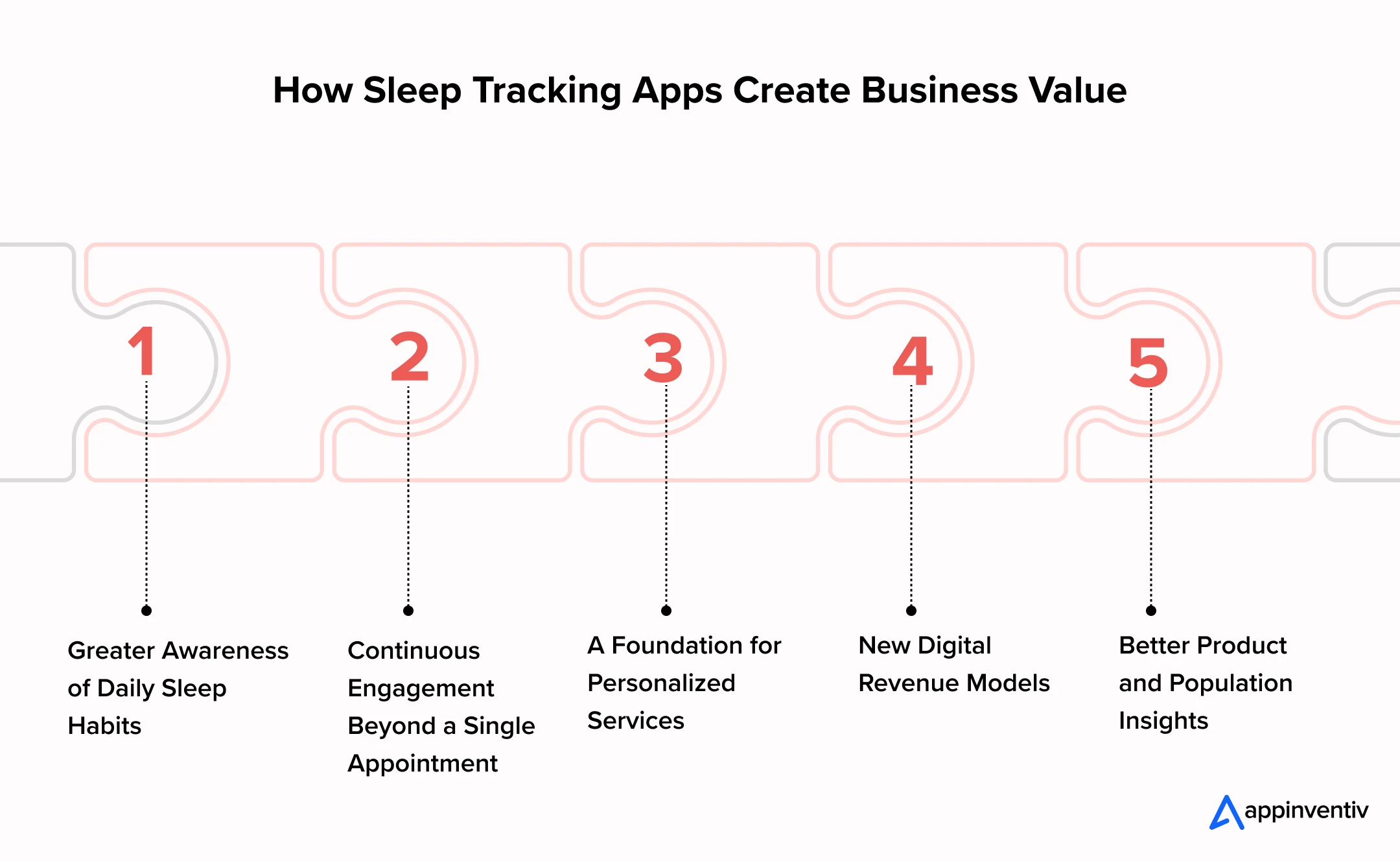
Greater Awareness of Daily Sleep Habits
People often remember a difficult night but cannot see patterns across several weeks. A tracking product can reveal inconsistent schedules, repeated interruptions, insufficient duration, and the possible effects of exercise, caffeine, screen use, travel, or stress.
Continuous Engagement Beyond a Single Appointment
Healthcare and wellness programs commonly struggle to maintain engagement between consultations. Sleep logs, morning check-ins, reminders, educational content, and progress reports create a recurring touchpoint. Users can also share a concise trend report with a professional instead of relying only on memory.
A Foundation for Personalized Services
Longitudinal data makes it possible to move beyond generic sleep tips. The system can learn that one user benefits from a stable wake time while another shows a relationship between late workouts and delayed sleep. Personalization can improve relevance when it is based on sufficient evidence and framed carefully.
New Digital Revenue Models
Businesses can offer subscriptions, premium analytics, connected-device bundles, employer wellness programs, clinician dashboards, research partnerships, or licensed technology. The right model depends on who pays, who uses the app, and whether the product makes wellness or clinical claims.
Better Product and Population Insights
Aggregated and properly de-identified information can help teams understand engagement, device reliability, and broad behavioral patterns. Organizations must still ensure that analytics, consent language, and downstream use comply with applicable privacy requirements.
These are some of the most valuable benefits of sleep tracking app development, but they appear only when the experience produces understandable action rather than another stream of charts.
Features That Make a Sleep Tracking Product Valuable
Feature selection should follow the target audience and intended use. A consumer wellness app needs a different evidence standard and workflow than a tool used by a sleep clinic. Still, the following capabilities form a strong product foundation.
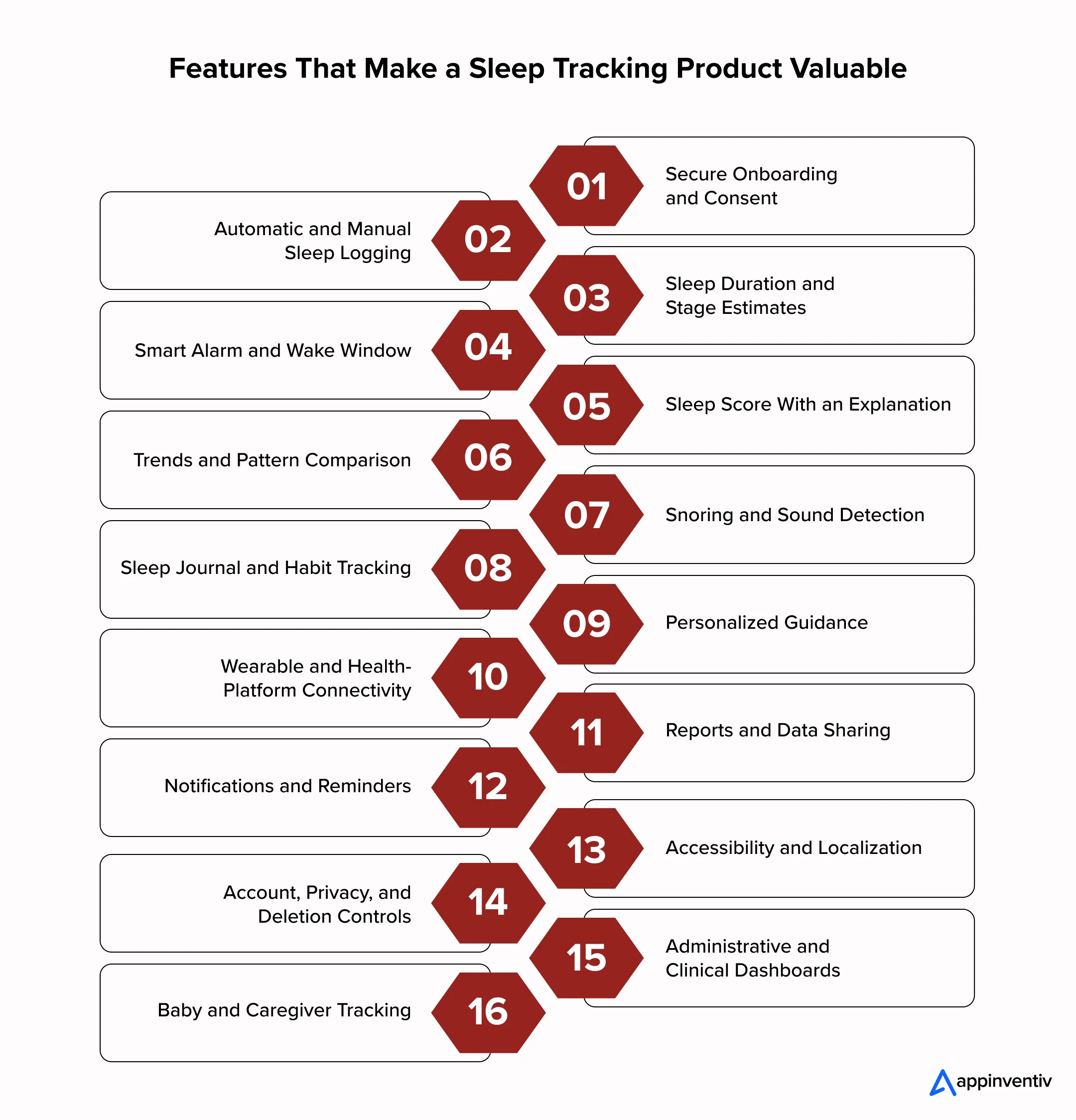
1. Secure Onboarding and Consent
Onboarding should capture only the information needed to configure the experience. It can ask about sleep goals, usual schedule, preferred wearable, and relevant lifestyle factors. Consent must be granular. Users should know which data will be collected, why it is required, how long it will be retained, and whether it will be shared.
2. Automatic and Manual Sleep Logging
Automatic detection reduces effort, while manual entry allows users to correct missed sessions or record naps. Editing should preserve provenance so the system can distinguish sensor-derived values from user-entered information.
3. Sleep Duration and Stage Estimates
The app can display total sleep, time in bed, estimated time to fall asleep, wake after sleep onset, and stage distribution. The interface should avoid implying clinical precision. Confidence indicators or data-quality messages are useful when the device was loose, the battery died, or the signal was incomplete.
4. Smart Alarm and Wake Window
A smart alarm attempts to wake the user during a lighter estimated stage within a selected window. It needs dependable background execution, local scheduling, quiet fallback behavior, and clear handling when the app lacks enough data.
5. Sleep Score With an Explanation
A single score is easy to understand but can become a black box. The product should show the factors that influenced it, such as duration, timing, interruptions, regularity, and recovery signals. Users also need to know whether changes are meaningful or simply normal nightly variation.
6. Trends and Pattern Comparison
Daily, weekly, and monthly views help users separate one unusual night from a persistent pattern. Useful comparisons include weekday versus weekend sleep, consistency over time, bedtime drift, and changes after a user records a habit.
7. Snoring and Sound Detection
Audio analysis can classify likely snoring, talking, coughing, or environmental disturbances. Privacy is critical because overnight recordings may capture partners, children, or conversations. A safer design performs classification on the device where possible, stores short event clips only with explicit consent, and lets users delete them easily.
8. Sleep Journal and Habit Tracking
Users can record caffeine, alcohol, medication, exercise, stress, illness, travel, room conditions, or screen exposure. The app should describe relationships as associations rather than causes unless they are supported by appropriate evidence.
9. Personalized Guidance
Recommendations can focus on achievable behaviors: maintaining a consistent wake time, adjusting reminders, reducing late caffeine, or improving the sleep environment. Guidance should be prioritized so users receive one or two useful actions instead of a long generic checklist.
10. Wearable and Health-Platform Connectivity
The application should show connected data sources, last synchronization time, permissions, and missing information. Users need straightforward controls to connect, disconnect, or change a primary source.
11. Reports and Data Sharing
Exportable reports can summarize sleep duration, consistency, interruptions, symptoms, and journal entries. If clinician sharing is enabled, use time-limited access, strong authentication, audit trails, and explicit patient authorization.
12. Notifications and Reminders
Bedtime reminders, wind-down prompts, device-charging alerts, and morning check-ins can support routine formation. Notification timing should reflect time zones, shift work, travel, and user preferences.
13. Accessibility and Localization
Dark screens are not automatically accessible. The app should support screen readers, scalable type, sufficient contrast, non-color indicators, plain-language explanations, multiple date formats, and localized guidance.
14. Account, Privacy, and Deletion Controls
Users should be able to review permissions, download their data, manage consent, delete recordings, and close their account without contacting support. These controls are among the most important sleep tracker app features because trust directly affects retention.
15. Administrative and Clinical Dashboards
B2B products may require cohort management, escalation rules, care-plan visibility, configurable surveys, consent status, device health, and audit logs. Role-based access must prevent employers, program operators, or unauthorized staff from seeing information beyond their legitimate purpose.
16. Baby and Caregiver Tracking
A baby sleep tracker app needs fast manual entry, shared caregiver access, feeding and diaper-event correlation, nap tracking, age-appropriate summaries, and safe account switching. It must avoid implying that phone or wearable-based monitoring can prevent emergencies. Alerts, if offered, require rigorous human-factors testing because false reassurance and alarm fatigue both create risk.
Also Read: How Much Does It Cost to Build a Custom Child Care and Day Care App
How Wearable Integration Works in a Sleep Tracking App
Wearable integration enables a sleep tracking app to collect health signals throughout the night without requiring continuous manual input. Smartwatches, fitness bands, smart rings, and other connected devices can capture movement, heart rate, respiratory patterns, blood oxygen trends, and skin temperature.
However, these devices do not directly measure whether a person is in light, deep, or REM sleep. They collect physiological signals that the application processes to estimate different sleep stages.
For instance, reduced movement combined with a lower heart rate may indicate that the user has fallen asleep. Changes in heart rate variability, breathing, and body movement may further help the system estimate transitions between different sleep stages.
The typical data flow looks like this:
Wearable Sensors → Device Platform → Data Processing → Sleep Analysis → User Dashboard
This integration usually involves the following stages.
1. Collecting Sleep-Related Data From Wearables
The connected device collects relevant signals while the user sleeps. The exact information available depends on the device and the permissions granted by the user.
Commonly collected data includes:
- Body movement and nighttime restlessness
- Heart rate and heart rate variability
- Estimated respiratory rate
- Blood oxygen saturation trends
- Skin or wrist temperature changes
- Bedtime, wake time, and sleep duration
- Snoring, coughing, and environmental noise
- Manually recorded habits and sleep symptoms
No individual signal provides a complete picture. For example, a motion sensor may classify someone lying still while awake as asleep. Similarly, heart rate may change because of stress, illness, medication, alcohol, or poor contact between the device and the skin.
Therefore, a reliable application combines multiple signals before generating a sleep estimate. This approach, known as sensor fusion, can improve the consistency of sleep and wake detection.
2. Connecting the App With Health Data Platforms
Businesses can obtain wearable data through centralized health platforms or direct device integrations.
Apple HealthKit allows users to share authorized health information collected through the iPhone, Apple Watch, and compatible applications. Depending on data availability, a sleep tracking app can access sleep duration, awake periods, and estimated core, deep, and REM stages.
Android Health Connect performs a similar role across compatible Android applications and devices. It supports sleep sessions, sleep stages, heart rate, oxygen saturation, and respiratory information.
Both platforms require explicit user permission. The app should request only the information required for its features and continue working when the user provides limited access.
For example, someone may allow access to sleep sessions but decline permission for heart rate or oxygen data. The application should still provide a basic sleep summary instead of preventing the person from using the product.
Using HealthKit and Health Connect can simplify sleep monitoring app development by providing one controlled channel for accessing information from multiple compatible sources. However, the development team must still manage revoked permissions, deleted records, duplicate sessions, synchronization failures, and operating-system restrictions.
3. Integrating Directly With Specific Wearable Devices
A business may also connect directly with wearable manufacturers through their APIs or software development kits. This approach may provide access to information that is unavailable through HealthKit or Health Connect.
Direct integration can be useful when the product depends on:
- Device-specific recovery or sleep scores
- Higher-frequency sensor information
- Proprietary temperature or respiratory measurements
- Device battery and wear-status information
- Faster synchronization
- Specialized clinical or research data
However, every direct connection increases development and maintenance requirements. Manufacturers may use different data formats, sleep-stage definitions, authorization methods, and synchronization rules. They can also revise or discontinue their APIs.
Therefore, businesses should not integrate every available wearable during the first release. They should prioritize devices based on target-user adoption, available data, regional support, and the value each connection adds.
This prioritization is especially important during sleep monitoring app development, as access to raw or processed data affects the features the business can realistically offer.
4. Standardizing Data Collected From Different Devices
Wearable devices do not always describe sleep in the same way. One device may classify a stage as “core sleep,” while another calls it “light sleep.” Devices may also use different time intervals, measurement units, sampling frequencies, and scoring methods.
The backend must standardize this information before analyzing it.
A unified sleep record may include:
- Sleep-session start and end times
- Total sleep duration
- Awake and estimated sleep-stage intervals
- Heart rate and HRV summaries
- Respiratory and oxygen trends
- Temperature deviation
- Source device and application
- Time zone
- Missing-data indicators
- Data-confidence level
This standardization gives the analytics and AI systems a consistent format. It also makes it easier to add new wearable brands without rebuilding the entire application.
5. Resolving Duplicate or Conflicting Records
A user may wear an Apple Watch and a smart ring at the same time. Both devices may create separate records for the same night. Another connected application may also write sleep data into HealthKit or Health Connect.
If the platform counts every record independently, it may show incorrect sleep duration or duplicate sessions.
The app must establish rules for determining:
- Which device acts as the primary source
- Whether overlapping sessions should be merged
- Which source should provide each health metric
- How missing or conflicting information should be handled
- Whether users can select their preferred device
For example, the system might use the smartwatch for heart rate and the smart ring for temperature while maintaining one consolidated sleep session. It should preserve the original data source so users and administrators can understand how the final result was produced.
6. Converting Wearable Data Into User Insights
Once the information has been collected, standardized, and verified, the application can transform it into understandable insights.
The user may see:
- Total and average sleep duration
- Estimated light, deep, and REM sleep
- Sleep and wake consistency
- Number and duration of nighttime awakenings
- Changes in resting heart rate or HRV
- Possible snoring or breathing events
- Weekly and monthly sleep trends
- Personalized recommendations
The dashboard should also explain when information is incomplete. If the wearable battery died or the sensor lost contact, the app should show a “partial data” message rather than presenting an unreliable score.
Building visible synchronization and data-quality controls during sleep monitoring app development helps users distinguish a poor night of sleep from an incomplete recording.
Ultimately, successful wearable integration is not about connecting the maximum number of devices. It is about collecting the right signals, standardizing them correctly, and translating them into insights users can understand and trust.
Explore our development capabilities across wearables, AI, interoperability, compliance, and scalable product engineering.
The Role of Role of AI in Sleep Tracker App Development
AI helps a sleep tracking app move beyond basic data collection. Instead of simply displaying bedtime, wake-up time, and movement, it can combine multiple signals to generate more meaningful sleep estimates and personalized recommendations.
For businesses, this creates opportunities to offer a differentiated product rather than another basic activity tracker. AI can support:
- More reliable sleep and wake detection
- Estimation of light, deep, and REM sleep
- Personalized sleep baselines
- Snoring and nighttime sound recognition
- Relevant habit recommendations
- Identification of missing or unreliable sensor data
- Conversational explanations of sleep reports
For example, a deep sleep tracker app can analyze movement, heart rate variability, and respiratory patterns together to estimate sleep stages. Over time, it can establish an individual baseline and identify meaningful changes instead of comparing every user against the same general threshold.
AI can also improve user engagement. It can explain why a sleep score changed, prioritize one achievable recommendation, and adjust suggestions according to the user’s response. This makes the app more actionable than a dashboard filled with charts.
However, AI also expands the product’s development and governance requirements. Businesses need representative training data, clearly defined accuracy targets, model-version controls, human review, and continuous performance monitoring. The system must also explain when data is incomplete or the prediction has limited confidence.
Health-related recommendations require additional controls. The application should not diagnose a sleep disorder unless the functionality has undergone appropriate clinical validation and regulatory assessment. Conversational assistants must use approved content, avoid unsupported medical advice, and direct users to professional care when necessary.
Therefore, successful AI-driven sleep tracker app development depends on balancing personalization with accuracy, explainability, privacy, and regulatory responsibility. AI should not be added simply as a marketable feature. It should solve a defined user problem and deliver measurable product or business value.
Technology Stack Required to Build a Sleep Tracking App
The technology stack of a sleep monitoring app determines how reliably it collects overnight data, connects with wearable devices, processes health signals, and delivers personalized insights. Businesses should select technologies based on the intended product scope instead of following a standard mobile application stack.
For instance, a basic wellness app may only require smartphone sensors and health-platform integration. An advanced product may need wearable applications, time-series databases, signal-processing engines, AI models, and healthcare interoperability.
The following table presents the major components involved in the technology stack of sleep monitoring app development:
| Development Layer | Suitable Technologies | Role in the Sleep Tracking Platform |
|---|---|---|
| Mobile application | Swift, SwiftUI, Kotlin, Jetpack Compose, Flutter, React Native | Builds the user-facing iOS and Android experience |
| Wearable application | watchOS, Wear OS, vendor SDKs | Collects information from smartwatches, rings, and fitness bands |
| Health data integration | Apple HealthKit, Android Health Connect, FHIR APIs | Exchanges authorized sleep and health information |
| Backend development | Node.js, Java, Python, .NET, Go | Manages application logic, user accounts, and integrations |
| API layer | REST, GraphQL, gRPC | Connects mobile apps, wearables, backend services, and external systems |
| Operational database | PostgreSQL, MySQL, MongoDB | Stores user profiles, consent, subscriptions, and configurations |
| Time-series storage | TimescaleDB, InfluxDB, cloud data lakes | Stores timestamped heart rate, movement, and sleep-stage records |
| AI and machine learning | Python, PyTorch, TensorFlow, scikit-learn | Supports classification, pattern recognition, and personalization |
| Signal processing | SciPy, NumPy, MATLAB, custom algorithms | Cleans and transforms raw movement, audio, and biometric signals |
| Cloud infrastructure | AWS, Microsoft Azure, Google Cloud | Provides scalable computing, storage, monitoring, and backups |
| Security and identity | OAuth 2.0, OpenID Connect, KMS, IAM, SIEM | Protects accounts, health data, APIs, and encryption keys |
| Notifications | Firebase Cloud Messaging, Apple Push Notification Service | Sends bedtime reminders, alerts, and morning summaries |
| Product analytics | Mixpanel, Amplitude, privacy-focused analytics | Measures engagement, retention, and feature performance |
| DevOps and monitoring | Docker, Kubernetes, GitHub Actions, Datadog | Supports deployment, observability, and incident management |
Step-by-Step Sleep Tracker App Development Process
Businesses exploring how to build a sleep tracker app need a structured process that balances functionality, accuracy, compliance, cost, and time to market. It also prevents teams from investing in advanced AI or wearable integrations before validating whether users actually need them.
The following sleep tracker app development process can take a product from an initial idea to a scalable market release.
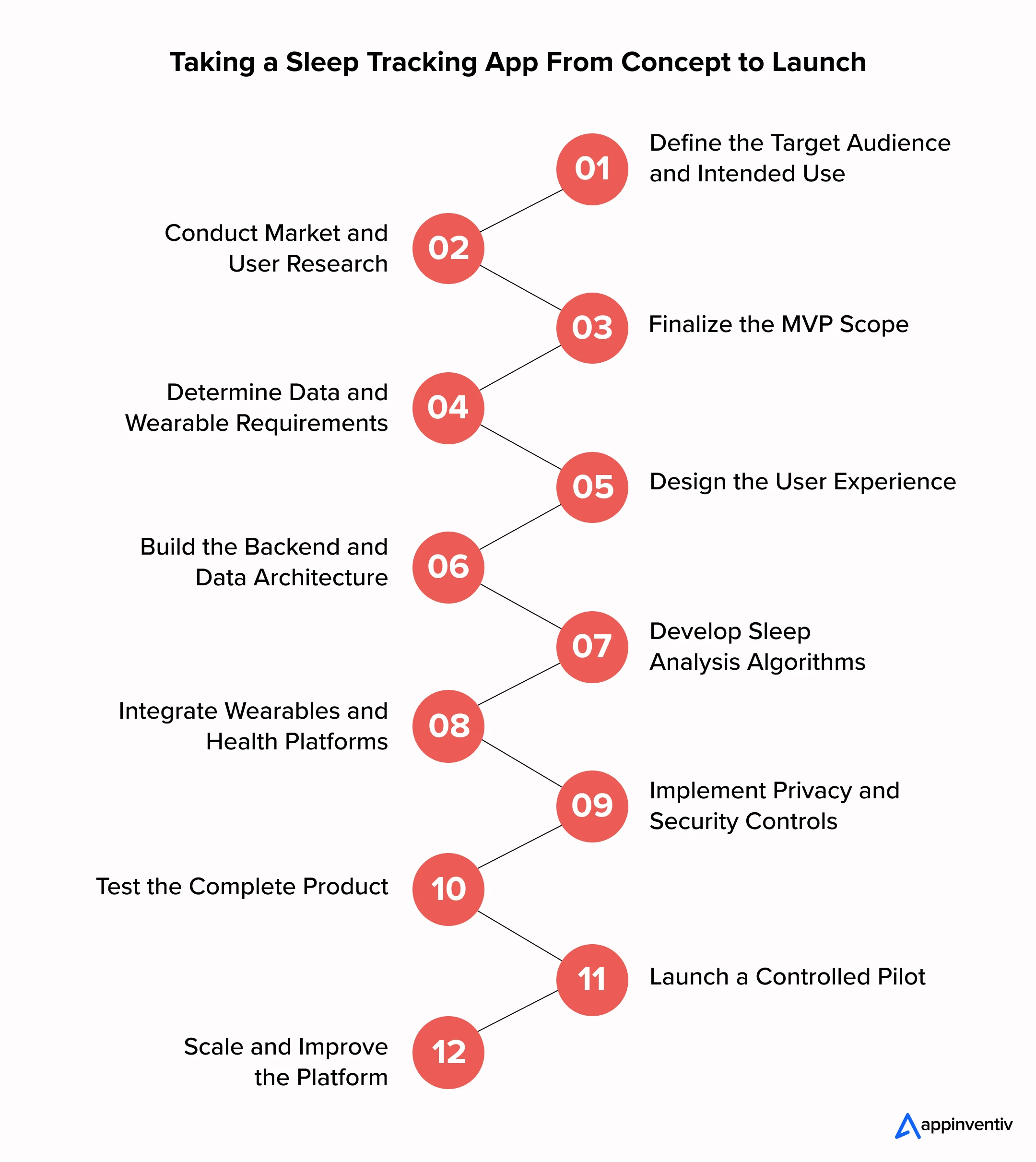
Step 1: Define the Target Audience and Intended Use
Start by identifying who will use the product and which problem it will solve.
The product may target:
- General wellness consumers
- Athletes and fitness enthusiasts
- Parents tracking infant sleep
- Employees participating in wellness programs
- Sleep clinic patients
- Healthcare professionals
- Researchers
- Senior-care providers
The intended use must also be documented. An application that helps users improve daily sleep habits has different requirements from one that claims to detect or manage a sleep disorder.
This decision influences product features, data requirements, clinical validation, compliance, marketing claims, and development costs.
Step 2: Conduct Market and User Research
Study existing applications, unmet user needs, wearable adoption, competitor limitations, and willingness to pay. Interviews and surveys can reveal whether users want detailed sleep stages, simple habit recommendations, professional reports, or caregiver coordination.
Businesses should also identify the buyer separately from the user. For example, an employee may use the app while an organization pays for the program. Similarly, a patient may use the application while a healthcare provider purchases the platform.
Market research should answer:
- Which problem makes users return every morning?
- Which wearables does the target audience already own?
- How much manual input will users tolerate?
- Which information do users understand and trust?
- Why would customers pay for the product?
- Which features already exist in competing applications?
Step 3: Finalize the MVP Scope
The minimum viable product should test the core business assumption without introducing unnecessary complexity.
A consumer wellness MVP may include:
- User registration and onboarding
- Manual and automatic sleep logging
- One health-platform integration
- Sleep duration and consistency tracking
- Morning sleep summaries
- Bedtime reminders
- Basic trend analysis
- Consent and privacy controls
- Data export and account deletion
Advanced sleep-stage models, raw audio recording, numerous wearable integrations, clinical dashboards, and conversational AI can be introduced after the primary tracking experience proves reliable.
A focused MVP reduces initial investment and gives the business real usage data before it commits to a larger product roadmap.
Step 4: Determine Data and Wearable Requirements
Define which signals the product needs and where they will come from.
For every data point, document:
- Source device or application
- Collection frequency
- Measurement unit
- Required user permission
- Expected accuracy
- Offline behavior
- Storage period
- Processing method
- User-facing purpose
The team should then build early proofs of concept for HealthKit, Health Connect, and priority wearable devices. Real-device testing is necessary because vendor documentation does not expose every synchronization, battery, and data-quality issue.
Step 5: Design the User Experience
The interface must make complex sleep information easy to understand. Users should be able to identify what happened during the night, why a score changed, and what action they can take.
UX designers should create flows for:
- First-time onboarding
- Wearable connection
- Permission management
- Bedtime preparation
- Morning summaries
- Weekly and monthly reports
- Missing or incomplete data
- Subscription upgrades
- Report sharing
- Account and data deletion
The design must also show failure states. If the wearable battery dies, a permission is revoked, or the sensor loses contact, the application should explain the problem rather than display a misleading score.
Step 6: Build the Backend and Data Architecture
The backend receives sleep records, manages user accounts, applies business rules, and prepares information for analytics.
At this stage, the development team should implement:
- Secure user authentication
- Consent records
- Device connection management
- Data ingestion pipelines
- Sleep data standardization
- Duplicate-record detection
- Encrypted storage
- Role-based access
- Audit logging
- Retention and deletion workflows
- Administrative controls
Identifiers should be separated from physiological records where practical. Internal access should follow the principle of least privilege.
Step 7: Develop Sleep Analysis Algorithms
The team can begin with rule-based methods before introducing machine learning. Simple algorithms may be sufficient for an early wellness MVP that calculates duration, timing, and consistency.
AI becomes more relevant when the product needs to:
- Combine multiple sensor signals
- Estimate sleep stages
- Detect nighttime sound events
- Establish personal baselines
- Identify unusual patterns
- Generate personalized recommendations
The development team must define reference data, acceptable error rates, validation methods, and minimum data-quality requirements. Results should also be tested across devices, user groups, and real sleeping environments.
Step 8: Integrate Wearables and Health Platforms
Connect the application with Apple HealthKit, Android Health Connect, or selected device APIs.
The integration must account for:
- Partial user permissions
- Delayed synchronization
- Duplicate sleep sessions
- Conflicting device records
- Time-zone changes
- Daylight-saving changes
- Revoked access
- Deleted records
- Device replacement
- API updates
The application should display its latest synchronization time and primary data source. This transparency helps users understand whether a report reflects a complete night.
Step 9: Implement Privacy and Security Controls
Security testing should begin during development instead of after the product is complete.
The team should implement:
- Encryption in transit and at rest
- Secure token management
- Multifactor authentication for privileged accounts
- Role-based access controls
- API security
- Mobile application hardening
- Secure key management
- Audit trails
- Data-loss prevention
- Vulnerability monitoring
- Backup and recovery
- Incident-response procedures
Every analytics, advertising, crash-reporting, and customer-support tool should be reviewed before it receives access to health-related information.
Step 10: Test the Complete Product
Testing must cover more than standard mobile functions. A sleep tracking platform should be evaluated throughout complete overnight sessions and across different devices.
The testing plan should include:
- Functional testing
- Usability testing
- Device compatibility testing
- Wearable synchronization testing
- Battery-consumption testing
- Network interruption testing
- Data accuracy testing
- AI model validation
- Accessibility testing
- Security testing
- Performance and load testing
- Compliance verification
Testers should recreate difficult conditions such as wearable removal, low battery, poor sensor contact, travel, daytime naps, overlapping records, and incomplete sessions.
Step 11: Launch a Controlled Pilot
Release the product to a limited user group before a full-scale launch. The pilot provides evidence about product reliability, engagement, and user understanding.
Track metrics such as:
- Successful nights recorded
- Wearable connection rate
- Missing-data frequency
- Synchronization delay
- Morning-summary views
- Recommendation completion
- User-reported accuracy
- Support requests
- First-week retention
- Subscription interest
Feedback from the pilot can guide improvements before the business spends heavily on marketing and wider device support.
Step 12: Scale and Improve the Platform
After launch, monitor application performance, device integrations, user behavior, security events, and AI-model accuracy.
The product roadmap may introduce:
- Additional wearable integrations
- Advanced sleep-stage analysis
- Personalized coaching
- Family and caregiver accounts
- Clinician dashboards
- Research tools
- Multilingual support
- Enterprise reporting
- Contactless monitoring
- Connected-bedroom integrations
The development team should maintain feature flags and rollback mechanisms. These controls allow the business to release updates gradually and reverse changes that affect accuracy or reliability.
Compliance Requirements for Sleep Tracker App Development
Sleep information can reveal health conditions, routines, work schedules, medication patterns, and personal behavior. Therefore, compliance must guide product design, data architecture, integrations, analytics, and marketing claims.
The applicable requirements depend on the product’s intended use, operating region, target audience, business relationships, and data-processing activities. Not every sleep app falls under the same regulation.
| Regulation or Standard | When It May Apply | Major Business Requirements |
|---|---|---|
| FDA medical-device requirements | The product diagnoses, treats, prevents, or manages a health condition | Product classification, evidence, quality controls, risk management, regulatory submission, post-market monitoring |
| HIPAA | The business handles protected health information for a covered healthcare entity | Business associate agreements, risk analysis, access controls, audit logs, safeguards, breach procedures |
| FTC Act | The product collects consumer health information in the US | Truthful privacy claims, fair data use, reasonable security, transparent disclosures |
| FTC Health Breach Notification Rule | A non-HIPAA health app experiences a breach or unauthorized disclosure | Consumer, FTC, and potentially media notification |
| GDPR | The product processes personal data belonging to individuals in the EU | Lawful basis, special-category condition, transparency, minimization, user rights, transfer controls |
| UK GDPR and Data Protection Act | The product serves users in the United Kingdom | Health-data protection, lawful processing, DPIAs, user rights, security controls |
| CCPA/CPRA | The business meets applicable thresholds and processes California residents’ information | Privacy notices, access, correction, deletion, opt-out controls, vendor management |
| State consumer health laws | The application processes consumer health information in covered US states | Consent, data-use limitations, deletion, sharing restrictions, geofencing restrictions where applicable |
| COPPA | The service is directed at children under 13 or knowingly collects their information in the US | Verifiable parental consent, limited collection, parental rights, secure deletion |
| ISO 27001 | The business needs a structured information-security management system | Risk management, policies, controls, audits, and continuous improvement |
| ISO 27701 | The organization needs formal privacy-information management | Privacy roles, processing controls, accountability, and processor governance |
| SOC 2 | Enterprise customers require assurance over service controls | Independent assessment of security, availability, confidentiality, and related controls |
| FHIR | The product exchanges information with healthcare systems | Standardized healthcare data formats and interoperable APIs |
A Brief Glimpse into the Sleep Tracker App Development Cost
The cost to build a sleep tracking product depends on its target users, platforms, wearable integrations, data-processing requirements, AI capabilities, and regulatory scope. A general wellness MVP costs considerably less than an enterprise or clinical platform requiring advanced validation.
The following estimates can help businesses establish an initial budget:
| Product Type | Typical Scope | Estimated Timeline | Estimated Cost |
|---|---|---|---|
| Proof of concept | UX prototype, architecture, one wearable integration test | 6–10 weeks | $25,000–$60,000 |
| Basic wellness MVP | Sleep logging, basic reports, reminders, one health-platform integration | 4–6 months | $40,000–$120,000 |
| Advanced consumer app | iOS and Android apps, multiple devices, subscriptions, AI insights | 6–10 months | $120,000–$300,000 |
| AI and wearable-led platform | Custom algorithms, sensor fusion, several integrations, advanced analytics | 9–15 months | $250,000–$500,000 |
| Enterprise healthcare platform | Administrative dashboards, clinical workflows, interoperability, compliance | 10–18 months | $350,000–$500,000+ |
| Regulated clinical solution | Clinical validation, quality management, regulatory documentation, controlled AI | 12–24+ months | $500,000–$1,000,000+ |
These ranges are indicative. The final sleep tracker app development cost will depend on discovery findings and the required evidence.
Major cost factors include:
- Number of user applications and platforms
- Native or cross-platform development
- HealthKit and Health Connect integration
- Number of direct wearable integrations
- Raw sensor processing
- Custom AI model development
- Audio analysis
- Clinical or algorithm validation
- Healthcare system integration
- Cloud storage and processing volume
- Security and compliance requirements
- User and administrative dashboards
- Subscription and payment systems
- Accessibility and localization
- Quality assurance and real-device testing
Businesses should also plan for post-launch expenses. These may include cloud infrastructure, cybersecurity monitoring, API maintenance, new-device testing, technical support, compliance reviews, and AI-model updates.
Major Challenges in Sleep Tracker App Development
Building a sleep tracking app presents challenges that go beyond ordinary mobile app development. The product must operate throughout the night, work with external devices, interpret incomplete physiological signals, and protect highly sensitive information.
The following table outlines the most significant challenges in sleep tracker app development and the appropriate solutions.
| Challenge | Impact on the Product | Recommended Solution |
|---|---|---|
| Indirect sleep measurement | Users may treat estimated stages as clinical facts | Explain limitations, display data confidence, and validate algorithms against suitable reference data |
| Wearable fragmentation | Different devices return inconsistent information | Build a normalized data model and modular integration layer |
| Incomplete sensor information | Missing data can produce misleading sleep scores | Apply quality thresholds, missing-data indicators, and no-score conditions |
| Duplicate sleep sessions | Multiple devices may count the same sleeping period twice | Establish source priority, overlap detection, and transparent merging rules |
| Overnight battery consumption | Users may stop tracking because of device drain | Optimize sampling, edge processing, background services, and data transfer |
| Poor sensor contact | Loose devices can affect heart rate and movement readings | Detect abnormal signal quality and notify the user without presenting unreliable results |
| Limited training datasets | AI models may perform differently across users | Use representative datasets, subgroup testing, and continuous validation |
| AI bias and model drift | Algorithm performance may decline after product or device updates | Monitor model performance, version outputs, and maintain rollback mechanisms |
| Data privacy risk | Unauthorized access can create legal and reputational damage | Apply encryption, minimization, access controls, audit logs, and vendor assessment |
| Regulatory scope expansion | New claims may move the product into medical-device territory | Review every major feature and marketing claim with regulatory specialists |
| Third-party API changes | Wearable connections may stop working | Version integration adapters, monitor vendor updates, and design fallback behavior |
| Alert fatigue | Excessive notifications reduce engagement | Prioritize alerts and allow users to control frequency and type |
| Low long-term retention | Users may lose interest after viewing basic reports | Provide personalized actions, progress tracking, and meaningful trend comparisons |
| Unclear recommendations | Users may not know what to do with the information | Convert reports into one or two simple and achievable next steps |
| Audio privacy concerns | The app may record private conversations or other people | Use on-device detection, explicit consent, limited storage, and deletion controls |
Businesses should evaluate these risks together. For instance, collecting additional sensor data may improve analysis but also increase battery use, development cost, privacy exposure, and compliance requirements.
Future Trends Shaping Sleep Tracker App Development
Sleep tracking is moving from basic motion detection toward connected, multimodal, and personalized experiences. The next generation of products will combine wearable signals, environmental data, AI, and healthcare interoperability.
Businesses should monitor the following trends when planning their long-term roadmap for sleep cycle app development.
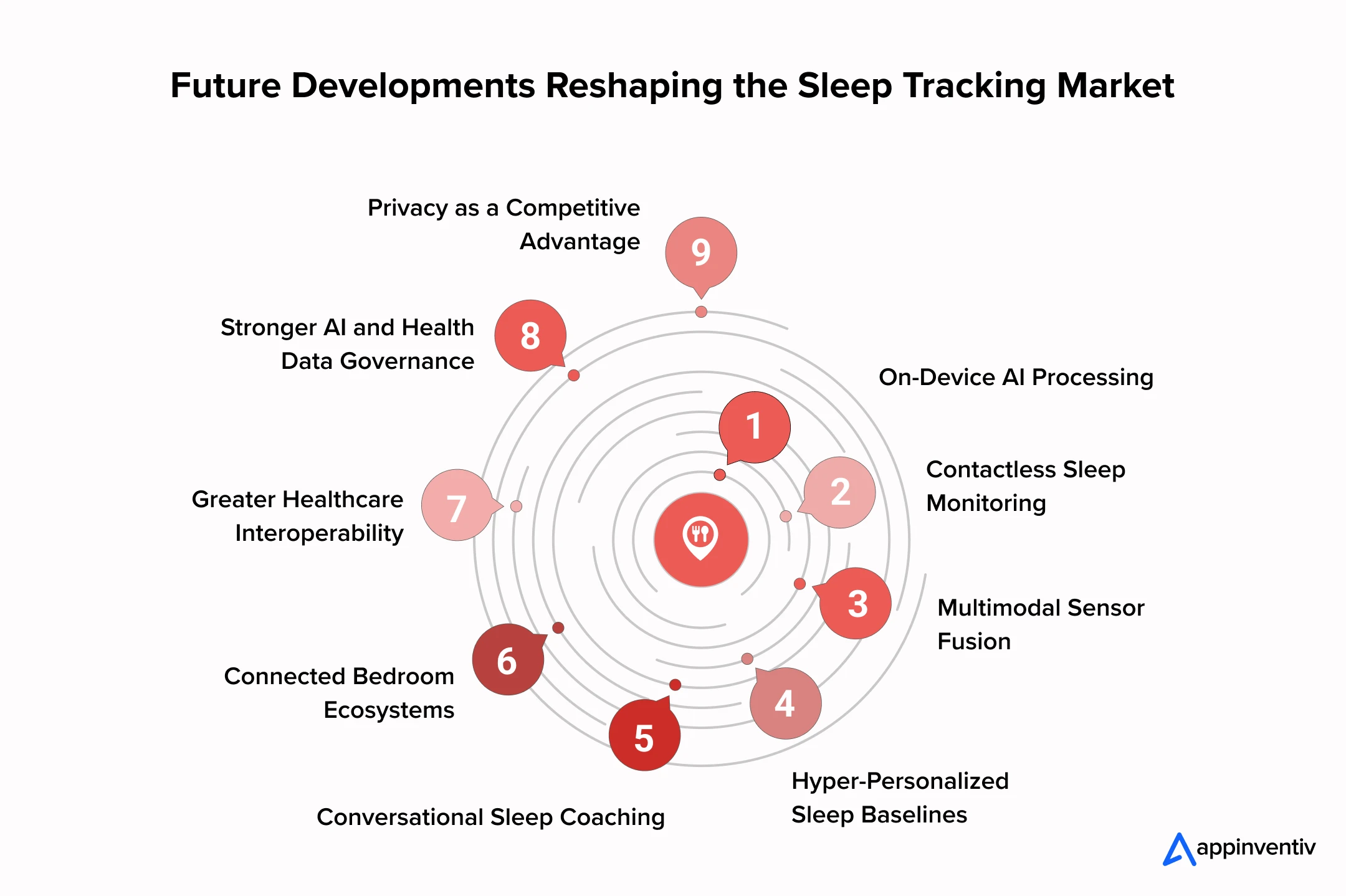
On-Device AI Processing
More sleep analysis will take place directly on smartphones and wearable tech devices. On-device processing can reduce latency, limit cloud dependency, and prevent raw audio or biometric signals from leaving the device.
It can also improve overnight reliability when internet connectivity is unavailable. However, development teams must optimize models for limited memory, computing capacity, and battery life.
Contactless Sleep Monitoring
Radar, sonar, pressure sensors, and other non-wearable technologies can monitor motion and breathing without requiring the user to wear a device.
Contactless tracking may be valuable for older adults, infants, hospitals, and users who find watches uncomfortable while sleeping. Businesses must still address shared-room consent, environmental interference, and device positioning.
Multimodal Sensor Fusion
Future products will increasingly combine information from watches, rings, phones, mattresses, room sensors, and connected health systems.
The competitive advantage will not come from collecting the most data. It will come from selecting trustworthy signals, resolving conflicts, and creating one understandable sleep record.
Hyper-Personalized Sleep Baselines
Applications will rely less on universal thresholds and more on individual patterns. AI will learn the user’s normal sleep duration, timing, heart rate, breathing, and recovery signals.
This personalization can produce more relevant insights. However, the model should not adapt so aggressively that it treats a continued negative change as the user’s new normal.
Conversational Sleep Coaching
Generative AI will make sleep reports easier to understand. Users will be able to ask questions about changes, missing data, scores, and habits through a conversational interface.
Businesses must ensure that responses come from reviewed content and authorized user information. The assistant should explain wellness insights without providing unsupported medical diagnoses.
Connected Bedroom Ecosystems
Sleep applications may integrate with smart lighting, thermostats, air-quality monitors, mattresses, speakers, and alarm systems.
For example, the platform could reduce room temperature before bedtime, adjust lighting during the wind-down period, or modify alarm settings according to the user’s schedule. Such automation requires clear consent and reliable fallback controls.
Greater Healthcare Interoperability
Sleep information will become easier to share across authorized applications and healthcare systems through HealthKit, Health Connect, FHIR, and direct APIs.
This can support remote monitoring and professional consultations. However, organizations must preserve consent, source information, access controls, and auditability throughout the exchange.
Stronger AI and Health Data Governance
Regulators and enterprise buyers will demand greater transparency around health data, automated decisions, model performance, and third-party sharing.
Products that maintain traceable datasets, model versions, performance records, consent histories, and clear claims will be better positioned for enterprise adoption.
Also Read: How AI is Revolutionizing Data Governance for Enterprises and How to Do It Right?
Privacy as a Competitive Advantage
Users are becoming more conscious of how health applications use personal information. Clear privacy controls, on-device processing, limited retention, and freedom from intrusive advertising can become significant product differentiators.
For sleep platforms, trust will influence engagement as much as feature depth.
Build a sleep tracking app that unifies fragmented device data without compromising accuracy, scalability, or user trust.
How Appinventiv Can Help Build a Future-Ready Sleep Tracking App
Building a successful sleep tracking platform requires more than developing a mobile interface. Businesses need a partner capable of bringing together product strategy, wearable connectivity, AI, cloud architecture, security, compliance, and user experience.
As a digital health and healthcare app development company, Appinventiv can help businesses move from product discovery to market deployment through one connected development roadmap.
Our experts can support:
- Product discovery and MVP planning
- iOS, Android, web, and wearable application development
- Apple HealthKit and Android Health Connect integration
- Direct wearable and IoT device connectivity
- Sleep data standardization and processing
- AI-based pattern analysis and personalization
- Cloud and API architecture
- Healthcare interoperability
- Privacy and security engineering
- Compliance-led product development
- Quality assurance and real-device testing
- Post-launch monitoring and product optimization
For businesses pursuing custom sleep tracker app development, we can evaluate whether advanced AI, multiple wearable integrations, or clinical functionality should be included in the initial release or introduced through later product phases. This approach helps reduce unnecessary development costs while protecting the platform’s long-term scalability.
As a wearable device app development company, our expert development practices can further support sleep-stage estimation, personalized baselines, audio-event classification, anomaly detection, and conversational sleep coaching. We build these capabilities with data governance, validation, monitoring, and human oversight incorporated into the development lifecycle.
Whether you are planning a consumer wellness application, baby sleep tracker app, fitness recovery platform, connected wearable product, or enterprise healthcare solution, we can help translate the idea into a secure and scalable digital product.
Get in touch with our experts to develop a sleep tracker app that connects wearable intelligence with meaningful user outcomes.
FAQs
Q. How much does it cost to build a sleep tracker app?
A. The cost to build a sleep tracker app generally ranges from $40,000 to $500,000+. A basic wellness MVP with sleep logging, reminders, trend reports, and one health-platform integration may cost between $40,000 and $120,000. An advanced solution with AI, multiple wearable integrations, and enterprise dashboards may cost between $250,000 and $500,000+.
The final investment of sleep tracker app development depends on:
- Number of mobile and wearable platforms
- Sleep tracker app features
- HealthKit and Health Connect integrations
- Number of supported wearable devices
- AI model development and validation
- Cloud infrastructure requirements
- Security and regulatory compliance
- Clinical or enterprise functionality
- Post-launch support and maintenance
Q. How can businesses ensure data privacy in a sleep tracker app?
A. Businesses should adopt privacy-by-design from the product discovery stage. The application should collect only the data required for its defined features and clearly explain how that information will be processed, retained, and shared.
Important privacy controls include:
- Granular and informed user consent
- Encryption in transit and at rest
- Role-based access controls
- Secure APIs and authentication
- Limited retention of audio and sensor data
- Transparent third-party data sharing
- User-controlled data export and deletion
- Audit trails for sensitive data access
- Regular security and privacy assessments
- Compliance with applicable health data regulations
Every analytics, advertising, customer-support, and crash-reporting tool should also be reviewed before receiving access to health-related information.
Q. How do sleep tracker apps make money?
A. Sleep tracker apps commonly make money through freemium subscriptions, premium analytics, personalized coaching, wearable-device sales, and enterprise licensing. A consumer application may provide basic tracking for free and charge users for longer reports, detailed trends, advanced insights, or guided sleep programs.
B2B platforms can generate revenue by licensing the solution to healthcare providers, sleep clinics, employers, research institutions, insurers, or wellness companies. Some businesses also bundle the application with a smart ring, watch, mattress sensor, or other connected device.
Q. How can wearable-device data be integrated into a sleep tracker app?
A. Wearable data can be integrated through Apple HealthKit, Android Health Connect, or direct APIs and SDKs provided by device manufacturers. The appropriate method depends on the required data, target devices, regional availability, and permitted use of the information.
The integration process generally involves:
- Selecting priority wearable devices
- Requesting user permission for required data
- Connecting with health platforms or device APIs
- Collecting sleep sessions and biometric signals
- Standardizing different device formats
- Identifying duplicate or overlapping records
- Establishing a preferred data source
- Handling offline collection and delayed synchronization
- Displaying missing-data and connection status
- Monitoring API and operating-system changes
A normalized backend data model allows the business to add new wearable brands without rebuilding its complete analytics system.
Q. Can a sleep tracker app integrate with Apple Health, Google Fit, and other wearables?
A. Yes. A sleep tracking app can integrate with Apple Health through HealthKit and access compatible Android health information through Health Connect. It can also connect directly with supported smartwatches, fitness bands, smart rings, and sleep-monitoring devices through manufacturer APIs.
For new Android products, businesses should evaluate Health Connect instead of relying only on Google Fit, as Google is moving health and fitness integrations toward its newer platform. However, data availability differs across manufacturers. Businesses must confirm which sleep stages, biometric signals, historical records, and permissions each integration supports before finalizing the product scope.
Q. How accurate are phone-only sleep trackers compared with wearable-connected apps?
A. Phone-only applications usually depend on movement, microphone input, device interaction, and sometimes sonar-like techniques. They can estimate bedtime, wake time, movement, and nighttime sounds, but they have limited access to physiological information.
Wearable-connected applications can additionally use signals such as heart rate, HRV, skin temperature, respiratory rate, and blood oxygen trends. Combining these signals can improve sleep and wake detection and support more detailed sleep-stage estimates.
However, neither approach should automatically be treated as clinically accurate. Results depend on:
- Sensor quality and placement
- Device fit
- Available physiological signals
- Algorithm quality
- User characteristics
- Sleeping environment
- Missing or noisy data
- Validation against suitable reference measurements
Phone-only tracking can work for basic habit and duration monitoring. Wearable integration is generally more suitable when the product requires richer sleep analysis, recovery insights, or personalized baselines.


Fast 2-minute response, fully NDA-protected.
Wearable Data Integration: Connecting Multiple Devices to a Unified Health Platform
Key takeaways: Device support should reflect the measurements your service needs, the people using it, and the decisions those readings inform. A unified health data platform must preserve source, timing, and measurement context while resolving duplicate records. Phone health platforms, manufacturer APIs, and direct device connections serve different integration needs. Clinical workflows require agreed review…
Diet and Nutrition App Development: Process, Features, Cost, and Technology Stack
Key Takeaways Diet and nutrition tracking app development goes past basic calorie counters with verified food databases, custom meal schedules, AI tools, wearable device links, and corporate manager tools. Structure database models around raw food items, serving portions, nutrient facts, recipes, software links, and regional diet rules. Pair computer vision models, recommendation algorithms, language engines,…
eCOA Software Development Guide: Enterprise Architecture, Tech Stack, Development Process, and Cost
Key takeaways: Build an enterprise eCOA platform using cloud servers, AI tools, and compliant system design. Map the full eCOA development process, from trial workflow analysis to live system maintenance. Connect your platform with EDC, CTMS, eConsent, HL7 FHIR, and wearables to simplify trial data sharing. Compare custom software against off-the-shelf platforms to make smart…