

































Jev Explained: Enterprise Use Cases, Limitations and How to Adopt

 Share -



- 01How does Jev turn raw data into typed decisions?
- 02Jev vs ChatGPT and Claude: Which one fits your workflow?
- 03Why should business leaders care about Jev's cost-per-decision shift?
- 04Is Jev suitable for enterprises, and how do you check readiness?
- 05What are the highest-value Jev use cases for enterprises?
- 06How do confidence scores and human-in-the-loop governance work with Jev?
- 07How to integrate Jev into enterprise workflows?
- 08What Jev is not, and which launch claims hold up?
- 09What are the known Jev limitations enterprises must plan for?
- 10How can Appinventiv help you out?
- 11FAQs

Key takeaways:
- What it is: Jev is a System One model from TypeSafe AI. It returns typed choices, scores and true-or-false probabilities instead of text.
- Where it wins: The strongest Jev use cases are high-volume, narrow decisions such as triage, routing, scoring and guardrails.
- Where it stops: It cannot generate text. It struggles with math and dates, and adversarial content in its input can steer it.
- How to adopt: Start in shadow mode against human-labeled data, gate actions by confidence, and keep an exit path to another model.
Every few months, a model launch breaks the internet. Very few of them change the unit economics of enterprise software. Jev might be one of the few.
TypeSafe AI took Jev out of stealth in September 2026, and the response was loud. The company says it cleared roughly 140,000 people off its waitlist within 36 hours. That figure is self-reported, so read it as a measure of curiosity, not production use. The stronger signal came from outside the company.
Vercel reported that close to 13% of paid teams on its AI Gateway were calling Jev within the first day, the fastest uptake in that gateway’s history. Cloudflare, LangChain and Langfuse added support within days.
Within a week, TypeSafe AI dropped the waitlist and opened sign-ups to everyone, with $5 in free credit to start.
Why the rush? Jev does not chat, and it does not write. It makes typed, structured decisions and attaches a confidence score to every answer, at a fraction of the latency and price of a frontier LLM. For any team paying premium rates to have a chatbot-grade model say “approve” or “escalate” a million times a month, that pitch lands hard.
So, what is Jev, and does it deserve a slot on your roadmap? Below, we break down how it works, whether it is ready for your enterprise, where it fits and how to run a pilot that holds up in front of your risk committee. We close with the launch claims worth doubting and the limits you still have to design around.
Get a candid read from our AI architects on where a decision model cuts cost and where it adds risk.

How does Jev turn raw data into typed decisions?
Jev is a decision model, not a language model in the usual sense. TypeSafe AI calls it the first “System One” model, a nod to Daniel Kahneman’s split between fast, intuitive thinking and slow, deliberate reasoning. Frontier LLMs are built for the slow lane. Jev is built for the fast one.
TypeSafe AI is led by Diogo Almeida, a former OpenAI researcher who worked on the methods behind ChatGPT, and it launched with a $40 million seed round led by DCVC.
The workflow is simple. Your code sends Jev a “state,” which holds the facts of the case as text or JSON, along with a set of typed questions. Jev answers every question in parallel and returns structured values your software can branch on directly. There is no free-form text to parse and no broken JSON to retry.
Jev supports three question types:
| Question type | What it returns | Typical enterprise use |
|---|---|---|
| Choice | One option from a list you define, with a probability for each option and a confidence score | Route a claim to fast-track, standard review or special investigation |
| Score | A rating against ordered levels you define, with probabilities and confidence | Rate a lead from poor fit to ideal customer profile |
| Noul | A 0 to 1 probability that a statement is true | “Does this contract include an indemnity clause?” |
Two design choices sit under the hood. First, Jev is non-autoregressive. It samples its outputs in parallel instead of generating one token at a time, which is where its 70 to 500 millisecond response times come from.
Second, TypeSafe AI trained it with a method it calls Reinforcement Learning for Calibrated Decisions. The goal is probabilities that track real accuracy, so a 0.9 means something close to “right nine times out of ten.”
That second point is the one enterprise buyers should watch. Calibration is a vendor claim for now, and we have not yet seen published calibration curves or a technical paper. Teams that already moved narrow tasks to small language models will recognize the logic: use the smallest model that makes the decision reliably, then prove it on your own data.
Jev vs ChatGPT and Claude: Which one fits your workflow?
This is not a cage match. Jev and general-purpose LLMs solve different problems, and TypeSafe AI itself says that Jev is not a drop-in replacement for the model behind a chatbot or coding agent.
The practical question is which layer of your stack each one should own.
| Dimension | Jev | ChatGPT and Claude-style LLMs |
|---|---|---|
| Core job | Structured decisions: choose, score, verify | Generate, reason, summarize, converse |
| Output | Typed values with probabilities and a confidence score | Free text, or JSON that still has to be validated |
| Latency | 70 to 500 ms end to end (vendor-reported) | Seconds, sometimes minutes, depending on model and reasoning depth |
| Pricing at launch | $0.042 per million input tokens; output is free | About $0.20 to $10 per million input tokens by TypeSafe AI’s count; output usually costs more |
| Explanations | None; probabilities only | Natural-language rationale on request |
| Inputs | Text and JSON only; 32k-token context window. | Text, images, files and audio on many models |
| Hallucination profile | Cannot return an off-schema answer, but can still pick the wrong option | Can invent facts, fields and citations |
| Best fit | High-volume triage, routing, scoring, guardrails | Drafting, research, complex reasoning, customer conversations |
The winning architecture in most enterprises will use both. An LLM drafts the customer reply, and Jev decides whether the reply is safe to send. An LLM pulls messy fields from a scanned form, and Jev scores whether the result is complete enough to auto-approve.
The most obvious early adopters are teams already running LLM-as-a-judge pipelines to grade model outputs. Many of those pass-or-fail calls can move to Jev for a fraction of the cost.
Why should business leaders care about Jev’s cost-per-decision shift?
Most leaders are really asking a sharper question: will Jev pay for itself? To answer that, drop tokens as the unit of measure. The unit your CFO cares about is cost per decision. That cost includes model spend, retries, latency and the people who review what the model gets wrong.
Token costs are already biting. In McKinsey’s State of AI 2026 survey, about one in five respondents said AI operating costs, including token costs, were limiting their AI use. Meanwhile, only 37% attributed any EBIT impact to AI, roughly flat from the prior year. The spend is visible. The returns are not.
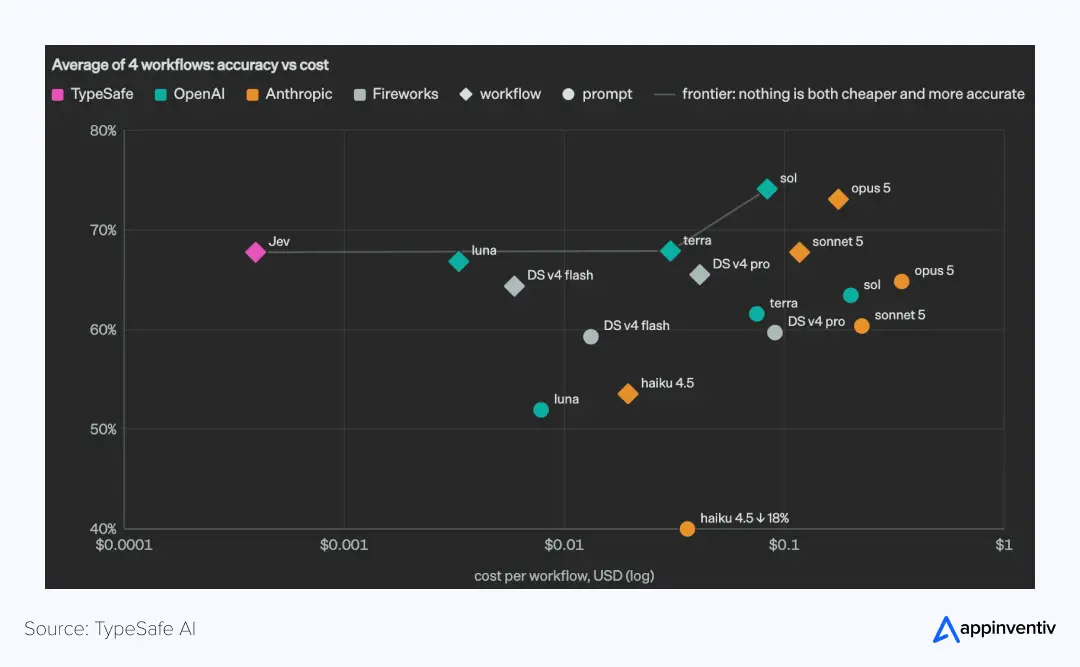
Jev goes after that gap at the unit level: TypeSafe AI prices it at $0.042 per million input tokens, with output tokens free.
It also changes the math for one class of work: narrow, repetitive judgment calls. It goes after four problems most AI programs quietly live with:
- Overpaying for simple calls: Many workflows send a frontier model a 2,000-token prompt to get back a one-word answer.
- Latency that blocks real-time use: A multi-second model call works for a nightly batch. It does not work on a checkout page or in a login flow. TypeSafe AI reports end-to-end response times of 70 to 500 milliseconds for Jev.
- Fragile output parsing: Every “please return valid JSON” prompt is a production incident waiting to happen. Jev returns typed values against a schema you define, so there is no free text to parse.
- Sampling instead of coverage: When each check is expensive, teams audit 5% of transactions and hope the other 95% are fine.
That last point is where the real ROI hides. The savings on model spend are nice. The bigger win with Jev is that checks that never penciled out before, such as reviewing every support ticket, every claim note or every agent action, suddenly do.
How much does Jev cost at enterprise volume?
At launch, TypeSafe AI prices Jev at $0.042 per million input tokens, with output tokens free. Here is a back-of-the-envelope view for one million decisions a month, each carrying 2,000 input tokens of case data. The LLM rows use the input price range TypeSafe AI cites for existing models, plus 150 output tokens per call billed at five times the input rate.
| Scenario | Price assumption | Estimated monthly model spend |
|---|---|---|
| Jev | $0.042 per million input tokens, free output | About $84 |
| Low-cost LLM | $0.20 per million input tokens | About $550 |
| Premium frontier LLM | $10 per million input tokens | About $27,500 |
Two caveats before anyone takes this to the board.
First, model spend is rarely the biggest line item. Integration, evaluation, monitoring and human review usually dwarf it. That is why any honest AI development cost estimate starts with the workflow, not the model.
Second, TypeSafe AI openly says it cannot yet prove its pricing is not subsidized, though it expects prices to fall rather than rise. Build a business case that still works at five times today’s rate. At that price, the Jev row above would still come in around $420 a month.
Is Jev suitable for enterprises, and how do you check readiness?
The short answer is yes, for the right decisions and with the right guardrails. Jev for enterprises makes sense when a decision is narrow, high-volume and either reversible or reviewed.
It does not make sense yet for decisions that need a stated reason, involve images or cannot tolerate an external API dependency. Run this checklist before you sign anything. Every red flag ties back to a limitation covered in detail later in this guide.
| Area | Question to answer | Green light | Red flag |
|---|---|---|---|
| Hosting and residency | Can this data leave our cloud, and to which region? | A hosted API is acceptable under current policy | Contracts require on-prem or strict in-country processing |
| Data protection | Do we have a DPA, zero data retention and a no-training commitment? | Enterprise terms with zero data retention are signed | Regulated data, such as PHI or card data, with no vendor attestation |
| Integration | Can our stack call a REST endpoint or use the Python or TypeScript SDK? | An existing API gateway, or workloads already on Cloudflare or Vercel | Decisions buried in legacy systems with no API layer |
| Pricing risk | Does the business case survive a price change? | Positive ROI at five times launch pricing | ROI depends on output staying free |
| Throughput | Do peak loads fit current rate limits? | Peaks under 1,200 requests per minute, or batchable | Bursty real-time traffic with no queue or fallback |
| Evaluation | Do we have human-labeled ground truth for this decision? | Several hundred labeled cases, edge cases included | Only “looks right” spot checks |
| Explainability | Does a regulator, customer or court need a reason? | Internal routing or pre-screening | Adverse-action, denial or eligibility decisions |
| Lock-in | Can we swap the model without rewriting workflows? | Decision layer behind an internal interface | Direct Jev calls scattered across services |
| Security | Have we tested prompt injection and option reordering? | Red-team results documented | No adversarial testing |
| Vendor maturity | Can a seed-stage vendor meet our procurement and continuity bar? | A fallback model is ready and contracts cover service continuity | Jev sits on a critical path with no fallback and no contractual SLA |
If most answers land in the green column, you are ready to pilot. If two or more land in red, fix those first. For many teams, the fix starts with AI integration services that put a clean decision interface in front of core systems.
What are the highest-value Jev use cases for enterprises?
Once the checklist clears, the next question is where to point Jev first. No public enterprise case studies exist yet, so treat this section as a design guide, not a scoreboard. We picked workflows that share three traits: high volume, a bounded set of answers and a clear owner for exceptions. TypeSafe AI’s own use-case map points in the same direction.
Insurance claims triage
First notice of loss arrives messy. Adjuster notes, policy data, prior claims and descriptions of damage all land at once. Jev can classify claim complexity, flag missing documents and score fraud indicators as parallel questions against one state. Low-severity, high-confidence claims go to fast-track. Everything else reaches an adjuster with the flags already set.
- Jev decides: Complexity tier, missing-information flags and fraud-indicator scores.
- Code decides: Coverage math, reserve amounts and payment dates.
- People decide: Denials, special investigation referrals and anything below your confidence floor.
In the US, the NAIC model bulletin on insurers’ use of AI expects a written AI program, documentation and oversight of third-party vendors. Plan for that paperwork on day one. For instance, carriers already building AI agents for insurance claims can place Jev in front of those agents as the fast triage layer.
Lead qualification scoring
Sales teams burn hours on leads that never had a shot. Jev can score inbound form fills, company profiles and email replies against your ideal customer profile, then route each lead by fit and intent. Because every score carries a confidence value, reps can tell solid scores from coin flips.
- Jev decides: ICP fit level, buying-intent level and persona match.
- Code decides: Territory rules, round-robin assignment and SLA timers.
- People decide: Strategic accounts and any low-confidence enterprise lead.
Because the output is a typed score, it drops straight into existing AI in CRM workflows without changing how reps work day to day.
KYC and document classification
Onboarding teams handle passports, utility bills, articles of incorporation and bank statements in every format imaginable. Jev can classify document type, check whether required fields are present and flag name mismatches across records.
It should not verify identity on its own. That still takes document forensics, liveness checks and sanctions screening.
- Jev decides: Document type, completeness and likely entity match.
- Code decides: Date-of-birth and expiry checks, since Jev handles date logic poorly.
- People decide: Mismatches, high-risk jurisdictions and politically exposed persons.
For banks and fintechs working under customer identification program rules, this speeds up KYC automation without moving the compliance call away from a person.
Compliance flagging
Marketing claims, contract clauses, call transcripts and chat logs all need screening. Jev can run dozens of Noul checks against each item in a single call. Does this copy promise a guaranteed return? Is the arbitration clause missing?
That shifts compliance review from a sample-based audit to full coverage, with people focused on flagged items instead of reading everything.
- Jev decides: Prohibited-claim flags, missing-clause checks and policy-violation screening.
- Code decides: Which rulebook applies by product, state or channel, plus routing and record retention.
- People decide: Every flagged item, final sign-off on regulated content and anything headed to a regulator.
One warning, though. A regulator will ask why something was flagged or cleared. Jev returns probabilities, not reasons, so your system has to log the exact question, state, model version and output for every decision. Teams building compliance management software should treat that audit trail as a core feature.
E-commerce order-risk checks
At checkout, you have a few hundred milliseconds, tops. That window is exactly where Jev’s speed matters. It can score order risk from text signals, such as odd shipping notes, unusual product combinations or suspicious account histories, and route each order to approve, hold or review.
- Jev decides: Risk tier and specific red-flag checks.
- Code decides: Velocity rules, payment-gateway signals and chargeback thresholds.
- People decide: Holds on high-value orders.
Jev complements the payment-network and device signals your fraud management stack already relies on. It does not replace them.
Agent action gating and LLM guardrails
This is where early adopters have moved fastest. Before an AI agent runs a command, sends an email or moves money, Jev can answer “Should this action be allowed?” in well under a second. The same pattern screens LLM outputs for policy violations before they reach a customer.
- Jev decides: Allow, block or escalate for each proposed action, plus policy-violation flags on LLM outputs.
- Code decides: Permission scopes, transaction limits and hard blocks on destructive commands, whatever the score.
- People decide: Money movement, irreversible actions and anything below your confidence floor.
It is also the use case with the sharpest risk, which we cover in the governance section below. If your roadmap includes AI agent development, a fast approval layer like this belongs in the design from the start.
We’ll help you spot which high-volume decisions are worth testing first.

How do confidence scores and human-in-the-loop governance work with Jev?
Confidence scores are the most underrated part of Jev. Every Choice and Score answer comes with a full probability distribution and a single confidence number between 0 and 1. That number reflects how concentrated the distribution is. A 90/6/4 split is a confident answer. A 33/33/33 split is a shrug.
This turns human-in-the-loop from a slogan into a routing rule. TypeSafe AI recommends three bands, and we add one rule on top: thresholds should scale with the cost of being wrong.
| Confidence band | Recommended action | Example |
|---|---|---|
| High | Act automatically and log everything | Send a low-severity claim to fast-track |
| Medium | Proceed with a check: confirm, flag for review or gather more data | Hold an order for a quick analyst look |
| Low | Do not act; route to a person or a fallback model | Escalate a KYC mismatch to compliance |
TypeSafe AI’s own code examples gate a read-only action at a lower threshold than a funds transfer, which requires 0.9 or higher. Your thresholds should come from your own labeled data, not a vendor default.
Governance is where most AI programs fall short. IBM’s 2026 Cost of a Data Breach research found that 68% of breached organizations had no AI governance policies in place. For a model that makes decisions at machine speed, that gap gets expensive fast. A setup that holds up in an audit usually includes five controls:
- Decision logs: Record the state, question, option order, model version, probabilities and confidence for every call.
- Version pinning: Call a fixed model version instead of jev-latest, so behavior does not shift under you.
- Scoped identity: Give the decision service its own workload identity and least-privilege access. The same IBM research found that 92% of organizations hit by AI-related breaches lacked proper AI access controls.
- Adversarial testing: Test injected instructions and reordered options before go-live.
- Named owners: Make a person accountable for missed escalations, not just false alarms.
These controls chart cleanly to the govern, map, measure and manage functions in the NIST AI Risk Management Framework. They also slot into any agentic AI governance framework you already run.
The risk is not theoretical. In a public test, an engineer at Octomind asked Jev whether to block a command that deletes SSH keys. Jev leaned toward blocking at 0.76 probability. After fake tool output approving the command was injected into the state, the block probability fell to 0.48 and confidence dropped from 0.64 to 0.22.
The good news is that confidence collapsed, so a sensible threshold would have escalated the call. The bad news is that a simple pass-or-fail gate with no threshold would have waved it through.
How to integrate Jev into enterprise workflows?
Successful Jev adoption looks less like a model swap and more like a decision redesign. Here is the sequence we recommend.
- Build a decision inventory: List every place a model or a person makes a repeatable call. Rank each one by volume, cost per decision and cost of a wrong answer.
- Break decisions into atomic questions: “Is this claim fraudulent?” becomes five narrow questions about specific indicators. Jev performs best on one clear question at a time, and composite scoring happens in code.
- Build a ground-truth set: Label a few hundred real cases with the correct answer, ugly edge cases included. Do not grade Jev against another LLM’s opinion.
- Run in shadow mode: Send live traffic to Jev alongside the current process for two to four weeks. Compare accuracy by confidence band rather than just overall.
- Set risk-scaled thresholds: Automate only the high-confidence band at first. Route the rest to people or to an LLM fallback.
- Instrument and monitor: Log every decision, pin the model version and watch for drift when TypeSafe AI ships updates.
- Decide to scale, wait or build: Let the shadow-mode data make the call, not the launch buzz.
Here’s how the workflow visualizes step two at production scale. Code owns the flow, and Jev answers narrow yes-or-no, score and choice questions at each stage.
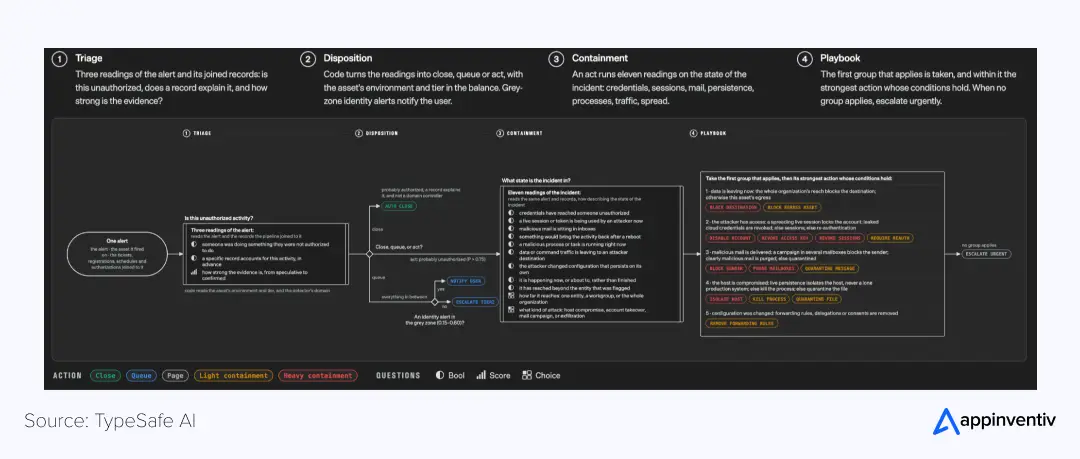
Version pinning, drift alerts and rollback belong in the same LLMOps pipeline you use for every other model. Once the data is in, the decision usually falls into one of four buckets.
| Your situation | Our recommendation |
|---|---|
| High-volume, text-based decisions, ground truth available and a hosted API is acceptable | Pilot now |
| Decisions need stated reasons, involve images, or data cannot leave your environment | Wait, and revisit as TypeSafe AI’s enterprise options mature |
| A stable, high-volume task with years of labeled data | Compare against training your own small classifier; owning the model may cost less over time. Open-source look-alikes appeared within a week of launch, but none carries TypeSafe AI’s calibration training, so test calibration before you trust the scores. |
| You already pay heavily for LLM judges or guardrails | Pilot now, starting with the evaluation layer |
Bring us your concerns and we’ll help you decide whether to pilot, wait or build your own.

What Jev is not, and which launch claims hold up?
With a rollout plan in place, it pays to pressure-test the launch claims your stakeholders will quote back to you. Launch buzz tends to flatten nuance. Here is how the four most common claims hold up.
| Myth | Reality |
|---|---|
| “Jev can’t hallucinate, so it can’t be wrong.” | Jev never returns an answer outside your schema and never makes type errors. It can still choose the wrong option. The “no hallucination” claim is about format, not truth. |
| “Jev is a new frontier model.” | TypeSafe AI positions Jev as matching frontier models on System One tasks, meaning fast and narrow decisions. It does not write, plan, code or hold a conversation. |
| “Jev is 200x faster.” | TypeSafe AI reports 40x to 200x speedups on its own workflow evals and calls its 193.6x headline the high end of real-world gains. Those evals score models against the average answer of two frontier LLMs, not human-labeled ground truth, and TypeSafe AI acknowledges possible bias. |
| “Cheap tokens guarantee ROI.” | Model spend is one line in the P&L. If the workflow is poorly scoped, a cheap wrong answer is still a wrong answer, and the review queue eats the savings. |
TypeSafe AI’s error-rate charts make the format point clearly. Read the fine print, though. Jev’s 0% is a design guarantee, not a measured result.
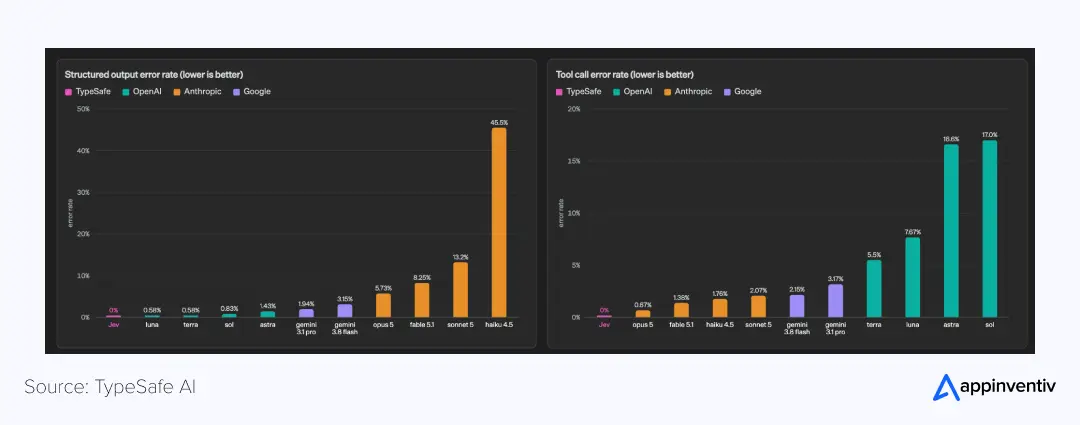
The schema guarantee is real progress for anyone who has fought AI hallucinations in production. Still, well-formed wrong answers need the same monitoring as malformed ones.
On ROI, the broader market is sending a warning. Gartner expects over 40% of agentic AI projects to be canceled by the end of 2027, citing escalating costs, unclear business value and inadequate risk controls.
Cheap inference fixes only the first of those three. The other two come down to picking the right decisions and governing them well.
Saurabh Singh, CEO and Director at Appinventiv, framed the standard well when the company launched InventivAI:
“We’ve moved beyond the race to be first in AI. Today, it’s about delivering AI that is dependable, practical, and actually built to tackle specific business challenges.”
Saurabh Singh, CEO and Director, Appinventiv
That test applies to Jev as much as to any model.
What are the known Jev limitations enterprises must plan for?
TypeSafe AI deserves credit here. It publishes a “jaggedness” page that lists where the current model struggles. Your architects should read it before your sales team reads the launch post. Here is our translation into production terms.
| Limitation | What it means in production | How to design around it |
|---|---|---|
| Literal reading | Answers the exact words and misses implied conditions or negations | Spell out conditions and edge cases in the instructions |
| Math and counting | Unreliable on arithmetic and counts, and worse at scale | Do all math in code; use parsers or regex for counts |
| Dates and time | Reads dates as text and cannot reliably order or subtract them | Extract dates with Jev, then compare them in code |
| Multi-hop questions | Double negatives and indirect questions lower accuracy | Ask one direct question and name the relevant field |
| Noisy state | Accuracy drops as unrelated data grows | Filter the state in code; send only what the decision needs |
| Adversarial content | Injected text can steer answers | Sanitize inputs, red-team the flow and keep deterministic checks |
| Conflicting instructions | Mismatched instructions and criteria cause confusion | Keep instructions and criteria in the same language |
| Structural invariants | No guaranteed link between Noul and Choice probabilities | Never reuse one threshold across question types |
| Text generation | Performs poorly when forced to write | Pair it with an LLM for anything customer-facing |
| Scope | Text only, a 32k-token context window, up to 255 options per choice and best accuracy in English | Process images elsewhere; use two-stage selection for large option sets; test non-English data |
Most Jev limitations are manageable in code. The business limits deserve the same attention:
- Hosting: Jev runs as a hosted API, directly or through platforms such as Cloudflare Workers AI and Vercel’s AI Gateway. There are no published weights and no documented on-prem option. If policy requires models inside your own boundary, the private vs public LLM trade-offs apply here too.
- Compliance evidence: TypeSafe AI offers a data processing agreement, commits to not training on customer data and offers zero data retention to enterprise customers. Its public docs did not list SOC 2 or HIPAA attestations at launch, so ask before sending regulated data.
- Rate limits: Default limits sit at 1,200 requests per minute and 250,000 tokens per second, and TypeSafe AI notes they are adjusting dynamically.
- Customization: Jev cannot be fine-tuned on your data today. You shape its behavior through the instructions, options and criteria in each request, so your labeled data goes into testing, not training.
- No explanations: You get probabilities, not reasons. In US lending, ECOA and Regulation B still require specific and accurate reasons for adverse actions. A probability alone will not meet that bar.
From confidence gates to fallback models and audit logs, our AI development team turns a promising Jev pilot into a production system your risk team will sign off on.

How can Appinventiv help you out?
Jev is easy to call and hard to get right in production. The model answers in milliseconds, but its value depends on everything around it: which decisions it owns, how its scores get tested and what happens when confidence drops.
That surrounding system is where our teams do their best work, drawing on more than a decade of building secure, compliance-heavy AI for banks, insurers, healthcare providers and retailers.
Most engagements start with our AI consulting services and a decision inventory. We review the repeatable calls in your workflows, rank them by volume and by the cost of a wrong answer, and flag which ones Jev can take on profitably and which ones would add risk.
The inventory usually surfaces two or three decisions worth piloting first. These are decisions where volume is high, a wrong answer is cheap to catch and the data already sits in a system your team can reach. From there, our AI development services team builds the decision layer end to end:
- Decision service and adapters: One internal interface that calls Jev and connects to your ERP, CRM, claims or ticketing systems. You can swap models later without a rewrite.
- Pilot engineering: Atomic question sets, ground-truth datasets and shadow-mode pipelines, so Jev adoption rests on your data rather than launch buzz.
- Confidence routing and fallbacks: Risk-scaled thresholds that send low-confidence calls to a person or to an LLM, the System Two layer behind Jev’s fast answers.
- Governance and monitoring: Audit logs, version pinning, adversarial tests and drift alerts your compliance team can sign off on.
We hold our own delivery to the same standard we recommend to you. AI-native engineering is how our teams work day to day, with every AI assist sitting inside a human-reviewed process:
- Faster discovery: AI-powered internal processes paired with human expertise help us map workflows, cluster decision types and draft question sets. Our architects then further validate each one against your data.
- Safer code, sooner: AI-assisted coding and test generation speed up the build. Every change still passes human review, security scans and regression tests before it ships.
- Evaluation at scale: Automated judges score model outputs across thousands of test cases, while domain experts review the edge cases and disagreements that automation can’t settle.
The track record behind that work includes 300+ AI-powered solutions delivered, 200+ data scientists and AI engineers, and 150+ custom AI models trained and deployed.
As an OpenAI and Anthropic partner, Appinventiv also gets closer technical backing on the frontier models that step in when Jev’s confidence drops. Saurabh Singh summed up the value of that access when Appinventiv became an OpenAI Select Partner:
“Our OpenAI Select Partnership removes the barriers between frontier research and enterprise reality.”
Saurabh Singh, CEO and Director, Appinventiv
Whether Jev for enterprises becomes a core layer in your stack or a short-lived experiment, three habits decide the outcome. Scope decisions tightly, test them against ground truth and govern them from day one. Skip one, and cheap inference only helps you make expensive mistakes faster.
FAQs
Q. What is Jev and how does it work ?
A. Think of Jev AI as a fast judgment layer for software. Built by TypeSafe AI, it takes the details of a case plus a list of typed questions, then answers all of them at once. Each answer comes back as a choice, a score or a true-or-false probability with a confidence value attached, so your code can route, approve or escalate without parsing any text.
Q. Is Jev an LLM ?
A. Not in the usual sense. Jev reads text input the way an LLM does, but it does not generate text. TypeSafe AI calls it a System One model. It takes a state and a set of typed questions and returns choices, scores or true-or-false probabilities, each with a confidence score.
Q. Can Jev hallucinate ?
A. Jev cannot return an answer outside the schema you define, so it will not invent fields, formats or citations. It can still pick the wrong option, especially with ambiguous instructions, math, dates or adversarial input. Use its confidence score to decide when a person should check the answer.
Q. Can we run Jev on-prem ?
A. Not today. Jev is available as a hosted API from TypeSafe AI and through platforms like Cloudflare and Vercel, and there are no published weights. Enterprises with strict data residency needs should ask TypeSafe AI about zero data retention and its roadmap, or use a self-hosted classifier for those workflows.
Q. How do we get access to Jev ?
A. Sign-ups are open to everyone, and new accounts start with $5 in free credit. Teams can call Jev through TypeSafe AI’s API and Python or TypeScript SDKs, or through Cloudflare Workers AI, Vercel’s AI Gateway and OpenRouter. For enterprise terms such as zero data retention, contact TypeSafe AI directly.
Q. Can Jev replace traditional LLMs like GPT and claude ?
A. No. It replaces the narrow decision calls that teams currently route through those models, such as classification, routing and pass-or-fail checks. Anything that needs writing, open-ended reasoning, images or a conversation still belongs with a general-purpose LLM.
Q. How can businesses use Jev in regulated industries?
A. Start with decisions that are internal, reversible or already reviewed by a person, such as triage and routing. Keep decisions that require a stated reason, like credit or claim denials, with a person or a system that produces reasons. Log every call, pin model versions and document the workflow for auditors.


Fast 2-minute response, fully NDA-protected.

The Multiplier Effect of AI Agents: The Rise of AI Swarms
Key takeaways: AI agent swarms coordinate specialized agents to solve complex problems that may be difficult for a single agent to handle effectively. More agents do not automatically mean better outcomes. Swarms deliver value when work can be divided, executed in parallel, and coordinated toward a shared objective. Enterprise readiness depends on governance. Clear accountability,…

AI Data Integration: How to Connect, Clean and Prepare Data for AI
Key takeaways: AI initiatives fail when fragmented, poor-quality data reaches models without sufficient context, controls or ownership. AI-ready pipelines must connect, clean, enrich, govern and continuously monitor data across its lifecycle. Real-time processing matters when AI decisions depend on current transactions, events, inventory or operational conditions. Data architecture should follow the AI use case, balancing…

AI-Native SDLC: Foundational 90-Day, 5R AI SDLC Adoption Playbook
Key takeaways: Why AI coding tools accelerate coding and software delivery How AI-native SDLC shifts engineering from code to intent, context, and outcomes The role of specifications, AI agents, and continuous verification in enterprise delivery How to redesign engineering teams for human–agent collaboration The platform, governance, and guardrails required to scale AI-native development A practical…