





























Wearable Data Integration: Connecting Multiple Devices to a Unified Health Platform

 Share -



- 01Why Businesses Need a Unified Platform for Wearable Health Data
- 02Key Business and Healthcare Use Cases for Wearable Data Integration
- 03How Multiple Wearable Devices Connect to a Unified Health Data Platform
- 04Real-World Examples of Wearable Integration in Healthcare
- 05How AI Enhances Wearable Data Integration for Better Health Insights
- 06Planning Wearable Integration: Key Decisions Before You Invest
- 07How to Implement Wearable Integration: From Development to Rollout
- 08Security, Privacy, and Compliance Requirements for Wearable Data Integration
- 09Wearable Data Integration Challenges and How to Address Them
- 10How Much Does Wearable Integration Cost?
- 11How Appinventiv Helps Build Connected Health Platforms
- 12FAQs

Key takeaways:
- Device support should reflect the measurements your service needs, the people using it, and the decisions those readings inform.
- A unified health data platform must preserve source, timing, and measurement context while resolving duplicate records.
- Phone health platforms, manufacturer APIs, and direct device connections serve different integration needs.
- Clinical workflows require agreed review responsibilities, suitable devices, and clear handling of delayed or missing readings.
- Budget for connector maintenance, vendor access, data operations, and user support alongside the initial build.
- Measure useful data coverage and workflow improvements before expanding the device portfolio or introducing AI.
McKinsey’s June 2026 State of the Consumer report highlights how widely health tracking has spread. Citing its consumer research, it reports that 75% of Gen Z and 73% of millennials surveyed use health-monitoring tools, including smartwatches, fitness trackers, and continuous glucose monitors. For businesses planning their next phase of digital health investment, the opportunity extends beyond connecting another device.
The harder task is making information from different devices useful together.
Consider someone who wears a smartwatch during workouts, uses a ring to track sleep, and checks glucose through a separate application. Their medical history sits with their healthcare provider. Each source adds context, but separate dashboards leave users and care teams piecing that context together.
For healthcare providers, this can mean more time reviewing scattered records. For digital health businesses, inconsistent readings and failed connections create support work and weaken trust. A platform may support several devices yet still struggle to produce a dependable view of one person’s health.
As businesses plan for 2027, wearable integration needs a clearer purpose. Which measurements should reach the platform? How quickly must they arrive? What happens when two devices disagree, a connection drops, or a user changes hardware?
These decisions shape development costs, clinical workflows, privacy controls, and the services a business can confidently offer. They also determine whether adding more devices improves the product or simply increases maintenance.
This blog examines wearable data integration from source access to usable health records. We cover connection methods, data quality, clinical workflows, security, and costs. The focus is on helping businesses bring readings from different devices into a platform their teams can use confidently.
Show us where your health data gets disconnected. Let’s map what to connect, what to keep, and what to fix first.
Why Businesses Need a Unified Platform for Wearable Health Data
Wearable health data integration brings authorized readings from different sources into a consistent, traceable record. For healthcare providers and wellness businesses, this means less administrative work, clearer information for follow-ups, and greater flexibility to serve users across supported devices.
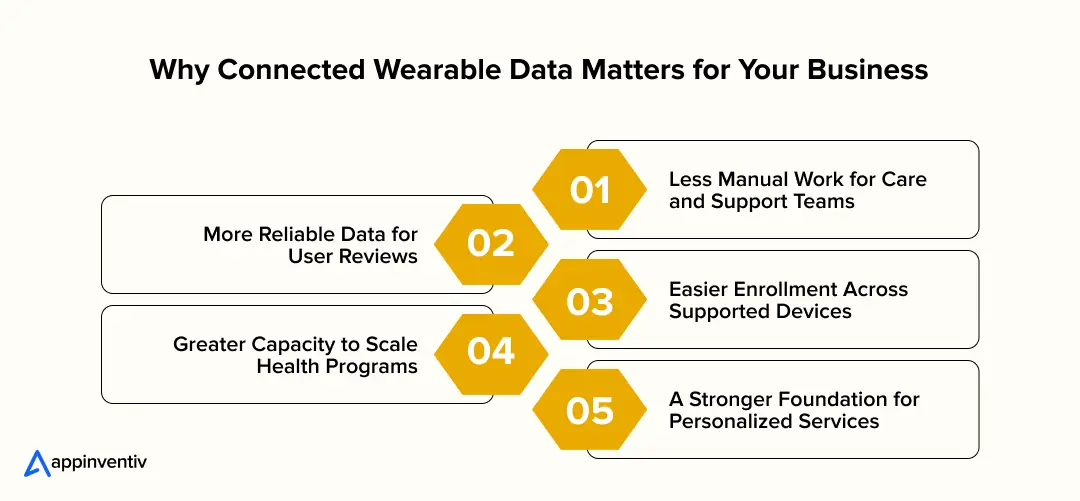
Less Manual Work for Care and Support Teams
One of the clearest benefits of wearable integration is less time spent collecting and reconciling information. Bringing activity and sleep records into one dashboard reduces requests for screenshots and separate reports. Teams can spend more of each session discussing progress instead of assembling it.
More Reliable Data for User Reviews
Shared rules for duplicates, timestamps, and source labels make records easier to interpret. Teams can distinguish repeated readings from separate observations and identify incomplete periods before reviewing progress. This supports more informed conversations and reduces avoidable corrections.
Easier Enrollment Across Supported Devices
Integration with wearable devices across selected brands lets more users participate with suitable hardware they already own. This can reduce equipment costs and remove a purchasing step from enrollment. Businesses gain flexibility while maintaining clear requirements for essential measurements.
Greater Capacity to Scale Health Programs
Centralized monitoring, validation, and reporting reduce the need to check every connection manually. Teams can identify affected users and address recurring issues through a shared process. This helps businesses expand participation without increasing administrative work at the same rate.
A Stronger Foundation for Personalized Services
A shared history of activity, sleep, and participant feedback gives coaching and reporting features more useful context. Businesses can build progress summaries and tailored support around that history, reusing established data connections as they introduce new services.
Key Business and Healthcare Use Cases for Wearable Data Integration
The most useful wearable integration use cases start with a defined task: preparing a coaching session, reviewing patient readings, or collecting study data. That task determines which measurements to collect, how quickly they must arrive, and who needs access.
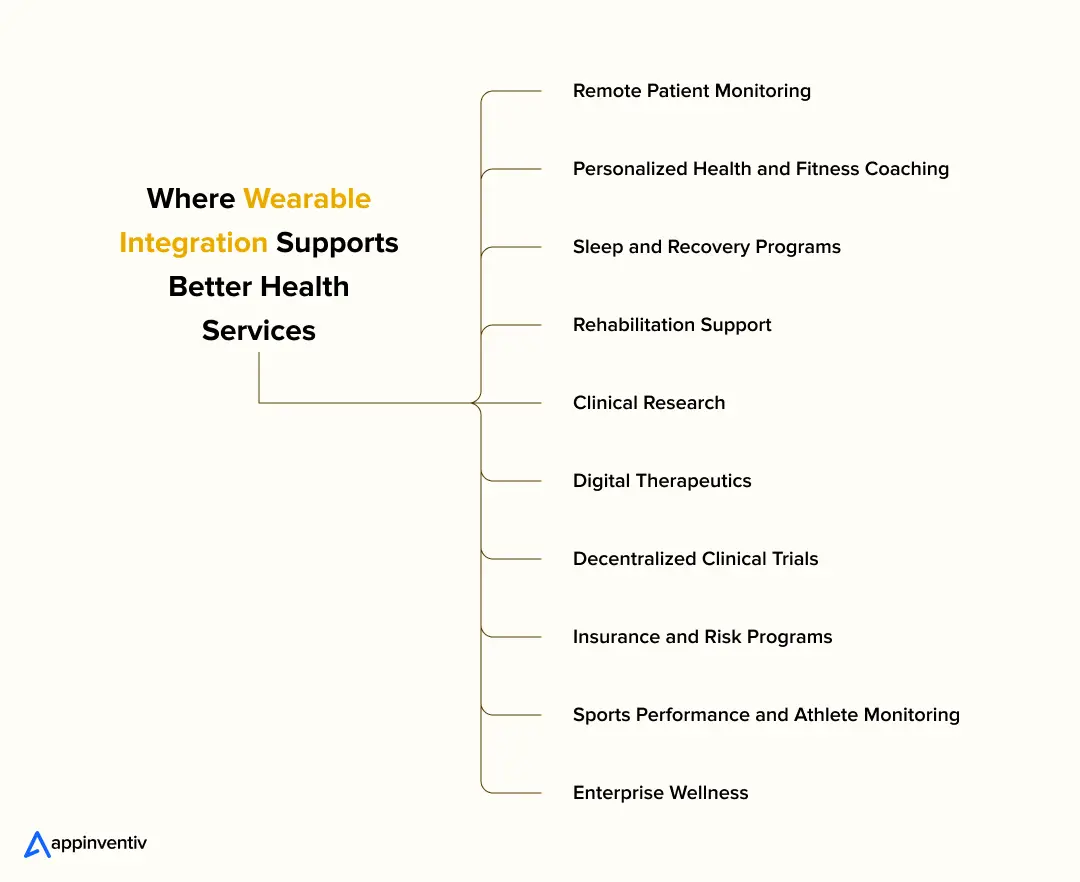
Remote Patient Monitoring
Smart wearable integration in healthcare can bring protocol-relevant readings into a care team’s review queue alongside information from connected medical devices. Show measurement time, missing records, and assigned follow-ups so staff can assess the available information and act within the program’s agreed procedures.
Integration focus: Patient records, suitable device data, and clinical review workflows.
Success measures: Data completeness, review time, and completed follow-ups.
Also Read: How Much Does it Cost to Develop a Remote Patient Monitoring Software?
Personalized Health and Fitness Coaching
Combine activity, workouts, sleep estimates, and participant feedback before coaching sessions. Coaches can discuss progress with context instead of asking users to open several apps or send screenshots.
Integration focus: Wearable histories, coaching dashboards, and participant goals.
Success measures: Session preparation time, program engagement, and membership retention.
Sleep and Recovery Programs
Connect sleep estimates with activity history and self-reported habits to support structured progress reviews. Keep device sources visible so a hardware change does not appear as an unexplained change in sleep.
Integration focus: Sleep records, activity data, and user journals.
Success measures: Usable nights of data, continued participation, and review effort.
Also Read: Sleep Tracker App Development: Features, Wearable Integration, AI, and Compliance
Rehabilitation Support
Bring suitable activity measurements and patient-reported progress into the therapist’s workflow between appointments. Select devices around the prescribed activity; step counts alone cannot establish whether an exercise was performed correctly.
Integration focus: Relevant movement data, exercise plans, and patient feedback.
Success measures: Documentation time, data coverage, and therapist adoption.
Clinical Research
Collect protocol-defined wearable measurements across study participants and flag missing records for investigation. Preserve timestamps, device details, and processing history so researchers can trace the information they use.
Integration focus: Device data, participant identifiers, and study systems.
Success measures: Data completeness, reconciliation effort, and traceability.
Digital Therapeutics
Digital therapeutics can use wearable data to support treatment adherence, progress tracking, and intervention timing. The platform should only surface measurements that are relevant to the therapy and clearly separate device-generated signals from patient-reported information.
Integration focus: Wearable data, therapeutic workflows, patient apps, and clinician or coach dashboards.
Success measures: Adherence, usable data coverage, intervention completion, and patient engagement.
Decentralized Clinical Trials
Wearable data integration can support decentralized trials by collecting protocol-defined measurements outside traditional study sites. Researchers can monitor data completeness, identify missing records, and reduce dependence on participant-entered logs.
Integration focus: Wearable devices, eCOA platforms, participant identity, trial systems, and study protocols.
Success measures: Data completeness, protocol adherence, reconciliation effort, and participant retention.
Insurance and Risk Programs
Insurers and wellness-linked insurance programs can use wearable data to support engagement, prevention initiatives, and selected risk-management programs. The integration model needs clear consent, access boundaries, and rules around how device data can and cannot influence insurance decisions.
Integration focus: Member apps, wearable platforms, consent management, and insurer analytics systems.
Success measures: Program participation, data continuity, member engagement, and support demand.
Sports Performance and Athlete Monitoring
Sports organizations can combine activity, recovery, sleep, workload, and training data from multiple wearables into a unified performance view. Coaches and performance teams can review trends without relying on separate device dashboards for every athlete.
Integration focus: Athlete wearables, training systems, recovery data, and performance dashboards.
Success measures: Data availability, review time, athlete compliance, and coaching adoption.
Enterprise Wellness
For enterprise wellness providers, wearable technology integration can reduce manual activity logging and support participation across selected devices. Participants receive personal progress views, while administrators receive appropriate aggregated reporting. Keep individual health histories access-controlled, even when an employer funds the program.
Integration focus: Participant apps, supported wearables, and program reporting.
Success measures: Enrollment completion, sustained participation, and support demand.
How Multiple Wearable Devices Connect to a Unified Health Data Platform
Wearables can share information through a phone’s health platform, a manufacturer’s cloud service, or a direct device connection. Your platform may need more than one route. The work then involves linking readings to the right user, checking their consistency, and delivering useful information to the intended workflow.
Connecting Through Apple HealthKit and Android Health Connect
Apple HealthKit and Android Health Connect let authorized applications access supported health records shared within their respective ecosystems. This can reduce the need for separate integrations with every device brand.
However, your application can only receive information available through that route and permitted by the user. Confirm which measurements reach the health platform before promising compatibility.
Business consideration: This approach can simplify device coverage, but the scope must account for permissions, missing data, and mobile synchronization.
Integrating Through Device Manufacturer APIs
Wearable API integration connects your platform to authorized information held by a device manufacturer’s cloud service. This route may provide measurements or historical detail unavailable through a phone’s health repository. Confirm supported records, update behavior, and commercial access before selecting it.
Access conditions vary. Garmin’s Health API, for example, requires approval and commercial licensing. Its data becomes accessible after users synchronize supported devices with Garmin Connect.
Business consideration: Verify access, available measurements, licensing costs, and delivery delays before finalizing the development estimate.
Using Direct Device Connections Where Needed
Direct wearable device integration may be appropriate when a supported Bluetooth connection or manufacturer SDK is needed to capture readings. A guided measurement session is one example. For this blog’s scope, the purpose is to collect data and pass it into the shared health record.
The application must handle pairing, reconnection, and interrupted transfers. Your team should also verify how captured readings reach the backend, retain their source details, and recover after a network interruption. Include physical-device testing in the delivery scope.
Business consideration: Include physical-device testing and troubleshooting in the budget when choosing this route.
Standardizing Readings and Resolving Duplicates
Wearable device data integration requires consistent measurement types, units, timestamps, and user identifiers. Preserve the original source and record identifier alongside standardized values. This lets teams trace dashboard figures and investigate discrepancies without losing the context of the incoming reading.
Duplicates need specific rules. A workout imported through two routes should not count twice. Equally, two devices recording different observations should not automatically be treated as duplicates. Health Connect offers priority-based deduplication for activity and sleep aggregation, but your backend must address overlaps outside that scope.
Business consideration: Ask your partner to demonstrate how source conflicts, corrected records, and device changes affect the final dashboard.
Delivering Data to Apps, Dashboards, and Clinical Systems
Wearable health data integration should deliver information where it supports a defined task. Participants may need progress summaries, coaches may need weekly trends, and clinicians may need selected observations within an existing review workflow. Decide which records each audience needs rather than displaying every available measurement.
Clinical exchange can use standards such as FHIR where supported. The receiving system still needs agreed patient matching, data formats, and display requirements.
Business consideration: Define who receives each output, how fresh it must be, and what action follows. Successful transmission alone does not establish a useful integration.
Real-World Examples of Wearable Integration in Healthcare
Healthcare organizations already use these connection approaches to support patient tracking and care-team reviews. The following examples show how organizations approach wearable integration in healthcare through patient apps, health repositories, and care-team platforms. Each highlights a practical dependency, from user permissions to update frequency, that businesses should examine when planning their own service.
| Healthcare Business | How the Integration Works | Lesson for Your Platform |
|---|---|---|
| Omada Health | Omada documents a connection that brings supported continuous glucose monitor readings into its app through a phone’s health application. Users must connect both stages and authorize sharing. Its guidance also identifies synchronization delays and app-use requirements. | Map the complete data journey. An available connection may still depend on user actions and delayed source updates. |
| Ochsner Health | MyOchsner allows patients enrolled in self-tracking programs to upload health and fitness information, including data from Apple Health, through its patient portal experience. | Place connected data within an established patient workflow, with clear enrollment and access requirements. |
| Huma | Huma documents Fitbit integration for supported measurements including steps, heart rate, and sleep. Its specified synchronization intervals differ by measurement, with hourly updates for some records and daily updates for others. | Set freshness expectations by measurement. Different data types do not need, or necessarily support, the same update schedule. |
These examples give buyers concrete questions to raise during discovery: which readings are accessible, what delays their arrival, and where will the information be used?
How AI Enhances Wearable Data Integration for Better Health Insights
When assessing future trends in wearable integration, focus on capabilities your data can support. AI-assisted summaries, personalized coaching, and pattern review are candidates for testing once records are consistent and traceable. Evaluate each against accuracy, staff effort, and user usefulness before expanding its role.
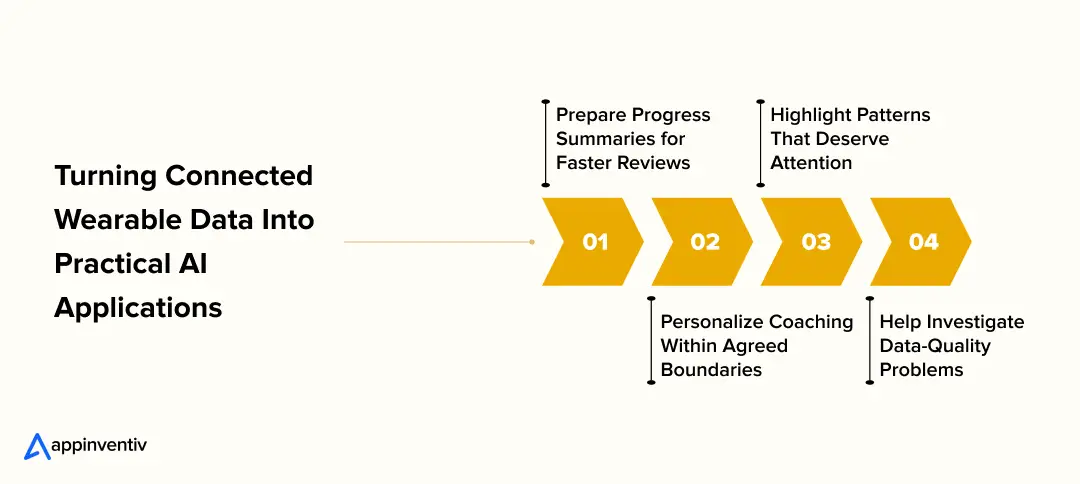
Prepare Progress Summaries for Faster Reviews
AI can draft summaries of recorded activity, sleep, and other supported measurements before a coaching session. Staff can spend less time assembling information and more time discussing it.
Each summary should link to supporting records and flag incomplete periods. Missing readings should never become invented explanations.
Measure: Preparation time saved and corrections required before use.
Personalize Coaching Within Agreed Boundaries
A platform could use recorded routines, stated goals, and participant feedback to suggest relevant coaching content. Someone struggling with consistency may benefit from different guidance than someone regularly completing their plan.
Keep recommendations within the service’s approved scope. Coaches should review changes that require professional judgment.
Measure: Recommendation relevance, participant engagement, and coach overrides.
Highlight Patterns That Deserve Attention
Models can be evaluated for identifying changes across several measurements, helping teams prioritize records for review. However, a device switch or interrupted synchronization can also change the apparent pattern.
Test performance across supported devices and data-coverage levels. Clinical applications need validation for their intended use.
Measure: Useful flags, false alerts, and review workload.
Help Investigate Data-Quality Problems
AI may help classify recurring ingestion issues or unusual record patterns across large datasets. Use straightforward validation rules for known errors, then assess whether a model improves handling of more complex cases.
Keep uncertain records visible for investigation rather than silently changing health values.
Measure: Investigation time and incorrectly flagged records.
Before funding AI, ask your development partner to demonstrate the proposed feature using representative data, including missing readings and device changes. The business case should show a measurable improvement over the existing workflow.
Also Read: Wearable AI: What Does the Implementation Mean for the Digital World
Planning Wearable Integration: Key Decisions Before You Invest
A wearable technology integration project should begin with the service you want to improve. Define the required measurements, acceptable sources, and destination workflow before selecting connectors. These decisions establish what belongs in the first release and what can wait.
Ask your development partner to turn those requirements into a data-flow map and a scoped delivery plan. The proposal should identify access dependencies, processing rules, and ongoing responsibilities before development starts.
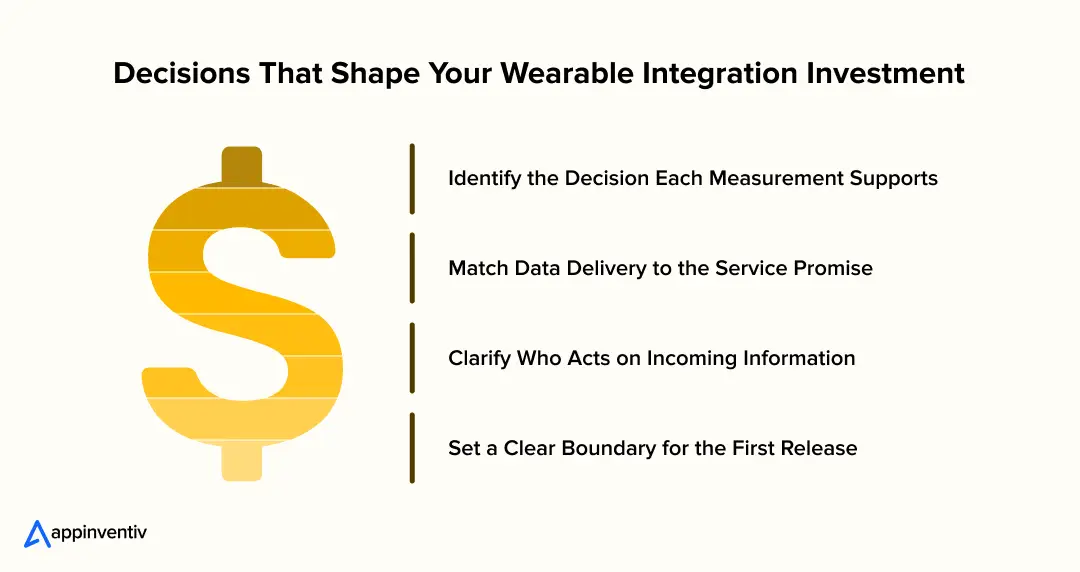
Identify the Decision Each Measurement Supports
Start with the work your team needs to perform. A fitness coach reviewing weekly participation may need workout history and daily activity totals. A remote care program may require specific measurements collected according to a clinical protocol.
For every proposed data type, answer five questions:
- Who needs this information?
- What decision or action will it support?
- How recent must the reading be?
- Which devices provide suitable data?
- What should happen when that data is missing?
These answers create a useful development brief. They also help remove unnecessary data collection before it becomes an ongoing cost.
Match Data Delivery to the Service Promise
A weekly progress report can accommodate delayed synchronization. A workflow requiring prompt review needs a connection that can reliably support that timing.
Define the acceptable delay between a measurement being recorded and becoming available to the intended user. Then test the complete path, including the device, phone, external platform, and your application.
For wearable API integration, check when the manufacturer makes readings available and how your platform retrieves them. A working API connection does not establish that the latest measurement has arrived. Build delivery expectations around the complete data path, including any required user actions.
Clarify Who Acts on Incoming Information
A dashboard does not establish responsibility. If readings require review, someone must own that task.
For a care program, define review hours, escalation procedures, and the response to missing information. For a wellness service, decide when the platform should provide a summary, send a reminder, or suggest contacting the support team.
These responsibilities influence staffing and product design. They should be agreed before the team builds notifications and alerts.
Set a Clear Boundary for the First Release
Choose one complete workflow for the initial release. For example, participants connect supported devices, the platform prepares a weekly activity summary, and coaches review it before scheduled sessions.
That scope gives the business something specific to evaluate: connection success, usable data coverage, preparation time, and participant engagement.
The first milestone should prove that connected data improves a service people use. Additional devices and measurements can follow when they support that outcome.
How to Implement Wearable Integration: From Development to Rollout
The best practices for wearable integration become useful when they are built into delivery: validate source access, test complete data flows, and agree on acceptance criteria. Each stage should produce evidence that records reach the correct user and remain usable when connections fail or source data changes.
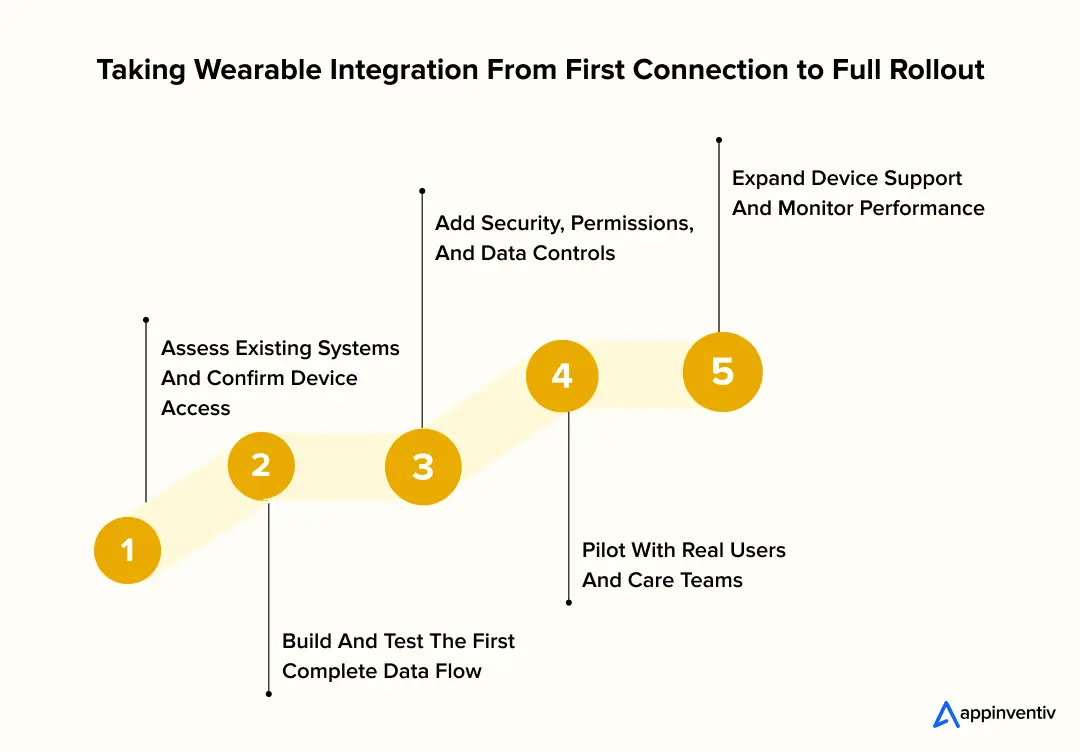
Assess Existing Systems and Confirm Device Access
Before starting wearable device integration, assess how the existing platform identifies users, stores health records, and controls access. Confirm whether its backend and dashboards can accept the required measurements. Reuse suitable components and identify the changes needed to support the agreed data flow.
Validate access using representative records from the selected sources. Identify vendor approvals, commercial agreements, and customer-system dependencies before committing to delivery dates.
Expected deliverable: An integration map showing supported measurements, connection routes, system changes, and unresolved dependencies.
Build and Test the First Complete Data Flow
Begin wearable device data integration with one supported source and one complete workflow. A participant authorizes access, readings reach the backend, and validated records appear in the intended dashboard. Verify source details and timestamps at each stage before adding more connections.
Test repeated uploads, incomplete readings, and interrupted connections during this stage. Resolving these issues early gives subsequent integrations a tested foundation.
Expected deliverable: A working connection with traceable records, validation rules, and a demonstrated recovery process.
Add Security, Permissions, and Data Controls
Build healthcare data security and access controls alongside data collection. Define what participants, coaches, clinicians, and support staff can see and change.
Include permission withdrawal, retention rules, credential protection, and audit records in the implementation scope. For platforms serving several organizations, verify that each customer’s information remains isolated.
Expected deliverable: Tested access rules and documented processes for managing data throughout its lifecycle.
Pilot With Real Users and Care Teams
Run the pilot across representative devices, phones, and user conditions. Include people who need onboarding assistance and staff who will operate the service after launch.
Measure connection completion, missing records, synchronization delays, and support requests. Ask staff whether the information reduces preparation work or creates another dashboard to check.
Expected deliverable: A pilot scorecard showing results against agreed targets, outstanding issues, and readiness for expansion.
Expand Device Support and Monitor Performance
Add further connections using the tested architecture and onboarding process. Monitor each source separately so a problem affecting one device family remains visible.
Assign responsibility for vendor changes, operating-system updates, connection failures, and user support. These activities need an ongoing budget and an accountable owner.
Expected deliverable: A phased rollout plan with monitoring, support coverage, and maintenance responsibilities.
Explore how our wearable development services connect device data, health applications, and care workflows.

Security, Privacy, and Compliance Requirements for Wearable Data Integration
Wearable integration in healthcare can involve device vendors, cloud providers, care organizations, and analytics services. Map who receives information, why they need it, and where it is processed. Use that map to establish applicable obligations, access controls, and contractual responsibilities before launch.
| Area to Address | What Your Business Should Establish |
|---|---|
| HIPAA- HITECH Applicability | For US services, assess whether your organization is a HIPAA covered entity or business associate. HITECH strengthened HIPAA enforcement, introduced breach notification requirements, and extended direct liability to business associates for certain obligations. Define applicable safeguards, reporting duties, and agreements; handling health data alone does not automatically make an app subject to HIPAA. |
| Consumer Health Data Obligations | Assess requirements outside HIPAA, including the FTC Health Breach Notification Rule where applicable. Certain personal health record providers and related entities must notify affected parties following qualifying breaches. |
| GDPR and Sensitive Data | Where GDPR applies, establish a lawful basis and an applicable condition for processing health data. Health information receives special protection; a device permission screen alone does not resolve these requirements. |
| Consent and Withdrawal | Explain what the platform collects, why, and who receives it. Separate device access from optional secondary uses. Define how withdrawal affects future collection and previously stored information. |
| Retention and Deletion | Set retention periods by purpose and applicable obligations. Document how deletion requests affect source records, derived reports, backups, and downstream providers. |
| Security and Third-Party Access | Protect records and credentials, restrict access by role, and maintain audit trails. Review what cloud, analytics, support, and AI providers receive and may retain or reuse. |
| Wellness Versus Medical Use | Assess intended functions and product claims before launch. The FDA’s January 2026 general wellness guidance addresses low-risk wellness products; medical functions require assessment under the relevant regulatory framework. |
Ask your development partner for evidence tied to these requirements: access-control tests, data-flow documentation, retention settings, and incident-response responsibilities. Compliance needs to be reflected in how the service operates, as well as its policies.
Wearable Data Integration Challenges and How to Address Them
Most integration problems appear after the first successful connection. Devices stop syncing, users change permissions, and previously valid records arrive again. Your development scope should cover these situations before they become recurring support costs. Let’s look into the major challenges in wearable integration in detail below:
| Challenge | Business Impact | Practical Response |
|---|---|---|
| Duplicate or overlapping readings | Inflated activity totals and inconsistent reports weaken trust. | Use source identifiers and measurement-specific rules to reconcile repeated or overlapping records. |
| Different measurement methods | Similar-looking scores may produce misleading comparisons across devices. | Preserve source labels and validate comparability before combining vendor-derived metrics. |
| Delayed or missing synchronization | Staff may review outdated information without realizing it. | Show measurement time and freshness; define when missing data requires investigation. |
| Partial or withdrawn permissions | Features may stop receiving required information unexpectedly. | Explain permission needs during onboarding and provide a usable experience when access changes. |
| Device replacement and account changes | Histories may split, overlap, or become linked incorrectly. | Verify account ownership, preserve source history, and test device-switching workflows. |
| Vendor updates and access restrictions | Previously working connections can require unplanned engineering work. | Maintain connector monitoring, regression tests, and a budget for source changes. |
| Too many alerts | Review queues become difficult to manage, increasing staff workload. | Agree on actionable rules, review ownership, and escalation procedures with the service team. |
| Sensitive data entering support tools | Logs, analytics, or exports may expose more information than staff need. | Limit collected fields, restrict access, and inspect logging and third-party tooling before release. |
Before accepting delivery, ask your partner to demonstrate failure recovery as well as successful synchronization. That demonstration reveals how much operational work your team may inherit.
How Much Does Wearable Integration Cost?
The budget depends on your data sources, required measurements, existing infrastructure, and destination workflows. Adding selected readings to an established health platform has a different scope from building new ingestion, storage, reporting, and clinical exchange capabilities.
A wearable API integration estimate should cover authorization, data retrieval, historical imports where required, validation, failure recovery, and maintenance. Ask your partner to separate these costs from new application features so you can compare proposals against the same requirements.
As a broader reference, Appinventiv’s wearable app development cost guide, the budget between $50,000 and $500,000. This is an application development range, rather than a standalone integration quote. Your project needs an estimate tied to its actual scope.
Separate Integration Costs From Platform Development
An existing product may already provide user accounts, dashboards, hosting, and access controls. Reusing suitable components can reduce the amount of new development.
A new platform needs those foundations alongside device connections. Ask proposals to separate the work so you can compare equivalent scopes.
| Budget Component | What It Should Cover |
|---|---|
| Discovery and access validation | Existing-system review, device compatibility, sample data, and vendor access requirements. |
| Device integrations | Authorization, ingestion, synchronization, updates, and connection recovery. |
| Data processing | User matching, standardization, duplicate handling, source tracking, and storage. |
| Application workflows | Onboarding, progress views, staff dashboards, notifications, and required clinical exchange. |
| Testing and launch | Physical-device testing, security checks, pilot support, and staff training. |
| Ongoing operation | Hosting, vendor fees, monitoring, maintenance, and user assistance. |
Identify What Will Change the Estimate Most
The number of device brands is only one cost driver. A connection providing daily summaries differs from one requiring detailed samples, historical imports, and frequent updates.
Other factors include:
- Existing infrastructure: Missing identity, storage, or access-control capabilities expand the build.
- Connection method: Direct hardware communication adds pairing and physical-device testing.
- Clinical integration: Receiving-system requirements and workflow validation add delivery dependencies.
- Data volume and retention: More frequent readings and longer retention increase processing and storage needs.
- User and organizational variation: Multiple customer organizations, regions, and roles require additional configuration and testing.
A useful estimate states which assumptions are confirmed and which could change after discovery.
Compare Ownership Costs at Your Expected Scale
Request operating estimates for both the pilot and the expected user base. Include commercial API access, infrastructure, support, and connector maintenance.
Also examine how charges increase. A per-user fee may behave differently from pricing based on connected accounts or data volume.
Where a third-party aggregation service is proposed, assess its measurement coverage, contractual terms, and export options alongside the initial development savings.
Connect the Budget to a Measurable Return
Choose a financial measure that reflects the service you are improving. For a coaching platform, that might be staff preparation time or contribution per active member. For a monitoring program, it may be an administrative effort per participant.
For illustration, saving ten minutes of monthly preparation across 1,200 participants releases 200 staff hours. Whether that becomes financial value depends on how the business uses the capacity.
Include recurring technology costs and additional support effort before calculating the net benefit. Keep projected retention or clinical improvements separate until your pilot provides evidence.
Bring your device shortlist and growth plans. Get a scope that accounts for integration, licensing, and ongoing support.
How Appinventiv Helps Build Connected Health Platforms
A connected health product needs device integrations, usable data, and workflows that fit the service. Planning these together gives businesses a clearer development scope and fewer surprises during rollout.
As a wearable app development company, we connect your applications with health platforms and manufacturer APIs. Our approach to wearable health data integration combines data processing, access controls, and application workflows so your teams can use incoming information effectively.
We Map Your Data Sources and Integration Requirements
We assess the measurements your service needs, the sources that provide them, and the systems receiving them. Our team defines access requirements, synchronization expectations, and processing rules before development begins. You get a clear integration scope of wearable technology for your healthcare platform with dependencies identified early.
We Connect Wearable Readings to Your Health Workflows
We build integration with wearable devices around the applications and workflows your teams already use. Our work connects available readings to backend systems, dashboards, and reports while preserving source details and applying agreed validation rules. Teams can review relevant information with visibility into missing or delayed records.
We Build for New Data Sources and Ongoing Maintenance
We design wearable technology integration around reusable components so additional sources can enter an established data workflow. Our team plans connection monitoring, maintenance, and documentation alongside the initial build. We define support responsibilities with you so the platform has a clear operating plan after launch.
For Health-ePeople, we built a platform that brought data from more than 200 healthcare devices and apps into one place. Our team integrated Human API to connect third-party sources, with dedicated experiences for users, caregivers, and researchers. The project demonstrates how wearable data integration can support a broader health platform where information from multiple sources becomes accessible through a shared experience.
Whether you are adding wearable data to an existing product or building a new health platform, the next step is a clear integration scope. Talk to our team about your target devices, data requirements, and care workflows. We’ll help you define what to build first and what it will take to support it as your service grows.
FAQs
Q. Why is wearable integration important for healthcare apps?
A. Wearable integration helps healthcare apps collect authorized readings without relying on users to enter every measurement manually. Activity, sleep, and other supported records can become part of the app’s existing reporting and review workflows.
For healthcare businesses, this can mean:
- Less administrative work collecting and organizing device reports.
- Easier participation across supported device brands.
- More consistent information for progress tracking.
- A shared data foundation for coaching, monitoring, and personalized features.
The value comes from making those records useful within the service the app provides.
Q. Can wearable data integration support multiple devices?
A. Yes. Wearable data integration can bring readings from supported smartwatches, fitness trackers, rings, and other sensors into one platform. Wearable sensor integration allows the platform to collect available measurements through supported device connections or APIs. For example, a user could share activity records from a watch and sleep estimates from a ring, with each source clearly identified.
Available measurements depend on the device model, permissions, and connection method. The platform also needs rules for overlapping records so the same workout or activity does not count twice.
Q. How long does it take to integrate wearable data into an app?
A. A limited integration with an established app may take several weeks, while a rollout involving multiple sources and clinical systems can extend over several months. These are broad planning estimates; the actual schedule depends on confirmed access and development requirements.
The main factors include:
- Vendor access: Approvals, credentials, and sample records.
- Data processing: User matching, standardization, historical imports, and duplicate handling.
- Application changes: Permissions, connection screens, dashboards, and reporting.
- Clinical connectivity: Receiving-system requirements and workflow validation.
- Production testing: Interrupted transfers, device changes, recovery, and monitoring.
An initial demonstration may be available earlier, but reliable everyday operation requires further testing.
Q. How does HL7 FHIR support wearable health data integration?
A. HL7 provides standards for exchanging healthcare information between systems. Its FHIR standard supports wearable health data integration through structured resources. An Observation, for example, can represent a measurement with its value, unit, timestamp, and references to the relevant patient and device.
An integration layer maps suitable wearable readings into the format supported by the receiving clinical system. This helps selected information enter EHR workflows consistently. FHIR does not itself connect every device, validate sensor accuracy, or guarantee that an EHR accepts every available reading.
Q. How Does Wearable Integration Enhance Patient Care?
A. Wearable integration in healthcare can give care teams additional context about a patient’s recorded activity and supported health measurements between appointments. When suitable data reaches an established review process, it can support more informed follow-up conversations.
Potential contributions include:
- More relevant follow-ups: Teams can discuss recorded changes alongside symptoms and patient feedback.
- Better continuity: Shared histories can support reviews across scheduled consultations.
- Less reporting effort: Automatic transfer can reduce the need for patients to compile separate records.
- More individualized support: Clinicians can consider available healthcare trends when reviewing an agreed care plan.
These benefits depend on appropriate devices, dependable data, and clear clinical responsibilities. Wearable readings complement professional assessment; integration alone does not establish a diagnosis or guarantee improved outcomes.


Fast 2-minute response, fully NDA-protected.
Sleep Tracker App Development: Features, Wearable Integration, AI, and Compliance
Key takeaways: Sleep tracking presents opportunities across consumer wellness, fitness, healthcare, employee wellness, senior care, and infant-care markets. Successful products combine actionable insights, wearable connectivity, user-friendly reports, privacy controls, and clearly differentiated experiences. HealthKit, Health Connect, and direct device APIs provide different data depths, costs, limitations, and maintenance requirements. AI supports sleep-stage estimation and personalization,…

Diet and Nutrition App Development: Process, Features, Cost, and Technology Stack
Key Takeaways Diet and nutrition tracking app development goes past basic calorie counters with verified food databases, custom meal schedules, AI tools, wearable device links, and corporate manager tools. Structure database models around raw food items, serving portions, nutrient facts, recipes, software links, and regional diet rules. Pair computer vision models, recommendation algorithms, language engines,…

eCOA Software Development Guide: Enterprise Architecture, Tech Stack, Development Process, and Cost
Key takeaways: Build an enterprise eCOA platform using cloud servers, AI tools, and compliant system design. Map the full eCOA development process, from trial workflow analysis to live system maintenance. Connect your platform with EDC, CTMS, eConsent, HL7 FHIR, and wearables to simplify trial data sharing. Compare custom software against off-the-shelf platforms to make smart…