





























10 Ways Generative AI in Manufacturing Is Transforming Enterprise Operations

 Share -


- 01Top 10 Generative AI Use Cases in Manufacturing Transforming Enterprise Operations
- 02Enterprise Architecture for Generative AI in Manufacturing
- 03Key Benefits of Generative AI in Manufacturing
- 04Challenges of Implementing Generative AI in Manufacturing and How to Overcome Them
- 05How to Implement Generative AI in Manufacturing: A Step-by-Step Enterprise Roadmap
- 06Future Trends Shaping the Next Generation of AI-Powered Manufacturing
- 07How Appinventiv Helps Enterprises Build Generative AI Solutions for Manufacturing
- 08FAQs

Key takeaways:
- Generative AI changes factories. The software links engineering facts, floor records, and corporate networks into fast decision tools.
- Corporate returns depend on linking the technology with current ERP, MES, PLM, and SCADA tools. Standalone language programs fail alone.
- AI helpers, digital twins, and autonomous agents cut plant downtime. These tools speed up design work, protect product quality, and secure the supply of parts.
- True corporate adoption demands clean files, protected setups, clear target numbers, and step-by-step installations across your production lines.
- Industrial firms running this software today build strong, self-directed factories. They outpace competitors and easily increase production numbers.
Manufacturers face intense pressure to reduce operational costs and shorten product development cycles. Factory teams adopting generative AI for manufacturing must manage unstable supply chains, severe labor shortages, and complex production environments.
Reflecting this urgency, Deloitte’s 2025 Smart Manufacturing Survey found that 92% of manufacturers believe smart manufacturing will be the primary driver of competitiveness over the next three years.
Traditional automation tools and predictive AI models fix specific, isolated floor problems well. They fail to link fragmented engineering data with daily decisions on the physical factory floor.
Generative AI in the manufacturing industry immediately fixes this common operational disconnect. The new technology combines large language models with industrial data streams to aid plant workers. This connection turns static records into clear, actionable facts for every production team. Managers make faster choices across engineering, production, quality control, and supply chain operations.
This system does not replace current software like ERP, MES, or PLM tools. It builds on top of those platforms to make corporate knowledge accessible to everyone. This report details ten valuable corporate use cases and the required technical architecture. We provide a clear deployment roadmap to help you successfully expand the technology across your operations.
Don’t let fragmented systems slow innovation. Build secure, enterprise-grade Generative AI that delivers measurable manufacturing outcomes faster.
Top 10 Generative AI Use Cases in Manufacturing Transforming Enterprise Operations
Generative AI manufacturing use cases are steadily moving from experimentation to enterprise deployment, mirroring the broader shift in generative AI for business.” Meaning is preserved, just extended.
Deloitte’s 2025 Smart Manufacturing Survey found that 24% of manufacturers have already deployed Generative AI at the facility or network level, while another 38% are actively piloting the technology.
These generative AI use cases in manufacturing show how leading manufacturers improve productivity, accelerate decision-making, and build more resilient operations, building on the broader shift toward AI in manufacturing.
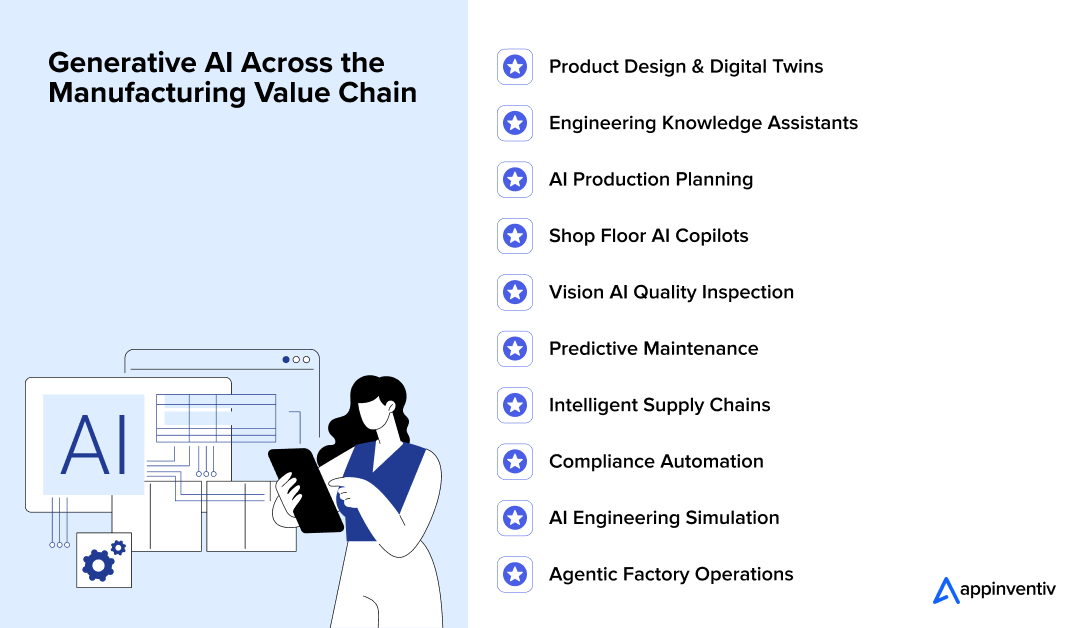
Accelerating Product Engineering with Generative Design and Digital Twins
Designing complex parts requires balancing material weight, strength, and production costs. Engineers usually test very few designs manually. New software works with CAD and PLM systems to build hundreds of detailed blueprints in minutes.
Digital twins in manufacturing then test these designs in virtual stress tests. Teams save months of lab work and cut prototype costs. This process accelerates the entire development cycle.
Real-world example: The Toyota Research Institute combined engineering constraints, such as aerodynamic drag, with text-to-image models. This lets designers create vehicle concepts with fewer design iterations. The system delivered designs quickly.
Empowering Engineers and Shop Floor Teams with Enterprise Knowledge Assistants
Valuable manufacturing knowledge lies hidden in old maintenance logs and equipment manuals. Frontline workers waste hours searching for data during machine breakdowns. Companies now deploy knowledge assistants to solve this issue.
These tools use retrieval-augmented generation to read manuals. Workers type questions in plain language and get immediate answers. Plant teams reduce downtime quickly. Operators resolve equipment failures without waiting for senior engineers.
Real-world example: Siemens and Microsoft developed the Siemens Industrial Copilot. It enables engineers to generate automation code, diagnose faults, and access operational knowledge using conversational AI. As one of the top generative AI use cases in manufacturing, this tool shortens repair times on the floor.
Also Read: AI in User Experience: Revolutionizing Human-Tech Interaction
Optimizing Production Planning Through AI-Driven Scenario Modeling
Production schedules change constantly due to machine failures or material shortages. Generative tools gather live data from ERP and MES platforms to fix this issue. The software simulates thousands of scheduling paths in seconds.
Planners see the cost of every choice immediately. Factories maintain delivery dates and control labor costs. Managers choose the most profitable path before disruptive floor delays.
Real-world example: Google Cloud works with manufacturers to apply generative AI for production planning and supply chain decision support. This helps production teams respond faster to changes. This is one of the fastest-growing Gen AI use cases in manufacturing, improving overall scheduling speed.
Augmenting Shop Floor Operations with AI Copilots
Modern factories generate billions of data points daily. Technicians need direct instructions during their shifts rather than charts.
The need for AI-powered assistance is becoming increasingly urgent, with Deloitte reporting that 48% of manufacturers struggle to fill production and operations management roles, while 46% face similar challenges hiring planning and scheduling talent. Factory copilots combine text, voice, and images to guide workers.
An operator points a tablet camera at a broken valve to see immediate repair steps. Less experienced workers handle advanced repairs safely. This direct guidance prevents human errors during complex changeovers. Training times decrease dramatically.
Real-world example: Siemens’ Industrial Copilot assists operators throughout the manufacturing lifecycle. The program helps with machine diagnostics and real-time production support to bridge skilled labor shortages. The application increases overall labor productivity across the plant.
Improving Quality Inspection with Vision AI and Synthetic Data Generation
For any Gen AI application in manufacturing industry settings, finding rare factory defects remains difficult. Good production lines produce few errors. Generative software solves this problem by creating thousands of realistic pictures of fake defects.
Inspection systems, powered by computer vision in manufacturing, study these images to learn quickly. Scrap rates drop, and bad products never leave the factory. This method completely prevents expensive customer product recalls. This is one of the clearest examples of generative AI in manufacturing, and it protects the factory’s corporate brand.
Real-world example: Bosch uses generative AI to create synthetic images of welding defects. At its Hildesheim plant, this shortened project timelines by up to six months and delivers annual productivity gains. The factory realized large financial savings quickly.
Advancing Predictive Maintenance with Context-Aware Diagnostics
Old predictive analytics in manufacturing tools predict machine failure dates using vibration sensors. According to Deloitte, predictive maintenance can increase productivity by 25%, reduce equipment breakdowns by 70%, and lower maintenance costs by 25%.
Generative AI builds on these capabilities by combining sensor telemetry with maintenance histories to deliver contextual diagnostics and AI-generated repair recommendations. The system tells technicians exactly why the machine fails.
It automatically generates a complete repair plan. Technicians spend less time diagnosing issues. Plant assets run longer without unplanned shutdowns. This cuts emergency repair bills by large margins. Schedules remain perfectly safe, making this one of the most measurable examples of generative AI in manufacturing.
Real-world example: Epiroc built its ESML AI Factory on Microsoft Azure to standardize AI across operations. The system improves steel quality prediction and manufacturing efficiency through enterprise-scale models. This setup helps engineers maintain consistent manufacturing standards worldwide.
Building More Resilient Supply Chains with Generative Intelligence
Procurement teams spend hours moving data between spreadsheets to find vendor risks. This is where dedicated manufacturing inventory software increasingly works alongside generative tools to keep stock data accurate. Generative tools instantly connect these separate logistics files. The software monitors shipping delays and supplier financial news to warn managers early.
Planners receive clear options to reroute shipments. Sourcing becomes fast, and factories avoid material shortages. This software protects the business from volatile market spikes. Logistics coordinators avoid blind spots. Deliveries arrive on time.
Real-world example: GA Telesis uses Google Cloud’s generative AI to modernize service operations for aerospace parts. The technology accelerates information retrieval across its global supply network. This is one of the strongest generative AI manufacturing use cases for helping parts reach clients without delays.
Also Read: CRM in Manufacturing: Benefits & Features
Automating Manufacturing Documentation and Regulatory Workflows
Compliance requirements demand hours of paperwork from engineering teams, work that RPA in manufacturing has traditionally automated at the transactional level. Generative systems write safety logs and compliance reports by gathering data from MES and PLM systems.
The software drafts clear procedures in seconds. Human experts review and sign the text. This process keeps records ready for official audits easily. Factories pass strict inspections without adding administrative staff numbers. Audit preparation takes minutes. Compliance is fast.
Real-world example: Siemens’ Industrial Copilot assists engineering teams by generating automation code and supporting engineering documentation. This streamlines industrial workflows and keeps human experts in the loop. Among practical gen AI use cases in manufacturing, this tool maintains complete corporate transparency across all departments.
Accelerating Product Innovation with AI-Powered Engineering Simulation
Testing new products in engineering software takes time. Generative software studies past simulation data to predict test results instantly. The tool evaluates dozens of material options and cost parameters simultaneously.
The software summarizes the test results and suggests improvements. Factories launch better products ahead of competitors. Engineers discover ideal material blends without doing repetitive physical testing. Product launch cycles accelerate, reflecting the strongest use cases for generative AI in manufacturing.
Real-world example: Siemens embeds generative AI across its Siemens Xcelerator portfolio. This integration helps product teams accelerate design exploration and refine products before production. The corporate software package speeds up overall commercialization timelines.
Enabling Autonomous Manufacturing with Agentic AI Systems
Generative AI manufacturing automation goes beyond simple tools that answer questions. Autonomous software agents now plan and execute complex work across plants. These systems monitor production metrics continuously.
The agent logs in to the ERP system to automatically order materials or adjust schedules. Humans remain in control to approve big changes. This setup minimizes operational friction across the entire factory network. Operations match corporate goals.
Real-world example: Siemens and Microsoft expand the Industrial Copilot ecosystem toward interconnected AI agents. These agents coordinate industrial workflows across engineering, operations, and service functions to run factories smoothly. This is one of the most advanced generative AI use cases in manufacturing, connecting factory floors directly to corporate offices.
Deploying these tools across multiple factories requires a solid data plan. The software must integrate with existing corporate databases and adhere to strict security rules.
The following section explains the technical foundation needed to run enterprise intelligence successfully. Corporate leaders must build this foundational structure carefully to secure a true competitive advantage.
Enterprise Architecture for Generative AI in Manufacturing
Selecting a large language model is only the first step in a broader AI in digital transformation journey. Success requires a system that securely connects software with factory machinery, corporate computers, and historic plant files. A good technical setup links your new tools with active assembly lines. The system protects company data and follows factory laws.
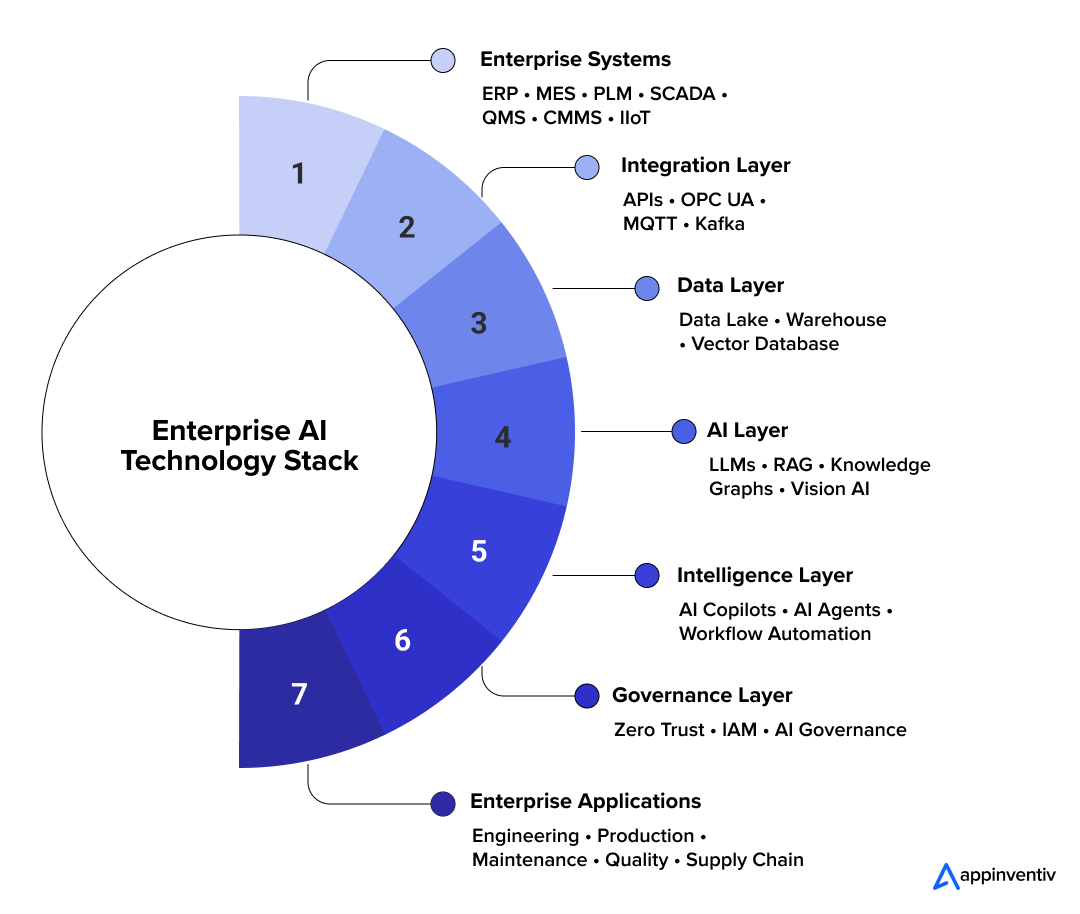
Core Components of a Generative AI Manufacturing Technology Stack
A solid Gen AI in manufacturing technology setup contains seven clear parts.
| Technology Layer | Factory Components |
|---|---|
| Core Programs | ERP, MES, PLM, SCADA, QMS, CMMS, Industrial IoT |
| Connection Tools | REST APIs, OPC UA, MQTT, Apache Kafka, ETL pipelines |
| File Storage | Data lakes, warehouses, historians, vector databases |
| Core Models | Foundation models, retrieval systems, knowledge graphs |
| Operating Layer | AI copilots, software agents, decision helpers |
| Protection Rules | Identity management, zero trust security, data encryption |
| Plant Applications | Design engineering, planning, repairs and quality control |
These foundations increasingly work alongside machine learning in manufacturing models that turn sensor and IoT data into predictive signals.
Every layer performs a specific job, starting with the big data in manufacturing that core programs generate as raw operational facts. Then the intelligence layers, closely tied to business intelligence in manufacturing systems, turn those records into direct instructions and automated workflows.
How Generative AI Integrates with Existing Manufacturing Systems
With gen AI in manufacturing, large companies do not replace their current software. Following a proven generative AI integration approach, the new tools form an intelligent cover over current setups. The tools speed up data collection and help managers choose next steps.
ERP software platforms hold purchase files and inventory counts. MES software tracks factory floor schedules and work orders. PLM programs contain blueprint files and engineering updates. SCADA networks stream real-time data directly from machine sensors.
The software combines these different text and number files using APIs and retrieval methods. This step builds a single corporate database. Engineers and line workers type normal text queries to read records, write sheets, or spot machine failures. Teams connect this setup to digital twins to test factory changes before altering physical machinery.
Build vs. Fine-Tune vs. Enterprise AI Platforms
Your deployment plan matches your budget, file safety needs, and factory complexity.
| Method | Expense | Deployment Speed | Customization | Growth Potential | Data Control | Best Target |
|---|---|---|---|---|---|---|
| Custom Development | High | Slow | Very High | High | Full Control | Unique factory processes with private patents |
| Fine-Tuned Models | Medium | Moderate | High | High | Strong | Firms adding private plant data to current models |
| Pre-built Platforms | Low | Fast | Moderate | Very High | Standard | Teams wanting quick setup with built-in safety rules |
Most large firms avoid building everything alone and instead rely on generative AI development services for parts of the buildout. They avoid buying simple pre-made software. A mixed method works best. Companies mix standard language models with private factory data and custom scripts.
This plan balances setup speed, tool updates, and safety rules perfectly. Factories protect their private corporate patents. Leaders can easily scale generative AI and manufacturing software across multiple global plants and business groups.
Enterprise AI fails without secure integrations, governed data, and scalable architecture. Build the right foundation before deployment begins.
Key Benefits of Generative AI in Manufacturing
Generative AI for manufacturing delivers more than simple task automation. Connected to core corporate databases, the tools help companies increase engineering output, refine plant procedures, and make rapid decisions using firm data.
The chart below outlines the principal corporate goals and the exact metrics teams track using manufacturing analytics software to verify results.
| Corporate Target | Floor Progress | Key Metrics |
|---|---|---|
| Speed Creation Timelines | AI-guided design reviews and reduced blueprint updates | Launch speed, Engineering timeline. |
| Raise Plant Speed | Refined factory plans and asset use | Overall Equipment Effectiveness (OEE), Schedule compliance. |
| Cut Machine Downtime | Targeted repair steps and early servicing | Mean Time to Repair (MTTR), Mean Time Between Failures (MTBF). |
| Protect Item Quality | Rapid flaw discovery and tighter inspection checkmarks | First-pass yield (FPY), Defect rate. |
| Drop Operational Expenses | Reduced scrap, corrections, and manual tasks | Cost per unit, Scrap rate. |
| Shield Supply Network Safety | Superior order predictions and vendor threat oversight | Inventory turns, Forecast accuracy. |
| Raise Employee Output | AI helpers that simplify building plans and floor jobs | Team records, Task finish speed. |
Together, these gains help factories raise production efficiency and maintain flexible, fact-backed output. Firms secure high returns, plant safety, and deep market durability.
Challenges of Implementing Generative AI in Manufacturing and How to Overcome Them
Corporate leaders see the clear value in generative tools as part of the wider digital transformation in manufacturing. Expanding gen AI across multiple factories requires serious planning.
Success requires up-to-date data configurations and tight system integration. Teams must build strict rules and support the workforce. Meeting these friction points early cuts deployment risks.
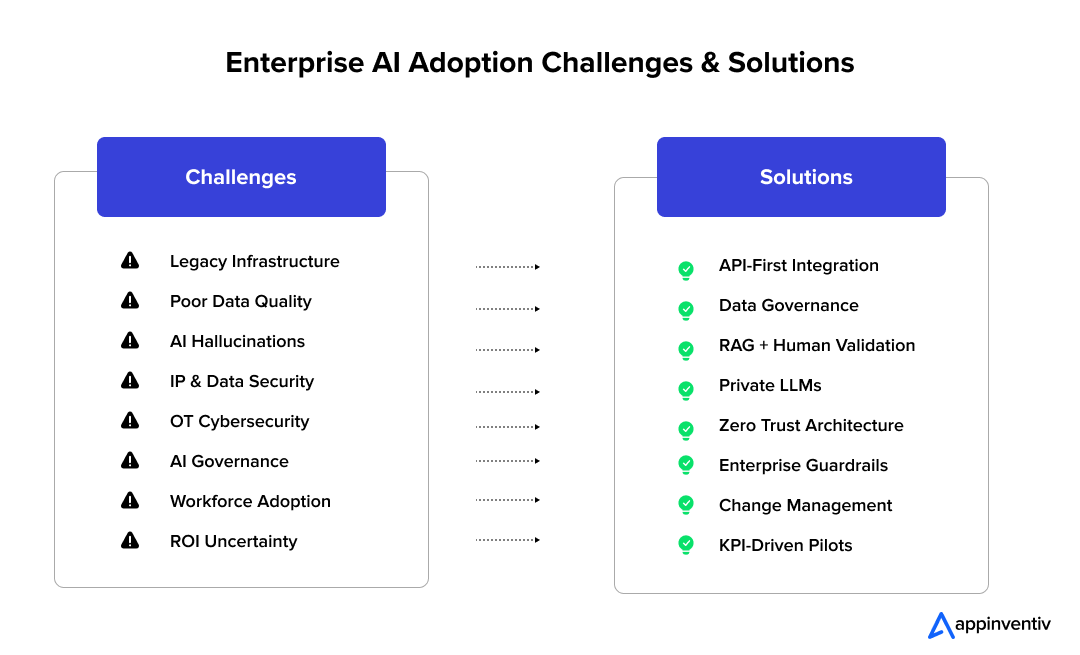
Modernizing Legacy Infrastructure and Manufacturing Data
Many plants run old ERP, MES, SCADA, and PLC networks. Creators never built these systems to run artificial intelligence tools. Operational records stay trapped inside separate departments. Files use conflicting formats. This data isolation lowers the quality of your automated outputs.
Action: Deploy an API-first connection plan. This step links corporate programs through standard interfaces. Establish strict data management practices. Clean up and centralize your manufacturing files before linking the core models.
Securing AI Reliability, Safety, and Governance
As generative AI and manufacturing systems converge, flawed text outputs can disrupt active assembly lines. Errors harm item quality and create physical hazards.
Executives must protect private blueprints and corporate patents, a core concern of cybersecurity in manufacturing. Teams must follow cybersecurity laws and new tech regulations simultaneously.
Action: Deploy private language models with retrieval-augmented generation systems. This method grounds text answers in trusted corporate facts. Keep human managers in charge of final approvals for critical choices. Adopt zero trust security principles and clear governance frameworks to control file access.
Driving Workforce Adoption
Advanced software delivers zero value without employee trust. Engineers and operators sometimes reject new tools. Workers fear job losses or doubt the automated advice.
Action: Launch the software through small pilot programs. Focus on specific floor problems, such as repair logs or engineering files. Provide direct technical training to staff. Gather constant user feedback to build confidence across the workforce.
Demonstrating Measurable Business Value
Many technology plans stall after the first test project. Teams fail to show clear financial gains. Securing long-term corporate funding becomes difficult without clear proof of investment returns.
Action: Set your target metrics before installing the software. Track core operational metrics such as Overall Equipment Effectiveness (OEE) and Mean Time to Repair (MTTR). Follow first-pass yield and unit expenses closely. Begin with high-return cases to build a strong corporate backing for full deployment.
How to Implement Generative AI in Manufacturing: A Step-by-Step Enterprise Roadmap
Successful software deployment starts with solving specific factory floor issues. Leaders do not buy technology just to own it. Following a clear deployment plan cuts company risks. This method speeds up financial returns. Teams smoothly expand the system across all plants.
Step 1: Pinpoint High-Value Factory Workflows
Focus on generative AI use cases in manufacturing where the software brings measurable cash returns. Look at product design, repair tasks, quality checks, schedule building, or database management.
Step 2: Check Your Factory Records
Study the quality and availability of current data. Check your ERP, MES, PLM, and SCADA databases. The software requires clean facts to give your workers accurate guidance.
Step 3: Pick the Technical Setup
Select a framework that aligns with the best use cases for generative AI in manufacturing and corporate goals. Decide between standard base models, retrieval networks, customized text models, or self-running software agents.
Step 4: Link New Tools with Current Software
Connect the new programs to your current ERP, MES, PLM, and SCADA infrastructure. Use protected APIs to exchange information. This step helps managers make fast choices.
Step 5: Build and Verify the Programs
Create the tools in small cycles. Review the text outputs with your top engineers. Run local test projects to check performance before a full corporate rollout.
Step 6: Set Up Safety and Control Rules
Create clear access levels for different job roles. Keep human managers in charge of final edits. Monitor model activity to maintain safe, steady operations.
Step 7: Track Operational Progress
Measure success with specific production metrics. Watch your Overall Equipment Effectiveness and First-Pass Yield numbers. Monitor Mean Time to Repair, design timelines, and unit expenses closely.
Step 8: Expand Across Global Operations
Grow successful generative AI manufacturing use cases across other plants and business units. Update the text models using daily floor feedback and new factory files. The system gains strength over time.
Turn your implementation strategy into measurable business outcomes with enterprise-grade Generative AI built for manufacturing at scale.
Future Trends Shaping the Next Generation of AI-Powered Manufacturing
Generative AI for manufacturing advances past simple desktop assistants, aligning with the human-centric direction of Industry 5.0 in manufacturing. Executives study these emerging market trends to protect future returns.
- Industrial Base Models: Specialized text networks learn from engineering papers, blueprints, and machinery guides. These tools give accurate answers. General consumer models cannot match this precision.
- Self-Running Software Agents: Automated programs run multi-step tasks across design, repair, and supply teams. The tools plan floor activities. Human managers keep full control over final choices.
- Mixed Data Inputs: Future plant software, built on multimodal AI applications, reads text, pictures, video feeds, and sensor signals simultaneously. Technicians diagnose faults quickly. Inspection teams detect damage to rare parts instantly, expanding generative AI use cases in manufacturing industry applications.
- Smart Digital Twins: Virtual models advance past standard simulation checks. The programs suggest product updates and predict floor results. Teams upgrade items throughout production cycles.
- On-Site Machine Software: Processing data next to active assembly lines cuts time delays. The system raises tool reliability. Plants make instant changes without waiting for remote cloud networks.
- Connected Plant Networks: Global factories use grouped software agents to adjust production schedules and inventory distribution. The tools manage power use. Corporate networks adapt easily to sudden market shocks.
Also Read: Navigating the Role of AI in Energy Sector
How Appinventiv Helps Enterprises Build Generative AI Solutions for Manufacturing
Deploying software requires more than installing a model. Companies need secure setups that integrate with legacy factory computers. Appinventiv, a generative AI consulting company, builds these systems. We guide companies from small pilot projects to large multi-plant operations.
We provide tech consulting, managed IT services for manufacturing, and plant readiness checks. Our teams build custom software, tools, and retrieval networks. We modernize old production steps. Our engineers construct corporate architectures. We connect new tools with your ERP, MES, PLM, SCADA, and IoT databases.
Teams choose between cloud manufacturing software setups and private local servers. We install data controls to protect corporate files.
Our work delivers clear financial and floor results:
- Inspection systems verify 250K+ production checkpoints daily.
- Teams identify machine root causes 3× faster.
- Old database updates take 2–4 months on average.
- Excess inventory holding times drop by up to 18 days.
- Software provides 24/7 operations monitoring.
- Managers receive plant reports in under 15 minutes.
We build protected, scalable systems to deliver clear floor value from day one. Let’s connect and build generative AI for manufacturing systems that scale globally.
FAQs
Q. What is Generative AI in manufacturing?
A. Generative AI for manufacturing connects language models and machine data to help your engineering teams. The programs automate heavy text tasks and guide technical choices. Factories use the tools to perfect product blueprints, organize shop schedules, write repair forms, and manage suppliers. Corporate data becomes clear instructions immediately.
Q. How much does it cost to implement Generative AI in manufacturing?
A. Setup expenses range from $50,000 to $500,000. Final costs match the total size of your project and custom network requirements. Small test projects require lower funding. Expanding the tools across multiple global plants to connect ERP and MES databases requires a larger capital investment.
Q. What does the implementation of Generative AI in manufacturing involve?
A. Deployment starts by selecting high-return tasks and verifying data quality across plant systems. Teams pick a technical setup and link the program with ERP and SCADA tools. Leaders build strict safety rules, test the text output with engineers, and grow the software using core floor metrics.
Q. How can Generative AI help in manufacturing?
A. This gen AI application in the manufacturing industry helps teams build items faster and perfect factory schedules. The tools quickly spot product flaws, explain the causes of machine breakdowns, and automatically write regulatory forms. Managers combine corporate records with automated decisions to resolve floor issues quickly, reduce operational expenses, and protect supply lines from disruption.
Q. What is the potential impact of Generative AI on industries?
A. This shift toward generative AI in the manufacturing industry transforms global business by automating complex tasks and enabling rapid corporate decision-making. Across production, logistics, finance, and retail, the software reduces operational expenses and increases employee productivity. Leaders use these automated tools to build durable business groups and protect long-term profit lines.
Q. How do you choose the right Generative AI development partner for manufacturing?
A. Select a team with deep experience in corporate databases and secure software deployment. Appinventiv links tech planning with custom code creation and retrieval networks. We connect new programs to your current ERP, MES, and PLM infrastructure. Our engineers build secure, plant-ready systems for complex industrial environments.
Q. What are the biggest challenges of implementing Generative AI in manufacturing?
A. Successful adoption requires more than deploying AI models. Manufacturers must establish strong AI governance, data governance, role-based access control, and data-protection controls while aligning AI with existing quality, safety, and process control frameworks. Ongoing model lifecycle management, regulatory compliance, and third-party risk assessments are also essential for secure, scalable enterprise deployments.


Fast 2-minute response, fully NDA-protected.

AI Data Integration: How to Connect, Clean and Prepare Data for AI
Key takeaways: AI initiatives fail when fragmented, poor-quality data reaches models without sufficient context, controls or ownership. AI-ready pipelines must connect, clean, enrich, govern and continuously monitor data across its lifecycle. Real-time processing matters when AI decisions depend on current transactions, events, inventory or operational conditions. Data architecture should follow the AI use case, balancing…

AI Agent Governance: How to Govern Autonomous AI Across Business Systems
Key takeaways: AI agents require controls at the action, identity, data, tool, and workflow levels. Every enterprise agent should have a registered owner, an approved purpose, and a defined risk tier. Access must be based on the agent’s task rather than inherited from a human user or shared service account. High-impact actions need real-time policy…

'I.D.E.A.S.' - The Five Pillar Framework to Ace AI-Native Enterprise Apps in 2027
Key takeaways: AI-native enterprise apps are moving beyond AI agents toward intelligent, adaptive, autonomous and context-aware digital capabilities that can operate across mobile, web, voice, wearables and emerging interfaces. The I.D.E.A.S. framework for AI enterprise apps in 2027 - Interactive Intent, Decisioning Autonomously, Experiential System Design, Adaptive Execution, and Security Layered. Context intelligence and reusable…