






Retrieval Augmented Generation in Australia: Architecture, Implementation and Cost

 Share -



- 01How Does Retrieval Augmented Generation Work?
- 02Why Do You Need RAG?
- 03Where RAG Sits in Australian AI Obligations
- 04RAG Architecture: Key Components and How They Work Together
- 05RAG Implementation Roadmap: A Step-by-Step Process
- 06How Much Does It Cost to Implement RAG in Business?
- 07How to Measure RAG Benefits and Business ROI
- 08What Are Some Common RAG Implementation Challenges and How to Address Them?
- 09When Should You Use RAG?
- 10How to Use RAG in Different Industries?
- 11Why RAG Gives Wrong Responses and How to Fix It?
- 12Agentic RAG: The Next Step Beyond Single-Pass Retrieval
- 13Build a Production-Ready RAG System with Appinventiv
- 14A Quick Readiness Checklist for RAG Development in Australia
- 15FAQs

Key takeaways:
- RAG grounds LLM answers in approved content, improving reliability without retraining a model.
- Data quality and access permissions decide production outcomes more than the model.
- Indicative build costs run from AUD 70,000 to 700,000, driven by data and integrations.
- Measure value against a pre-deployment baseline, separating realised benefits from projected savings.
A general-purpose LLM writes fluent answers, yet it has never read your current leave policy, your supplier contracts or last quarter’s product records. Fluency without the facts is how confident but wrong answers reach customers and staff.
Retrieval Augmented Generation in Australia addresses this gap. RAG connects a large language model (LLM) to relevant information at query time. So, answers draw on approved sources rather than memory alone.
Building this capability in an AI system involves more than choosing a model. Data access, privacy obligations, security controls, hosting arrangements and ongoing operating costs all influence the design.
So, how can you build a reliable AI knowledge system without replacing its existing data platforms? This blog opens with a direct answer to such questions, then covers RAG architecture, the implementation process, cost drivers, risks, use cases and more. The real challenge is simple to state: how do you build a reliable AI knowledge system without replacing the data platforms you already run?
Connect your existing data and AI capabilities with a practical implementation plan built around your business requirements.
How Does Retrieval Augmented Generation Work?
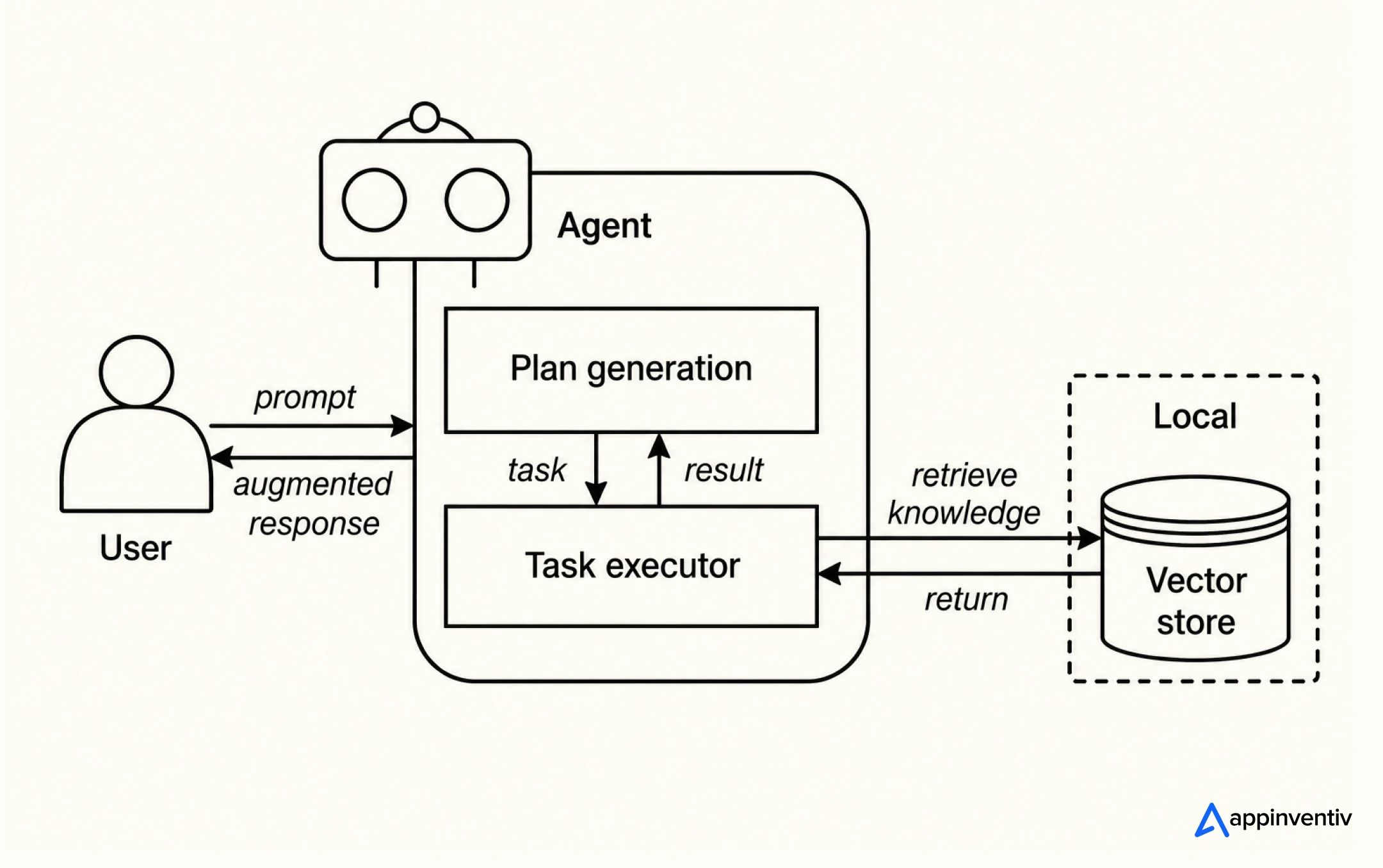
Retrieval augmented generation (RAG) is an AI pattern that retrieves relevant passages from an organisation’s own data and hands them to an LLM as context before it answers. The model stops guessing from training data and starts reading approved sources.
Here is how it works, step by step.
- A user submits a question.
- The system processes the query, cleaning it, rewriting it where needed and applying the user’s identity.
- A retrieval layer searches the relevant data sources.
- Relevant passages are ranked and selected.
- The LLM generates a response using the retrieved context.
- The application returns the answer, with source citations where supported.
RAG vs Traditional LLMs vs Fine-Tuning: What Are the Key Differences
| Factor | Traditional LLM | Fine-tuned LLM | RAG |
|---|---|---|---|
| Knowledge freshness | Fixed at training cutoff | Fixed until retrained | Reflects the indexed sources, refreshed on a schedule or on change |
| Use of proprietary data | None unless pasted into prompts | Baked into model weights | Retrieved at query time, with access controls |
| Initial effort | Low | High (data preparation, training, testing) | Moderate (ingestion, retrieval, evaluation) |
| Ongoing maintenance | Prompt tuning | Periodic retraining | Content pipelines, index health, evaluation |
| Suitable use cases | General drafting and summarising | Consistent tone, format or specialised task behaviour | Policy, product, contract and technical knowledge that changes |
Why Do You Need RAG?
Most enterprise knowledge sits in places that do not talk to each other: SharePoint libraries, ERP records, CRM notes and PDFs. Manual searching costs hours and produces inconsistent answers. RAG makes that knowledge accessible through one conversational layer, without training a foundation model from scratch.
The appeal is practical. Answers can carry citations, retrieval can respect existing permissions, and the system can sit on top of established platforms rather than replace them. That combination speaks directly to traceability, controlled access and operational efficiency, including for regional and remote operations in the nation where staff need reliable answers on patchy connectivity.
Businesses Challenges RAG Can Address
RAG can help address several recurring operational problems:
- Employees wasting time searching across multiple, disjointed document repositories.
- Inconsistent answers from outdated or disconnected knowledge bases
- Support teams manually checking product documentation and case histories
- Difficulty locating current procedures, technical manuals and compliance documentation
- Limited access to insights spread across ERP, CRM, intranet and document management platforms
Where RAG Sits in Australian AI Obligations
Australia regulates AI mainly through existing, technology-neutral laws and guidance rather than a single AI Act. RAG touches several at once. Relevant obligations depend on the organisation, the information being processed and the intended use of the system.
The table maps each obligation to a typical use case and the design response. None of it is automatic: system design and validation still carry the compliance load.
| Obligation | Use case | What it means for a RAG build |
|---|---|---|
| Privacy Act 1988 and the Australian Privacy Principles, including security of personal information | HR assistant, customer knowledge base | Permission-aware retrieval, minimised personal data in indexes, a Privacy Impact Assessment and careful cross-border hosting decisions |
| APP 1.7 to 1.9 automated decision-making transparency, commencing 10 December 2026 | Claims, eligibility or service triage that informs decisions about individuals | Map where RAG outputs inform decisions, log them and update the privacy policy |
| OAIC guidance on commercially available AI products | Customer-facing chatbots | Avoid entering personal information into public AI tools, label chatbots clearly and run due diligence on providers |
| Guidance for AI Adoption (AI6), National AI Centre | Any enterprise AI deployment | Named accountability, an AI register, testing and monitoring, and human oversight |
| APRA CPS 230, in force from 1 July 2025 | Banks, insurers and super funds | Treat LLM, vector database and hosting providers as potential material service providers, with exit and continuity plans |
| Essential Eight, Information Security Manual and Data Availability and Transparency Act 2022 | Government and public-sector knowledge assistants | Hardened hosting, assessed cloud services and controlled data sharing |
RAG Architecture: Key Components and How They Work Together
A production-ready RAG architecture is a pipeline of loosely coupled layers. Each layer can be swapped without a rebuild, which lets enterprises keep their existing data platforms. The layers below form the backbone of most RAG system development projects.
| Layer | Role | Design consideration |
|---|---|---|
| Data connectors and ingestion | Pull content from SharePoint, ERP, CRM, wikis and document stores | Preserve source permissions and metadata at ingestion |
| Processing and chunking | Clean, split and tag documents | Keep versions and effective dates so superseded policies drop out |
| Embedding model | Converts text to vectors | Check where embedding calls are processed |
| Vector or hybrid index | Stores vectors alongside keyword search | Choose region and residency to suit your data classification |
| Retriever and reranker | Finds and orders the best passages | Filter by user entitlements before ranking |
| Orchestration and prompting | Assembles context, instructions and citations | Version prompts and keep audit trails |
| LLM | Generates the grounded answer | Assess provider terms, hosting region and CPS 230 exposure |
| Guardrails and monitoring | Redaction, refusal rules, evaluation and logging | Support AI register reporting and ADM transparency |
RAG Implementation Roadmap: A Step-by-Step Process
A successful RAG implementation is a business and engineering programme, not a model integration exercise. Ownership, data, security and measurement need to move together. The seven phases below reflect how you should sequence the work.
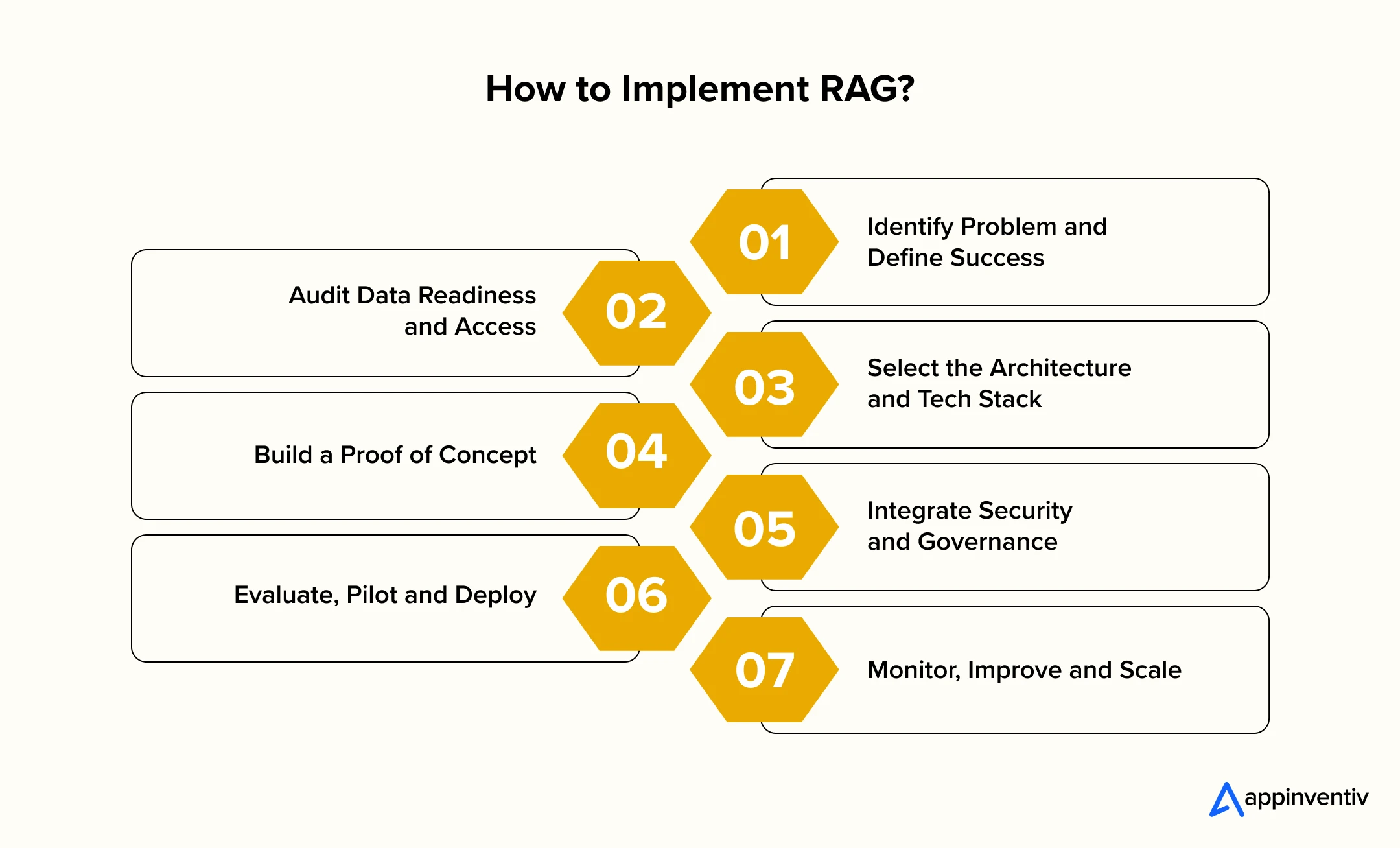
1. Identify the Business Problem and Define Success
Do not build AI just to have AI. Pinpoint a specific operational problem like the time it takes support agents to find policy details. Define clear success metrics, such as a 30% reduction in average handling time or a decrease in escalated tickets.
2. Audit Data Readiness and Access
Review the data sources you plan to connect. Are they accurate, up-to-date, and correctly permissioned? You must clean out duplicate files and ensure that sensitive documents are restricted. Remember, the AI will only be as good as the data it reads.
3. Select the Architecture and Technology Stack
Decide whether you will use open-source or commercial LLMs, and choose a vector database that fits your scale. For many organisations, data residency is critical, so select cloud providers that offer local hosting regions in Sydney or Melbourne to keep data onshore.
4. Build a Representative Proof of Concept
Start small. Select one department or one specific type of document (e.g., just IT support manuals). Build a prototype to test how well the embedding model understands your specific industry jargon and how accurately the retriever fetches the right paragraphs.
5. Integrate Security and Governance Requirements
This is where you lock the system down. Implement role-based access control (RBAC) so the retriever respects existing user permissions. Apply data masking if necessary, and ensure all API calls between your database and the LLM are encrypted.
6. Evaluate, Pilot and Deploy
Do not launch to the whole company at once. Run a pilot group. Use human evaluation to check the accuracy of the answers and the relevance of the cited sources. Adjust your chunking strategy or retrieval parameters based on their feedback.
7. Monitor, Improve and Scale
Once deployed, continuously track user queries. Look for questions the system fails to answer. This usually indicates missing internal documentation rather than a broken AI. Scale by connecting additional data sources one by one, repeating the data audit process each time.
Assess your data sources, integration needs and retrieval requirements before committing to a production build.
How Much Does It Cost to Implement RAG in Business?
RAG implementation cost depends less on the model than on everything around it. On average, RAG costs range between AUD 70,000 and AUD 700,000 or more. Six factors move the budget most: data readiness, integrations, security requirements, deployment model, evaluation effort and expected usage. Clean data and one repository sit at the low end. Many systems, strict hosting and heavy usage push towards the top.
Estimated cost breakdown by project complexity
| Project type | Scope | Estimated Cost | Estimated Timeline |
|---|---|---|---|
| Proof of Concept (PoC) | One use case, one or two data sources, basic access control | 70,000 to 200,000 | 3-5 months |
| Departmental production system | Several sources, role-based access, evaluation harness, monitoring | 200,000 to 350,000 | 5-9 months |
| Enterprise platform | Many systems, stricter security and hosting, multiple use cases, continuous tuning | 350,000 to 700,000 | 9-12+ months |
Ranges exclude ongoing LLM usage, hosting and support, and are confirmed after discovery.
How Can You Control RAG Costs?
- Start with one workflow and expand once the baseline is proven.
- Clean and deduplicate content before indexing, not after.
- Route simple queries to smaller models and reserve larger ones for complex questions.
- Reuse existing identity, search and cloud services instead of buying parallel stacks.
How to Measure RAG Benefits and Business ROI
Securing budget for AI development in Australia requires proving return on investment. You cannot measure the success of a RAG system purely on technical metrics like latency or vector search accuracy. You have to measure business impact, typically on five core metrics.
| Measure | What to track | What it tells the board |
|---|---|---|
| Speed | Time to find an answer, average handling time | Are hours coming back? |
| Accuracy | Score on the test set, groundedness, citation coverage | Can people rely on it? |
| Adoption | Weekly users, repeat use, queries resolved without escalation | Has it replaced old habits? |
| Risk | Permission incidents, complaints linked to answers | Is exposure shrinking? |
| Cost | Cost per resolved query, payback period | Does it pay for itself? |
Build an ROI Baseline Before Deployment
Capture today’s numbers before the first user logs in, then compare over a period that includes peak and quiet cycles.
A simple starting point is:
Net benefit = Quantified benefits − Total implementation and operating costs
ROI (%) = (Net benefit ÷ Total implementation and operating costs) × 100
For example, if an application reduces time spent on a recurring task, estimate the hours saved and apply a reasonable labour-cost assumption. Count the benefit only when the saved time translates into measurable capacity, reduced expenditure or another defensible business outcome.
Separate realised savings from projected benefits. Also monitor accuracy, citation quality, user adoption and the frequency of human corrections.
The AI ROI assessment should also consider risk reduction, governance overheads and the cost of meeting applicable security and privacy requirements.
What Are Some Common RAG Implementation Challenges and How to Address Them?
Several issues can affect reliability after the initial prototype is complete.
| Challenge | Why it matters | Practical response |
|---|---|---|
| Poor document quality | Missing, duplicated or outdated content weakens retrieval | Clean source data and assign document ownership |
| Irrelevant search results | The model receives passages that do not answer the question | Tune chunking, metadata filters, hybrid search and reranking |
| Hallucinated answers | The model may infer details that the sources do not support | Test groundedness, constrain responses and allow abstention |
| Access-control gaps | Users may receive information outside their permissions | Apply and test permission-aware retrieval |
| Stale indexes | Updated policies or records may not appear in answers | Monitor ingestion jobs and implement refresh schedules |
| Slow responses | Retrieval, reranking and model calls add latency | Profile each component and optimise the critical path |
| Uncontrolled costs | Long prompts and repeated calls increase usage | Track cost per query and set usage limits |
When Should You Use RAG?
RAG in AI suits any task where the answer lives in content that changes and must be traceable. The main RAG use cases include:
- Internal knowledge search across policies, procedures and manuals
- Customer and agent support grounded in product documentation
- Contract, tender and compliance document review
- Technical troubleshooting from maintenance records and manuals
- Cited, source-linked answers that staff can verify
- Employee self-service tools for HR, IT and operational queries
When You Don’t Need RAG
RAG may be unnecessary when:
- The information set is small, stable and fits in a prompt
- The task is general drafting with no proprietary data
- No owner exists for keeping the source content current
- The task relies on general knowledge that a standard LLM can handle.
- A conventional search engine already provides a clear, reliable answer.
- The workflow is deterministic and is better served by business rules or structured APIs.
- The business problem has not been defined well enough to justify an AI application.
How to Use RAG in Different Industries?
RAG use cases and benefits vary by sector, but the underlying opportunity is similar: helping people find relevant, authorised information without manually searching several systems.
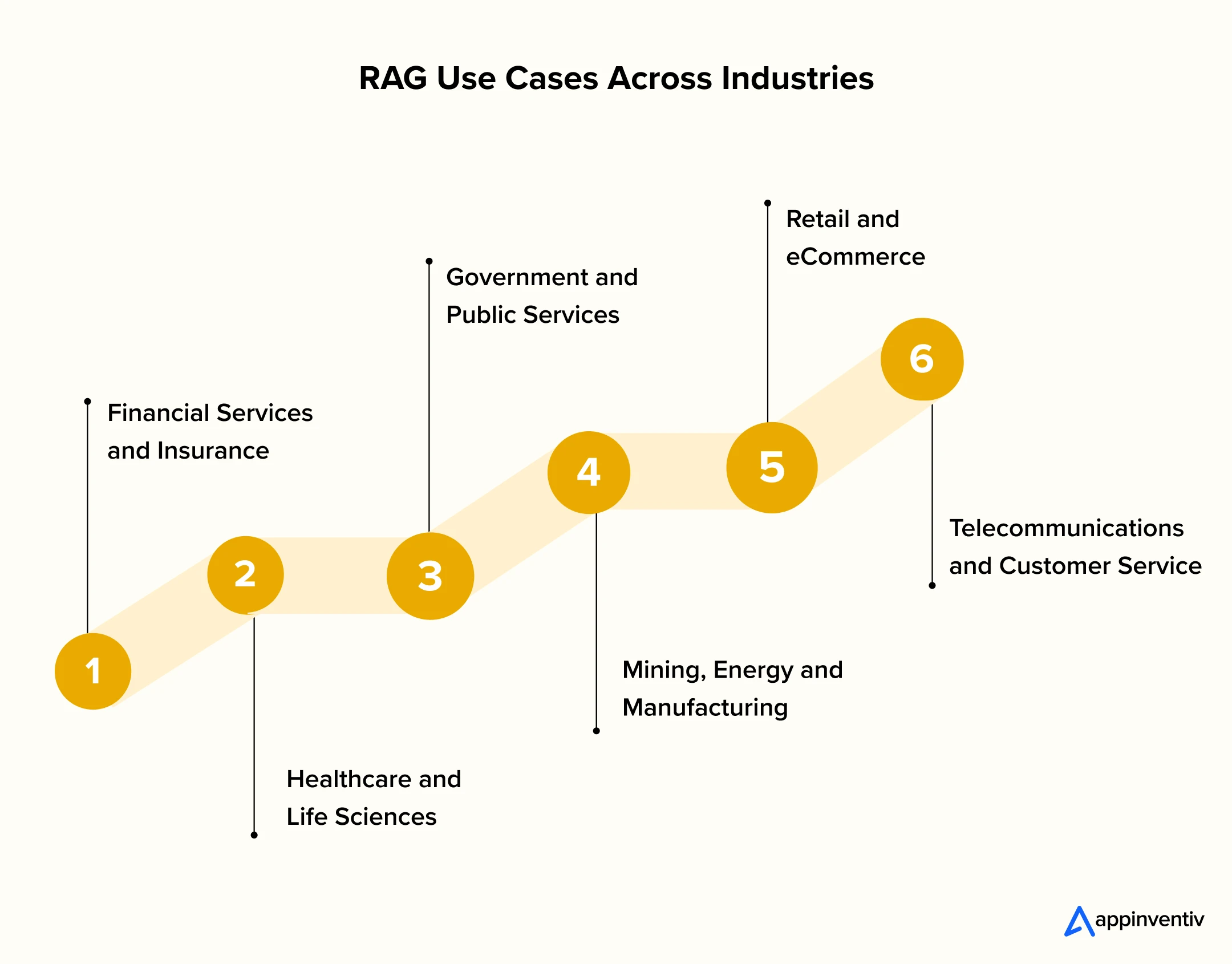
RAG for Financial Services and Insurance
- Source Data: Regulatory guidelines, policy disclosure statements, historical claims data.
- User Problem: Claims assessors spend too long cross-referencing complex policy wordings against incident reports.
- Expected Operational Measure: Reduction in the time taken to evaluate and process standard insurance claims.
RAG for Healthcare and Life Sciences
- Source Data: Clinical trial protocols, internal treatment guidelines, pharmaceutical documentation.
- User Problem: Medical researchers and administrators struggle to quickly locate specific compliance protocols across vast document libraries.
- Expected Operational Measure: Faster retrieval of clinical guidelines, reducing administrative delays in trial progression.
RAG for Government and Public Services
- Source Data: Legislation, departmental policies, public service manuals.
- User Problem: Public servants need to provide communities with accurate, legally sound answers without digging through thousands of pages of policy.
- Expected Operational Measure: Improved consistency and speed of responses provided to the public through government contact centres.
RAG for Mining, Energy and Manufacturing
- Source Data: Equipment maintenance logs, safety procedures, engineering schematics.
- User Problem: Field engineers waste time searching for specific repair procedures for heavy machinery while onsite.
- Expected Operational Measure: Decreased equipment downtime due to faster access to historical maintenance solutions.
RAG for Retail and eCommerce
- Source Data: Product catalogues, return policies, supplier contracts.
- User Problem: Customer service agents give inconsistent answers regarding product compatibility and return eligibility.
- Expected Operational Measure: Improved first-contact resolution rates in customer support interactions.
RAG for Telecommunications and Customer Service
- Source Data: Technical troubleshooting guides, network outage history, plan details.
- User Problem: Agents struggle to diagnose complex technical faults quickly using static knowledge base articles.
- Expected Operational Measure: Reduction in average call handling time and fewer escalations to Tier 2 technical support.
Appinventiv builds proof-of-concept RAG systems on your real documents, so evidence replaces assumptions before you commit.
Why RAG Gives Wrong Responses and How to Fix It?
RAG improves grounding but does not eliminate hallucinations. Wrong answers usually trace back to retrieval, content or prompting, not the LLM alone. Fixing them means testing each layer separately.
| Likely cause | How to address it |
|---|---|
| Relevant content was not retrieved | Improve query processing, chunking, search and reranking |
| Conflicting or outdated documents | Establish authoritative sources and update schedules |
| Retrieved text lacks context | Adjust chunk boundaries and metadata |
| The model invents missing details | Require evidence-based responses and test abstention behaviour |
| Citations do not support the answer | Validate citation-to-claim alignment |
| The user lacks sufficient context or access | Ask a clarifying question or explain the access limitation |
When an answer is wrong, inspect the retrieved passages and the generated response separately. Changing the model alone will not fix a poor data pipeline or an ineffective search index.
Agentic RAG: The Next Step Beyond Single-Pass Retrieval
RAG is evolving beyond basic vector search, with newer approaches focused on improving retrieval accuracy, handling complex queries and working across multiple data sources.
- Agentic RAG: plans its own retrieval, picks sources, checks the evidence and searches again before answering multi-step questions across several systems.
- Adaptive RAG: judges each question’s complexity first, then answers directly, retrieves once or runs deeper retrieval, controlling cost and latency.
- Hybrid RAG: combines keyword and vector search, often with reranking, so exact terms like clause numbers and part codes still surface.
- Graph-based RAG: retrieves along relationships between entities, not just similar text, suiting contracts, assets, supply chains and regulatory links.
- Multimodal RAG: retrieves from drawings, images and scanned forms as well as text, useful in engineering, field service and insurance claims.
More autonomy raises the stakes. Every extra retrieval step is another chance to surface a restricted document, and once an agent acts rather than only answers, its outputs may inform decisions covered by the APP 1.7 ADM transparency obligation. Adopt these approaches only where single-pass RAG fails on your test set, and keep human control in line with the AI6 practices.
Build a Production-Ready RAG System with Appinventiv
Moving from a basic AI experiment to a secure, enterprise-grade RAG solution requires deep technical expertise. The transition involves navigating complex data pipelines, strict local privacy laws, and robust cloud architectures.
Appinventiv provides comprehensive AI development services in Australia, helping businesses design, develop, and deploy reliable knowledge systems that respect your data security.
Our team of 1700+ tech experts has delivered 3000+ digital products, including 300+ AI solutions for 35+ industries. Our work with local businesses such as Tribees, Multinail, Rapid Teachers and Lite N’ Easy gives a good testament of our digital engineering expertise.
Our focus always remains the same: building a secure and scalable system that fits the business problem, with evaluation and governance considered from the beginning.
Ready to build a RAG system your teams can trust? Speak with our AI team today.
A sound first engagement will leave you with four things: a data readiness assessment, an architecture decision record, a test set built from your own questions, and a custom quotation.
A Quick Readiness Checklist for RAG Development in Australia
- The business problem and intended users are clearly defined.
- Success measures and a baseline have been agreed.
- Authoritative data sources and document owners are identified.
- Data quality, update frequency and access permissions have been assessed.
- The architecture and technology stack fit the use case.
- Retrieval quality and answer groundedness have been tested.
- Citations are checked against the supporting source material.
- Authentication and permission-aware retrieval are implemented.
- Applicable privacy, security and governance requirements have been assessed.
- Monitoring, feedback, incident response and maintenance processes are in place.
- Development, operating costs and expected business benefits have been evaluated.
FAQs
Q. What is Retrieval Augmented Generation (RAG)?
A. RAG is an architecture that retrieves relevant passages from an organisation’s own data and supplies them to an LLM as context. The model then answers from that material rather than from training memory alone. It can improve grounding and allow citations, though quality still depends on data and design.
Q. Is RAG better than fine-tuning an LLM?
A. They solve different problems. RAG suits knowledge that changes and needs citations, while fine-tuning suits consistent style or specialised task behaviour. Many enterprises start with RAG because it is faster to update and easier to audit. Some later combine both approaches.
Q. Can RAG work with existing ERP and CRM systems?
A. Yes. RAG sits on top of existing platforms through connectors or APIs, so teams do not need to replace ERP, CRM or intranet systems. Permissions and data freshness need careful handling at the integration layer.


Fast 2-minute response, fully NDA-protected.
The Multiplier Effect of AI Agents: The Rise of AI Swarms
Key takeaways: AI agent swarms coordinate specialized agents to solve complex problems that may be difficult for a single agent to handle effectively. More agents do not automatically mean better outcomes. Swarms deliver value when work can be divided, executed in parallel, and coordinated toward a shared objective. Enterprise readiness depends on governance. Clear accountability,…
AI Data Integration: How to Connect, Clean and Prepare Data for AI
Key takeaways: AI initiatives fail when fragmented, poor-quality data reaches models without sufficient context, controls or ownership. AI-ready pipelines must connect, clean, enrich, govern and continuously monitor data across its lifecycle. Real-time processing matters when AI decisions depend on current transactions, events, inventory or operational conditions. Data architecture should follow the AI use case, balancing…
AI-Native SDLC: Foundational 90-Day, 5R AI SDLC Adoption Playbook
Key takeaways: Why AI coding tools accelerate coding and software delivery How AI-native SDLC shifts engineering from code to intent, context, and outcomes The role of specifications, AI agents, and continuous verification in enterprise delivery How to redesign engineering teams for human–agent collaboration The platform, governance, and guardrails required to scale AI-native development A practical…