

























Generative AI Integration Solutions: Use Cases, Approaches, Challenges, and Enterprise Implementation Guide

 Share -


- 01Generative AI Integration and Enterprise Adoption Trends
- 02Common Generative AI Integration Services for Enterprises
- 03Key Approaches to Generative AI Integration
- 04Enterprise Systems for Generative AI Integration
- 05Enterprise Use Cases of Generative AI Integration
- 06Generative AI Integration Across Industries
- 07Enterprise Generative AI Integration Architecture Explained
- 08Overcoming Generative AI Integration Challenges
- 09A Framework for Successful Generative AI Integration
- 10Generative AI Integration Costs
- 11Expected Business Outcomes from Generative AI Integration
- 12Choosing the Right Generative AI Integration Partner
- 13How Appinventiv Helps Enterprises Successfully Integrate Generative AI
- 14Frequently Asked Questions

Key takeaways:
- Generative AI delivers value only when integrated with enterprise data, systems, workflows, and governance frameworks.
- Enterprise adoption is shifting from standalone copilots to RAG platforms, AI agents, and workflow-driven automation.
- Successful deployments require a layered architecture spanning data, orchestration, security, model management, and business applications.
- Most AI initiatives struggle during production scaling, making integration strategy more critical than model selection.
- Organizations that connect AI to CRM, ERP, knowledge repositories, and analytics platforms unlock measurable operational and financial impact.
Generative AI integration has moved well beyond experimentation. Many enterprises have already tested large language models through internal pilots, proofs of concept and standalone copilots. The real challenge starts after those early successes.
Business value does not come from the model alone. It comes from connecting AI to the systems, data, and workflows that drive day-to-day operations.
Most organizations already have the building blocks in place. Customer data sits inside CRM platforms. Operational records live in ERP systems. Critical knowledge is spread across SharePoint repositories, data warehouses, document management systems, and business applications.
Without access to these environments, even the most advanced model operates with limited context. This is why enterprise priorities are shifting toward generative AI integration. The focus is no longer on selecting a model.
The focus is on building secure connections between AI systems and enterprise technology stacks, creating retrieval pipelines for trusted data access, orchestrating workflows across applications, and establishing governance controls that support scale.
This generative AI integration guide covers the services, architectures, implementation frameworks, and enterprise use cases shaping modern deployments.
Organizations are scaling AI rapidly. Integrate your systems now before disconnected pilots slow business growth.
Generative AI Integration and Enterprise Adoption Trends
Generative AI integration trends show corporate AI use has entered a new phase. Companies have stopped testing simple chatbots and moved beyond isolated pilots into real generative AI for business strategies.
According to Deloitte’s State of AI in the Enterprise 2026 survey, 84% of organizations are increasing AI investments, signaling a shift from experimentation toward production-scale deployments.
Businesses spend money on connected AI systems. These tools link to internal applications and business workflows. They tie into operational data.
Four trends explain this change:
| Enterprise Trend | Market Meaning |
|---|---|
| 88% of organizations use AI in one or more business functions. | Mainstream adoption is a reality. |
| Generative AI spans operations, engineering, customer service, and product teams. | Companies want actual results over experiments. |
| AI agents will run core operations within two years. | Executives fund workflow automation and execution. |
| Many AI projects fail to deliver a clear financial return. | Poor integration limits financial success. |
The market is moving through six clear stages:
- Experimentation
- AI Assistants
- RAG Systems
- AI Copilots
- Agentic Workflows
- Autonomous Operations
Generative AI integration is a top priority. Corporate value comes from “connecting AI for enterprise deployments to CRM platforms and ERP systems.
The urgency is growing, 54% of organizations expect to move at least 40% of their AI initiatives into production within the next three to six months, increasing demand for enterprise generative AI implementation capabilities.
Executives tie AI tools to data warehouses and document repositories. Standalone models create less value.
Common Generative AI Integration Services for Enterprises
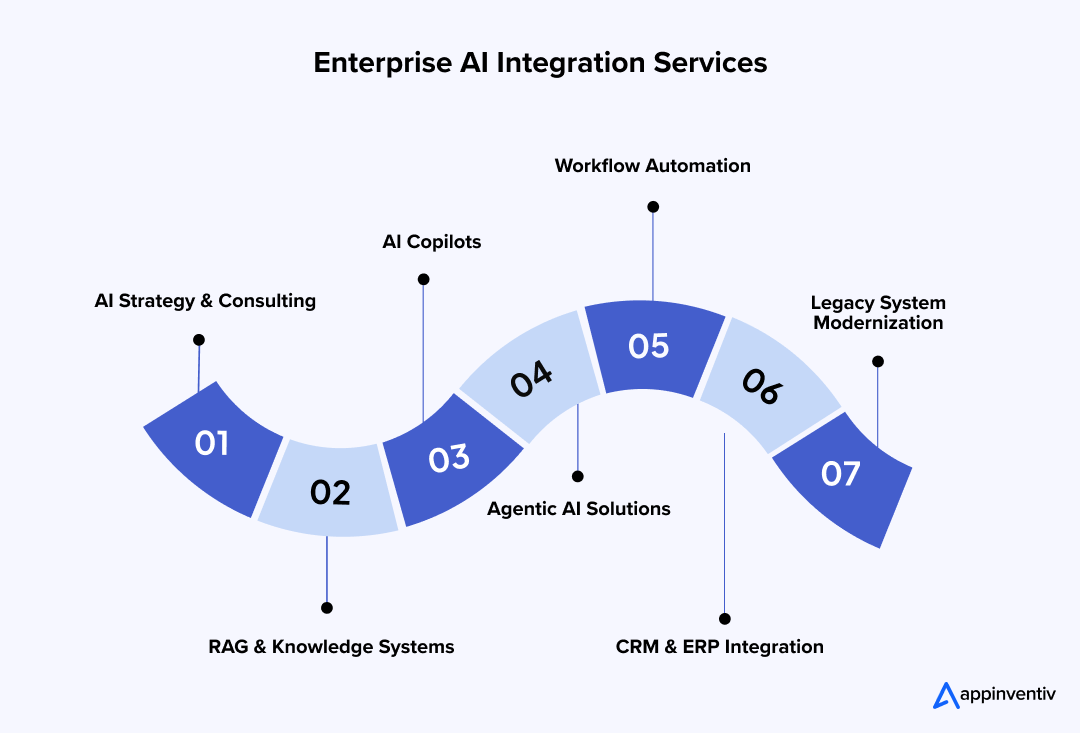
Most corporate AI projects fail without clear integration plans. Organizations buy services to connect AI models with corporate data and business software. The generative AI integration process links these tools to operational workflows and governance rules.
Enterprise AI Consulting and Integration Strategy
Many companies assess their AI strategy and technical architecture first. They choose high-value use cases and check data readiness. Leaders select foundation models and plan deployment architectures. They set governance policies to match business goals.
Knowledge Base and RAG Implementation
Retrieval-Augmented Generation (RAG in generative AI) lets AI systems read trusted corporate data in real time. Teams build document ingestion pipelines and vector databases. They deploy embedding models and retrieval layers. These tools add citation mechanisms to fix mistakes. Accuracy rises in internal tools and customer applications.
AI Copilot Integration Across Business Functions
Companies integrate AI copilots into customer service and software engineering. HR, finance, procurement, and operations teams use them too. The systems assist employees. They find information and write content. They summarize records and draft messages inside the current business software. This supports daily decisions.
Intelligent Agent and Multi-Agent System Development
Companies build AI agents to execute specific tasks. They do not want simple chat assistants. Multi-agent systems connect specialized agents for research and compliance. Other agents handle customer support and analytics. Orchestration software manages its shared memory and task delegation.
Workflow Automation and Process Orchestration
Generative AI workflow integration embeds AI into automated workflows. Organizations connect AI tools to workflow engines and APIs. They link them to event-driven architectures and approval chains. This automation handles document processing and service requests. It runs employee onboarding and operational reporting.
Enterprise Search and Knowledge Discovery
Enterprise search platforms combine semantic search and vector retrieval. They use metadata indexing and natural language interfaces. Employees can quickly find documents, policies, and contracts. They read technical text without opening multiple separate systems.
Learn how an AI-powered enterprise search tool makes this possible.
CRM, ERP, and Business Application Integration
Engineers connect generative AI to CRM and ERP systems. They link it to ITSM and collaboration platforms. These connections automate record summaries and customer intelligence. They sort help tickets and forecast demand. The software runs workflows across Salesforce, SAP, Oracle, ServiceNow, and Microsoft Dynamics.
Generative AI Modernization for Legacy Systems
Organizations use generative AI to protect legacy technology investments. AI interfaces and API layers upgrade older systems. Middleware services and data connectors avoid the need for a complete platform replacement. This method cuts implementation risks and modernization costs.
Key Approaches to Generative AI Integration
Success depends on choosing the right deployment model. This table outlines common integration methods, from API-based setups to private AI deployments for regulated environments. We categorize them by business goals, technical difficulty, and governance needs.
| Integration Method | Best For | Complexity | Governance Level |
|---|---|---|---|
| API-Based Integration | Content generation, chatbots, summarization, and customer interactions | Low | Moderate |
| Platform-Level Integration | Enterprise applications, ERP/CRM connectivity, workflow automation, middleware, and data pipelines | High | High |
| Custom Model Integration | Domain-specific AI, proprietary knowledge, regulated industries, and highly specialized enterprise workflows | Very High | Very High |
| Retrieval-Augmented Generation (RAG) | Enterprise knowledge assistants, document intelligence, and internal search | Medium | High |
| AI Copilots | Employee productivity, decision support, and workflow assistance | Medium | High |
| Agentic AI Systems | Multi-step workflows, task execution, and business process automation | High | High |
| Model Orchestration | Multi-model environments, workload routing, and cost management | High | High |
| Private AI Deployments | Regulated industries, sensitive data environments, and data sovereignty | Very High | Very High |
Enterprise Systems for Generative AI Integration
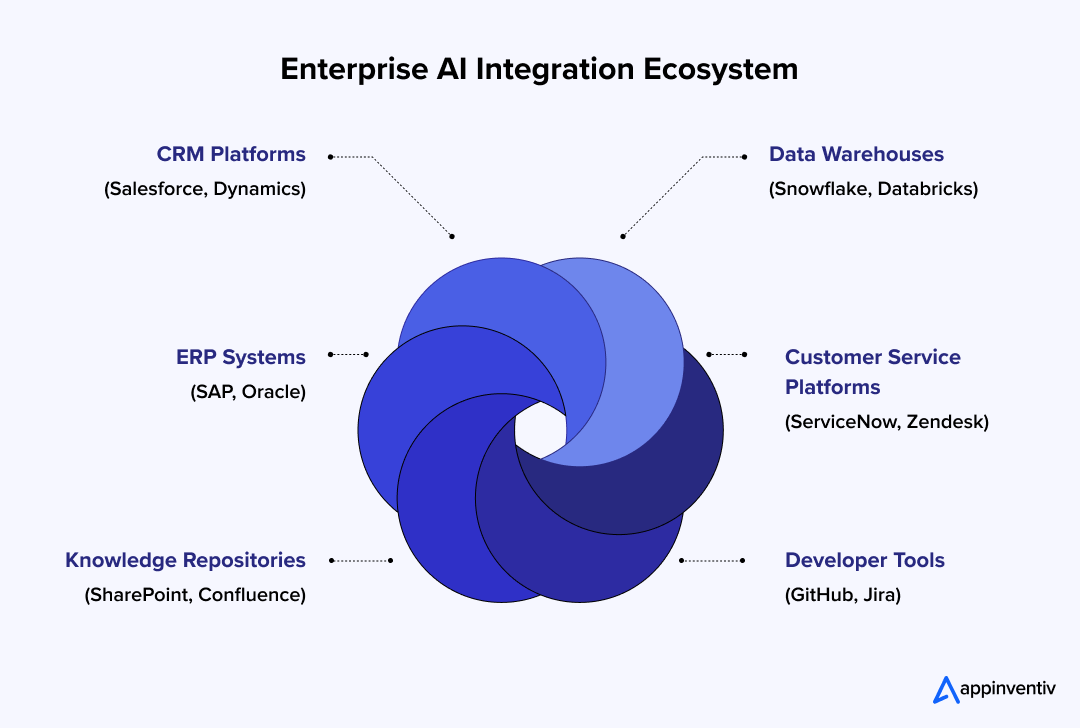
Generative AI creates the most value when connected to core business tools. These integrations let AI models read corporate data. They provide context and automate workflows.
An enterprise generative AI integration platform provides context, automates workflows, and supports cross-departmental decision-making.
CRM Software
CRM systems hold customer data and sales records. They track support history and account details. Teams connect generative AI to Salesforce, Microsoft Dynamics 365, and HubSpot. This setup summarizes accounts and qualifies leads. It analyzes sales opportunities and personalizes customer outreach.
ERP Systems
ERP tools run core business operations. AI integrations with SAP, Oracle, NetSuite, and Microsoft Dynamics Finance assist employees. Staff search business data using natural language queries. The tools generate reports and analyze procurement records. They support financial and operational planning.
Customer Service Software
Customer support teams use generative AI to raise response quality. The technology cuts handling times. Integrations with ServiceNow, Zendesk, and Freshdesk support ticket classification. They summarize cases, retrieve knowledge, draft responses, and manage escalations.
Enterprise Knowledge Repositories
Many organizations store critical knowledge in SharePoint, Confluence, and Google Drive. They use document management systems and internal databases. Generative AI connections turn these repositories into searchable hubs. The tools give context-rich answers built on verified corporate facts.
Data Warehouses and Analytics Tools
Enterprise data warehouses store operational facts and business intelligence. AI integrations connect to Snowflake, Databricks, BigQuery, Amazon Redshift, and Microsoft Fabric. These tools run natural language analytics and write automated reports. They spot trends and speed up data access.
Software Development Tools
Engineering teams build generative AI into their development environments. Connections to GitHub, GitLab, Jira, Azure DevOps, and CI/CD pipelines automate code generation. They create documentation, analyze issues, review pull requests, and write test cases. These links raise developer productivity.
Enterprise Use Cases of Generative AI Integration
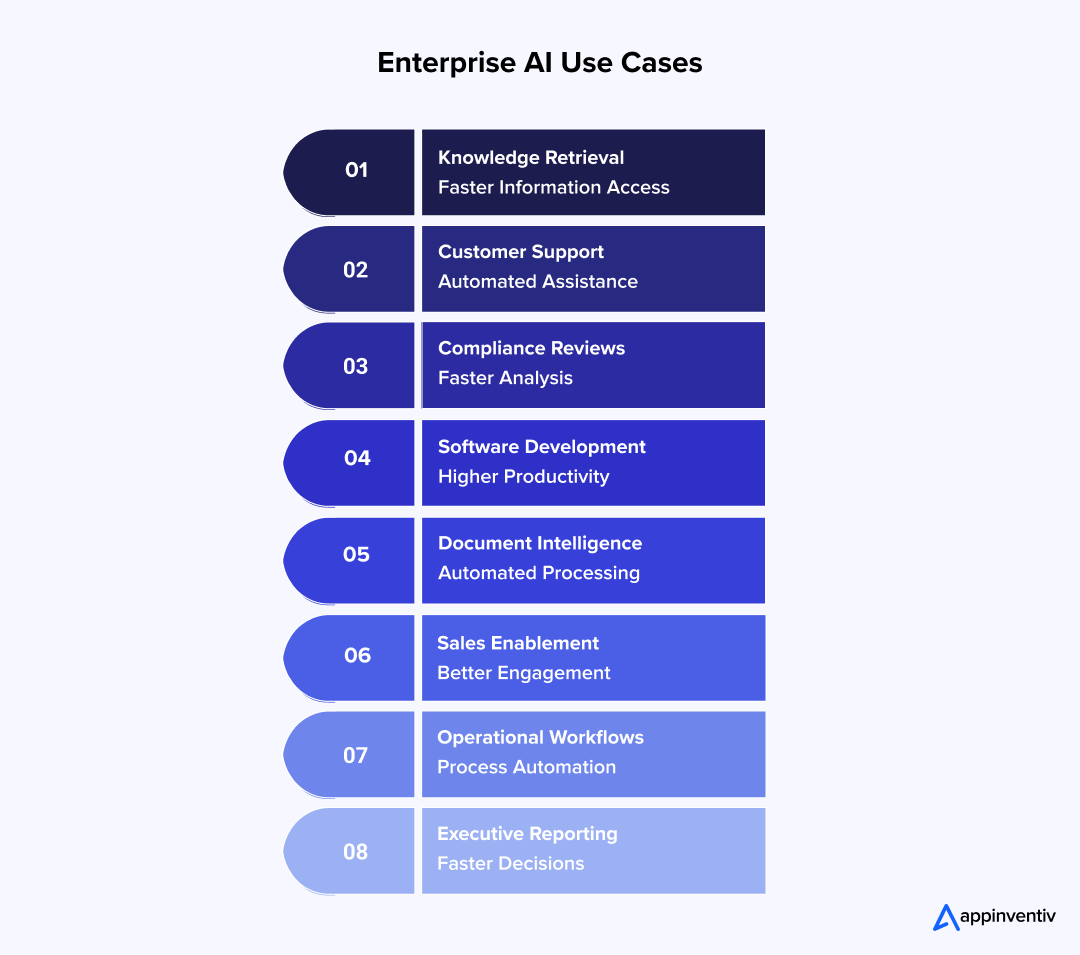
Generative AI creates value inside current corporate networks. Connected tools read business data and run workflows. They support operations and corporate strategy.
Knowledge Retrieval and Corporate Search
Staff waste time searching for files across databases and portals. Connected AI finds relevant facts quickly. It summarizes findings and answers questions using corporate files.
Example: Morgan Stanley deployed an AI knowledge assistant built on OpenAI technology. The tool helps financial advisors find facts across thousands of internal research documents.
For more real-world deployments like this, explore AI integration examples from top enterprises.
Customer Support Automation
AI tools help support teams sort help tickets and read knowledge files. They draft messages and summarize cases. This cuts manual work. Agents get consistent answers and focus on complex customer problems.
Example: Klarna launched an AI assistant to handle customer service across multiple markets and languages. The tool answers a large portion of customer inquiries.
Faster Software Development
Engineering teams build generative AI in digital product development workflows. The tools write code and build documentation. They review pull requests, create test cases, and fix bugs.
Example: Tech teams worldwide use GitHub Copilot. The tool assists developers with routine programming tasks, helping them complete projects faster.
Sales and Customer Engagement
Sales teams use generative AI to write account summaries. The tools draft outreach text and analyze customer interactions. Reps spot new deals in the sales pipeline.
Example: Salesforce Einstein GPT connects CRM data with generative AI. The platform assists sales reps with content creation and customer tracking inside Salesforce.
Corporate Reporting and Decision Support
Executives gather metrics from multiple applications to make strategic choices. Generative AI combines data and writes corporate reports. It tracks trends and states facts in plain language.
Example: Microsoft Copilot for Microsoft 365 creates business summaries and data reports. The software extracts facts from corporate emails, meetings, and shared documents.
This momentum aligns with broader market trends, as 74% of enterprises plan to deploy agentic AI capabilities within the next two years.
Production-ready AI requires expertise in governance, orchestration, retrieval, monitoring, and enterprise-grade integration.
Generative AI Integration Across Industries
AI integration spans every business sector. Workforce access to AI has expanded rapidly, rising from under 40% to nearly 60% of employees in a single year. Companies connect AI systems to core applications and knowledge repositories. They link tools to workflow engines and operational data. This raises productivity and improves decision-making.
| Industry | Common Integration Use Cases |
|---|---|
| Healthcare | Clinical documentation, patient support tools, and medical data retrieval |
| Financial Services | Compliance reviews, anti-money laundering tracking, risk analysis, and automated customer service |
| Retail & Ecommerce | Product discovery, customer interaction tools, and inventory tracking |
| Manufacturing | Technical knowledge management, production support, and document data extraction |
| Logistics & Supply Chain | Procurement workflows, inventory planning, and operational support |
| Insurance | Claims processing, policy analysis, and underwriting support |
Use cases vary by sector. In healthcare, for instance, generative AI in healthcare is reshaping clinical documentation and patient support tools. Manufacturing is one of the clearest examples of this shift, and integrating generative AI into manufacturing operations shows how these architectural layers translate into shop-floor results. The core technical architectures remain similar. Systems rely on RAG pipelines and corporate search.
Companies rely on generative AI consulting services to deploy AI copilots, workflow automation, and agentic AI capabilities across these architectures.
Enterprise Generative AI Integration Architecture Explained
Enterprise generative AI integration relies on multiple architectural layers that work together to connect business data, AI models, workflows, and applications.
This architectural maturity remains a work in progress across the market, with only 42% of organizations reporting that their AI strategies are highly prepared for large-scale adoption.
Each layer of the generative AI integration architecture plays a specific role in delivering secure, scalable, and reliable AI capabilities.
A thorough generative AI implementation guide can help enterprises plan this architecture with ROI in mind.”
Data Layer
The data layer provides the business context that AI systems depend on. It serves as the primary source of enterprise knowledge and operational information.
Common data sources include:
- ERP systems
- CRM platforms
- Data lakes
- Data warehouses
- Document repositories
- Knowledge management platforms
Integration and Middleware Layer
This layer enables data and application connectivity across the enterprise ecosystem. It allows AI systems to access information and interact with business applications.
Key components include:
- APIs
- Enterprise connectors
- Event streams
- Middleware platforms
- Integration gateways
Intelligence Layer
The intelligence layer processes information and generates outputs. It combines different model types to support reasoning, retrieval, and content generation.
Typical components include:
- Large Language Models (LLMs)
- Small Language Models (SLMs)
- Embedding models
- Reranking models
Orchestration Layer
Enterprise AI workflows often involve multiple models, tools, and applications. The orchestration layer coordinates these interactions and manages task execution.
Common technologies include:
- LangGraph
- CrewAI
- Semantic Kernel
- Model Context Protocol (MCP)
Governance and Security Layer
Governance remains a critical challenge. Only 21% of organizations have mature governance models for autonomous AI agents, despite rapid growth in enterprise AI adoption.
This layer protects enterprise data and supports regulatory compliance. It provides visibility into how AI systems access information and generate outputs, a core principle of explainab-le AI practices.
Core capabilities include:
- Access controls
- Audit logging
- Data masking
- Model monitoring
- Human review workflows
- Policy enforcement
Application Layer
This is the layer where users interact with AI capabilities. It converts backend intelligence into practical business functions.
Common applications include:
- AI copilots
- Intelligent agents
- Enterprise search platforms
- Customer support assistants
- Workflow automation tools
Overcoming Generative AI Integration Challenges
Most generative AI projects do not fail because of the model itself. Many stem from broader AI adoption challenges that enterprises fail to anticipate before deployment. In fact, 25% of organizations have successfully moved at least 40% of their AI experiments into production, highlighting the complexity of enterprise integration and operationalization.
The real difficulty lies in connecting AI to corporate data and business systems. Leaders must link tools to governance rules and operational workflows. Spotting these hurdles early cuts deployment risks and creates value faster.
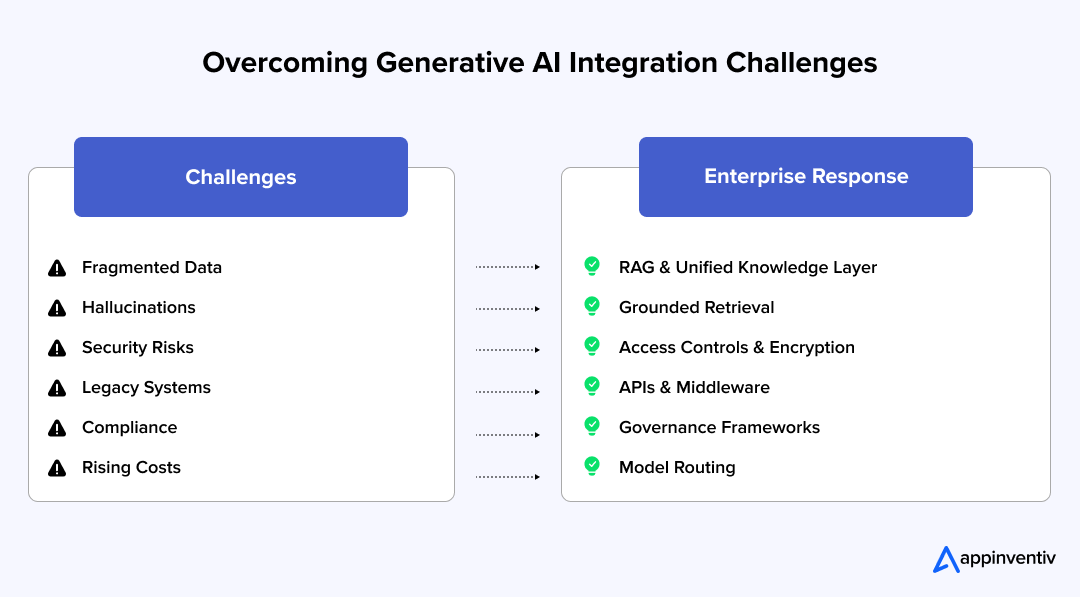
Fragmented Corporate Data
Corporate data sits scattered across CRM tools, ERP systems, and data warehouses. It hides in cloud storage and document repositories. This separation stops AI tools from reading complete business facts.
Solution: Tech teams connect these systems using data pipelines and unified knowledge layers. They deploy corporate search tools and Retrieval-Augmented Generation (RAG) to link AI models to all data sources.
AI Mistakes and Inaccurate Answers
Large language models fabricate incorrect information when they lack access to trusted corporate facts. This error creates risks for customer tools and critical business applications, and is one of several AI risks that companies must plan for before deploying models at scale.
Solution: Companies raise accuracy by using RAG pipelines. They add source-tracking and text-validation tools. Teams calculate confidence scores and use human reviewers for high-risk tasks.
Security and Privacy Risks
AI tools handle sensitive customer data and financial records. They read operational plans and proprietary corporate secrets. Data leaks create major business liabilities. Executives can refer to this generative AI security guide to build the right controls.
Solution: Generative AI integration security begins with strict access controls and data masking techniques. They protect facts with encryption and keep detailed audit logs. Teams build secure cloud environments to shield corporate assets.
Legacy System Compatibility
Many companies run old applications. Engineers did not design these legacy systems to connect with AI tools or modern data workflows.
Solution: Developers build API layers and use middleware software. They install corporate data connectors to bridge the gap between old infrastructure and new AI features. This avoids replacing entire software systems.
Governance and Regulatory Compliance
Leaders must track how AI systems read data and write answers. They need to monitor how tools support business decisions. Changing laws adds massive operational complexity.
Solution: Executives set up clear AI governance rules. They include system monitoring, data audits, human oversight, and steps to reduce bias in AI models before they affect decisions. Teams evaluate models regularly to ensure compliance with industry regulations.
Cost Management and Model Selection
AI costs rise quickly when companies launch large models across multiple departments. This happens when teams lack usage controls or technical planning.
Solution: Tech leaders deploy model routing techniques. They use smaller models for specific tasks and track actual usage. Orchestration software balances performance, scalability, and computing expenses.
Also Read: AI in Product Design: Transforming Creativity and Efficiency
A Framework for Successful Generative AI Integration
Successful corporate AI projects require more than model deployment. Companies use a generative AI integration guide to align business goals with their data infrastructure. They must choose a clear model strategy and set governance rules.
Teams coordinate the generative AI integration process before they expand AI use across departments. This generative AI integration framework outlines the main stages of a production integration program.
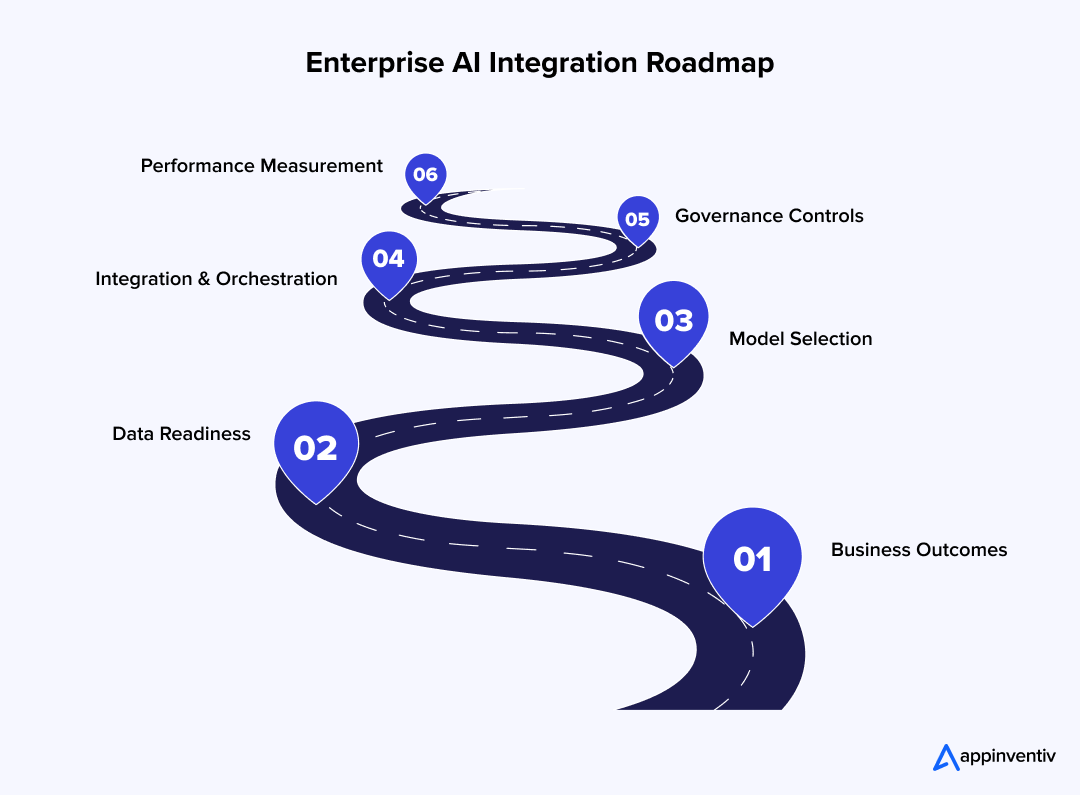
Step 1 – Define High-Value Business Outcomes
Understanding how to integrate generative AI into business starts with measurable goals, not software selection.
Common corporate goals include:
- Automated customer service operations
- Knowledge retrieval and corporate search systems
- Faster software development cycles
- Document processing and automated data extraction
- Higher sales productivity for account managers
- Workflow automation across business units
At this stage, companies define clear target metrics. These include response times and operational costs. Teams track worker output, customer satisfaction, or direct revenue growth.
Step 2 – Assess Data Readiness
The value of an AI system depends on data quality. Teams check several core areas before integration begins.
| Target Area | Core Questions |
|---|---|
| Data Access | Can the AI safely read the required business data? |
| Data Quality | Is the information complete, accurate, and current? |
| Data Structure | Does the company manage structured and unstructured files well? |
| Data Security | Are access controls and privacy safeguards active? |
| Data Governance | Did the leaders clearly define ownership and data retention rules? |
Many companies find that data fragmentation creates a big hurdle. This data problem often outweighs the difficulties of model selection.
Step 3 – Select Models and Deployment Strategy
Different tasks require specific model architectures and setup methods.
| Operational Need | Technical Method |
|---|---|
| Basic content generation | Large Language Models (LLMs) |
| Domain-specific tasks | Fine-tuned models |
| Cost-sensitive workloads | Small Language Models (SLMs) |
| Regulated environments | Private or self-hosted deployments |
| Corporate knowledge retrieval | RAG-based architectures |
Companies calculate inference costs and latency rules before choosing a model. They check context window limits, technical performance, and data residency laws. These factors shape the final hardware and software choices.
Step 4 – Build Integration and Orchestration Layers
This stage connects AI systems with corporate software. The generative AI integration architecture links models to data sources, orchestration layers, and daily workflows.
Core components include:
- APIs and corporate connectors
- Vector databases for semantic search
- Embedding pipelines for data preparation
- Event-driven architectures for real-time updates
- Workflow engines for process management
- Agent orchestration software for multi-task tools
Engineers deploy generative AI integration tools like LangGraph, CrewAI, and Semantic Kernel. They use databases like Pinecone and Weaviate. These tools form the generative AI integration tech stack, including Azure AI Search, Kafka pipelines, and Model Context Protocol (MCP) systems.
Step 5 – Establish Governance Controls
Engineers build governance into the system architecture early. A responsible AI deployment checklist can help teams verify that nothing critical is missed before go-live. They also do not add safeguards after deployment finishes.
Critical controls include:
- Role-based access controls (RBAC)
- Detailed audit logging for security teams
- Data masking rules for privacy protection
- Human approval workflows for high-risk choices
- Model monitoring tools to track errors
- Prompt and response guardrails
- Compliance reporting for regulators
These safeguards maintain security and accountability. They align AI operations with industry regulations.
Step 6 – Measure Performance and Business Impact
Corporate AI success requires continuous tracking and regular updates. Teams monitor two sets of metrics to verify performance.
| Technical Performance Metrics | Core Business Metrics |
|---|---|
| Response latency | Employee productivity gains |
| Retrieval accuracy | Operational cost reduction |
| Hallucination rates | Customer satisfaction scores |
| System availability | Revenue growth impact |
| Model utilization | Process cycle time |
Companies that monitor both technical and financial outcomes expand their AI investments safely. They prove long-term value to corporate boards and stakeholders.
Generative AI Integration Costs
The cost to develop a generative AI app varies based on software features, data storage options, and security policies. The total number of connected business tools also affects spending. Some firms fund a single project. Other companies pay for company-wide deployment across multiple software systems.
| Project Scope | Estimated Price Range |
|---|---|
| AI Knowledge Assistant | $30,000 – $80,000 |
| RAG Corporate Search Platform | $50,000 – $150,000 |
| Department-Level AI Copilot | $75,000 – $200,000 |
| Intelligent Agent Deployment | $100,000 – $300,000+ |
| Multi-Agent Corporate Automation Platform | $200,000 – $500,000+ |
| Company-Wide Generative AI Program | $300,000 – $1,000,000+ |
Several technical and business choices shape the final price:
- Number of connected applications
- Total data volume and file types
- RAG database and pipeline setup
- Agent workflow steps and rules
- Model selection and hosting methods
- Security software and compliance audits
- Private cloud or on-premises server needs
- Links to ERP, CRM, and core business software
- Ongoing system monitoring and technical operations
Companies that start with one clear project reduce generative AI integration cost and deploy faster. They expand their systems step by step. This method brings faster financial returns than launching massive rollouts on day one.
Expected Business Outcomes from Generative AI Integration
Successful integration projects create value beyond text generation. Connected AI systems link to business data and workflows. They connect to corporate applications. These tools raise operational output and improve decisions.
| Business Area | Expected Outcomes |
|---|---|
| Customer Service | Faster response times and smaller support workloads |
| Knowledge Management | Better corporate search and faster data retrieval |
| Operations | Less manual labor and direct workflows |
| Software Development | Higher developer productivity and faster delivery cycles |
| Compliance | Rapid document reviews and policy analysis |
| Executive Decisions | Fast access to business metrics and corporate reports |
Embed generative AI directly into CRM platforms and ERP systems for the best results. Engineers link tools to data warehouses and collaboration software. They tie models to corporate knowledge repositories. Standalone applications deliver less value.
The opportunity remains substantial. Only 20% of organizations currently report revenue gains from AI initiatives. In comparison, 74% expect AI to contribute to future revenue growth, reinforcing the importance of measuring generative AI integration ROI through effective integration and deployment strategies.
Transform expected business outcomes into measurable results through enterprise-scale AI integration programs.
Choosing the Right Generative AI Integration Partner
AI project success depends on implementation skills. Many projects fail to reach production. They lack strong integration planning or clear data strategies. Weak governance controls and poor operational support cause failures. A generative AI integration guide helps executives evaluate vendor capabilities before choosing a partner.
Generative AI Integration Partner Evaluation Checklist
| Evaluation Area | Target Capabilities |
|---|---|
| Enterprise Architecture Expertise | Track record linking AI to ERP systems and CRM platforms. Knowledge of data warehouses, APIs, and business software. |
| AI Engineering Capabilities | Deep knowledge of LLMs, SLMs, and RAG architectures. Mastery of vector databases, agentic systems, and model orchestration. |
| Data Engineering Experience | Ability to build data pipelines and embed workflows. Skill in creating retrieval layers and corporate knowledge systems. |
| Governance and Security Practices | Experience with role-based access controls and audit logging. Knowledge of guardrails, compliance rules, and safe AI habits. |
| Deployment Flexibility | Support for cloud, hybrid cloud, and private cloud setups. Ability to deploy on-premises. |
| Industry Experience | Proven delivery history within your specific industry and business setting. |
| Integration Tools and Software | Command of orchestration platforms and workflow engines. Familiarity with corporate connectors and middleware tools. |
| Scalability and Performance Planning | Ability to support large corporate workloads. Experience with system monitoring and operational reliability. |
| AI Operations (AIOps) and Monitoring | Continuous model evaluation and performance tracking. Skill in prompt management and software lifecycles. |
| Long-Term Support | Ongoing model upgrades and post-deployment support. Ability to handle regular governance updates. |
The strongest partners bring skills in architecture, engineering, governance, and operations. They deliver generative AI integration solutions that help companies move past isolated pilots. They build AI systems that run reliably across the entire company.
How Appinventiv Helps Enterprises Successfully Integrate Generative AI
Building a generative AI system requires more than connecting a model to an application. It requires skills in enterprise architecture and data engineering.
Our AI integration services cover enterprise architecture, data engineering, RAG deployment, agent development, and software orchestration. Companies need governance rules and long-term AI operations. Appinventiv brings all these capabilities together.
Our teams build corporate AI tools for healthcare, finance, and retail. We deliver a custom generative AI integration solution for manufacturing, logistics, and other industries. We help businesses move from early experiments to full production.
| Track Record Metric | Company Scale |
|---|---|
| Generative AI Applications Launched | 80+ |
| Data Scientists and AI Engineers | 200+ |
| Custom Generative AI Models Deployed | 75+ |
| Industries Served | 35+ |
Industry groups recognize our work. We ranked in the Deloitte Fast 50 India list for two straight years. Statista and the Financial Times named us an APAC High-Growth Company for two consecutive years.
The benefits continue after deployment. Appinventiv AI tools speed up content workflows by 70%. They meet content quality compliance rules 98% of the time. These metrics show clear business value for large corporate operations.
Appinventiv helps corporations design and govern AI systems. We connect tools across complex software networks. Our team provides the technical depth and delivery experience to turn generative AI integration investments into clear business results.
Let’s connect and operationalize AI integration before competitors capture your leads.
Frequently Asked Questions
Q. What is generative AI integration?
A. Generative AI integration connects AI models to corporate systems and business software. The technology links models to data sources and operational workflows. The AI reads CRM platforms and ERP systems directly. It accesses corporate databases and knowledge repositories. This connectivity replaces standalone chatbots. Organizations use real corporate facts to automate tasks. They retrieve data, write content, and support executive decisions.
Q. How do generative AI integration services work?
A. Understanding how generative AI integration services work starts with how they connect AI models to corporate networks. Engineers use APIs and software connectors. They install middleware platforms and orchestration layers. The setup builds data connections and RAG pipelines. It adds workflow automation and security controls. These services allow AI tools to interact with business software. The systems pull trusted facts and run tasks across daily operations.
Q. What is the role of generative AI in integration with predictive models?
A. Generative AI and predictive AI serve different corporate purposes. They work together inside corporate networks. Predictive models forecast metrics such as customer churn and demand trends. They spot operational risks. Generative AI converts those forecasts into plain language reports. It writes recommendations and clear action steps. This partnership helps companies make quick choices. Executives read advanced analytics without technical confusion.
Q. Why choose Appinventiv for generative AI integration services?
A. Appinventiv brings together technical skills in AI engineering and data architecture. We build corporate governance into every project. Our team has launched more than 80 generative AI applications. We deployed 75 custom models. Our staff includes 200 AI specialists. Appinventiv constructs scalable systems. These tools link to your current technology setup. We maintain strict security, hardware performance, and regulatory compliance.
Q. How do you integrate generative AI into a web application?
A. Engineers connect AI models to web applications using APIs or endpoints. They link corporate data sources and build retrieval pipelines. Teams install strict security controls. Many companies deploy RAG architectures and vector databases. They use orchestration software to raise response quality. Developers embed the tool into current web interfaces. It runs inside daily workflows and business processes.
Q. What is the typical generative AI integration project timeline?
A. Timelines vary by project difficulty and data readiness. The deployment scope also changes the schedule. A basic AI assistant takes 8 to 12 weeks to build. Simple data retrieval tools fit this shorter timeline. Large projects require 3 to 9 months. These bigger deployments feature RAG architectures and agent workflows. They require ERP connections and strict governance tools. Teams need this time for system setup, testing, and field deployment.


Fast 2-minute response, fully NDA-protected.

Automated Decision-Making in Australia: Benefits, Cost and Implementation
Key takeaways: Automated decision-making combines rules, algorithms, AI and human oversight to improve high-volume decisions. ADM programmes require privacy, security, auditability and accountability to be designed into architecture. ADM implementation costs typically range from AUD 70,000 to AUD 700,000 or more. Implementation starts with decision mapping, then moves through development, testing, controlled pilots and monitoring.…
AI Red Teaming Attack Strategies: Jailbreak, Crescendo, Base64 & More Explained
Key takeaways: Jailbreak testing must follow the full execution path from prompt and context to retrieval, tools, and enterprise APIs. Crescendo and adaptive attacks expose failures that single-turn testing misses by exploiting conversation history and model feedback loops. Base64 and Unicode tests probe gaps in normalization, tokenization, filtering, and decoding before adversarial input reaches model…

AI Agent Protocols: MCP, A2A, ACP & More Explained
Key takeaways: MCP connects agents to enterprise tools, while A2A lets independent agents delegate tasks without exposing internal logic. The protocol stack now spans agent access, collaboration, UI interaction, open networking, commerce, and machine-to-machine payments. A2A had support from 150+ organizations by April 2026, with 22,000+ GitHub stars and five production-ready SDK languages. Enterprise agent…