





















How Machine Learning in Retail is Redefining the Sector: Key Applications, Challenges, and Implementation Strategies

 Share -


- 01How Machine Learning Works in Retail: Understanding the Path from Data to Decisions
- 02Types of Machine Learning Used in Retail
- 03Machine Learning Use Cases in Retail: Where Predictions Shape Business Decisions
- 04Benefits of Machine Learning in Retail: Connecting Operational Gains to Business Value
- 05Challenges of Implementing Machine Learning in Retail and How to Address Them
- 06The Future of Machine Learning in Retail: From Better Predictions to Coordinated Decisions
- 07How to Implement Machine Learning in Retail: From Pilot to Business Adoption
- 08How Much Does It Cost to Implement Machine Learning in Retail?
- 09How Appinventiv Helps Retailers Put Machine Learning into Practice
- 10Frequently Asked Questions

Key takeaways:
- ML creates value when predictions reach teams in time to change a decision.
- Key applications include demand forecasting, personalization, pricing, fraud detection, and assortment planning.
- Reliable inventory records and system integrations matter as much as model accuracy.
- Implementation budgets range from $40,000 to $400,000+, depending on scope, data readiness, and integrations.
- Scale after a controlled pilot demonstrates business gains alongside manageable operating costs.
A retailer can predict a stockout correctly and still lose the sale. The forecast may arrive after purchase orders close, sit outside the replenishment system, or reach a team without authority to act. Better information alone does not put the product on the shelf.
That gap should shape how enterprise leaders approach machine learning in retail. Forecasting demand, recommending products, and adjusting prices each carry a different operational question: what decision will change, who controls it, and how quickly can the business respond?
Consider a model that recommends smaller discounts on products likely to sell at full price. Its commercial value depends on whether merchandising teams can apply those recommendations within promotion schedules and supplier agreements. Prediction accuracy matters, but so does the retailer’s ability to use it.
For CIOs and retail leaders, this makes ML investment a joint technology and operating decision. This article examines machine learning use cases in retail, the systems and responsibilities needed to support them, and how to assess implementation costs against measurable business returns.
Let’s assess where machine learning could make a measurable difference using your retail data.

How Machine Learning Works in Retail: Understanding the Path from Data to Decisions
Machine learning in retail uses historical data to identify patterns and estimate likely outcomes. Those estimates can guide decisions about purchasing, pricing, product recommendations, and fraud checks. To understand how this works, consider a retailer planning next week’s inventory across multiple stores.
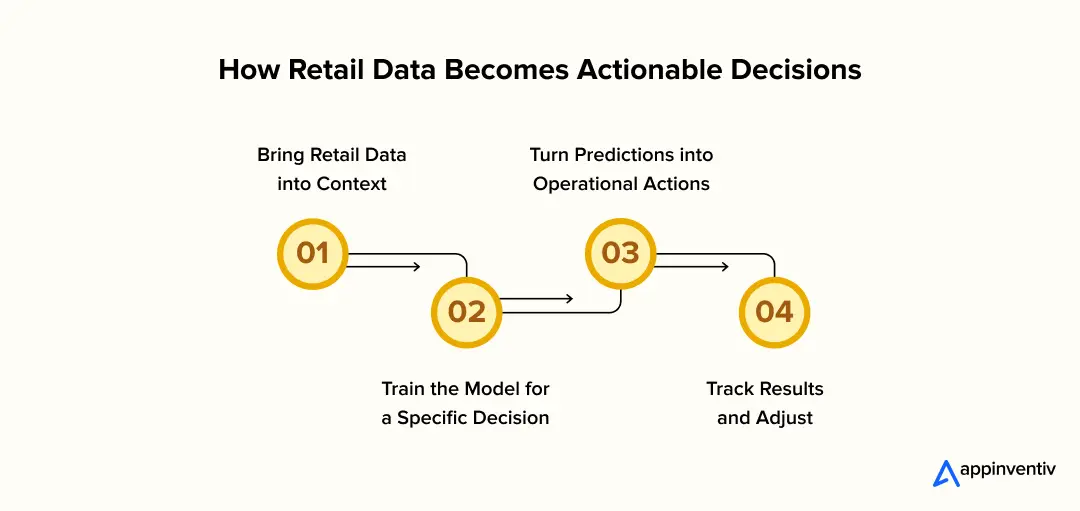
1. Bring Retail Data into Context
The process starts with sales, inventory, promotions, returns, and supplier lead times. These records need consistent product identifiers and usable timestamps so the system can connect them.
Context matters here. If an item recorded no sales because it was unavailable, treating that period as low demand could lead to another understocked week.
2. Train the Model for a Specific Decision
For retail demand prediction, a model learns relationships between past demand and factors such as seasonality, prices, and promotions. It then estimates demand for a defined period, product, and location.
Teams test those estimates against later historical periods that the model did not see during training. The comparison should include the retailer’s existing forecasting method to establish whether ML improves performance.
3. Turn Predictions into Operational Actions
A demand forecast does not determine an order quantity on its own. Replenishment systems must also account for available stock, delivery schedules, shelf life, and minimum order quantities.
The retailer can automate routine orders within agreed limits and send unusual recommendations to planners for review. This is where the model connects with existing retail systems and decision-making responsibilities.
4. Track Results and Adjust
Once deployed, the model needs monitoring as buying patterns, assortments, and supplier performance change. Teams should track prediction errors alongside stockouts, waste, and inventory levels.
A more accurate forecast is useful evidence. Whether stores carry the right stock is the business test.
Types of Machine Learning Used in Retail
The choice of learning approach depends on the decision a retailer needs to make and the data available. Predicting product demand, identifying customer groups, and testing a sequence of pricing decisions require different methods.
Supervised Learning: Predict Outcomes from Historical Examples
Supervised learning uses examples with known outcomes, such as completed sales or transactions confirmed as fraudulent. The model learns relationships between those outcomes and the information available before they occurred.
Retailers can use this approach to forecast demand, estimate churn risk, or flag suspicious transactions. Its usefulness depends on reliable historical records. A fraud model, for example, needs confirmed outcomes rather than transactions merely flagged for investigation.
Unsupervised Learning: Find Patterns Without Predefined Labels
Unsupervised learning identifies structures within data without requiring a known outcome for every example. It can group customers by purchasing behavior or reveal products frequently bought together.
For a retailer, these patterns can inform customer segmentation, assortment planning, and cross-selling. However, a customer cluster is only a starting point. Commercial teams still need to establish whether that group responds differently enough to justify a separate offer or campaign.
Reinforcement Learning: Learn from Actions and Their Consequences
Reinforcement learning evaluates actions through feedback, aiming to improve a defined outcome over successive decisions. Potential retail applications include markdown timing and inventory allocation, where today’s action can affect tomorrow’s options.
This approach requires careful controls because experimentation can affect margins, stock availability, and customer experience. Teams can evaluate policies in simulations before considering limited live trials, although results depend on how closely those simulations reflect actual trading conditions.
These approaches can work together. A retailer might use supervised learning to forecast demand and a separate optimization system to recommend orders within business constraints.
Machine Learning Use Cases in Retail: Where Predictions Shape Business Decisions
Retail leaders face different decisions across buying, merchandising, marketing, and store operations. Each requires its own data, operating rules, and measures of success. The following applications show how machine learning supports those decisions, with examples from retailers that have documented their use.
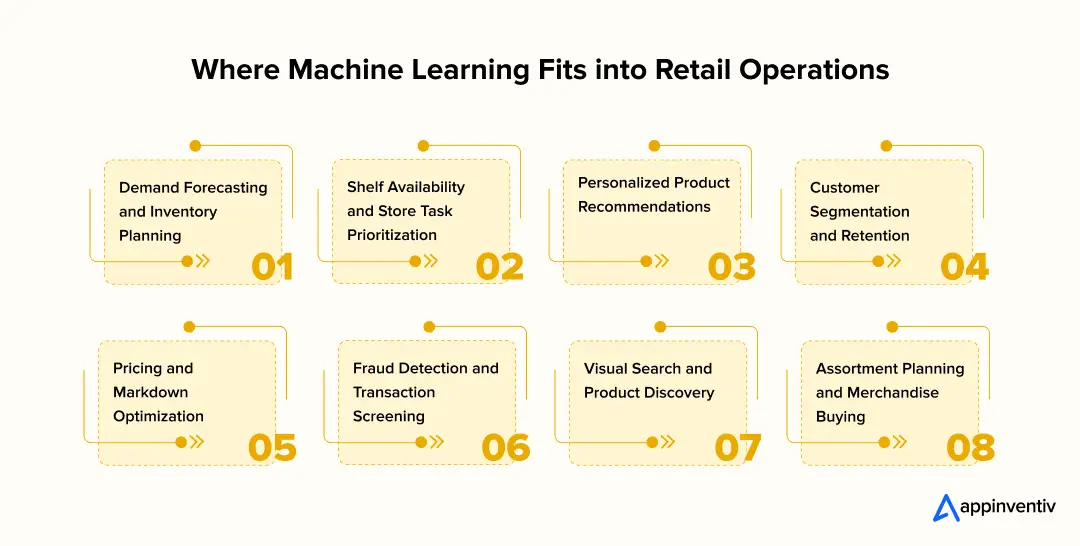
1. Demand Forecasting and Inventory Planning
A national sales forecast can hide local shortages. The same product may sell quickly in one region and remain untouched in another. Machine learning helps retailers estimate demand at a more useful level, such as individual products, stores, and selling periods.
Models can incorporate sales history, promotional activity, seasonal patterns, and other relevant signals. Planning teams can then use those estimates to determine where stock should go and when replenishment may be necessary.
Real-world example: Walmart
Walmart describes using machine learning models trained on past sales, online searches, and page views to support inventory planning. Its systems also consider weather patterns and regional differences when guiding inventory placement across stores and fulfillment facilities.
[Also Read: AI for Demand Forecasting: How Businesses Use AI to Predict Demand Accurately]
2. Shelf Availability and Store Task Prioritization
Stock recorded in a store’s inventory may still be unavailable to shoppers. Products can remain on overhead shelves while their selling locations sit empty. Store teams need to know which gaps deserve attention first.
ML solutions for retail can combine inventory signals, product demand, and image analysis to prioritize replenishment tasks. The output becomes a specific instruction for an associate: which shelf needs attention and where replacement stock can be found.
Real-world example: The Home Depot
The Home Depot’s Sidekick application uses machine learning to help associates prioritize tasks, including replenishing high-demand products. It also uses machine vision to identify out-of-stock products and locate inventory within stores.
3. Personalized Product Recommendations
A large catalog creates a discovery problem: customers may leave without finding products they would have bought. Recommendation models use shopping behavior and product relationships to rank items for a particular customer or session.
Retailers can apply these recommendations across homepages, product pages, email campaigns, and other shopping touchpoints. The commercial objective should determine the design. Helping a customer replenish a familiar product requires different recommendations from helping them explore a new category.
Real-world example: Amazon
Amazon documents using machine learning and AI to personalize product recommendations throughout the shopping journey. Its applications include homepage recommendations, personalized deals, and emails featuring products customers may want to purchase.
4. Customer Segmentation and Retention
Customers with similar spending levels can have very different relationships with a retailer. One may shop frequently across categories, while another buys only during seasonal promotions. Treating them identically can waste marketing budget.
Machine learning can group customers by behavior and estimate outcomes such as purchase likelihood or churn risk. Marketing teams can use those insights to decide which audience needs a reminder, a relevant recommendation, or a different offer.
Real-world example: Carrefour Taiwan
Carrefour Taiwan built machine learning models for customer segmentation, lifetime value, conversion prediction, and churn prediction using Google Cloud AutoML. Its documented approach used those insights to refine advertising audiences and deliver more personalized campaigns.
5. Pricing and Markdown Optimization
Discounting creates competing demands. Merchandising teams need to clear inventory, protect margins, and maintain a credible price position. A uniform markdown can overlook differences in product demand, remaining stock, and selling time.
Machine learning can estimate how demand may respond to price changes. An optimization system can then use those estimates to recommend prices within commercial constraints, including margin thresholds and promotion commitments.
Real-world example: Zalando
Zalando has documented combining forecasting and optimization to recommend discounts across its assortment. Its pricing work accounts for business targets, sales events, competitor prices, and warehouse capacity. The company also describes using A/B testing to evaluate pricing impact.
6. Fraud Detection and Transaction Screening
Fraud screening involves a difficult trade-off. Accepting a fraudulent order creates a loss, while rejecting a legitimate purchase can damage the customer relationship.
Machine learning for fraud detection across retail businesses evaluates combinations of transaction and behavioral signals to estimate risk. Those scores can support decisions to approve an order, request additional verification, or send it for review.
Real-world example: Amazon
An AWS case study describes Amazon’s Buyer Fraud Service using machine learning algorithms to detect orders with a high probability of fraud. The documented system evaluates more than 2,000 historical and real-time data points for each order.
7. Visual Search and Product Discovery
Customers do not always know the words that describe what they want. A shopper may recognize a furniture style in a photograph but struggle to reproduce it through a text search.
Visual search uses machine learning to identify features within images and retrieve similar products from a catalog. It gives retailers another way to connect customer intent with available merchandise.
Real-world example: Wayfair
Wayfair’s Image Search lets customers photograph an item and find visually similar products. Its engineering team describes models trained to recognize visual similarity across product categories, with availability filters applied when retrieving results.
8. Assortment Planning and Merchandise Buying
Forecasting existing products answers only part of a buyer’s problem. Retailers also need to decide which unfamiliar products deserve shelf space and purchasing budget.
Machine learning can analyze product attributes, images, customer preferences, and the performance of comparable items. Buyers can use those estimates to assess potential additions before committing to inventory.
Real-world example: Stitch Fix
Stitch Fix developed Style Explorer, a merchandise recommendation system that predicts product performance across customer segments. Its documented approach combines information such as imagery, fabric attributes, and customer interactions to support inventory curation.
Explore our services for forecasting, personalization, and fraud detection, including the data engineering and integrations needed to put them to work.
Benefits of Machine Learning in Retail: Connecting Operational Gains to Business Value
For retail leaders, the value of machine learning lies in improving how the business uses its stock, budget, and people. More accurate demand forecasts, for instance, can help buyers reduce excess orders while keeping enough inventory to meet customer demand. That can release cash tied up in slow-moving products and reduce the need for clearance discounts. The benefits below connect these operational improvements to the business results they should support.
| Business Benefit | How Machine Learning Can Contribute | What Retail Leaders Should Evaluate |
|---|---|---|
| Less capital tied up in inventory | More precise demand estimates can help teams adjust purchasing and stock allocation, reducing unnecessary inventory. | Whether stock levels fall while product availability remains stable or improves. |
| Stronger merchandise margins | Pricing and assortment models can help teams identify where discounts are necessary and where demand may support full-price sales. | Margin after markdowns, returns, and fulfillment costs, alongside the time taken to sell inventory. |
| More productive marketing spend | Customer segmentation and response predictions can help direct campaigns toward relevant audiences and offers. | Additional purchases attributable to the campaign, rather than purchases customers would have made anyway. |
| Greater capacity within existing teams | Automated scoring and prioritized recommendations can reduce routine review work for planners, marketers, and store associates. | Whether time saved translates into shorter backlogs, better service, or capacity to support more stores and products. |
| More relevant customer experiences | Search, recommendations, and stock availability signals can help customers find suitable products and complete purchases. | Completed purchases, repeat visits, returns, and service issues, rather than engagement alone. |
| Lower avoidable transaction losses | Fraud models can help distinguish suspicious activity from legitimate purchases and direct uncertain cases for review. | Fraud losses alongside incorrect declines and the effort required for manual investigation. |
These benefits also depend on teams working from the same information. If demand for a product is weakening, buyers may need to reduce orders while merchandising teams review its price. Using a shared forecast helps prevent one team from replenishing stock that another is trying to clear. For CIOs, this makes reliable data connections between retail systems an important part of the investment, alongside the models themselves.
Challenges of Implementing Machine Learning in Retail and How to Address Them
A pilot can perform well with prepared data and close supervision. Live retail operations introduce conditions that the pilot may barely encounter: missing inventory updates, new products, overlapping promotions, and supplier delays.
Scaling machine learning in retail requires teams to address these conditions before they affect purchasing, pricing, or customer decisions. The table below connects common implementation challenges with practical responses.
| Challenge | How It Affects Retail Operations | Practical Response |
|---|---|---|
| Inconsistent data across systems | Different product identifiers, delayed returns, and inaccurate stock records can distort predictions. | Reconcile identifiers across POS, ecommerce, ERP, and inventory systems. Assign owners to resolve recurring data issues and monitor freshness. |
| Sales history that hides unmet demand | A product may show low sales because it was unavailable, leading models to underestimate future demand. | Include stock availability and out-of-stock periods in forecasting data. Flag periods where recorded sales provide an incomplete picture. |
| Limited history for new products | New products and stores lack the historical examples needed for reliable predictions. | Use attributes and comparable products or locations to build initial estimates. Keep forecasts under closer review until sufficient evidence accumulates. |
| Changing customer behavior | Seasonal shifts, competitor activity, and unusual events can weaken patterns learned from past data. | Monitor performance by category, location, and selling period. Define when teams should investigate, retrain models, or use a fallback method. |
| Integration with existing retail systems | Recommendations may arrive too late or require employees to transfer information manually between tools. | Build around the timing of actual decisions. Connect outputs to existing workflows and define what happens when data or model services are unavailable. |
| Low confidence among business users | Buyers and planners may disregard recommendations they cannot assess or reconcile with local knowledge. | Involve users during testing. Show relevant context, allow justified overrides, and review override outcomes to identify model or process weaknesses. |
| Conflicting commercial objectives | A model focused on revenue may recommend discounts that weaken margins. Lower inventory targets may compromise availability. | Agree on the business objective and operating limits before development. Evaluate the primary outcome alongside measures that expose unwanted consequences. |
The Future of Machine Learning in Retail: From Better Predictions to Coordinated Decisions
Forecasting, personalization, and inventory optimization already have established retail applications. The next stage is likely to bring these capabilities closer together. For enterprise leaders, that changes the investment question: how can individual models support decisions across the business without creating conflicting actions?
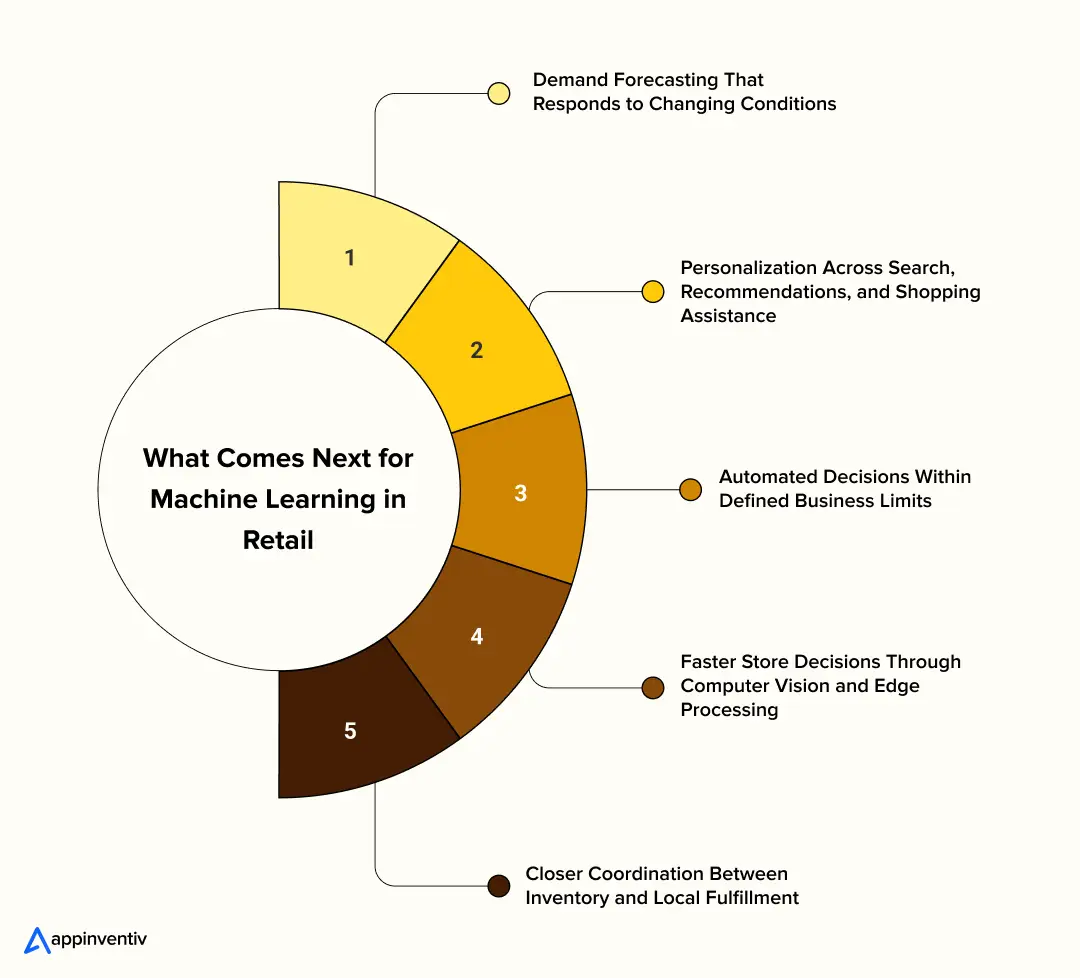
1. Demand Forecasting That Responds to Changing Conditions
Retail demand prediction is expanding beyond historical sales to incorporate signals such as local weather, promotional activity, and changes in shopping behavior. Current retail AI platforms already support combining these inputs with operational data.
The opportunity ahead lies in making forecasts responsive at the right frequency. Fresh food purchasing may need frequent adjustments, while longer-term assortment decisions follow a different schedule. Retailers will need to match forecast updates to decisions teams can still change.
2. Personalization Across Search, Recommendations, and Shopping Assistance
Product discovery is becoming more conversational and visual. Multimodal AI systems can interpret text, voice, and images, allowing customers to describe their needs through several forms of input. These capabilities are also entering shopping assistants that can help assemble carts and perform authorized actions.
This points toward closer coordination between recommendation models, search, and generative AI interfaces. Retailers will need consistent product information, availability, and customer preferences across those experiences. Otherwise, a more capable interface may simply expose inconsistencies faster.
3. Automated Decisions Within Defined Business Limits
Agentic systems are attracting retail investment alongside established predictive applications. NVIDIA’s 2026 retail and consumer packaged goods research identifies agentic AI as a growing area of focus.
Predictive models can supply demand estimates or risk scores, while an agent coordinates the steps needed to act. The practical opportunity is selective automation: routine decisions proceed within approved limits, while unusual conditions require review. Retail leaders will need to define those limits, assign accountability, and retain a reliable way to reverse actions.
4. Faster Store Decisions Through Computer Vision and Edge Processing
Computer vision and processing near store devices can turn camera and sensor inputs into operational alerts. Available retail platforms already support detecting conditions and triggering actions through connected cameras, sensors, and edge systems.
The next challenge is making these signals useful within daily store work. More alerts do not automatically create better execution. Systems will need to prioritize issues, direct tasks to available employees, and confirm whether the underlying problem was resolved.
5. Closer Coordination Between Inventory and Local Fulfillment
ML-supported supply chain systems can connect demand estimates with inventory placement and logistics planning. This provides a foundation for coordinating store fulfillment, local delivery, and micro-fulfillment operations more closely.
For retailers considering these models, the opportunity is to evaluate fulfillment choices together. An item’s location, picking capacity, delivery promise, and expected margin all affect where an order should be served. Investment decisions should therefore consider cost per fulfilled order alongside speed and availability.
How to Implement Machine Learning in Retail: From Pilot to Business Adoption
Implementing machine learning in retail involves changing how a specific decision gets made. Before development begins, the retailer needs to identify that decision, establish how it works today, and agree on what would justify replacing the current approach. The following steps take that work from initial planning through rollout.
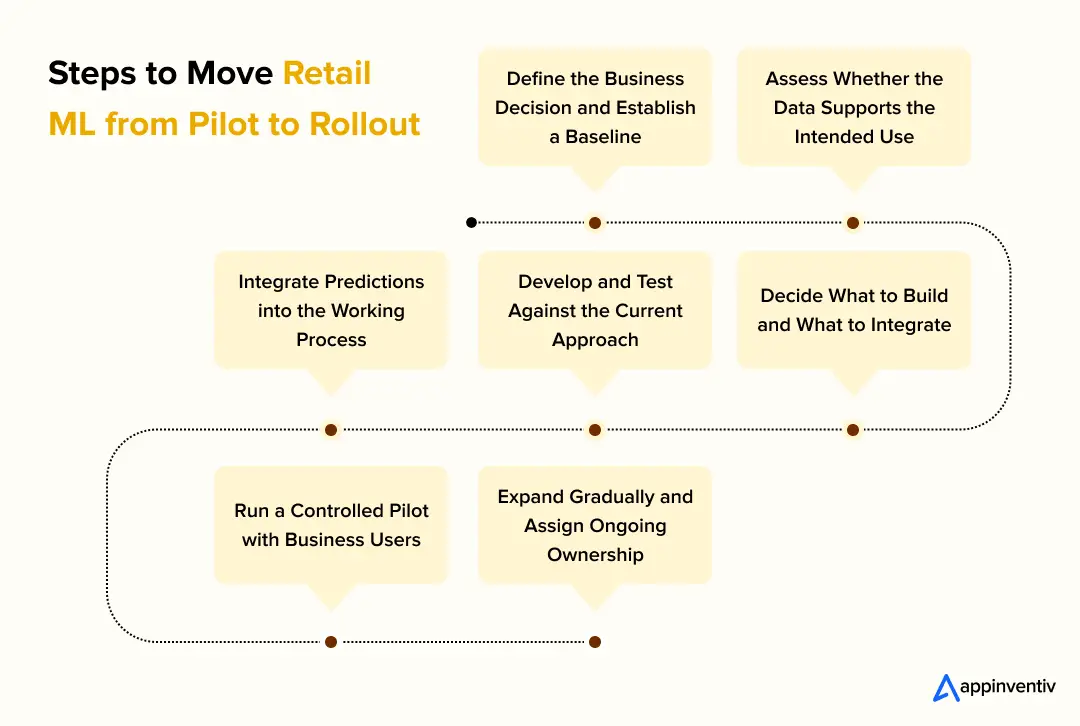
1. Define the Business Decision and Establish a Baseline
Start with a decision that occurs frequently enough to test and has a measurable business consequence. Define who makes it, what information they use, and how much time they have to act.
Record current performance before introducing ML. Depending on the application, that might include stock availability, markdown losses, campaign response, or manual review time. Agree on the improvement required to justify further investment, including outcomes that must not deteriorate.
2. Assess Whether the Data Supports the Intended Use
Check whether the available data captures the conditions surrounding each decision. Sales records alone may be insufficient without information about promotions, stock availability, returns, and product changes.
This assessment should answer three practical questions:
- Is there enough relevant history to train and evaluate the model?
- Will the required information be available when a live prediction is needed?
- Who will correct missing, delayed, or inconsistent records?
Resolve gaps that could materially affect predictions before moving into development.
3. Decide What to Build and What to Integrate
Review the capabilities already available in the retailer’s planning, ecommerce, and enterprise platforms. An existing feature may cover a standard requirement, while distinctive commercial rules may require custom development.
Compare options against the actual workflow. Consider integration effort, access to data, customization limits, operating costs, and the ability to monitor results. A quick initial setup offers limited value if business teams must maintain a separate manual process around it.
4. Develop and Test Against the Current Approach
Build an initial model and compare it with the existing method using data excluded from training. For forecasting, testing should follow time order so that future information does not influence earlier predictions.
Examine performance across relevant categories, locations, and trading conditions. An overall improvement can conceal weaker results in important parts of the business. Business users should review those differences before the team decides where the model is ready for a pilot.
5. Integrate Predictions into the Working Process
Specify where recommendations will appear, when they will arrive, and what happens next. Employees should receive them through the tools they already use wherever practical.
Define which actions require approval and which can proceed automatically within agreed limits. Include a fallback process for unavailable data, service failures, or unreliable predictions. This work makes the model usable during normal operations, including days when conditions are imperfect.
6. Run a Controlled Pilot with Business Users
Limit the initial rollout to a manageable scope and a suitable evaluation period. Where practical, compare results with a similar group continuing to use the existing approach.
Assess both commercial performance and employee adoption. Record overrides and investigate their reasons. Repeated overrides may expose missing business context, an unsuitable recommendation, or a workflow that needs adjustment.
The pilot should establish whether the combined model and process improve results enough to warrant expansion.
7. Expand Gradually and Assign Ongoing Ownership
Extend the rollout after the pilot meets its agreed criteria. Check data quality, integrations, and operating conditions in each new area rather than assuming the first deployment represents every store or category.
Assign responsibility for business outcomes, technical reliability, and model maintenance. Set review schedules and clear triggers for investigation, retraining, or pausing automation. Include these ongoing responsibilities in the budget so the application remains supported after launch.
How Much Does It Cost to Implement Machine Learning in Retail?
The cost of machine learning in retail can range from $40,000 for a focused implementation to $400,000 or more for a complex enterprise platform. Treat this as an initial planning range. The estimate depends on the applications involved, the condition of existing data, and the systems that need to exchange information.
A retailer with reliable data and accessible integrations can begin with a narrower scope. Where sales, inventory, and customer records need substantial preparation, the budget must cover that work before model development can deliver useful results.
Implementation Cost by Project Scope
The following ranges provide a starting point for planning comparable retail projects. All figures are in USD.
| Project Scope | Estimated Cost | Work Included |
|---|---|---|
| Focused pilot | $40,000–90,000 | One use case, a defined dataset, model development, limited integration, and controlled testing. |
| Multiple connected applications | $90,000–200,000 | Several capabilities, such as recommendations, search, and forecasting, connected to existing business systems. |
| Custom enterprise platform | $200,000–400,000+ | Multiple models, real-time predictions where required, extensive integrations, deployment controls, and model monitoring. |
What Changes the Estimate?
Two retailers pursuing the same use case may need very different amounts of engineering work. The main differences usually emerge during discovery:
- Data preparation: Reconciling product records, correcting historical data, and building reliable data feeds adds work beyond training the model.
- System integration: Connecting POS, ERP, ecommerce, warehouse, and supplier systems requires development and testing across each interface.
- Response requirements: Predictions needed during checkout require different infrastructure from forecasts generated overnight.
- Deployment scope: Supporting additional stores, markets, and sales channels introduces more operating conditions to validate.
- Physical infrastructure: Computer vision applications may require cameras, edge devices, installation, and store-level support.
Budget for Operation After Launch
The implementation estimate should sit alongside a separate operating budget. Hosting, software subscriptions, data processing, monitoring, retraining, and technical support continue after deployment. Business teams also need time to review exceptions and assess results.
Ask for a breakdown of one-time development costs, recurring charges, and costs that increase with usage. This makes proposals easier to compare and shows whether an affordable pilot will remain economical when expanded across the business.
Discuss your priority use case with our team to assess development scope, integration requirements, and ongoing costs before you commit to a rollout.

How Appinventiv Helps Retailers Put Machine Learning into Practice
For a retailer considering machine learning, the first investment decision is choosing a problem worth solving. Recurring stockouts may point to forecasting gaps, inaccurate inventory records, or delayed replenishment. Understanding the cause helps establish where ML belongs in the solution.
Our machine learning app development services help retailers build applications with demand forecasting, personalized recommendations, and fraud detection capabilities. From preparing data and developing models to integrating predictions into app workflows, we focus on making these capabilities useful in everyday retail operations.
As a retail software development company, we also build inventory, order management, and loyalty systems around how your business operates. Our teams connect POS, ERP, CRM, and ecommerce platforms, bringing sales, stock, and customer information together. This foundation helps retailers apply demand forecasts and product recommendations within the systems their teams and customers already use.
If you’re planning a retail ML initiative, bring us the operational problem you want to address and the systems involved. We can help assess what needs to change, scope the first implementation, and define how you’ll measure its value before expanding across stores or channels. Get in touch to discuss your requirements.
Frequently Asked Questions
Q. How can machine learning reduce retail stockouts?
A. Machine learning can help reduce stockouts by estimating demand for individual products and locations. Models can account for seasonal patterns, promotions, and recent sales changes that simpler forecasts may miss.
Turning those estimates into better availability also requires:
- Accurate records of stock on hand and incoming deliveries.
- Replenishment rules that account for supplier lead times.
- Store processes that move available stock onto shelves.
Forecasts should reach buying and replenishment teams while there is still time to act.
Q. How do you build a machine learning model for retail demand forecasting?
A. Start by defining what the model must forecast, such as daily demand for each product at each store. Prepare historical sales alongside prices, promotions, stock availability, and relevant calendar information.
The development process then includes:
- Establishing a baseline using the current forecasting method.
- Training models using information available before each forecast.
- Testing against later periods excluded from training.
- Reviewing errors across products, stores, and demand conditions.
- Piloting forecasts within the replenishment process.
For sales forecasting using machine learning, the algorithm choice follows the data and business requirements. No single model is best for every retail assortment.
Q. How can retailers integrate machine learning into existing retail systems?
A. Retailers can connect models to POS, ERP, ecommerce, CRM, and inventory platforms through supported APIs, data pipelines, or scheduled exchanges. The integration method depends on when the prediction is needed.
An overnight demand forecast can support next-day planning. A fraud score may need to return during checkout. In either case, implementation should define data ownership, response requirements, access controls, and a fallback when predictions are unavailable. Recommendations should appear within the tools employees use to make the relevant decision.
Q. How can machine learning support retail customer segmentation?
A. Machine learning can group customers using purchase frequency, category preferences, spending patterns, and responses to previous campaigns. These groups can help marketing teams distinguish regular buyers, promotion-led shoppers, and customers whose purchasing activity is declining.
The next step is testing whether different treatments improve results. Compare tailored campaigns with a suitable control group and measure additional purchases, margin after discounts, and unsubscribes. A technically distinct customer segment does not automatically need a separate campaign.
Q. How is machine learning used for retail fraud detection?
A. Machine learning for retail fraud detection estimates transaction risk using signals such as order value, purchasing behavior, device information, and previous confirmed outcomes. Retailers can use the score to approve transactions, request verification, or prioritize manual review.
Performance needs to be assessed across several measures:
- Fraud losses on approved transactions.
- Legitimate purchases incorrectly declined.
- Customer friction from additional checks.
- Time spent investigating flagged orders.
Reviewing these measures together helps teams avoid reducing fraud at the expense of too many valid sales.
Q. How can retailers use machine learning for pricing optimization?
A. Machine learning can estimate how product demand may respond to price changes. A separate optimization process can use those estimates to recommend prices or markdowns within agreed commercial limits.
Useful inputs include sales history, previous prices, promotions, remaining inventory, and selling deadlines. Historical relationships require careful interpretation because price changes often coincide with advertising or seasonal demand. Retailers should test recommendations within a controlled scope and assess margin, sell-through, and customer response before expanding automation.
Q. How does machine learning help personalize shopping experiences in retail stores?
A. Machine learning can use permitted purchase history and current shopping context to suggest relevant products, offers, or replenishment reminders. In physical stores, these suggestions can appear through loyalty apps, digital displays, or associate tools.
Recommendations become more useful when they reflect local availability. Suggesting an unavailable product creates extra work for the shopper and store team. Retailers should also provide clear customer choices about personalization and measure completed purchases, repeat visits, and returns alongside offer engagement.


Fast 2-minute response, fully NDA-protected.

AI-Native Security Maturity Model: Score Where Your Security Stack Stands
Key takeaways: If Human oversight scores below 2, you're at Level 3 at most, whatever your total score says. Moving to Level 3 starts with unifying your telemetry, which most teams can do with tools they already own. Define approval points before you automate response. Oversight added later costs more. Buy a platform when your…

The AI ROI Crisis: Why Enterprises Are Struggling to Prove Value and How to Fix It
Key takeaways: AI ROI is a capital-allocation question. Boards want payback periods and P&L impact. AI ROI challenges rarely have a single cause. Data, legacy systems, use-case choice, ownership and stalled pilots compound each other. Choose two or three outcome metrics per use case, set the baseline first, and report in dollars. Make every further…

Retrieval Augmented Generation in Australia: Architecture, Implementation and Cost
Key takeaways: RAG grounds LLM answers in approved content, improving reliability without retraining a model. Data quality and access permissions decide production outcomes more than the model. Indicative build costs run from AUD 70,000 to 700,000, driven by data and integrations. Measure value against a pre-deployment baseline, separating realised benefits from projected savings. A general-purpose…