
























Digital Transformation in Government: From Legacy Systems to Modern Services

 Share -



- 01What Are the Key Differences Between Digitisation, Digitalisation and Digital Transformation for Government?
- 02Why Government Agencies Are Moving Beyond Legacy Systems
- 03How to Modernise Legacy Government Systems Without Disrupting Services?
- 04What Technologies Are Powering Government Digital Transformation?
- 05How Does AI Support Government Digital Transformation?
- 06How Do Security, Privacy and Accessibility Shape Government Digital Transformation?
- 07A Practical Digital Transformation Roadmap for Government
- 08How to Measure the Success of Digital Transformation in Government?
- 09Common Digital Transformation Mistakes in Government
- 10What Does the Future of Digital Government Look Like?
- 11Modernise Legacy Government Systems With Appinventiv
- 12FAQs

Key takeaways:
- Government transformation is about improving services, not simply replacing technology.
- Legacy modernisation needs a phased approach that protects critical services.
- Cloud, APIs, data platforms, digital identity and AI create the foundation for connected government.
- Security, privacy, accessibility and measurable outcomes must be built in from the beginning.
Digital transformation for government has shifted from a technology agenda to a service-continuity one. Across Australia, agencies still run payments, licensing and case management on ageing systems that carry cybersecurity and operational risk. Fragmented platforms, manual processes and data silos make people repeat the same details to different agencies.
The South Australian Auditor-General’s Report 3 of 2026 found that 49% of hardware devices, 24% of operating systems and 24% of applications were legacy.
These conditions increase technology debt, cyber risk and service costs while making change harder to deliver. Digital transformation is therefore not a portal replacement or cloud migration exercise. It is a redesign of the technology, processes, data and operating model that sit behind public services. That is the direction of the Government’s 2030 vision of simple, secure and connected public services.
This blog uncovers how digital transformation can help government agencies modernise legacy systems while improving service delivery, security, and operational efficiency.
Modernise critical systems without disrupting the services communities and businesses rely on.

What Are the Key Differences Between Digitisation, Digitalisation and Digital Transformation for Government?
Digitisation converts analogue records into digital form, digitalisation uses digital tools to improve a process, and digital transformation strategy redesigns how an agency delivers services end to end. Putting a form online is not transformation.
| Approach | What Changes | Government Example |
|---|---|---|
| Digitisation | The format: paper or analogue records become digital files | Scanning planning files and archives into a document repository |
| Digitalisation | The process: an existing workflow runs on digital tools | An online permit application that still gets re-keyed into a legacy back end |
| Digital transformation | The operating model: services, data, technology and roles are redesigned around the user journey | A single digital front door where people submit once, data is shared across agencies with consent, and routine approvals complete automatically |
Putting a government form online does not automatically make the underlying service digital.
If staff still re-enter submitted information into another system, communities still provide the same information multiple times, and approvals still depend on manual handoffs, the organisation has digitised a step rather than transformed the service.
The Government’s Digital Service Standard reinforces this principle by focusing on user needs, connected services, inclusion, trust, adaptability and measurable outcomes.
Why Government Agencies Are Moving Beyond Legacy Systems
Agencies are moving beyond legacy systems because ageing technology accumulates cost and risk, isolates data, fails modern service expectations and keeps staff in manual work. Each of these pressures compounds the others. Some other reasons of modernising legacy systems for governments are listed below:
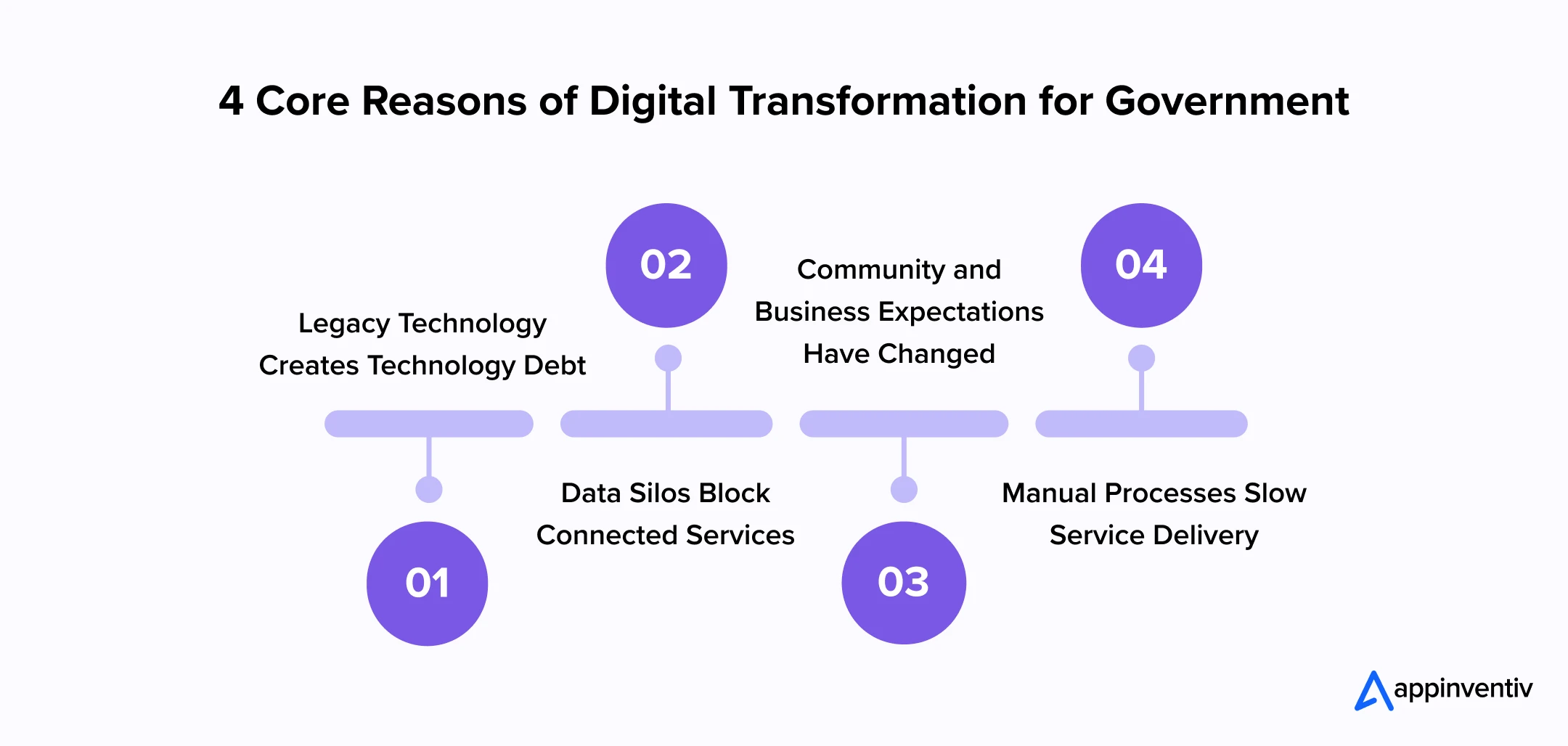
Legacy Technology Creates Technology Debt
Deferred upgrades compound into risk. South Australia’s Auditor-General found that 49% of hardware assessed across 10 agencies qualified as legacy, and warned of significant cyber security, privacy and compliance risks.
Data Silos Block Connected Services
When each program holds its own records, communities repeat the same information across agencies. The ‘tell us once’ principle in the national strategy depends on shared, governed data that silos make impossible to deliver.
Communities and Business Expectations Have Changed
People expect secure, mobile-friendly, always-available services with real-time status updates. Local government digital transformation use cases such as online development applications, rates and waste services show how fast expectations reset once one council delivers well.
Manual Processes Slow Service Delivery
Paper forms, rekeying between systems and email approvals add delay and error at every handoff. This is where a technology problem becomes a service-delivery problem that communities feel directly.
How to Modernise Legacy Government Systems Without Disrupting Services?
Government digital transformation implementation succeeds when change is staged in right sequence. The approach below moves from discovery to decommissioning, keeping payments, case management and community-facing channels running while the underlying estate is rebuilt in controlled waves.
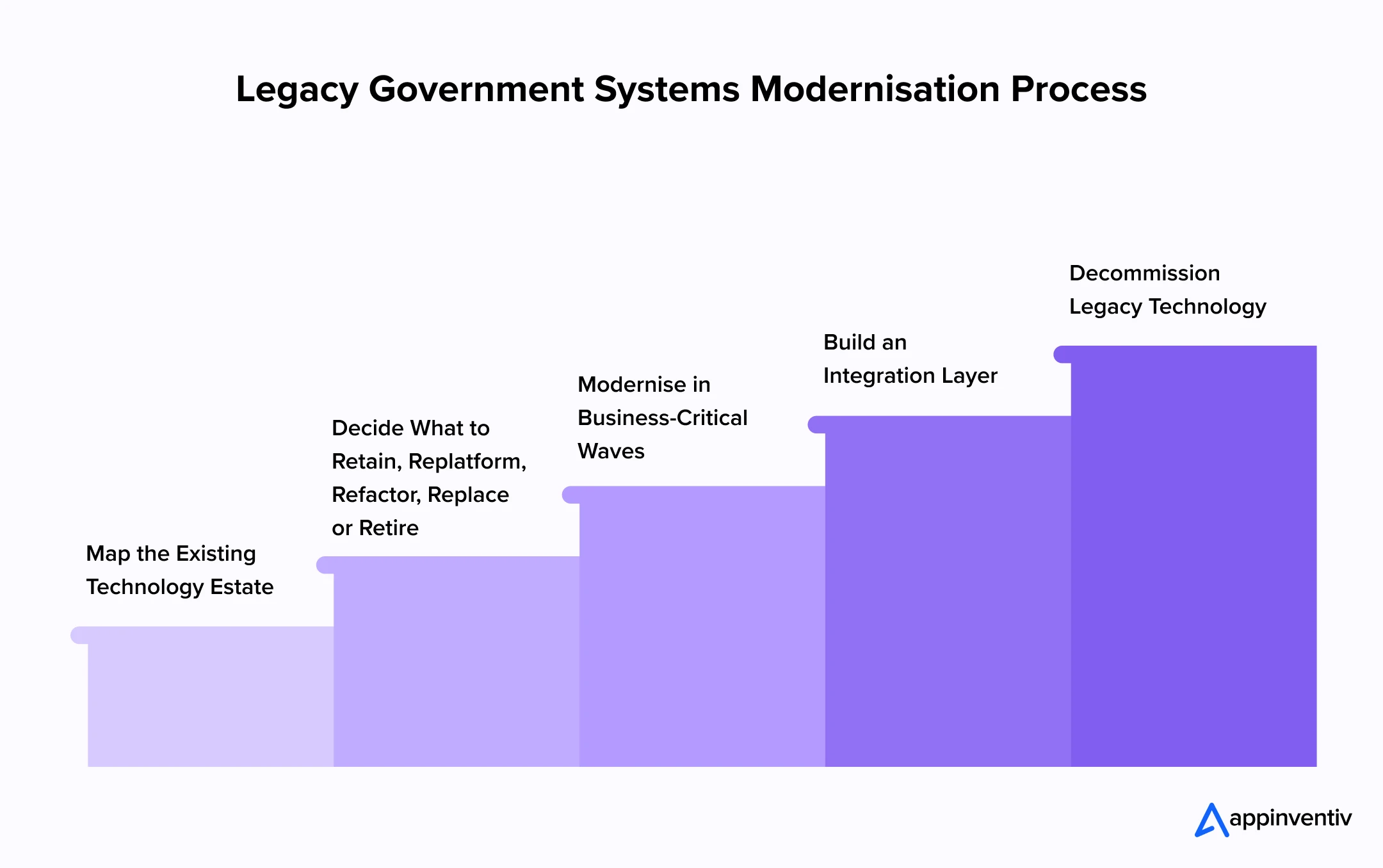
Map the Existing Technology Estate
Start with an application and dependency map. Identify applications, databases, interfaces, infrastructure, vendors, data owners, authentication mechanisms, business processes and critical service dependencies.
The objective is not to produce an inventory that becomes outdated after a few months. It is to understand which systems support critical journeys, where data moves, which integrations are fragile and where technical debt creates operational risk. A useful starting model is:
Community journey → Business process → Application → Data → Integration → Infrastructure → Owner
Use a 7R Modernisation Framework
Not every legacy application needs the same treatment. We typically assess systems against seven possible paths:
| Disposition | Meaning | Typical use |
|---|---|---|
| Retain | Keep as is | Stable, low-risk systems still fit for purpose |
| Rehost | Move to cloud infrastructure unchanged | Quick exit from ageing data centres |
| Replatform | Shift to a managed platform with light optimisation | Databases and middleware nearing end of support |
| Refactor | Restructure code to gain cloud-native capability | Valuable applications with sound logic |
| Rearchitect | Redesign into modular, API-led services | Monoliths blocking integration |
| Replace | Swap for a commercial or SaaS product | Commodity functions such as HR or finance |
| Retire | Switch off the system and archive its data | Redundant or duplicated applications |
Modernise in Business-Critical Waves
Modernisation programmes become risky when technology teams work without reference to service criticality. You should start with systems whose failure carries the highest cost, run old and new in parallel where needed, and release in increments that can be rolled back.
Build an Integration Layer
Integration is often the difference between a modern front end and a genuinely modern service. An API and event-driven integration layer lets modern front ends draw on legacy data while back-end systems are replaced. It also stops point-to-point connections multiplying and gives security teams one place to enforce access policy.
Decommission Legacy Technology
Modernisation is incomplete until old systems are switched off. Set retirement dates, archive records under records-management obligations, cancel licences and hosting contracts, and report decommissioned systems as a headline metric. Otherwise agencies pay to run both estates.
Assess your technology estate, prioritise critical systems, and build a phased modernisation roadmap.

What Technologies Are Powering Government Digital Transformation?
Modern government services rest on a small set of capabilities that work together. Cloud and APIs provide the foundation, data platforms enable analytics and AI, and digital identity and intelligent automation turn those capabilities into trusted, efficient services. The table below outlines every technology’s role.
| Technology | Government Transformation Role |
|---|---|
| Cloud | Modern infrastructure and scalable application environments |
| APIs and integration | Connect legacy and modern systems |
| Data platforms | Enable shared data analytics and AI |
| AI and Gen AI | Support service delivery, analysis and administrative work |
| Agentic AI | Automate defined multi-step workflows with appropriate controls |
| Digital ID | Support trusted identity and access |
| Automation | Reduce repetitive administrative processes |
| Digital twins | Support infrastructure planning and asset management |
How Does AI Support Government Digital Transformation?
AI can lift service quality and staff productivity, but only on foundations that are ready for it. Agencies in scope must also meet the DTA’s Policy for the responsible use of AI in government, version 2.0.
Where AI Can Improve Government Services
AI implementation can triage enquiries, summarise case files, detect anomalies and draft correspondence, freeing staff for judgement-heavy work. Councils can apply it to planning assessments and customer requests.
Why AI Cannot Simply Be Added to Legacy Systems
AI depends on clean, accessible, governed data. Legacy systems with siloed records, no APIs and weak audit trails cannot supply it reliably, so pilots stall before production.
Preparing Government Systems for Agentic AI
Agentic AI needs defined workflows, API access, identity controls, human approval points and full logging. Start with bounded, auditable processes before widening autonomy. The practical sequence is:
Clean data → Governed APIs → Defined workflow → AI capability → Human oversight → Monitoring
AI should sit inside this architecture, not around it.
How Do Security, Privacy and Accessibility Shape Government Digital Transformation?
Trust is the licence to operate for digital government, and it grows as AI enters service delivery. Security, privacy and accessibility must be designed in from the first sprint, not audited at the end.
Build Security Into the Architecture
Apply identity and access management, zero-trust principles, API security, encryption, continuous monitoring and secure development, aligned to the Protective Security Policy Framework and the Essential Eight.
Protect Government Data and Privacy
Align with the Australian Privacy Principles (APPs) under the Privacy Act 1988, classify sensitive information, set data governance rules, assess data residency, control third-party access and enforce cloud controls.
Design for Accessibility and Digital Inclusion
Design to WCAG, test with assistive technologies, keep alternative service channels open and use inclusive service design. The Digital Service Standard v2.0 expects agencies to apply the latest WCAG version.
A Practical Digital Transformation Roadmap for Government
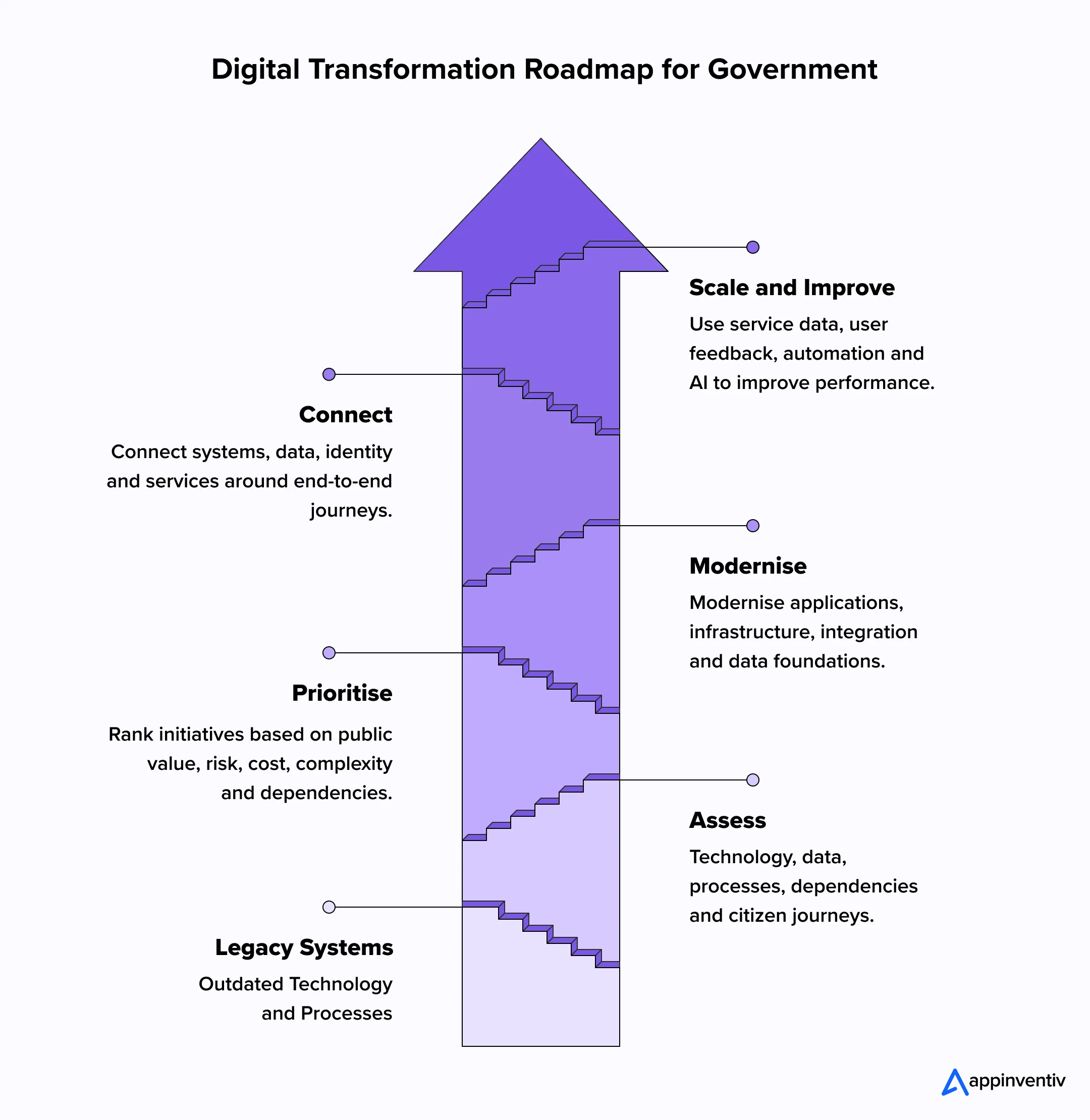
A digital transformation roadmap for local government and larger agencies follows the same five stages, scaled to estate size and risk. Each stage produces decisions and artefacts the next one needs, which keeps a government digital transformation strategy anchored to service outcomes rather than isolated technology projects.
- Assess
Review technology, data, processes, dependencies and community journeys together. The output is a fact base showing where services fail and which systems cause it.
- Prioritise
Rank initiatives by public value, risk, cost, complexity and dependencies. Prioritisation should also consider whether a capability can be reused across multiple services.
- Modernise
Modernise applications, infrastructure, integration and data foundations in business-critical waves, with security and accessibility controls built into every release.
- Connect
Connect systems, data, identity and services around end-to-end journeys, such as starting a business or registering a birth, so the community experience one government.
- Scale and Continuously Improve
Use service data, user feedback, workflow automation and AI to keep improving performance. Treat modernised services as products with owners, backlogs and measurable targets.
How to Measure the Success of Digital Transformation in Government?
Success is measured by service outcomes, not milestones delivered. A balanced scorecard tracks what communities experience, how efficiently agencies operate and whether the technology estate is becoming simpler and safer.
| Area | Example metrics |
|---|---|
| Service | Completion rate, satisfaction, accessibility |
| Operations | Processing time, manual workload, cost per transaction |
| Technology | Availability, legacy systems retired, integration coverage |
| Risk | Security incidents, recovery time, compliance performance |
For leadership teams, the strongest measures usually connect several layers.
For example, reducing application processing time is useful. Showing that the reduction also lowered manual handling, improved completion rates and reduced cost per transaction provides a much stronger transformation case.
Common Digital Transformation Mistakes in Government
Most digital transformation challenges for the government sector are predictable. They stem from early decisions, such as scoping technology instead of service outcomes or deferring the retirement of old platforms. The eight mistakes listed below recur across federal, state and local programs and are avoidable with deliberate governance.
Replacing Technology Without Redesigning the Process
A new system running the same approvals and handoffs delivers the same delays. Redesign the process first, then select the technology.
Treating Cloud Migration as Transformation
Moving applications to the cloud changes where they run, not how services work. Without redesign, costs often rise and silos remain.
Building New Portals Around Fragmented Back-End Systems
A polished front end cannot hide disconnected records. Communities still wait while staff reconcile data behind the portal.
Running AI Pilots Without Production Architecture
Pilots built outside core systems rarely scale. Define data access, security, monitoring and ownership before the proof of concept begins.
Underestimating Data Migration and Integration
Data quality, undocumented interfaces and mapping effort consume more time than development. Profile and cleanse data early and rehearse migrations repeatedly.
Measuring Project Delivery Instead of Service Outcomes
On-time, on-budget delivery says nothing about whether services improved. Tie funding gates to completion rates, processing times and satisfaction.
Modernising Without a Legacy Retirement Plan
Without committed switch-off dates, old and new systems run in parallel indefinitely and costs double. Make retirement part of the business case.
Organisational Barriers Can Slow Technology Modernisation
Siloed budgets, risk-averse procurement and unclear ownership delay delivery more than technology does. Secure executive sponsorship and cross-agency governance early.
What Does the Future of Digital Government Look Like?
The next phase of digital government will move beyond individual online transactions toward connected services powered by interoperable data architectures, sovereign cloud capabilities, and governed agentic workflows.
As agencies transition toward whole-of-government digital identity frameworks and real-time spatial digital twins, public sector delivery will become inherently invisible, highly secure, and continuously tailored to individual community and business needs.
Future public service environments will move past reactive, application-driven portals. Instead, state and federal platforms will operate as composable networks where data is securely shared once and reused continuously.
When a community registers a birth, buys a property, or starts a business, integrated background services will automatically update licensing, tax, and healthcare entitlements across all relevant departments without requiring multiple application filings
Governed agentic AI assistants, running on sovereign cloud infrastructure, will handle routine administrative verifications, allowing public employees to focus on high-touch human support.
Through robust alignment with the Government Architecture, digital services will be inherently composable, resilient, and continuously adaptive to emerging national priorities.

Modernise Legacy Government Systems With Appinventiv
Public sector rarely needs another strategy document. It needs a digital transformation partner for government that can modernise live systems while services keep running.
Appinventiv helps government organisations approach this transition in controlled stages, with capabilities across legacy modernisation, cloud and platform engineering, API and integration architecture, data platforms, AI solutions, secure digital services, and custom software development.
Our team of 1700+ tech experts focuses on building a technology foundation that can support connected services, automation and responsible AI while reducing long-term technology complexity.
With 3000+ digital assets deployed, 90% client retention, 11+ years of APAC delivery experience, and 5+ agile delivery centres, we bring experience across complex digital environments.
We are also approved on the Queensland Government ICTSS and Local Buy LGA procurement panels. These procurement pathways complement our delivery capabilities for organisations undertaking complex digital transformation programmes.
Modernise critical government systems with a phased, service-led approach with our tech experts.
FAQs
Q. What is digital transformation in government?
A. Digital transformation in government is the redesign of services, data and operating models using digital technology to deliver simple, secure and connected outcomes. It goes well beyond putting forms online. It covers legacy modernisation, shared data, digital identity, automation and AI. The national 2030 strategy and parallel state strategies set the direction.
Q. What is the role of digital transformation in government services?
A. It allows agencies to deliver faster, more consistent and more accessible services through every channel. It reduces manual handling, enables ‘tell us once’ experiences and gives leaders the data to improve performance. It also strengthens resilience by replacing unsupported systems.
Q. How long does government digital transformation take?
A. On average, the timeline for government digital transformation ranges between 4 months to 1 year or more. However, the exact timeframe varies depending on service criticality, system complexity, data quality, integration dependencies and governance requirements. Large programmes are usually delivered through multiple phases rather than one technology replacement project.
Q. What are the main challenges for digital government transformation?
A. The main challenges are legacy complexity, poor data quality, skills shortages, funding and procurement cycles, security and privacy obligations, and change management. Organisational barriers often cause more delay than technology. Clear ownership, outcome-based measures and phased delivery address most of them.
Q. How should an agency choose a digital transformation partner for government?
A. Evaluate partners against modernisation experience, architecture capability, cybersecurity, data governance, integration depth, delivery controls, procurement requirements, local accountability and their ability to support the technology after launch.
Q. What is the cost of digital transformation for the public sector?
A. The cost of digital transformation for government typically ranges between AUD 70,000 and AUD 700,000 or more. However, the cost varies depending on the applications involved, data migration, integration complexity, infrastructure, security requirements and delivery model. A credible estimate requires an assessment of the existing technology estate rather than a generic project rate.


Fast 2-minute response, fully NDA-protected.

Smart Infrastructure for the Public Sector: Use Cases, Technologies and Implementation Strategy
Key takeaways: Smart infrastructure connects physical assets, data, technology and governance to improve public services and operational outcomes. Australia's $242 billion infrastructure pipeline and a shortfall of 300,000 workers makes asset-level intelligence a delivery necessity, not an innovation extra. Smart infrastructure use cases demonstrate how AI, IoT, digital twins and analytics can transform infrastructure management.…

Digital Twins for Government Infrastructure: Use Cases, Architecture and Implementation Strategy
Key takeaways: Digital twin use cases for government infrastructure span predictive maintenance, transport planning, disaster response, climate resilience and more. NSW, Victoria and Queensland are advancing digital twin initiatives, supporting a more connected approach to infrastructure planning. Digital twin implementation costs may start at AUD 70,000 and exceed AUD 700,000 as infrastructure, integrations and…
Creating a Digital Transformation Strategy in the UK: From Vision to Execution
Key takeaways: A digital transformation strategy succeeds for UK businesses when it is governed as a single programme, not a portfolio of disconnected technology purchases. UK transformation budgets should prioritise modernising legacy systems and strengthening data foundation before scaling advanced capabilities. AI delivers return only when built on governed data and a change-ready operating model,…