




























AI Data Integration: How to Connect, Clean and Prepare Data for AI

 Share -



- 01Traditional ETL Cannot Solve Every AI Data Problem
- 02Why Enterprise Data Is Not Ready for AI
- 03The AI Data Integration Pipeline: From Source Systems to AI-Ready Data
- 04What Are The Business Benefits of AI-Ready Data?
- 05How to Measure ROI From AI Data Integration?
- 06AI Data Integration Architecture: What Does an AI-Ready Data Stack Look Like?
- 07How to Build an AI Data Integration Strategy: A Step-by-Step Approach
- 08Common AI Data Integration Challenges and How to Solve Them
- 09How Appinventiv Helps Enterprises Build AI-Ready Data Foundations?

Key takeaways:
- AI initiatives fail when fragmented, poor-quality data reaches models without sufficient context, controls or ownership.
- AI-ready pipelines must connect, clean, enrich, govern and continuously monitor data across its lifecycle.
- Real-time processing matters when AI decisions depend on current transactions, events, inventory or operational conditions.
- Data architecture should follow the AI use case, balancing performance, security, scalability and long-term ownership.
- Strong AI data foundations reduce delivery risk and make pilots easier to scale into governed production systems.
AI projects rarely fail because of the model alone. The harder problem often sits underneath it: whether the organisation can provide AI systems with reliable, relevant, current and governed data.
According to Gartner through 2026, organisations will leave 60% of AI projects unsupported by AI-ready data.
That figure reflects a problem many enterprises encounter after the initial proof of concept. The model may demonstrate promise, but production exposes fragmented source systems, inconsistent records, missing context, unclear ownership and data that cannot be accessed at the speed the use case requires.
AI models do not resolve these issues automatically. Large language models, predictive systems and AI agents depend on the quality and relevance of the information available to them. When the underlying data is incomplete or outdated, scaling the model can simply scale the underlying problem.
For practical purposes, AI data integration is the process of securely connecting, harmonising, cleaning and preparing data from disparate sources so AI systems can consume reliable, relevant and appropriately governed information.
This makes AI data integration an architectural and operational priority, not simply a data engineering exercise. Enterprises need a repeatable way to connect the right systems, improve data quality, add business context and maintain governance as data and AI workloads change.
Connect fragmented enterprise data, fix quality gaps and build an AI-ready foundation before unreliable inputs limit your AI outcomes.
Traditional ETL Cannot Solve Every AI Data Problem
A conventional ETL pipeline is usually designed around known schemas and predictable destinations. Extract data from operational systems, transform it according to established rules and load it into a warehouse.
That model works well for many workloads. AI introduces more variability.
A retrieval system may need to process contracts, PDFs, knowledge articles and database records together. An AI agent may need fresh information from APIs and event streams before taking action. A predictive model may require engineered features with strict lineage and version control.
| Capability | Traditional ETL | AI-Ready Data Integration |
|---|---|---|
| Data Types | Primarily structured (SQL, tables) | Multi-modal (Text, images, logs, vector embeddings) |
| Processing Velocity | Scheduled batches (Daily/Hourly) | Real-time event streaming (Kafka, MQTT) |
| Adaptability | Breaks on schema drift (requires manual fixes) | Auto-detects and adapts to schema changes using ML |
| End Destination | Data Warehouse or BI Dashboard | Vector Databases, Feature Stores, LLM Context Windows |
The shift does not mean every organisation needs a completely new stack. AI in data integration for your business is about adding the capabilities required by the workload while preserving investments that already work.
Key Types of Data Integration
Enterprises typically combine several patterns rather than choosing one:
- Batch integration for large historical datasets and periodic model training.
- Real-time data processing for fraud detection, operations and use cases where stale information changes the outcome.
- API integration for applications that require controlled access to live enterprise services.
- Event-driven integration for reacting to transactions or system events as they occur.
- Data virtualisation or federated access where copying data would create unnecessary risk or cost.
- Semantic and document integration for connecting business content with structured enterprise records.
The right pattern depends on the decision being supported. Not every AI use case requires milliseconds of latency. Forcing real-time architecture where daily updates are sufficient can add cost without improving business outcomes.
Why AI Requires Different Data Preparation
A single source of truth is useful, but it is not enough. AI systems need the right information, context and permissions for a particular task.
A RAG application, for example, may retrieve passages from documents while validating customer or product information against structured systems. That requires more than document ingestion. Content needs metadata, versioning, access controls, source traceability and a process for removing outdated information.
The same principle applies to generative AI data integration, predictive ML and agents. Searchable data is not automatically trustworthy AI input. Even reliable AI depends on clear versioning, structure and context, including links between unstructured content and the structured data that defines enterprise entities and transactions.
Why Enterprise Data Is Not Ready for AI
Most enterprises do not suffer from a simple shortage of data. They face fragmentation, uncertain ownership and inconsistent meaning across systems built at different times for different purposes. AI exposes these weaknesses quickly because models can consume more information than traditional applications, but they cannot independently resolve every contradiction within it.
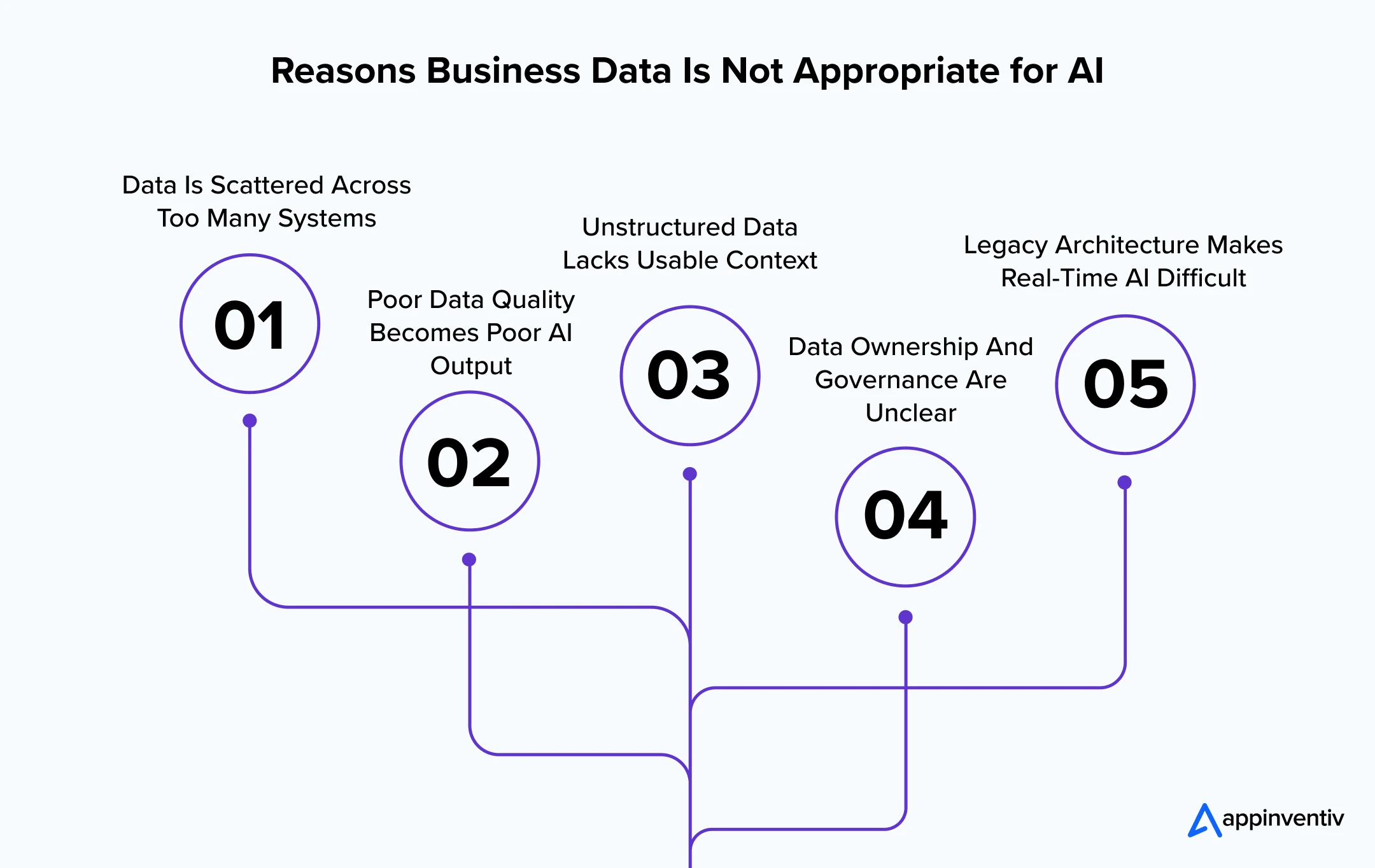
Data Is Scattered Across Too Many Systems
Customer data may sit across CRM, ERP, service, finance and product platforms. Operational knowledge may be locked inside shared drives, document repositories and collaboration tools. Connecting everything is rarely the answer.
An effective AI data integration architecture starts by identifying which systems materially influence the target decision. A customer-support assistant may not need access to the full finance warehouse. A supply chain prediction engine may have no reason to ingest internal HR content. Scope should follow business value and data relevance.
Poor Data Quality Becomes Poor AI Output
Duplicate records, missing values and inconsistent identifiers have always created reporting problems. AI can turn them into a broader reliability issue.
If the same customer has multiple identifiers, a model may receive an incomplete view. If a product description is outdated, a generative system can produce a response that appears credible but is operationally wrong.
Quality controls therefore need to test more than whether a pipeline completed successfully. Teams should measure freshness, completeness, validity and consistency against the requirements of the specific AI workload.
Unstructured Data Lacks Usable Context
Business documents are often written for people, not machines. Important information may be buried in long reports, attached to the wrong record or stored without a clear owner.
Preparing this content can involve extraction, classification, chunking, metadata tagging and entity linking. AI data mapping is especially important here because a document’s reference to a customer, asset or contract should connect to the correct enterprise record.
Without that context, retrieval can be technically functional while still returning the wrong information.
Data Ownership and Governance Are Unclear
A recurring enterprise problem is not knowing who can answer three basic questions:
- Who owns this data?
- Who approved its use?
- Is it still current?
Those questions become more serious when AI is introduced. The data owner may approve use for analytics but not for an external model. A policy document may have been superseded without the old version being removed from an index. Sensitive fields may be accessible to a pipeline that was originally designed for a narrower audience.
Governance must therefore sit inside the pipeline design. Access rules, retention policies, lineage and approval workflows should travel with the data rather than being documented separately.
Legacy Architecture Makes Real-time AI Difficult
Many core systems were not built for continuous data sharing. They may rely on overnight batches, tightly coupled interfaces or database structures that are difficult to change.
The answer is not always wholesale replacement. AI API layers, event streaming, change data capture and staged modernisation can make selected information available without destabilising core operations.
The objective is targeted automated data integration that improves AI access while keeping business-critical systems reliable.
The AI Data Integration Pipeline: From Source Systems to AI-Ready Data
A production-grade AI pipeline should be treated as a controlled lifecycle, not a one-time preparation exercise. You need to typically structure the work around six stages: connect, ingest, clean, transform, prepare and continuously govern. Each stage should have clear ownership, quality checks and evidence that the data remains suitable after deployment.
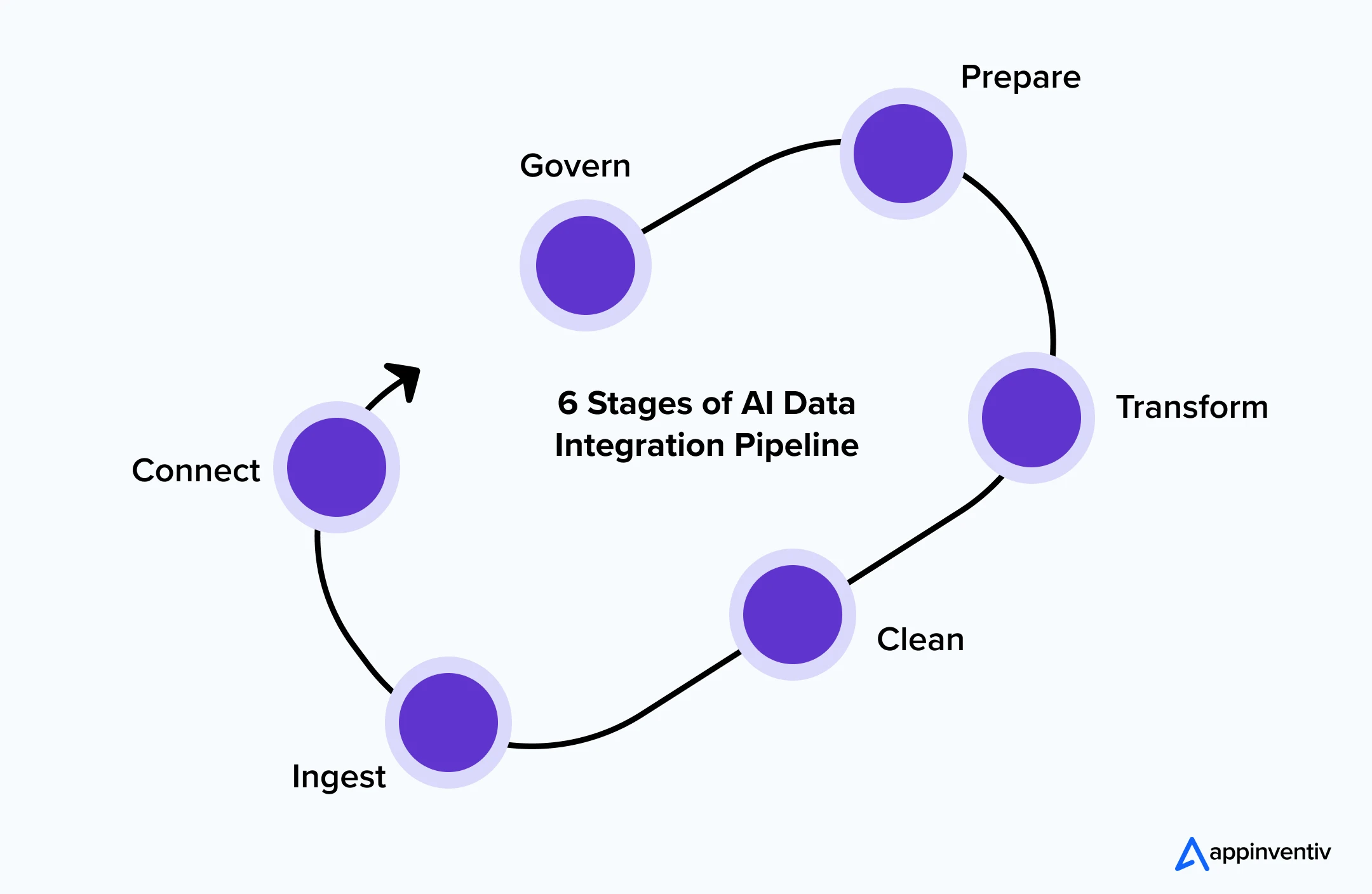
1. Connect
Identify the sources required for the use case and establish secure, authorised access.
Typical sources include databases, warehouses, data lakes and lakehouses, enterprise applications, SaaS platforms, APIs, event streams and document repositories.
The principle is simple: do not integrate every available dataset. Start with the information required to improve a measurable business outcome.
An AI data integration engineer should also assess source stability, access patterns, sensitivity and expected change before designing the connection.
2. Ingest
Move or expose data using the pattern that fits the workload: batch, streaming, API-based or event-driven.
Ingestion should preserve source metadata and lineage wherever possible. For real-time data processing, the design must also define what happens when events arrive late, are duplicated or fail during delivery.
Speed without recoverability is not an enterprise integration strategy.
3. Clean
Standardise formats, resolve duplicates, handle missing values and identify invalid records.
Cleaning rules should be observable and repeatable. If teams manually repair data before every model run, the process will eventually become a production bottleneck.
This is where AI-powered data integration can assist with anomaly detection and pattern recognition, while business-critical validation rules should remain explicit and auditable.
4. Transform and Enrich
Convert raw information into a consistent representation and add the context required by the AI workload.
This can include entity resolution, classification, AI data mapping, joins across systems and enrichment with approved external or internal reference data.
For unstructured content, transformation may also include extracting text, identifying document types and associating content with business entities.
5. Prepare
Preparation should change according to the destination.
ML workloads may require labelled datasets, engineered features and training-validation splits. RAG systems may require chunking, embeddings, metadata filters and source references. Generative applications need carefully governed context. Agents may require current state information, tool permissions and boundaries around what they can access or change.
This is the point where AI for data integration becomes workload-specific rather than generic data movement.
6. Govern, Monitor and Improve
AI-powered data governance changes the definition of observability.
Traditional data observability asks whether the pipeline is working. AI data observability must also ask whether the information reaching the system is still appropriate and whether the resulting outputs remain trustworthy.
Monitor freshness, drift, retrieval quality, access anomalies and failed validation rules. Link DataOps with custom MLOps or LLMOps where relevant, but keep accountability clear. Every team should know who responds when the data, pipeline or AI behaviour falls outside agreed thresholds.
Build secure pipelines that connect APIs, databases, documents and real-time sources while keeping data clean, contextual and governed.
What Are The Business Benefits of AI-Ready Data?
The value of AI-ready data is not measured by how much information has been centralised. Its value comes from reducing the time and uncertainty involved in delivering reliable AI outcomes. Better integration improves reuse, traceability and scalability while giving leadership a clearer basis for controlling cost and operational risk.
The most immediate benefit is faster access to decision-ready information. Teams spend less time manually collecting files, reconciling records or rebuilding one-off datasets for every AI initiative.
AI-ready data can also improve:
- Model and response reliability: Better context reduces avoidable errors caused by stale, incomplete or conflicting information.
- Time to production: Reusable pipelines reduce repeated integration work when new AI use cases are approved.
- Governance and audit readiness: Lineage and access controls make it easier to establish where information came from and who could use it.
- Lower integration debt: Automated controls reduce dependence on manual cleansing and undocumented workarounds.
- Scalability: A governed foundation supports additional use cases without creating separate, uncontrolled data copies.
Enterprises may not simply invest in AI software development. They first invest around data management, security, quality practices and governance to remove barriers to scaling.
The important distinction is that AI ready data should be defined against a use case. Data suitable for an executive forecasting model may not be suitable for a customer-facing AI assistant.
How to Measure ROI From AI Data Integration?
The benefits of AI-ready data look more promising when you can measure their impact on business performance. If better data quality reduces rework, reusable pipelines shorten deployment cycles, and automated data preparation frees up team time, these improvements can translate into measurable financial returns.
To assess ROI, you should start by establishing a baseline for the AI use case and tracking changes in four core areas:
- Data preparation costs: How much time and effort do teams save on manual data cleaning, reconciliation and preparation?
- Time to production: Do reusable integration pipelines reduce the time and engineering effort required to deploy new AI use cases?
- Operational efficiency: Are data-related errors, repeated work or delays in decision-making decreasing?
- Ongoing integration costs: Does reusing governed pipelines reduce the cost of maintaining separate integrations for different AI initiatives?
Compare the financial value of these improvements against the total cost of implementation and ongoing operations, including infrastructure, engineering, governance and maintenance.
A practical formula to measure the ROI is:
| ROI (%) = [(Financial benefits − Total investment) ÷ Total investment] × 100 |
The key is to measure actual outcomes against the baseline rather than assuming that better data will automatically deliver savings. This gives a clearer view of whether the integration investment is delivering value and where further improvements are justified.
AI Data Integration Architecture: What Does an AI-Ready Data Stack Look Like?
There is no mandatory stack. The architecture should reflect the organisation’s existing estate, regulatory requirements and target workloads. The reference model below separates responsibilities into layers so leaders can identify capability gaps without assuming that every layer requires a new platform or vendor.
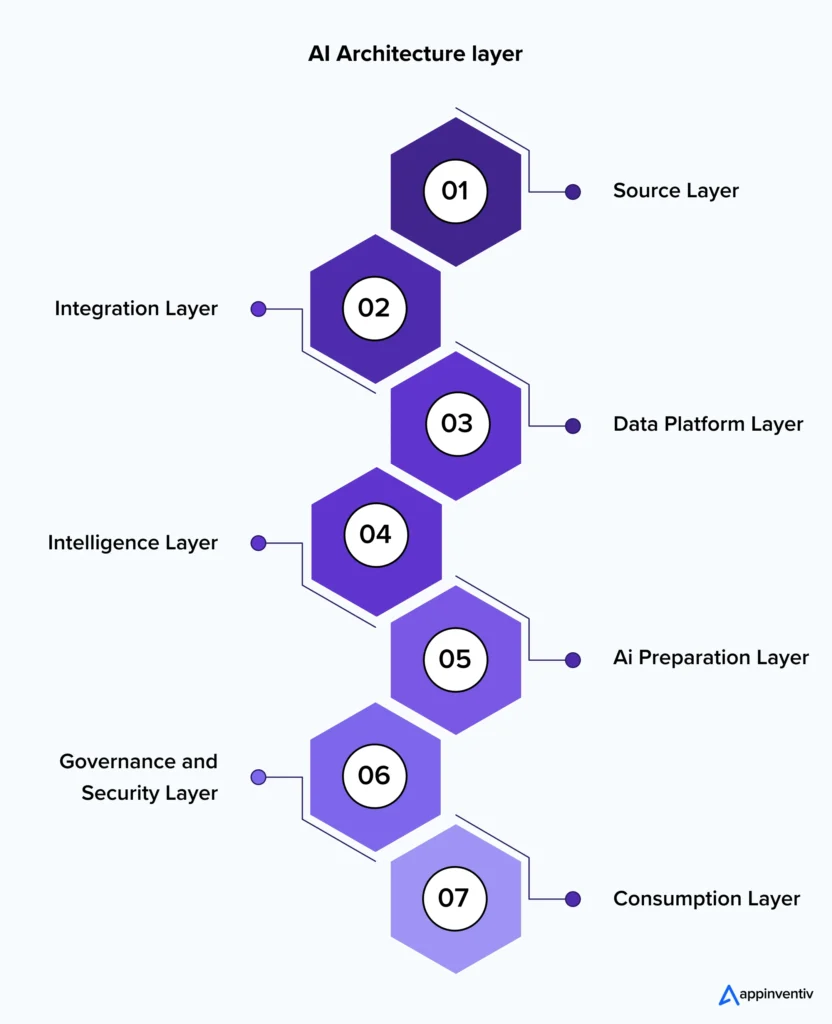
| AI Architecture layer | Role |
|---|---|
| Source layer | Core systems, SaaS applications, databases, APIs, documents and event streams containing operational enterprise information. |
| Integration layer | Connectors, APIs, ETL/ELT, change data capture and streaming services that securely move or expose required data. |
| Data platform layer | Warehouses, lakes or lakehouses that provide scalable storage, processing, lineage and controlled enterprise access. |
| Intelligence layer | Metadata, catalogues, semantic models and data quality services that make information understandable and discoverable. |
| AI preparation layer | Feature pipelines, vector indexes, embeddings, chunking and workload-specific transformations for models, RAG and agents. |
| Governance and security layer | Identity, access controls, encryption, lineage, retention, policy enforcement and continuous monitoring across the lifecycle. |
| Consumption layer | AI applications, copilots, agents, analytics and operational systems that use governed data to support decisions and actions. |
This layered approach is particularly useful when evaluating AI data integration platforms. A platform can be strong at orchestration without replacing the organisation’s data platform. Another may improve AI-specific preparation without being the system of record.
The architecture should remain a reference model, not a procurement checklist for the top AI solutions for data integration platforms.
How to Build an AI Data Integration Strategy: A Step-by-Step Approach
A successful strategy starts with business decisions and works backwards into architecture. We recommend defining the outcome first, identifying the information required to support it, then addressing the highest-risk data gaps before selecting technology. This sequence prevents enterprises from building expensive integration capacity without a credible path to measurable use.
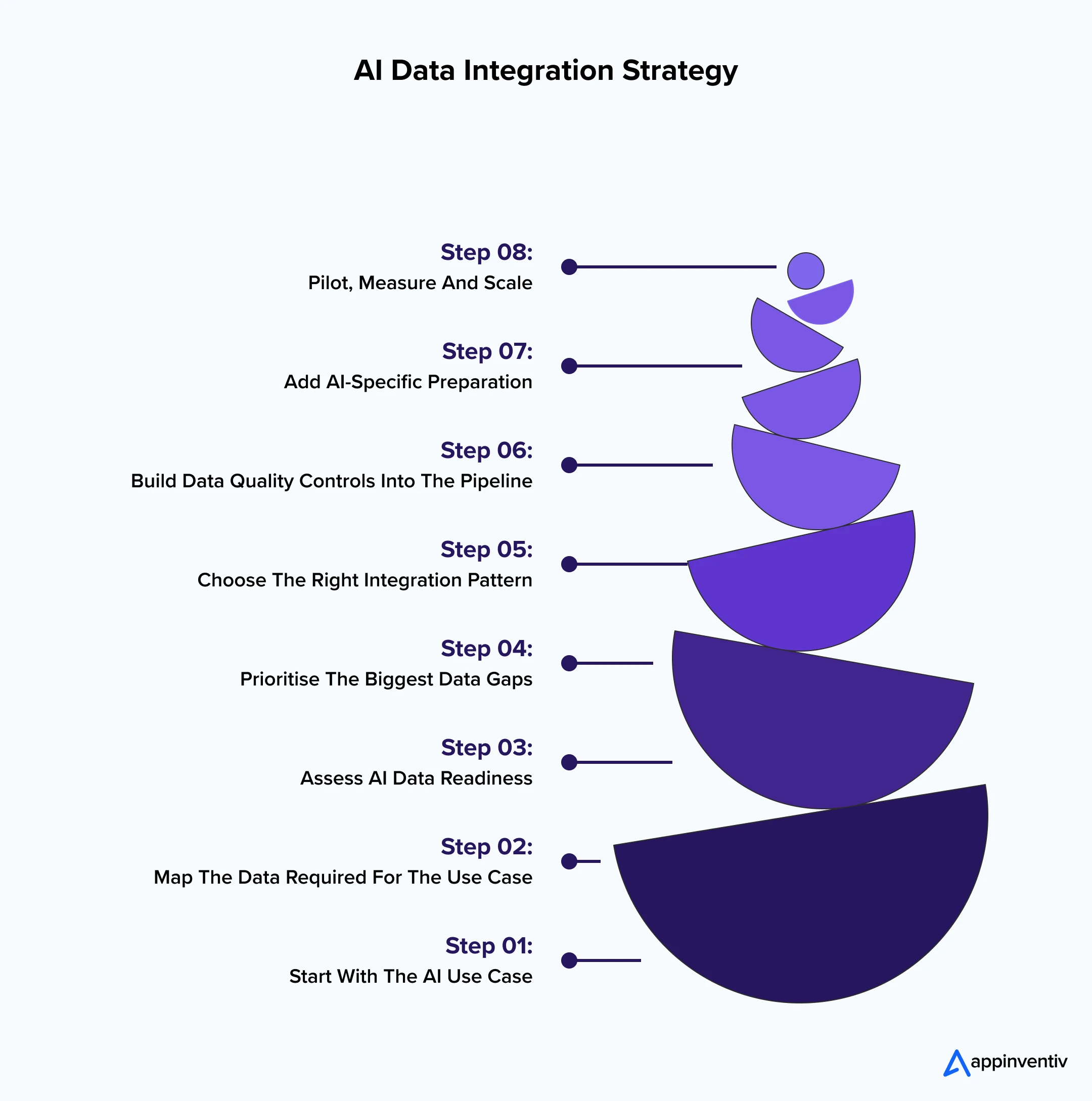
Start with the AI Use Case
Define the decision, process or outcome to improve. Establish expected value, risk tolerance, users and measurable success criteria before discussing platforms.
Map the Data Required for the Use Case
Identify essential sources, data owners, refresh requirements and permissions. Distinguish useful information from information that is merely available.
Assess AI Data Readiness
Evaluate quality, accessibility, lineage, freshness, context and governance. An ai data integration engineer should identify constraints before production architecture is finalised.
Prioritise the Biggest Data Gaps
Address the gaps most likely to limit accuracy, compliance or scale. Avoid spending months improving datasets that do not affect the target outcome.
Choose the Right Integration Pattern
Use batch, APIs, events or streaming based on actual business requirements. AI driven data integration should improve responsiveness without adding unnecessary complexity.
Build Quality Controls into the Pipeline
Do not leave cleansing as a manual activity before deployment. Validate critical fields continuously and route exceptions through clear ownership processes.
Add AI-specific Preparation
Prepare information differently for ML, RAG, GenAI or agents. Context, feature engineering, metadata and retrieval requirements should reflect the workload.
Pilot, Measure and Scale
Test technical performance alongside business value. Measure reliability, cost, adoption and control effectiveness before expanding the architecture to further use cases.
This approach is particularly important for agentic AI data integration. Agents that can query systems or trigger actions require stricter decisions about permissions, current data and accountability than read-only analytics workloads.
Also Read: How to Integrate AI Into an App for Enterprises
Common AI Data Integration Challenges and How to Solve Them
Most integration failures are predictable. Data silos, weak metadata and legacy constraints rarely disappear through model upgrades. The practical response is to match each problem with an architectural or operating control, rather than treating every issue as a reason to replace the entire data estate.
| Challenge | Why it affects AI | Practical approach |
|---|---|---|
| Data silos | AI receives incomplete business context | Integrate only the systems relevant to the use case through governed interfaces |
| Poor quality | Incorrect or inconsistent inputs undermine output reliability | Automate validation, anomaly detection and exception ownership |
| Unstructured content | Information lacks consistent machine-readable context | Classify, enrich, tag and link content to business entities |
| Outdated information | AI may act on superseded facts | Apply freshness checks, versioning and controlled index updates |
| Legacy systems | Data access can be slow or tightly coupled | Use APIs, CDC or staged modernisation around high-value use cases |
| Weak metadata | Systems cannot reliably understand meaning or ownership | Establish cataloguing, lineage and business definitions |
| Security concerns | Sensitive data may reach unauthorised models or users | Enforce identity, least privilege and policy controls throughout pipelines |
| Scaling complexity | One-off pipelines become difficult to maintain | Standardise reusable patterns, observability and deployment controls |
These challenges explain why AI for enterprise data integration needs both engineering and governance ownership. A technically successful pipeline can still create risk if data permissions or retention requirements are unclear.
They also explain why AI-powered data integration should be applied carefully. Automation can accelerate schema matching, anomaly detection and transformation, but critical controls still require explicit business rules and accountable owners.
How Appinventiv Helps Enterprises Build AI-Ready Data Foundations?
Moving from fragmented data to production AI requires more than model development. It requires delivery teams that can work across cloud infrastructure, enterprise applications, data engineering, security and AI operations.
Appinventiv, a leading provider of AI services and solutions helps organisations across 35+ industries identify the shortest credible path from current data constraints to governed, scalable AI implementation.
Our team of 1700+ tech architects approach AI data integration as part of the wider enterprise architecture. Our 200+ data scientists and AI engineers assess where data sits, how it moves, which controls already exist and what the target AI workload actually requires. From there, we design custom pipelines, integration patterns and AI preparation layers that fit the organisation’s existing systems rather than forcing a complete technology reset.
With 11+ years of delivery experience, 3,000+ digital assets deployed and a 90% client retention rate, we bring experience across modern software engineering and enterprise transformation. Our delivery environment also incorporates ISO 27001, ISO 9001 and SOC 2-aligned practices, with a stated 99.5% security compliance SLA.
We have successfully deployed 300+ AI-powered solutions, trained 150+ custom AI models and completed 75+ enterprise AI integrations, giving our teams experience across the integration work that often sits between a promising model and a deployable business system.
That experience spans AI-enabled products and platforms such as Mudra, Vyrb, JobGet and MyExec. Our AI integration services include:
- Data architecture assessment and AI readiness planning
- Secure cloud and enterprise system integration
- Custom AI data integration solutions for structured and unstructured data
- Batch, streaming and event-driven automated data integration
- RAG and generative AI data integration workflows
- MLOps, LLMOps and production monitoring
- AI data governance, lineage and access-control design
The goal is not to deploy the best AI for data integration in the tech industry based on a generic ranking. It is to select and engineer the right combination of architecture, controls and delivery practices for the enterprise use case.
Stop letting bad data stall your AI initiatives. Contact Appinventiv’s data engineering team for a comprehensive audit of your data architecture and a roadmap to AI readiness.
FAQs
Q. How do I know if my data is AI-ready?
A.Your data is AI-ready when it is accurate, complete, consistently structured, well-governed, and accessible for the intended AI use case. Check data quality, ownership, privacy, security, and integration before deployment.
Q. How do real-time data streams affect AI model training and deployment?
A. Real-time data processing is most valuable when decisions depend on current events, transactions or operational conditions. Streaming can keep production AI informed with fresh information, while historical datasets usually remain essential for model training. The architecture should balance latency requirements against cost, resilience and data quality controls.
Q. How to choose an AI data integration service provider?
A. Look beyond a vendor’s connector library. Assess its experience with enterprise architecture, custom integration, security, data governance, AI workload preparation and long-term operations. The right partner should be able to explain how the proposed solution fits your existing systems, ownership model and risk requirements.
Q. What are the essential components of an AI data integration platform?
A. Core components of an AI data integration platform typically include source connectivity, ingestion and orchestration, transformation, data quality controls, metadata and lineage, security, AI-specific preparation and continuous monitoring. The exact combination varies by workload, so the top AI agents for data integration or platforms should be evaluated against your architecture rather than feature lists alone.
Q. What is the best software for AI data integration in cloud environments?
A. There is no single best choice for every enterprise. Cloud integration requirements depend on source systems, latency, AI workloads, security policies and existing cloud investments. When evaluating top AI solutions for data integration platforms, compare interoperability, governance, observability, workload support and total operating complexity.
Q. How does Appinventiv approach AI data integration for enterprise clients?
A. Appinventiv begins with the specific business use case rather than a generic data audit, mapping only the systems and fields that use case requires before designing the integration layer. From there, the team builds the connect-through-govern pipeline described above, tailored to the client’s compliance environment and existing architecture, and hands over a foundation designed to support the next several AI initiatives rather than a single deployment.


Fast 2-minute response, fully NDA-protected.

AI Agent Governance: How to Govern Autonomous AI Across Business Systems
Key takeaways: AI agents require controls at the action, identity, data, tool, and workflow levels. Every enterprise agent should have a registered owner, an approved purpose, and a defined risk tier. Access must be based on the agent’s task rather than inherited from a human user or shared service account. High-impact actions need real-time policy…

'I.D.E.A.S.' - The Five Pillar Framework to Ace AI-Native Enterprise Apps in 2027
Key takeaways: AI-native enterprise apps are moving beyond AI agents toward intelligent, adaptive, autonomous and context-aware digital capabilities that can operate across mobile, web, voice, wearables and emerging interfaces. The I.D.E.A.S. framework for AI enterprise apps in 2027 - Interactive Intent, Decisioning Autonomously, Experiential System Design, Adaptive Execution, and Security Layered. Context intelligence and reusable…

Automated Decision-Making in Australia: Benefits, Cost and Implementation
Key takeaways: Automated decision-making combines rules, algorithms, AI and human oversight to improve high-volume decisions. ADM programmes require privacy, security, auditability and accountability to be designed into architecture. ADM implementation costs typically range from AUD 70,000 to AUD 700,000 or more. Implementation starts with decision mapping, then moves through development, testing, controlled pilots and monitoring.…